Introduction
Heterosis, or increased hybrid vigour in hybrids, has been exploited extensively in maize breeding. The heterosis effect has been assumed to depend on the level of genetic divergence between parents (Falconer, Reference Falconer1981). Therefore, the preliminary genetic screening of parental inbred lines is considered crucial for the prediction of superior crosses for efficient hybrid breeding (Lopes et al., Reference Lopes, Saglam, Ozdogan and Reynolds2014).
In general, the more genetically distant two inbred lines are, the more likely it is that the hybrid will show increased heterosis (Flint-Garcia et al., Reference Flint-Garcia, Buckler, Tiffin, Ersoz and Springer2009). Positive correlations between genetic distances and heterosis were reported for different DNA markers such as RFLP (Godshalk et al., Reference Godshalk, Lee and Lamkey1990; Melchinger et al., Reference Melchinger, Lee, Lamkey and Woodman1990; Boppenmaier et al., Reference Boppenmaier, Melchinger, Brunklaus-Jung, Geiger and Herrmann1992; Ajmone-Marsan et al., Reference Ajmone-Marsan, Castiglioni, Fusari, Kuiper and Motto1998; Benchimol et al., Reference Benchimol, Souza, Garcia, Kono, Mangolim, Barbosa, Coelho and Souza2000), RAPD (Lanza et al., Reference Lanza, Souza, Ottoboni, Vieira and Souza1997; Bruel et al., Reference Bruel, Carpentieri-Pípolo, Gerage, Fonseca, Prete, Ruas, Ruas, de Souza and Garbuglio2006), AFLP (Ajmone-Marsan et al.,Reference Ajmone-Marsan, Castiglioni, Fusari, Kuiper and Motto1998; Barbosa et al., Reference Barbosa, Geraldi, Benchimol, Garcia, Souza and Souza2003) and SSR (Barbosa et al., Reference Barbosa, Geraldi, Benchimol, Garcia, Souza and Souza2003; Xu et al., Reference Xu, Liu and Liu2004; Aguiar et al., Reference Aguiar, Schuster, Amaral, Scapim and Vieira2008; Srdić, Reference Srdić, Nikolić, Pajić, Drinić and Filipović2011). Other studies, however, reported a low or negative correlation between both parameters (Legesse et al., Reference Legesse, Myburg, Pixley, Twumasi-afriye and Botha2008; Fernandes et al., Reference Fernandes, Schuster, Scapim, Vieira and Coan2015). Studying the expression profiles in maize hybrids, Stupar et al. (Reference Stupar, Gardiner, Oldre, Haun, Chandler and Springer2008) showed that intraheterotic group crosses lead to higher level of heterosis when compared with inter-heterotic ones. Cheres et al. (Reference Cheres, Miller, Crane and Knapp2000) also reported variation among sunflower hybrids with similar genetic distances of their parents.
Transposable elements (TEs) occupy more than 85% of the maize genome (Olsen and Wendel, Reference Olsen and Wendel2013) and represent the major source of genomic variation implicated in speciation and evolution of their hosts (Bonchev and Parisod, Reference Bonchev and Parisod2013). The polymorphisms of TEs, detected by PCR-based techniques, have been used to assess the natural variation in plants (Casa et al., Reference Casa, Brouwer, Nagel, Wang, Zhang, Kresovich and Wessler2000, Reference Casa, Mitchell, Smith, Register, Wessler and Kresovich2002; Kalendar et al., Reference Kalendar, Flavell, Ellis, Sjakste, Moisy and Schulman2011). It is also assumed that TE dynamics is implicated in the occurrence of heterosis. The hypothesis is that the combination of inbred-specific repetitive sequences allows novel trans-interactions potentially leading to non-additive expression levels and increased hybrid vigour (Brunner et al., Reference Brunner, Fengler, Morgante, Tingey and Rafalski2005; Springer and Stupar, Reference Springer and Stupar2007; Paschold et al., Reference Paschold, Jia, Marcon, Lund, Larson, Yeh, Ossowski, Lanz, Nettleton, Schnable and Hochholdinger2012). In sunflower, Buti et al. (Reference Buti, Giordani, Vukich, Pugliesi, Natali and Cavallini2013) have shown that TE-related distances positively correlate with heterosis. However, this is not a common phenomenon and it holds true for only some traits and/or TE primers combinations. Such discrepancies, however, in the correlation between genetic distances and heterosis suggest that DNA-based estimated genetic distances cannot be always considered as predictive of ‘general’ hybrid vigour (Flint-Garcia et al., Reference Flint-Garcia, Buckler, Tiffin, Ersoz and Springer2009). The interplay between heterosis and TE dynamics in maize is still largely unexplored and requires further investigations.
Here, we applied the TE-based marker method retrotransposon microsatellite amplified polymorphism (REMAP) to assess genetic distances among sweet corn (Zea mays var. saccharata) and field corn (Z. mays var. indentata) inbred lines. Genetic distances between former ones were correlated to the heterosis effect in hybrids for which comprehensive phenotypic data are available (Vassilevska-Ivanova and Kraptchev, Reference Vassilevska-Ivanova and Kraptchev2007; Vassilevska-Ivanova et al., Reference Vassilevska-Ivanova, Kraptchev, Naidenova and Nedev2007; Kraptchev et al., Reference Kraptchev, Vassilevska-Ivanova and Velikova2010). The goal was to identify inbred lines and hybrid combinations with potential for further implementation in maize breeding's practice.
Materials and methods
Plant material
Eleven sweet corn lines (Z. mays var. saccharata), one F1 commercial hybrid, and four field corn lines (Z. mays var. indentata) were included in the study. This germplasm collection was developed at the Institute of Plant Physiology and Genetics, Bulgarian Academy of Sciences, Sofia, Bulgaria. The F1 sweet corn hybrid Zaharina (Kraptchev et al., Reference Kraptchev, Vassilevska-Ivanova and Shtereva2014) and its parental lines 6–13 and C-6 (pollen source) were included as a standard to support the presumption of heterotic effect resulted after crossing of two relatively distant genotypes.
Genomic DNA extraction and REMAP procedure
Genomic DNA was extracted from fresh 5-d-old seedlings using the High Pure PCR Product Purification Kit (Roche) and further processed for REMAP analysis. The method relies on PCR amplification of DNA fragments flanked by a retrotransposon copy and an adjacent microsatellite locus (Kalendar et al., Reference Kalendar, Grob, Regina, Suoniemi and Schulman1999). Here, a single primer (5ʹ-AACTAAAACTTGAGCATGGCATCAT-3ʹ) matching the 5ʹ LTR of the Gypsy retrotransposon Gyma and facing outward of the element was used in combination with the microsatellite primer AG 8 5ʹ-AGAGAGAGAGAGAGAG-3ʹ anchored at the 3ʹ end of the corresponding microsatellite repeat. The primer sequences are from Kuhn et al. (Reference Kuhn, L'opez-Ribera, de F'atima Pires da Silva Machado and Vicient2014). The PCR was performed in a 20 µl reaction mixture containing 10 ng DNA, 1× reaction buffer (0.8 M Tris–HCl, 0.2 M (NH4)2SO4), 200 µm dNTPs, 0.5 µm of 5 pmol GYMA, 5 pmol AG 8 primers and 1 U Taq polymerase (Thermo Scientific™). The PCR program consisted of: initial denaturation at 95°C (5 min), followed by 35 cycles of denaturation at 94°C (30 s), annealing at 55°C (30 s) and extension at 72°C (3 min). The reaction was completed by additional extension at 72°C (10 min). Ten-microlitre aliquots of PCR products were resolved by 1.5% (w/v) agarose gel electrophoresis at 70 V for 6 h in 1× TBE buffer and detected by ethidium bromide staining.
Data analysis
Well-resolved REMAP bands were scored manually as a binary value, ‘1’ for presence and ‘0’ for the absence of a band. The binary data were used to estimate genetic relatedness between maize genotypes using two approaches. Genetic and phenotypic parental distances were computed in XLSTAT v2014.1.01 (Microsoft, Addinsoft, Inc., Brooklyn, NY, USA). Pairwise comparisons were made between lines based on Jaccard's similarity coefficient (JS, Jaccard, Reference Jaccard1908) and Simple Matching Index (SMI, Sokal and Michener, Reference Sokal and Michener1958). The Jaccard's distance (JD) was estimated by JD = 1 – JS. Euclidean distances (ED) were calculated based on six phenotypic traits. The Principal coordinate's analysis (PCoA; GenAlEx) was used to plot population divergence based on genetic and phenotypic distance matrices. The significance of associations between parental distances and F1 performance and mid-parent heterosis (MPH) was tested by Spearman rank correlation analysis in SigmaPlot 12.5. Absolute MPH was calculated according to the formula: MPH = F1–MP, where F1 = F1 performance and MP = (P1 + P2)/2 (Teklewold and Becker, Reference Teklewold and Becker2006). In addition, for each parent a mean distance was calculated by averaging the distances to the seven other parents. Likewise, mean heterosis was estimated by averaging the heterosis obtained when each parent is crossed with the others.
Results
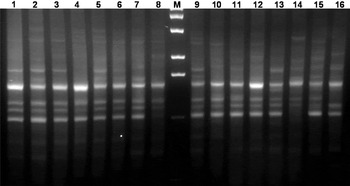
We surveyed eleven sweet corn lines, one F1 hybrid and four temperate field corn inbred lines using the REMAP marker method. It generated readable and polymorphic fingerprints ranging from 200 up to 2000 bp. Among the sweet corn lines, the total number of bands was 175 with approximately 27 bands per sample that provided a resolution sufficient for a further reliable analysis (Fig. 1). The JD and SMI dissimilarity matrices of 11 sweet corn lines and the F1 hybrid are given in online Supplementary Table S1. The ED for inbred lines was estimated based on the phenotypic characteristics such as plant height (PH), length of tassel (LT), insertion height (IH), length of the ear (LE), diameter of the ear (DE) and number of kernel rows per ear (KR/E) (online Supplementary Table S2).
REMAP profile of maize inbred lines included in the study: Zea mays var. saccharata : Line 6–13 (1), (mother parent of F1 hybrid Zaharina); Line C-6 (2) (pollen source of F1 hybrid Zaharina); F1 hybrid Zaharina (6–13 × C-6) (3); Lines: DH-3 (4), DH-7 (5), DH-8 (6), 1–23 (7), 2–20 (8), 2–24 (9), 3–31 (10), 6–28 (11), 3–18 (12). Z. mays var. indentata: Lines: A 654 (13); Mo-17 (14); B-73 (15); M-320/78 (16). M- DNA ladder Gibco 1 kb.

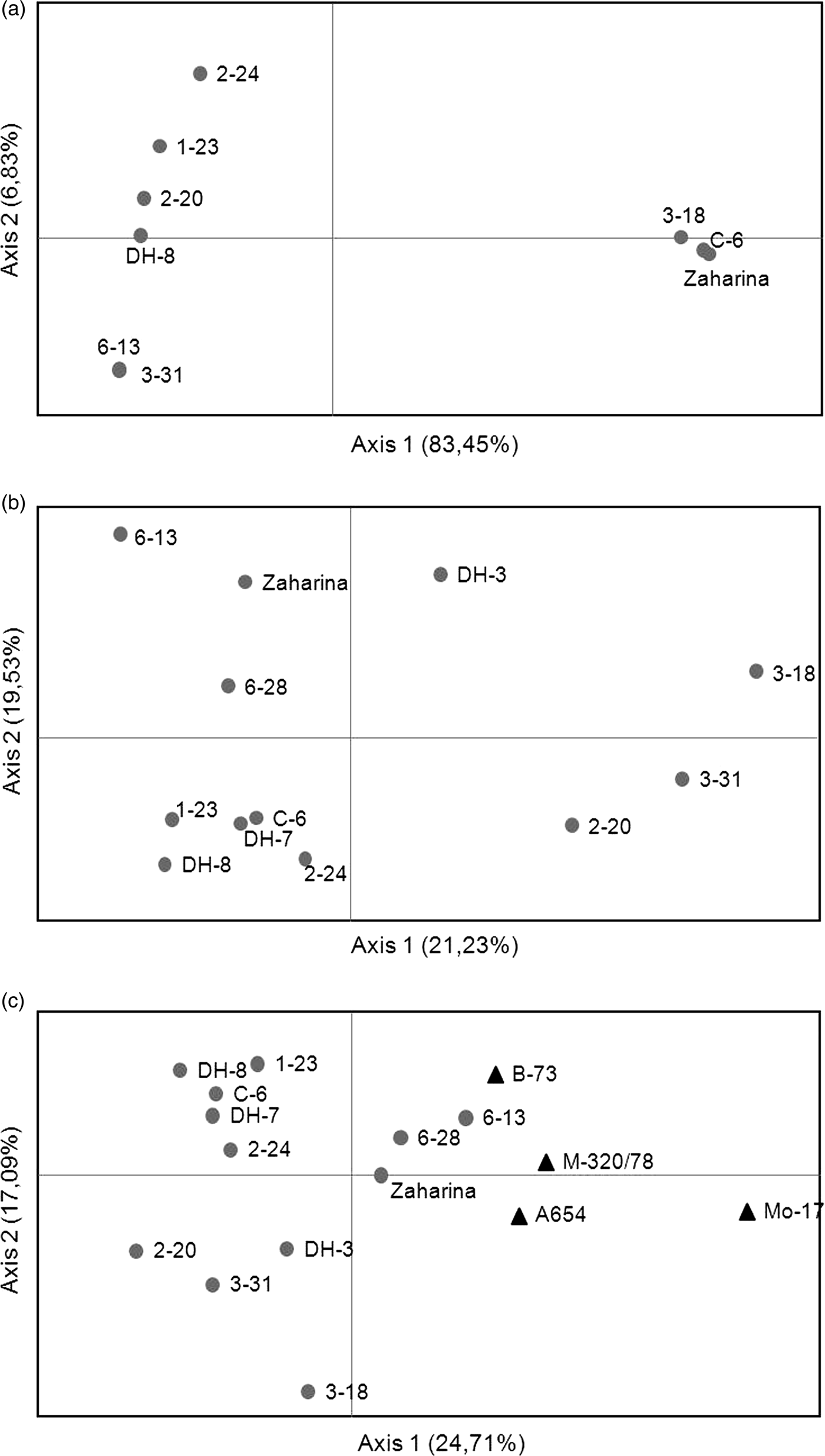
To visualize the genetic and phenotypic degree of relatedness among lines, pairwise distance matrices were plotted using the principal coordinate analysis (PCoA) (Fig. 2). REMAP markers allowed one to differentiate sweet corn and field corn lines as evidenced by their distant clustering (Fig. 2(c)). Taken sweet corn lines separately, pairwise comparison showed a lower level of phenotypic differentiation compared with the genetic one (Fig. 2(a) and (b)). Distances for some lines (e.g. 2–24, 1–23 and DH-8) were comparable both for phenotypic and genetic diversity coefficients. However, the differential clustering among the rest of lines and the F1 hybrid depended on the type of coefficient (phenotypic or genetic) applied to measure the distances. Parental lines C-6 and 6–13 that give rise to the high-quality hybrid Zaharina are distantly separated phenotypically and genetically. These data agree with the notion that greater genetic and phenotypic distances are associated with better hybrid performance. The phenotypic data showed a high similarity between the parent C-6 and the hybrid and the distant distribution of the line 6–13. On the contrary, genetic data revealed that line 6–13 is relatively closer to the hybrid, whereas the C-6 line was more distant.
Two-dimensional PCoA plots inferred from phenotypic (a) and genotypic (b, c) pairwise distant matrices. Genetic differentiation was calculated by the Jaccard's coefficient for sweet corn lines (b) and for Zea mays var. saccharata and Z. mays var. indentata all together (c). The spatial distribution of Z. mays var. indentata lines is depicted as triangular marks. The percentage of total variance explained by each axis is noted in parentheses.

Correlation between genetic distances among inbred lines and heterosis
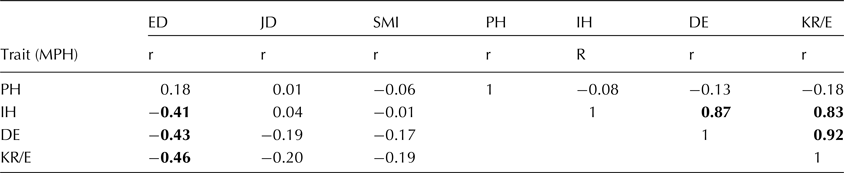
The average phenotypic and genetic distances among lines and their correlation with the MPH in their hybrids was calculated for each of the four traits (Table 1, first three columns). It was established that higher phenotypic divergence correlated with lower heterosis for IH, DE and KR/E in all crosses. In contrast, we did not observe such a trend for the parameter genetic divergence estimated by the JD and SMI coefficients.
Correlation of parental distances (ED, JD and SMI) with mid-parent heterosis (MPH) for traits plant height (PH), insertion height (IH), diameter of the ear (DE) and kernel rows per ear (KR/E) (first three columns)

The correlation values of co-inheritance of phenotypic traits are shown in the last three columns. The significance is tested at P < 0.05. Significant correlation values are marked in bold.
Co-inheritance of different agronomical traits and building strategies for monitoring of their joint selection is an important criterion for improving the quality of the hybrids. Here, the only positive correlation was between IH, DE and number of KR/E (Table 1, last three columns). Plant height shows the highest heterosis in almost all crosses; however, it does not imply an increase in the maize yield (DE and number of KR/E).
Assessing the added effects of each parent to the heterosis in hybrids
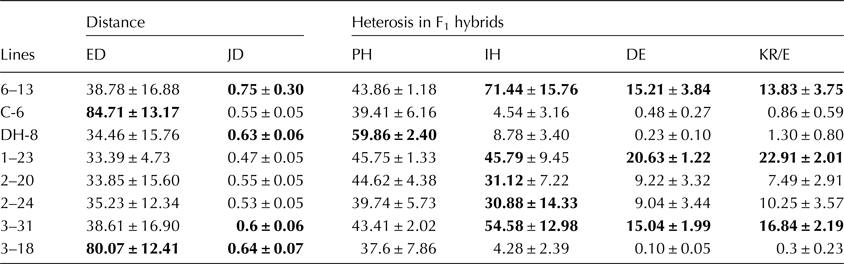
We also estimated the relative contribution of each parent to the heterosis effect in derived hybrids. To do so, we calculated the averaged ED and JD of each line to other ones and compared with the mean heterosis in its derived hybrids (Table 2).
Mean Euclidean (ED) and Jaccard's (JD) distances and standard deviation (SD) of each parent and mean mid-parent heterosis (MPH) of its hybrids for the traits plant height (PH), insertion height (IH), diameter of the ear (DE) and kernel rows per ear (KR/E)

The distinct values of heterosis effect are shown in bold.
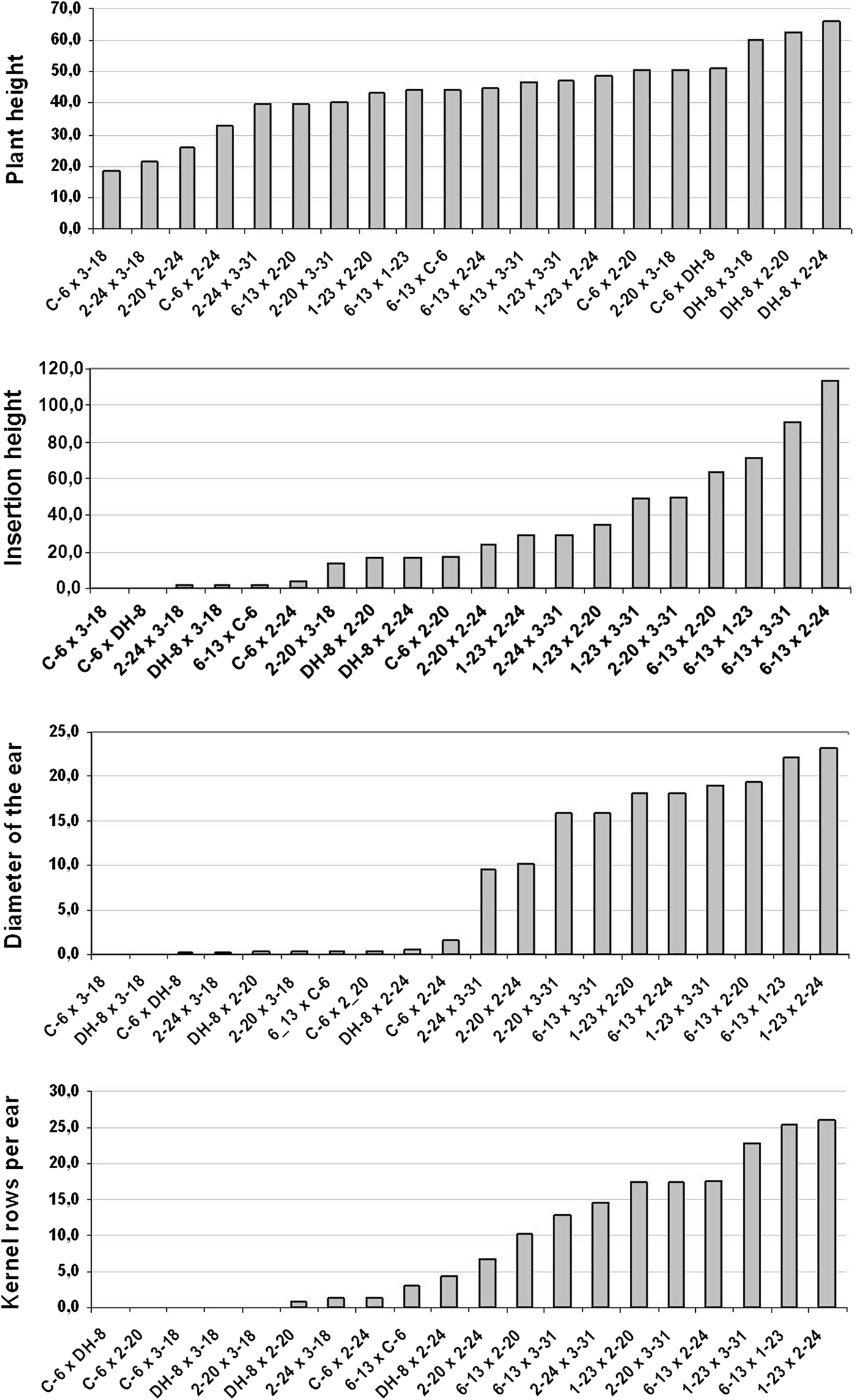
Among the studied biological traits, PH has the greatest heterosis in hybrids without significant variations between inbred lines with DH-8 displaying the highest value (59.86 ± 2.4) when used as a parent. Much more pronounced between-parent-specific genetic distances, however, were observed for the traits IH, DE and KR/E. Associations between genetic distance and heterosis in developed hybrids was visible for particular lines. For instance, the highest genetic distances of lines 6–13 (0.75 ± 0.30) and 3–31 (0.6 ± 0.06) correlated with increased IH, DE and KR/E. In addition, the line DH-8 displayed the highest mean of genetic distance (0.63 ± 0.06) and also high effect on heterosis for PH in its derived hybrid. Lines 2–20 and 2–24, despite showing lower mean distances, have a great effect for heterosis for the IH in their respective hybrids. These associations are also clearly visualized on the graphic in Fig. 3. The phenotype distances of individual lines were shown to negatively correlate with the increase of heterosis (Table 1). For instance, lines C-6 and 3–18 displayed the highest phenotypic distance than the rest of lines (84.71 ± 13.17 and 80.07 ± 12.41, respectively), but their contribution to the heterosis was low.
Heterosis effect in different hybrids of the sweet corn (Zea mays var. saccharata).

Discussion
According to recent theories on the implication of repetitive elements in the manifestation of heterosis in maize (Springer and Stupar, Reference Springer and Stupar2007), our experiment was designed to verify if the variability in the retrotransposon component of the genome of parental inbred lines (assessed by REMAP markers) can be related to heterosis in maize hybrids. The emphasis was put on sweet corn inbred lines as a valuable resource for the development of maize germplasm collections. The study was carried out using inbred lines showing significant phenotypic variability in order to ensure a consistent genetic variability to the experiment. We used the heterosis information for 20 hybrids, a number allowing a statistical treatment of data.
The first main observation in our study is the low correlation between genetic and phenotypic distances when taking the average of these parameters for all inbred lines (data not shown). Teklewold and Becker (Reference Teklewold and Becker2006) also reported such a trend in Ethiopian mustard. However, some inbred lines make an exception and show similar genetic and phenotypic clustering as displayed on the PCoA plots. Our data indicated that TE diversity, even estimated in relatively close inbred lines, exceed the diversity calculated on six phenotypic traits and it obviously counts for the observed lack of correlation. We suggest two reasons that explain the excess of genetic diversity. First, TEs (Helitron elements, DNA transposons and retrotransposons) comprise two-thirds of the maize genome generating a vast amount of allelic diversity throughout the genome (Springer and Stupar, Reference Springer and Stupar2007). Previous studies documented high variations in the structure (Fu and Dooner, Reference Fu and Dooner2002) and the content of repetitive elements in different maize genotypes (Kato et al., Reference Kato, Lamb and Birchler2004). Moreover, flow cytometry studies evidenced significant variation in the size of the maize genome between different inbred lines (Laurie and Bennett, Reference Laurie and Bennett1985; Lee et al., Reference Lee, Sharopova, Beavis, Grant, Katt, Blair and Hallauer2002). Second, one should take in consideration the usually polygenic inheritance of traits and the existence of linkage disequilibrium that could cause a lack of correlation between phenotypic and genetic distances (Burstin and Charcosset, Reference Burstin and Charcosset1997).
It is assumed that the presence of genetic diversity is prerequisite per se for the existence of heterosis. The detection of heterotic groups among maize inbred lines and breeding stocks has been considered as an important step that would further simplify the choice of parental lines for the production of high-yield hybrids (Reif et al., Reference Reif, Melchinger, Xiab, Warburtonb, Hoisingtonb, Vasalb, Srinivasan, Bohn and Frisch2003). The positive correlation between genetic distances and heterosis/specific combining ability in sweet corn was previously reported (Guimarães et al., Reference Guimarães, Paterniani, Lüders, Souza, Laborda and Oliveira2007; Stupar et al., Reference Stupar, Gardiner, Oldre, Haun, Chandler and Springer2008; Srdić et al., Reference Srdić, Nikolić, Pajić, Drinić and Filipović2011). Similarly in sunflower, IRAP-based distances between parental lines had higher correlation to heterosis for seed number per head and PH (Buti et al., Reference Buti, Giordani, Vukich, Pugliesi, Natali and Cavallini2013). In our study, we observed a lack of statistically significant correlation between genetic distances and heterosis. Genetic distances may allow predicting hybrid performance; however such associations were only detected at the level of individual lines (e.g. 6–13, 3–31 and DH-8) and for some traits. These lines meet the criterion that parents with the greatest possible divergence enhance the heterosis in the hybrids with increased probability of superior segregants in advanced generations. The high quality of the F1 hybrid Zaharina, developed after the cross between the genetically distant lines 6–13 and C-6, supports this notion.
Here, crosses between lines from heterotic groups do not imply increased heterosis effect. There are hybrids of good performance for a particular trait obtained from both genetically related and distant inbred lines. In support to this observation, Charcosset et al. (Reference Charcosset, Lefort-Buson and Gallais1991) and Bernardo (Reference Bernardo1992) argued the association of DNA markers with genes and QTL loci affecting the trait is at least required to predict hybrid performance. Indeed, TEs may be occasionally implicated in the expression of particular genome regions ultimately resulting in altered phenotypes, as observed for the teosinte branched1 (tb1) locus in maize (Clark et al., Reference Clark, Nussbaum-Wagler, Quijada and Doebley2006). The inbred line-specific patterns of correlations between genetic distances (inferred from TE-markers) and the heterosis effect can be explained by the existence of variation in TE dynamics among the studied lines. In addition, it is likely that the variation in parental lines that produces heterosis may predominantly reflect a variation at specific genes rather than at TEs. With the power of the methodological platform we used, we cannot say to what extent TE variation impacts or associates with the phenotypic traits showing increased heterosis. Further analyses on the transcription and target specificity of TEs in inbred lines would allow getting more detailed conclusions about this issue.
In this study, the plant material platform used for the assessment of variation consists of eight inbred lines for phenotypic distances and eleven lines for genetic distances both studied based for six phenotypic traits. We are conscious that the platform can be optimized in order to increase the robustness of the analysis and the statistical significance of the results. First, the variation in hybrids performance and correlations with parental distances varies significantly for distinct phenotypic traits. Therefore, including more phenotypic traits and/or inbred lines in the analysis would provide a more comprehensive insight about the interaction between parental distances and hybrid performance. Second, there exists a great diversity of TEs with type-specific copy number and patterns of dynamics. Thus, the output data may also significantly depend on the type of TE, marker method, primers and PCR conditions chosen in the experiments (Buti et al., Reference Buti, Giordani, Vukich, Pugliesi, Natali and Cavallini2013). This fact implies the usefulness of testing different combinations of these parameters.
Based on the obtained data, a number of sweet corn inbred lines and hybrids can be considered as useful for development and use in maize breeding programmes. Lines 6–13, 1–23 and 3–31 show the highest impact on the heterosis for IH, DE and number of KR/E. Similarly, the line 2–24 has the highest contribution to IH and line DH-8 for PH. Therefore, hybrids derived from these parents or their combination with other maize lines can be used as prospective genetic resources in maize breeding programmes.
Supplementary Material
The supplementary material for this article can be found at https://doi.org/10.1017/S1479262116000411
Acknowledgements
This work was supported by European Social Fund (ESF), Operative Program ‘Development of Human Resources’, project BG051PO001–3.3.06–0025.