Introduction
China has the capacity to be broadly food self-sufficient for the next 10-15 years (Norse et al., Reference NORSE, LU and HUANG2014) but increasing urban development, reduced agricultural land, improved living standards and dietary changes mean that poultry will play a major role in China's domestic economy and provide a key source of food security. Chicken meat is one of China's most important poultry products. In 2000, the total industry value exceeded 50 billion yuan, increasing to 200 billion yuan by 2010. On average, the industry accounts for about 7% of total animal husbandry and 4% of agricultural output. Chicken production has generally increased steadily from 1,010,000 tons in 1982 to 12,785,000 tons in 2013; or an annual average increase of 8.53%. Chinese chicken consumption has also grown steadily with intermittent dips over time, such that China is now the second-largest global chicken consumer. In trade terms, Chinese chicken exchange has shifted from one of net exporting to net importing, with the highest import balance of 661,000 tons experienced in 2008.
The food security importance of chicken meat for developing countries such as China can be put at risk by biosecurity events such as highly pathogenic avian influenza (HPAI). HPAI is classified as a worldwide pandemic that mainly presents as a respiratory symptom with serious negative impacts on human health and the global poultry industry (Simon, Reference SIMON2003). Such pandemics spread rapidly, and can result in poultry species mortality rates of up to 100% within 48 hours (OIE, 2015). HPAI can thus create significant domestic and international disruptions to poultry production, consumption, imports and exports (Taha, Reference TAHA2007). The first HPAI case in China was reported in the Guangxi province in January 2004. The disease has subsequently been detected and reported a further 85 times in a further 20 Chinese provinces between 2004 and 2013. China experienced its most serious HPAI event in 2004/05 which accounted for 73% of total infections, 84% of total dead chickens, 88% of gross culled chickens and 85% of provinces being infected. In 2006, China responded to this event with an industry-wide HPAI immunisation program which appears to have decreased further outbreaks. A study of HPAI impacts on the Chinese chicken meat supply and demand provides insights into the domestic economy and export earning impacts from HPAI outbreaks, with attendant lessons for other developing nations facing sanitary and phytosanitary (SPS) restrictions and negative food supply consequences. In the following review, reports are evaluated for the quantity losses in chicken meat domestic production, consumption and imports and exports from HPAI epidemics in China between 2004 and 2013 on the basis of partial equilibrium theory. These are used to estimate the economy-wide impacts on Chinese chicken production, consumption, and import and export activity. In response, we make policy/program recommendations that may assist authorities to mitigate future impacts of HPAI outbreaks on an important global source of protein.
Previous modelling
Analysts typically quantify the actual or potential losses caused by contagious animal disease impacts using cost-effectiveness or input-output frameworks with a singular focus on either production, consumption or trade of the relevant agricultural product. Some past studies have estimated a mixed set of impacts (e.g. production and trade). For example, Rushton et al. (Reference RUSHTON, VISCARRA, BLEICHE and McLeod2005) described the poultry production losses in five South East Asian countries caused by HPAI. You and Diao (Reference YOU and DIAO2007) developed a spatial equilibrium model to simulate the effects of avian influenza on the productive yield and price of the Nigerian chicken industry, while Myles et al. (Reference MYLES, HOOD and ALLEN2009) used an input-output model to assess the possible economic impact of avian influenza on poultry production in Mississippi. With regard to consumption impacts, Park et al. (Reference PARK, JIN and BESSLER2008) employed an error correction model to extrapolate the impact of avian influenza on demand in the Korean poultry meat market, and Ishida et al. (Reference ISHIDA, ISHIKAWA and FUKUSHIGE2010) similarly analysed the influence of bovine spongiform encephalitis (BSE) and avian flu on Japanese consumer demand for poultry meat products. Trade impacts from HPAI events have also been estimated. For example, Djunaidi and Djunaidi (Reference DJUNAIDI and DJUNAIDI2007) conducted a spatial equilibrium model to simulate trade impacts from HPAI events which occurred simultaneously in Asia, the United States, Brazil and Europe on the import and export volumes and price of poultry products. Finally, there are mixed study examples. One such study simulated the probable impact of HPAI on farm income, feed demand and consumer food expenditure using the FAPRI economic sector model (Brown et al., Reference BROWN, MADISON, GOODWIN and CLARK2007). Similarly, Buetre, et al. (2013) adopted the AgEmissions model to simulate revenue losses caused by foot-and-mouth disease on the supply and demand of 15 livestock products in Australia. Most recently Saatkamp et al. (Reference SAATKAMP, MOURISTS and HOWE2016) presented a framework for assessing the economic impacts of the outbreak of highly contagious livestock diseases which included virus control-related direct costs, spread prevention and zoning-related direct consequential costs, market and price disruption-related costs during and after the outbreak.
The review of the literature suggests that there are abundant studies on the impact of HPAI events on poultry production, consumption or trade in isolation; but less often measured are the actual first-round poultry meat losses across all three sectors. An exception is Parrlberg et al. (Reference PARRLBERG, SEITZINGER and LEE2007) who described the impact of livestock production, consumption, imports and exports caused by foot-and-mouth disease (FMD) in the United States. However, to the best of our knowledge a similar study for disease impacts in China or other developing nation contexts is not available. Therefore, this study is the first of its kind to empirically evaluate chicken meat quantity losses as a consequence of HPAI.
Economic losses
Estimated quantity losses for Chinese HPAI economic impacts are derived using a partial equilibrium model. The partial equilibrium model is based on an analysis of a restricted range of data that consider only one sector of the economy; in this case, Chinese chicken meat supply and demand. The standard example is an analysis of changes to the price of a single product based on changes to sectoral supply and demand, with the prices of all other products being held fixed (Jain, Reference JAIN2007). In this case, this paper defines the sectoral supply of chicken meat to include production and import sources, while sectoral chicken meat demand includes consumption and export channels. It was assumed that the world chicken meat price is fixed, and not influenced by any changes to China's chicken meat trade. As such, it is possible to describe the structural model as consisting of four behaviour functions and an inventory balancing function.
the model
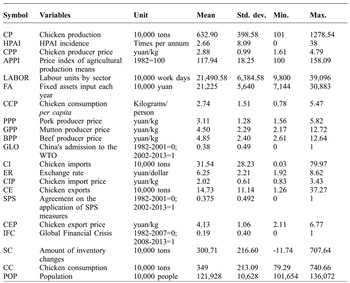
Paarlberg et al. (Reference PAARLBERG, SEITZINGER and LEE2008) provides a useful basis for our model specification, where the investigators measured impacts of foot-and-mouth disease on livestock product trade-level supply and demand as the dependent outcome. Their disease impact parameters on production, processing, consumption and trade are set between 0 and 1. Using the same approach to specify production, this paper used consumption and trade impacts from HPAI events in China, where 0 denotes a HPAI shock to chicken meat supply and demand, and 1 denotes no shock. Each function is expressed below on the basis of economic theory and actual economic relationships. Table 1 provides details for the variables used in each of the model, while a detailed explanation for each is offered in the following sections.
production sector
The impact of HPAI on chicken production is used as the dependent variable of interest. Independent variables include: 1) chicken meat prices where, as prices increase, farmers would be expected to increase profits and thus motivate increased supply and vice versa; 2) production costs where, as costs increase farmers would be expected to reduce production levels and drive supply contractions; and 3) production factors such as labour and capital which may increase productive capacity and shift supply to the right. The impact parameter of HPAI outbreaks on chicken production is thus specified as α, ϵ [0,1], and the chicken production function is as expressed below:

where t is the yearly time period, CPt represents chicken meat production, CPPt denotes the price of chicken products, APPI t represents the farm production costs, LABOR t denotes labour force input levels and FAt is farm asset inputs each year.
The output from the model is shown in Table 1 .
Model variable summary statistic results.

consumption sector
The impact of HPAI on chicken meat consumption was used as the dependent variable of interest. Measures of chicken consumption per capita were used to eliminate any potential population influence. Corresponding independent variables include: 1) chicken meat prices where, as prices fall, demand should increase and vice versa; 2) substitute prices for alternative sources of protein (e.g. pork or beef) where consumption of substitutes will increase as the price of chicken increases; 3) domestic meat consumption habits where consumers can be positively affected by their past consumption decisions (Duesenberry, Reference DUESENBERRY1949) which in this instance is the previous period's consumption choices; and 4) a dummy variable for China's 2002 admission to the World Trade Organisation (WTO) under globalisation reforms, which enabled higher chicken consumption as a result of lower poultry prices (Fuller et al., Reference FULLER, BEGHIN and CARA2001). The impact parameter of HPAI on chicken consumption per capita is specified as β, ϵ [0,1], and the chicken consumption function is expressed below:
where CCP t represents chicken meat consumption per capita, CPPt is the chicken price; PPPt is the substitute pork price; GPPt is the substitute mutton price; BPPt is the substitute beef price; CCPt-1 represents consumers’ demand habits; and GLO t represents China's shift toward globalisation.
trade sector
When chicken meat imports were specified as the dependent variable of interest, the selection of independent variables was based on supply-demand and exchange rate theories (Feenstra, Reference FEENSTRA2015). These include: 1) the import price for chicken meat products in order to link the import volume of chicken products to its price(s) such that imports will decline if the import price grows; and 2) a measure of the relevant exchange rate that reflects a devaluation of the RMB when the US dollar exchange rate increases, which will also result in import volume reductions. The impact parameter on chicken imports is specified as δ,ϵ [0,1] and the chicken import function is expressed as:
where CIt is the chicken meat import volume; ERt represents the exchange rate in each period; and CIPt denotes the chicken meat import price. Similarly, chicken meat exports as a dependent variable utilise supply-demand theory and exchange rate theory to derive relevant independent variables including: 1) the chicken meat export price, such that if price rises are experienced total export volumes will increase; 2) production levels beyond domestic capacity for consumption which may drive higher export pressures dependent on prices; 3) a dummy variable for bilateral agreements on the application of sanitary and phytosanitary measures (SPS), which provide conditions for strict international trade requirements related to animal and plant quarantine; and 4) a dummy variable denoting industry influences from the Global Financial Crisis which decreased international demand for chicken products and reduced Chinese chicken export volumes. The impact parameter of HPAI for chicken meat exports thus specified as χ, ϵ [0,1] and the chicken meat export function is as expressed below:
where CEt represents chicken meat export volumes; SPSt denotes any instances of export trade bans consistent with SPS restrictions; CEPt represents the chicken meat export price; CPt provides a measure of domestic chicken meat production; and IFCt represents the presence of Global Financial Crisis shocks on export volumes. Finally, we use two further equations to account for the total stocks and utilisation of Chinese chicken meat products in the economy, expressed as follows:
where SCt represents the inventory change amounts; CPt is the contribution from chicken meat production; CCt is the contribution from chicken meat consumption; CEt is the contribution from chicken meat exports; CIt is the contribution from chicken meat imports; CCPt denotes the consumption per capita; and POPt is the total population.
data collection
Monthly data that reflects the short-term impact of HPAI on the Chinese chicken meat is not available. Instead, it is necessary to rely on annual measures of poultry losses and price impacts. The time-series data covered the period from 1982 to 2013, and was used to derive statistics for all the variables shown in Table 1. According to the Shou Yi Gong Bao (Chinese Ministry of Agriculture), 85 cases of HPAI infection and subsequent transmission occurred between 2004 and 2013 (Shou Yi Gong Bao, 2014). Larger numbers of HPAI cases per year resulted in greater damage to the value chain. Chinese chicken production, trade volume, chicken, pork, beef and mutton producer prices were sourced from FAOSTAT (2014). National population, GDP per capita, exchange rates, and the price index of agricultural production mean values were derived from the China Statistical Yearbook. It should be stated that, due to incomplete annual data for the pork, beef and mutton producers, prices were occasionally used as an alternative source of data as a substitute for these meat market prices. Import and export prices for Chinese chicken products were generally derived from multiplying the ratio of imports to exports by the annual exchange rate. Finally, to avoid price fluctuation effects all price variables such as yearly fixed assets input, the mean-price index of agricultural production, producer prices for substitutes (chicken, pork, beef and mutton), and import and export prices were uniformly indexed using 1982 as the base year.
estimations
In order to reflect the dynamic and continuous effects of HPAI outbreaks, the model incorporated lag-terms for each of the endogenous variables. Elasticity significance was expressed with logarithmic conversions on both sides of equations (1) to (4) for n samples of observation {(X, Y): t = 1, 2 ... n}. As a consequence, the four major partial equilibrium chicken meat supply and demand outcomes were re-written as:
Equations (7) to (10) show that: CPt, CCPt, CIt and CEt are the endogenous variables in the models; CPt-1, CCPt-1, CIt-1 and CPt are the instrument variables in each respective equation; and HPAIt, CPt-1, CCPt-1, CIt-1, CPPt, LABORt, FAt, APPIt, PPPt, GPPt, BPPt, GLOt, ERt, CIPt-1, SPSt, CEPt and IFCt represented the exogenous variables. The structural equations are thus exactly identified because the number of instrumental variables are equal to the number of endogenous variables. Note that the endogenous variables in the partial equilibrium models are related to each other, which may be contrary to classic assumptions of ordinary least squares and result in coefficient estimation deviations. Any focus on the adoption of finite information when using the single equation estimation would bias the estimation results. To address this, each equation was estimated using a systemic estimation method, to allow adoption of full information and obtain parameter values for the equations. However, the systemic estimation method might result in all of the equation estimates being affected if errors subsequently appeared in one of the equation outcomes. In order to overcome shortcomings with these two estimation methods our analysis suggested that the form of each equation should be primarily determined by a single equation using OLS estimation, and the coefficient values for each variable estimated using three-stage least squares (3SLS) methods.
Industry implications
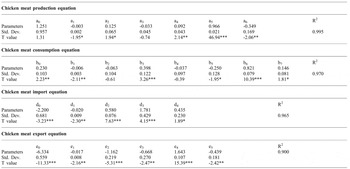
For all estimations, classical hypothesis tests including the Breusch-Pagan, Ramsey reset and variance inflation factor (VIF) calculations were used to determine whether any of the equations resulted in issues of heteroskedasticity, endophytism and/or multicollinearity. The p-values for both heteroskedasticity and endophytism tests in each of the four equations were all greater than 0.05 which suggests no issues with the model. Similarly, tests for multicollinearity did not return maximum VIF values greater than 10 nor average VIF scores higher than 0.8, suggesting no multicollinearity between any of the variables. The degree of fit for each equation is good ( Table 2 ), and in each case the model explanation is 90% or higher. Finally, the parameters of most variables are statistically significant and their signs consistent with theoretical expectations.
Model estimation results.

Note:*, ** and *** indicate significance levels of 10%, 5%, 1% respectively.
sectoral outcomes
The model-generated coefficient estimates were plugged back into the equations to derive values for the total sector losses from a HPAI event. Note that the smaller the estimated loss result, the larger the overall sectoral impact. For chicken production in China the equation can be completed as below:
which suggests that, ceteris paribus, logged chicken meat production would decline by 0.003% in the case of a HPAI outbreak. Conversely, higher chicken prices would have a significant and positive impact on the yield, where farmers would choose to adjust their output in light of the price to some extent. Chinese chicken meat production was not very sensitive to labour force drivers, but it would react negatively to increased production costs as we might expect. Finally, production was driven by factors associated with the last production term, possibly signalling some lagged resource endowments. The estimated chicken meat consumption per capita equation result was:
such that where other conditions are unchanged, the logged chicken meat consumption per capita would decline by 0.006% in the case of a HPAI event—twice that of production falls. Price increases of 1% would result in a per capita chicken consumption decrease of 0.063%. However, increased chicken meat consumption could be generated by increases to the price of pork, indicating a significant substitution effect, and increased consumption in the previous period associated with consumer habits. For trade impacts, the estimated chicken meat import equation result was:
This suggests that logged Chinese chicken meat imports would decline by 0.02% in the event of a HPAI outbreak. Higher import levels and the chicken meat import price during the previous trade period both resulted in statistically significantly positive correlations for chicken imports. Chicken meat import levels for China showed high responsiveness to the influence of the relevant exchange rate. Finally, the estimated chicken meat export equation result was:
Hence, logged Chinese chicken meat exports would decline by 0.017% in the case of a HPAI outbreak. Chinese chicken meat exports would also be significantly negatively affected by the requirements of SPS agreements among trade partners, higher export prices and impacts from the global financial crisis.
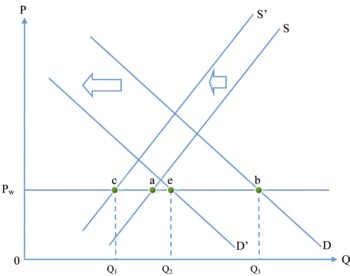
A summary of the effect of HPAI outbreaks on China's chicken meat supply and demand is provided in Figure 1 . As shown, the consumption quantity falls at roughly twice the rate of production; indicated by the larger leftward shift in demand (b→e) relative to the leftward shift in supply (a→c). Exports decrease as a result of lower poultry production and total stocks, while corresponding falls in import levels fail to impact on total supply. Overall, they tend to cancel each other out. So, where we might expect to see short-run redistributions of supply to counter internal production falls following Chinese HPAI outbreak shocks, we observe larger domestic consumption reductions that are not addressed by alternative sources of world supply. To provide some insight into this unexpected result we now turn our attention to calculating the losses from HPAI events over the period of 2004 to 2013.
HPAI outbreak impacts on China's chicken meat supply and demand.

loss evaluation
As shown in the preceding section, chicken meat consumption suffered the greatest losses following individual HPAI events, followed by the production sector, then per capita exports and imports. One reason for this pattern may be that China has been a net importer of chicken meat since 1998, and is indeed the second-largest chicken meat importer in global terms. In the event of a HPAI outbreak domestic chicken meat consumption tended to decrease rapidly, with declining imports as a flow-on effect. It is likely that this is reflective of general food safety fears by the Chinese population, and reluctance to take chances on infected chicken products no matter what their origin or source. High levels of information asymmetry and limited capacity to inform consumers of safe meat alternatives, or consumer inability to identify imported from domestic products, could possibly motivate dramatic consumption falls.
As a whole, it is possible to use the number of HPAI outbreaks in any given year to scale up total losses. When HPAI took place n times (n = 1, 2, 3 ... 38) annual chicken meat production, per capita consumption, imports and exports each declined by n*0.003%, n*0.006%, n*0.020% and n*0.017% respectively. Following this, impact parameters of n HPAI events on chicken meat production, per capita consumption, imports and export can be expressed as α = e -0.003*n , β = e -0.006*n , δ = e -0.020*n and χ = e -0.017*n , while the natural constant e can also be defined as 2.718. As such, the chicken meat production sector losses from HPAI are now expressed below.
where SCPt denotes lost production each year, OCPt represents the original annual chicken meat production, and CPt is actual chicken meat production affected by HPAI. In 2004, α was the lowest which suggests that year suffered the greatest losses, closely followed by 2005. These years recorded the greatest HPAI poultry meat production impacts in China. Total losses for 2004-2005 were 1,859,000 tons accounting for 9.26% of original production levels. The lowest HPAI loss events were recorded in 2009 and 2011 when only single events were recorded resulting in losses of 33,500 and 35,900 tons respectively. Between 2004 and 2013, there were a total of 2,516,500 tons of lost chicken production accounting for 2.26% of original chicken output in total (111,293,700 tons). Note that original production increased for the first two years then fell to its lowest point (9,739,700 tons) in 2006 after the major HPAI events. Similar per capita chicken consumption losses from HPAI events can be expressed as below.
where SCCPt represents the lost per capita consumption each year, OCCPt is the original per capita chicken consumption per year, and CCPt denotes the actual per capita chicken consumption affected by HPAI events. In 2004 and 2005 during the largest outbreak, per capita chicken consumption reduced by over 0.7 kg per capita but in subsequent years, when the number of HPAI events decreased, consumers gradually returned to previous levels of consumption. The lowest consumption per capita was in 2004 (3.93 kg) due to protein substitutes and changing preferences over time, while it peaked at 5.57 kilograms in 2012. Similarly, actual chicken consumption per person ranged between 3 and 5.5 kg.
Overall consumption losses during 2004 and 2005 were 2,003,100 tons or 73.16% of gross losses. From 2004 to 2013 HPAI losses totalled 2,737,900 tons of chicken consumption accounting for 4.3% of original per capita consumption (63,673,900 tons). 2004 saw the lowest original consumption (5,110,500 tons) while the highest consumption was 7,541,100 tons in 2012. Actual gross volumes in 2013 dropped from 7,406,600 tons to 6,096,000 tons mostly as a result of the H7N9 flu event which saw consumers switch to other protein sources. Over a 10-year period, actual consumption was 60,936,000 tons. Total HPAI losses in terms of chicken import reductions can therefore be expressed as below:
where SCIt represents the lost imports each year, OCIt is the original chicken import level per year, and CIt denotes the actual chicken imports affected by HPAI events. Despite the number of HPAI events in 2005 being lower than those in 2004, import losses were at their highest in 2005. One possible reason for this is the compound impact of HPAI losses across the two years, when losses reached 265,200 tons accounting for 71.6% of actual import volumes. Between 2004 and 2013, total chicken meat imports decreased by 731,700 tons in total accounting for 12.09% of original import volumes (6,050,900 tons). Despite periodic HPAI events, imports within 10 years fluctuated remarkably. 2004 and 2011 experienced the lowest imports (nearly 400,000 tons) whilst the highest imports (870,000 tons) were in 2008.
Because China mainly imports frozen chicken, chicken bones and toes from the United State on the basis of cheaper prices and domestic consumption habits, chicken meat imports actually grew in response to the falling US dollar exchange rate; increasing by 28.56% per year for 2005 and 2008. After that period though, the global financial crisis and economic recession impacts have resulted in an acute fall. Finally, losses in chicken meat exports as a result of HPAI events can be expressed as below:
where SCEt represents lost exports each year, OCEt is the original chicken meat export volume per year, and CEt denotes actual chicken exports affected by HPAI events. Chicken meat export losses in 2004 and 2005 accounted for 47.58% and 36.80% of original export volumes respectively. When HPAI was effectively controlled, chicken meat exports escalated substantially. From 2004 to 2013 there were a total of 207,800 tons of losses in chicken meat exports, accounting for 13.43% of the original export volumes (1,546,800 tons). Exports without any HPAI shock remained over 100,000 tons, with only slight fluctuations. It was found that the fewest exports (106,900 tons) were in 2006 and the most exports (201,900 tons) were in 2005. Gross actual exports amounted to 1,339,000 tons. Sanction and trade realities likely played an increasing role in this outcome. For example, after China's admission to the WTO and their adoption of globalisation principles, major chicken importers including Japan cited bird flu concerns to conduct drug testing of Chinese poultry products under the SPS agreement. This resulted in a ban on Chinese chicken meat imports, especially following the large-scale HPAI event in 2004. This, together with an appreciation of the RMB exchange rate, resulted in continuing low exports in the period to 2013, with a 58.92% fall.
Chicken industry issues
Evaluating losses from events such as these is challenging, and there are inevitability some deficiencies in the model construction. Firstly, the precision of our results was somewhat affected by limited yearly data. Secondly, our estimation of the results was not entirely satisfactory due to the use of different databases. Thirdly, the Shou Yi Gong Bao (2014) only records HPAI cases for chickens generally; they do not distinguish between broilers and layers, so it is likely that our HPAI parameters are larger than shown here. Critically, cases of HPAI could not be used to represent the danger of the disease to chicken meat supply and demand. These are limitations which we would hope to address in future iterations of the research. Our analysis highlights the fact that HPAI events provide significant impacts for the chicken meat sector, particularly supply and demand. Although HPAI outbreaks were limited to specific areas, the market risks and impacts were enlarged to generate spill-over effects along the value chain and negative externalities for farmers, consumers and international trade. In light of China's increasingly fragile food supply issues and concerns about internal industry immunisation practices, the impact of HPAI on national chicken industries cannot be ignored. Similarly, the social welfare importance of effective pre-event and post-event control measures against HPAI cannot be underestimated. This model has identified several important issues specific to Chinese food officials.
significant consumer welfare impacts
The negative welfare impacts of HPAI outbreaks in China are clearly not equally shared across sectors. Consumers are particularly vulnerable to the effects of these outbreaks where chicken meat consumption has increased in importance over recent decades, and is expected to increase in importance further in the future. One way to address this imbalance would be to increase the potential of chicken imports to shore up supply during any future HPAI event, such that consumer welfare impacts were lessened. Barriers to this approach may arise from current import restrictions and/or internal concerns about long-run continuing impacts on domestic production from any opening up of trade. Thus, a better understanding of current restrictions on imports to address consumption shortfalls under HPAI events should be undertaken as a priority focus for the Chinese government, and protocols developed where necessary to ensure supply smoothing - as well as domestic production support following a return to normal conditions.
information asymmetry
A constraint to the recommendation above may stem from the fact that Chinese consumers would likely be highly unable to differentiate between domestic and imported chicken meat products during any future HPAI event. Protocols to support consumer education and the use of branding techniques to help consumers during HPAI-driven supply shocks might help to overcome this information asymmetry. Whilst it may be uncomfortable for officials and industry stakeholders to admit failings in the food system, and to have the superior quality and safety of imported products temporarily marketed over domestic chicken meat products in the short-run, this would be more cost effective and welfare-benefiting for consumers in the long-run. Further, it could allow consumers to transition back toward the local chicken meat products again once the HPAI event had been contained and production resumed, assisting Chinese officials in any effort to resume domestic consumption over other countries.
vulnerable food system
China has: one of the world's most vulnerable food systems with significant internal concerns about food security and safety; with one of the lowest per capita water-availability volumes in the world; increasing evidence of antibiotic misuse and poor practices; high urbanisation trends that are lowering agricultural land; and changing domestic diet and consumption patterns. Whilst China is expected to be self-sufficient in food production over the next 10-15 years and is investing capital into offshore agricultural and livestock production facilities to enjoy favourable trade agreements with food suppliers, it would be a sensible national policy to carefully consider and manage any internal threat to food supplies. Thus, any policies or programs that seek to address current failings or weaknesses in the chicken meat supply and demand, its practices and supply-chain would be a wise investment in the current context of low HPAI incidents—rather than adopting a complacent view based on a perception of reduced or diminishing future event probability.
Conclusions and future directions
This is the first attempt to investigate the Chinese losses of chicken meat associated with HPAI using a partial equilibrium model which helps highlight the relevant and systemic impact of HPAI epidemics. The biggest losses were in chicken per capita consumption, followed by production, then exports and imports. Disease outbreak impacts on chicken meat supply and demand were highest in 2004 and 2005 when the industry suffered considerable total losses equalling 4,496,700 tons. Between 2004 and 2013 additional smaller-scale HPAI events caused significant losses. While it appears that HPAI controls have helped stem the incidence of HPAI events in China, future complacency is a significant risk at both industry and government levels. There are two important management insights provided by this research. To avoid excessive fluctuations in chicken meat supply and demand it may be helpful for the government to support higher imports of ‘clean’ processed chicken meat during HPAI outbreaks, which would lessen current significant negative consumer welfare impacts. Branding strategies could also be employed to assist consumers differentiate between domestic and imported products, allowing consumers to reduce their HPAI-related impacts. Given the vulnerability of China's food security and safety, government investments in simple measures such as these could provide significant national benefits.