Introduction
Rice (Oryza sativa L.) is a staple food for more than half of the world's population, especially Asian countries. In 2019, Malaysia had 684,416 ha total rice production area, of which 425,613 ha were under the government-scheme for irrigated cultivation granaries (Department of Agriculture Malaysia 2019). A granary is an area covered by a major rice irrigation system and is considered by the Malaysian government in the national Agriculture Policy of Malaysia as a major rice-producing area. Twelve rice granary areas have been allocated by the government; ten of these are in Peninsular Malaysia; the other two are located in West Malaysia (Sabah and Sarawak states). The rice granaries are Muda Agricultural Development Authority (MADA), Kemubu Agricultural Development Authority (KADA), Integrated Agricultural Development Area (IADA) Kerian, IADA Barat Laut Selangor, IADA Pulau Pinang, IADA Seberang Perak, IADA Ketara, IADA Kemasin Semerak, IADA Pekan, IADA Rompin, IADA Kota Belud, and IADA Batang Lupar.
Malaysia produced approximately 2.91 billion kg of rice in 2019 with an average yield of 4,260 kg ha−1 (Department of Agriculture Malaysia 2019). Nonetheless, local rice production only meets 73% of the national sufficiency level; thus, Malaysia needs to import approximately 20% to 24% of its rice for consumption from neighboring countries (Radin Firdaus et al. Reference Radin Firdaus, Tan, Rahmat and Gunaratne2020). Several constraints to high rice production in Malaysia include water scarcity, unfavorable soil conditions, poor crop management practices, insect pests, diseases, and weeds. Karim et al. (Reference Karim, Man and Sahid2004) estimated rice yield loss in Malaysia due to weeds to be 10% to 35%. Weedy rice (Oryza spp.), locally called padi angin by farmers due to its high shattering trait, has become the most predominant weed species in the majority of rice fields (Dilipkumar et al. Reference Dilipkumar, Chuah, Goh and Sahid2017). It has been reported that a low infestation of weedy rice (1 to 10 panicles m−2) causes a 5% rice yield loss; a moderate infestation (11 to 20 panicles m−2), 15%; a high infestation (21 to 30 panicles m−2), 30%; and a heavy infestation (≥31 panicles m−2), more than 50% (Azmi and Karim Reference Azmi and Karim2008).
Weedy rice was a perpetual problem across all granaries in Peninsular Malaysia until the launch of Clearfield® rice technology (CRT) in late 2010 (Azmi et al. Reference Azmi, Azlan, Yim, George and Chew2012). The CRT package of imidazolinone (IMI)-resistant rice varieties (‘MR 220CL1’ and ‘MR 220CL2’) and premixed IMI herbicides, imazapic plus imazapyr (OnDutyTM, BASF Malaysia Sdn. Bhd, 40706 Shah Alam, Selangor, Malaysia), coupled with its Clearfield® stewardship guidelines, was the “offspring” of a Malaysian Agricultural Research and Development Institute (MARDI) and BASF Malaysia Sdn. Bhd. collaboration. The stewardship guidelines specify that the CRT package can only be used for two consecutive planting seasons to ensure its sustainability.
Following its release, the CRT package was highly touted as the most successful solution to weedy rice management in Malaysia. This great success was ironically detrimental to the sustainability of the technology, because farmers violated the crop rotation restriction and planted Clearfield® rice continuously. Consequently, many weedy rice populations are now reported to survive the application of IMI herbicides. Several weedy rice populations have been confirmed resistant to the IMI herbicides imazapic and imazapyr at various levels (Dilipkumar et al. Reference Dilipkumar, Burgos, Chuah and Ismail2018), with resistance conferred by reduced sensitivity of the acetohydroxyacid synthase (AHAS) gene (Ruzmi et al. Reference Ruzmi, Ahmad-Hamdani and Mazlan2020; Yean et al. Reference Yean, Dilipkumar, Rahman and Song2021).
Although the CRT package has been adopted for nearly 10 years in Malaysia, information on the current status of the technology, the emerging issues, and the farmers’ knowledge about the technology are limited. These matters need to be understood and addressed to implement a better strategy for disseminating CRT or future herbicide-resistant rice technologies. For a new technology to be well implemented, it is crucial to document the adoption readiness, perception of the performance of the technology, and challenges faced by farmers to ensure that the technology will remain relevant to the rice industry. Thus, the current survey was conducted to determine farmers’ knowledge of and management practices for weedy rice, as well as the adoption level of CRT in the selected major rice granaries in Peninsular Malaysia. This survey is expected to generate valuable information for researchers, extension officers, the private sector, and policy makers, enabling them to identify the knowledge gaps among rice farmers and support system deficiencies that hinder sustainable herbicide-resistant rice technology adoption.
Materials and Methods
Study Sites
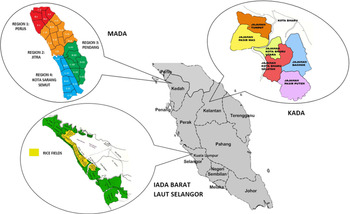
The survey was conducted in three major rice granaries in Peninsular Malaysia, namely MADA, KADA, and IADA BLS (Figure 1). These three surveyed regions represented 56% (291,481 ha) of rice production areas in Peninsular Malaysia.
Rice production areas surveyed in Malaysia, 2019: Muda Agricultural Development Authority (MADA), Kemubu Agricultural Development Authority (KADA), and Integrated Agricultural Development Area Barat Laut Selangor (IADA BLS) granaries.

Survey Design
A survey of 452 farmers was conducted using a structured survey questionnaire with 152, 135, and 165 farmers randomly selected from KADA, MADA, and IADA BLS, respectively. The questionnaire was designed based on a previous survey conducted in the U.S. Midsouth (Burgos et al. Reference Burgos, Norsworthy, Scott and Smith2008). The questions were then modified and expanded to achieve the objective of this study for Malaysia. The survey consisted of 15 questions grouped into three parts: (1) respondents’ demographics, (2) adeptness in recognizing weedy rice and their management practices, and (3) CRT (Supplementary Appendix S1). In Part 1, the farmers were asked to fill in their sociodemographic information: age, educational level, their experience in rice farming, their primary job, and field size.
In Part 2, farmers were interviewed concerning their adeptness at recognizing weedy rice and what they do to manage weedy rice. Part 3 consisted of questions to document information on the implementation of CRT among farmers. Farmers were asked about the obstacles of adopting CRT, source of Clearfield® rice seed and OnDutyTM herbicide, adherence to the use of OnDutyTM herbicide with Clearfield® rice, knowledge on the application rate and timing of OnDutyTM in Clearfield® rice fields, the number of seasons cultivating Clearfield® rice consecutively, and the occurrence of weedy rice resistance to OnDutyTM herbicide. Before data collection, a pilot test was performed to determine the appropriateness of the questions, clarity, and likelihood of obtaining good quality data. Forty-five rice farmers were chosen for the pilot test. This quantity matched the sample number range recommended by Kieser and Wassmer (Reference Kieser and Wassmer1996).
Data Analyses
Data from the questionnaire were coded and analyzed using Statistical Package for Social Sciences (SPSS) v. 21 (IBM, 1 New Orchard Road, Armonk, NY 10504-1722, USA). The sociodemographic characteristics were analyzed using a chi-square test to investigate the association between the variables and study sites. A chi-square test was used to compare farmers’ adeptness in recognizing weedy rice across three rice granary areas. Pairwise correlation between farmers’ characteristics was estimated with Spearman’s rank correlation. The Spearman’s rank correlation test was also conducted to determine the correlation between farmers’ backgrounds and adoption of CRT. The Kruskal-Wallis test with pairwise comparison was used to test differences in deterrents experienced in adopting CRT among respondents between the granaries.
Results and Discussion
Sociodemographic Characteristics of Farmers
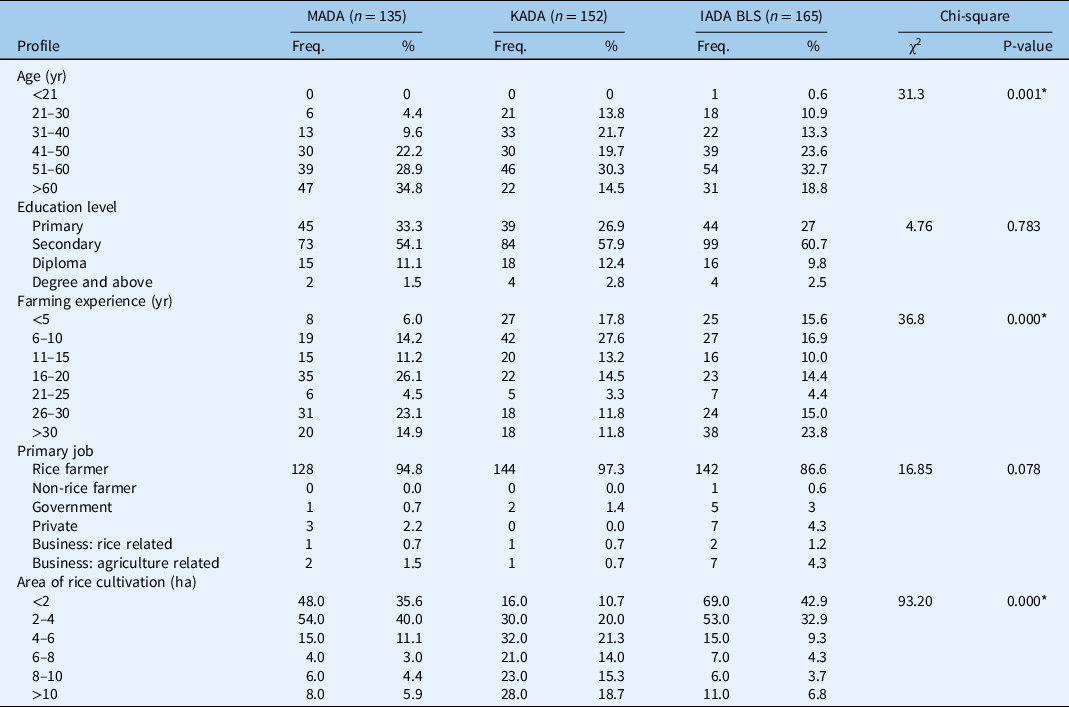
The three rice granary areas in Peninsular Malaysia were mostly managed by rice farmers (87% to 97%) with no difference between rice granaries (Table 1). However, the farmers differed in the length of rice farming experience (P < 0.01). The majority (57% to 67%) of farmers from MADA and IADA BLS had been cultivating rice 16 to >30 yr, whereas 59% of farmers from KADA had <16 yr of experience. The majority (35%) of farmers from MADA were >60 years old, whereas only 15% to 19% of farmers from IADA BLS and KADA were in this age group. The education level of the farmers did not vary significantly (P > 0.05) between rice granary areas. The majority (84% to 87%) of farmers across the three rice granaries had primary and secondary education. The average farm size differed significantly (P < 0.01) across the granary areas. The farm sizes of respondents ranged from small (0 to 2.0 ha), medium (2.1 to 4.0 ha) to large (>4 ha). About 70% of the farmers from MADA and IADA BLS had small- or medium-scale rice fields, whereas 69% of farmers from KADA had big rice fields (P < 0.01). A positive correlation (r = 0.63, P < 0.01) was observed between the age of farmers and farming experience; however, farmers’ educational levels were negatively correlated (r = −0.39, P < 0.01) with farmers’ ages. The older farmers had lower education levels than the younger ones. The older farmers may be less educated, but they are more experienced in rice cultivation compared with young farmers. On the other hand, young farmers may lack farming wisdom and intuition but may be more receptive to new technologies than older farmers.
Sociodemographic characteristics of surveyed farmers from three rice granary areas in Peninsular Malaysia, 2019.a

a MADA, Muda Agricultural Development Authority; KADA, Kemubu Agricultural Development Authority; IADA BLS, Integrated Agricultural Development Area Barat Laut Selangor.
* Statistically significant at P < 0.01.
Weedy Rice Management Practices
The adeptness of rice farmers at recognizing weedy rice differed significantly between rice granary areas (P < 0.001) (Table 2). The great majority (72% to 93%) of farmers from IADA BLS and MADA could identify weedy rice, whereas only 57% of farmers from KADA were able to recognize weedy rice. This coincided with the differences in the farmers’ ages between granaries, as a positive correlation (r = 0.11, P < 0.05) was observed between farmers’ ages and ability to distinguish weedy rice from the cultivated rice. Most of the respondents from MADA (86%) and IADA BLS (76%) were more than 41 yr of age, while only 65% of farmers from KADA were this age. Because older farmers are more experienced, this makes them intimately acquainted with the morphological nuances of weedy rice compared with rice.
Adeptness of farmers in recognizing weedy rice and their farming practices to manage weedy rice across three granary areas. a

a MADA, Muda Agricultural Development Authority; KADA, Kemubu Agricultural Development Authority; IADA BLS, Integrated Agricultural Development Area Barat Laut Selangor.
* Statistically significant at P < 0.01.
The majority of farmers from MADA (71.9%) and KADA (58.6%) indicated a water seeding rice system was the best option to manage weedy rice, whereas 55% of the farmers from IADA BLS preferred a transplanting rice system to control weedy rice (Table 2). Water management is crucial for weedy rice management. Flooding the field early helps suppress the emergence and growth of weedy rice (Chauhan Reference Chauhan2013; Vidotto and Ferrero Reference Vidotto and Ferrero2000). Field surveillance at MADA showed that rice farmers who adopted transplanting and water seeding systems for crop establishment managed to reduce weedy rice density up to 79% compared with those practicing wet seeding (Mansor et al. Reference Mansor, Rezaul Karim and Zainal2012).
The drawback of transplanting and water seeding is an elevated water requirement. Thus, wet-seeding rice culture was introduced, but at the cost of sacrificing the suppressive effect of standing water on weed growth, especially on weedy rice emergence. The weedy rice problem escalated. Therefore, CRT was introduced in Malaysia in 2010 to control weedy rice in the wet seeding rice system. Rice fields planted with Clearfield® rice increased from 0.9% in 2011 to 56% of total production area in 2015 across Peninsular Malaysia (Rosnani et al. Reference Rosnani, Asruldin, Fatihah and Nurul2018). Surprisingly, the current survey showed that less than 15% of farmers from MADA, KADA, and IADA BLS adopted CRT (Table 2).
Adoption Constraints of CRT
The majority of respondents reported that the CRT package (seeds and herbicides) was expensive (Table 3). The second major complaint was the evolution of resistance to IMI herbicides among weedy rice populations. It has been documented that the evolution of IMI-resistant weedy rice populations could reduce the effectiveness of CRT (Dilipkumar et al. Reference Dilipkumar, Burgos, Chuah and Ismail2018). The occurrence of resistant weedy rice was highest (P > 0.05) in IADA BLS and lowest in KADA (Table 3). This pattern conforms with the number of years CRT has been adopted by rice farmers in West Coast Malaysia, including IADA BLS and MADA, where the practice started in 2011. On the other hand, farmers from KADA (East Coast Malaysia) started to use the technology in 2010.
Difficulties or deterrents experienced by respondents in adopting Clearfield® rice technology in Peninsular Malaysia, 2019. a

a MADA, Muda Agricultural Development Authority; KADA, Kemubu Agricultural Development Authority; IADA BLS, Integrated Agricultural Development Area Barat Laut Selangor.
b Categories: 1 = none; 2 = low; 3 = high; 4 = very high. Means within a column followed by the same letter are not different at P = 0.05 using the Kruskal-Wallis test with pairwise comparison.
Another major complaint voiced by the respondents was about the growth retardation of non-Clearfield® rice varieties planted after Clearfield® rice. This carryover effect to conventional rice was reported significantly more by respondents from IADA BLS (P < 0.05) than by those from MADA and KADA (Table 3). Dissipation studies conducted in Malaysia showed that the residual effect of OnDutyTM in soil remained until 126 d after application under glasshouse conditions (Ibrahim et al. Reference Ibrahim, Juraimi, Hakim, Aslani, Karim and Alam2017) and 85 d after application under field conditions (Bzour et al. Reference Bzour, Zuki, Mispan, Jodeh and Abdel-Latif2019). However, the persistence and leaching of IMI herbicides in soil are influenced by several factors such as the physicochemical properties of the soil, organic matter, soil pH, photodegradation, chemical degradation, microbial activity, and the hydrolysis process (Refatti et al. Reference Refatti, de Avila, Noldin, Pacheco and Pestana2017). Land preparation practices such as soil tillage and water management also contribute to the accumulation of IMI herbicide residues across seasons (Bzour et al. Reference Bzour, Zuki, Mispan, Mohamed, Jodeh and Abdel-Latif2017). Additional studies are needed to completely understand the factors affecting the carryover effect of IMI herbicides on non-Clearfield® rice across rice granaries, particularly in IADA BLS.
Farmers’ Understanding and Adoption of CRT Stewardship
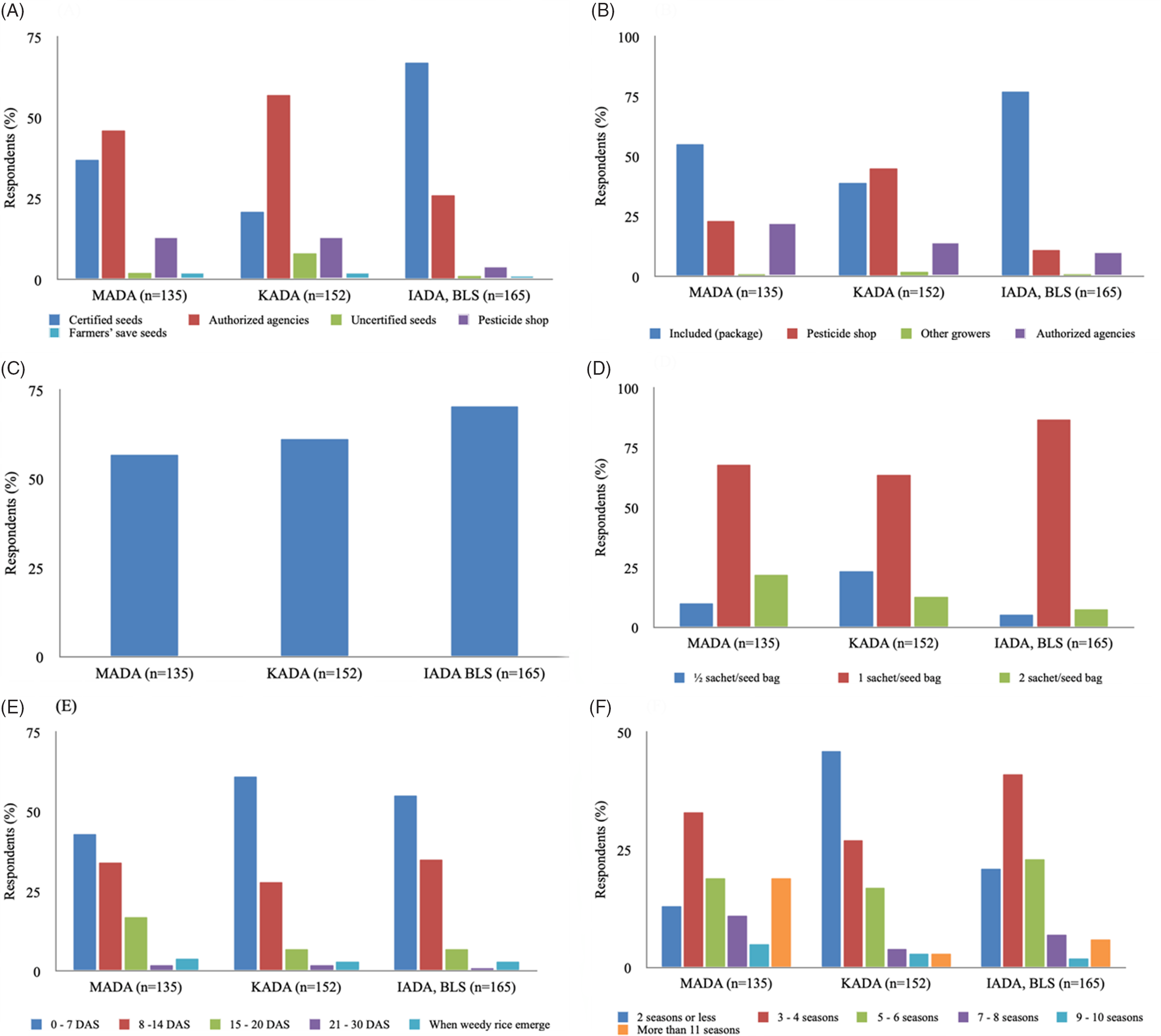
The sustainability of CRT is dependent on the proper practice of the stewardship program (Dilipkumar et al. Reference Dilipkumar, Chuah, Goh and Sahid2017). The Clearfield® rice stewardship program in Malaysia consists of four components: (1) certified Clearfield® varieties MR220CL1 and MR220CL2; (2) use of the OnDutyTM IMI herbicides premix, with the recommended surfactant; and (3) the stewardship guidelines detailing how the technology should be used sustainably. In Malaysia, Clearfield® rice seeds are distributed by certified rice seed production companies and authorized agencies under the Department of Agriculture. The present survey indicates that 93% of farmers from IADA BLS obtained the Clearfield® seeds legally, followed by 83%and 78% of farmers from MADA and KADA, respectively (Figure 2A).
Rice farmers’ awareness and adoption of Clearfield® rice technology stewardship across three granary areas in Malaysia, 2019. MADA, Muda Agricultural Development Authority; KADA, Kemubu Agricultural Development Authority; IADA BLS, Integrated Agricultural Development Area Barat Laut Selangor. (A) Source of Clearfield® rice seed; (B) sources of OnDutyTM; (C) farmers’ adherence to the use of OnDutyTM herbicide with Clearfield® rice; (D) farmers’ knowledge of the field application rate for OnDutyTM (1 sachet/seed bag is the recommended rate); (E) respondents’ knowledge of the application timing for OnDutyTM herbicide (0 to 7 d after sowing (DAS) is the recommended application timing for OnDutyTM); (F) number of seasons of consecutive Clearfield® rice cultivation (not more than two consecutive seasons is the recommended practice).

About 23% of farmers from KADA purchased Clearfield® rice seeds from unauthorized sources. Such activity may contribute to the spread of IMI-resistant weedy rice populations, as almost one-fifth of farmers in this region are at high risk of having planted contaminated seed. The use of uncertified seeds contaminated with weedy rice seeds was a major reason for the rapid dispersal of IMI-resistant weedy rice (Oryza sativa L.) in Brazil (Merotto et al. Reference Merotto, Goulart, Nunes, Kalsing, Markus, Menezes and Wander2016). The OnDutyTM herbicide is either provided with the seed package or purchased separately from pesticide shops. All farmers purchased OnDutyTM from authorized agencies, except 2% of the farmers from KADA, and 1% of the farmers from IADA BLS and MADA, respectively, who obtained the herbicide from other rice growers (Figure 2B).
Even though the majority of farmers claimed to obtain OnDutyTM from authorized agents (Figure 2B), the proper application of OnDutyTM in the Clearfield® rice system is equally important to ensure high efficacy of weedy rice control in the field. About 57% to 70% of the respondents cultivated a Clearfield® rice variety without spraying OnDutyTM (Figure 2C). Surprisingly, this unwise decision by the farmers was positively correlated with the farmers’ ages (r = 0.15, P < 0.01) and farming experience (r = 0.11, P < 0.05). Those older and more experienced farmers tended to put the technology at high risk of promoting weedy rice escape, eventually leading to IMI-resistant gene transfer from Clearfield® rice to weedy rice.
About one-fourth (24%) of the respondents from KADA sprayed half the rate of OnDutyTM, whereas less than 10% of the respondents from MADA and IADA BLS applied the reduced rate (Figure 2D). In addition, a large number of respondents (43% in MADA, 55% in IADA BLS, and 61% in KADA) did not follow the recommended timing of OnDutyTM application (Figure 2E). OnDutyTM is recommended to be sprayed within 7 d after sowing, but about 55% of the farmers from MADA, 22% from KADA, and 21% from IADA BLS delayed the herbicide application in order to tank mix OnDutyTM with other POST herbicides (Figure 2E). The problem is the efficacy of these tank mixes has not been characterized properly.
It is recommended that the CRT system should not be used for more than two consecutive seasons to avoid gene flow and carryover problems. Continuous cultivation of Clearfield® rice increases the chances of transferring herbicide-resistance genes to weedy rice (Zhang et al. Reference Zhang, Linscombe, Webster, Tan and Oard2006). Only 13%, 21%, and 46% of farmers from MADA, IADA BLS, and KADA, respectively, adhered to the crop rotation guideline (Figure 2F). About 34% of the farmers from MADA, 9% from KADA, and 14% from IADA BLS cultivated Clearfield® rice consecutively for more than five seasons (Figure 2F). Age (r = 0.16, P < 0.01) and experience (r = 0.19, P < 0.01) of farmers were positively correlated with the continuous cultivation of Clearfield® rice. This practice not only increases the occurrence of gene flow from Clearfield® rice to weedy rice (Shivrain et al. Reference Shivrain, Burgos, Gealy, Smith, Scott, Mauromoustakos and Black2009), but also exaggerates the risk of selecting AHAS-resistant populations of other weed species (Panozzo et al. Reference Panozzo, Scarabel, Tranel and Sattin2013).
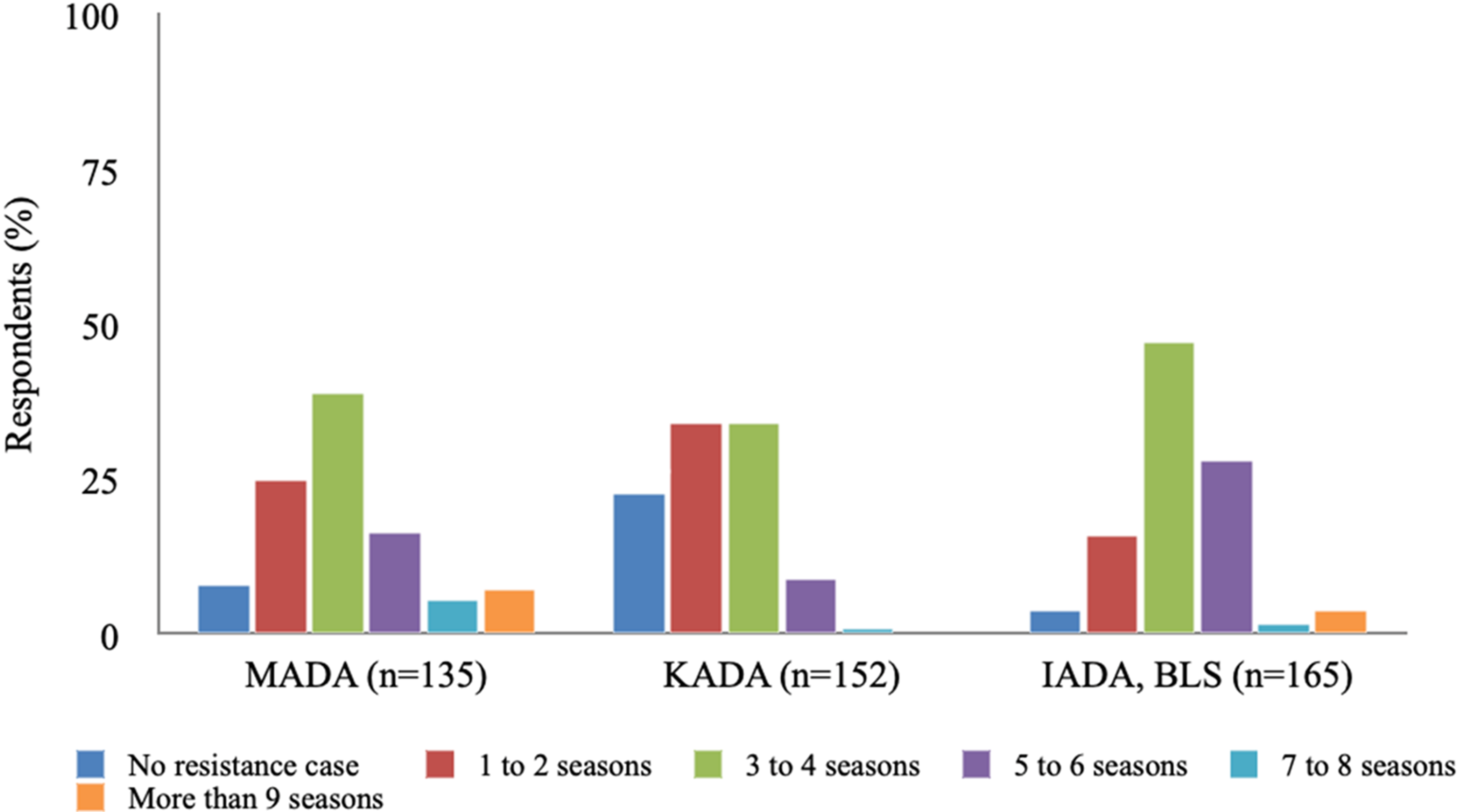
The number of consecutive seasons of cultivating Clearfield® rice was positively correlated (r = 0.35, P < 0.01) with the occurrence of resistant weedy rice at MADA, IADA BLS, and KADA. About 67% and 80% of farmers from MADA and IADA BLS, respectively, reported having an IMI-resistant weedy rice problem in their fields in the past three to nine planting seasons (Figure 3). However, only 43% of farmers from KADA reported the occurrence of IMI-resistant weedy rice in their fields in the same period.
Occurrence of imidazolinone-resistant weedy rice in Malaysia, 2019. MADA, Muda Agricultural Development Authority; KADA, Kemubu Agricultural Development Authority; IADA BLS, Integrated Agricultural Development Area Barat Laut Selangor.

This survey provided a clearer understanding of weedy rice management in Malaysia, rice farmers’ knowledge and adoption level of CRT, the constraints on adoption of the technology, and factors contributing to nonsustainable use of the technology. Recognition of weedy rice is not a problem for the great majority of farmers, especially those older farmers with decades of rice farming experience. The sustainable adoption of CRT is hampered by the reluctance of farmers to follow the stewardship guidelines for proper use of CRT. This factor led to failures of the CRT and evolution of IMI-resistant weedy rice. This latter development has left farmers looking for other options to manage weedy rice and may compel them to return to water seeding or transplanting, which farmers know are effective strategies against weedy rice. More of the older and more experienced farmers cultivating Clearfield® rice disregard the stewardship recommendations, probably due to lack of knowledge about all the components of the technology and not understanding the consequences of ignoring the stewardship guidelines. Therefore, intensive educational programs are needed for this group of farmers.
Acknowledgments
The authors are profoundly grateful for the respondents who took the time to share their experience and knowledge by completing the survey. This research was fully funded by the Malaysian Agricultural Research and Development Institute (MARDI) under the Eleventh Malaysia Plan Program (P-RI401). No conflicts of interest have been declared.
Supplementary Material
To view supplementary material for this article, please visit https://doi.org/10.1017/wsc.2021.16