Introduction
Helminths are inconspicuous components of biodiversity yet they can impact host fitness (Bosch et al., Reference Bosch, Torres and Figuerola2000; Hawlena et al., Reference Hawlena, Khokhlova, Abramsky and Krasnov2006), thereby affecting host species abundance in communities (e.g. Schall, Reference Schall1992). There have been notable efforts to uncover the hidden diversity of helminths that parasitize lizards in the Neotropics (e.g. Rocha & Vrcibradic, Reference Rocha and Vrcibradic2003; Menezes et al., Reference Menezes, Vrcibradic, Vicente, Dutra and Rocha2004; Anjos et al., Reference Anjos, Rocha, Vrcibradic and Vicente2005, Reference Anjos, Bezerra, Passos, Zanchi and Galdino2011), which have found highly diverse helminth faunas in these systems (see Ávila & Silva, Reference Ávila and Silva2010). However, in spite of the increase in such studies in recent decades (e.g. Menezes et al., Reference Menezes, Vrcibradic, Vicente, Dutra and Rocha2004; Ávila & Silva, Reference Ávila and Silva2011; Barreto-Lima et al., Reference Barreto-Lima, Toledo and Anjos2011; Filogonio et al., Reference Filogonio, Toledo, Anjos, Rajão, Galdino and Nascimento2012; Galdino et al., Reference Galdino, Ávila, Bezerra, Passos, Melo and Zanchi-Silva2014), efforts are still needed in order to understand the patterns of helminth diversity within Neotropical lizard hosts.
Although the Caatinga is one of the largest semi-arid domains in the world, only relatively recently have researchers started to understand the helminth fauna of its lizards (e.g. Silva & Kohlsdorf, Reference Silva and Kohlsdorf2003; Almeida et al., Reference Almeida, Ribeiro, Santana, Vieira, Anjos and Sales2009; Anjos et al., Reference Anjos, Bezerra, Passos, Zanchi and Galdino2011; Ávila et al., Reference Ávila, Anjos, Ribeiro, Morais, Silva and Almeida2012; Brito et al., Reference Brito, Ferreira, Ribeiro, Anjos, Almeida, Mesquita and Vasconcellos2014). The flat lizard, Tropidurus semitaeniatus, occurs in patches of rocky habitat within the matrix of the semi-arid Caatinga formation in Brazil (Carvalho et al., Reference Carvalho, Britto and Fernandes2013). Although T. semitaeniatus is known to host six helminth species (Ávila et al., Reference Ávila, Anjos, Ribeiro, Morais, Silva and Almeida2012; Brito et al., Reference Brito, Ferreira, Ribeiro, Anjos, Almeida, Mesquita and Vasconcellos2014), there is no detailed information regarding within-population epidemiology for this species. The aim of the present study was to determine whether or not levels of helminth infection and species richness in a population of T. semitaeniatus are influenced by host sex, age and body size.
Materials and methods
Fieldwork was conducted at the Fazenda Experimental do Vale do Curu (FEVC), which belongs to Universidade Federal do Ceará, in the municipality of Pentecoste in the state of Ceará, Brazil (03.42°S, 39.33°W). The FEVC has an area of 142 ha of typical Caatinga habitat, a semi-arid environment in north-eastern Brazil where the annual temperature averages 26.8°C and the mean annual rainfall is 766.1 mm, with most of the rain occurring from February to June (Leal et al., Reference Leal, Silva, Tabarelli and Lacher2005).
To avoid any effects of seasonality, lizards were collected only during the rainy season from February to March 2010 by actively searching the study site between 7.00 and 16.00 h. Lizards were either shot using air rifles, rubber bands (an elastic strip manually fired at a target) or captured manually; lizards not immediately killed at capture were promptly euthanized by lethal injection of sodium thiopental. All specimens were fixed in 10% formalin and then maintained in 70% alcohol. A total of 139 lizards, comprising 56 females, 43 males and 40 juveniles were collected and deposited in the scientific collection of Coleção Herpetológica da Universidade Federal do Ceará – CHUFC, Brazil (CHUFC L5826–L5844, L5855–L5974).
In the laboratory the snout–vent length (SVL) of each lizard was measured to the nearest 0.01 mm using digital calipers. Post-mortem examinations were undertaken of the stomach, small and large intestine, liver, lungs and body cavity of each lizard and all helminths recovered were cleared in phenol and preserved in 70% alcohol. Voucher specimens of helminths were deposited in the Coleção Parasitológica da Universidade Regional do Cariri (URCA), Brazil.
For each helminth species the prevalence, mean abundance, mean intensity of infection (following Bush et al., Reference Bush, Lafferty, Lotz and Shostak1997) and the discrepancy index (D), were estimated. The level of aggregation was calculated using the following formula:
 $$\begin{eqnarray} D = 1 - \frac {2{ \sum _{ i = 1}^{ N } }\,\left ({ \sum _{ j = 1}^{ i } }\, x _{ j }\right )}{ \bar {>x}N ( N + 1)} \end{eqnarray}$$
where x is the number of parasites in host j (hosts are ranked from the least to most infected) and N is the total number of hosts (Poulin, Reference Poulin1993). The index has a minimum value of zero (D= 0) if all hosts harbour the same number of parasites, and a maximum value of one (D= 1) if all parasites were found in a single host. This index was calculated using the Quantitative Parasitology 3.0 software (Rózsa et al., Reference Rózsa, Reiczigel and Majoros2000).
For the most prevalent helminth species, the binomial test was used to assess the effects of sex (adult only) and host age on the prevalence of infection. The Mann–Whitney test was used to assess the effect of host sex on the intensity of infection. The relationship between intensity and species richness with host body size was evaluated using the Spearman Rank Correlation test (one test per factor). All analyses were performed using the R platform (R Development Core Team, 2013).
Results and discussion
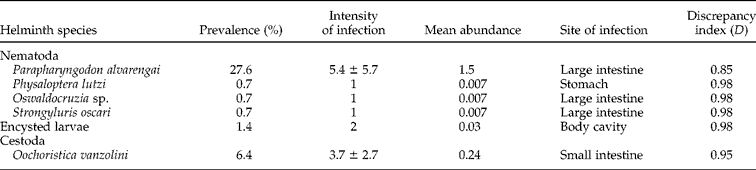
Four species of nematodes, one unidentified larval nematode and one cestode species were recovered. Forty-seven of 139 lizards harboured one helminth species and five lizards harboured two species, for an overall prevalence of 33.8%. The discrepancy (D) was high for all parasite species (table 1). Thirty-five per cent of males and 23.2% of females were infected, although this difference was not significant (P= 0.29) and neither was the intensity of infection of the most prevalent species Parapharyngodon alvarengai (P= 0.20). No significant differences were observed between host ages, with 22.5% of juveniles being infected compared to 29.5% of adults (P= 0.5). Similarly, host body size showed no significant effect on either the intensity of infection with P. alvarengai (r= 0.15, P= 0.064) or the overall species richness (r= 0.065, P= 0.44).
The prevalence (%), intensity (± SD) and mean abundance of infection of helminth species in Tropidurus semitaeniatus from Pentecoste municipality, Ceará State, Brazil.

The host population of T. semitaeniatus from FEVC had six generalist helminth species, all of which had been previously recorded for other lizards (Ávila & Silva, Reference Ávila and Silva2010; Anjos et al., Reference Anjos, Bezerra, Passos, Zanchi and Galdino2011; Brito et al., Reference Brito, Ferreira, Ribeiro, Anjos, Almeida, Mesquita and Vasconcellos2014; Galdino et al., Reference Galdino, Ávila, Bezerra, Passos, Melo and Zanchi-Silva2014). Notably, the parasites Oochoristica sp., Strongyluris oscari, P. alvarengai and Physaloptera lutzi had been found previously in other populations of T. semitaeniatus (Brito et al., Reference Brito, Ferreira, Ribeiro, Anjos, Almeida, Mesquita and Vasconcellos2014); however, Oochoristica vanzolini and Oswaldocruzia sp. were previously unknown as parasites of this host. Regarding parasite richness, lizards of the genus Tropidurus are known to harbour from 3 to 21 species of endoparasites (Anjos et al., Reference Anjos, Ávila, Ribeiro, Almeida and Silva2013), although local richness varies from 5 to 8 helminth species (Vrcibradic et al., Reference Vrcibradic, Vicente, Galdino, Barros, Hatano, Sluys and Rocha2000; Bursey & Goldberg, Reference Bursey and Goldberg2004; Ávila & Silva, Reference Ávila and Silva2011; Ávila et al., Reference Ávila, Anjos, Ribeiro, Morais, Silva and Almeida2012; Anjos et al., Reference Anjos, Ávila, Ribeiro, Almeida and Silva2013; Pereira et al., Reference Pereira, Gomides, Sousa, Sousa Lima and Luque2013; Galdino et al., Reference Galdino, Ávila, Bezerra, Passos, Melo and Zanchi-Silva2014). Previously reported helminth richness for T. semitaeniatus was 3 (Brito et al., Reference Brito, Ferreira, Ribeiro, Anjos, Almeida, Mesquita and Vasconcellos2014) and 4 (Ávila et al., Reference Ávila, Anjos, Ribeiro, Morais, Silva and Almeida2012) species, and so the present results represent the richest helminth component community reported parasitizing T. semitaeniatus and one of the richest infecting any species of Tropidurus.
Previous studies on helminth parasitism of T. semitaeniatus did not provide information on overall prevalence (Ávila et al., Reference Ávila, Anjos, Ribeiro, Morais, Silva and Almeida2012; Brito et al., Reference Brito, Ferreira, Ribeiro, Anjos, Almeida, Mesquita and Vasconcellos2014). However, in comparison to other Tropidurus species (Anjos et al., Reference Anjos, Ávila, Ribeiro, Almeida and Silva2013; Pereira et al., Reference Pereira, Gomides, Sousa, Sousa Lima and Luque2013), the overall prevalence we found for T. semitaeniatus was low, being less than half of that found for a population of the sympatric T. hispidus (Galdino et al., Reference Galdino, Ávila, Bezerra, Passos, Melo and Zanchi-Silva2014). In a study of soil nematodes, Austin et al. (Reference Austin, Semmens, Parsons and Treonis2009) argued that the high temperatures of rocky substrates may be unfavourable to their development. Where our study took place in the Caatinga the rocky substrate used by T. semitaeniatus can reach temperatures exceeding 40°C and, thus, we suggest that it may be less favourable to the development of nematodes with direct life cycles, thereby decreasing the likelihood of lizards being infected. This hypothesis is corroborated by the high discrepancy index found for all helminth species encountered, with most species being clustered in just a few host individuals. Furthermore, Galdino et al. (Reference Galdino, Ávila, Bezerra, Passos, Melo and Zanchi-Silva2014) also found a high discrepancy index for all helminth species found infecting T. hispidus in the Caatinga, whereas a discrepancy index lower than 0.70 was found for about half of the helminth species infecting Tropidurus populations from more humid habitats and with lower temperatures (e.g. T. torquatus from south-eastern Brazil; Pereira et al., Reference Pereira, Gomides, Sousa, Sousa Lima and Luque2013).
Males and females of T. semitaeniatus did not differ in the prevalence or the intensity of helminth infection. It has been argued that intersexual differences in infection may be the result of physiological and ecological differences between males and females (Vogel & Bundy, Reference Vogel and Bundy1987; Zuk & McKean, Reference Zuk and McKean1996). However, this explanation does not seem to be generally applicable among host lizards as there are many reports, such as the present study of T. semitaeniatus, where similar levels of intersexual infection cannot be accounted for by intersexual ecological similarities (e.g. Barreto-Lima et al., Reference Barreto-Lima, Toledo and Anjos2011; Anjos et al., Reference Anjos, Ávila, Ribeiro, Almeida and Silva2013). The present result does differ from that of Brito et al. (Reference Brito, Ferreira, Ribeiro, Anjos, Almeida, Mesquita and Vasconcellos2014), who found differences of helminth abundance between host sexes.
Adult and juvenile T. semitaeniatus had similar prevalence of infection, and the intensity of infection was not related to lizard body size (a proxy of age). Differences in the level of infection between adults and juveniles are expected to be due to behavioural and ecological segregation of these life stages. Therefore, a positive relationship between host body size and both intensity of infection and parasite richness is expected (Poulin, Reference Poulin1997). Nonetheless, no such relationship was found between intensity of infection and body size of T. semitaeniatus. Similar results have been found for other lizard species (Rocha et al., Reference Rocha, Vrcibradic, Vicente and Cunha-Barros2003; Menezes et al., Reference Menezes, Vrcibradic, Vicente, Dutra and Rocha2004) and also for the sympatric T. hispidus (Galdino et al., Reference Galdino, Ávila, Bezerra, Passos, Melo and Zanchi-Silva2014). In general, the effects of age on infection patterns are related to ontogenetic differences in diet (Aho, Reference Aho, Esch, Busch and Aho1990). However, data on the diet of T. semitaeniatus from other populations found that the adults and young do indeed differ in the number and volume of prey (Kolodiuk et al., Reference Kolodiuk, Ribeiro and Freire2010). Thus, the present finding of no relationship between age and infection level cannot be related to similarities in the diets of adult and young lizards. Nonetheless, it is important to note that the type of prey consumed by hosts might also play a role in infection patterns among the ages. Information on diet composition by age is needed in order to elucidate the cause of the ontogenetic similarities in helminth infection found in T. semitaeniatus.
The detailed within-population data provided in this study reveals parasitological information for the lizard T. semitaeniatus beyond that reported by previous studies on the species. The present results show that the studied population of T. semitaeniatus exhibited the richest helminth component community reported infecting this species. Furthermore, this study extended the taxonomic range of host species for the helminth species O. vanzolini and Oswaldocruzia sp.
Acknowledgements
We are grateful to the administrative staff of Fazenda Experimental do Vale do Curu da Universidade Federal do Ceará for their logistical support. Thanks to Erik Wild for the kind language review.
Financial support
For this study, C.A.B.G. benefited from grants from Conselho Nacional de Desenvolvimento Científico e Tecnológico (CNPq) proc. 35.0241/2008-2, Fundação Cearense de Apoio ao Desenvolvimento Científico e Tecnológico (FUNCAP) conv. 22/2007. C.A.B.G. also thanks Fundação de Amparo à Pesquisa do Estado de Minas Gerais (FAPEMIG). R.W.A. received a research grant from FUNCAP (BPI-0067-00006.01.00/12). D.C.P. is currently funded by a doctoral scholarship from Coordenação de Aperfeiçoamento de Pessoal de Nível Superior (CAPES). D.Z.S. received grants from FUNCAP (BMD-0008-00060.01.14/10) and from CAPES.
Conflict of interest
None.
Ethical standards
All authors gave their consent to participate in the study. The study was approved by the Instituto Chico Mendes de Conservação da Biodiversidade with the permit 21551-1 to collect the animals. All lizards not killed during capture were humanely euthanized following the methods recommended by the American Veterinary Medical Association (2013).