What are Healthy Positive Organizations like?
American Psychological Association (APA) has a special program which awards organizations that promote employee health and well-being, while improving its productivity at the same time. The main characteristics of these organizations are: employee involvement, work-life balance, employee growth and development, health and safety, and employee recognition (APA, 2015). The review literature prepared by Grawith, Gottschalk, and Munz (Reference Grawitch, Gottschalk and Munz2006), concludes that the same five broad categories link healthy workplace practices in organizations to employee well-being and organizational improvements.
In his vitamin model, Peter Warr (Reference Warr2007) did an analogy of the effects of vitamins in the body and the effects of some job features on worker well-being and psychological health. In this context, he identified the following key factors: opportunity for personal control, opportunity for skill use, externally generated goals, variety, environmental clarity, contact with others, availability of money, physical security, career outlook, valued social position, supportive supervision, and equity. The last three are clearly related to employee recognition.
For more than twenty years, The European Institute “Great Place to Work” has analyzed what the characteristics of the best workplaces are like. Based on its results (http://www.greatplacetowork.es) an excellent workplace is one which, at any level (employee-company; employee-supervisor; employee-employee) cares about relationships based on: pride (you feel proud of the company you work for and of your job within it), camaraderie (enjoying the people you work with), trust (includes: fairness, credibility, respect). Of these three, trust is a huge construct. Along with respect and fairness, recognition is an important element, because respect can mean appreciating good work and extra effort, and, fairness can imply equitable opportunity for recognition.
The importance of recognition is also present in Lowe’s Healthy Organization Model (Lowe, Reference Lowe2010). In this, four features constitute the concept called vibrant workplaces. These components are: relationship, jobs, environment and organizational support. Within the last two, employee recognition has a specific role.
All of the above results show that employee recognition is one of the keys elements in healthy positive organizations. But, what do we understand about employee recognition?
Employee recognition
In the employee recognition review made by Brun and Dugas (Reference Brun and Dugas2008), they conclude employee recognition is:
First and foremost a constructive response; it is also a judgment made about a person’s contribution, reflecting not just work performance but also personal dedication and engagement. Lastly, recognition is engaged in on a regular or ad hoc basis, and expressed formally or informally, individually or collectively, privately or publicly, and monetarily or non-monetarily. (Brun & Dugas, Reference Brun and Dugas2008, p. 727)
The same authors summarize four main forms of recognition: personal recognition, recognition of job dedication, recognition of results and recognition of work performance. These four can appear in different kinds of interactions: organizational, vertical, lateral, external and social.
Recognition of work performance means to acknowledge the professional employee ability. An example is: assignments to special projects (at a vertical level). To consider that the employee is a good worker and/or to value his/her work, belong this category.
Work performance recognition is one of the most important kind of recognition because the tight relationship between work performance and well-being (Daniels & Harris, Reference Daniels and Harris2000). Therefore, we will focus our research on it.
According to some research, employee recognition helps managers to cope with stressful professional situations. On the contrary, the lack of recognition is a key factor for psychological distress at work (Brun & Dugas, Reference Brun and Dugas2008). If so, it could be of interest to understand the path that recognition takes to affect workers’ behavior.
Resource passageways
Lately, The Conservation of Resources Theory has been broadly applied in organizational literature (Hobfoll, Reference Hobfoll2011). In the same way that gain and loss mechanism explains the personal resources dynamics, it also does the same in work places, affecting workers. In this sense, there is a dynamic interaction between settings and workers. This dynamic interaction could work to promote the gain or loss of resources, thus affecting both parts: labor context and workers. For example, those companies which invest in the creation of healthy work places, are characterized by providing different company resources (for example: work-life balance, career development, safety, employee recognition, and so on) that will ease the workers’ psychological resources gain, and, subsequently, their positive functioning. At the same time the workers’ positive functioning will affect their productivity and ultimately, the company’s results. This company’s positive dynamics which implies resources growth between the company and the worker is what Hobfoll (Reference Hobfoll2011) calls “resources passageways”. When companies aren’t able to provide this positive context, workers lose resources and become unproductive. The opposite will happen in those organizations able to provide positive setting for their workers. According to this, it is possible to think that in the relationship between employee recognition (as environmental resource) and subjective well-being (as a consequence) could mediate the worker's psychological resources.
Research objectives
Investigations point out that recognition affects variables such as: employee performance and retention (Luthans, Reference Luthans2000), employee morale (Hopkins, Reference Hopkins1995), motivation (Magnus, Reference Magnus1981), job satisfaction (Larsen, Reference Larsen1993), happiness and positive mood (Argyle, Reference Argyle1997), organizational and professional commitment (Gifford, Reference Gifford2009), engagement (Kahn, Reference Kahn1990; Saks, Reference Saks2006), and perceived organizational support (Wayne, Shore, Bommer, & Tetrick, Reference Wayne, Shore, Bommer and Tetrick2002).
Moreover, the lack of recognition has negative consequences on variables such as burnout, moving, low sense of well-being (Amutio, Ayestarán, & Smith, 2006; Maslach, Schaufeliv, & Leiter Reference Maslach, Schaufeli and Leiter2001; Rodríguez, Martínez, Moreno, & Gálvez, Reference Rodríguez, Martínez, Moreno and Gálvez2006).
According to the model of effort-reward imbalance (ERI), the failed reciprocity between effort and rewards is likely to elicit negative emotions, and conversely, appropriate rewards evoke positive emotion and well-being (Siegrist, Reference Siegrist and Durham2000).
Nevertheless, we don't know if other variables could mediate in the relationship between employee recognition and its consequences. According to the concept of resource passageways (Hobfoll, Reference Hobfoll2011), environmental resources could promote workers’ psychological resources. Therefore, it is possible that in the relationship between employee recognition and its consequences, psychological resources could mediate. Knowing this could help us to understand the way in which recognition produces consequences on workers. According to this, the relationship between employee recognition and a consequence such as well-being, must be indirect and must be mediated by psychological resources. To verify this question is the objective of this research.
Method
Sample
The sample was comprised of 1831 workers, selected from a representative sample of the Spanish population consisting of 3,000 people. The sampling error was 1.8% for a confidence level of 95%. The distribution by gender was: 42% women and 58% men. The distribution by age was: 18–25 (14.64%), 26–35 (30.15%), 36–45 (28.02%), 46–55 (19.06%), over 55 (8.14%). The distribution by social class was: high (4.97%), medium-high (19.72%), medium-medium (50.57%), medium-low (23.32%), and low (1.42%). The distribution with respect to the kind of work was: 12.9% self employed and 86.1% employed. The employed professional categories were: 2.8% directors; 13.8% middle managers; 12.3% administrators; 46.6% skilled workers; 24.3% unskilled workers. These 1831 workers represented different professional sectors (industrial, services, agriculture, etc.).
Procedure
Data was collected at the homes of participants by 121 interviewers, who explained the purpose of the research to them, and recorded information on socio-demographic variables. Each was given a booklet containing self-reported measures and when, after fifteen days, returning to collect it, they checked that everything was answered and rewarded the participants for their cooperation in the study.
All steps of the research respected the European Society for Opinion and Marketing Research (ESOMAR) ethic code (www.esomar.org).
Measures
Well-being
We used three scales, the first two of which were: Satisfaction with Life Scale (Diener, Emmonds, Larsen, & Griffin, Reference Diener, Emmons, Larsen and Griffin1985) and Subjective Happiness Scale (Lyubomirsky & Lepper, Reference Lyubomirsky and Lepper1997). Both are within subjectivist tradition, which emphasizes how happy or unhappy people perceive themselves, and not particular objective circumstances surrounding their lives. The first, (Satisfaction with Life Scale) is composed of 5 items and the second (Subjective Happiness Scale) is composed of 4 items. Both are 7-point Likert scales. Both scales present good psychometric properties, Subjective Happiness Scale has a Cronbach’s alpha between .79 and .94, for more details refer to Lyubomirsky and Lepper (Reference Lyubomirsky and Lepper1997); and Satisfaction With Life Scale has a Cronbach’s alpha of .87 for more details refer to Diener et al. (Reference Diener, Emmons, Larsen and Griffin1985). The third scale is composed of one item. The use of one general item to measure global well-being is quite common in happiness studies (Veenhoven, Reference Veenhoven2009). In our case, the item used was based on the second part of Fordyce Emotions Questionnaire (1988). The item said: In general, in this part of your life, what percent of the time do you think you have felt…..? Very happy, happy, neither happy nor unhappy, unhappy, very unhappy. Please divide these 5 levels into a total of 100 points.
Positive Psychological Functioning
To measure those we employed The Positive Psychological Functioning Scale (Merino & Privado, Reference Merino and Privado2015). This is a scale of 33 items which measure 11 psychological key resources: autonomy, resilience, self-esteem, purpose in life, enjoyment, optimism, curiosity, creativity, humor, environmental mastery and vitality. The reliability index this scale were good reliability index (α = .91).
Employee Recognition
In our study we focused on recognition of work performance made by peers (at lateral level) and by supervisors (at vertical level; Brun & Dugas, Reference Brun and Dugas2008). We choose this kind of recognition due to the importance on workers and on companies’ production, and, horizontal and lateral levels of interactions, because they are the main sources of employee recognition. To measure this, we used two items based on 9-point Likert scales: the first one was for the employee recognition provided by supervisors: “My supervisors consider me a valuable worker” and the second one was for employee recognition provided by co-workers “My co-workers value my work”.
Statistical analysis
Structural Equation Model was applied to observe the relationship among the constructs: employee recognition, PPF and well-being. All statistical analyses were performed with AMOS 7.0 (Arbuckle, Reference Arbuckle2006). These techniques require at least three measurement indicators to accurately estimate the latent factors and a minimum of 100 participants and 10 times the number of observed variables. This study used a sample of 1,831 participants, above the minimum of 100, and a total of 38 indicators, which are 1,831/38 = 48 participants per indicator or variable (Byrne, Reference Byrne2001).
The procedure used to fit the models was maximum likelihood based on the χ2 test. The goodness of fit statistics used to evaluate the adequacy of the models were: absolute, incremental and parsimony. The value of the absolute fit of the model to empirical data is indicated by the statistic χ2. If statistically significant, the null hypothesis would be rejected, therefore, the matrix theoretical and empirical data would be unequal. However, the null hypothesis is commonly rejected with large samples, so the ratio χ2/df (Bentler & Bonett, Reference Bentler and Bonett1980) is often used, indicating a good fit with values less than 3. Other absolute fit index is: Root Mean Square Error of Approximation (RMSEA; Steiger, Reference Steiger1990). The RMSEA values below .05 indicate good fit.
Incremental fit measures compare the resulting model with the null model. Normed Fit Index (NFI) of Bentler and Bonett (Reference Bentler and Bonett1980) and Comparative Fit Index (CFI) of Bentler (Reference Bentler1990) are the most used. Values above .95 indicate good fit and then, the empirical model is significantly different from the null model.
Parsimony fit indices take into account the complexity of the hypothesized model in the assessment of overall model fit. More representative coefficients are Parsimony Goodness of Fit Index (PGFI) of Jöreskog and Sörbom (Reference Jöreskog and Sörbom1993) and Parsimony Normed Fit Index (PNFI) of James, Mulaik, and Brett (Reference James, Mulaik and Brett1982). Values above .50 indicate good fit.
Results
Descriptive analyses and correlation matrix
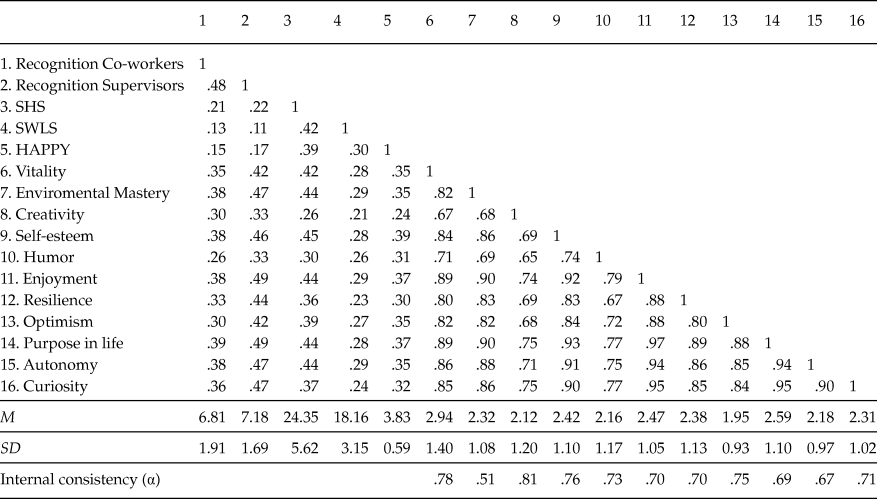
Table 1 shows the correlations between the different measures used in this study, the mean and standard deviation, and reliability indices (α). The reliabilities of the tests are adequate, almost all tests values are above .70, which are the minimum values required in research (Abad, Olea, Ponsoda, & García, Reference Abad, Olea, Ponsoda and García2011; Martínez-Arias, Hernández-Lloreda, & Hernández-Lloreda, Reference Martínez Arias, Hernández Lloreda and Hernández Lloreda2006). Only three measures of PPF have reliabilities below this criterion: environmental mastery (.51), purpose in life (.69) and autonomy (.67). Regarding the correlation matrix, PPF scales have values above .30 which would indicate the existence of latent factors underlying the measures applied (Hair, Black, Babin, Anderson, & Tatham, Reference Hair, Black, Babin, Anderson and Tatham2006).
Correlations between variables, descriptive statistics and internal consistency

Note: All Correlations are statistically significant, p < .001.
Structural Equation Model
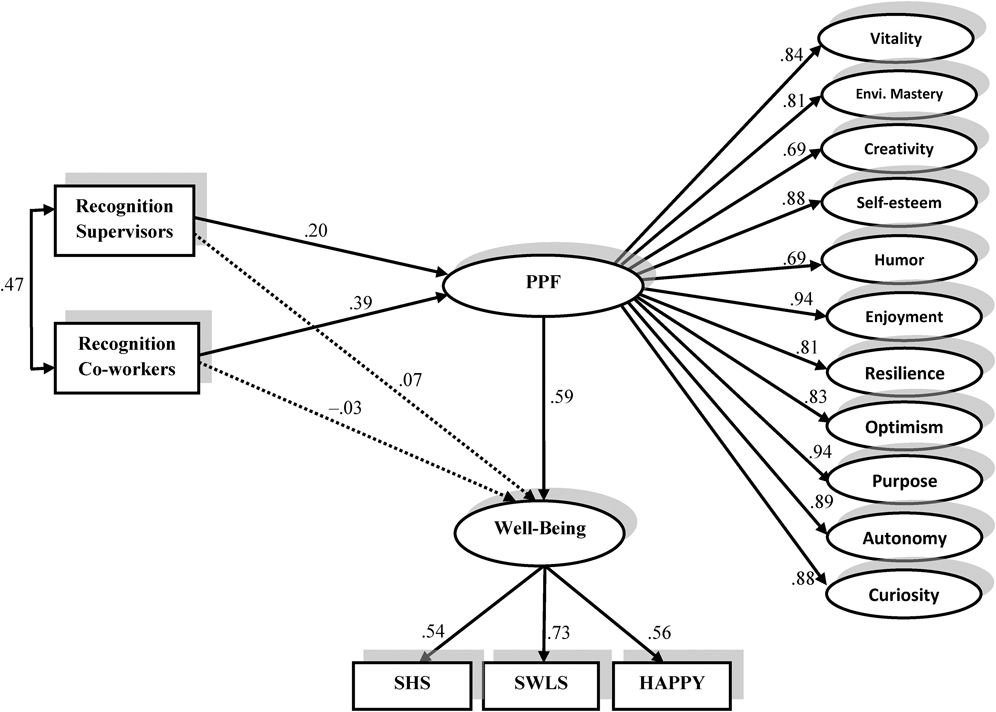
We proceeded to contrast the model that relates to the constructs: employee recognition, PPF and well-being. In Figure 1, the model contrasted is shown. To simplify this figure, items that compound each first order factors were omitted.
Structural Equation Model of Employee Recognition, PPF and Well-Being. To simplify figure, items that compound each first order factors were omitted. The dotted lines are not statistically significant (p > .030).

The absolute goodness of fit index χ2 showed that the model differs significantly from the empirical data, χ2 (129) = 3473.20, p < .001, and the ratio χ2/df was 5.343, greater than 3, indicating poor fit. The RMSEA value was .049, indicating good fit with the proposed factor structure. The incremental fit indices show good fit, NFI value was .878 and CFI value was .898, therefore the empirical model is significantly different from the null model. The parsimony fit indices have values higher than .50 and PNFI was .770, also showing good model fit.
Therefore, according to the goodness of fit indices, it can be concluded that the structural equation model shows quite good fit with empirical data.
Analyzing the values of the relationships among the latent constructs of the model, all factor loadings, correlations and regression weights are statistically significant (p < .001), except the regressions from co-workers and supervisors recognition on well-being. As shown in Figure 1, there is a significant correlation between co-workers’ recognition and supervisor’s recognition (r = .47).
However, supervisors’ recognition predict less PPF (r = .20) than co-workers’ recognition (r = .39). Both variables explained 26% of the variance of this latent factor. Neither supervisors’ recognition nor co-workers’ recognition explain well-being. This last factor is explained by PPF (r = .59). Therefore, the effect of employee recognition on well-being is mediated by PPF, as shown in Figure 1.
To check if the regression weights of recognition regarding well-being were different from zero, the model of Figure 1 was compared with another in which these two weights were set to zero. According to Yung, Thissen and McLeod (Reference Yung, Thissen and McLeod1999), if the χ 2 difference is not statistically significant, we can say that there are no differences between the two models, which in our case would indicate that the regression weight for recognition is zero. The result was: Δχ2 = χ2 (129) - χ2 (127) = 3473.4 – 3470.2 = 3.2, p = .200. So we can say that the regression weights of recognition regarding well-being can be set to zero.
In view of this data, we can see how the effect of recognition from supervisors and peers affects well-being indirectly through the FPP. Recognition affects directly FPP and indirectly well-being. So the least we can say is that recognition influences well-being but after being modulated by the FPP.
Discussion
Some interesting consequences of practical implications could be extracted from our results. First, employee recognition promotes positive psychological functioning and its absence worsens it. This is especially important, because it implies that lack of recognition leads to deterioration of a worker’s resources, and consequently, worker’s psychological health and performance could be affected. Moreover, it is possible that employee recognition does not act alone, and in organizations with no recognition, there are no other healthy variables such as work-life balance, health and safety, variety, and so on. Of course, the opposite would also be true. This is coherent with the Hobfoll idea of interactive resources dynamics between work setting and workers. Thus the more resources gained, the more the worker is going to have, and vice versa (Hobfoll, Reference Hobfoll1989, Reference Hobfoll2002, Reference Hobfoll2011).
Second, the relationship between employee recognition and well-being is indirect and it is mediated by positive psychological functioning. This result is supported by Hobfoll (Reference Hobfoll1989, Reference Hobfoll2002, Reference Hobfoll2011). When, due to adverse events, resources are threatened or when there is loss, a chain of losses occurs, producing poor adaptation to the environment with negative consequences, such as stress. The opposite is also true, so, positive environments lead to resources gain, and these have positive consequences, such as well-being (Hobfoll Reference Hobfoll1989, Reference Hobfoll2002, Reference Hobfoll2011). Applied to our case, employee recognition (positive environment), strengthens worker’s positive psychological functioning (worker’s psychological resources), and as a consequence, subjective well-being (positive consequence). Different studies demonstrate the relationship between employee recognition and some positive variables: employee performance and retention (Luthans, Reference Luthans2000), employee morale (Hopkins, Reference Hopkins1995), motivation (Magnus, Reference Magnus1981), job satisfaction (Larsen, Reference Larsen1993), happiness and positive mood (Argyle, Reference Argyle1997), organizational and professional commitment (Gifford, Reference Gifford2009), engagement (Kahn, Reference Kahn1990; Saks, Reference Saks2006), and perceived organizational support (Wayne et al., Reference Wayne, Shore, Bommer and Tetrick2002). The lack of employee recognition is associated with negative variables such as: burnout, moving, low well-being (Amutio et al., Reference Amutio, Ayestaran and Smith2008; Maslach et al., Reference Maslach, Schaufeli and Leiter2001; Rodríguez et al., Reference Rodríguez, Martínez, Moreno and Gálvez2006). It would be of interest for future research to investigate whether PPF has a mediator role in these relationships (such as happened in our research), and the same could be applied with respect to the Effort-Reward Imbalance Model (Siegrist, Reference Siegrist and Durham2000): the relationship between effort-reward imbalance and its positive (well-being) or negative (stress) consequence could be mediated by psychological resources.
Third, recognition promotes recognition. Our results show a clear association between recognition from supervisors and from co-workers, and imply employee recognitions are linked. This result is coherent with Rohades and Eisenberger (Reference Rohades and Eisenberger2006), whose research found that when supervisors felt their organization valued their contributions and cared about their well-being, supervisors in turn provided support to their employees. So supervisors responded reciprocally building a positive environment, which influenced performance.
Fourth, the influence of recognition between co-workers on positive psychological functioning has double the influence of recognition from supervisors. Brun and Dugas (Reference Brun and Dugas2008) point out the relevance of recognition given by co-workers as a sign of membership, integration and acceptance. It is possible that these kinds of feelings, so important to teamwork, are the basis of the different results found in peer and supervisor recognition. Future research could address this question.
We would like to thank to the Coca-Cola Happiness Institute for making this research possible.