Introduction
Over the past years, standardized ileal digestibilities (SID) of crude protein (CP) and amino acids (AA), sometimes also referred to as true ileal digestibilities (NRC, 1998), have been introduced into diet formulation for pigs (e.g. AmiPig, 2000; GfE, 2008; Rademacher et al., Reference Rademacher, Sauer and Jansman2009). The SID of CP and AA are corrected for basal ileal endogenous CP and AA losses (IAALB), and are nearly independent of the CP and AA contents in the assay diets (Fan et al., Reference Fan, Sauer and McBurney1995a; Eklund et al., Reference Eklund, Mosenthin, Piepho and Rademacher2008a and Reference Eklund, Mosenthin, Piepho and Rademacher2008b). Thus, they represent the fundamental properties of the individual feed ingredients (Mosenthin and Rademacher, Reference Mosenthin and Rademacher2003), and they are more likely additive in mixed diets than apparent ileal digestibilities (AID) (Stein et al., Reference Stein, Pedersen, Wirt and Bohlke2005). In contrast, AID of CP and AA increase quadratically with increasing CP and AA contents in the assay diets. The AID of CP and AA are functions of their corresponding dietary CP and AA levels until they reach individual plateau AID above dietary threshold levels for CP and each AA (Fan et al., Reference Fan, Sauer, Hardin and Lien1994; Eklund et al., Reference Eklund, Piepho, Tafaj, Rademacher and Mosenthin2006; Eklund, Reference Eklund2007). If IAALB are used at smaller dietary CP and AA levels to transform AID into SID, this correction may have a substantial impact on the determination of the SID, due to the fact that any possible inaccuracy in the estimation of IAALB likely has a more pronounced effect on the determination of SID at smaller rather than at greater dietary CP and AA levels. Therefore, it has been generally accepted that SID should be determined from the AID measured at greater dietary CP and AA levels, ideally from the plateau AID (Fan et al., Reference Fan, Sauer and McBurney1995a; Fan and Sauer, Reference Fan and Sauer1997; Eklund et al., Reference Eklund, Mosenthin, Piepho and Rademacher2008a).
Tabulated values of SID of CP and AA in feed ingredients for pigs have been determined in grower–finisher pigs (e.g. AmiPig, 2000; GfE, 2008; Rademacher et al., Reference Rademacher, Sauer and Jansman2009), but are also used in diet formulation for nursery pigs. However, Li et al. (Reference Li, Sauer and Fan1993) reported in early weaned pigs a significant increase in ileal AA digestibilities with age and proposed that piglets may have a limited capacity for CP digestion and AA absorption. In addition, factors such as body weight (BW) and age (Caine et al., Reference Caine, Sauer, Tamminga, Verstegen and Schulze1997a and Reference Caine, Tamminga, Verstegen, Sauer and Schulze1997b), and the level of feed intake (Moter and Stein, Reference Moter and Stein2004; Diebold et al., Reference Diebold, Mosenthin, Sauer, Dugan and Lien2005) may affect AID and IAALB in piglets. Thus, SID of CP and AA may differ considerably between piglets and grower–finisher pigs. Walker et al. (Reference Walker, Maxwell, Owens and Buchanan1986) determined lower SID of AA in 4-week-old pigs compared to finisher pigs. Presently, there are only few reports on SID of CP and AA, which were determined in protein supplements for piglets. The key issues for the calculation of SID of CP and AA are (i) the measurement of plateau AID and (ii) estimates of IAALB (Fan et al., Reference Fan, Sauer and McBurney1995a), which have recently been determined in piglets (Eklund, Reference Eklund2007; Eklund et al., Reference Eklund, Mosenthin, Piepho and Rademacher2008a).
Since SID of CP and AA pigs may differ noticeably between piglets and grower–finisher pigs, the objective of this study was to determine SID of CP and AA in a variety of protein supplements of animal and plant origin according to experimental procedures as described previously by Eklund (Reference Eklund2007) and Eklund et al. (Reference Eklund, Mosenthin, Piepho and Rademacher2008a).
Material and methods
Animals and housing
The experiment was conducted with 12 barrows (German Landrace × Pietrain), that were weaned at 15 days of age at an average initial BW of 4.0 ± 0.5 kg. The pigs were obtained from the University of Hohenheim Research Station, and were kept in pairs until surgery to adapt them to their metabolism cages (0.75 m × 1 m). The research unit was equipped with an automated temperature control system kept at 30°C at the beginning of the experiment and gradually decreased to 25°C at the conclusion of the trial. Each cage was equipped with an infrared heating lamp and a low-pressure drinking nipple. Before and after surgery until 29 days of age, the pigs were fed a commercial milk replacer four times daily at 0800, 1200, 1600 and 2000 h. The research protocol was approved by the German Ethical Commission for Animal Welfare. Care of the animals used in this experiment was in accordance with the guidelines issued by the German regulation for care and treatments of animals (Lorz and Metzger, Reference Lorz and Metzger1999).
Surgical procedure and design of T-cannula
On day 7 and 9 post weaning, six pigs each were fitted with T-cannulas at the distal ileum according to the procedure described by Li et al. (Reference Li, Sauer and Fan1993). The cannulas were prepared from a plastisol solution (Techniplast; FH & Sons, Toronto, Canada) according to the procedures outlined by Li et al. (Reference Li, Sauer and Fan1993). The internal diameter of the barrel of the cannulas was 10 mm, the total diameter was 13 mm, the length of the barrel was 50 mm and each of the two flanges was 40 mm in length. The washer had an outer diameter of 50 mm and a barrel of 10 mm. Natural rubber plugs were used as stoppers.
Dietary treatments and feeding regime
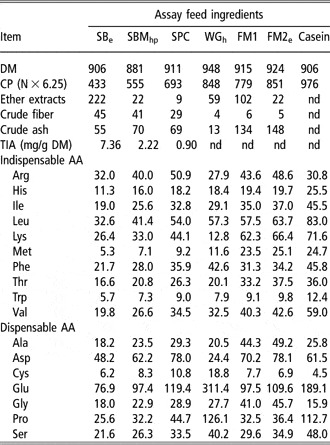
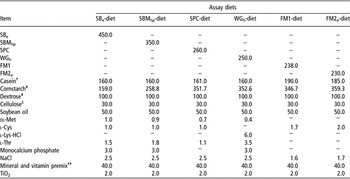
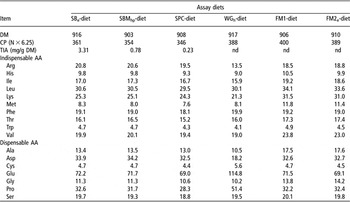
The SID of CP and AA were determined in six protein supplements including extruded soybeans (SBe), (American Soybean Association, St. Louis, USA), high-protein soybean meal (SBMhp), (American Soybean Association), soy protein concentrate (SPC), (The Solae Company, Geneva, Switzerland), hydrolyzed wheat gluten (WGh), (Roquette, Lestrem, France), conventional fish meal 1 (FM1), (TripleNine, Esbjerg, Denmark) and extracted fish meal 2 (FM2e), (TripleNine) (Table 1). Both fish meals were made from whole fish. The FM1 was cooked at 90°C for 1 h and then air-dried within 10 to 15 s at 400°C. The other product, referred to as FM2e, was cooked at 90°C for 1 h and vacuum-dried for 1 h at 70°C to 100°C. The FM1 contained 102 g/kg of dry matter (DM) HCl-ether extracts, in contrast to 22 g/kg DM in FM2e as a result of fat extraction with iso-hexane (Table 1). Each assay feed ingredient was added to a purified cornstarch-based basal diet supplemented with casein and crystalline AA (Table 2) to meet or to exceed the dietary threshold levels of CP and indispensable AA for piglets in the assay diets and NRC (1998) nutrient recommendation for piglets from 5 to 10 kg of BW. These dietary threshold levels in the assay diets were determined in a previous study in which piglets of the same age and genetics, and kept under the same experimental conditions were fed a cornstarch casein-based diet at a feed intake level of 30 g/kg of BW (Eklund, Reference Eklund2007). Only the threshold level for Cys was obtained from a study in grower–finisher pigs (Fan et al., Reference Fan, Sauer, Hardin and Lien1994) as a value for Cys was not provided for piglets by Eklund (Reference Eklund2007). The inclusion of casein to the assay diets aimed to meet the dietary threshold levels in the assay diets and to balance the AA profile between these diets. Moreover, it cannot be completely ruled out that at higher dietary inclusion levels of the assay feed ingredients, in particular of soy protein, SID may decline (Zhang et al., Reference Zhang, Qiao, Chen, Wang, Xing and Yin2005). Titanium dioxide (TiO2) was added to the assay diets as an indigestible marker. The analyzed chemical composition of the assay diets is presented in Table 3. The assay diets were fed in a mash form, mixed with water (1/1 w/v) twice daily at 8000 and 2000 h at a total level of 30 g/kg of individual BW per day. The BW of the animals was determined at the beginning of each of the three experimental periods to maintain a constant feed intake level in relation to the piglets’ BW. The level of feed intake may affect AID and IAALB in piglets (Moter and Stein, Reference Moter and Stein2004; Diebold et al., Reference Diebold, Mosenthin, Sauer, Dugan and Lien2005). In piglets, weaned at 21 days of age or earlier, the voluntary daily feed intake, on the basis of BW, often does not exceed 35 g/kg BW in the first week after weaning (Brooks and Tsourgiannis, Reference Brooks and Tsourgiannis2003). Therefore, this relatively low feeding level was chosen to keep the feed intake constant for all animals and to avoid feed refusals, which eventually may compromise the results obtained. Moreover, reference values for dietary threshold levels, IAALB and SID of CP and AA in casein, used in this study, were initially determined at a feed intake level of 30 g/kg of BW, as well.
A set of three assay diets was assayed at the same time-period in two congruent 3 × 3 Latin Square designs (Latin Square 1 and 2 = FM1-diet, SPC-diet, WGh-diet) with three animals each, resulting in six observations per assay diet. A second set of three assay diets was assayed at the same time-period in two additional 3 × 3 Latin Square designs (Latin Square 3 and 4 = SBe-diet, FM2e-diet, SBMhp-diet), which were congruent among each other, as well. Each of these Latin Square designs included three animals, resulting in six observations per assay diet, as well. The experimental animals were randomly allocated to the four Latin Squares.
Analyzed chemical composition of the assay feed ingredients and casein (g/kg of dry matter)

SBe = extruded soybeans (American Soybean Association, St. Louis, USA); SBMhp = high-protein soybean meal (American Soybean Association); SPC = soy protein concentrate (The Solae Company, Geneva, Switzerland); WGh = hydrolyzed wheat gluten (Roquette, Lestrem, France); FM1 = fish meal 1 (TripleNine, Esbjerg, Denmark); FM2e = extracted fish meal 2 (TripleNine); DM = dry matter; N = nitrogen; TIA = trypsin inhibitor activity; AA = amino acid; nd = not determined.
Formulation of assay diets g/kg (as fed)

SBe = extruded soybeans (American Soybean Association, St. Louis, USA); SBMhp = high-protein soybean meal (American Soybean Association); SPC = soy protein concentrate (The Solae Company, Geneva, Switzerland); WGh = hydrolyzed wheat gluten (Roquette, Lestrem, France); FM1 = fish meal 1 (TripleNine, Esbjerg, Denmark); FM2e = extracted fish meal 2 (TripleNine).
†Meggle AG, Wasserburg, Germany.
‡CereStar, Krefeld, Germany.
§J. Rettenmaier & Soehne GmbH, Rosenberg, Germany.
††The mineral and vitamin premix supplied the following minerals and vitamins per kg of diet: calcium, 7.2 g; phosphorus, 2.4 g; sodium, 1.6 g; magnesium, 400 mg; copper, 80 mg; selenium, 0.48 mg; zinc, 200 mg; manganese, 84 mg; iron, 180 mg; iodine, 0.9 mg; vitamin A, 2000 IU; vitamin D3, 200 IU; vitamin E, 100 mg; vitamin B1, 3 mg; vitamin B2, 6 mg; vitamin B6, 5 mg; vitamin B12, 30 μg; folic acid, 2 mg; vitamin K3, 4 mg; biotin, 252 μg; niacin, 30 mg; choline chloride, 300 mg; Ca-pantothenate, 15 mg.
Analyzed chemical composition of the assay diets (g/kg of dry matter)

SBe = extruded soybeans (American Soybean Association, St. Louis, USA); SBMhp = high-protein soybean meal (American Soybean Association); SPC = soy protein concentrate (The Solae Company, Geneva, Switzerland); WGh = hydrolyzed wheat gluten (Roquette, Lestrem, France); FM1 = fish meal 1 (TripleNine, Esbjerg, Denmark); FM2e = extracted fish meal 2 (TripleNine); DM = dry matter; N = nitrogen; TIA = trypsin inhibitor activity, calculated from diet ingredient composition; AA = amino acid; nd = not determined.
Experimental procedure
After a 3- to 5-day recuperation period from surgery, the pigs were fed their assay diets. Occasional feed refusals were recorded. The age of the animals averaged 29 days at the beginning of the experiment. Each of the three experimental periods consisted of 5 days for adaptation to the assay diets and 2 days for digesta collection. Ileal digesta were collected for a total of 24 h on day 6 from 0800 to 2000 h, and on day 7 from 2000 to 0800 h. Digesta collection was carried out from 35 to 51 days of age. The collection procedure was adapted from Li et al. (Reference Li, Sauer and Fan1993) using plastic bags attached to the barrel of the cannula with elastic bands. The bags were changed at least every 20 min, and the content was immediately frozen at −30°C. During collection, 2 ml of 2.5 M formic acid were added to the sampling bags in order to minimize further bacterial fermentation. Samples of digesta were pooled within each animal and period, freeze-dried and ground in an oscillating disk-mill to a particle size of 0.5 mm.
Analytical procedure
Analyses of DM and proximate nutrients in the assay feed ingredients, assay diets and ileal digesta samples were performed as outlined by Naumann and Bassler (Reference Naumann and Bassler1997). The nitrogen (N) contents in the assay feed ingredients, assay diets and ileal digesta samples were analyzed using a gas combustion method according to the official method 990.03 of the Association of Official Analytical Chemists (2000) (FP-2000, Leco Corp., St. Joseph, MI, USA). Ethylenediaminetetraacetic acid was used as a reference standard before and after all N analyses. Amino acid contents in the assay feed ingredients, assay diets and ileal digesta samples were measured using ion-exchange chromatography with postcolumn derivatization with ninhydrin. Amino acids were oxidized with performic acid, which was neutralized with sodium metabisulfite (Llames and Fontaine, Reference Llames and Fontaine1994; European Union Directive 98/64/EC, 1998). Amino acids were hydrolyzed by means of 6 N HCl for 24 h at 110°C. The amino acids were quantified by reaction with ninhydrin using photometric detection at 570 nm (440 nm for proline). Cys and Met were analyzed as cysteic acid and methionine sulfone, respectively. Tryptophan was analyzed by HPLC with fluorescence detection (extinction 280 nm, emission 356 nm), after alkaline hydrolysis with barium hydroxide octahydrate for 20 h at 110°C (European Union Directive 2000/45/EC, 2000). Tyr was not determined, because it is susceptible to oxidation. Titanium dioxide concentrations in the assay diets and in ileal digesta samples were analyzed according to the method described by Brandt and Allam (Reference Brandt and Allam1987). Products from soybean processing were assayed for trypsin inhibitor activity using the American Oil Chemists’ Society (1997) official method Ba 12-75.
The AID of CP and AA in the assay diets were calculated according to equation
(1):

where AIDD = AID of CP or AA in the assay diet (%), I D = marker concentration in the assay diet (g/kg DM), A F = nutrient concentration in ileal digesta (g/kg DM), A D = nutrient concentration in the assay diet (g/kg DM) and I F = marker concentration in ileal digesta (g/kg DM).
The SID of CP and AA in the assay diets were calculated by correcting AID of CP and AA for IAALB, expressed as g/kg DM intake (DMI). The IAALB originated from estimates in piglets of the same age and genetics, and kept under the same experimental conditions fed at a similar feed intake level of 30 g/kg of BW (Eklund et al., Reference Eklund, Mosenthin, Piepho and Rademacher2008a). Only the IAALB of Cys was obtained from grower pigs (Jørgensen and Gabert, Reference Jørgensen and Gabert2001) as a value for Cys was not provided for piglets by Eklund et al. (Reference Eklund, Mosenthin, Piepho and Rademacher2008a). The SID of CP and AA in the assay diets were obtained according to equation
(2):

where SIDD = SID of CP or AA in the assay diets (%), AIDD = AID of CP or AA in the assay diets (%), IAALB = basal ileal endogenous CP or AA losses (g/kg DMI) and AAD = CP or AA concentration in the assay diets (g/kg DM).
The SID of CP and AA in casein were determined previously in piglets of the same age and genetics, and kept under the same experimental conditions at a similar feed intake level of 30 g/kg of BW (Eklund et al., Reference Eklund, Mosenthin, Piepho and Rademacher2008a). Only SID of Cys in casein was obtained from a study with grower pigs (Jørgensen and Gabert, Reference Jørgensen and Gabert2001) as a value for Cys was not provided for piglets by Eklund et al. (Reference Eklund, Mosenthin, Piepho and Rademacher2008a). Crystalline AA (l-Lys-HCl, dl-Met, l-Cys and l-Thr) were assumed to be completely digested at the end of the ileum. The SID of CP and AA in the assay feed ingredients were calculated according to equation
(3):

where SIDA = SID of CP or AA in the assay feed ingredient (%), SIDB = SID of CP and AA in casein (%), C B = the contribution level of CP or AA from casein to the assay diet (%) and C A = the contribution level of CP or AA from the assay feed ingredient (%) to the assay diet.
Statistical analysis
Data were subjected to mixed model analysis using the MIXED procedure of SAS (2003). The following linear model was used: yijk = μ+βj+γi+δk+eijk where yijk = jth measurement on kth animal in ith treatment, μ = the overall mean, βj = effect of jth period (fixed), γi = effect of ith treatment (fixed), δk = effect of kth animal (random), eijk = error associated with yijk (random). The comparisons across squares were included, because animals were kept during the same time period under the same experimental conditions and procedures. Moreover, SID did not differ (P > 0.05) between Latin Square 1 and 2 or between Latin Square 3 and 4. Thus, experimental conditions were expected to be similar for cross-square comparisons from Latin Square 1 and 2 to Latin Square 3 and 4, as well. The significance level for all Wald-type F-tests was set at α = 0.05. Multiple comparisons among all pairs of treatments were performed using a t-test with degrees of freedom determined by the Kenward–Roger method (Kenward and Roger, Reference Kenward and Roger1997). Significant differences between treatments were indicated by different superscript letters using the algorithm for letter-based representation of all pair-wise comparisons according to Piepho (Reference Piepho2004).
Results and discussion
General observations
All animals remained healthy throughout the experiment and readily consumed their feed allowances. The concentrations of indispensable AA in SBe, SBMhp, SPC, WGh and FM1 were in good agreement with tabulated values (NRC, 1998; AmiPig, 2000; Degussa, 2006). However, the CP concentration in SBe and SBMhp was up to 40 g/kg DM greater, and in FM1 and FM2e up to 80 and 150 g/kg DM, respectively, greater than values published in the aforementioned nutrient tables. The CP concentration of the assay feed ingredients ranged from 433 g/kg DM in SBe to 851 g/kg DM in FM2e (Table 1). In the assay diets, the total CP concentration originating from casein and the respective assay feed ingredients varied between 346 and 400 g/kg DM to reach the dietary threshold levels for CP and AA (Table 3). The contribution levels of CP from the assay feed ingredients to the CP content in the assay diet ranged from 50.3% to 58.7% for FM1 and WGh, respectively. As a result, the contribution levels of AA from the assay ingredients to their total contents in the assay diets varied between 32% for Met and 75% for Arg in soy products, between 17% for Lys and 60% for Arg and Phe in WGh, between 46% for Phe and Val and 64% for Arg in FM1 and between 48% for Val and 67% for Arg in FM2e. This is in agreement with recommendations of Fan and Sauer (Reference Fan and Sauer1995) indicating that a large proportion of dietary AA should be supplied by the assay feed ingredient when the difference method is used to determine CP and AA digestibilities.
Products from soybean processing
Due to the use of different processing methods, soybean products differ considerably in nutrient composition and total AA contents (Table 1). For example, the CP concentration in SBe, SBMhp and SPC were 433, 555 and 693 g/kg DM, respectively. Moreover, due to differences in processing, SBMhp and SPC contained only 22 and 9 g/kg DM HCl-ether extracts, respectively, whereas the HCl-ether extract concentration in SBe was 222 g/kg DM.
The SID of indispensable AA in SBe and SBMhp for piglets were between 2 and 19, and 2 and 12 percentage units smaller in SBe and SBMhp, respectively, compared with tabulated SID for grower–finisher pigs (NRC, 1998; AmiPig, 2000; Pedersen and Boisen, Reference Pedersen and Boisen2002; CVB, 2003; GfE, 2008; Rademacher et al., Reference Rademacher, Sauer and Jansman2009). The SID of indispensable AA in SPC for piglets were similar to those reported by GfE (2008), but 2 to 16 percentage units smaller than those reported by NRC (1998), AmiPig (2000) and Pedersen and Boisen (Reference Pedersen and Boisen2002).
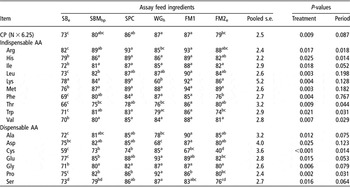
The SID of AA originating from SPC range from 78% to 93% for indispensable AA, and from 74% to 88% for dispensable AA, respectively, whereas those in SBMhp range from 75% to 89% for indispensable AA, and from 73% to 85% for dispensable AA, respectively (Table 4). For piglets, reports on SID of indispensable AA in soy protein concentrate and soybean meal are not consistent between studies. For example, SID of indispensable AA in soybean meal range from 86% to 98% and from 76 to 86% in studies by Walker et al. (Reference Walker, Maxwell, Owens and Buchanan1986) and Yang et al. (Reference Yang, Kim, Lohakare, Yun, Lee, Kwon, Park, Choi and Chae2007), respectively. The SID in SBMhp, reported herein, are in good agreement with those reported by Yang et al. (Reference Yang, Kim, Lohakare, Yun, Lee, Kwon, Park, Choi and Chae2007), whereas Walker et al. (Reference Walker, Maxwell, Owens and Buchanan1986) reported up to 17 percentage units greater SID. For soy protein concentrate, reports on SID of indispensable AA vary between 94% and 100% (Walker et al., Reference Walker, Maxwell, Owens and Buchanan1986) and between 81% and 91% (Yun et al., Reference Yun, Yong and Chae2005; Yang et al., Reference Yang, Kim, Lohakare, Yun, Lee, Kwon, Park, Choi and Chae2007). Moreover, Yun et al. (Reference Yun, Yong and Chae2005) and Yang et al. (Reference Yang, Kim, Lohakare, Yun, Lee, Kwon, Park, Choi and Chae2007) determined up to 6 percentage units smaller SID of indispensable AA in soy protein concentrate compared with the present study, whereas Walker et al. (Reference Walker, Maxwell, Owens and Buchanan1986) reported up to 17 percentage units greater SID of indispensable AA in soy protein concentrate than the present study. There is evidence, however, that the comparison of SID between the aforementioned studies and the present study may be confounded by methodological differences in the measurement of SID between these studies. In the present study, the determination of SID is based on analyzed values for CP and AA of the assay feed ingredients and the assay diets as well. In the studies by Yun et al. (Reference Yun, Yong and Chae2005) and Yang et al. (Reference Yang, Kim, Lohakare, Yun, Lee, Kwon, Park, Choi and Chae2007), however, values for soy protein concentrate from NRC (1998) were used to calculate the CP and AA contents of the assay diets. Total AA contents and profiles, may differ considerably between different batches of soybean meal or soy protein concentrate (Degussa, 2006), and the determination of SID based on tabulated values for the AA contents of the assay feed ingredients may be inaccurate.
Standardized ileal digestibilities (%)Footnote † of crude protein and amino acids in the assay feed ingredients

SBe = extruded soybeans (American Soybean Association, St. Louis, USA); SBMhp = high-protein soybean meal (American Soybean Association); SPC = soy protein concentrate (The Solae Company, Geneva, Switzerland); WGh = hydrolyzed wheat gluten (Roquette, Lestrem, France); FM1 = fish meal 1 (TripleNine, Esbjerg, Denmark); FM2e = extracted fish meal 2 (TripleNine); N = nitrogen; AA = amino acid.
a,b,c,d Within a row, least squares mean values with a common superscript are not significantly different at α = 0.05. Multiple comparisons among all pairs of treatments were performed using a t-test with degrees of freedom determined by the Kenward–Roger method.
† Least squares mean values, n = 6.
In the study by Walker et al. (Reference Walker, Maxwell, Owens and Buchanan1986), total ileal recoveries of AA in piglets fed enzyme-hydrolyzed casein were considered to represent IAALB and were subsequently subtracted from total ileal recoveries of AA in the assay diets. Walker et al. (Reference Walker, Maxwell, Owens and Buchanan1986) assume however, that CP and AA from enzyme-hydrolyzed casein were not completely digestible at the ileal level, and therefore IAALB and SID in soybean meal and soy protein concentrate in the study by Walker et al. (Reference Walker, Maxwell, Owens and Buchanan1986) may have been overestimated.
In the present study, the SID of indispensable AA in SBMhp are consistently up to 6 percentage units smaller compared with SPC, however, these differences are not significant (P = 0.127 to 0.718). Similarly, Walker et al. (Reference Walker, Maxwell, Owens and Buchanan1986) and Yang et al. (Reference Yang, Kim, Lohakare, Yun, Lee, Kwon, Park, Choi and Chae2007) reported in piglets consistently up to 9 percentage units smaller SID of AA in soybean meal compared with soy protein concentrate. For most AA, these differences were significant, probably due, at least in part, to the use of soybean meal with a smaller CP concentration which amounted to 473 g/kg (as fed) and 452 g/kg (as fed) in the study by Walker et al. (Reference Walker, Maxwell, Owens and Buchanan1986) and Yang et al. (Reference Yang, Kim, Lohakare, Yun, Lee, Kwon, Park, Choi and Chae2007), respectively, whereas in the present study, the CP concentration was 489 g/kg (as fed). Since a smaller CP content in soybean meal is closely associated with greater crude fiber content (Van Kempen et al., Reference Van Kempen, van Heugten, Moeser, Muley and Sewalt2006), considerably smaller SID of AA in soybean meal compared with soy protein concentrate can be expected in the studies by Walker et al. (Reference Walker, Maxwell, Owens and Buchanan1986) and Yang et al. (Reference Yang, Kim, Lohakare, Yun, Lee, Kwon, Park, Choi and Chae2007). In piglets, the effect of soybean meal with different crude fiber content on SID of AA has not yet been studied.
The SID of AA originating from SBe range from 66% to 82% for indispensable AA, and from 59% to 77% for dispensable AA, respectively (Table 4). In piglets, there are so far no reports on SID of AA in extruded soybeans, although there are some reports on AID of AA in extruded soybeans determined by the difference method in piglets (Fan et al., Reference Fan, Sauer and de Lange1995b; Viljoen et al., Reference Viljoen, Coetzee, Fick, Siebrits and Hayes1998). The AID of indispensable AA in extruded soybeans in these studies were up to 14 percentage units greater (Viljoen et al., Reference Viljoen, Coetzee, Fick, Siebrits and Hayes1998) and up to 18 percentage units smaller (Fan et al., Reference Fan, Sauer and de Lange1995b) compared with SID of indispensable AA obtained in SBe in the present study.
The AID of AA in extruded soybeans in the study by Viljoen et al. (Reference Viljoen, Coetzee, Fick, Siebrits and Hayes1998) were determined in a 89 g/kg CP-containing basal diet and in a 144 g/kg CP (air-dry basis)-containing assay diet. However, AID are not additive at small dietary CP levels due to the contribution of IAALB to total ileal AA recoveries (Fan et al., Reference Fan, Sauer, Hardin and Lien1994; Eklund, Reference Eklund2007). Consequently, AID of soybeans have been overestimated in the study by Viljoen et al. (Reference Viljoen, Coetzee, Fick, Siebrits and Hayes1998).
Similar to the establishment of SID tables for grower–finisher pigs (e.g. GfE, 2008; Rademacher et al., Reference Rademacher, Sauer and Jansman2009), the AID of CP and AA in extruded soybeans, extracted from data provided in the study by Fan et al. (Reference Fan, Sauer and de Lange1995b), can be transformed into the corresponding SID according to the principles as described herein (equations (2) and (3)). For most indispensable AA, the SID are between 4 and 15 percentage units smaller compared with the corresponding values for SBe in the present study. Low SID in soybeans may, at least in part, result from high levels of trypsin inhibitor activity (TIA) in the soybeans. In the study by Fan et al. (Reference Fan, Sauer and de Lange1995b), the TIA of the complete diet amounted to 1.23 mg/g DM and to 3.31 mg/g DM in the present study. It is recommended that the maximum TIA level for grower–finisher pigs should not exceed 0.5 mg/g (as fed) diet, but it is speculated that this value might surpass the tolerance level for piglets (Huisman and Tolman, Reference Huisman and Tolman2001). For piglets, there are so far no studies on the effect of TIA on SID of CP and AA, although Qin et al. (Reference Qin, ter Elst, Bosch and van der Poel1996) reported that AID of N in heat-treated soybeans increased as the level of TIA in the diet decreased from 1.16 to 0.48 mg/g (as fed) diet. Moreover, a comparison of soybean products in the present study shows that SID in SBe are consistently up to 15 percentage units smaller compared with those in SPC (P = 0.007) and SBMhp (P = 0.010) except for Lys (P = 0.136 and P = 0.401, respectively) (Table 4). The corresponding TIA in SBMhp and SPC was 2.22 and 0.9 mg/g DM product, respectively, compared with 7.36 mg/g DM product in SBe (Table 1). Extrusion of whole soybeans used in the present experiment was not as efficient in reducing TIA compared with steam-heating and toasting or hot aqueous ethanol extraction of defatted soy flakes to produce soybean meal or soy protein concentrate, respectively.
Hydrolyzed wheat gluten
The SID of AA originating from WGh range from 76% to 88% for indispensable AA, and from 68% to 93% for dispensable AA, respectively, except for Lys, with an SID of only 60% (Table 4). For piglets, SID of CP and AA in wheat gluten have not yet been determined, and tabulated values for SID of CP and AA in wheat gluten for pigs are inconsistent. According to Jansman et al. (Reference Jansman, Smink, van Leeuwen and Rademacher2002) and Rademacher et al. (Reference Rademacher, Sauer and Jansman2009), wheat gluten, similar to casein, is almost completely digestible at the ileal level. In contrast, AmiPig (2000) provides SID in wheat gluten, which were between 2 and 8 percentage units greater for indispensable AA compared with those in the present study with piglets.
Chae et al. (Reference Chae, Han, Kim, Yang, Hancock, Kim and Anderson1999) determined AID of AA in wheat gluten for piglets. After being transformed into SID similar to the establishment of SID tables for grower–finisher pigs (e.g. GfE, 2008; Rademacher et al., Reference Rademacher, Sauer and Jansman2009) and according to the principles described herein (equations (2) and (3)), most of these SID are up to 5 percentage units greater than the corresponding SID for WGh in the present study. Moreover, SID of Lys is even 24 percentage units greater compared with the results of the present study. Differences between these studies may result from the use of different sources of wheat gluten. Although CP concentration of WGh in the present study and that by Chae et al. (Reference Chae, Han, Kim, Yang, Hancock, Kim and Anderson1999) was similar, amounting to 803.9 (as fed) and 804.1 g/kg (as fed), respectively, there are considerable differences in the AA profiles of the indispensable AA. The wheat gluten protein, which was used in the study by Chae et al. (Reference Chae, Han, Kim, Yang, Hancock, Kim and Anderson1999), contained notably greater levels of Arg, His, Lys and Phe, but considerably smaller levels of Met, Thr and Val.
The particular small SID of Lys in the present study might be simply a reflection of an experimental error, due to the use of the difference method to determine SID (Knabe et al., Reference Knabe, LaRue, Gregg, Martinez and Tanksley1989). Due to the extremely small Lys content in WGh, the contribution level of Lys from WGh, amounting to 17% of the total Lys content in the assay diet, is small as well. At smaller inclusion levels, digestibility values may be inaccurate with the difference method (Fan and Sauer, Reference Fan and Sauer1995) resulting in underestimation of SID in the present study. The reliability of digestibility measurements by means of the difference method depends on the contribution level of AA from the assay feed ingredient to their total dietary contents. The greater the contribution of a particular AA to the total contents in the assay diets, the more reliable is its digestibility measurement (Fan and Sauer, Reference Fan and Sauer1995).
The SID of indispensable AA in WGh were similar to those in SBMhp (P = 0.064 to 0.958) and SPC (P = 0.308 to 0.911), but smaller for Lys, compared with both SBMhp and SPC (P = 0.003 and P = 0.001), respectively and for Arg in SPC (P = 0.010) as well. Moreover, the SID of WGh showed similar values for Arg, Thr and Trp compared with those in SBe (P = 0.064 to 0.958).
Fish meal products
Despite different processing methods, the contents of AA were similar between FM1 and FM2e (Table 1). Both fish meal products like other rendered animal by-products (Gottlob et al., Reference Gottlob, DeRouchey, Tokach, Goodband, Dritz, Nelssen, Hastad and Knabe2006) have greater crude ash contents than plant feed ingredients (Table 1). In the present study, the CP concentration in FM1 and FM2e was 779 and 851 g/kg DM (Table 1), respectively; however, the total amount of AA (except for Tyr) was below the corresponding CP concentration amounting to 678 and 745 g/kg DM in FM1 and FM2e, respectively. Therefore, the CP content in FM1 and FM2e may have been overestimated in the present study due to a great proportion of non-protein-N compounds in fish meals (Gottlob et al., Reference Gottlob, DeRouchey, Tokach, Goodband, Dritz, Nelssen, Hastad and Knabe2006).
The SID of AA originating from FM1 range between 85% and 94% for indispensable AA, and between 83% and 90% for dispensable AA, respectively, except for Cys for which an SID value of only 67% was obtained. The SID of AA originating from FM2e varies between 74% and 89% for indispensable AA, and between 76% and 85% for dispensable AA, respectively, except for Cys for which an SID value of only 40% was measured (Table 4). The SID of CP and indispensable AA were consistently up to 12 percentage units smaller in FM2e compared with FM1, with significant differences for CP (P = 0.035), Phe (P = 0.028) and Trp (P = 0.008).
The SID in FM1 were 1 to 7 percentage units greater (CVB, 2003; GfE, 2008; Rademacher et al., Reference Rademacher, Sauer and Jansman2009) or between 2 to 8 percentage units smaller (NRC, 1998; AmiPig, 2000; Pedersen and Boisen, Reference Pedersen and Boisen2002), than tabulated values for grower–finisher pigs. In piglets, SID in FM2e were 1 to 17 percentage units smaller compared with those reported for grower–finisher pigs (NRC, 1998; Pedersen and Boisen, Reference Pedersen and Boisen2002; CVB, 2003; GfE, 2008; Rademacher et al., Reference Rademacher, Sauer and Jansman2009).
For piglets, there are only reports on AID rather than on SID of CP and AA in fish meal products (Gabert et al., Reference Gabert, Sauer, Schmitz, Ahrens and Mosenthin1995; Kim and Easter, Reference Kim and Easter2001). Similar to the establishment of SID tables for grower–finisher pigs (e.g. GfE, 2008; Rademacher et al., Reference Rademacher, Sauer and Jansman2009), these AID were transformed into the corresponding SID according to the principles as described herein (equation (2)). The SID of indispensable AA in FM1 in the present study are in good agreement with SID calculated from the corresponding AID obtained in the study by Gabert et al. (Reference Gabert, Sauer, Schmitz, Ahrens and Mosenthin1995). In contrast, SID of indispensable AA in FM2e were up to 11 percentage units smaller compared with the corresponding SID calculated from AID of indispensable AA (Gabert et al., Reference Gabert, Sauer, Schmitz, Ahrens and Mosenthin1995). The transformation of AID of indispensable AA determined in the study by Kim and Easter (Reference Kim and Easter2001) into the corresponding SID resulted in 21 and 17 percentage units smaller SID for FM1 and FM2e, respectively, compared with the results of the present study.
The variation in SID of CP and AA between FM1 and FM2e, and the results obtained in different studies might be attributed to differences in processing methods used to manufacture these fish meal products. Some authors reported that the quality of fish meal depends on the type and species of fish, the freshness of the fish before processing and the processing of the meal (Kim and Easter, Reference Kim and Easter2001). Time and temperature used to dry the pressed fish might alter Cys, His, Lys and Trp, because they are susceptible to destruction during heat treatment (Mason and Weidner, Reference Mason and Weidner1964; Johnston and Savage, Reference Johnston and Savage1987). Kim and Easter (Reference Kim and Easter2001) determined AID of AA in fish meal produced from different raw materials and processed under varying drying conditions. Piglets fed fish meal produced from mackerel and dried at 70°C had greater AID of AA than piglets fed either fish meal produced from menhaden dried at 85°C or herring dried at 80°C. Thus, it may be speculated that the variations in SID of AA between FM1 and FM2e in the present study may be also due to differences in processing, in particular to heat treatment.
Conclusions and implications
In the present study, the greatest SID for most indispensable AA were observed for FM1 and SPC (SID ⩾ 85% for most indispensable AA), followed by WGh, FM2e and SBMhp (SID ⩾ 80% for most indispensable AA). By far the smallest SID were observed for SBe (SID < 80% for most indispensable AA). The method used to process and to produce soybean products had a major impact on the SID of CP and AA in these products. Heat treatment during extrusion in SBe was less efficient in reducing TIA than steam-toasting in SBMhp or hot aqueous ethanol extraction in SPC. The difference method which was used to determine SID of CP and AA in the assay feed ingredients, may underestimate SID when the contribution of a particular AA to its total content in the assay diet is rather small (e.g. Lys in WGh).
Digestibility values measured in the present study in a variety of protein supplements provide a basis to formulate diets for piglets according to standardized ileal digestible contents of CP and AA. However, there is a need to further extend the database by determining SID of CP and AA not only in other protein supplements but also in feed ingredients such as cereal grains and their by-products.
Acknowledgements
The authors are grateful to H. Brehm and M. Steffl for their excellent work with animal surgery. Financial support of the project by American Soybean Association, USA; Archer Daniels Midland Company, USA; Arla Foods, Denmark; Evonik Degussa GmbH, Germany; Hamlet Protein A/S, Denmark; Roquette, France; Tate & Lyle, Belgium; The Solae Company, Switzerland; TripleNine, Denmark is gratefully acknowledged.