Introduction
Copper-containing enzymes occur in all organisms, and play important roles in the biological activation of oxygen, necessary for the oxidation of a great variety of different substrata (Solomon et al. Reference Solomon, Chen, Metz, Lee and Palmer2001). Multicopper oxidases include mononuclear copper enzymes (e.g. amine oxidase), coupled binuclear copper enzymes (e.g. tyrosinase) and enzymes containing trinuclear copper clusters (e.g. laccase, pigment oxidase, ferroxidase and ascorbate oxidase) (Solomon et al. Reference Solomon, Chen, Metz, Lee and Palmer2001; Nakamura & Go Reference Nakamura and Go2005). These enzymes have overlapping substratum specificities and can co-occur in the same samples, making their identification difficult (Ratcliffe et al. Reference Ratcliffe, Flurkey, Kuglin and Dawley1994; Baldrian Reference Baldrian2006). Surveys of lichens using assays with intact thalli or leachates indicate that Peltigerlean lichens contain both laccases (EC 1.10.3.2) and tyrosinases (EC 1.14.18.1) (Laufer et al. Reference Laufer, Beckett and Minibayeva2006a, Reference Gómez-Toribio, García-Martín, Martínez, Martínez and Guillénb; Zavarzina & Zavarzin Reference Zavarzina and Zavarzin2006), and that phenol oxidase activity is largely absent in lichens from other orders.
Recently, progress has been made in establishing the structure and function of lichen laccases (Lisov et al. Reference Lisov, Zavarzina, Zavarzin, Demin and Leontievsky2012), while lichen tyrosinases remain largely unstudied. In free-living fungi, a major role of tyrosinases is eumelanin synthesis (Bell & Wheeler Reference Bell and Wheeler1986). Eumelanins are produced by a two-step reaction involving first the oxidation of tyrosine to o-dihydroxyphenylalanine (DOPA) by tyrosinase working as monophenol oxidase, and second by the conversion of DOPA to dopaquinonone by tyrosinase working as a diphenol oxidase. Dopaquinone then undergoes spontaneous cyclization to form brown or black pigments. By contrast, allomelanins are formed by the oxidation of di-(DHN) or tetrahydroxynaphthalene, via the pentaketide pathway (Plonka & Grabacka Reference Plonka and Grabacka2006). It is not known which forms of melanins occur in lichens (Muggia et al. Reference Muggia, Schmitt and Grube2009), but melanins are widely distributed in lichens, and are found in both Peltigeralean and non-Peltigeralean species. Melanins are believed to protect the photobiont again excessive light and UV-B, as melanin concentrations increase following exposure to UV-B (Nybakken & Julkunen-Tiitto Reference Nybakken and Julkunen-Tiitto2006; McEvoy et al. Reference McEvoy, Gauslaa and Solhaug2007; Nybakken et al. Reference Nybakken, Asplund, Solhaug and Gauslaa2007; Larsson et al. Reference Larsson, Vecerova, Cempirkova, Solhaug and Gauslaa2009). Based on the known distribution of tyrosinases in lichens, it could be predicted that lichens from the Peltigerales synthesize melanin using tyrosinases, while others use polyketide synthases, enzymes that are present in most lichens (Muggia & Grube Reference Muggia and Grube2010).
As part of an ongoing detailed microcharacterization of lichen tyrosinases, a range of both Peltigeralean and non-Peltigeralean species were tested for cytosolic rather that cell wall activity. While in general cytosolic tyrosinases activities were consistent with earlier reports based on assays of cell wall bound enzymes, unusually high cytosolic tyrosinase activity was found in the non-Peltigeralean genus Dermatocarpon. The aim of the work presented here was to study Dermatocarpon tyrosinase in more detail, and to determine whether its properties differ from those of Peltigeralean tyrosinases. In addition, to test whether tyrosinase may play a role in desiccation tolerance in lichens, we compared activities in dry and rehydrated thalli.
Materials and Methods
The species of lichens examined in this study and their collection localities are listed in Table 1. Specimens were collected from the field either dry or hydrated. If hydrated, they were allowed to dry slowly between sheets of newspaper. Lichens were stored refrigerated at 5°C for up to two weeks before use. In all cases, large collections of lichens were made, and the thalli used were randomly sampled from those that appeared most healthy. Lichens (typically up to 1 g dry mass) were thoroughly ground in 50 mM phosphate buffer pH 7 using a little aluminium oxide to facilitate grinding, and centrifuged at 5000 g for 20 min. Tyrosinase activity was estimated in the resulting supernatant by following the oxidation of 2 mM L-dihydroxyphenylalanine (DOPA; Sigma) to 2-carboxy-2,3-dihydroindole-5,6-quinone (dopachrome; Horowitz et al. Reference Horowitz, Gling and Horn1970) in 50 mM phosphate buffer pH 6. The extinction coefficient of the product measured at A475 is 3·6 mM–1 cm–1. Activities were expressed as units g–1 dry mass. To test whether tyrosinase activity is affected by water stress, activity was first measured in dried lichen thalli. Replicate samples were then slowly rehydrated by storage at 10°C in darkness, in air at 100% relative humidity (RH) for 24 h, followed by storage for a further 24 h under the same conditions, but on wet non-cellulosic cloth. Hydrated lichens were then ground and tyrosinase activity measured as for desiccated lichens.
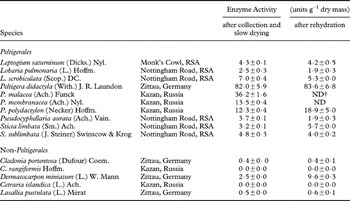
Total tyrosinase activity after collection (dry), and following rehydration in a range of lichen species. All measurements were made with 2 mM DOPA at pH 6 in 50 mM phosphate buffer.

* Data given±standard deviation, n=5 preparations
† not determined.
To further characterize the tyrosinase from D. miniatum, activity was compared with that from extracts of Peltigera polydactylon (hydrated material was used in both cases). The effect of the known tyrosinase effectors 1 mM sodium dodecyl sulphate (SDS), 1 mM KCN and 40 mM NaF on enzyme activity was tested in both species. To test the ability of the tyrosinases to oxidize the monophenols tyramine and phenol, the ‘hydrazone’ method of Rodrígues-López et al. (Reference Rodríguez-López, Escribano and García-Cánovas1994) was employed, involving the reaction of 3-methyl-2-benzothiazolinone hydrazone (MBTH) with quinone produced by the oxidation of monophenols. The effect of pH on enzyme activity was also tested using McIlvaine's citrate-phosphate buffer (50 mM) from pH 3 to 6·5.
Results
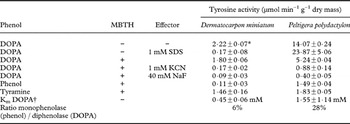
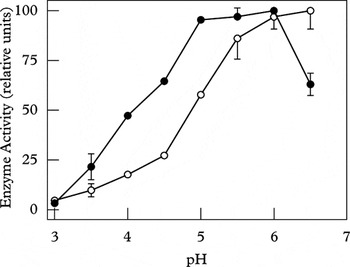
While total activities of tyrosinase were usually much higher in Peltigeralean than in non-Peltigeralean lichens (Table 1), the non-Peltigeralean species Dermatocarpon miniatum displayed anomalously high tyrosinase activity. Rehydrating dry thalli had no consistent effect on tyrosinase activity in Peltigeralean lichens, but significantly increased activity in D. miniatum. Comparing tyrosinase from D. miniatum and Peltigera polydactylon revealed some interesting differences (Table 2). Both enzymes readily metabolized DOPA, with the enzyme from D. miniatum having a lower Km. While the classic tyrosinase inhibitors KCN and NaF strongly inhibited activity in both species, the detergent SDS stimulated activity in P. polydactylon, but inhibited activity in D. miniatum. Both enzymes metabolized the monophenol tyramine, but the enzyme from Peltigera was much more effective at metabolizing phenol. The ratio of monophenol to diphenol oxidase activities (expressed as the rate of metabolism of phenol divided by the rate of metabolism of DOPA) was almost five times higher in Peltigera compared with Dermatocarpon. Unfortunately, attempts to concentrate the enzyme from Dermatocarpon to enable further characterization by chromatography or electrophoresis were unsuccessful, as the enzyme rapidly lost almost all its activity (data not shown). The pH optimum of the tyrosinase from Dermatocarpon was lower than that from Peltigera (Fig. 1)
Comparison of tyrosinase activity from Dermatocarpon miniatum (Verrucariales, Eurotiomycetes) with that from Peltigera polydactylon (Peltigerales, Lecanoromycetes) with and without 3-methyl-2-benzothiazolinone hydrazone (MBTH). Experiments carried out with 2 mM o-dihydroxyphenylalanine (DOPA), 10 mM phenol or 5 mM tyramine in 50 mM phosphate buffer pH 6.

* Figures given±standard deviation, n=5 preparations.
† Concentration range for determining Km of DOPA was 0·2 to 2 mM.
Effect of pH on the activity of tyrosinases extracted from hydrated material of Dermatocarpon miniatum (closed circles) and Peltigera polydactylon (open circles) with 2mM DOPA as a substrate at 20oC. Above pH 7 DOPA precipitated. Activities expressed as a percentage of maximum activities (see Table 2 for actual values). Error bars indicate the standard deviation, n=3 preparations, overlapping error bars removed.

Discussion
Results presented here clearly demonstrate that the lichen Dermatocarpon miniatum displays intracellular tyrosinase activity at rates comparable to those found in many Peltigeralean species. Previous surveys of cell wall tyrosinase activity in lichens have consistently shown that high activities occur only in the Peltigerales (Laufer et al. Reference Laufer, Beckett and Minibayeva2006a; Zavarzina & Zavarzin Reference Zavarzina and Zavarzin2006; Beckett & Minibayeva Reference Beckett and Minibayeva2007). Specifically, Beckett & Minibayeva (Reference Beckett and Minibayeva2007) found that cell surface tyrosinase activity is absent in D. miniatum. However, these earlier surveys did not include measurements of cytosolic tyrosinase activity. Full information on the cellular location of tyrosinases is available for only two Peltigeralean species (from the genera Pseudocyphellaria and Peltigera) and two non-Peltigeralean species (from the genera Cetraria and Cladonia) (Laufer et al. Reference Laufer, Beckett and Minibayeva2006a). This study reported strong cytosolic tyrosinase activity in both Peltigeralean lichens, but no activity in the non-Peltigeralean species. While results presented in Table 1 are broadly consistent with these findings, the non-Peltigeralean species D. miniatum is an exception, as it displays strong intracellular tyrosinase activity. Further investigation revealed that the kinetic properties of Dermatocarpon tyrosinase differ from those of Peltigera tyrosinase (Table 2). For example, stimulation of tyrosinase activity by the detergent SDS is common in tyrosinase from Peltigeralean lichens (Laufer et al. Reference Laufer, Beckett and Minibayeva2006a), but SDS inhibits Dermatocarpon tyrosinase. Stimulation of tyrosinase activity by SDS also occurs in free-living fungi (Espìn & Wichers Reference Espìn and Wichers1999), but the mechanism of action is unknown. In addition, Dermatocarpon tyrosinase displays relatively poorer monophenol oxidase activity compared with Peltigera (Table 2), and the enzyme has a lower pH optimum (Fig. 1). While Dermatocarpon clearly possesses strong intracellular tyrosinase activity, significant differences exist between this enzyme and the enzyme that occurs in Peltigera.
Tyrosinase appears to play little role in desiccation tolerance in Peltigeralean lichens, as rehydrating desiccated thalli had no consistent effect on enzyme activity (Table 1). These results are in agreement with earlier reports showing no stimulation during rehydration of surface tyrosinase activity in Pseudocyphellaria aurata (Laufer et al. Reference Laufer, Beckett and Minibayeva2006a). By contrast, tyrosinase activity in D. miniatum was strongly stimulated by rehydration (Table 1). The greater increase in enzyme activity in D. miniatum found here could in part have been caused by the dry material having a slightly lower water content than the Peltigeralean species, as it was collected from an exposed rocky outcrop. As conversion of inactive to active forms of tyrosinase appears not to occur in D. miniatum (Table 2), the enzyme is probably upregulated during rehydration. In D. miniatum, tyrosinase may have a minor role in desiccation tolerance, for example by polymerizing reactive molecules formed during rehydration stress, or to strengthen cell walls against pathogen attack by synthesizing melanins. However, more work is needed to establish the role of tyrosinases in desiccation tolerance in D. miniatum.
Differences between the tyrosinases in Dermatocarpon and Peltigera are probably a consequence of differences in the roles of the enzyme in the different species. Peltigeralean lichens almost all contain strong cell wall laccase activity (Zavarzina & Zavarzin Reference Zavarzina and Zavarzin2006). Surveys have shown that the ratio between tyrosinase activity and laccase activity is remarkably similar in a range of species (Laufer et al. Reference Laufer, Beckett, Minibayeva, Luthje and Böttger2006b). Even in genera such as Leptogium where laccases are absent, peroxidases appear to take over their function (Liers et al. Reference Liers, Ullrich, Hofrichter, Minibayeva and Beckett2011). Extracellular laccases and peroxidases are probably involved in producing reactive oxygen species (ROS) that play several important roles in lichen biology, for example assisting lignocellulosic breakdown or in pathogen defence (Zavarzina et al. Reference Zavarzina, Lisov, Zavarzin and Leontievsky2011). ROS can be produced via an indirect mechanism involving extracellular redox cycling, which has been described in detail in free-living fungi (Gómez-Toribio et al. Reference Gómez-Toribio, García-Martín, Martínez, Martínez and Guillén2009a, Reference Gómez-Toribio, García-Martín, Martínez, Martínez and Guillénb). Briefly, laccases and peroxidases catalyze the conversion of hydroquinones to quinone radicals, which then spontaneously form quinones, producing superoxide (O2.–) or other radicals as byproducts. Hydroquinones can be regenerated from the quinones using a plasma membrane quinone reductase. The possession of tyrosinases may be important for lichens with strong laccase or peroxidase activity, firstly because tyrosinases can synthesize quinones from simple phenolics precursors, which are known to be produced in large quantities by Peltigeralean lichens (Zagoskina et al. Reference Zagoskina, Nikolaeva, Lapshin, Zavarzina and Zavarzin2011). Secondly, in saprophytic free-living fungi it has also been suggested that tyrosinases protect fungi by removing (via polymerization) reactive phenols and quinones produced as by-products during lignocellulosic breakdown (Sinsabaugh Reference Sinsabaugh2010). Non-Peltigeralean lichens display almost no laccase activity, which may explain the absence of cell wall tyrosinases in these lichens. As discussed in the Introduction, a major role for tyrosinases in free-living fungi is considered to be melanin synthesis. Melanin synthesis in free-living fungi appears to occur in the cytoplasm (Bell & Wheeler Reference Bell and Wheeler1986; Henson et al. Reference Henson, Butler and Day1999). In lichens that are heavily pigmented, but that display low or no tyrosinase activity (e.g. Lasallia pustulata) melanins are probably synthesized via the ‘DHN’ or polyketide synthase pathway (Muggia et al. Reference Muggia, Schmitt and Grube2009). However, in Dermatocarpon, which has a heavily pigmented lower cortex, tyrosinase is presumably involved in melanin synthesis rather than extracellular ROS metabolism. These differences may explain the almost exclusively cytosolic location and rather different biochemical characteristics of Dermatocarpon tyrosinase compared with the corresponding enzyme from Peltigera.
In future work, we hope to further characterize D. miniatum tyrosinase. Unfortunately, our attempts to concentrate the enzyme were unsuccessful, as activity was rapidly lost even following a mild dialysis procedure. By contrast, we have found that tyrosinases from Peltigera are remarkably stable following isolation. In conclusion, it is clear that lichens from orders other than the Peltigerales can display significant intracellular tyrosinase activity. While in the Peltigerales extracellular tyrosinases appear to have functions associated with laccase-mediated redox cycling, these functions are not needed in clades of lichens without significant laccase activity. However, melanization reactions occur in many diverse lichens, both Peltigeralean and non-Peltigeralean, and in both groups tyrosinases may be involved. In future studies, we plan to clarify the structure, properties, relationship of this enzyme to forms occurring in free-living fungi, and the specific roles of tyrosinases in various aspects of lichen biology such as desiccation tolerance.
The University of KwaZulu Natal, the NRF (South Africa), the European Union (integrated project Peroxicats) and Russian Foundation for Basic Research (No 11-04-93962) are thanked for financial support. We also thank Shuttleworth Weaving, Nottingham Road, South Africa, for allowing us to collect lichens on their premises.