There is a significant corpus of scientific research that shows how children with specific language impairment (SLI) have difficulties with basic syntactic features and tend to use them inconsistently. These aspects include assignment of thematic roles in passive sentences and assignment of referents in relative clauses (Hesketh, Reference Hesketh2006) and in those that contain clitic pronouns (see for a review van der Lely, Reference van der Lely and Jenkins2004, Reference van der Lely2005). Problems with specific morphological and syntactic aspects are a phenotypic trait of SLI participants (Conti-Ramsden & Hesketh, Reference Conti-Ramsden and Hesketh2003; Leonard, Reference Leonard1998; Norbury, Bishop, & Briscoe, Reference Norbury, Bishop and Briscoe2001; Rice & Wexler, Reference Rice and Wexler1996). It is thought that grammatical structures, such as passive sentences and pronominal reference, in which dependencies must be established are problematic for children with SLI (van der Lely, Reference van der Lely1998, Reference van der Lely2005; van der Lely & Batlle, Reference van der Lely and Battell2003), while their performance is virtually normal with sentences that follow Subject-Verb-Object order (Stavrakaki, Reference Stavrakaki2003).
Other authors, such as Montgomery (Reference Montgomery1995), consider that the grammatical comprehension problems of children with SLI vary according to the amount of material they must retain in their working memory in order to process a sentence. He matched children with SLI with children of the same linguistic age and saw that both groups understood short sentences equally well, but that when the length of the sentences was increased, children with SLI had greater comprehension difficulties than control participants. In other studies, Montgomery (Reference Montgomery2000a, Reference Montgomeryb, Reference Montgomery2002, Reference Montgomery2004) concluded that comprehension difficulties in children with SLI are due as much to a reduced capacity of phonological working memory as to difficulties in responding with the necessary speed to process the information associated with the task. That is to say, it may be that children with SLI not only have difficulties with the storage and processing of input but they also find it more difficult to attend to other information processing demands, such as scanning and visual processing of each stimulus picture, generating a linguistic representation of each stimulus picture or deciding which picture best represents the sentence pronounced by the examiner. Short-term phonological memory and processing speed seem to be the components which affect linguistic performance of children with SLI (Montgomery & Windsor, Reference Montgomery and Windsor2007); in other words, the ability to produce and understand language depends on the ability to store and integrate linguistic information in the working memory (Archibald & Gathercole, Reference Archibald and Gathercole2006).
Several studies have focused on the role of the capacity of working memory in understanding (a) sentences containing object-relative clauses (Robertson & Joanisse, Reference Robertson and Joanisse2010; Weighall & Altmann, Reference Weighall and Altmann2011), (b) passive sentences (Montgomery, Magimairaj, & O’Malley, Reference Montgomery, Magimairaj and O’Malley2008) or (c) sentences with different syntactic ambiguities (Felser, Marinis, & Clahsen, Reference Felser, Marinis and Clahsen2003). They have shown that children with higher memory capacity have better understanding of sentences than children with less capacity. In this line, Magimairaj and Montgomery (Reference Magimairaj and Montgomery2012) conducted a study in which children aged 6–12 years had to complete a verbal working memory (listening) span task, varying in syntactic processing difficulty (simple sentences and complex sentences), and a standardized sentence comprehension test. Their results have shown that the simple tasks are the best predictors of sentence comprehension, and the most robust indicators of working memory, since they sufficiently grasp the controlled attentional focus. Their results also led them to the conclusion that children with higher memory capacity have more ability to store a greater quantity of linguistic material for processing.
Although there is general consensus on the fact that SLI participants have difficulties in grammatical comprehension, there is still a divergence of opinion as to the interpretation of these difficulties; the difficulties in question being: limitations in the capacity and speed of processing and in the working memory (Hoffmann & Gillam, Reference Hoffmann and Gillam2004; Joanisse & Seidenberg, Reference Joanisse and Seidenberg1998; Marton & Schwartz, Reference Marton and Schwartz2003; Montgomery Reference Montgomery1995, Reference Montgomery2000a, Reference Montgomeryb, Reference Montgomery2002, Reference Montgomery2004, Reference Montgomery2005) and difficulties which affect morphology and syntax in children with grammatical SLI (van der Lely Reference van der Lely1996, Reference van der Lely, Levy and Schaeffer2003, Reference van der Lely2005). The lack of definitive conclusions in this area may be due to the multiplicity of processes involved in the comprehension of oral language since, in order to understand a sentence, a whole series of processes need to come into operation, including processes relating to perception, verbal working memory, attention, access to lexis in long-term memory, selection and integration of information, all of which are functioning, in this instance, in an information-processing system with limited capacity (Montgomery, Reference Montgomery2002). Since what is entailed is not simply a single comprehension process, it is understandable that the results of these studies suggest a range of different positions when we attempt to interpret the comprehension problems experienced by these children.
Grammatical comprehension in Spanish-speaking children with SLI
It is important to make clear that there are few studies of grammatical comprehension in Spanish-speaking children with SLI, with the result that there is insufficient factual information on which to test any of the hypotheses that attempt to explain these problems (Restrepo & Gutiérrez-Clellen, Reference Restrepo and Gutiérrez-Clellen2001). Most of these studies have focused on the production difficulties experienced by these children, examining, for example, problems with articles (Anderson & Souto, Reference Anderson and Souto2005; Bedore & Leonard, Reference Bedore and Leonard2001, Reference Bedore and Leonard2005; Restrepo & Gutiérrez-Clellen, Reference Restrepo and Gutiérrez-Clellen2001), or the frequent omission of gender-marking (Anderson & Souto, Reference Anderson and Souto2005; Bedore & Leonard, Reference Bedore and Leonard2005; Restrepo & Gutiérrez-Clellen, Reference Restrepo and Gutiérrez-Clellen2001). These children experience more difficulties with gender agreement than with agreement of number, because the former is more abstract in nature (Restrepo & Gutiérrez-Clellen, Reference Restrepo and Gutiérrez-Clellen2001).
Another area of morphemic difficulty is that of clitic pronouns, where we witness both omissions and substitutions in spontaneous language tasks and structured tasks (Bedore & Leonard, Reference Bedore and Leonard2001; Bosch & Serra, Reference Bosch, Serra, Baker, Beers, Bal, de Jong and Leemans1997; Gutiérrez-Clellen, Restrepo, Bedore, Peña, & Anderson2000; Jacobson & Schwartz, Reference Jacobson and Schwartz2002; Simon-Cereijido & Gutiérrez-Clellen, 2007).
Problems have also been described in the syntax and omission of arguments in the sentence (direct and indirect object, and temporal and causal complements) (Sanz-Torrent, Aguilar, Serrat, & Serra, Reference Sanz-Torrent, Aguilar, Serrat, Serra, Almgren, Barreña, Ezeizabarrena, Idiazabal and MacWhinney2001; Sanz-Torrent, Llorenç, Badia, & Francesc, Reference Sanz-Torrent, Llorenç, Badia and Sidera2011). Substitutions of person and time in the use of verbs have also been described, as well as less variety in the use of verbs of activity, state or change of state. All this leads to a tendency to use simple verbal structures (Bedore & Leonard, Reference Bedore and Leonard2005).
In this line of inquiry a study by Sanz-Torrent et al. (Reference Sanz-Torrent, Llorenç, Badia and Sidera2011) about verb production and argument structure in children with SLI using different methodologies, evidenced that Catalan and Spanish-speaking children with SLI have special difficulties in producing complex verbs relating to argument structures, and make errors in the specification of obligatory arguments. This study concluded that processing limitations and deficits in the semantic representation of verbs both contribute to these difficulties.
To evaluate grammatical comprehension and its development in Spanish-speaking children, we created a test for examining the comprehension of grammatical structures, the Grammatical Structures Comprehension Test (Test de Comprensión de Estructuras Gramaticales - CEG) (Mendoza, Carballo, Muñoz, & Fresneda, Reference Mendoza, Carballo, Muñoz and Fresneda2005a). Although it was initially designed as a measure of grammatical acquisitions in children aged 4 to 12, one cue of its predictive validity may be its capacity to detect the grammatical difficulties presented by children with SLI, since, as mentioned earlier, the grammatical constructions we selected are those that present most difficulties for children with SLI (Muñoz, Fresneda, Mendoza, & Carballo, Reference Muñoz, Fresneda, Mendoza and Carballo2008).
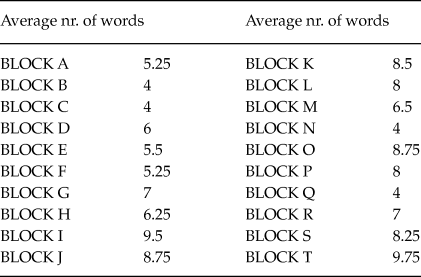
The CEG test has a multiple choice format (children are shown four pictures and have to choose the one that best represents the sentence read out by the examiner) and is divided into 20 blocks of four items each, containing the most representative grammatical structures in the Spanish language (Muñoz et al., Reference Muñoz, Fresneda, Mendoza and Carballo2008). The design of the CEG was based on the Test for Reception of Grammar -TROG - (Bishop, Reference Bishop1983), taking into account the specific characteristics of Spanish grammar (Mendoza, Carballo, Muñoz, & Fresneda, Reference Mendoza, Carballo, Muñoz and Fresneda2005b). Since, as mentioned earlier, the CEG includes some of the grammatical structures which are most affected by SLI, we hope it will be a sensitive tool to help us evaluate this population. Since it also evaluates twenty different grammatical structures, it permits a differential analysis of the performance of children with SLI in each of these structures. The CEG measures comprehension of grammatical contrasts in unnatural situations, so the effect of contextual factors is probably lower. Difficulties in attention and short-term memory can have an adverse effect on performance, although the extent of these influences can be evaluated by qualitative analysis (for instance, by analyzing the type of distractor selected in case of error or by comparing performance in items with a smaller or greater number of words). The average number of words in the items in each block varies from 4 to 9.75, which also makes it possible to analyze the answers according to the number of words in each sentence. CEG was standardized on a population of 1404 participants (Muñoz et al., Reference Muñoz, Fresneda, Mendoza and Carballo2008).
In the psychometric study, the CEG showed a reliability factor of 0.9096, revealing good internal consistency. Criterion validity has been demonstrated by the high correlation between CEG and other tests shown to have adequate validity. Finally, the study of discrimination indices shows that both the items and the blocks in the CEG discriminate between different age groups and between the participants in the total sample.
Delay or disordered development?
Rice (Reference Rice, Rice and Warren2004) addresses an old debate that may be important in achieving a better understanding of the linguistic difficulties of children with SLI: delayed development vs. altered development. We can ask ourselves if children with SLI develop a pattern of linguistic growth similar to that of younger children with normalized linguistic development, which would mean that their linguistic system is delayed, or if their linguistic growth differs from the standard, which would indicate the presence of a deviant or altered linguistic system. Bishop and Rosenbloom (Reference Bishop, Rosenbloom, Yule and Rutter1987) set forth some indications with which to distinguish between a delayed and a deviant development of linguistic comprehension. They proposed that one sign of delay in receptive grammar was the tendency to ignore final flexions of verbs, plural markers, etc., while deficient comprehension of certain structures would be an example of deviance of receptive grammar. Serra (Reference Serra2002) believes that comprehension problems in SLI can be observed when no pragmatic cues are available to the participants and they can only use linguistic cues. Comprehension in these children therefore develops in a different way to that of children with language delay.
In this study we set the following aims. First, to determine whether the CEG test has fair or good discriminant accuracy to SLI, in the sense that children with SLI should obtain a score significantly lower than that of children of the same chronological age (chronological control participants). Second, to find out if there is a similar pattern in the comprehension of different grammatical structures analyzed by the CEG for children with SLI and younger children with similar global scores (linguistic control participants). Thirdly, to explore whether there are differences between the two groups due to the length of the sentence (which increases memory demands) or if these differences appear in the grammatical structures that are more sensitive to SLI (such as clitics and alteration of the SVO order).
Due to the low number of publications on grammatical comprehension in Spanish-speaking children with SLI, we believe this study will be useful in answering some of the questions surrounding the explanation of linguistic difficulties in SLI: grammatical deficit vs. difficulties in processing and phonological memory.
Method
Participants
Forty-two native Spanish-speaking children took part in this study and were divided into three groups. The experimental group was made up of 14 children (5 girls and 9 boys) aged between 5 and 14 who had been diagnosed as having SLI by qualified specialists. All children had a non-verbal IQ ≥ 85, none of them had hearing problems and, according to their teachers, their linguistic difficulties interfered with their academic and social performance. They were all receiving speech-language therapy at the time of their participation in the study. All children in this group scored below the 15th percentile in the total CEG score for their age.
Each subject in this group (SLI) was matched randomly with a child of the same gender and chronological age who did not have language problems (selected from the standardization sample of CEG). In this group we had to make an exception; since four of the children in the SLI group were older than 11 years and 11 months, the age limit established for the CEG, these children had to be paired with 11-year old children. This second group was the chronological control group (CC). No significant differences were found in the age-mean of the children in both groups: t = .649; p = .522.
We selected a third group, also made up of 14 participants, through random pairing of each child in the SLI group with another child from the CEG standardization sample, using the following criterion: children, each of whom had achieved the same total number of correct answers in the CEG as a corresponding SLI child and whose CEG score corresponded to the 50th centile of their age-group. The third group was the control group for grammatical comprehension, known as the linguistic control group (LC).
With this procedure, each child from the SLI group was matched with another child of the same chronological age (CC group) and with another, theoretically younger, child with a similar global score in the CEG (LC group). Table 1 shows the age distribution in each group.
Distribution of age (years) of participants in each group: Linguistic Control (LC), SLI and Chronological Control (CC) groups

Procedure
Each child from the SLI group took the CEG test as part of an evaluation protocol. This consisted of 80 multiple-choice items (with 4 possible answers in each), distributed in 20 blocks of representative structures of the Spanish language. The structures in question are as follows:
(a) non-reversible predicative SVO sentences [e.g., el gato come un plátano (the cat eats a banana)]; (b) Attributive sentences [e.g., el perro es negro (The dog is black)]; (c) negative predicative sentences [e.g., el niño no come (The child does not eat)]; (d) pronominalized predicative sentences [e.g., la niña se lava las manos (the girl washes her hands)]; (e) reversible predicative SVO sentences [e.g., el ratón persigue al gato (The mouse chases the cat)]; (f) SVO predicative sentences with plural subject [e.g., los niños ven la televisión (Children watch televisión)]; (g) disjunctive coordinated sentences [e.g., ni el gato ni el perro son negros (Neither the cat nor the dog are black)]; (h) predicative sentences with S-V-Complement of place. [e.g., el perro está delante del gato (The dog is in front of the cat)]; (i) adversative coordinated sentences [e.g., la niña no sólo es rubia, sino también delgada (The girl is not only blonde, but also thin)]; (j): SO relative sentences [e.g., el perro persigue al gato que es pequeño (The dog chases the cat which is small)]; (k) SVO with split subject [e.g., es el gato el que muerde al perro (It is the cat that bites the dog)]; (l) absolute comparative sentences [e.g., el cuadrado es más grande que el círculo (The square is bigger than the circle); (m) OVS with focused subject. [e.g., a la mujer la peina el hombre (Literally To the woman combs the man – More correctly The man combs the woman’s hair)]; (n) sentences with pronominalized object (contrasts in gender and number) [e.g., las niñas lo miran (The girls are watching him)]; (o) SS-type relative sentences [e.g., el niño que mira a la niña está comiendo (The boy who is watching the girls is eating)]; (p) adversative coordinated sentences. [e.g., la niña es morena, pero el niño no (The girl is a brunette, but the boy is not)]; (q) sentences with pronominalized object (contrasts in gender and number) [e.g., la mujer los lleva (The woman takes them)]; (r): reversible passive sentences [e.g., La niña es empujada por el niño (The girl is pushed by the boy)]; (s) sentence with split object. [e.g., es a la niña a quien besa el niño (It is the girl whom the boy kisses)]; (t) OS relative sentences. [e.g., el círculo dentro del que hay un cuadrado es azul (The circle within which there is a square is blue)].
After applying and correcting the test, each child was matched with another child from each of the other groups, as outlined above. Before performing the statistical analysis, the average number of words in the four sentences in each block of the CEG was calculated, as shown in Table 2.
Average number of words of the four sentences in each block

Results
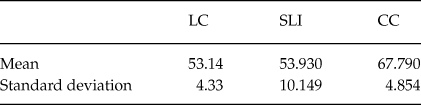
In Table 3 we show the mean and standard deviation of the total number of correct responses of each group in the CEG. The ANOVA of the total variable of correct responses, taking the group to which they belong as the grouping factor, gives a value of F 2 = 19.609, p < .0001, η2 = .501. In the post-hoc analysis (Tukey DHS) no differences were found between the SLI group and the LC group, since the participants were matched according to the number of correct responses, although there were significant differences between the SLI and the CC group F 1 = 21.241, p < .0001, d = .9345.
Mean and standard deviation of the number of correct responses obtained in the CEG by participants of each group: Linguistic Control (LC), SLI and Chronological Control (CC)

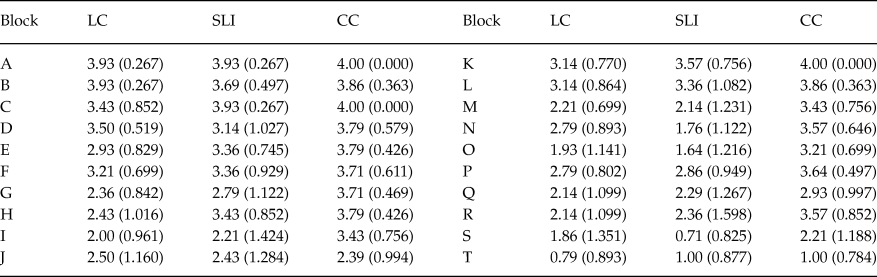
Once we had examined all elements we proceeded to analyze the total number of correct responses obtained by each group in the different blocks in the CEG. Table 4 shows the statistics (mean and standard deviation) of this number of correct responses. The MANOVA of each number of correct responses in each block (20 blocks) considering the group as an independent variable (3 groups) gives the following results: F(40, 42) = 2.746, p = .001, η2 = .723. We can therefore say that there are statistically significant differences in the number of correct responses per block between the three groups, with a high effect size.
Mean and standard deviation (std. dev.) of the groups in the different blocks of the CEG

Note: GROUPS: LC: Linguistic control, SLI: Specific Language Impairment; CC: Chronological Control.
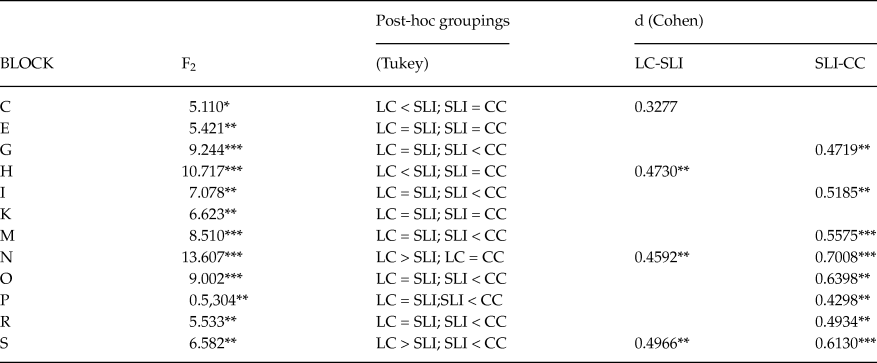
In view of these results, we carried out an ANOVA for each variable (number of correct responses in each block). The results of the analysis can be seen in Table 5, which presents the variables (blocks of the CEG) in which significant differences between the two groups were obtained.
Values of F, post-hoc groupings (Tukey) and effect size in blocks with significant differences between groups: Linguistic Control (LC), SLI and Chronological Control (CC)

Note: *p < .05; **p < .01; ***p < .0005.
According to our findings, there are statistically significant differences between the three groups in 12 of the 20 blocks of sentences of the CEG: C (negative predicative), E (reversible predicative SVO), G (disjunctive coordinated), H (predicative with S-V-Complement of place), I (adversative coordinated), K (SVO with split subject), M (OVS with focused object), N (pronominalized object with contrast in gender and number), O (SS relative clauses), P (adversative coordinative), R (passive reversible) and S (OVS with split object). In the post-hoc groupings the following possibilities can be observed:
-
- (LC = SLI) < CC: Blocks G (disjunctive coordinated), I (adversative coordinated), M (OVS with focused object), O (SS-type relatives), P (adversative coordinated) and R (reversible passive).
-
- LC < (SLI = CC): Blocks C (negative predicative) and H (predicative with S-V-Complement of place).
-
- SLI < (LC = CC): Blocks N (pronominalized object with contrasts in gender and number) and S (OVS with split object).
-
- (LC = SLI) (SLI = CC): Blocks E (reversible predicative SVO) and K (SVO with split subject).
-
- LC = SLI = CC: Blocks A (non-reversible predicative SVO), B (Attributive), D (pronominalized predicative), F (SVO predicative with plural subject), J (SO relative), L (absolute comparative), Q (pronominalized object) (contrasts in gender and number) and T (OS relative).
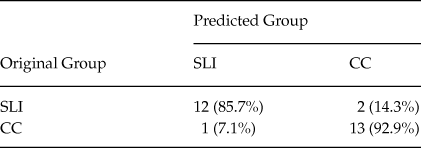
To determine the degree of sensitivity and specificity of the CEG to grammatical comprehension in SLI, we carried out an analysis of the discriminant function of the variables (blocks) and found significant differences between the SLI and the CC groups (blocks G, I, M, N, O, P, R and S). The results of this analysis were as follows: Box’s M = 63.080, F = 1, 159, p = .238. We can therefore say that the variance in both groups is the same. The canonic correlation of the discriminant function is 0.878. In Table 6 we present the statistics of the classification by cross-validation.
Percentage and total number of participants in SLI and CC groups classified correctly with the criterion of discriminating function using cross-validation

As seen in the Table, 85.7% of children with SLI were correctly classified with the variables introduced in the discriminant function analysis and 92.9% of the CC group were also correctly classified. The percentage of correct classifications in the SLI group is an indication of the sensitivity of the test and the percentage of participants in the control group is a measure of its specificity. According to the standards suggested by Plante and Vance (Reference Plante and Vance1994), a discriminant accuracy of 80% or higher can be considered good and above 90% is excellent.
Discussion
The study’s findings confirm that there are significant differences between the number of items in the CEG answered correctly by children with SLI and that of their chronological control participants, with higher scores obtained by the latter. This indicates that the CEG is a useful tool for the detection of grammatical comprehension problems in children with SLI, with a high effect size, that is, with a high clinical significance. We also verified that there are no differences in the total number of correct responses in the CEG between children with SLI and their linguistic control participants. This was to be expected, since we matched the participants of the two groups on the basis of their total score in the CEG. With this result we achieved the first aim of the study. The analysis of the discriminant function shows a high degree of sensitivity and specificity of the CEG, more specifically of blocks G, I, K, M, N, O, P, R and S considered as a whole.
As for the second aim, we have seen that the differences between the three groups do not appear in all the blocks or in the same direction. The existence of delay can be seen (SLI = LC) in blocks G, I, M, O, P and R. In three of these blocks (G, I, P) we analyzed disjunctive coordinated sentences [e.g., ni el gato ni el perro son negros (neither the cat nor the dog are black)] and two types of adversative coordinated sentences [e.g., la niña no solo es rubia, sino también delgada (the girl is not only blond, but also thin)- el perro es pequeño, pero el gato no (the dog is small, but the cat is not)]; in two blocks (M, R) the sentences presented are in non-canonical order [e.g., a la niña la pinta el niño (the girl is painted by the boy)- el niño es abrazado por la mujer (the boy is hugged by the woman)] and in the last block, O, the sentences have SS-type relative clauses [e.g., el perro que persigue al gato es pequeño (the dog that runs after the cat is small)]. Some of these blocks (I, O, P and R) have an average of over 8 words per sentence, in block I it as high as 9.5 words. In these types of sentences, children with SLI behave like their control participants matched by the total number of correct responses in the CEG.
In two of the blocks, the following pattern was obtained: LC < (SLI = CC). The sentences in block C are negative predicative [e.g., el niño no come (the child does not eat)] and those in block H are predicative sentences with S-V-Complement of place [e.g., el perro está delante del gato (the dog is in front of the cat)]. In a pilot study of a version of the CEG for children between 2 and 4 years of age (Calet, Mendoza, Carballo, Fresneda, & Muñoz, Reference Calet, Mendoza, Carballo, Fresneda and Muñoz2010), it was shown that small children have great difficulties in answering correctly when faced with predicative negative sentences and that they tend to choose the affirmative form. Nevertheless, the size of the effect is small and does not seem clinically significant. As for block H, in which sentences with a circumstantial complement of place are analyzed (spatial terms such as on, under, in front of, behind), the results obtained are more conclusive: the scores of the LC group are significantly lower than those obtained by children with SLI. A possible explanation of this result may be that smaller children have more difficulties with spatial terms and with their lexical precision; in contrast, the children with SLI, who are older, have probably already acquired the vocabulary for these spatial concepts, since their results in this block are similar to those of their chronological control participants. According to Gray, Plante, Vance, and Henrichsen, (1999), vocabulary is not an especially difficult area for children with SLI, in spite of the fact that they can have important semantic difficulties. van der Lely (Reference van der Lely2005) says that, although lexical deficits in SLI have been discovered, these are usually less severe than grammatical deficits and that they can be secondary to the latter.
In blocks E and K, in which reversible active sentences are analyzed [e.g., la niña empuja al niño (the girl pushes the boy), es el hombre el que besa a la mujer (it is the man who kisses the woman)], the behavior of the SLI group is different from that of the two control groups: its performance in these two blocks can be considered intermediary, since there are no significant differences with either of the other groups, while there are differences between the LC and CC groups. It can be said that the children with SLI analyzed in this study are already able to take their own decisions as far as word order goes. This means that reversibility does not cause them any trouble, since they consider the first noun to be the agent. Bishop (Reference Bishop1979) indicated that children with receptive problems have difficulties in using word order cues to interpret sentences. Other authors, such as van der Lely and Dewart (Reference van der Lely and Dewart1986) and van der Lely and Harris (Reference van der Lely and Harris1990) have commented that children with disorders in expressive and receptive language (SLI-ER) answer at random in sentence comprehension tasks when they only have word order cues. The children with SLI in our study do not seem to experience this difficulty, possibly due to the age of most of the children with SLI in our sample group. It is likely that the children in the LC group, who are younger, base their comprehension more on the strategy of animacy (animate subject and inanimate object) and that reversibility situations in which both subject and object are animate can cause them trouble (Chapman, Reference Chapman, Kavanaugh and Strange1978; Miller & Paul, Reference Miller and Paul1995).
In contrast, when the reversibility is associated with an alteration of the SVO order (as in blocks M and R), children with SLI show the same difficulties in sentence comprehension as the younger children. In the sentences in this block, besides the reversibility of thematic roles, there is also an alteration of the usual order. Both children with SLI and their linguistic control participants seem to base their comprehension on “the first noun as agent”. This is the cause of their difficulties in understanding this kind of sentence. Until the age of 6 or 7, children with normal linguistic development do not understand passive verbal sentences (Horgan, Reference Horgan1978). Furthermore, the interpretation difficulties of passive reversible sentences in children with SLI has been recognized by different researchers, using different methodologies and theoretical perspectives (Bishop, Reference Bishop1979, Reference Bishop1997; Evans & McWhinney, Reference Evans and McWhinney1999; van der Lely, Reference van der Lely1994, Reference van der Lely1996; van der Lely & Dewart, Reference van der Lely and Dewart1986).
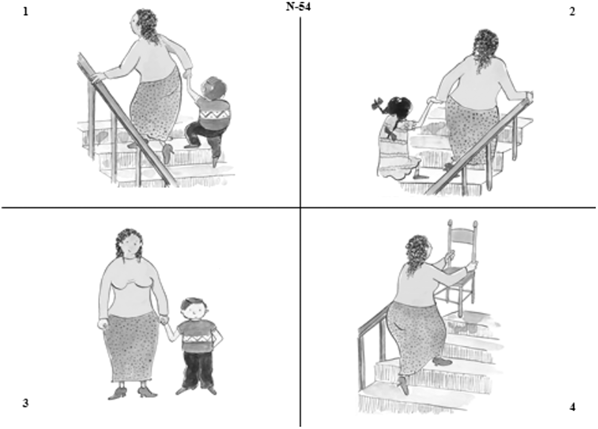
In two other blocks (N and S) a different pattern appears, since SLI < (LC = CC), i.e., the children of the SLI group have significantly worse results in the task evaluated in these blocks than their linguistic control participants. The effect size indicates a high clinical significance. In block N the stimuli are sentences with direct clitic pronouns [e.g., la mujer lo sube (the woman takes him upstairs), los perros la persiguen (the dogs run after her)]; moreover, the only differences between the distractor pictures are in gender and number. In Figure 1 we can see an example of the pictures used as stimuli in one of the pages in this block. Besides the correct option (1), there are two grammatical distractors (2 and 4, in which the woman takes a girl and a chair upstairs, respectively; both of feminine gender in Spanish), and a lexical distractor (3, where the action is not that of going upstairs).
Picture of item N-54: “La mujer lo sube” (The woman takes him upstairs).

We also have evidence of the difficulties Spanish-speaking children with SLI have with the use of direct clitic pronouns (Bedore & Leonard, Reference Bedore and Leonard2001, Reference Bedore and Leonard2005; Bosch & Serra Reference Bosch, Serra, Baker, Beers, Bal, de Jong and Leemans1997; Jacobson & Schwartz, Reference Jacobson and Schwartz2002), and similar problems have been found in other Romance-languages (Jakubowicz, Nash, Rigaut, & Gérard, Reference Jakubowicz, Nash, Rigaut and Gérard1998; Paradis, Crago, & Genesse, Reference Paradis, Crago and Genesse2006). Most of this research has focused on the production of clitics, either through elicitation or in spontaneous use, while relatively few studies have been made of comprehension. Nevertheless, Jakubowicz et al. (Reference Jakubowicz, Nash, Rigaut and Gérard1998) points out difficulties in the comprehension of the above-mentioned terms. These difficulties appear consistently in our study and they fit into the pattern of “delay within the delay” (Rice, Reference Rice, Levy and Schaeffer2003), since comprehension of these terms is more deficient in children with SLI than in their linguistic control participants.
Block S was also more difficult for children with SLI than for their linguistic control participants. In the sentences in this block there are two elements that make them grammatically complex: alteration of SVO order and emphasis on the object [e.g., es al ratón al que persigue el gato (Literally it is the mouse to which the cat is chasing –More correctly The cat is chasing the mouse)]. Here we find again that SLI < (LC = CC). But the average number of words in the items in this block is 8.25, which might suggest that the poor results of children with SLI in this block are due to the limitations of their working memory and to the difficulty they experience in retaining and integrating the elements making up each sentence. In this case, there is an interaction between two elements: grammatical complexity and length of sentence; elements which, on the other hand, are difficult to differentiate since in everyday language when the length of a sentence increases, so does its complexity. Nevertheless, the results obtained lead us to the conclusion that grammatical complexity affects processing and comprehension of sentences to a higher degree than length does.
Marton and Schwartz (Reference Marton and Schwartz2003) carried out a study on working memory and sentence comprehension in English-speaking children with SLI and found that grammatical complexity had a higher effect than length of sentences. The authors concluded that the processing of more complex sentences requires a greater capacity of working memory. These findings have been replicated with Hungarian children with SLI (Marton, Schwartz, Farkas, & Katsnelson, Reference Marton, Schwartz, Farkas and Katsnelson2006). This may suggest that the working memory is a storage space that depends not only on the amount of information stored, but also on processing demands. Therefore greater resources are required to process a complex sentence than a syntactically simple one, even though it may have more words.
In the CEG there is no systematic control of the length of sentences, instead, what is checked is their complexity. This is why we cannot perform an experimental study of the effects of length of sentence. Nevertheless, if we compare the two blocks in which children with SLI obtained worse results than their linguistic control participants (blocks N and S) we can see that the average number of words of sentences in block N is 4, similar to that of blocks B and C, which is where they obtained scores similar to the control participants of their age. The average number of words in sentences in block S is 8.25, similar to that of other blocks (I, K, O) in which the performance of children with SLI was similar to that of the LC group. In agreement with Hoffmann and Gillam (Reference Hoffmann and Gillam2004) and Marton et al. (Reference Marton, Schwartz, Farkas and Katsnelson2006), we suggest that the processing of complex information requires the assignment of a higher quantity of resources and can explain the difficulties shown by children with SLI in solving complex grammatical tasks.
Lastly, in the rest of the blocks (A, B, D, F, J, L, Q, T) we found no significant differences between the three groups. Although in the process of designing the CEG we verified that all blocks discriminated significantly between target age groups, the aim of this study is not to study age groups but rather to compare a clinical group (SLI) with two control groups (LC and CC). The ages of the participants are very diverse, and strict control of the age was not the objective on this occasion. We found that the easiest blocks were A, and B and the most difficult was T, in which the older children in the standardization sample of the CEG had very low scores. Of the remaining blocks, in D, in which we analyzed the contrasts between the pronouns “se” (himself, herself, itself) and “le” (him, her, it), there are no significant differences, although the SLI group has lower accuracy. In block Q there is also an analysis of direct clitic pronouns, similar to N, although with a more complex set of distractors, since on one page there are distractors of gender and number. This block is usually more difficult for all participants, including those in the CC. No differences were found between the groups in the sentences with a plural subject or in the absolute comparative sentences.
As for the relative sentences, significant differences were only found in those in block O [e.g., el cuadrado que está dentro del círculo es azul (the square which is inside the circle is blue)], with similar results for the SLI and LC groups. In blocks J [e.g., el cuadrado está dentro del círculo que es azul (the square is inside the circle which is blue)] and T [e.g., el cuadrado dentro del que hay un círculo es azul (the square in which there is a circle is blue)] no differences between groups were found. Generally, relative clauses inserted in the center [e.g. el cuadrado dentro del que hay un círculo es azul (the square in which there is a circle is blue)] are harder to understand than those that branch out on the right [e.g., el cuadrado está dentro del círculo que es azul (the square is inside the circle which is blue)]. Slobin (Reference Slobin, Ferguson and Slobin1973) suggested that a basic principle in language processing is to avoid interruption of linguistic units, which is what happens when clauses are inserted in the center. The only sentences with relative clauses in which significant differences have been found are those of the SS type [e.g., el círculo que está dentro del cuadrado es azul (the circle which is inside the square is blue)], perhaps because they have an intermediate level of difficulty. In these, the participants from the SLI group obtain results similar to those of their linguistic control participants. According to Correa (Reference Correa1995) it is probable that children who are speakers of Romance languages interpret relative clauses earlier than English-speaking children due to structural differences between the two languages. These differences can be attributed to the fact that Romance languages are less restricted in this respect than English due to the fact that they allow greater flexibility in word order.
In carrying out this study we have attempted to examine grammatical comprehension skills in children with SLI. Very few studies have been carried out on this topic up until now, especially in Spanish-speaking children with SLI. As Bedore and Leonard (Reference Bedore and Leonard2005) pointed out, language assessment tools have tended to centre on lexical analysis and less work has been done on the morphosyntactic dimension; moreover, within the latter, research efforts have focused more on production than on comprehension.
In this research we have verified that children with SLI show difficulties in the comprehension of sentences, since they scored significantly lower than their chronological control participants in the CEG. However, when analyzing each of the blocks, it can be seen that not all grammatical constructions analyzed in the CEG are equally susceptible to error in this population. Generally, in most blocks in which significant differences are registered, the results they obtain are similar to those of their linguistic control participants. This shows that children with SLI have a delay in the comprehension of certain grammatical structures, as mentioned above, but at the same time have greater difficulties than younger children in the comprehension of sentences with direct object clitic pronouns. These difficulties are not attributable to the length of the sentences, but rather to their grammatical complexity and to difficulties in the assignment of the referents they require. In block S the results of the SLI group were also lower. Both the length of a sentence and its complexity affect the demand on working memory and make information processing harder for children with SLI.
Some of the limitations of this study are that no distinction was made between children with expressive SLI and expressive-receptive SLI. It is likely that, when the performance of both groups is compared, differences will be identified between the two. The age margin should be reduced as well, since in the SLI group we had children between the ages of 5 and 14, which in some cases prevented us from making a reference to age standards. We did match them one-to-one with children from both control groups. Let us also mention that it would be most interesting in future studies to include measures of working memory to better examine the two theoretical accounts of SLI.
It has been verified that the CEG is a sensitive tool for the identification of children with SLI. It is therefore a useful instrument for the evaluation of this population. Since one set of blocks discriminates between children with SLI and children with normal linguistic development, it might be interesting to design a more limited version to be applied to this population.