The goal of management of oral anticoagulation is to ensure that treatment is effective and safe in preventing thromboembolism, and is without haemorrhagic complications. In patients with the Fontan circulation, the incidence of thromboembolism is reported as between 3 and 16 percent by retrospective studies.1 In patients with a single mechanical valve not receiving any antithrombotic therapy, the risk of thromboembolism is between 5.7 and 20 percent per patient-year, depending on the site and type of valve.2–4 With anticoagulation, the risk of thromboembolism is less than 5.3 percent per patient-year,5 and the risk of serious haemorrhage is less than 3.2 percent per patient-year.6 Furthermore achieving optimal anticoagulation in children with cardiac disease involves many complexities. Streif et al.7 have demonstrated the profound effect of young age, and the effect of congenital cardiac disease, in particular the Fontan circulation, on dosages of warfarin. Antithrombotic therapy in children is also affected by recurrent infection, issues of compliance, issues of vascular access, and the lack of specific formulations for use in children.1 Successful management of anticoagulation in populations of children with cardiac disease, without excessive use of resources, therefore, requires good prescribing practices, robust guidelines, and adherence of the patients to the prescribed regime.
In our department, children with the Fontan circulation, or with mechanical valves, are anticoagulated indefinitely. All physicians in the service, including junior doctors, share the responsibility of prescribing warfarin. With multiple prescribers, it is important that interpretation of the International Normalised Ratio, and subsequent prescribing practices, are standardised. It is also important that communication between physicians is effective. A computerised system to support decision-making, called Warfarin Manager, was developed for use by the department in an attempt to improve consistency of prescribing practices, and communication between physicians. We hypothesised that the use of Warfarin Manager would improve prescribing practices, and thus maintain the International Normalised Ratios of our patients closer to their target range. The aim of this study was to assess these prescribing practices, and the stability achieved for the ratio, by making a retrospective comparison between the pre-existing system, whereby decisions concerning treatment with warfarin were recorded manually, and the computerised records obtained from Warfarin Manager. To our knowledge, there is no previously published data on the use of computerised systems to support decision-making in the management of the maintenance of anticoagulant therapy using warfarin in children.
Materials and methods
Our department is the only centre for paediatric cardiology and cardiothoracic surgery in New Zealand. As such, the target population is all children with cardiac disease requiring anticoagulation in New Zealand. The sample population is children with cardiac disease requiring anticoagulation living in Auckland, as this is the population whose maintenance with warfarin is routinely managed by our department. To be eligible for inclusion in this study, patients had to be undergoing anticoagulation by means of warfarin prescribed by physicians from our department. Patients were excluded only if their file in either system had fewer than three measurements of the International Normalised Ratio.
The need for anticoagulation, and its potential for producing haemorrhagic complications, were explained to children and their caregivers at the time of initiation of treatment. After stabilisation of the dosage of warfarin, patients were instructed in home monitoring using a portable prothrombin time monitor (Coagucheck S®, Roche Diagnostics, Mannheim, Germany), which determines the prothrombin time for whole blood using a capillary sample obtained by finger prick, and calculates an International Normalised Ratio. In contrast to studies elsewhere, showing this device to compare favourably with laboratory measurements of the ratio in plasma in children,8, 9 our laboratory had previously collected paired samples of whole blood and plasma simultaneously, permitting calculations of the ratios, from 41 patients aged 0 to 40 years with cardiac disease, which showed disagreement, particularly for higher ratios (Fig. 1). For this reason, it has been our practice to use an algorithm derived from this previously unpublished data to determine equivalent ratios for plasma from those obtained using whole blood. For prescription of the warfarin needed to maintain anticoagulation, patients or their caregivers made telephone contact with the on-call physician, and discussed the results of their International ratio relative to their prescription. This physician was usually a paediatric trainee rotating through the department, or occasionally a paediatric cardiologist.

Figure 1. Paired measurements of the International ratio for whole blood (coagucheck) and plasma (laboratory) from 41 patients aged 0 to 40 years with cardiac disease, showing a non-linear relationship, with disagreement particularly at higher ratios. The illustrated regression equations were used to determine the equivalent values of the ratio for plasma from those measured using whole blood ( Paired Plasma-Whole Blood International Normalised Ratio samples; – – for plasma International Normalised Ratios ≤ 2.5, whole blood International Normalised Ratio = 0.91 × plasma International Normalised Ratio + 0.2; ––– for plasma International Normalised Ratios > 2.5, whole blood International Normalised Ratio = 2.36 × plasma International Normalised Ratio −3.66).
A manual system of recording the prescriptions for warfarin was used prior to the introduction of Warfarin Manager. Data from the 4 months immediately prior to the introduction of Warfarin Manager were available for study. Using this manual system, the physician determined an equivalent ratio for plasma from that obtained using whole blood, reviewed the handwritten record, prescribed a dose of warfarin, advised on the due date for the next measurement of the ratio, and recorded in the file these details and the date. Decision-making was based on pre-existing departmental guidelines for long term maintenance of anticoagulation using warfarin, which are adopted from the nomogram first published by Michelson et al.5
Warfarin Manager is a non-proprietary rules-based computer system to support decision-making developed within our department. It uses the same pre-existing guidelines used by the manual system. When phoned with a value for the International Normalised Ratio, the physician enters the date and the given ratio. Warfarin Manager determines the equivalent ratio for plasma from the value obtained for whole blood, and calculates the dose needed for warfarin, and the date of the next check needed. These calculations, the prescription made by the physician, and any comments, are recorded in the file. Responsibility for the safety of the patient, and the prescription for warfarin, remain entirely with the prescribing physician, as does the freedom to prescribe as the physician feels appropriate, even if this is outside the recommendations of the guidelines.
Statistical analysis
The first two measurements of the ratio from the files of each patient were excluded from the analysis, because Warfarin Manager was designed for maintenance therapy, and as such requires at least the first entry be manually entered. For each subsequent measurement, the measured ratio, the dose of Warfarin prescribed, and the interval to the next measurement of the ratio, were recorded. We also determined the dose and recheck interval as recommended within the departmental guidelines.
The stability of the International Normalised Ratio was calculated for each patient using the Rosendaal method.10 This method calculates the mean time spent by each patient within the target range for their International ratio, assuming the ratio itself has a linear relationship over time between two consecutive measurements, thus avoiding bias from more frequent measurements as made in unstable patients.
Differences in prescribing practices, and the stability of the ratio, as occurring between the manual system and using Warfarin Manager were compared using the chi-squared test and the paired Student t-test, respectively.
Results
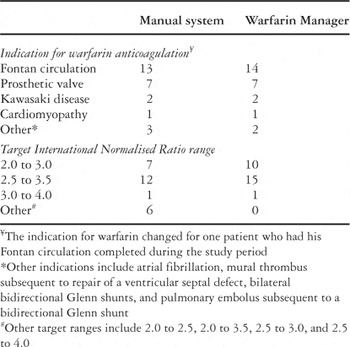
Of 33 patients with files in our manual system, one had fewer than three entries. A further six had fewer than three entries in Warfarin Manger, leaving 26 patients who had a file in both the manual system and Warfarin Manager, and were therefore included in the study. There were 16 males and 10 females, with an age range from 3.1 to 18.1 years, and a median age of 6.4 years. Indications for treatment with warfarin, and the target ranges for the International ratio, are shown in Table 1. Data from the manual system was obtained over four months, and contained 274 measurements of the ratio, of which 9 were excluded because of an incomplete record. Data from Warfarin Manager was analysed after a period of 11 months, and contained 608 measurements. All records were complete using Warfarin Manager.
Table 1. Indications for warfarin and target ranges for the International Normalised Ratio. Sample size = 26

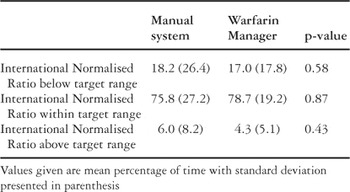
Patients were in their targeted range for a mean of 76 percent (standard deviation 27 percent) of the time under the manual system, and for a mean of 79 percent (standard deviation 19 percent) of the time using Warfarin Manager (see Table 2). Patients were neither more under- nor over-anticoagulated using Warfarin Manager than they had been using the manual system.
Table 2. Stability of the International Normalised Ratio.

There was no difference in the number of checks of the ratio made per patient over a period of 28 days with Warfarin Manager, the median being 1.9, with a range of 0.5 to 4.8, compared to the manual system, with a median of 2.1, and a range from 0.7 to 7.8, these differences not being significant. Similarly, the mean interval between the measurements of the ratio did not change significantly with the introduction of Warfarin Manager, when the median was 14.6 days, with a range from 5.9 to 53.6 days, compared to the manual system, which had a median of 13.5 days, and a range of 3.6 to 41.4 days, this difference again not being significant. The percentage of measurements of the ratio that resulted in an adjustment of dosage was no different with Warfarin Manager, with a median of 39 percent, and a range from 0 to 80 percent, than in the manual system, where the median was 28 percent, and the range was from 0 to 100 percent. This difference was also not significant.
There was a significant increase of prescriptions made within the recommended guidelines, both in terms of dosage and recheck interval, following the introduction of Warfarin Manager. Using the manual system, the prescribing physician prescribed outside the guidelines for dosage 37.2 percent (91/274) of the time, and 67.9 percent (186/274) of the time for recheck interval. The prescribing physician amended the calculation made by Warfarin Manager for dose 21 percent (127/608) of the time, and 33 percent (198/608) of the time for recheck interval, prescribing outside the recommended guidelines on these occasions.
Discussion
Our study is non-randomised, and as such is limited by inherent biases. Selection bias occurs as the 6 patients who were excluded for not having a file with more than two checks of the International ratio may be different to those studied. The reason for including only patients with a file in both the manual system and Warfarin Manager was to reduce any differences in compliance between the two groups, ensuring that each patient was included in each group. As a result of this, however, patients were older, and had been on warfarin for longer, and thus were more familiar with the system for home monitoring, during the period of study with Warfarin Manager, introducing an element of performance bias to the study. The study is also limited by the short period for which data was available from the manual system, with fewer checks of the ratio to compare with Warfarin Manager. Although we attempted to include all children with cardiac disease in Auckland receiving anticoagulation with warfarin, the numbers are very small.
Despite these caveats, our study provides useful insights into the use of computerized systems to support decision-making for children with cardiac disease. There are a number of reports detailing the use of such systems designed for management of anticoagulation using warfarin in adults.11–18 Comparison between studies, however, is hindered by differences in reporting of results. All but one12of the randomised trials have shown an improvement in the stability of the International ratio when calculated either by point prevalence or as the mean proportion of time spent within a target range.15–17 In contrast, our study has not shown an improvement in the stability achieved for the ratio. This may reflect the higher baseline stability in our children, at 76 percent, compared to that reported in adults, where the baseline stability was 43 to 68 percent.13, 15–17 It may also reflect features of Warfarin Manager that are different to computerised systems developed for a larger number of physicians. Poller et al.12 have shown a greater improvement in stability of the ratio using computerised systems in patients with a higher target range of 3.0 to 4.5. In our children, only one patient was within this target range, and the percentage of time this patient spent in the target range increased by 12 percent following introduction of Warfarin Manager.
The number of checks of the ratio made for each patient over a period of 28 days, and the corresponding interval between checks made of the ratio, did not change. This is consistent with studies in adults,12, 16 and may be a reflection of the guidelines in place prior to the introduction of the computerised system, although this interpretation is to some extent refuted by the closer compliance with the guidelines following introduction of Warfarin Manager.
The prescribing physician overrode Warfarin Manager by amending one in five calculations of dosage, and one in three calculations for the interval between measurements of the ratio. This finding is consistent with previous observations.16 Prescribing physicians amend the dose calculated by the computer, or the date set for rechecking, for a number of reasons relating to information that the computerised system does not take into account when calculating prescriptions, such as intervening illnesses, initiation of interacting medicines, concerns about adherence of the patient to the regime of warfarin, or family circumstances and important dates. This rate of amendment is not necessarily an indication that the prescribing algorithm is less robust than would be ideal, but more likely reflects the complexities of management of anticoagulation in children. It is doubtful that a computer system would be able to account for all the variables that affect such management without becoming too cumbersome for use in a busy cardiology department. Less than 4 percent of advice generated by the computer has been shown to need revision in a study of such computer systems for management of warfarin in adults that required a second opinion to alter the advice of the computer programme.12 In our study, some of the amendments made were undoubtedly the result of lack of confidence on the part of the prescribing physician, particularly in the case of inexperienced junior doctors who adopt a cautious strategy for prescribing prior to discussing the management of their patient with a more senior physician. Until the need to override Warfarin Manager is reduced, it will not be a suitable tool for self-guided management by the patient or their family.
The significant change in prescribing practice that occurred with the introduction of Warfarin Manager is likely due to the immediate second opinion it provided the non-haematologist prescribing physician, who often had limited experience in the supervision of anticoagulation. Following introduction of Warfarin Manager, the recommended guidelines were more closely adhered to, and record keeping was faultless. The latter is a particularly important feature, given the resultant potential for education and audit.
Our study has demonstrated that it is possible to use a computerised system to support decision-making in the maintenance of warfarin used for anticoagulation in children with cardiac disease. Importantly, the stability of the International ratio was maintained. Given the organizational benefits of a computerised system, particularly in terms of ease of access to the records of the patients, Warfarin Manager has illustrated that relatively simple computerised systems can be developed at a local level for use in point-of-care services providing oral anticoagulation for children. All such systems need to be evaluated to ensure that the stability of the International ratio for each patient is at least maintained or enhanced, and that safety is not compromised.