1. Introduction
Pronounced endemism, strong glacial–eustatic control over sedimentation and consequent widespread disconformities hamper the selection of acceptable Global Boundary Stratotype Sections and Points (GSSPs) for the Carboniferous stages, including the Serpukhovian, Moscovian, Kasimovian and Gzhelian stages. The Serpukhovian Stage, proposed by Nikitin (Reference Nikitin1890), was re-introduced into the Russian stratigraphic scheme in 1974 by the Interdepartmental Stratigraphic Committee of the USSR and has become internationally recognized (Skompski et al. Reference Skompski, Alekseev, Meischner, Nemirovskaya, Perret-Mirouse and Varker1995; Gibshman, Reference Gibshman2001). The type Serpukhovian was deposited in the Moscow Basin and is situated in the Zaborie quarry near the southern margin of the town of Serpukhov, Russia. Unfortunately, the lower boundary of the type Serpukhovian is a basin-wide unconformity that resulted from a latest Visean regression and subaerial exposure followed by a Serpukhovian transgression. Deposition of the type Serpukhovian was strongly influenced by the major glacial–eustatic changes during the late Visean and continued through the Pennsylvanian (Richards & Task Group, Reference Richards2003). The succession constituting the type Visean was deposited in the Namur–Dinant Basin of Belgium, northern France and southern England. There, the type Visean is represented by a quarry section in Belgium and the contact with the overlying Namurian succession (correlative with the Serpukhovian Stage) is a regional unconformity (Paproth et al. Reference Paproth, Conil, Bless, Boonen, Carpentier, Coen, Delcambre, Deprijck, Deuzon, Dreesen, Groessens, Hance, Hennebert, Hibo, Hahn, Hislaire, Kasig, Laloux, Lauwers, Lees, Lys, De Beek, Overlau, Pirlet, Poty, Ramsbottom, Streel, Swennen, Thorez, Vanguestaine, Van Steenwinkel and Vieslet1983). The relatively deeper-water carbonate-slope and basinal sections that may serve as potential candidate sections for GSSP of the Visean–Serpukhovian (V/S) boundary are known from the Cantabrian Mountains (Spain), the South Urals (Russia) and southern Guizhou, South China (Richards & Task Group, Reference Richards2003; Wang & Qi, Reference Wang and Qi2003; Nemyrovska, Reference Nemyrovska2005; Nikolaeva et al. Reference Nikolaeva, Kulagina, Pazukhin, Kucheva, Stepanova, Kochetova, Gibshman, Amon, Konovalova and Zainakaeva2005, Reference Nikolaeva, Kulagina, Pazukhin, Kochetova and Konovalova2009; Qi & Wang, Reference Qi and Wang2005; Blanco-Ferrera et al. Reference Blanco-Ferrera, Sanz-Lopez, Garcia-Lopez and Bastida2009).
The Visean–Serpukhovian boundary has yet to be defined by a GSSP, but the first appearance datum (FAD) of conodont Lochriea ziegleri Nemirovskaya, Perret-Mirouse & Meischner, Reference Nemirovskaya, Perret-Mirouse and Meischner1994 in the evolutionary lineage Lochriea nodosa (Bischoff, Reference Bischoff1957) – Lochriea ziegleri presents an excellent possibility for boundary definition. A group of Lochriea species ornamented by numerous nodes and/or ridges appears at, or a short interval below, the Visean–Serpukhovian boundary. Although a globally recognized base of the Serpukhovian Stage is not officially ratified, the International Subcommission on Carboniferous Stratigraphy (SCCS) Task Group to establish a GSSP for the V/S boundary believes the FAD of conodont Lochriea ziegleri in the evolutionary lineage from Lochriea nodosa to Lochriea ziegleri is most suitable for boundary definition. This lineage, along with the associated faunas and strata, is being studied in several areas; the Naqing (Nashui) section in South China and the Verkhnyaya Kardailovka section in the SE Urals of Russia have the best potential as GSSP candidates however, and are under intensive study (Richards, Reference Richards2010).
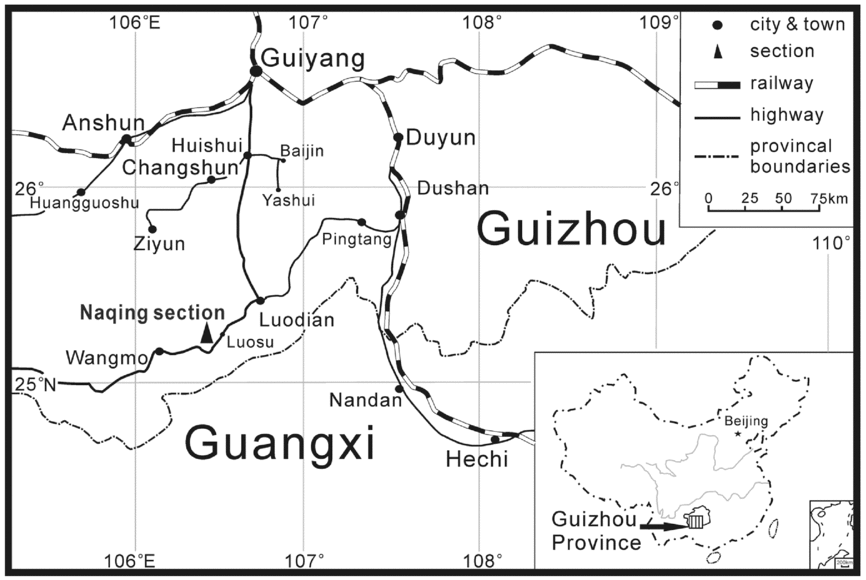
Carboniferous marine sediments are widely distributed and well developed in South China, where they form continuous sequences of marine carbonates containing conodonts and foraminifers. The Naqing section (formerly called the Nashui section) in Luosu, Luodian, Guizhou Province is the most-studied section across the V/S boundary in South China, as discussed by Wang & Qi (Reference Wang and Qi2003), Qi & Wang (Reference Qi and Wang2005), Wang & Jin (Reference Wang and Jin2005), Qi et al. (Reference Qi, Wang, Wang, Ueno and Wang2007, Reference Qi, Wang, Wang, Lane, Richards, Katsumi and Groves2009, Reference Qi, Wang, Richards, Groves, Ueno, Wang, Wu, Hu, Wang, Qi, Groves, Barrick, Nemirovskaya, Ueno and Wang2010a , Reference Qi, Wang, Richards, Groves, Ueno and Wu b ), Wang, Qi & Wang (2008) and Groves (Reference Groves, Wang, Qi, Groves, Barrick, Nemirovskaya, Ueno and Wang2010). The Naqing section is located at latitude 25° 15′ 03.9″ N and longitude 106° 29′ 06.9″ E, exposed on the side of the Wangmo–Luodian highway (S312) c.45 km SW of Luodian, 7 km SW of Luosu countryside and 2 km SW of the village of Naqing, and is easily accessible by car from the capital of Guizhou Province Guiyang (Fig. 1). This section is a relatively deeper-water carbonate-slope facies section that comprises grey thin- to medium-bedded wackestone and packstone beds intercalated with chert beds. The abundant and highly diverse conodont faunas, including 28 species or subspecies representing 6 genera obtained from the Naqing section, provide sufficient support for this section which is being considered as the GSSP for the base of the global Serpukhovian Stage. The purpose of this paper is to report recent results on the conodont succession from the V/S boundary interval of the Naqing section.
Location map of the Naqing section.

2. Geological setting
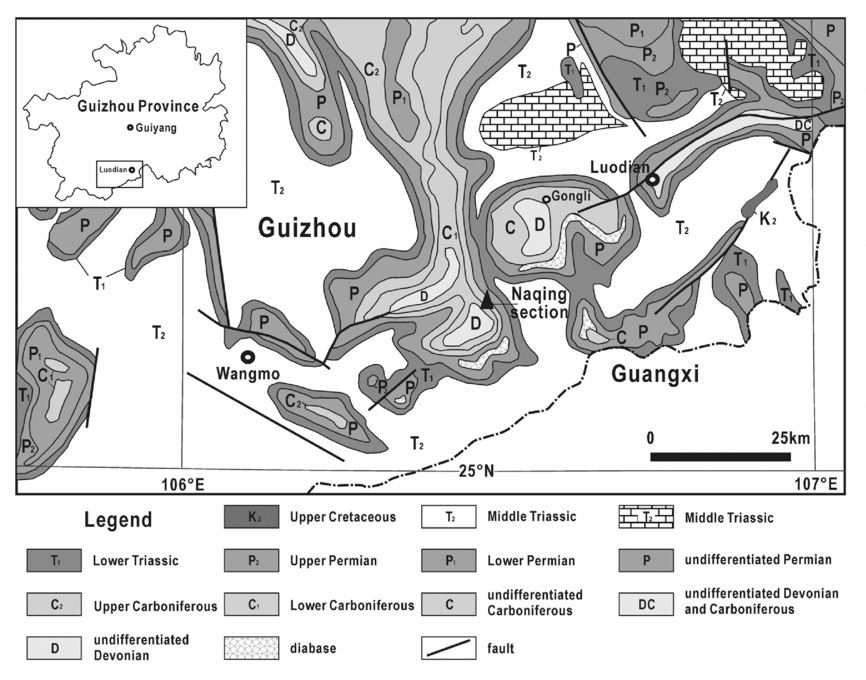
Geologically, the southern part of Guizhou belongs to the Dian–Qian–Gui Basin developed in the SW part of the South China block. The basic tectonic framework of the Late Palaeozoic of South China was formed during middle–late Silurian time when most of the eastern part of South China was folded during the Caledonian Orogeny. Transgression began again in the Early Devonian and slowly progressed northwards. The rifted basins were filled, the topography was reduced and extensive carbonates were laid down before the Pennsylvanian (Wang & Jin, Reference Wang and Jin2000). The palaeogeographic evolution of the Dian–Qian–Gui Basin was greatly influenced by NE- and NW-trending faults (Wang et al. Reference Wang, Lu, Zhao and Luo1994) and, as a result, isolated carbonate platforms are well developed in the basin (Fig. 2). During Mississippian time, lithofacies changed rapidly across the region. Generally, there are four lithofacies groups: (1) the platform margin to slope marked by slump structures and limestone conglomerate; (2) the platform margin with high-energy grainstone and reef limestone; (3) the platform interior marked by low-energy shallow-marine carbonate rocks; and (4) shallow basins characterized by gravity flows and deposits formed in deeper-water environments (Wang et al. Reference Wang, Lu, Zhao and Luo1994). The Naqing section belongs to the first lithofacies group. It is one of the best exposed sections in the Guizhou area and contains a carbonate succession that appears to be continuous from the Mississippian to the Late Permian.
Geological map of the study area.

This section is represented by the platform margin to slope facies, which are well exposed along the east limb of the Naqing Anticline. Conodont elements are abundant throughout the section, providing precise correlation with the global chronostratigraphic scale. Intercalated gravity flows and coarse-grained bases of turbidite beds throughout the section contain many fusulines and non-fusuline foraminifers, which are the index fossils used for regional stratigraphic correlation. These characteristics make the Naqing section important for stratigraphic correlation between shallow- and deep-water facies, thereby providing an excellent reference for both regional- and global-scale correlations.
3. Sedimentological characteristics
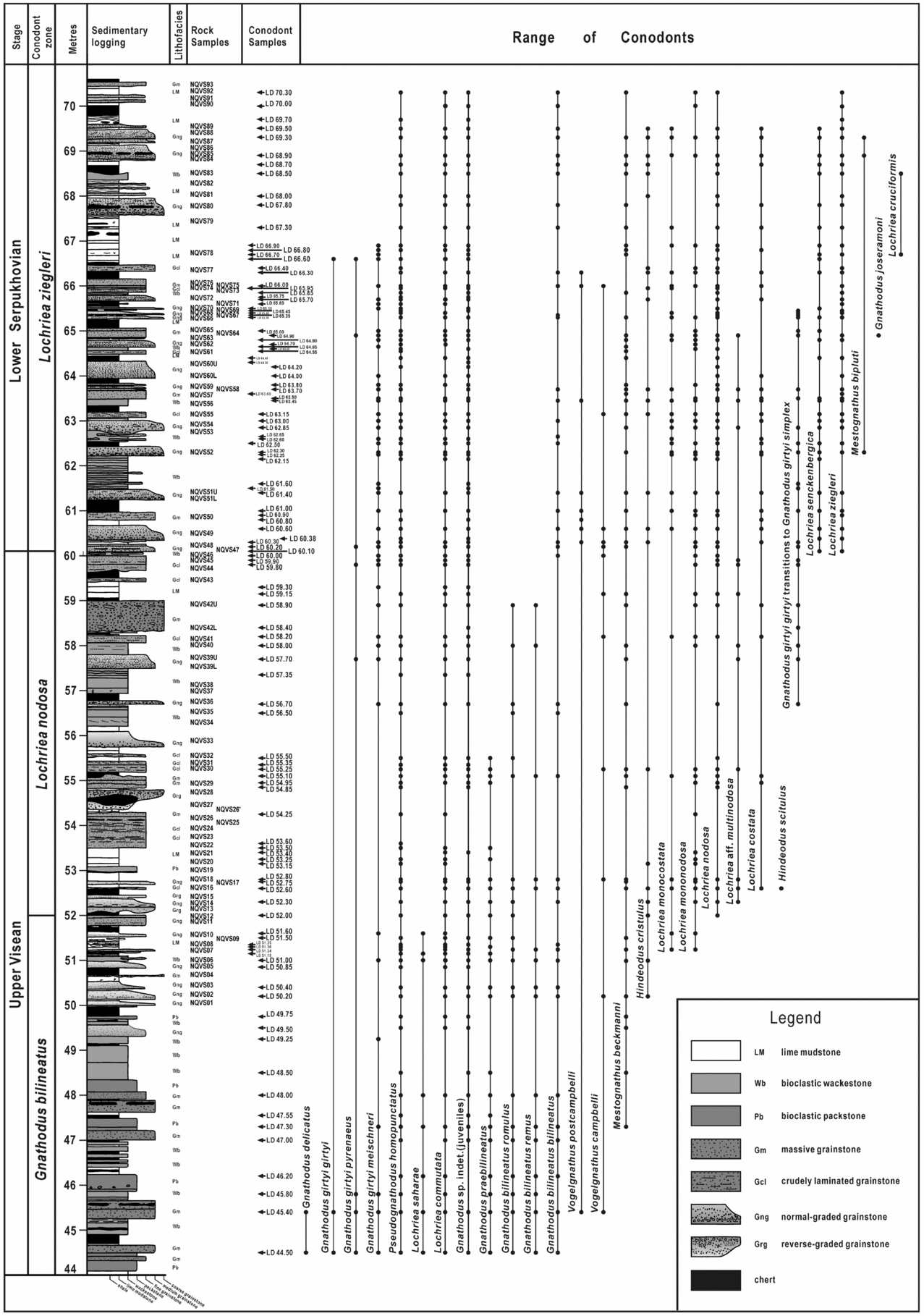
The upper Visean to lower Serpukhovian succession (c. 26 m thick) in the Naqing section is generally characterized by thin- to medium-bedded lime mudstone, frequently intercalated with bioclastic wackestone to grainstone and chert layers. A total of 105 rock samples were taken from the studied succession (c. 50–71 m): 49 from the upper Visean succession; 1 from the bed that contains the base of the Serpukhovian; and 55 from the lower Serpukhovian succession. Rock samples were cut and polished for slab observation, and more than 150 thin-sections were prepared for detailed petrographic and microfacies analyses. Based on detailed field investigation and measurements and observations of polished slabs and thin-sections in the laboratory, 7 facies were divided from the studied succession including lime mudstone facies (LM), bioclastic wackestone facies (Wb), bioclastic packstone facies (Pb), massive grainstone facies (Gm), crudely laminated grainstone facies (Gcl), normal-graded grainstone facies (Gng) and reverse-graded grainstone facies (Grg). These facies occur throughout the studied succession, both below and above the Visean–Serpukhovian boundary (Fig. 3).
Range chart of conodonts from the V/S boundary interval in the Naqing section.

Lime mudstone is mostly homogeneous or slightly bioturbated (ichnofacies index 2), showing mottled texture. Burrows are either vertical, cutting through the lamination, or horizontal. In some cases, lime mudstone is crudely laminated, nodular or conglomeratic. Lime mudstone consists mainly of microcrystalline particles to micrite and a small portion of recognizable fossil fragments such as foraminifers and crinoid. Thin-bedded lime mudstone is sometimes intercalated with thin (a few millimetres to centimetres thick) black shale and grainstone layers. Bioclastic wacke- and packstone is mostly massive, or sometimes horizontal- or cross-laminated, with scattered coarse fossil fragments. Bioclastic grainstone beds are a few centimetres up to 70 cm thick, overlying lime mudstone beds with sharp, irregular lower boundaries. They often show normal grading that is represented by either less or finer grains upwards (i.e. changing from coarse grainstone to wackestone or fine grainstone). Grainstone is composed of abundant fossil fragments (including echinoderm, foraminifer, bryozoans, brachiopod, trilobite, etc.) and irregular micritic lumps. In some cases, a few intraclasts composed of either lime mudstone or grainstone occur in the lower part of the coarse grainstone beds. Grainstone beds locally show load cast structures at the base, overlying lime mudstone bed with sharp contact. Thin beds of bioclastic wackestone to grainstone are partly massive, crudely laminated or cross-laminated. Parallel-laminated grainstone is represented by alternation of dark-grey, micritic and light-grey, sparitic laminae. Elongate fossil fragments are mostly parallel to the lamination. Laminae show either distinct or gradational boundaries. Rare reverse grading is represented by the wackestone or fine grainstone at the base to the intraclasts-bearing coarse grainstone in the upper part. Discontinuous or continuous chert layers are often intercalated within either lime mudstone or grainstone beds. Fossil fragments are clearly recognized in the chert that occurs within grainstone, indicating that most of the chert layers were probably precipitated during diagenesis by replacing carbonate sediment.
The sample (at 60.10–60.22 m) that bears the Visean–Serpukhovian boundary at its basal part is a slightly normal-graded bioclastic medium to fine grainstone, with a discontinuous chert layer (c. 5 cm thick) in the middle part separating the lower coarser part and the upper finer part. The grainstone is composed of abundant foraminifers and crinoid stems. Well-preserved Lochriea senckenbergica Nemirovskaya, Perret-Mirouse & Meischner, Reference Nemirovskaya, Perret-Mirouse and Meischner1994 and L. ziegleri were dissolved out from this bed, indicating the base of Serpukhovian. The bed was most likely deposited from turbidity currents that transported shallow-water foraminifers downslope. The conodont fossils were washed into the turbidity currents and deposited together with foraminifers. Such grainstone beds may provide a good correlation between shallow-water foraminifers biostratigraphy and deep-water conodont biostratigraphy (Wang et al. Reference Wang, Qi, Lambert, Wang, Wang, Hu, Lin and Chen2011), although detailed foraminifer biostratigraphy is also needed.
The carbonates of the studied succession straddling the Visean–Serpkhovian boundary lack typical shallow-water features such as exposure structures or wave-generated deposits and structures. The succession was overall deposited in a relatively deep-water setting, well below fair-weather wave base or even storm wave base. Scarce bioturbation in the lime mudstone beds deposited from the settling of suspended sediment, is indicative of rare fauna activities, most likely below euphotic zone (Burchette & Wright, Reference Burchette and Wright1992). The frequently intercalated normal-graded bioclastic wacke- to grainstone is representative of a turbidite sequence (i.e. Bouma sequence) that deposited from turbidity currents on a slope environment (e.g. Nemyrovska et al. Reference Nemyrovska, Wagner, Winkler Prins and Montanez2011). Parallel lamination was formed by separation of carbonate grains in the upper-flow transport regime of the turbidity current, whereas cross-lamination resulted from migration of diluted current ripples. Bioclastic wacke- and packstone was most likely formed by distal, dilute turbidity currents. The abundant occurrence of shallow-water foraminifer fossils in the grainstone beds indicates that the turbidity currents were derived from a nearby carbonate platform. Turbidity currents were most likely generated by storms that frequently swept across the shallow platform, or were related to sea-level fluctuations (Wright, Reference Wright1986).
Distinctive shallow-water carbonate cycles during the Carboniferous ice age are indiscernible in the deep-water slope settings of the studied succession. The worldwide regression event during the Visean–Serpkhovian boundary, reported from the shallow-water carbonate platform (e.g. Veevers & Powell, Reference Veevers and Powell1987; Wang et al. Reference Wang, Ueno, Mizuno and Sugimaya2001), is also difficult to recognize in the Naqing section; there is no evidence indicating an upwards shallowing or deepening trend across the boundary. This is most likely caused by the fact that the eustatic signature, if there was any, was most likely obscured by many other geological factors such as siliciclastic input, carbonate production, water depth, topographic relief and tectonic subsidence and uplift (e.g. Miall, Reference Miall2005; Chen et al. Reference Chen, Chough, Lee and Han2012).
4. Conodont fauna
A total of 175 samples, each weighing c. 3–5 kg, were processed for conodonts from the V/S boundary interval in the Naqing section; 116 samples were productive (Figs 3–6). An estimated 11 000 mostly well-preserved platform conodont elements, including a large number of juveniles, were extracted. Conodont frequency is relatively high with an average of 30 platform elements per kilogram. Some samples exceed 100 platform specimens per kilogram at certain levels, for example: LD45.40, LD47.30, LD48.00, LD52.60, LD52.80, LD60.30, LD60.60, LD61.00, LD61.40, LD62.30, LD62.50, LD62.85, LD63.45, LD63.70, LD64.90, LD66.00, LD66.30, LD68.90, LD69.30 and LD70.30. Platform elements outnumber the ramiform elements, and 28 species or subspecies in 6 genera were identified. Our research focused on the platform elements; only these are classified in this paper.
A relatively abundant conodont assemblage in the V/S boundary interval includes all known conodont genera characteristic of the deep-water late Visean – early Serpukhovian successions of Eurasia. Present are the Gnathodus bilineatus and Gn. girtyi groups of species and the genera Lochriea, Pseudognathodus and Vogelgnathus, which are all common elsewhere. Mestognathus beckmanni Bischoff, Reference Bischoff1957 and M. bipluti Higgins, Reference Higgins1961, which were interpreted to be shallower-water species, also occur in small numbers near the V/S boundary. It was hypothesized that these two species were transported in from shallower-water settings periodically.
In general, the conodont fauna at Naqing is dominated by the Gnathodus bilineatus group, including Gn. praebilineatus Belka, Reference Belka1985, Gn. bilineatus remus Meischner & Nemyrovska, Reference Nemyrovska1999, Gn. bilineatus romulus Meischner & Nemyrovska, Reference Nemyrovska1999, Gnathodus bilineatus bilineatus (Roundy, Reference Roundy1926) and all transitional forms. A great number of juveniles were obtained, most of which could not be identified at the species level. Gnathodus bilineatus bilineatus is the most common species of this group.
The next abundant group of conodonts comprises Lochriea species. This group includes simple unornamented Lochriea species, Lochriea commutata (Branson & Mehl, Reference Branson and Mehl1941), L. saharae Nemyrovska, Perret-Mirouse & Weyant, Reference Nemyrovska, Perret-Mirouse and Weyant2006 and ornamented Lochriea species: L. mononodosa (Rhodes, Austin & Druce, Reference Rhodes, Austin and Druce1969), L. monocostata (Pazukhin & Nemirovskaya, in Kulagina et al. Reference Kulagina, Rumyantseva, Pazukhin and Kotchetkova1992), L. nodosa, L. costata (Pazukhin & Nemirovskaya, in Kulagina et al. Reference Kulagina, Rumyantseva, Pazukhin and Kotchetkova1992), L. ziegleri and L. senckenbergica. Lochriea commutata is much more numerous than the other species of Lochriea in the Visean, and range up to the end of the Serpukhovian. The strongly ornamented Lochriea species make their debut during early Serpukhovian time.
The third abundant group of conodonts contains Pseudognathodus species, the most numerous of which is Ps. homopunctatus (Ziegler, Reference Ziegler1960) which appears in almost each productive sample. Less common is Ps. mermaidus (Austin & Husri, Reference Austin, Husri, Bouckaert and Streel1974). Ps. symmutatus (Rhodes, Austin & Druce, Reference Rhodes, Austin and Druce1969) is rare. Vogelgnathus species are less common. This group is dominated by V. campbelli (Rexroad, Reference Rexroad1957) and V. postcampbelli (Austin & Husri, Reference Austin, Husri, Bouckaert and Streel1974). Rather short-lived invasions of the Vogelgnathus-dominated faunas can be linked to rapid rises in sea level during the periods of maximum flooding of the late Asbian – early Serpukhovian eustatic transgressive-regressive cycles (Ramsbottom, Reference Ramsbottom1973; Ross & Ross, Reference Ross and Ross1988). These invasions of Vogelgnathus linked to sea-level rise could represent global events based on the conodont faunas from the Cantabrian Mountains (Boogaard, Reference Boogaard1992; Nemyrovska, Reference Nemyrovska2005). Two main invasions of Vogelgnathus took place during the time span of the V/S boundary interval in the Naqing section: one during the early Gn. bilineatus Zone (sample LD45.4) and another in the earliest Serpukhovian (the earliest L. ziegleri Zone, samples LD60.30, LD60.60) shortly above the FAD of L. ziegleri. The most abundant Vogelgnathus specimens (104 elements) are found in the sample LD60.60.
Least abundant is the Gnathodus girtyi group which, besides Gn. girtyi girtyi Hass, Reference Hass1953, includes some transitional forms between Gn. girtyi girtyi and Gn. girtyi simplex Dunn, Reference Dunn1965, Gn. girtyi meischneri (Austin & Husri, Reference Austin, Husri, Bouckaert and Streel1974) and Gn. girtyi pyrenaeus Nemyrovska & Perret-Mirouse in Nemyrovska, Reference Nemyrovska2005 as well as some new forms.
In the Naqing section, the Gn. bilineatus lineage starts from its ancestor Gn. praebilineatus followed by the first representatives of the bilineatus group, Gn. bilineatus remus and Gn. bilineatus romulus, which gave rise to Gn. bilineatus bilineatus. Some forms in the upper part of the section show the features of more advanced bilineatus, but they still cannot be assigned to Gn. bilineatus bollandensis Higgins & Bouckaert, Reference Higgins and Bouckaert1968.
The Lochriea lineage, which is regarded as the most important for the Visean–Serpukhovian boundary interval, was proposed as such by a number of conodont workers from other areas (Nemirovskaya, Perret-Mirouse & Meischner, Reference Nemirovskaya, Perret-Mirouse and Meischner1994; Skompski et al. Reference Skompski, Alekseev, Meischner, Nemirovskaya, Perret-Mirouse and Varker1995; Belka & Lehmann, Reference Belka and Lehmann1998; Nemyrovska, Reference Nemyrovska2005; Somerville, Reference Somerville2008; Nigmadganov et al. Reference Nigmadganov, Nikolaeva, Konovalova and Orlov-Labkovsky2010). The Naqing section is one of the best sections, containing all known species recorded in the interval of the upper Visean – lower Serpukhovian elsewhere. The early Visean species L. cracoviensis Belka, Reference Belka1985 was not found in the Naqing area, as it is the only characteristic of the lower Visean.
It has been suggested that all strongly ornamented Lochriea are derived from L. nodosa (Nemirovskaya, Perret-Mirouse & Meischner, Reference Nemirovskaya, Perret-Mirouse and Meischner1994; Skompski et al. Reference Skompski, Alekseev, Meischner, Nemirovskaya, Perret-Mirouse and Varker1995). The vertical succession of the strongly ornamented Lochriea in Naqing is almost the same as in other areas. However, in Naqing L. cruciformis (Clarke, Reference Clarke1960) appears later than in the Rheinisches Schiefergebirge and the Lublin Basin, where L. cruciformis appears before L. ziegleri and L. senckenbergica (Skompski et al. Reference Skompski, Alekseev, Meischner, Nemirovskaya, Perret-Mirouse and Varker1995). Lochriea mononodosa is regarded as an ancestor of L. nodosa. That means that its first appearance should be earlier than that of L. nodosa, as it is in the Naqing section. However, in the Triollo section (Cantabrian Mountains, Spain; Nemyrovska, Reference Nemyrovska2005) and in the Baily Hill Quarry and Dear Park sections (Ireland; Somerville & Somerville, Reference Somerville and Somerville1999), L. mononodosa was found above the first occurrence of L. nodosa. The forms illustrated as L. mononodosa from the V/S boundary beds (Skompski et al. Reference Skompski, Alekseev, Meischner, Nemirovskaya, Perret-Mirouse and Varker1995; Skompski, Reference Skompski1996) show a more advanced sculpture than those that could fit into the lineage L. commutata – L. mononodosa – L. nodosa. These specimens have only one large node or ridge on one side of the platform, but this node is too big for these forms to be regarded as ancestors of L. nodosa (Nemyrovska, Reference Nemyrovska2005). The same is found in the Naqing section. On the other hand, L. mononodosa is rather rare everywhere so it remains difficult to define its exact first appearance. Additional studies are required to distinguish L. mononodosa and L. monocostata from the transitional forms between L. commutata and L. mononodosa and L. monocostata. These studies are in progress.
The same problem occurs with L. cruciformis. Lochriea ziegleri and L. senckenbergica are always found in much greater numbers than L. cruciformis, which could be why L. cruciformis is not found in the same succession of the Lochriea species in different areas. The Visean–Serpukhovian boundary is better defined by L. ziegleri because it occurs everywhere and in much larger numbers (Nemyrovska, Reference Nemyrovska2005). In the Naqing section, the entry of L. cruciformis is 6.6 m above the FAD of L. ziegleri; the same situation was noted in the Triollo section, Spain (Nemyrovska, Reference Nemyrovska2005) and in the Yordale beds, England (Varker in Skompski et al. Reference Skompski, Alekseev, Meischner, Nemirovskaya, Perret-Mirouse and Varker1995). In the Rheinisches Schiefergebirge, Germany and the Lublin Basin, Poland, L. cruciformis is found below L. ziegleri (Meischner & Skompski in Skompski et al. Reference Skompski, Alekseev, Meischner, Nemirovskaya, Perret-Mirouse and Varker1995). In the Dnieper–Donets Depression, Ukraine (Nemirovskaya in Skompski et al. Reference Skompski, Alekseev, Meischner, Nemirovskaya, Perret-Mirouse and Varker1995) and in the Carranques section, Cantabrian Mountains, Spain (Sanz-Lopez et al. Reference Sanz-Lopez, Blanco-Ferrera, Sánchez De Posada and García-López2007), L. cruciformis is recorded at the same level as L. ziegleri.
5. Conodont biostratigraphy
Three conodont zones are distinguished in the V/S boundary interval of the Naqing section: the Gnathodus bilineatus and Lochriea nodosa zones in the Upper Visean and the Lochriea ziegleri Zone in the lower Serpukhovian.
5.a. Gnathodus bilineatus Zone
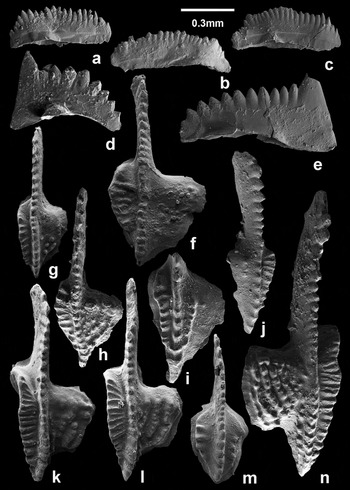
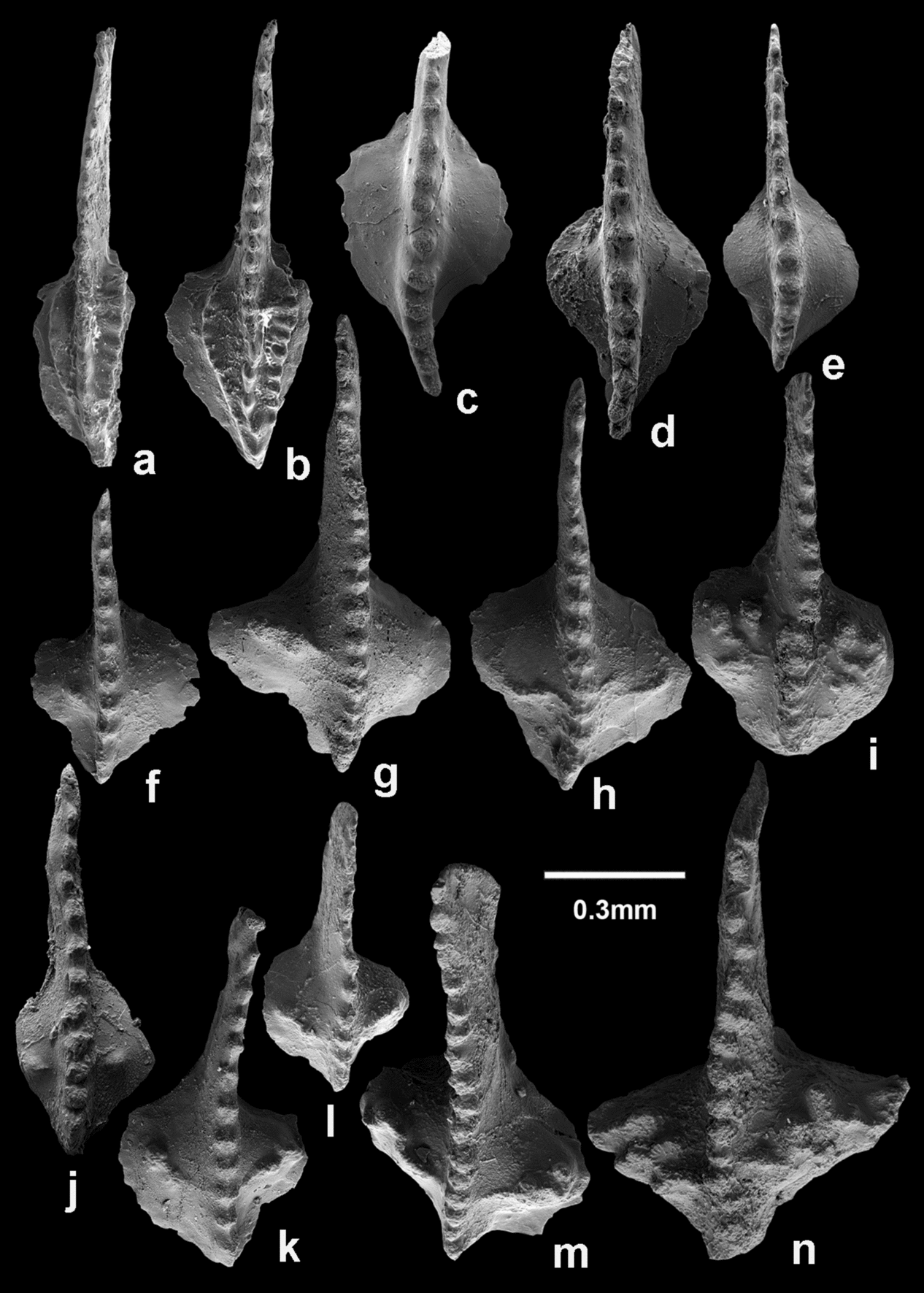
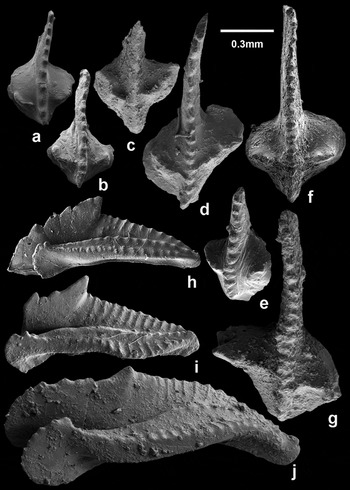
The lower part of the studied interval belongs to the Gnathodus bilineatus bilineatus Zone. The characteristic taxa of this zone include Gn. bilineatus bilineatus (Fig. 4n), Gn. bilineatus remus (Fig. 4l) and Gn. bilineatus romulus (Fig. 4k), which represent the earliest subspecies of Gn. bilineatus s.l. as well as Gn. praebilineatus (Fig. 4h), Pseudognathodus homopunctatus (Fig. 4m), L. saharae (Fig. 5c, d), L. commutata (Fig. 5e), Gn. girtyi girtyi (Fig. 4i), Gn. girtyi meischneri (Fig. 5a), Gn. girtyi pyrenaeus (Fig. 5b), Vo. campbelli and Vo. postcampbelli. In the uppermost bed of the zone, L. mononodosa and L. monocostata appear. A large number of juveniles of Gnathodus species were recorded in almost every sample. The upper zonal boundary coincides with the entry of L. nodosa. This zone covers the interval below 52 m of the section.
All illustrated specimens (deposited in the Nanjing Institute of Geology and Palaeontology, Chinese Academy of Sciences) are from the Visean–Serpukhovian boundary interval in the Naqing section, Luodian, Guizhou, South China: (a) Vogelgnathus campbelli (Rexroad, Reference Rexroad1957), lateral view, 60.3 m, Cat. no. 155754; (b) Vogelgnathus campbelli (Rexroad, Reference Rexroad1957) transitions to Vogelgnathus postcampbelli (Austin & Husri, Reference Austin, Husri, Bouckaert and Streel1974), lateral view, 60.3 m, Cat. no. 155755; (c) Vogelgnathus postcampbelli (Austin & Husri, Reference Austin, Husri, Bouckaert and Streel1974), lateral view, 60.3 m, Cat. no. 155756; (d) Hindeodus scitulus (Hinde, Reference Hinde1900), lateral view, 52.6 m, Cat. no. 155757; (e) Hindeodus cristulus (Youngquist & Miller, Reference Youngquist and Miller1949), lateral view, 69.3 m, Cat. no. 155758; (f) Gnathodus joseramoni Sanz-Lopez, Blanco-Ferrera & García-López, Reference Sanz-Lopez, Blanko-Ferrera and García-López2004, oral view, 64.9 m, Cat. no. 155759; (g) Gnathodus delicatus Branson & Mehl, Reference Branson and Mehl1938, oral view, 51.15 m, Cat. no. 155760; (h) Gnathodus praebilineatus Belka, Reference Belka1985, oral view, 45.4 m, Cat. no. 155761; (i) Gnathodus girtyi girtyi Hass, Reference Hass1953, oral view, 45.4 m, Cat. no. 155762; (j) Gnathodus girtyi girtyi Hass, Reference Hass1953 to Gnathodus girtyi simplex Dunn, Reference Dunn1965, oral view, 61.5 m, Cat. no. 155763; (k) Gnathodus bilineatus romulus Meischner & Nemyrovska, Reference Nemyrovska1999, oral view, 48.0 m, Cat. no. 155764; (l) Gnathodus bilineatus remus Meischner & Nemyrovska, Reference Nemyrovska1999, oral view, 48.0 m, Cat. no. 155765; (m) Pseudognathodus homopunctatus (Ziegler, Reference Ziegler1960), oral view, 48.0 m, Cat. no. 155766; and (n) Gnathodus bilineatus bilineatus (Roundy, Reference Roundy1926), oral view, 45.4 m, Cat. no. 155767.

All illustrated specimens (deposited in the Nanjing Institute of Geology and Palaeontology, Chinese Academy of Sciences) are from the Visean–Serpukhovian boundary interval in the Naqing section, Luodian, Guizhou, South China: (a) Gnathodus girtyi meischneri (Austin & Husri, Reference Austin, Husri, Bouckaert and Streel1974), oral view, 45.4 m, Cat. no. 155768; (b) Gnathodus girtyi pyrenaeus Nemyrovska & Perret-Mirouse, in Nemyrovska, Reference Nemyrovska2005, oral view, 45.4 m, Cat. no. 155769; (c) Lochriea saharae Nemyrovska, Perret-Mirouse & Weyant, Reference Nemyrovska, Perret-Mirouse and Weyant2006, oral view, 47.3 m, Cat. no. 155770; (d) Lochriea saharae Nemyrovska, Perret-Mirouse & Weyant, Reference Nemyrovska, Perret-Mirouse and Weyant2006 transitions to Lochriea commutata (Branson & Mehl, Reference Branson and Mehl1941), oral view, 45.4 m, Cat. no. 155771; (e) Lochriea commutata (Branson & Mehl, Reference Branson and Mehl1941), oral view, 51.5 m, Cat. no. 155772; (f) Lochriea mononodosa (Rhodes, Austin & Druce, Reference Rhodes, Austin and Druce1969), oral view, 59.15 m, Cat. no. 155773; (g) Lochriea monocostata (Pazukhin & Nemirovskaya, Reference Sanz-Lopez, Blanco-Ferrera, Sánchez De Posada and García-López1992 in Kulagina et al. Reference Kulagina, Rumyantseva, Pazukhin and Kotchetkova1992), oral view, 65.3 m, Cat. no. 155774; (h) Lochriea costata (Pazukhin & Nemirovskaya, Reference Sanz-Lopez, Blanco-Ferrera, Sánchez De Posada and García-López1992 in Kulagina et al. Reference Kulagina, Rumyantseva, Pazukhin and Kotchetkova1992), oral view, 60.3 m, Cat. no. 155775; (i) Lochriea aff. multinodosa (Wirth, Reference Wirth1967), oral view, 63.7 m, Cat. no. 155776; (j) Lochriea nodosa (Bischoff, Reference Bischoff1957), oral view, 54.85 m, Cat. no. 155777; (k) Lochriea nodosa (Bischoff, Reference Bischoff1957) transitions to Lochriea ziegleri Nemirovskaya, Perret-Mirouse & Meischner, Reference Nemirovskaya, Perret-Mirouse and Meischner1994, oral view, 62.6 m, Cat. no. 155778; and (l–n) Lochriea ziegleri Nemirovskaya, Perret-Mirouse & Meischner, Reference Nemirovskaya, Perret-Mirouse and Meischner1994, Cat. nos 155779–155781, oral views: (l) 60.9 m; (m) 62.5 m; and (n) 68.9 m.

5.b. Lochriea nodosa Zone
The lower boundary of this zone is defined by the first appearance of L. nodosa; its upper boundary coincides with the entry of L. ziegleri. This zone includes the interval between 52 m and 60.1 m in the Naqing section. The entry of L. nodosa can be traced all over Eurasia and is an important stage in the evolution of Lochriea species. The most characteristic species of this zone are Lochriea nodosa (Figs 5j, 6a, e), L. mononodosa (Fig. 5f), L. monocostata, L. costata, L. aff. multinodosa (Wirth, Reference Wirth1967), L. commutata, Gnathodus bilineatus bilineatus and Pseudognathodus homopunctatus. Gnathodus girtyi girtyi, Gn. girtyi meischneri, Gn. girtyi pyrenaeus, Mestognathus beckmanni and Vogelgnathus campbelli are less common, but still present. The first appearance of L. costata is in the lower beds of this zone. With the exception of L. nodosa and L. costata, all other species extend from the zone below (Gnathodus bilineatus Zone).
5.c. Lochriea ziegleri Zone
The lower boundary of this zone is defined by the first appearance of L. ziegleri, which is now regarded as the best marker for the V/S boundary. This zone spans the interval from 60.1 m upwards in the Naqing section. The following species are characteristic of this zone: Lochriea ziegleri (Fig. 5l–n), L. senckenbergica (Fig. 6f, g), L. nodosa (Figs 5k, 6b), L. costata (Fig. 5h), L. monocostata (Fig. 5g), L. mononodosa, L. commutata, Gnathodus bilineatus bilineatus, Mestognathus beckmanni (Fig. 6i), Mestognathus bipluti (Fig. 6j), Vogelgnathus campbelli (Fig. 4a, b), V. postcampbelli (Fig. 4c) and Pseudognathodus homopunctatus. As well as the zonal species, L. senckenbergica and Mestognathus bipluti made their debut in this zone.
All illustrated specimens (deposited in the Nanjing Institute of Geology and Palaeontology, Chinese Academy of Sciences) are from the Visean–Serpukhovian boundary interval in the Naqing section, Luodian, Guizhou, South China: (a) Lochriea nodosa (Bischoff, Reference Bischoff1957) transitions to Lochriea ziegleri Nemirovskaya, Perret-Mirouse & Meischner, Reference Nemirovskaya, Perret-Mirouse and Meischner1994, oral views, 52.6 m, Cat. no. 155782; (b) Lochriea ziegleri Nemirovskaya, Perret-Mirouse & Meischner, Reference Nemirovskaya, Perret-Mirouse and Meischner1994 transitions to Lochriea cruciformis (Clarke, Reference Clarke1960), oral views, 70.3 m, Cat. no. 155783; (c, d) Lochriea cruciformis (Clarke, Reference Clarke1960), oral views: (c) 66.7 m, Cat. no. 155784 and (d) 68.5 m, Cat. no. 155785; (e) Lochriea nodosa (Bischoff, Reference Bischoff1957) transitions to Lochriea senckenbergica Nemirovskaya, Perret-Mirouse & Meischner, Reference Nemirovskaya, Perret-Mirouse and Meischner1994, oral view, 52.6 m, Cat. no. 155786; (f, g) Lochriea senckenbergica Nemirovskaya, Perret-Mirouse & Meischner, Reference Nemirovskaya, Perret-Mirouse and Meischner1994, oral views: (f) 64.8 m, Cat. No. 155787 and (g) 62.3 m, Cat. no. 155788; (h) Mestognathus beckmanni Bischoff, Reference Bischoff1957, lateral view, 51.24 m, Cat. no. 155789; (i) Mestognathus beckmanni Bischoff, Reference Bischoff1957, transitions to Mestognathus bipluti Higgins, Reference Higgins1961, lateral view, 61.0 m, Cat. no. 155790; and (j) Mestognathus bipluti Higgins, Reference Higgins1961, lateral view, 68.9 m, Cat. no. 155791.

6. Correlation
The majority of conodont species from the Naqing section occur in other areas of Eurasia and North America. In Eurasia, correlations among a number of sections represented by relatively deep-water facies with Naqing are rather straightforward (S. I. Park, unpub. Ph.D. thesis, Philips University of Marburg, 1983; Nemirovskaya, Perret-Mirouse & Meischner, Reference Nemirovskaya, Perret-Mirouse and Meischner1994; Skompski et al. Reference Skompski, Alekseev, Meischner, Nemirovskaya, Perret-Mirouse and Varker1995; Nemyrovska, Reference Nemyrovska2005; Belka & Lehmann, Reference Belka and Lehmann1998; Sanz-Lopez et al. Reference Sanz-Lopez, Blanco-Ferrera, Sánchez De Posada and García-López2007; Somerville, Reference Somerville2008; Nigmadganov et al. Reference Nigmadganov, Nikolaeva, Konovalova and Orlov-Labkovsky2010; Pazukhin et al. Reference Pazukhin, Kulagina, Nikolaeva, Kochetova and Konovalova2010). Even in shallower-water sections there are a large number of species in common (Groessens, Reference Groessens, Bouckaert and Streel1975; Higgins, Reference Higgins1975; Nemirovskaya, Reference Nemirovskaya and Vyalov1985; Varker & Sevastopulo, Reference Varker, Sevastopulo, Higgins and Austin1985; Skompski et al. Reference Skompski, Alekseev, Meischner, Nemirovskaya, Perret-Mirouse and Varker1995; Kabanov et al. Reference Kabanov, Aleksev, Gabdullin, Gibshman, Bershov, Naumov and Samarin2013). However, Late Mississippian conodont faunas of North America differ greatly; they are mostly represented by shallow-water taxa and ornamented Lochriea species are almost absent (Lane & Straka, Reference Lane and Straka1974). Recently a couple of specimens assigned to early L. ziegleri were found in North America from the Barnett Formation, central Texas.
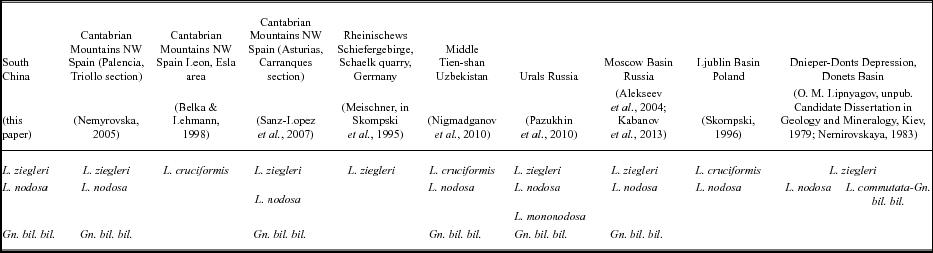
Preliminary correlations of conodont zones in the V/S boundary interval of the Naqing section with those in other areas are listed in Table 1. Abundant and taxonomically diverse conodont faunas in the Naqing section enable the correlation of the Tatangian (upper Visean) and lower Duwuan (lower Serpukhovian) (Zhang, Reference Zhang2000) to the coeval deposits of other areas. Two levels are most reliable for correlation by conodonts within the studied interval: the entry of Gn. bilineatus s.l. at the base of the Tatangian and the first occurrence of strongly ornamented Lochriea, particularly L. ziegleri, at the base of the Duwuan in South China (Y. P. Qi, unpubl. Ph.D. thesis, Graduate University of Chinese Academy of Sciences, 2008). The first level is outwith the scope of the present paper but the second level is discussed below.
Preliminary correlations of conodont zones in the V/S boundary interval of the Naqing section with those in other areas.

The Gnathodus bilineatus Zone can be correlated to the middle part of the Genicera (or Alba) Formation (G. bilineatus Zone) in the Cantabrian Mountains (Sanz-Lopez, Blanko-Ferrera & García-López, Reference Sanz-Lopez, Blanko-Ferrera and García-López2004; Nemyrovska, Reference Nemyrovska2005), to the uppermost part of the lower Visean – lower part of the upper Visean of the Rheinisches Schiefergebirge (Meischner & Nemyrovska, Reference Nemyrovska1999), to the late Asbian and early Brigantian of western Europe (England, Ireland and Belgium; Higgins, Reference Higgins1975, Reference Higgins, Higgins and Austin1985; Somerville, Reference Somerville2008), to the Alexinian and Mikhailovian horizons (characterized by the G. bilineatus bilineatus Zone) of the Russian Platform (Barskov et al. Reference Barskov, Alekseev, Goreva, Kononova, Migdisova and Menner1984; Makhlina et al. Reference Makhlina, Vdovenko, Alekseev, Byvsheva, Donakova, Zhulitova, Kononova, Umnova and Shik1993) and to the Gn. bilineatus bilineatus and L. mononodosa Zone of South Urals (Pazukhin et al. Reference Pazukhin, Kulagina, Nikolaeva, Kochetova and Konovalova2010). The Gn. bilineatus bilineatus Zone can be compared to the Alexinian and lower Mikhailovian horizons of the Moscow Basin (Alekseev et al. Reference Alekseev, Goreva, Isakova and Makhlina2004) and it can be correlated to the lower Talassian of the Paltau section, Uzbekistan (Nigmadganov et al. Reference Nigmadganov, Nikolaeva, Konovalova and Orlov-Labkovsky2010), to the Donetzian and Mezhevskian of the Donets Basin (O. M. Lipnyagov, unpub. Candidate Dissertation in Geology and Mineralogy, Kiev, 1979) and to the lower Chesterian (characterized by the G. bilineatus Zone) of North America (Lane & Straka, Reference Lane and Straka1974; Lane, Sandberg & Ziegler, Reference Lane, Sandberg and Ziegler1980; Krumhardt, Harris & Watts, Reference Krumhardt, Harris and Watts1996; Lane & Brenckle, Reference Lane, Brenckle and Heckel2001).
The Lochriea nodosa Zone, the latest Visean zone, is widely recognized in Eurasia both in shallow and deep-water biofacies (Skompski et al. Reference Skompski, Alekseev, Meischner, Nemirovskaya, Perret-Mirouse and Varker1995; Nemyrovska, Reference Nemyrovska2005; Pazukhin et al. Reference Pazukhin, Kulagina, Nikolaeva, Kochetova and Konovalova2010). This zone at Naqing can be correlated with the same zone in the upper beds of the Alba (equivalent to the Genicera) Formation of the Cantabrian Mountains (Adrichem-Boogaert, Reference Adrichem-Boogaert1967; Menéndez-Alvaréz, Reference Menéndez-Álvaréz1978; Higgins & Wagner-Gentis, Reference Higgins and Wagner-Gentis1982; S. I. Park, unpub. Ph.D. thesis, Philips University of Marburg, 1983; Belka & Lehmann, Reference Belka and Lehmann1998; Sanz-Lopez, Blanko-Ferrera & García-López, Reference Sanz-Lopez, Blanko-Ferrera and García-López2004; Nemyrovska, Reference Nemyrovska2005) and in the uppermost Visean, the upper Mikhailovian and Venevian horizons of the Moscow Basins (Alekseev et al. Reference Alekseev, Goreva, Isakova and Makhlina2004), to the upper part of the Mezhevskian Horizon of the Donets Basin and Dnieper–Donets Depression (O. M. Lipnyagov, unpub. Candidate Dissertation in Geology and Mineralogy, Kiev, 1979; Nemirovskaya, Reference Nemirovskaya1983, Reference Nemirovskaya and Vyalov1985) and Middle Tienshan (Nigmadganov et al. Reference Nigmadganov, Nikolaeva, Konovalova and Orlov-Labkovsky2010), L. nodosa Zone of Germany (Meischner, Reference Meischner1970) and Ireland (Somerville & Somerville, Reference Somerville and Somerville1999) and can be roughly correlated with the upper part of the Gnathodus bilineatus Zone in North America (Lane & Straka, Reference Lane and Straka1974; Lane & Brenckle, Reference Lane, Brenckle and Heckel2001). This zone is also recognized in the uppermost Visean of the Pyrénées (Boersma, Reference Boersma1973; Buchroithner, Reference Buchroithner1979; Perret, Reference Perret1993; Sanz-López, Reference Sanz-Lopez, Garcia-López and Bastida2002), in Belgium (Groessens, Reference Groessens, Bouckaert and Streel1975) and Poland (Skompski, Reference Skompski1996).
The Lochriea ziegleri Zone is the earliest Serpukhovian conodont zone, and is easily distinguished in Eurasia as the zonal index is strongly ornamented and easy to identify. Its lower boundary represents the most reliable correlative level in Eurasia and coincides with the V/S boundary. This zone in the Naqing section can be directly correlated with the same zone in the Cantabrian Mountains of Northern Spain (Nemyrovska, Reference Nemyrovska2005), the L. cruciformis Zone of Northern Spain (Sanz-Lopez et al. Reference Sanz-Lopez, Blanco-Ferrera, Sánchez De Posada and García-López2007), the L. ziegleri Zone in Moscow Basin and the South Urals of Russia (Alekseev et al. Reference Alekseev, Goreva, Isakova and Makhlina2004; Pazukhin et al. Reference Pazukhin, Kulagina, Nikolaeva, Kochetova and Konovalova2010), the Donets Basin of Ukraine (Skompski et al. Reference Skompski, Alekseev, Meischner, Nemirovskaya, Perret-Mirouse and Varker1995; Nemyrovska, Reference Nemyrovska1999), Germany, England, the French Pyrénées and Poland, (Nemirovskaya, Perret-Mirouse & Meischner, Reference Nemirovskaya, Perret-Mirouse and Meischner1994; Skompski et al. Reference Skompski, Alekseev, Meischner, Nemirovskaya, Perret-Mirouse and Varker1995) and Uzbekistan (Nigmadganov et al. Reference Nigmadganov, Nikolaeva, Konovalova and Orlov-Labkovsky2010). It can also be roughly correlated with the uppermost part of the G. bilineatus Zone and the lower part of the Cavusgnathus naviculus (Hinde, Reference Hinde1900) Zone in North America (Lane & Straka, Reference Lane and Straka1974; Lane & Brenckle, Reference Lane, Brenckle and Heckel2001). Moreover, because specimens of L. ziegleri were identified from the Barnett Formation, central Texas, the correlation between Eurasia and North America might be easier than before. However, other strongly ornamented Lochriea such as L. senckenbergica and L. cruciformis have not yet been found in North America.
The appearance of conodont species Lochriea ziegleri within the lineage Lochriea nodosa – L. ziegleri is being discussed as the most promising marker for the Visean–Serpukhovian boundary by the majority of conodontologists. Some conodont workers prefer to use another ornamented species of Lochriea – L. cruciformis (see the correlation described in Table 1).
7. Conclusion
Both L. ziegleri and L. cruciformis fall close to the Visean–Serpukhovian boundary (Skompski et al. Reference Skompski, Alekseev, Meischner, Nemirovskaya, Perret-Mirouse and Varker1995; Nikolaeva et al. Reference Nikolaeva, Gibshman, Kulagina, Barskov and Pazukhin2002, Reference Nikolaeva, Kulagina, Pazukhin, Kochetova and Konovalova2009; Nemyrovska, Reference Nemyrovska2005; Qi & Wang, Reference Qi and Wang2005) in contrast to L. ziegleri, which is much more widespread around Eurasia. The abundance of conodonts discovered in the Naqing section has confirmed the potential of L. ziegleri as the best marker for the definition of the Visean–Serpukhovian boundary.
In the Naqing section the first Lochriea ziegleri and L. senckenbergica occur in the same sample, but the lineage of Lochriea nodosa – L. ziegleri with many transitions between seems to be quite reliable (taxonomic studies are in progress). The L. costata – L. cruciformis lineage cannot yet be demonstrated by data from the Naqing section (even with very close sampling), as insufficient specimens were obtained. The first appearance of Lochriea aff. multinodosa, another strongly ornamented species, is close to the base of the Lochriea nodosa Zone in the Naqing section.
The lineage of Lochriea nodosa – L. ziegleri or L. senckenbergica therefore has the greatest potential to be used for defining the Visean–Serpukhovian boundary. In addition, The entry of strongly ornamented L. ziegleri is widespread in Eurasia as well as in North America. Furthermore, this species could be easily recognized and more numerous than any other strongly ornamented Lochriea species. The FAD of Lochriea ziegleri is therefore the best marker for the base of the Serpukhovian or Duwuan of China.
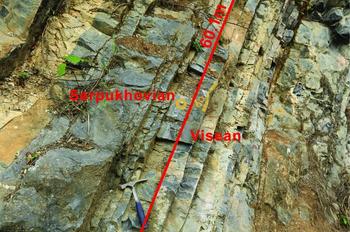
The previously reported FAD of L. ziegleri in the Naqing section has been found lower at 60.6 m (Y. P. Qi, unpub. Ph.D. thesis, Graduate University of Chinese Academy of Sciences, 2008; Qi et al. Reference Qi, Wang, Wang, Lane, Richards, Katsumi and Groves2009), down to 60.38 m (Qi et al. Reference Qi, Wang, Richards, Groves, Ueno, Wang, Wu, Hu, Wang, Qi, Groves, Barrick, Nemirovskaya, Ueno and Wang2010 b) and now down to 60.1 m (Qi et al. Reference Qi, Wang, Richards, Groves, Ueno, Wang, Wu, Hu, Wang, Qi, Groves, Barrick, Nemirovskaya, Ueno and Wang2010 a) (Fig. 7) above the base of the section, according to continuous centimetre-scale sampling in May 2008 and October and November 2009.
Visean and Serpukhovian boundary level in the Naqing section.

Acknowledgements
This work was supported by National Natural Science Foundation of China (Grant nos 41072009, 40772005, 41290260, 40839904) and State Key Laboratory of Palaeobiology and Stratigraphy, Nanjing Institute of Geology and Palaeontology, Chinese Academy of Sciences (Grant no. 20102105). This manuscript was greatly improved by comments from James E. Barrick of Texas Tech University.