“If it wasn't for the ‘ouses in between”: Music and the Victorian City
The dystopia of the Victorian city is ubiquitous as a trope of nineteenth- and early twentieth-century literature, appearing across a wide array of literature in fiction, poetry, pamphlets, articles, reviews, socio-demographic works, socialist tracts, and miscellaneous papers. Anti-urbanism plays a prominent role in Dickens, Kingsley, and Gissing, to name but a few, and emerges in more pointedly sociological titles such as Andrew Mearns's The Bitter Cry of London (1883); Thomas Escott's England: Its Peoples, Polity, and Pursuits (1885); Charles Booth's Life and Labour of the People of London (1889–1902); Ford Madox Ford's The Heart of the Empire (1905); and W. W. Hutching's London Town Past and Present (1909) (Lees, in Fraser and Sutcliffe, 1983: 154; Hulin and Coustillas, Reference Hulin and Coustillas1979: passim). Themes of urban degradation, overpopulation, squalor, unemployment, lack of education, despair, and pollution fill their pages.
Although arguably less well known, anti-urbanism also plays a major role in late nineteenth-century British music. It occurs in working-class socialist songs, and was sufficiently prominent to be parodied in music hall and operetta. Socialist songs, written for the advancing cause, were composed by Herbert Burrows, Jim Connell, John Bruce Glasier, Fred Henderson, Tom Maguire, and many lesser-known figures in the socialist movement. These are compiled in various anthologies including Carpenter's Chants of Labour (1888); The Labour Songbook (1888), published by the Bristol Socialist Society; Socialist Songs (1889) of the Aberdeen Branch of Morris's Socialist League; Songs for Socialists (3rd edition, 1890), compiled by Morris's colleague, James Leathan; John Trevor's Labour Church Hymnbook (1892); Glasier's Socialist Songs (1893); Robert Blatchford's Clarion Songbook (1906); The SDF (Social Democratic Federation) Songbook (1910); and the Fabian Society Songs for Socialists (1912) (Waters 132). William Morris, one of the most famous and controversial late Victorian converts to socialism, wrote chants from the mid 1880s to the early 1890s. These were intended to be recited, rather than sung, and accompanied by the harp or lute – much in the tradition of the medieval minstrel or troubadour. His earliest chants appear in the Social Democratic Federation's (SDF) weekly Justice in 1884, and others were published in the Socialist League's (SL) Commonweal, later to be issued as Chants for Socialists (1885) (Waters 128). Most of the chants were collected in Poems By the Way (1896), Pilgrims of Hope and Chants for Socialists (1915), and in Morris's Collected Works, edited by his daughter May. As Christopher Waters points out, Morris's chants have a deeply aggressive anti-urban bias, frequently couched in socialist utopian philosophies of anti-capitalism, glorified medievalism, and British ruralism. In “The Day is Coming,”
For Morris, a vision of a future was worth cultivating because it could breed working-class discontent with the present and thus inspire the struggle for the socialist society of the future. He thus took great pains in his poetry to juxtapose past and present in order to encourage the kind of activity that would bring about “the change” he so ardently longed for:
In contrast, Gus Elen's comedic rendition of “If It Wasn't for the ’Ouses in Between” (1894) is a good example of music hall treatment, with words by Edgar Bateman and music by George Le Brunn. Here, in a satire on the Englishman's relation to the countryside, Bateman reduces social utopianism to naïve urban resignation:
Gilbert and Sullivan gave urban social politics much the same treatment in their opera Utopia, Limited, or the Flowers of Progress (1893), especially in the song from Act II, “Society has quite forsaken all her wicked courses.” Here the dialogue shows just how much – or little – deference was then paid to the rich fabric of socialist concerns over urban blight and poverty. The dialogue is between the lazy anglophile King of the South Sea Island of Utopia, and the Flowers of Progress, six representatives of English culture who were brought to him by the King's English-educated daughter Zara:
King Our city we have beautified – we've done it willy-nilly –
And all that isn't Belgrave Square is Strand and Piccadilly.
Flowers of Progress We haven't any slummeries in England!
King We have solved the labour question with discrimination polished
So poverty is obsolete and hunger is abolished.
Flowers of Progress We are going to abolish it in England! (Utopia, Limited)
Whilst anti-urbanism and socialist utopianism coalesce in songs, operetta, and music hall – and indeed in much literature of the period generally – the same could not be said of the genre of Victorian music history. Whilst various strands of social disaffection relating to music do inevitably appear within Victorian musicology, most notably in disparate works of criticism debunking the idea that Britain is a “land without music,”Footnote 2 anti-urbanism and socialist utopianism are, arguably, seldom joined together by a comprehensive prescription for change within straightforward histories of music. There is one valuable exception, however, which is the exception that proves the rule, namely Henry Davey's History of English Music ([1895]/rev. 1921).
Henry Davey and the History of English Music
Little is known about Henry Davey. He was born in Brighton in 1853 and died in Hove in 1929, having amassed a considerable estate, as his Times obituary suggests (“Wills and Bequests” 9). He acquired his grounding in music through the popular teaching system known as Tonic Sol-fa (Brown and Stratton 117).Footnote 3 He later studied at the Leipzig Conservatory (1874–77), principally with Jadassohn, Reinecke, Richter, and Wiedenbach, and returned to Brighton, where he became a journalist and teacher until 1903. From 1897 he was also known to have worked as librarian of the Brighton and Sussex Natural History Society. In 1901 he catalogued the library of the Royal Academy of Music and there with J. S. Shedlock discovered Henry Purcell's manuscript of the Fairy Queen. His History of English Music ([1895]/rev. 1921) is his most significant historical work, although he did also write a young person's musical guide, The Student's Musical History (1891) (Smith and Sadie, “Davie, Henry,” Handel (1913)) and contributed articles to The Dictionary of National Biography.Footnote 4 Despite considerable interest in Davey's findings, noted below, his work as a music historian has only been investigated to any great extent in Temperley's “Xenophilia in British Musical History” (3), Music and Metaphor in Nineteenth-Century British Musicology (Zon 185–87) and Benjamin Davies's work on Reformation historiography (Davies 263–69). This ostensible lack of interest may have something to do with his frequently confused ideological position. He writes with a rather cavalier and personal methodology, even by late nineteenth- and early twentieth-century standards, and his historical writing is a mixture of subjective reflection and detached observation – perhaps owing something to his journalistic roots.
Davey's principal work, his History of English Music, is significant for three reasons. First, whilst not being the very first history to concentrate solely on English music, it is the first monograph published in England to have covered the full expanse of English music history in any scholarly detail.Footnote 5 Histories of national music, like Carl Engel's An Introduction to the Study of National Music (1866) and Henry Chorley's The National Music of the World (1880), provide only limited topical coverage; more journalistic or semi-academic books, such as Frederick Crowest's Phases of Musical England (1881), Francis Hueffer's Half a Century of Music in England 1837–1887 (1889) or J. A. Fuller Maitland's English Music in the XIXth Century (1902), remain chronologically narrow; and one significant contemporary music history was left sadly unfinished, namely the unpublished second volume to Crowest's The Story of British Music (From the Earliest Times to the Tudor Period) (1896).
Second, and very possibly because of its uniqueness, Davey's History appears to have been widely read and discussed in his own time, and continues to be read to this day with great critical interest. Benjamin Davies, for example, writes of Davey as “the first English scholar to publish a comprehensive study of the principal manuscript sources of Tudor music” (Davies 265) and indeed this seems to be corroborated by the extent of subsequent research, drawing in part upon Davey's findings and methodology, from the 1890s to the 1990s, including that of E. H. Crashaw, Clement Antrobus Harris, Percy Scholes, W. H. Gratten Flood, Jeffrey Pulver, Wyn K. Ford, Nicholas Temperley, and David Skinner, to name but a few. Davey himself reports in the preface to the second edition of the work's widespread appreciation:
Immediately on the publication, a number of enthusiastic appreciations, with or without qualification, recognised the additions the book had made to the knowledge of general music history. Foreign and American critics were especially eulogistic. A rival historian, Dr. Willibald Nagel, who had already published his first volume, contributed a criticism to the Monatshefte fuer Musikgeschichte, not without carping, but paying me the highest compliments for the discoveries; and such authorities as Adler, Haberl, Riemann, Bewerunge, Koller, Ecorcheville, Soubies, Eitner, were equally appreciative. To be called ein gediegener Historiker by Riemann I consider a compliment which atones for any ignoring or cavilling from ordinary critics. I had never expected attention from foreign scholars, or that any applications for review copies would arrive from foreign periodicals, or that I should be complained of for not expounding English matters sufficiently for foreigners' comprehension. (Davey Reference Davey1921, xi–xii)
Closer to home, however, as Davey recounts, reviews of the 1895 work were more mixed, and even aggressive, owing to the tendentious nature of his some of his claims, amongst them the unrepentantly nationalistic view that it had been the Englishman Dunstable who had invented counterpoint. Fuller Maitland's extensive review of the first edition is characteristic in its hostility to the idea. Acknowledging the virtuosity of Davey's achievement, he nonetheless condemns his judgment over the issue as “wholly misleading” (Fuller Maitland 146). A particular nemesis in the debate was the German-born émigré musicologist Frederick Niecks, who, taking umbrage at the substance and content of his argument, engaged Davey in semantic swordplay in discussion after his Musical Association lecture on “The Teaching of Musical History” (Niecks 174–81). The issue is further noted in Davey's preface to the second edition, and persists in reviews of the time (“The History of English Music” 112–13). In addition, Davey's apparent indifference towards more recent English music – summarized in his omission of detailed discussion of anyone but Sullivan – is noted more than once. Fuller Maitland, for example, writes that “He belongs to, or at least appears to side with, that school of critics who, from wilful or congenital blindness, refuse to see any kind of progress in the present day in English music” (147). The second edition did not, for many critics, rectify this flaw (“Feste” 772–73; Engel 307–08), as Davey added only a modest thirty-page appendix on “Recent Musical History” to a largely unchanged first edition.
Third and last, Davey's History is especially significant as a barometer of the way in which contemporary ideological currents and trends not usually associated with music histories influence music historical thinking of the time. For although, on a certain level, it can be read like some of its more conventional counterparts in Ritter, Crowest, or Walker – in other words, as a straightforward chronological and fact-based history of English music – it is in fact an unusually synthetic and often prismatic intersection of anti-urbanism and socialist utopianism which motivates its attitude towards the history, and present state, of English music. Indeed, it is its unique blend of social conscience and urban disaffection which shapes its structure and defines its terms. Davey intimates this when he writes rather cryptically that “As Ruskin's and William Morris's views of art extend, they may some day reach our best composers, and cause them to give their attention to works which are practically useful, and actually needed. Then we shall perhaps have original art-works” (1895: 491). Indeed, it is this statement, examined below, which forms the basis of this article, for it is this reference which I believe unlocks the key to understanding Davey's often controversial musicological position and helps to measure and assess his unique contribution to musicological scholarship in late nineteenth-century Britain.
“Loathsome London”: Ruskin and Morris's discontent
When Davey mentions Ruskin and Morris it does not suggest that he had direct contact with Ruskin or Morris, nor that he operated in their particular spheres of activity, but rather that he imbibed the language of their ideology and translated it, uniquely, into an explanation of, and solution to, the festering “xenophilia” which fuelled the prevalent view of nineteenth-century Britain as a “land without music.” Where, as Temperley notes, some writers rationalize the “land without music” with talk of innate inferiority, the decline in musical genius, faults in British character, the oppressive hegemony of Handel, Davey, echoing Ruskin and Morris, puts its down “to the overcentralization of power and wealth in London after 1700, which deprived composers of the multiple opportunities open to musicians in countries like Germany and Italy” (Temperley, “Xenophilia” 10).
London, by far Britain's largest city, burgeoned from a population of 2.5 million at the time of the Great Exhibition in 1851, to just under 4 million in 1871 and 6.5 million on Victoria's death in 1901. One-fifth of the population of England and Wales lived in London by this time (Hunt 287). Inevitably, this came at a great price to social welfare, especially after London's capitalist hegemony was undermined by the Great Depression of 1874 to 1896. Other cities across the country became similarly depressed, with ensuing urban degradation condemned in seminal works by Engels and Marx, amongst many others. Engels focuses especially on the idea of city in his Condition of the Working Class in England (1844–45), reproaching industrial capitalism as unviable and unethical (Merrifield 104).
John Ruskin and William Morris echo this condemnation. For them the city was “the major symptom of the disease of modern life, the turbulent source of that ‘storm-cloud’ that blackened the skies of the nineteenth century, the shoddy mechanical construction that denied all the lessons of natural growth” (Levine 2: 496). Like, Engels and Marx, Ruskin's dispute with the city is motivated by a rank hatred of capitalism, but it is also underlain by unabated aesthetic repugnance. London was an ineluctable force overtaking and overshadowing the country. More and more houses were being built, fields bricked over, gardens ever diminishing – “this is what Ruskin meant when he speaks of London's insatiable maw, a hunger which only the country could feed” (Bullen 23). Decrying the city in Fors Clavigera, the primary focus of which is London, Ruskin contemns the moral virus he sees destroying the city: “What a pestilence of them [ugly houses], and unseemly plague of builders' work – as if the bricks of Egypt had multiplied like its lice, and alighted like its locusts – has fallen on the suburbs of loathsome London?” (Letter 29, “La Douce Amie,” Fors Clavigera 28: 137). Ruskin's abiding hatred of London is also the result of its putative individualism and lack of organic social configuration and development. In Lectures on Art he writes that “You must have lovely cities, crystallised, not coagulated, into form; limited in size, and not casting out the scum and scurf of them into an encircling eruption of shame” (Lecture IV, “The Relation of Art to Use,” Lectures on Art (20: 113)).
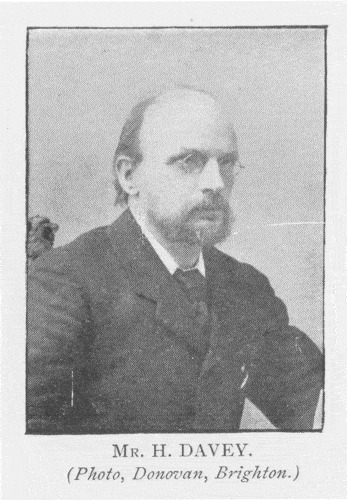
“Mr. H. DAVEY.” Photograph from John Warriner, ed., National Portrait Gallery of British Musicians (London: Sampson Low, 1896).

Morris's view of the city – and London in particular – was greatly influenced by Ruskin, most notably in The Earthly Paradise:
Setting this in prose in The Art of Socialism, Morris illuminates one of the principal sources of discontent – destruction of the countryside:
Think of the spreading sore of London swallowing up with its loathsomeness field and wood and heath without mercy and without hope, mocking our feeble efforts to deal even with its minor evils of smoke-laden sky and befouled river: the black horror and reckless squalor of our manufacturing districts, so dreadful to the senses which are unused to them that it is ominous for the future of the race that any man can live among it in tolerable cheerfulness: nay in the open country itself the trusting aside by miserable jerry-built brick and slate of the solid grey dwellings that are still scattered about, fit emblems in their cheery but beautiful simplicity of the yeoman of the English field. (Qtd. in Cole 638–39)
Morris's dystopic vision is, in fact, a counterfoil to his most widely read anti-urban utopian paean, News from Nowhere: Or, An Epoch of Rest, Being Some Chapters from a Utopian Romance. Like Thomas More's Utopia (1516), itself a play on the words “eutopia” (the good place), and “outopia” (no place) (Levitas 2), News from Nowhere projects to a future medieval paradise,Footnote 6 in which man “must use machines sparingly, if at all, and must return to the primal form of civilized life, the village community” (Passinen 261).Footnote 7 In this society London becomes a distant memory: “After a pause, I said: ‘Your big towns, now; how about them? London, which – I have read about as the modern Babylon of civilisation, seems to have disappeared'” (Claeys and Sargent 274). Inevitably, Ruskin features widely in Morris's anti-urban socialist utopianism: “in the true Utopia,” he writes, “man will rather harness himself, with his oxen, to his plough, than leave the devil to drive it” (Letter 95, “Fors Infantiae,” Fors Clavigera 28: 499).Footnote 8 In deference, Morris revelled in Ruskin's influence, encapsulating it, tellingly, in his autobiographical account of conversion, How I Became A Socialist (1894): “Ruskin . . . before my days of practical Socialism, was my master . . . I cannot help saying, by the way, how deadly dull the world would have been twenty years ago but for Ruskin! It was through him that I learned to give form to my discontent” (W. Morris, “How I Became a Socialist” (1894); qtd. in Cunningham 725).
“Too huge, heterogeneous, and changing”: Davey's discontent and the problem of London
Arguably, it was through Ruskin and Morris that Davey also learned to give form to his discontent, and as with Ruskin and Morris, part of that discontent was expressed in often unabashedly nationalist terms. Where, for example, Crowest's The Story of British Music (1896) and Chorley's The National Music of the World (1880) are somewhat circumspect in their nationalism, Davey is more absolute. Where he writes unrepentantly that “The art of musical composition is an English invention” (1), Crowest is more guarded, speaking of it in its own terms, as having a “glorious past . . . [and an] excellent present status and promise” (vi),Footnote 9 and Chorley is rather demure, suggesting that “with all our honesty, our wealth, our welcome – and now, our great and widely diffused musical culture – we may fail for a while – not for the future, I earnestly believe – betwixt eclecticism and exclusiveness, in having a music of our own” (234). It is in fact a rather disappointed or frustrated nationalism which underlies Davey's History, for unlike these contemporaries, Davey follows a downward spiral right towards a foreign-dominated English musical present, progressing from a composition-orientated past (chapters 1 to 3) to a more politicized expostulation (chapters 4 to 6), and from this to a period of more obviously foreign hegemony (chapter 7). Chapter 8 is nationalistically situated as a response to the previous chapter, and interestingly, chapter 9 – the nineteenth-century present – contains a conceptually non-descriptive title:
1 Before the Invention of Composition
2 The Invention of Polyphony (1400–53)
3 The Period of the Invention of Instrumental Composition (1453–1536)
4 The Reformation: From the Dissolution of the Monasteries to the Defeat of the Armada (1536–88)
5 The Madrigalian Period (1588–1630)
6 The Age of Declamatory Songs, of the Fancies for Viols, and of the Suppression of Ecclesiastical Music (1630–1660)
7 The Period of Foreign Influence, and of Dramatic Music (1660–1700)
8 The Period of Patriotic Songs (1701–1800)
9 The Nineteenth Century (Davey Reference Davey1895: xiii–xv)
As Davey describes it, his History of English Music portrays English musical history as an ineluctable process of foreignization, from its indigenous roots to its domination by foreign musical powers:
Musical history may be divided into three periods, each of 161 years. The first (1400–1561) was the English period, although the Flemings surpassed the English in the middle portion; the second (1561–1722) was the Italian period, beginning with the composition of Palestrina's “Improperia”; the third (1722–1883) was the German period, lasting from the completion of Bach's “Wohltemperirtes Klavier” to the death of Wagner. . . . Since the original invention was English, the history of English music is longer than that of any other nation, and all through the period of Italian supremacy it remains important; but in the 18th and 19th centuries it is of little interest except as regards the performances of foreigners’ works; and a General History of Music might after 1700 omit the compositions of Englishmen almost entirely. (Davey, Reference Davey1895: 2–3)
Speaking in tones which Ruskin and Morris would applaud, he laments the loss of traditional patronage and decries the attendant decline in English musical reputation. More specifically, however, he pinpoints the origin of the problem in urban centralization and the limitations London imposes on employment outside the capital:
We have now reached the prosaic period, when England, for 300 years distinguished by its musical skill, sank so far from its old repute as to acquire the name of an unmusical country, a disrepute which it still retains so far that many read with astonishment and even incredulity of its glorious achievements in the past.
What could have been the reason or reasons for so extraordinary a change? The principal reason undoubtedly was and is the centralisation of England in London, which gives no chance to performers or composers elsewhere. London itself has too huge, heterogeneous, and changing a population to be an artistic centre at all commensurable with its importance in the kingdom, while at the same time it prevents any other town from becoming one, as all first-rate talent of every description gravitates there; London musicians themselves have to contend with the very greatest performers of the whole world. No other town in the British Islands offers any career to a musician except as an organist or teacher. We have no small governments or local princes requiring local orchestras, if we except the Viceroy of Ireland; and our cathedrals, which might partially replace this want, are generally in small towns which have been very far outstripped by others, and now have little importance even in their own province. Consequently our best musicians avoid them, and come to London. (Davey, Reference Davey1895: 366–67)
Similarly, technological achievements (the railways) mitigate against the development of “local life,” by bringing the sheer geographical sprawl of London even further into the country. London is just too big and clawing, which, as Ruskin claimed, was “the insatiable maw, a hunger which only the country could feed” (Bullen 243):
It must also be remembered that the social conditions of English life are very different from those on the Continent; especially the living away from business in scattered suburbs is very unfavourable to entertainments of all kinds. And another matter is not without importance. The part which England has played in the world's history has been so magnificent and imposing, that both Englishmen and foreigners do not realise that England is quite a small country; that France is much more than twice the size of Great Britain, that the German Empire is thrice the size of our island. With our small distances and rapid communication, local life has no opportunity to assert itself; and London is everything, while itself too huge for artistic life. The result is only too evident when a post outside London has to be filled. High salaries, fortunes to a Continental artist, may be offered at Edinburgh, Dublin, or Melbourne; but nothing will induce an English musician, with a made reputation, to settle out of London. (Davey, Reference Davey1895: 489–90)
Davey's attitude towards the polarization of London and the provincial town is not simply geographic or cultural – it is also racial, and to some extent reiterates common Saxon/Celtic racial bifurcations expounded, as Derek Scott shows (Scott, “In Search” 11–14), in Matthew Arnold's On the Study of Celtic Literature (1867) and codified musicologically in Chorley's The National Music of the World (Zon, Representing 119–28). Thus the problems of London are, for Davey, partly rooted in ethnology, even though he himself admits to using the word English without
scientific accuracy . . . I sometimes mean the forty English counties, sometimes England and Wales, sometimes all the British Islands. It is a fact not without political significance, that there is no special name for the entire cluster of islands, nor for their inhabitants. (Davey, Reference Davey1895: 3)
Nevertheless, Davey, drawing upon a well-established history of racial anthropology, divides Britain between the Kelts [sic], who occupied northern and south-western counties, and the English, who occupied eastern and southern counties. They did intermarry – to what extent is not known – but they were not equally gifted in music: the Kelts “have to this day a higher average of musical gifts than the more Teutonic inhabitants of the eastern and southern counties” (Davey, Reference Davey1895: 4). Davey continues:
The Kelts all have a decided gift for music and poetry, and even in earliest times were celebrated for it; the English are usually much less gifted, but when they possess the gift they can cultivate it to a much higher point than any Kelt ever can. It may be assumed that, as a rule, a high general average does not produce the highest genius; and the Teutonic race, both in England and Germany, is distinguished especially by the individuality and isolation of its constituents; while the Kelts – in France as in our islands – follow a general type, and are social, coherent, cultivated, easily polished into similarity. Thence proceeds the result that the average Englishman – especially of the south and east – is, in culture, inferior to the average Scotchman or Irishman; but our great geniuses, even the greatest men the world has ever produced, come from the English. (Davey, Reference Davey1895: 4–5)
Here Davey speaks of the English in terms of individual genius and the extraordinary, whereas generally they are musically inferior. The Kelts, on the other hand, fail to produce individual talent but achieve a higher general level of musical accomplishment. They represent a more fixed standard, whereas the English express “individuality often pushed into eccentricity” (Davey, Reference Davey1895: 6). By extension, the English are prone to separateness by virtue of their uniqueness, whereas the Kelts show inalienable symptoms of conformity. The current state of concert life is indicative of this divide. The Crystal Palace concerts, or those given by the Musical Union
scarcely ever give a hearing to an English composer . . . [but] In the northern counties there is a very general enthusiasm for music . . . [and choral] societies flourish everywhere there, and the workmen of the factories very commonly join in brass bands, of which there are an immense number, holding contests which are reckoned important local events. Our composers, unfortunately, ignore these opportunities. (Davey, Reference Davey1895: 479–80)Footnote 10
This dichotomy, between the provincial richness of opportunity in the Keltic north, and the urban neglect of indigenous music in the English south, is something which drives Davey's projection of the English musical future – indeed his socialist utopian message. London may have the upper edge in individuality, but the north and its towns are more innately capable of sustaining musical activity. Davey writes in this vein when he discusses the rise of provincial music festivals: “Nearly every festival now boasts a new work; and it is only there that the choral music of English composers gets a hearing” (Davey, Reference Davey1895: 482). It is the provincial festival which fosters English music – not London – and this is the way of the future. Leeds, Bristol, Birmingham, Worcester: this is where new music is happening. As for London, there is nary a sign of it, according to Davey. In the north, however – in Glasgow, Liverpool and Manchester – not only are there festivals, but ongoing winter concerts as well, each of which sponsor English music.
“London is not the whole of England”: Davey's problem solved
Davey's response to this uniquely English problem, both in the hegemonic position of London and in the disparate social, economic and aesthetic and demography of musical culture across the country, is to identify what he calls “The principal defects in the present state of English music” (Davey, Reference Davey1895: 495). He lists these in a programme of necessary improvements, and it is in these that one finds his own musicological conception of history meeting the anti-urbanism and socialist utopianism of Ruskin and Morris. Like his chapter headings, his improvements, here, also show a downward spiral, in this case by musical genre, social (class) distribution and geography, from grand opera (ideally placed in provincial towns) to folk song and street music (of London). London is very clearly not intended as the hub of musical England:
I. The establishment of a complete permanent Grand Opera company in every large town should be continually held up as the ideal to be striven after.
II. Our leading musicians should occupy themselves with the production of those works which are absolutely needed, which the incompetent must supply if the competent will not.
III. More enthusiasm, and a wider acquaintance with the masterpieces of the art, must be cultivated by (and expected in) the great body of our professional musicians. This involves the reverent preservation and study of the great deeds achieved by English composers from 1400–1700; frequent performances of the madrigals by our societies, of the anthems by our choirs, of the songs by our vocalists, and even of the instrumental and dramatic works.
IV. The public, and the profession also, must be taught that every country alike has its high-class music and its low-class music; that where the high-class is highest, there the low-class will probably be lowest. Thorough apprehension of this idea would be a very considerable improvement in English musical knowledge; but the improvement must begin at the top.
V. Ignorant amateurs who presume to publish lucubrations on the art, or to edit existing music, should be sternly repressed by all our critics. Competent writers or editors of course should receive due appreciation.
VI. All children should learn our best old folk-tunes, for which some born song-poet should write suitable words. At present there is a general ignorance of the words even of the most familiar tunes – “Rule, Britannia” for instance.
VII. If we must not hope to put down the noisy vulgarities of street music, let us at least strive to make them as little mischievous as possible. Even if barrel-organs and church bells were only required to be in tune a very great advance would have been made.
VIII. All music writers (journalists and others) must apprehend that the West-end of London is not the whole of England; that the vast majority of the nation have never even once heard a full modern orchestra. A busy London critic cannot possibly have any conception of the state of music in the country. (Davey, Reference Davey1895: 495–97)
Davey's first point is the establishment of a grand opera company in every large town, something which “should be continually held up as the ideal to be striven after” (Davey, Reference Davey1895: 495). This comes not simply as a means of developing high musical culture in increasingly populous areas, but as a redistribution and equalization of cultural wealth amongst an increasingly mobile class structure. When discussing Arthur Sullivan (of Gilbert and Sullivan), for instance, Davey defends him against detractors who would have the public believe that he has succeeded in “‘writing down’ to popular taste” (Davey, Reference Davey1895: 486) – composers such as Mozart, or writers such as Shakespeare, no doubt experienced similar criticism. Sullivan is, in other words, an agreeable emblem of “populist Englishness,” to use Vaninskaya's terms (85), and his operas are engines of social change. As Davey says, Gilbert and Sullivan satirize English institutions and contain “stories incomprehensible or uninteresting except to the English and their kindred” (1895: 487). Indeed, for Davey, ambitious composers must stop ignoring less cultured tastes:
Nothing is common or unclean to the truly creative mind. But our best composers would scorn to compose anything for the general public, and imagine they are elevating the art by holding altogether aloof from uncultivated taste, and using just those resources and forms which have received the sanction of great names. This Grundyism is a terrible enemy to English music; and our most ambitious composers are completely under its sway. (1895: 492)
Davey, unsurprisingly, blames London for this situation. It is too morally lax and over-fed to consider the merit of producing works of broader social appeal – “works which are practically useful and actually needed . . . original art-works,” to use Davey's own phrase. Echoing the words of Ruskin and Morris, he speaks of current conditions in London being “a little too comfortable to bring forth the due ripening of genius” (1895: 494), as if London's self-satisfaction was stifling the spread of beauty to the masses. As Ruskin says, “Under these circumstances, (If there is to be a future of England) no designing or any other development of beautiful art will be possible . . . Beautiful art can only be produced by people who have beautiful things about them, and leisure to look at them; and unless you provide some elements of beauty for your workmen to be surrounded by, you will find that no elements of beauty can be invented by them” (Lecture III, “Modern Manufacture and Design” The Two Paths, Ruskin 16: 338).
Morris describes it more aggressively in “The Hopes of Civilization”:
all history shows us what a danger to society may be a class at once educated and socially degraded: though, indeed, no history has yet shown us – what is swiftly advancing upon us – a class which, though it shall have attained knowledge, shall lack utterly the refinement and self-respect which come from the union of knowledge with leisure and ease of life. The growth of such a class may well make the “cultured” people of to-day tremble. (W. Morris, “The Hopes of Civilization” (1885); qtd. in Salmon 49)
As a means of equalization, Morris also identifies a movement towards cultural inversion. The cultured become cultureless and the educated uneducated:
the workman claiming everywhere political equality, which cannot long be denied; and education spreading, so that what between the improvement in the education of the working-class and the continued amazing fatuity of that of the upper classes, there is a distinct tendency to equalization here. (Qtd. in Salmon 49)
This same socialist utopian principle emerges when Davey mentions Crystal Palace. He disparages musical elitism but praises the practical nature of the average church or chapel choir:
If a composer uses the old resources and old forms, he must use them better than any one has done before; if he writes symphonies on the plan of Beethoven's they must be better than Beethoven's, or they will be played once at the Crystal Palace, loudly applauded, and declared an honour to English art, and never be heard again. Young composers should be carefully taught that great works have been achieved only be taking resources or styles previously neglected, and treating them artistically. Plenty of such resources and styles lie around us, urgently needing artistic treatment, but abandoned to the uninventive. A very obvious case is what may be called the “Congregational Oratorio;” a work suited to the capacity of an average church or chapel choir, with a share for the congregation. (Davey, Reference Davey1895: 495)
Here Davey equates the imitation of old forms with aesthetic poverty and Germanness (Beethoven), but the practical application of these with wholesome average Englishness. In another example he suggests that imitativeness is a form of immaturity, or stunted growth, whilst practicality is a necessary prerequisite to real inventiveness. There is a progression from “student” to “man,” and from “working upon given models” to making “a business of composing,” and it is the need for practical composers – what Morris calls “visionary or practical people” (Morris, qtd. in Morton 190) – which is prerequisite to this:
Let, therefore, the young composer be encouraged to devote himself to the strictly practical; and let musicians endeavour to apprehend the idea that thus and thus only the art will be enlarged, that a composer who invents a new form, or ennobles a neglected resource, is doing a more artistic work than the composer who writes a symphony in exact imitation of Beethoven. Working upon given models is the task of students; a man who wishes to make a business of composing ought to produce something new in each successive work; either in detail or design novelty should always be present. (Davey, Reference Davey1895: 495)
This element of practicality is essentially reiterated in Davey's second point. He calls, again, for “works which are absolutely needed,” and asks leading musicians to “occupy themselves” (1895: 496) with their production. It is in both these points, one and two, that one observes Davey's very close proximity to Ruskin and Morris, and the raison d'être of his comment “As Ruskin's and William Morris's views of art extend, they may some day reach our best composers, and cause them to give their attention to works which are practically useful, and actually needed. Then we shall perhaps have original art-works” (Davey, Reference Davey1895: 491). As part of the programme of practicality, it is necessary, as in point three, for professional musicians to cultivate “wider acquaintance with the masterpieces of the art” (Davey, Reference Davey1895: 491). Davey, like Ruskin and Morris, believes in the hegemonic iconography of the arts of the middle to later part of the middle ages. Indeed, no sooner does he claim that music is an English invention than he situates its invention at the beginning of the fifteenth century:
In the Middle Ages the ecclesiastics of Western Europe began to perceive that something of hitherto unknown capabilities might be created; but during three or four centuries they could not exactly discover how to set about what they intuitively felt might be done. They were groping for a new art of which they had an inkling only. At last the secret was discovered in England by John Dunstable, who, by making each voice-part independent, raised music to the rank of a structural art, about 1400–20. (Davey, Reference Davey1895: 1–2)
Points four to six effectively amplify these ideas through a series of interrelated ideas on musical education. Point four urges the public and musical profession to ensure that high-art music always supersedes low-class music, reiterating Ruskin's point, that “Under these circumstances (If there is to be a future of England) no designing or any other development of beautiful art will be possible . . . Beautiful art can only be produced by people who have beautiful things about them, and leisure to look at them; and unless you provide some elements of beauty for your workmen to be surrounded by, you will find no elements of beauty can be invented by them.” As a concomitant, point five derides the ignorant amateur historian, and praises the work of competent writers, again in the hope of obtaining a true and accurate historical record and genuinely practical educative pathway to it. Point six stresses the need for children to learn England's true vernacular music, folksong – the gateway to a knowledge of Britain's music achievement. Points seven and eight seem merely abusive, but in fact they summarize the position of Davey's socialist anti-urbanism, by simply decrying, in point seven, the vulgarities and deleterious effects of common urban music (very possibly including also theatre and dance music; which is largely omitted from his History), and in point eight, triumphantly refuting the unwarranted centrality of London's West-End musical culture.
Back to the future: Davey's improvements and his move to the provincial town
As Davey's improvements show, like Ruskin and Morris he perceives an urgent and pressing need for change. But for all his pessimism about the current state of English music, he remains an optimist about the future – even a utopian, along the lines of Ruskin and Morris – and a closer look at the implications of his improvements reveals this to be the case. Davey erects a range of oppositions based on the polarity of city (London) and provincial town which conform to romantic Morrisian utopianism: musically, as otherwise, the city (symbolized by London) is authoritarian, centralized, hierarchical and elitist, and to this may be added foreign; the provincial town is democratic, libertarian, egalitarian and communal, and truly English. The city is about industry and mechanization, the provincial town, about nature, the past and labour; the city is about unvarying uniformity, the provincial town, burgeoning creative individuality. The city represents a contempt for common culture; the town, populist Englishness (Vaninskaya 85).
As an anti-urban socialist utopian Davey therefore argues for practical improvement and a musically democratized future, and he does this from the standpoint of a deficient and alienating (“foreign”) present. In Morris's terms, in “The Hopes of Civilization,” this represents the essence of the socialist agenda:
Whatever, therefore, of unforeseen and unconceived-of may lie in the womb of the future, there is nothing visible before us but a decaying system, with no outlook but ever-increasing entanglement and blindness, and a new system, Socialism, the hope of which is ever growing clearer in men's minds – a system which not only sees how labour can be freed from its present fetters, and organized unwastefully, so as to produce the greatest possible amount of wealth for the community and for every member of it, but which bears with it its own ethics and religion and aesthetics: that is the hope and promise of a new and higher life in all ways. (Qtd. in Salmon 49–50)
Morris also considers the strength of aspiration proportionate to the level of decadence or corruption. So he, like Davey, considers his reforming role with extreme urgency, as the times are bereft of practicality, lacking improvement and in desperate need of renewal:
Every age has had its hopes, hopes that look to something beyond the life of the age itself, hopes that try to pierce into the future; and, strange to say, I believe that those hopes have been stronger not in the heyday of the epoch which has given them birth, but rather in its decadence and times of corruption. (Morris qtd. in Salmon 28)
Morris, unlike Ruskin, couches his aspirations for improvement in terms of revolution (Salmon 28), but even in Davey, as his eight improvements show, there is a sense of the need for upheaval before the provincial road to improvement can be taken. Indeed, the provincial town is the new musical civilization which Davey wants, a civilization to overcome the old degenerate civilization of the London's musical art world. As Morris writes in “The Society of the Future” (1888): “My special leading motive as a Socialist is hatred of civilization; my ideal of the new society would be not be satisfied unless that Society destroyed civilization” (May Morris 2: 457). For Davey, like Ruskin and Morris, it is ultimately the past which represents the future, and only through the overturning of the city can society progress. Only by reforming the city, and pushing to the town – the utopian community – will England have a musical future, and only by reclaiming music as an English invention – in the manner of Dunstable and the art of the Middle Ages – can the city be reformed. Only then can we say that England, like Dunstable, has “dowered the whole world with a glorious new art” (Davey, Reference Davey1895: 499). Only then can we fulfil the socialist utopian dream, when, as Ruskin, Morris, and Davey believed, the art of the past carries us to the future.