

A core concern in democratic politics is the quality of interest representation that constituents receive from elected officials. Representatives may behave as trustees who advance the interests of their constituents on the basis of their informed judgement rather than their will, or by contrast as delegates seeking policies that correspond to the popular will of their constituents without recourse to independent judgement.Footnote 2 When choosing to advocate on behalf of policies impacting their constituents, elected representatives face possibly conflicting values manifest by the good and by the will of the constituency, their electorate or primary constituency and political parties.Footnote 3
In their classic study of constituency pressure in the US Congress, Miller and Stokes noted that representatives have ‘imperfect information’ about constituency preferences on issues while constituents' ‘awareness of the policy stands of the Representative is ordinarily slight’.Footnote 4 Given this uncertainty, the electoral incentives driving issue representation appear weak. By contrast, Norton and Wood describe ‘two faces’ of representation manifest in the careers of members of the United Kingdom Parliament (MPs): the ‘Westminster’ roles of ‘contributor to national debate, specialist, trainee minister, party politician, law maker, [and] check on the executive’ as against the ‘constituency’ roles of ‘local ombudsman, local interest spokesman, constituency welfare officer, [and] educator and explainer of government policies’.Footnote 5 In noting the tension between an MP's party-political and policy-educational functions, Norton and Wood claim, ‘as a partisan, the MP's focus is primarily national, while, as an educator and explainer of government policies, the activity is focused on constituents.’Footnote 6 This article aims to address that tension by examining the impact of constituency needs and political careerism on MPs' policy advocacy through parliamentary questions on a salient area of UK health care policy.
Parliamentary questions represent revealed preferences in this study in a manner similar to that played by roll-call votes in studies of the US Congress.Footnote 7 Judge writes that an MP will rarely give precedence to public opinion over the party policy when deciding how to vote in Parliament.Footnote 8 However, Pattie, Fieldhouse and Johnston did find a small electoral effect of Conservative MPs' votes of conscience on free votes and during rebellions.Footnote 9 Apart from voting, an important mechanism of ministerial accountability requires ministers to answer questions put by members of the House of Commons in regard to the operations of the cabinet departments they control ‘whilst at the same time providing protection for the administration against the “incessant tyranny” of Parliament, which according to Bagehot, made the function of an “independent unsheltered authority” impossible’.Footnote 10 Thus, parliamentary questions function as tools to ‘extract information from governments…monitor their activities and induce them to defend their decisions’.Footnote 11
Most of the time, then, party leadership reigns over ‘backbench’ MPs, but backbenchers must also be careful to pay attention to the views of constituents that will hold MPs accountable. What constituent groups actually believe and want is likely not to be cognizable with many issues –‘the represented have no will on most issues and the duty of the representative is to do what is best for them, not what they latently want’– and imperfectly related by the people to their representatives, as through the voice of organized interests or the media, in other situations.Footnote 12 These complications can lead to representatives' rational anticipation of the policy preferences of their constituents even from imperfect cues.Footnote 13 As Pattie et al. find in the case of free votes, constituent interest must be high for MPs' parliamentary behaviour to have an impact on the electoral connection.Footnote 14
The National Health Service (NHS) faces issues that potentially create conflict between the two spheres of an MP's obligation. This conflict is especially likely for members of the party in government – the Labour Party throughout the period 1998–2005 in which our subsequent empirical results are conducted. Beyond its importance, health policy is a domain in which direct MP representation would be anticipated because local government has little responsibility for service provision. We test a constituent demand hypothesis that constituencies having more residents with health risks will induce their MPs to be more concerned about the issues of waiting times and the rationing of care. We also test a series of political supply hypotheses mapping MPs' partisanship and parliamentary status to parliamentary questions. To test these hypotheses, we statistically examine the determinants of the number of parliamentary questions asked by a constituency's parliamentary representatives regarding waiting times and rationing of care as a function of the aggregate health levels of their constituents via zero-inflated negative binomial regression models. Our results suggest support for the hypothesis in some health risk categories, but not in others. We also show evidence that political careerism goes a long way towards explaining whether MPs ask any questions at all in these areas. With Norton and Wood, we find that the likelihood of MPs' silence increases with their seniority in the context of waiting times, but not in care rationing.Footnote 15
In the next section, we briefly discuss scholarly accounts of the relationship between MPs and the constituents they represent. We turn next to the issues of waiting times and the rationing of care in the NHS. Our data and empirical models are then described and statistical results are subsequently presented. We conclude with a discussion of the implications of our findings, their limitations and some potential extensions.
THE PERSONAL VOTE AND THE BRITISH PARLIAMENT
The traditional view of British politics characterizes it as dominated by parties and issues. Pattie et al. write that ‘the implicit assumption has been that British voters, knowing their MPs to be liable to vote on strict party lines (subject to the demands of the party whips) in the Commons, pay little attention to individual candidates and cast their votes on party grounds alone.’Footnote 16 Britain's cohesive and stringent political party structure means that individual MPs questioning a policy championed and implemented by their own party may be considered mutinous.Footnote 17 Therefore, a government party MP may be less likely to enquire about the workings of the NHS on his party's watch, while an opposition MP is quicker to point out the shortcomings of government policy. As Saalfeld puts it, ‘the incentives’ to put questions for the purpose of extracting information from the government ‘are particularly strong for the opposition’.Footnote 18
Norton and Wood note ‘two faces’ of MPs' active representation of their constituents.Footnote 19 The first is constituency service, which can include providing services and information requested by their constituents as well as answering questions and handling problems on their behalf. This helps an MP to build a personal relationship and connection with constituents. For example, evidence suggests that working-class constituents are more likely to value constituency service over policy advocacy, while the reverse is true for more educated constituents.Footnote 20 The second means of representation is policy advocacy, the focus of our empirical test. Norton and Wood note, ‘the leadership of the parliamentary party carries the greatest weight with most backbench MPs most of the time. Nevertheless, the MP must be attentive to the policy wishes of that subset of constituents who “count”.’Footnote 21 Our empirical question is whether the constituents who ‘count’– those within Fenno's primary constituency – in regard to MPs' position-taking with respect to NHS policy are those who face the greatest health risks.Footnote 22
We measure position-taking activity through ministers' questions – questions asked orally and in writing by MPs to the secretary of state for health, whose portfolio includes the NHS. Because MPs will frequently enquire about concerns raised by their constituents, these questions provide a way to gauge which issues constituencies receive policy advocacy on. Putting questions enables MPs to claim credit for substantively representing their constituencies. However, Norton and Wood suggest that ‘a legislator would be unlikely to vote against coincident preferences of both the parliamentary primary leaders and the [local party opinion leaders that make up the MP's] primary constituency’, yet when party and constituency preferences are not congruent, the MP ‘may have more leeway to vote with the preferences of one or the other’.Footnote 23 Carrying this logic into the context of questions, we anticipate that where local party opinion leaders are concerned with health risks, questions regarding salient NHS policies should increase. We posit that such concern by the MP's primary constituency is most likely when constituents face significant health risks.
With regard to the MP's career concerns and party-political roles, we test a series of hypotheses.
H1: As the seniority of constituency representation increases, the number and likelihood of questions put to ministers decreases.
Norton and Wood claim that in the earlier ‘expansionist’ stage of their careers, MPs will cater more to their constituents, building support and votes while simultaneously downplaying their Westminster role.Footnote 24 At a later (protectionist) stage they will shift more interest from the constituency to the Westminster arena. In earlier work, Norton and Wood argued that first-term members that fear the loss of their seat and make every effort to build voter support fared better in the elections.Footnote 25 Empirical analysis supports the idea that more junior MPs participate in constituency service; as the number of terms increase, Norton and Wood find that the opportunity cost for an MP participating in constituency service sharply increases in that the benefits they can receive from these activities greatly decrease.Footnote 26 Furthermore, Norton traces these behavioural changes in MPs to the tumultuous Parliament of 1970–74, during which there were an unprecedented number of dissensions.Footnote 27 The actions of the MPs during this term set a behavioural precedent in which backbench MPs could break with the government without necessarily sacrificing their party status.
H2: The longer a constituency is represented by a member of the governing party, the lower the likelihood of questions put to ministers from the constituency's MP.
H3: The longer a constituency is represented by a member of the opposition or other party out of government, the higher the number and likelihood of questions put to ministers from the constituency's MP.
Cole writes that ‘Party competition…affects the type of questions tabled. Government backbenchers often ask [parliamentary questions] to help sustain the government in office, while opposition politicians use [parliamentary questions] to undermine the credibility of ministers and assist their party's electoral prospects.’Footnote 28 Wiberg notes 14 reasons why members ask parliamentary questions, nine of which directly challenge government policy.Footnote 29 Thus, we hypothesize that the tabling of questions should be done by those MPs in a position to criticize government policy. Two additional hypotheses related to the position of MPs hold within a party and their propensity to ask parliamentary questions are examined.
H4: The longer a constituency is represented by a member of the government's front bench (i.e. a member of the executive), the lower the number and likelihood of questions put to ministers from the constituency's MP.
Ministers do not ask questions of the government, so we anticipate that constituencies that are represented by ministers will have no questions during the period of such service by their MP. However, should an MP leave government, he or she may ask questions. Because such a move may occur during a year where questions may resume, we test the durational hypothesis stated above.
H5: The longer a constituency is represented by a member of the opposition's shadow cabinet, the higher the number and likelihood of parliamentary questions from the constituency's MP.
Parliamentary questions also play a role in substantive representation, or in the presentation of the MPs constituency ‘face’. Norton and Wood found that backbench MPs identified parliamentary questions as a vital means of representing the issues of their constituents.Footnote 30 Wiberg notes that ‘to a large extent, parliamentary questioning is signalling: MPs do not signal necessarily to the government alone, but also to an extra-parliamentary audience.’Footnote 31 Consequently we pose a competing hypothesis to the party-political claims stated above. We do this in the policy area of health care rationing, and describe that area in more detail in the next section.
SUBSTANTIVE POLICY ADVOCACY: RATIONING OF CARE AND WAITING TIMES
The rationing of care by the NHS has garnered much public attention. Jaymee Bowen, or ‘Child B’ as she came to be called in media accounts, was denied a bone-marrow transplant in 1995 after a relapse of non-Hodgkin's lymphoma.Footnote 32 Although Ms Bowen's father lobbied for her treatment to be continued, consulted doctors in the United States and researched other possible options, the request was denied because NHS paediatricians put the probability of her entering remission after another round of chemotherapy or marrow transplant at only 10 per cent – too low to receive treatment according to the NHS guidelines. A private donor provided funds for the treatment, prolonging Ms Bowen's life for a few months. That action hardly settled the ethical and practical issues that arose, highlighting the conflict between the balancing of costs and benefits at the individual and national levels.Footnote 33
This need for cost effectiveness led to the creation in 2004 of the National Institute for Health and Clinical Excellence (NICE) as an ‘independent organization responsible for providing national guidance on the promotion of good health and the prevention and treatment of ill health’.Footnote 34 One of the main functions of NICE is to develop clinical guidelines for the appropriate treatment of illnesses as recommendations for health care professionals, i.e. setting procedures for which treatments will be received by patients. The creation of this agency followed Labour's new agenda of regulation with relation to the NHS, in contrast to the rhetoric of competition espoused by the previous Conservative government. The Thatcher government, which attempted to run the NHS more like a business by contracting-out services such as catering and laundry and giving doctors a budget with which to manage their services, attracted the criticism of fundamentally changing the ethos of the NHS.Footnote 35 New Labour's agenda of regulation was developed to create national standards and remedy differences in care by geographical location (‘postcode rationing’).
Furthermore, two notorious failings of the system, including a high mortality rate for open-heart infant surgery at the Bristol Royal Infirmary as well as the killing of several hundred patients by a family doctor underscored this need for regulation.Footnote 36 Nevertheless, because of financial constraints, conflict frequently arises between a patient's individual interest and the overall best interests of patients in the NHS. The guidelines set out by NICE attempt to incorporate both clinical and cost effectiveness, determine the best interests of patients on a national level, while also providing directives that are mandatory within the NHS, without requirement for funding to be provided. Cost-effectiveness analysis permits NHS decision makers to increase efficiency by spending their limited budgets on procedures that provide the most health benefits ‘per pound spent’.Footnote 37
The creation of NICE as an independent body underscores the political sensitivity inherent in this type of decision-making and the nature of the cost-effectiveness policy sets the stage for conflict over the value of human life. Individual cases, such as that of ‘Child B’, that garner national attention and lead to demand for political action also reinforce the subjective and controversial nature of health rationing, thereby providing a relevant area in which to study representation by MPs.
The term ‘health rationing’ has come to refer to this process of deciding who will or will not receive health care. Norheim defines rationing as ‘the withholding of potentially beneficial health care through financial organizational features of the healthcare system in question’, and asserts that NHS guidelines are an attempt to extend ‘the approach of evidence based medicine for the single patient to improving clinical practice for a group of patients’.Footnote 38 Eddy claims that the use of such guidelines is an attempt to force health care professionals into making decisions that politicians find most desirable.Footnote 39 The debate over the rationing of health care has been politically divisive because there seems to be no easy solution to determine a general distribution of treatment. Parties are often at odds over the level (central versus local) at which certain health care decisions will be made, as well as how to make those decisions. The so-called ‘postcode lottery’, in which patients in certain areas are denied medications that were available to others in neighbouring areas, was harshly criticized by the opposition Conservative Party during the period of our statistical sample.
A related issue is that of the time NHS patients spend waiting for procedures. O'Boyle and Cole studied the new system of determining criteria for minor surgery (skin lesion excisions).Footnote 40 As a result of escalating rates of skin cancer, referral rates for skin lesions have increased, leading patients with clinically benign lesions to spend longer on waiting lists than stipulated in contracts. The remedial practice of re-referrals transfers patients from one waiting list to another, they find, without actually making waiting lists shorter. Due to political pressure on the government, from constituents as well as the opposition, to cut waiting-list times, patients with urgent medical issues are now given priority. Those with benign conditions may wait years to be treated or even excluded from waiting lists entirely.
More generally, the demand for health care services in the United Kingdom is always greater than its supply, and since price is not an issue because of universal coverage, the waiting list has become a mechanism for regulating the supply of care. At any given time, there are about a million people on NHS waiting lists for elective surgery, and the average waiting time for an elective surgery in the NHS is about four months.Footnote 41 Goddard and Tavakoli found a negative relationship between waiting times and demand for services, suggesting that long waits deter eligible patients from seeking treatment.Footnote 42 Furthermore, there are discrepancies in waiting times across regions. While some claim that patients can ‘shop around’– find another facility with a shorter waiting time – others assert that most people do not change locations, because of the associated costs. Behavioural evidence is conflicting; listed patients are either giving up and electing not to receive treatment or they are waiting to receive the care from their local provider.Footnote 43
Waiting times are a politically volatile issue. All parties advocate for their reduction. Various policies have been enacted with the aim of reducing waiting times, including the use of private providers and contracting-out procedures to the private sector.Footnote 44 When they increase, the opposition parties have interpreted them as a sign of failing policy, but when they decrease, the government has claimed they indicate that their health care policy has been effective.Footnote 45
The contentious nature of cost effectiveness (as evidenced by the creation of NICE as an arm's-length body) and waiting times in the NHS along with their popular and political salience makes this an excellent area for studying representation through policy advocacy. Constituents at risk of illness have a demand – latent or expressed by the MP's primary constituency – for more care to be more quickly and more widely available. Yet given the aforementioned conflict between their parliamentary and constituency roles, the supply of policy advocacy may not meet that demand. We test the following hypothesis.
H6: As the number of individuals in a constituency facing health risks increases (decreases), the number of parliamentary questions regarding waiting times and rationing of care increases (decreases).
In the following section, we describe the measures of constituency ‘healthiness’ used to test this hypothesis as well as our other measures and statistical methods. After that discussion, we present our findings.
DATA AND METHODS
To measure parliamentary attention to NHS issues and examine the hypotheses set forth above, we performed a content analysis of parliamentary questions asked between 1997 and 2005.Footnote 46 We began by electronically searching all written questions from the ‘Question Book’ for ‘NHS’, or ‘National Health Service’.Footnote 47 From this subset of over 10,000 questions, we performed two separate searches to construct our dependent variables. For waiting times, we searched the subset of NHS questions for variants of ‘wait(ing)’ and ‘time(s)’ and checked each resulting question for its relevance to the issue of patient waiting times. This yielded 586 questions for the period of parliaments beginning between 1997 and 2005. We employed a similar procedure for the issue of care rationing, choosing a list of terms that capture the topic in general terms: ‘clinical excellence’, ‘criteria’, ‘restrict’, ‘guideline’, ‘referral’ and ‘NICE’. The unit for this data collection was the parliamentary constituency. We then searched through each set of results by parliamentary constituency and created a count of the number of questions asked by the MP of that constituency in that year, excluding repeat questions from the count. The resulting dependent variables record the pooled count of parliamentary questions between 1997 and 2005 for each constituency.Footnote 48
To measure constituent health, we collected HealthACORN demographics from Consolidated Analysis Center, Inc. (CACI), which are collected for the purpose of market research and include information on diet, exercise and wellness in each of the UK's district and unitary local authorities. The HealthACORN demographics subdivide constituents into four groups, 25 types and 60 subtypes by analysing diet, health, exercise and demographic characteristics.
The ‘HealthACORN User Guide’ notes that the characteristics of each health type (diet, fitness, etc.) are represented as a numerical ratio against the national average for the same characteristics.Footnote 49 The descriptions themselves indicate attributes that are much more likely to be found in a certain area: while not all citizens exhibit these traits, the probability of finding them in that geographic area is much higher. The characteristics we employ are described in detail in the Appendix. Eight indicators of constituents tending toward high health risks are included in the analysis: disadvantaged elderly; vulnerable disadvantaged; smokers with high levels of obesity; post-industrial pensioners with long-term illness; elderly with related illnesses; multi-ethnic, high smoking, high fast-food consumption; urban estates with sedentary lifestyle; and metropolitan multi-ethnic, overweight smokers. Four indicators of constituents with low health risks are analysed: mixed ethnic metropolitan areas with good health; metropolitan, affluent, healthy professionals; students and young professionals; and affluent towns and villages.
If the MP is fulfilling the role of ‘local-interest spokesman’ through the supply of parliamentary questions, we would expect that the more needy areas would correspond to a greater likelihood of questions from MPs regarding both waiting times and rationing. Constituents with unhealthy tendencies and health problems should be associated with more questions because of their greater need for health care and consequently greater likelihood of long waiting times for care and risk rationing. On the other hand, healthier constituents should have decreased attention because these constituents have less need for medical attention and face lower risks of waiting and being denied care.
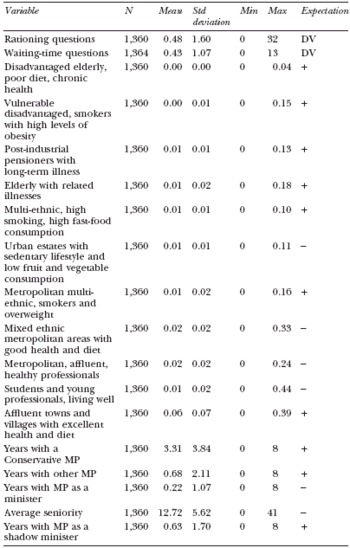
To measure the political supply factors, we used information from MPs' parliamentary web pages and Dod's Parliamentary Companion. We calculated the average seniority for each constituency by dividing the total seniority for each of the MPs representing that constituency during the period 1997–2005. For example, if an MP served for 20 years before losing an election in 2001, his seniority would be 20 and if his successor remained in office until 2005, his seniority value would be 4, giving the variable average seniority a value of 12 (24 years/two members) for that constituency. From these sources, we also created three variables indicating the total number of years a constituency was represented by the Labour Party, the Conservative Party (the opposition party) or any other party over the period of 1997–2005. Finally, we created a variable capturing the number of years throughout 1997–2005 that a constituency was represented by an MP who served on the government's front bench in order to control for the fact that ministers would be unlikely candidates for asking questions regarding government policy. Likewise, we measured the number of years a constituency was represented by a shadow cabinet member, who might ask more questions to challenge the current party's policy. Summary statistics are presented in Table 1.
Summary Statistics

The dependent variable in each of the regression models is the count of parliamentary questions asked by the constituency's MPs. Regressors are constituent demand, the HealthACORN types and the political supply variables. The unit of analysis is the parliamentary constituency–local authority dyad. Since the HealthACORN types are measured by local authority, not constituency, a scheme was developed to associate the ACORN data to each dyad. Each of the HealthACORN characteristics is multiplied by a weighting variable that records the number of census addresses in the dyad. This weight is available from MIMAS via the use of its GeoConvert system.Footnote 50 For example, if 25 per cent of the census addresses in constituency A are in local authority B and 75 per cent are in local authority C, the total weighted HealthACORN demographics for constituency A is equal to 0.25 * ACORNB + 0.75 * ACORNC.
Our dependent variables are, as noted, counts of questions by MPs representing the constituency in each dyad. The mean (maximum) number of questions for those constituencies with non-zero values is 3.06 (32) in the case of care rationing and 2.32 (13) in the case of waiting times. Nonetheless, a substantial number of dyads had no questions asked (80 per cent of dyads in the case of waiting times and 81 per cent for rationing). To address these characteristics of the data, we estimated a zero-inflated binomial regression (ZINB) model via maximum likelihood.Footnote 51 As a model of MPs' choice of whether to put questions to ministers, the negative binomial regression model – which permits the estimation of an overdispersion parameterFootnote 52 – assumes that every MP has a positive probability of putting a question. This is unlikely to be true given what we know of partisan politics in the UK. Per hypothesis H3, we expect that government MPs are less likely than members of the opposition to pose any questions at all, and, per H1, that less senior MPs are more likely to do so in the hopes of developing a personal vote. The ZINB is a mixture of probability models for two latent groups, the group that never asks questions (a logit probability model) and the group that sometimes asks questions (a negative binomial probability model). The approach permits different predictors in each of the models, a feature we exploit.
We estimate robust standard errors clustered on the local authority for which the healthiness measures were calculated.Footnote 53 This addresses unobserved heterogeneity at the local-authority level that would not be captured at the constituency level, where the political choices central to our story are made.Footnote 54
RESULTS
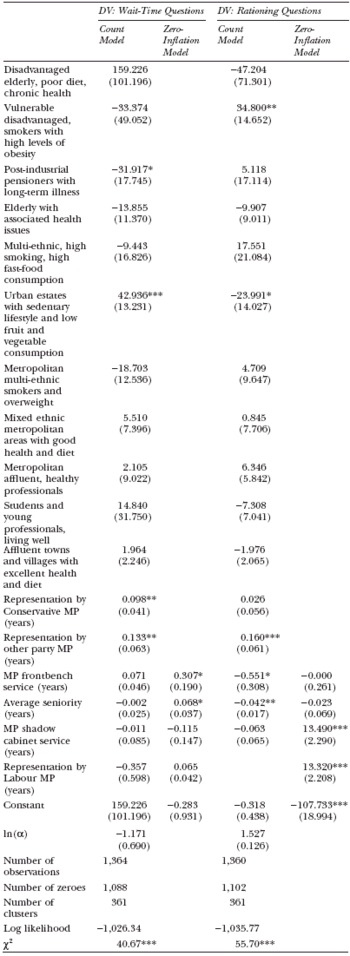
Table 2 presents our results. The zero-inflation model estimates the influence of the regressors on the probability of zero questions (significant positive coefficients imply a greater likelihood of zero questions), while the count model predicts the probability of asking more questions, demonstrated by a significant positive coefficient, given that the constituency's representatives have already ‘jumped the hurdle’ into asking questions. Model likelihood-ratio tests reject the null hypothesis that all coefficients are simultaneously zero, and we find no evidence of a multicollinearity problem.Footnote 55 A Vuong model comparison test statistic (having an asymptotic normal distribution) favours the ZINB over a standard negative binomial regression in the waiting-time (Pr>z = 0.002) and rationing (Pr>z = 0.037) models.Footnote 56
Constituency Demand and Political Supply of Parliamentary Questions Regarding NHS Waiting Times and Care Rationing, 1997–2005

Significance *>0.1, **>0.05, ***>0.01 (two-tailed test). The parliamentary constituency–local government dyad is the unit of analysis. Inflation model is logistic. White (1982) standard errors clustered on the local authority in which HealthACORN demographics were recorded appear in parentheses.
Two constituent health groups display statistically significant effects on the supply of questions regarding waiting times. While both groups have high health risks, only one supports our hypothesis (H6). A 1 per cent increase in urban estate residents with sedentary lifestyles and low fruit and vegetable consumption is associated, ceteris paribus, with approximately 15 additional questions about waiting times. However, all else being equal, a 1 per cent increase in the number of post-industrial pensioners with long-term illness in a constituency is associated with almost 11 fewer parliamentary questions put to the health secretary about waiting times. We observe similarly mixed support for the hypothesis in the case of care rationing. Constituencies including populations of vulnerable disadvantaged smokers with high levels of obesity are associated with an increase of about 13 questions when that group's concentration increases by 1 per cent, all other things being equal. By contrast, a 1 per cent increase in urban estates residents with sedentary lifestyles is associated with about nine fewer questions, ceteris paribus. It is interesting to note that the urban-estates measure has opposite effects in the waiting-time and care-rationing models. None of the low-risk health categories had a significant effect on either form of parliamentary questions.
The influence of political factors on the supply of questions is more stable across the models. Yet it is interesting to note thatparliamentary questions are inelastic in each of the statistically significant political variables, each of which is measured in years of service. The average seniority of a constituency's representatives significantly decreases parliamentary questions in both models, providing support for our hypothesis (H1). A 10 per cent increase in seniority – moving MPs farther into their parliamentary careers – decreases questions by 5.3 per cent in the rationing and 6.3 per cent in the waiting-times models. These are the largest political effects we observe in either model.
Membership in the governing party (Labour in our sample) has a significant negative impact on questions regarding rationing, shown through member silence. Labour Party representation does not have a significant effect on questions regarding wait times. These results provide some support for hypothesis H2.
A 10 percentage increase in the length of representation by the opposition (Conservative) party increases waiting-times questions by 3.2 per cent, while the effect is insignificant in the rationing model. Longer representation by a minority opposition party (i.e. not the Conservative Party) increases waiting-times and rationing questions. In each case, a 10 per cent increase in minority party representation is associated with an increase in questions of approximately 1 per cent in each model. These results are consistent with our expectation (H3) that minority party backbenchers question the government more frequently than do members of the governing party. Representation by a minority party (such as the Liberal Democrats) has a positive and statistically significant effect in both the waiting-times and rationing models. A percentage change in years of service by a minority party is associated with a 0.09 per cent increase in waiting-time questions and a 0.11 per cent increase in rationing questions. Our evidence suggests that minority party members use parliamentary questions as a means of drawing attention to the shortcomings of the government.
As anticipated (H4), the longevity of government frontbench service is associated with fewer questions in both models, though the overall effect is statistically insignificant in the case of waiting times. The coefficients in Table 2 suggest that the effects are inconsistent in sign; however, it is possible in a zero-inflation model, a mixture of two probability models, for a variable's coefficient and its total effect to carry different signs (or to have zero impact in one model but not in the other) when the variable appears in both the count and inflation equations. This can happen when the effect in the count model is sufficiently large to counteract the effect in the inflation model. The estimated elasticity for years of frontbench service in the rationing model is −0.039, but is statistically insignificant (p > 0.335). The effect is small, namely doubling the length of frontbench representation reduces the number of waiting-time questions by only 3 per cent. It is interesting to note that longevity in government does significantly increase the probability of silence in the waiting-time model, while it significantly decreases the number of questions about rationing, given that questions are asked. Overall, support is surprisingly weak for this hypothesis.
The effect of years of shadow cabinet service (H5) is a strong predictor of silence in the rationing model, but not the number of questions providing some support for the hypothesis. Yet its overall effect is statistically insignificant, and the variable is not a significant predictor in the waiting-time model. The rationing model thus provides some support for the hypothesis.
CONCLUSION
By examining parliamentary questions as means for MPs to engage in policy advocacy on behalf of constituents, we juxtaposed the two ‘faces’ of parliamentary representation, those of constituent and party, and explored the factors playing a role in representation on a key issue in British health care policy. We found some support for constituency representation among high-risk categories, but observed other high-risk categories that received significantly less representation through parliamentary questions as their proportions increased within a given constituency. Our results for political supply factors were much more consistent across models, suggesting support for the influence of party-political and career concerns on the behaviour of MPs in this area.
Our results have several implications for future research. A contributing factor in health rationing may be financial deficits and funding shortfalls in NHS trusts, which display geographic disparities.Footnote 57 Areas that are more rural or affluent or both may be receiving less funding because of a perceived lower need for health services, due to either smaller populations or better economic living standards. Budget shortfalls may mean that NHS trusts in deficit are forced to cut back on services, resulting in more rationing of services for their members.Footnote 58 Indeed, we find a negative effect of our urban-estates measure on rationing questions, but a positive effect on wait times. It may be that individuals in these communities find care available, but with long waits. Future enquiry in this vein could prove a very interesting contribution to health policy research. Our research also has implications in the area of constituency service. The results provide support for the claims of Norton and Wood and Gaines regarding the role of the party and the personal vote for British MPs.Footnote 59 Furthermore, regarding the two ‘spheres’ of obligation postulated by Norton and Wood, the political sphere appears to determine much of the action, although MPs do exhibit some responsiveness to the needs of their constituents.Footnote 60
In the wider context, these results provide interesting insight into the relationship between legislators and their constituencies as well as the balancing of interests on the part of the representative. The scope of our study is limited, of course, by our focus on rationing and waiting times. Patterns of representation may be very different in, say, education or foreign policy. Our method is robust to such enquiry, and further research should explore different spheres of public and political interest. This may also be a viable strategy to use to compare the amount of attention paid to different issues and use that to determine an overall sense of parliamentary representation of constituent interests. The influence that political factors exhibit over MPs may vary across issues with differing salience and importance. Another limitation of this study is that the time period, 1997–2005, is entirely contained in a Labour majority period. Further research should endeavour to collect data on parliamentary questions during other periods to compare the behaviour of the parties in theirdiffering roles. Other forms of policy advocacy beyond parliamentary questions would also provide a fuller picture of substantive representation on the topic we have examined.
Nonetheless, our analysis does provide a valuable and unique look into representation in an important policy area. MPs balance their constituency and parliamentary roles in health policy as scholars have observed more generally. Yet with so few categories of constituent health risks mapping to parliamentary behaviour, MPs seem likely to respond to the most salient issues in their constituencies rather than give careful consideration to the full contours of constituents' policy demands. MPs' political motivations are much clearer.
APPENDIX
The HealthACORN measures employed in the analysis are:
-
• Disadvantaged elderly, poor diet, chronic health refers to areas such as Glasgow and Easington, with low levels of exercise and high levels of high blood pressure, cholesterol, heart attacks, diabetes and arthritis. The diet is characterized by an elevated consumption of fast food and sugary drinks, as well as canned soups, sausage and bacon.
-
• Vulnerable disadvantaged, smokers with high levels of obesity characterizes areas such as Merthyr Tydfil, with a mixed age range, high levels of broken families, unemployment and depression and angina. More than half of the people in these areas are smokers, there is a high level of obesity and the diet is poor, with high fat content and low consumption of fruit and vegetables.
-
• Post industrial pensioners with long-term illness are in areas such as Rhondda, Cynon, Taff and Neath Port Talbot with older couples that are also pensioners with high tendencies to be overweight. Over 10 per cent of these populations have angina and over 5 per cent have had a heart attack but the diet is only moderately unhealthy with low consumption of fruit and vegetables countered by low consumption of high-fat and high-sugar foods.
-
• Elderly with associated health issues refers to areas such as Bolsover, containing elderly middle-income residents living in homes that they own. The diet in these areas is characterized by traditional food items such as pies and canned soups, with a lower than average consumption of sugar and an average intake of fast food. While the levels of heart-related illnesses as well as diabetes and arthritis are higher, they are no more severe than in other elderly demographics.
-
• Multi-ethnic, high-smoking, high fast-food consumption populations are in poor, usually urban areas, with single parents and children where more than 75 per cent of housing is rented and include areas such as Lambeth and Greenwich. Half of these populations are smokers and nearly one-third are overweight with consumption of fast food and ‘hot instant snacks’ significantly above the national average.
-
• Urban estates with sedentary lifestyle and low fruit and vegetable consumption are represented by areas such as Knowsley and Liverpool, with council estates of families with children and with high levels of obesity and smoking. Almost 15 per cent of people get no exercise whatsoever and over half eat less than one serving of fruit or vegetables a day. There are also elevated levels of heart attacks and high cholesterol.
-
• Metropolitan multi-ethnic, smokers and overweight refers to localities such as Hackney and Tower Hamlets, with fair health, but a high incidence of smokers and obesity. Fried foods are likely to be consumed while fruit, vegetables and high-fat and/or -sugar foods are consumed less.
-
• Mixed ethnic metropolitan areas with good health and diet are on the other end of the socio-economic and health spectrum. These are locales characterized by neighbourhoods such as Hammersmith and Fulham and the Isles of Scilly, with high proportions of students and single people, usually between the ages of 20 and 30, who tend to exercise more than average and have lower levels of heart problems. Although the diet in these areas is not bad, it is not particularly healthy with lower levels of fruit and vegetable consumption than average and higher intakes of sugary drinks, milkshakes and desserts.
-
• Metropolitan affluent, healthy professionals are areas such as Camden, with a young, mobile and professional population that tend to live in rented housing. On the whole they are non-smokers who engage in physical activity and have eating habits similar to the national average, with low levels of disease.
-
• Students and young professionals, living well are indicated in locales such as the City of London, with the lowest levels of heart disease, diabetes, arthritis and high blood pressure. Soup, rice and sandwiches purchased outside the home are staples of the diet, while fruit and vegetables are not.
-
• Affluent towns and villages with excellent health and diet in areas such as Ceredigion, Pembrokeshire and Anglesey are more rural areas that contain wealthier families and couples whose children have already left home. Health is better than average and people in these areas generally avoid fast food and have a higher intake of fish, vegetables, game and dried fruit. Comparatively few people in these areas are obese or smoke.