Introduction
The treatment of Alzheimer's disease (AD) and other dementias has proven to be moderately effective at best (Saddichha and Pandey, Reference Saddichha and Pandey2008). Following the rapid increase in the world's population affected by dementia and the expanding need for effective interventions for patients and their caregivers, most clinicians agree that maintenance or even improvement of patient Quality of Life (QOL) is the central goal of dementia care (Rabins et al, Reference Rabins, Lyketsos and Steele2006).
Health related QOL has been defined by Patrick and Erickson (Reference Patrick and Erickson1993) as “the value assigned to duration of life as modified by the impairments, functional states, perceptions and social opportunities that are influenced by disease, injury, treatment or policy”. Dementia is associated with cognitive, functional and behavioral impairments that severely compromise QOL (Black and Rabins, Reference Black, Rabins, Burns, O'Brien and Ames2005). As a result, people consider dementia as a state worse than death (Patrick et al., Reference Patrick, Starks, Cain, Uhlmann and Pearlman1994). QOL is important because this allows for the acknowledgment of the patient's own opinion and the positive aspects of their life despite the dementia. For example, QOL studies have shown that dementia patients appreciate their lives at least as much as cognitively intact elders (Ready et al., Reference Ready, Ott and Grace2004). QOL measures also provide a unique method of evaluating the impact of pharmacological and non-pharmacological treatments in dementia and the effectiveness of social and health services (Logsdon et al., Reference Logsdon, Gibbons, McCurry and Teri1999).
The measurement of QOL in dementia remains an area of debate. Clinical studies have shown controversial results on the influences of demographic and clinical factors on QOL in dementia (Albert et al., Reference Albert1996; Logsdon et al., Reference Logsdon, Gibbons, McCurry and Teri1999; Andersen et al., Reference Andersen, Wittrup-Jensen, Lolk, Andersen and Kragh-Sørensen2004). Comparing results of QOL studies is hampered by the limited number of studies using the same QOL scale and the different sample characteristics. In the current study, we used Alzheimer Disease Related QOL scale, a proxy-rated dementia specific QOL measure (ADRQL; Rabins et al., Reference Rabins, Kasper, Kleinman, Black and Patrick1999). Only Thomas et al. (Reference Thomas2006) used ADRQL in community-residing patients who came to consultation in a specialized center, while Missotten et al. (Reference Missotten2008) used it in a mixed population of both community and institutional residing patients. ADRQL has been mainly used in institutional studies (Gonzales-Salvador et al., Reference Gonzales-Salvador2000; Lyketsos et al., Reference Lyketsos2003; Sloane et al., Reference Sloane2005; Edelman et al., Reference Edelman, Fulton, Kuhn and Chang2005); while Quality of Life-AD (QOL-AD, Logsdon et al, Reference Logsdon, Gibbons, McCurry and Teri1999) is the most widely used QOL scale in community studies (e.g. Logsdon et al., Reference Logsdon, Gibbons, McCurry and Teri1999; Reference Logsdon, Gibbons, McCurry and Teri2002; Vogel et al., Reference Vogel, Mortensen, Hasselbalch, Andersen and Waldemar2006; Matsui et al., Reference Matsui2006).
Dementia care in Greece is different to that in other countries because the vast majority of patients, more than 95%, receive care at home from family members (Triantafillou et al., Reference Triantafillou2006). The main objective of the study was to explore the relationship between QOL and patients demographics, disease characteristics, cognitive status, dementia severity, functional status and behavioral and psychological symptoms of dementia. Moreover, we addressed our study to evaluate caregivers’ demographics, depressive symptoms and burden. According to our knowledge, this is the first study of factors associated with Quality of Life in dementia patients in Greece. Results will be extremely useful, as community services for dementia in Greece are developing and the need to establish priorities is urgent.
Methods
Participants
Study participants were a consecutive series of consenting 161 patient–caregiver dyads who visited a Dementia Clinic between May 2007 and April 2008. All patients met diagnostic criteria for dementia according to DSM-IV-TR. Caregivers were all primary caregivers, involved in their role for at least two hours, twice a week. The only exclusion criteria used for both patients and caregivers were chronic mental illness and current chemo- or radiotherapy for cancer.
Procedure
The study took place in the “Alzheimer Center”, the first specialized dementia clinic in Athens, Greece. It belongs to the Psychogeriatric Association, a non-profit organization. All services are free of charge for patients and families. It consists of a 15-bed short-term hospitalization unit, a day care center for occupational therapy and two consultation clinics. All caregivers and patients signed written consent before their enrollment in the study. The study was approved by the Ethics Committees of both the Psychogeriatric Association and the Department of Psychiatry, Medical School of the University of Ioannina.
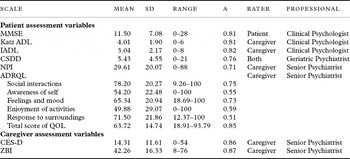
Patients and caregivers were interviewed separately. The professionals involved in collecting demographic factors and administrating psychometric scales had at least three years’ experience working with dementia patients and received special training for administering the scales (Table 3).
Measures
The patient characteristics measured and the criteria and instruments used were:
Demographic data: gender, age, marital status, education and co-morbidity according to their caregivers.
Disease characteristics: dementia type (Diagnostic and Statistical Manual of Mental Disorders (DSM-IV; American Psychiatric Association, 2000) criteria were used for the diagnosis of Alzheimer's disease (AD) and vascular dementia (VD)); consensus criteria by McKeith et al. (Reference McKeith1996) for the diagnosis of dementia with Lewy bodies (DLB); Neary et al. (Reference Neary1998) criteria for the diagnosis of frontotemporal dementia (FTD)); we also assessed age of dementia onset and medication profile including use of anti-dementia, antidepressive, antipsychotic and anxiolytic drugs.
Cognitive status: measured by the Mini-mental State Examination (MMSE; Folstein et al., Reference Folstein, Folstein and McHugh1975), the most widely used instrument for measuring cognitive decline. MMSE was translated and validated in Greek by Fountoulakis et al. (Reference Fountoulakis, Tsolaki, Chazi and Kazis1994).
Severity of dementia: rated by the Global Deterioration Scale (Reisberg et al., Reference Reisberg, Ferris, De Leon and Crook1982), a semi-structured rating based on an interview with the caregiver. The instrument stages severity of dementia on seven levels. Dementia patients may have scores from 3 to 7 in this scale.
Functional level: rated on Katz ADL (Katz et al., Reference Katz, Down, Cash and Grotz1970), a measure of six basic activities of daily living (bathing, dressing, toileting, transferring, continence, feeding) and Lawton's IADL (Lawton and Brody, Reference Lawton and Brody1969), a measure of eight instrumental activities of daily living (telephoning, shopping, food preparation, housekeeping, laundry, transportation use, medication use, financial management).
Depressive symptoms: were rated on the Greek version of the Cornell Scale for Depression in Dementia (CSDD; Politis et al., Reference Politis2006). CSDD is a 19-item instrument for measuring depressive symptoms in dementia. Both the patient and the caregiver are interviewed by a psychiatrist, but the scale is clinician-rated. Ratings >12 are strongly correlated with a psychiatric diagnosis of major depressive episode (Alexopoulos et al., Reference Alexopoulos, Abrams, Young and Shamoian1988).
Behavioral and psychological symptoms of dementia (BPSD): the Neuropsychiatric Inventory (NPI; Cummings et al., Reference Cummings, Mega, Gray, Rosenberg-Thompson, Carusi and Gornbein1994) assesses 12 non-cognitive, psychiatric symptoms of dementia: delusions, hallucinations, agitation, dysphoria, anxiety, euphoria, apathy, disinhibition, irritability, aberrant motor behaviour, sleep, and appetite and eating disorders. The caregiver rates each of the syndromes by frequency and severity. We included night-time behaviors and appetite/eating which are not usually counted in the total score of the NPI. The scale was translated and validated in Greek by Politis et al. (Reference Politis, Mayer, Passa, Maillis and Lyketsos2004).
Quality of Life (QOL): rated using the Alzheimer Disease Related Quality of Life (ADRQL; Rabins et al., Reference Rabins, Kasper, Kleinman, Black and Patrick1999), a proxy-rated, dementia-specific instrument. Scale development was guided by focus groups and expert panels in order to reflect caregivers’ and dementia experts’ opinion about QOL in dementia. ADRQL includes 47 items in five domains: social interaction, awareness of self, enjoyment of activities, feelings and mood, and response to surroundings. The score in each item is weighed according to its importance to the quality of life given by the caregivers during the scale's development. Rabins et al. (Reference Rabins, Kasper, Kleinman, Black and Patrick1999) claim that the scale measures mainly observable behaviors, eliminating the subjective nature of proxy responses.
The characteristics of caregivers measured and the instruments used include:
Demographic data: gender, age, education, marital status, caregiver living with the patient, relationship to the patient, weekly caregiving time, years of caregiving, presence of professional caregiver and subjective economic situation (bad, fair, good).
Depressive symptoms: rated on the Greek version of the Center for Epidemiological Studies-Depression Scale (CES-D; Radloff, Reference Radloff1977; Fountoulakis et al., Reference Fountoulakis2001), a 20-item measure that has been used in caregiver research (Brodaty et al., Reference Brodaty, Green and Koschera2003).
Caregiver burden: assessed on the Zarit Burden Interview (ZBI; Zarit et al, Reference Zarit, Reever and Bach-Peterson1980), a 22-item scale translated and validated in Greek by Papastavrou et al. (Reference Papastavrou, Kalokerinou, Papacostas, Tsangari and Sourtzi2007). In a review of caregiver stressors and health by Pinquart and Sörensen (Reference Pinquart and Sörensen2006), ZBI was used in 32 of 85 articles studied.
Statistical methods
The Statistical Package for Social Sciences (SPSS), version 13 for Windows, was used for the data analyses. To analyze demographic factors and to investigate the prevalence of cognitive and psychiatric symptoms in persons with dementia and their caregivers, mean scores and standard deviations were calculated. Cronbach's α was estimated to assess the internal consistency of all scales used. ADRQL, the dependent variable in this study, was normally distributed (Kolmogorov-Smirnov test). Univariate linear regression was employed to estimate the possible association of each independent variable studied with ADRQL. Variables that showed significant association (p < 0.05) were considered in the multiple regression analysis. A stepwise variable selection process was used in order to get the final multivariate model. The possibility of multicollinearity was investigated in order to ensure the validity of our final multivariate model.
Results
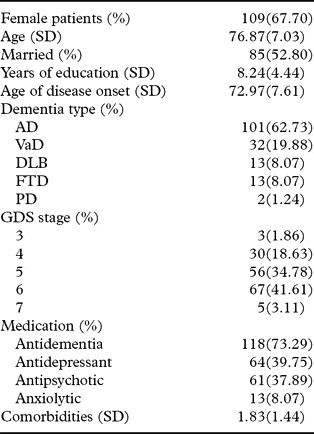
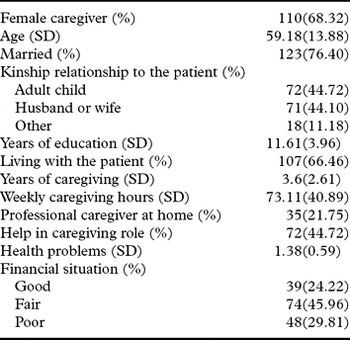
All 161 patients included were community residing dementia patients. Their characteristics are in Table 1. The study population was old, with 112 patients (69.57%) being 75 years or older, and had a low educational level, with 85 patients (52.8%) having ≤6 years of education. Patients had had dementia for an average of about four years, with 46% suffering from moderate (n = 74) and 39% suffering from severe (n = 63) dementia according to the MMSE scores (0–9 for severe and 10–19 for moderate dementia). The level of cognition in our study was low (mean MMSE = 11.50) but comparable to that of Thomas et al. (Reference Thomas2006) and Missotten et al. (Reference Missotten2008) (mean MMSE = 12.8 and 8.56, respectively). Caregiver characteristics are shown in Table 2. Most caregivers were spouses and involved in the caregiving role on a daily base. The mean scores of assessment scales in both patients and caregivers are presented in Table 3. Alpha coefficients were fair to good for all scales used.
Patients' characteristics (n = 161)

AD = Alzheimer's disease; VaD = vascular dementia; DLB = dementia with Lewy bodies; FTD = frontotemporal dementia.
Caregivers’ characteristics (n = 161)

Patient and caregiver assessment variables (n = 161)

MMSE = Mini-mental State Examination; Katz ADL = Katz Activities of Daily Living; IADL = Lawton's Instrumental Activities of Daily Living; CSDD = Cornell Scale for Depression in Dementia; NPI = Neuropsychiatric Inventory; ADRQL = Alzheimer Disease Related Quality of Life; CES-D = Center for Epidemiological Studies-Depression Scale; ZBI = Zarit Burden Interview.
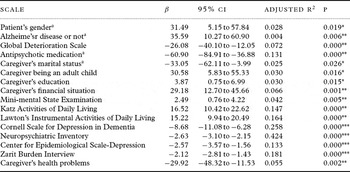
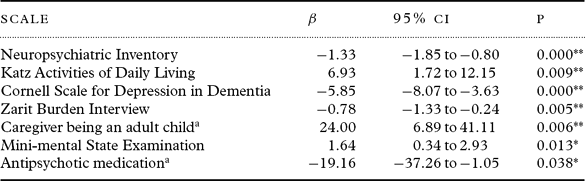
The initial univariate analyses are shown in Table 4, where only those variables appearing significantly associated with ADRQL were included. NPI score appeared to explain a good proportion of variability alone (R2 = 0.424). This reflects the importance of neuropsychiatric symptoms in dementia patients’ QOL, but could also be artificially inflated by the large behavioral component of the ADRQL scale. Furthermore, patient depressive symptoms (CSDD), caregiver burden and depression also explained a fair amount of variability on their own. All 16 variables presented in Table 4 were introduced into the multiple regression analysis. The final model is presented in Table 5, where the following variables (and scales) were included: patient's depression (CSDD), behavioral symptoms (NPI), basic activities of daily living (Katz ADL), cognitive status (MMSE), antipsychotic treatment, caregiver being an adult child and caregiver's burden. The adjusted R2 was 0.598 in this model. The variables of global deterioration scale, caregiver's financial situation, Katz ADL and caregiver's health problems were treated as continuous in the univariate analyses for simplicity and ease of interpretation, although they are categorical with 5, 3, 7 and 4 levels respectively. Apart from Katz score, none gets into the final multivariate model, something that is true whichever way we treat them.
Univariate regression analyses (n = 161)

a Better patient QOL was observed with: female gender, no antipsychotic medication, AD diagnoses, unmarried caregiver and caregiver being an adult child.
Variables that did not correlate significantly with patient QOL include: age of disease onset, patient's age, marital status, education and comorbidities, antidementia, antidepressant and anxiolytic medication, patient-caregiver relationship other than caregiver being an adult child, caregiver's gender, age, living with the patient or not, years of caregiving, weekly caregiving hours, presence of a professional caregiver at home, help in caregiving role and dementia type other than AD.
* p<0.05, ** p<0.01.
Final multivariate model (n = 161)
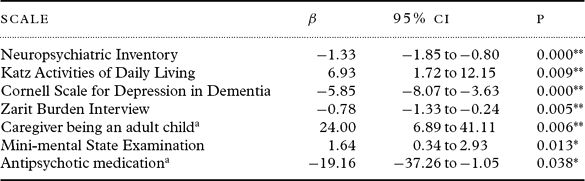
Total adjusted R2 = 0.598; * p < 0.05, ** p < 0.01.
All 16 variables that showed significant associatiotion (p < 0.05) in the univariate regression were introduced in the multiple regression analysis. Variables that lost significance in the multiple regression include: patient's gender, Alzheimer's disease or not, Global Deterioration Scale, Lawton's Instrumental Activities of Daily Living, caregiver's financial situation, caregiver being an adult child, caregiver's marital status, caregiver's education, caregiver's depression and caregiver's health problems.
aBetter patient QOL was observed with: no antipsychotic medication and caregiver being an adult child.
We were highly concerned with the potential correlation between independent variables, but intercorrelations among independents were below 0.80. Moreover, most variables that were highly correlated were not included in the final multivariate model. For example, high correlation was found between GDS and MMSE (r = 0.778), but GDS was not included in the final model. To further test for multicollinearity, the Variance Inflation Factor (VIF) was calculated for each independent variable. VIF values were between 1.287 and 3.644, indicating the lack of a severe collinearity problem. Intercorrelations between independent variables included in the final multivariate model were below 0.6. In the final model, the largest VIF was 1.745 (well below the level of 4 generally used to consider multicollinearity as a problem); the condition number was 12.291 and the Darbin-Watson statistic 2.155.
Discussion
In the current study, many patient and caregiver characteristics appeared to be associated with scores of patient QOL in a univariate approach, but we consider the results of the multivariable regression analyses as most important.
The only patient demographic factor that appeared to be associated with ADRQL was gender, with QOL being higher for women patients. The loss of significance in the multivariate analysis may be attributed to the fact that most women patients were being cared by their adult children. Gender was not associated with QOL in previous QOL studies (e.g. Logsdon et al., Reference Logsdon, Gibbons, McCurry and Teri1999; Missotten et al., Reference Missotten2008). Patients with AD had better QOL than those with other forms of dementia. Only a few studies have examined the effect of dementia type to QOL: Boström et al. (Reference Boström, Jönsson, Minthon and Londos2007) found that patients with DLB had a poorer QOL than AD patients; Allan et al. (Reference Allan, McKeith, Ballard and Kenny2006) attributed the better QOL in AD patients to fewer autonomic symptoms in AD. The loss of significance in the multivariate analysis may be attributed to different clinical characteristics between dementia subtypes.
Antipsychotic treatment was an independent predictor of patient QOL. Albert et al. (Reference Albert1996) found the same association, as did Ballard et al. (Reference Ballard2001) in an institutional study. This result must be interpreted cautiously as this study is cross-sectional, took place in a specialized clinic and antipsychotics are prescribed to patients with the most problematic behavior. However, it may reflect adverse effects of these medications on QOL, perhaps due to side effects or unnecessary prescription of antipsychotics.
All patients’ clinical characteristics were associated with their QOL. In agreement with other studies, ADRQL was positively associated with depressive symptoms (Logsdon et al., Reference Logsdon, Gibbons, McCurry and Teri1999; Thomas et al., Reference Thomas2006), cognitive functioning (Wlodarczyk et al., Reference Wlodarczyk, Brodaty and Hawthorne2004; Thomas et al., Reference Thomas2006; Missotten et al., Reference Missotten2008), dependency for IADL and ADL (Logsdon et al., Reference Logsdon, Gibbons, McCurry and Teri1999; Andersen et al., Reference Andersen, Wittrup-Jensen, Lolk, Andersen and Kragh-Sørensen2004; Wlodarczyk et al., Reference Wlodarczyk, Brodaty and Hawthorne2004) and disease staging (Albert et al. Reference Albert2001; Missotten et al., Reference Missotten2008). Negative associations were found between ADRQL and behavioral problems (Jönsson et al. Reference Jönsson2006; Thomas et al. Reference Thomas2006; Vogel et al., Reference Vogel, Mortensen, Hasselbalch, Andersen and Waldemar2006; Missotten et al., Reference Missotten2008). Disease staging and IADL lost significance in the multivariate analysis, in accordance with the studies of Missotten et al. (Reference Missotten2008) and Logsdon et al. (Reference Logsdon, Gibbons, McCurry and Teri1999). This loss of significance may be attributed to our sample, which included mainly patients with moderate and severe dementia. Instrumental activities of daily living appear more associated with quality of life in the early stages of the disease whereas later in the course of the disease, basic activities of daily living become more important to patients QOL (Logsdon et al., Reference Logsdon, Gibbons, McCurry and Teri2002).
Caregiver factors appeared associated with patients’ QOL. Previous studies have not included several caregivers’ characteristics as possible predictors of patient QOL. We found that better patient QOL was associated with higher caregivers’ education (as found by Logsdon et al., Reference Logsdon, Gibbons, McCurry and Teri1999), better financial situation (not found by Logsdon et al., Reference Logsdon, Gibbons, McCurry and Teri1999), fewer caregivers’ health problems, caregiver being unmarried and caregiver being an adult child. In accordance with other studies, we also found that higher caregiver burden (Karlawish et al., Reference Karlawish, Casarett, Klocinski and Clark2001; Logsdon et al., Reference Logsdon, Gibbons, McCurry and Teri2002) and depression (Karlawish et al., Reference Karlawish, Casarett, Klocinski and Clark2001; Logsdon et al., Reference Logsdon, Gibbons, McCurry and Teri2002) were associated with poorer caregiver ratings of patient's QOL. In the final multivariate model only two caregiver factors were included: caregiver not being an adult child and caregiver burden. The others caregiver characteristics may constitute predictors of caregiver burden, and this may explain the fact that they lost significance in the multivariate analysis.
The independent contribution of caregivers’ burden to their ratings of patient QOL may be influenced by their own experience and psychological factors (Sands et al., Reference Sands, Ferreira, Stewart, Brod and Yaffe2004; Fuh and Wang, Reference Fuh and Wang2006). The association between burden of care and patients’ QOL is far more complex. QOL and caregiver burden share common predictive factors; for example, functional decline and behavioral problems are well known to worsen patients’ QOL and increase caregivers’ burden at the same time (Pinquart and Sörensen, Reference Pinquart and Sörensen2003). Moreover, patterns of behavior of highly burdened caregivers may severely compromise patients’ QOL. For example, highly burdened caregivers may precipitate patients’ behavioral problems; adopt less effective strategies and become less engaged in constructive activities with their patients (Marriott et al., Reference Marriott2000). The independent contribution of the caregiver being an adult child to patient QOL may also be explained by practical caregiving issues: adult children are more educated, have better physical health, may be better informed about dementia and may adopt better caregiving skills than patients’ husbands or wives (Fredman et al., Reference Fredman, Daly and Lazur1995).
The contribution of caregivers’ characteristics to patients’ QOL may be more important in Greece. The vast majority of Greek dementia patients receive care at home from family members. Owing to local cultural factors and the absence of public nursing homes, caregiving at home is often a matter of obligation and not a matter of option. Moreover, community services for dementia patients and caregivers are lacking. We strongly believe that reducing caregiver burden and improving caregiver skills is necessary in order to improve patients’ QOL.
There are several limitations in our study. We conducted a cross-sectional study which cannot provide definitive answers regarding cause and effect. Our sample may not be representative of dementia community patients, as the study was conducted in a referral clinic. Many patients were referred to the clinic for a second opinion and their caregivers may be particularly motivated. Quality of life, functional status, behavioral competence, comorbitities and economic situation were measured based on caregiver report and the results might have been be biased by the caregivers. Caregivers are known to underestimate patients’ abilities, including QOL (Logsdon et al., Reference Logsdon, Gibbons, McCurry and Teri2002). Finally, the sample size, although large, did not allow us to differentiate predictive factors between subgroups of patients and caregivers. This is important, because determinants of QOL may differ, for example, between levels of dementia severity. Positive psychotic symptoms (e.g. delusions, hallucinations, agitation) in the context of dementia may affect more patients with moderate and severe dementia than patients with mild disease (Matsui et al., Reference Matsui2006). Finally, the impact of caregiving differs according to the caregiver's kinship relationship to the patient, which in turn may influence patients’ QOL (Fredman et al., Reference Fredman, Daly and Lazur1995; Donaldson and Burns, Reference Donaldson and Burns1999).
This is the first study of dementia QOL in Greece. The mean ADRQL score (63.72%), similar to that found in a Belgian study (65.77%; Missotten et al., Reference Missotten2008) and better than that found in a French study (52.82; Thomas et al., Reference Thomas2006), indicates that dementia patients do have quality in their lives. Many patient and caregiver factors contribute to patients’ QOL. Future community services for dementia in Greece must focus on the proper management of those factors. Proper recognition and management of behavioral problems and depression in dementia are very important. Special attention must be given to highly burdened caregivers, especially husbands or wives of dementia patients who are taking care of severely demented individuals.
Despite the possible unique characteristics of Greek dementia patients and caregivers, we propose that the current study adds considerably to the existing literature. This is one of the few studies measuring QOL of dementia patients living at home by the use of a proxy-rated dementia specific QOL measure (e.g. Thomas et al., Reference Thomas2006). While carrying out this study, it became apparent to all participants that using ADRQL is an excellent way of exploring a patient's everyday life and focusing on its important aspects. QOL measurement in dementia not only must be included in clinical trials but should also be included, as a standard measurement tool, in every day clinical practice.
Conflict of interest
None.
Description of authors' roles
Antonis Mougias collected the data, conducted the analyses, wrote the paper and helped in designing the study. Venetsanos Mavreas designed the study. Antonis Politis and Costas G. Lyketsos provided the Hellenic version of ADRQL and revised the paper. All the authors approved the final version of the paper.
Acknowledgments
We thank the Greek Psychogeriatric Association “Nestor” for the use of their facilities and their time while writing this paper.