Well-being is a topic that arouses a lot of interest in today's society, both at a collective level, when speaking of the welfare of the state, and at an individual level, when it refers to happiness. Certainly, this interest in individual well-being has been accompanied by the development of positive psychology, which has revealed new paradigms to understand the optimal functioning of the individual (Seligman, Reference Seligman2008). Positive psychology is making it possible to define the contours of the human well-being more precisely (see Vázquez, Hervás, Rahona, & Gómez, Reference Vázquez, Hervás, Rahona and Gómez2009). Well-being can be understood as a person's general state of happiness with his life or as personal growth or self-development (Diener, Emmons, & Griffin, Reference Diener, Emmons, Rand and Griffin1985; Ryff & Keyes, Reference Ryff and Keyes1995). Alternatively, it can be interpreted according to two ancient philosophical orientations: hedonism and eudaemonic. While the first perspective involves understanding well-being as maximizing positive experiences and minimizing negative experiences, the second perspective refers to living in order to develop human potential (Ryan & Deci, Reference Ryan, Deci and Fiske2001; Ryan, Huta, & Deci, Reference Ryan, Huta and Deci2008). Thus, for hedonism, happiness would be the result of maximizing positive experiences in the present moment. Whereas for the eudaemonic conception, happiness would result from a life lived through congruent actions in accordance with deep personal values so that the person feels alive and genuine (Ryff & Keyes, Reference Ryff and Keyes1995; Ryff & Singer, Reference Ryff and Singer1998; Waterman, Reference Waterman1993).
This latter conception of well-being is linked to self-development or psychological growth, based on the implementation of strengths, actions or behaviors associated with the development of the true potential of oneself (Vázquez et al., Reference Vázquez, Hervás, Rahona and Gómez2009). The Self-determination theory (Ryan & Deci, Reference Ryan, Deci and Fiske2001), which is framed within the eudaemonic perspective, describes the human being as an active organism with an innate tendency for personal growth, that engages optimally and effectively in the environment they live in (Balaguer, Castillo, & Duda, Reference Balaguer, Castillo and Duda2008). The surrounding environment is key. If, in the interaction with such environment, people regulate their behavior in a voluntarily and volitional way (i.e. self-regulation), it will promote well-being. However, if the environment acts in a controlling manner (i.e. controlled regulation), this innate tendency will be frustrated and would develop malaise (Ryan & Deci, Reference Ryan, Deci and Fiske2001). Therefore, intrinsic motivation will be prototypic of autonomic regulation, while extrinsic motivation will be a prototype of controlled regulation (Balaguer et al., Reference Balaguer, Castillo and Duda2008). That is, you can pursue a career either for intrinsic reasons (i.e. enjoyment or interest) or for extrinsic reasons (i.e. status, external pressure), each generating different consequences.
Within the eudaemonic perspective, the concept of passion refers to an attitude and intense emotion obtained through a specific activity that is considered important and in which time and energy are invested (Vallerand et al., Reference Vallerand, Blanchard, Mageau, Koestner, Ratelle and Léonard2003). Research indicates that certain people perform activities like work, play sports or study in a passionate manner. These people enjoy their accomplishment, obtaining positive results in terms of happiness and life satisfaction (Vallerand et al., Reference Vallerand, Blanchard, Mageau, Koestner, Ratelle and Léonard2003). However, for others, practicing a passionate activity will report dissatisfaction and burnout (Vallerand, Paquet, Philippe, & Charest, Reference Vallerand, Paquet, Philippe and Charest2010). According to the Dualistic Model of Passion (Vallerand et al., Reference Vallerand, Blanchard, Mageau, Koestner, Ratelle and Léonard2003), there are two inherent types of passion: Harmony and Obsession. Thus, carrying out an activity passionately involves self-defining with features representing the core of one's identity (Vallerand, Reference Vallerand2012). For example, those who passionately study psychology view themselves as “Students of psychology” through the realization of their own prototypical behaviors of high value to them. Thus, representations of the activities that people enjoy and perform regularly are incorporated into the identity of the person to the extent that they are highly valued, leading in turn to development of passion towards these activities (Aaron, Aaron, & Smollan, Reference Aaron, Aaron and Smollan1992). In this sense, the dimensions of harmony and obsession represent a way of performing the conduct that reflects the autonomous and controlled regulation of the Self-Determination Theory, respectively. The harmoniously passionate person freely accepts the activity as relevant to himself in the absence of associated contingencies. This regulation would respond to an integrating tendency of self, being significant for the person but not overwhelming compared to other areas of life or social categories (Deci & Ryan Reference Deci and Ryan2000; Ryan & Deci, Reference Ryan, Deci, Leary and Tangney2003). This leads to greater flexibility and awareness of the activity associated with positive experiences and balanced with other activities (Hodgins & Knee, Reference Hodgins, Knee, Deci and Ryan2002). In turn, obsessive passion results from a controlled regulation of the activity over the self. This controlled regulation involves intrapersonal pressure because the person accepts the activity as relevant due to associated contingencies such as social acceptance, guilt reduction or because the sense of emotion derived from the performance of the activity is uncontrollable (Mageau, Carpentier, & Vallerand, Reference Mageau, Carpentier and Vallerand2011). Therefore, it is associated with stiffness, which, even though initially yields benefits (i.e. improved performance), it also has associated costs such as a self-defensive style of restriction towards other experiences (Aaron et al., Reference Aaron, Aaron and Smollan1992). This self-defensive style is characterized by experiencing conflict, frustration and rumination in the performance of other activities, and is perceived as a loss of opportunities to perform the desired activity (Vallerand, Reference Vallerand2012).
Among the previous research on passion, there are studies on awareness of personal strengths and promoting personal autonomy. Results show that when people recognize the use of their strengths in the development of activity or have the autonomy to do the job, they are more likely to experience harmonious passion (Forest et al., Reference Forest, Mageau, Crevier-Braud, Bergeron, Dubreuil and Lavigne2012; Mageau et al., Reference Mageau, Vallerand, Charest, Salvy, Lacaille, Bouffard and Koestner2009). Following the Self-Determination Theory that argues that the subject integrates elements of his surrounding context to define his identity through an activity, this subject may take items from an existing social category that have associated the experience of passion. Thus, it is expected that subjects who define themselves as members of a social category, will perform consequent behaviors that will ensure the permanence in that category (Tajfel, Reference Tajfel1978). People try to satisfy their need for positive social identification through the processes of categorization, identification and comparison (Morera et al., Reference Morera, Marichal, Quiles, Batancor, Rodríguez, Rodríguez and Vargas2004). In this sense, it is also expected that social categorization will have an associated positive emotional value as a team member and lead them to perform behaviors to preserve this valence. Similarly, the passion with which activities consistent with social identity are performed, may mediate the generation of positive responses, as they are prototypical behaviors of social category, which secure membership. However, the effect of the valence of such behaviors on positive responses is unknown. That is, if more harmonious or obsessive behaviors corresponding to the execution of the activity that constitutes group categorization may have different impact over the emotional value experienced by the student (i.e. happiness).
As for the consequences of passion, research has shown that the relationship with well-being is positive for harmonious passion and negative or null for obsessive passion (Mageau, Vallerand, Rousseau, Ratelle, & Provencher, Reference Mageau, Vallerand, Rousseau, Ratelle and Provencher2005). While passion through activities such as sports, arts and work, especially in the educational stage, is positively related to life satisfaction and vitality, obsessive passion in the same activities is related negatively, experiencing rumination and distress (Rosseau & Vallerand, Reference Rousseau and Vallerand2008) or shows no relationship for people with this passion (Vallerand et al., Reference Vallerand, Salvy, Mageau, Elliot, Denis, Grouzet and Blanchard2007; Vallerand et al., Reference Vallerand, Mageau, Elliot, Dumais, Demers and Rousseau2008).
Therefore, the objective of this present work is to study the relationship between social identity, the dimensions of passion and their impact on positive responses in students such as happiness and satisfaction with the service. The hypotheses of this study are:
-
• Hypothesis 1: Social identity will relate positively with harmonious and obsessive passion.
-
• Hypothesis 2: Passion will have a mediating effect between social identity and responses of happiness and satisfaction in students.
-
• Hypothesis 3: High social identity will predict higher levels of happiness and satisfaction in students when they experience harmonious passion with their studies.
-
• Hypothesis 4: High social identity will predict lower levels of happiness and satisfaction in students when experiencing obsessive passion with their studies.
Method
Participants
The sample of the study is composed of 266 participants from Universidad Miguel Hernández of Elche (49.2%), the Universidad Nacional de Educación a Distancia (39.1%), and the Universidad de Alicante (9.4%). Most participants were students of Psychology, Occupational Therapy, and Advertising and Public Relations (84.8%). The remaining 15.2% were from degrees in social and legal sciences (Business Management, Journalism, Labour Relations and Law). The mean age was 28.42 years (SD = 9.84), with 71.8% of the sample being women. Also, 63.3% of participants were studying in their first years of their degree.
Variables and instruments
Social Identity
A social identification scale was developed ad hoc for this study after reviewing the main social and organizational identification scales created by Haslam (Reference Haslam2001) and collecting van Knippenberg and van Schie’s (2001), Grice, Paulsen, and Jones’ (Reference Grice, Paulsen and Jones2002) considerations in order to assess social identity in students. This scale consists of 14 items. A sample item is: “I feel personally insulted when someone criticizes my degree.” The response scale is from 1 to 5 on a Likert-type scale.
Happiness
The scale developed by Salanova, Martínez, Bresó, Llorens and Grau (Reference Salanova, Martínez, Bresó, Llorens and Grau2005) was used. It consists of 5 items measuring the pleasant feeling that follows the completion of studies (i.e. “When I'm studying, I feel happy”). The response scale is a 7-point Likert-type scale and measures the frequency of these feelings (0 = never, 6 = always).
Satisfaction
The satisfaction with the service provided by the education centre was evaluated using the face scale developed by Salanova et al. (Reference Salanova, Martínez, Bresó, Llorens and Grau2005). The scale consisted of three items assessing the perceived satisfaction with the university, faculty and degree. The response scale consisted of 5 points.
Passion
The Lisbona, Bernabé, Palací, Martín-Aragón, and Gómez (Reference Lisbona, Bernabé, Palací, Gómez-Bernabeu and Martín-Aragón2012) adaptation of Vallerand et al.’s. (2003) Passion Scale to the Spanish population was used. The scale assesses the degree and level of passion regarding an activity in which people invest time and energy. The scale is composed of two dimensions: Harmony (e.g. “I'm totally involved in my studies”) and Obsession (e.g. “My mood depends on whether or not I am able to study something”) of 6 items each. It uses a Likert-type response scale from 1to7 (1 = strongly disagree, 7 = Strongly Agree).
All scales used exceed Nunnally and Bernstein’s (Reference Nunnally and Bernstein1994) .70 criterion (see Table 1).
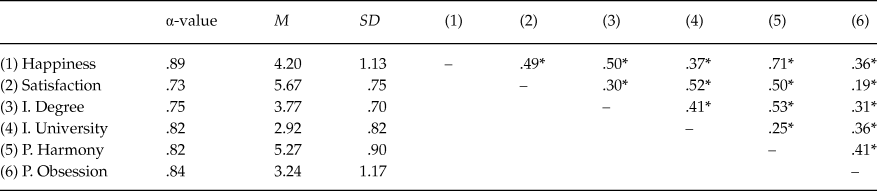
Cronbach’s Alpha, descriptive analyses and Pearson correlations matrix

Note: *p < .001.
Procedure
The administration of the tests took place after a briefing meeting with teachers from participating universities. The sample selection was not random directed. The voluntary participation of different academic courses in various degrees was requested. At all times, the participant was aware of the objectives of the research as well as the voluntary nature of the survey and their participation in the study.
Statistical Analyses
Analysis of internal consistency of the scales using Cronbach's Alpha were performed to evaluate the reliability of the scales used. Values higher than α = .70 are indicative of a good level of internal consistency (Nunnally & Bernstein, Reference Nunnally and Bernstein1994). Statistically significant relationships were analyzed using descriptive analysis (mean and standard deviation) and Pearson’s Product Moment correlation with significance level of p < .001. With respect to hypotheses 1 and 2, Structural Equations are carried out for the analysis of appropriateness of the proposed theoretical model. The latent variables of the model are calculated from the average of the measurement scales. A good model fit will be obtained if chi-square is significant, the relationship between χ2/degrees of freedom, is between 2 and 3, the GFI, CFI and NFI indices are greater than .90 and RMSEA is between .05 – .08 (Lau, Wong, Lam, & McGrath, Reference Lau, Wong, Lam and McGrath2009). To test the mediating effect, the Sobel Test is used. For α = .05, a critical value of z/2 = 1.96 is used to consider a mediating effect on the dependent variable. As for hypothesis 3 and 4, in order to analyze the indirect effect on the dependent variable, the Bootstrapping procedure developed by Preacher and Hayes (Reference Preacher and Hayes2004) is used. According to this model, the indirect effects are significant at p < .05 in the 95% of Confidence Intervals. To determine the strength of the mediating effect, the SPSS macro developed by Preacher, Rucker and Hayes (Reference Preacher, Rucker and Hayes2007) was used. This procedure performs multiple regression analysis in order to test the direct and indirect effects on the dependent variable. In this study, the analysis corresponding to the Model 4 (Preacher et al., Reference Preacher, Rucker and Hayes2007) are performed. According to this model, it is assumed that the independent variable has a less indirect effect (c-c`) that the total effect (c) when the mediating variable is included (Baron & Kenny, Reference Baron and Kenny1986).
The statistical program SPSS 18 was used for the descriptive statistics and reliability analysis. The structural equations’ calculation is performed with the AMOS 18 application and the MODMED macro from Preacher and Hayes (Reference Preacher and Hayes2004) is used for mediational analysis in SPSS 18.
Results
Table 1 presents the descriptive analysis of the studied variables. Levels of internal consistency are greater than the Crombach’s alpha = .70 criterion (Nunnally & Bernstein, Reference Nunnally and Bernstein1994). Happiness and satisfaction are strongly related to the dimensions of social identity, harmony and obsession. Regarding Hypothesis 1, the obtained correlation matrix reveals statistically significant positive relationships between happiness, satisfaction, social identity, harmony and obsession.
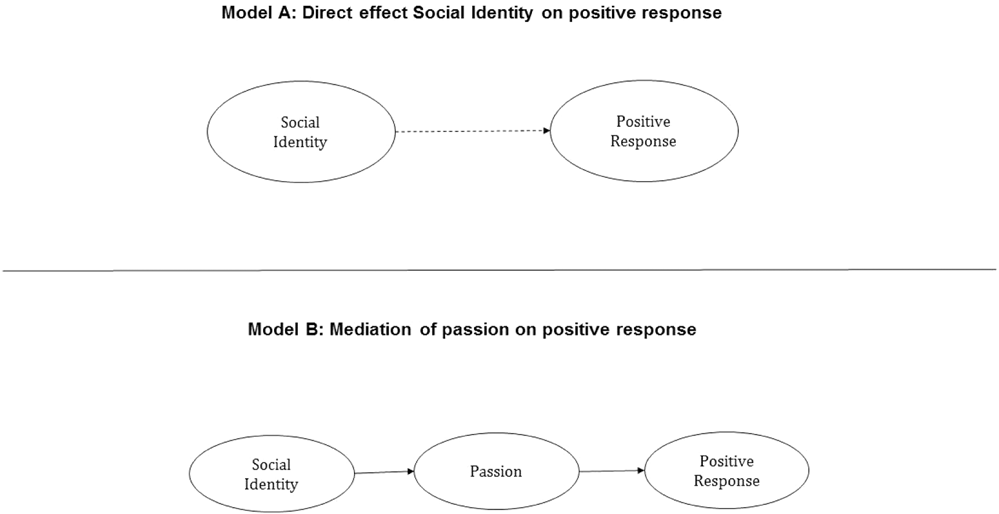
Regarding Hypothesis 2, models are represented in Figure 1. In Model A, the direct effect of social identity on positive responses (i.e. happiness and satisfaction), without any passion, is tested. Subsequently, in Model B, the passion variable is introduced as a mediating effect between the independent variable and dependent variable. The results indicate that Model B has a better overall fit compared to Model A (∆ χ2 /df = –.325), showing a mediating effect of passion and improving the fit indices of the initial theoretical model (see Table 2).
Models of the study.

Adjustment of Fit Indices for mediation of passion

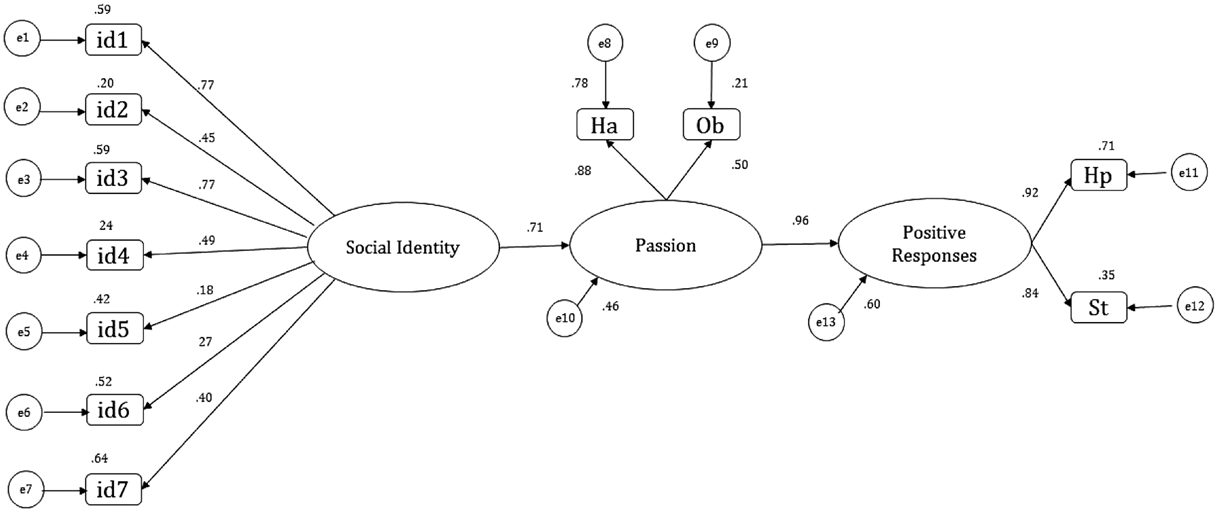
Regarding the direct effects, in Model A social identity has a direct effect (β = .68; p < .001) on the positive responses in students, while in Model B, this direct effect is partially void in the presence Passion (β = .037; p = .797). The Sobel Test (z = 7.04; se = .14; p < .001) corroborates the mediating effect of passion between social identity and positive responses in students (see Figure 2).
Model with passion as mediator between social identity and positive responses in students.

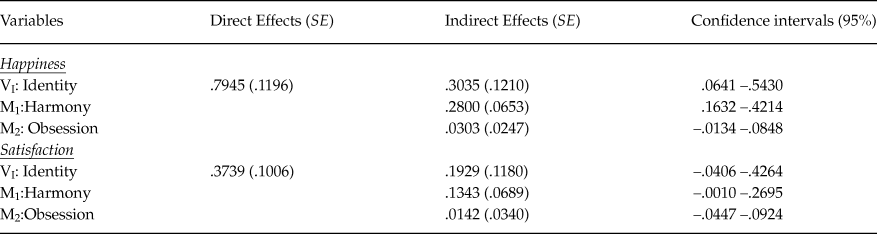
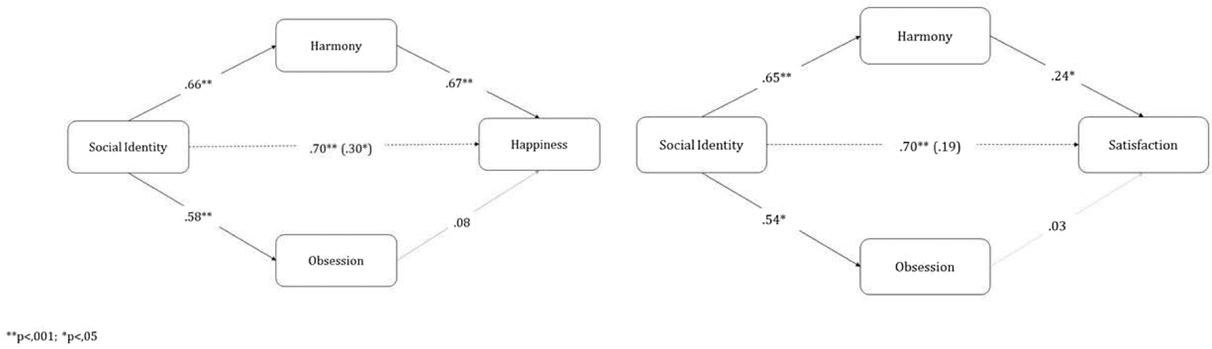
As for the mediating effects proposed in Hypotheses 3 and 4, Table 3 shows the direct and indirect effects on happiness, satisfaction with the mediating variables: harmony (m1) and obsession (m2). Regarding the effect of social identity on happiness (see Figure 3), the results show a partial mediation effect (β = .30; p < .05) in the presence of harmonious passion (β = 24; p < .05) and not with obsessive passion (β = .08; p = .064). Regarding the effect on satisfaction (see Figure 3), the results indicate a partial mediation effect (β = 19; p = .104) in the presence of harmonious passion (β = .24; p < .05) and not with obsessive passion (β = .03; p = .608). The mediating power of harmonious passion, is moderate over happiness and low over satisfaction.
Direct and indirect effects on Happiness and Satisfaction

Effect of social identity over happiness and satisfaction, with the dimensions of harmony and obsession as mediators.

Discussion
The results confirm Hypothesis 1, social identity is positively related to passion. Subjects that define themselves as a member of a category perform behaviors with a certain level of passion that can ensure permanence in this social category, satisfying their need for identity (Tajfel, Reference Tajfel1978). This highlights the importance of categorization as a member of a group based on an activity to carry out their study behaviors in a certain way. According to Vallerand (Reference Vallerand2012), the results would show that the performance of an activity contributes to the definition of self-identity, signaling a new precedent in Dualistic Process Model (Vallerand et al., Reference Vallerand, Blanchard, Mageau, Koestner, Ratelle and Léonard2003), the categorization of the subject in a social group. As for the relationship with the positive responses, a positive relationship is observed for both obsession and harmony. As Vallerand (Reference Vallerand2012) points out, the obsessive passion also has positive contingencies as an improvement of the immediate performance associated with well-being, which would explain the obtained results. However, longitudinal studies are needed throughout the years of study, since they are students in their first year of their degree. This would enable monitoring and observing of the evolution of obsessive passion for study.
Regarding Hypothesis 2 about the mediating role of passion, the results confirm this mediating effect over social identity for studies and the positive responses regarding studies. In this sense, the identification as a member of a social category would be a new precedent of passion that predicts positive responses in the performance of an activity. According to the Theory of Self-Regulation by Deci and Ryan (Reference Deci and Ryan2000), students take a new element such as social category to generate behaviors consistent with their needs, either from an autonomous or controlled level. Therefore, passion mediates the relationship between the social identity and well-being obtained when carrying out an activity specific to the category to which they belong. A high identification with the degree, leads to a particular way of experiencing the behaviors that have to do with study and assessing them, both from a harmonious and an obsessive perspective, having an effect on the positive responses regarding studies. Thus, a student who defines himself as a member of a degree and a faculty will perform congruent behaviors to maintain such category since it is a positive value for himself due to the associated positive responses.
However, in more detail, this depends on the kind of passion experienced. Regarding the mediating role of the dimensions of the construct (Hypotheses 3 and 4), the results confirm that those subjects with a strong identification with their studies, studying in harmonious balance with other areas of their life, experience greater happiness and satisfaction. These results are in line with other research that associates harmonious passion with positive emotions, such as student’s well-being and engagement (Lisbona et al., Reference Lisbona, Bernabé, Palací, Gómez-Bernabeu and Martín-Aragón2012; Mageau et al., Reference Mageau, Vallerand, Rousseau, Ratelle and Provencher2005). Nevertheless, whereas in the case of happiness, the found effect is moderate, for satisfaction, the effect is low. This is because satisfaction with the service involves assessing other categories such as the University or the Faculty and not just the study behavior. It is possible, according to the models of satisfaction with the service, that there are other variables that mediate and outweigh it, such as the relationship with teachers and curriculum (Salinas & Martinez, Reference Salinas and Martínez2007). The results show that studying harmoniously produces moderate happiness responses in students who identify with their degrees. However, the same pattern is not observed with obsession. Therefore, in line with previous results (Vallerand et al., Reference Vallerand, Blanchard, Mageau, Koestner, Ratelle and Léonard2003), students who study harmoniously are aware of the decision to pursue a career, accepting its consequences. This makes them feel they can disengage from study whenever they want, yielding greater well-being and strengthening their social status as students and maintaining the balance with other categories.
As for the theoretical contributions, it is the first study performed on this sample that highlights social identity as a new precedent for passion, and the mediating effect it has on an activity and its implications for well-being. That is, strengthening the identity of students with a motivated study pattern in balance with other areas of their lives as members of a social category has higher levels of happiness and greater satisfaction with the service associated to it. This is unlike students with a more obsessive profile regarding their studies, which will strengthen their social category and would not report high levels of happiness and satisfaction with the service.
The results are satisfactory but it should be cautiously considered. One of the limitations found is that some of the instruments used were created ad hoc. However, they have yielded adequate levels of internal consistency. Furthermore, the cross-sectional design has a partial view of the phenomenon associated to it. Therefore, more empirical studies analyzing the relationship between social identity, passion and well-being are needed. In addition, longitudinal studies would further analyze the consequences of performing a behavior either in a harmonious or obsessive way including objective performance indicators. Among the strengths of this study, the results show lines of action to follow on behalf of universities in order to promote the well-being of students, such as promoting identification with their studies through different strategies, with special attention being paid to those students who can develop obsessive study behaviors that will not yield well-being and an increased performance.