Introduction
Millions of children in the United States and across the world grow up learning two or more languages. For example, at least 23% of school-age children in the U.S. speak a language other than English at home (Federal Interagency Forum on Child and Family Statistics, 2019). These children have been called sequential bilinguals, as they acquire a first language (L1) in the home and a second language (L2) through subsequent community exposure. The language learning environments of developing sequential bilinguals are variable (e.g., Hoff & Core, Reference Hoff and Core2013; Unsworth, Reference Unsworth, Nicoladis and Montanari2016), with inter-learner differences in factors such as age of exposure to the L2, current patterns of input and output in each language, and the social value associated with each language. These environmental factors interact with the cognitive, sensory, and social abilities a child brings to the task of language learning, shaping development in two languages.
Like their monolingual peers, sequential bilingual children can be affected by developmental language disorder (DLD). DLD is defined as an impairment in language in the absence of an obvious cause (Bishop, Snowling, Thompson, Greenhalgh & the CATALISE-2 Consortium, Reference Bishop, Snowling, Thompson and Greenhalgh2017); affected children have no overt cognitive deficits, sensory loss, or neurological impairment, but lag behind peers in the acquisition of language skills. For bilingual children, DLD will manifest as delays in both languages in comparison to typically developing (TD) peers with a similar language-learning environment (Kohnert, Ebert & Pham, Reference Kohnert, Ebert and Pham2021; see also Andreou & Lemoni, Reference Andreou and Lemoni2020). To date, little research has considered the similarities and differences between children with DLD and their TD peers in terms of the factors that affect language acquisition in bilingual children.
The purpose of this study is to explore relations between language proficiency and a set of environmental and personal variables that may influence language learning within a group of school-age Spanish–English bilingual children with DLD and a group of TD peers. We examine skills in the L1 (Spanish), skills in the L2 (English), and variables that capture the home language environment (including proportion of L2 usage, length of L2 exposure, maternal education, and the number of L1 communication partners) that capture some child characteristics (gender and analytical reasoning). We consider whether relationships among these measures differ for children with and without DLD.
Language influences for typically developing bilinguals
A number of potential influences on typical bilingual language development have been explored in the existing literature (see Unsworth, Reference Unsworth, Nicoladis and Montanari2016, for a review). The focus of this study is on factors relevant to the home environment (versus school or community environments) within school-age sequential bilingual children in minority L1-majority L2 environments. Even within the home environment, there are numerous potential influences that may interact. Kohnert et al. (Reference Kohnert, Ebert and Pham2021) offer one approach to characterizing potential influences on the development and maintenance of two languages: the means-opportunities-motives (MOM) framework. Means are the internal resources that a child brings to the task of language learning, such as sensory and cognitive capacities; opportunities are experiences in each language that support learning; and motives encompasses the overall prestige of a language as well as the specific purposes for which a child needs it. In the following sections, we summarize relevant literature on factors that may influence typical bilingual language development, with a focus on studies that have included school-age children who speak a minority L1 in the home. We organize the influences in our review into quantitative environmental factors, qualitative environmental factors, and child characteristics (e.g., Lauro, Core & Hoff, Reference Lauro, Core and Hoff2020; Unsworth, Reference Unsworth, Nicoladis and Montanari2016), and use the MOM framework to guide the interpretation of how each factor may influence dual language development.
Quantitative environmental factors: Input, output, and length of exposure
Quantitative factors, including the length of exposure to an L2 and the overall quantity of input and output in that language, play a notable role in L2 development. These quantitative factors clearly contribute to a child's opportunities to learn an L2. These same factors could also inversely determine opportunities to learn and maintain the L1, as there may be a tradeoff between opportunities in each language. A number of studies have explored the roles of length of L2 exposure and proportion of input and output in the L2 on development in the L2, the L1, or both.
Length of exposure determines the overall amount of time a child has had to experience an L2, and more time could lead to stronger skills. With children, longer exposure also implies that a child began acquiring an L2 at a younger age. As noted by Bedore and colleagues (Bedore, Peña, Griffin & Hixon, Reference Bedore, Peña, Griffin and Hixon2016), length of exposure and age of acquisition are actually separate influences; however, in a sample of children of homogeneous age, these variables inherently have a very strong inverse relationship and they are often not separated for practical reasons. As would be expected, length of exposure is generally a significant and positive predictor of proficiency in the L2 (Bedore et al., Reference Bedore, Peña, Griffin and Hixon2016; Hammer, Komaroff, Rodriguez, Lopez, Scarpino & Goldstein, Reference Hammer, Komaroff, Rodriguez, Lopez, Scarpino and Goldstein2012; Paradis & Jia, Reference Paradis and Jia2017; Sorenson Duncan & Paradis, Reference Sorenson Duncan and Paradis2020). More specifically, the relationship between length of exposure and L2 proficiency in early school-age bilingual children appears to be linear (Bedore et al., Reference Bedore, Peña, Griffin and Hixon2016), at least for children entering the elementary school years. As children progress through school, the importance of length of exposure may decrease, especially for children exposed to the L2 before age 3 (Bedore et al., Reference Bedore, Peña, Griffin and Hixon2016).
The effect of length of L2 exposure on L1 skills are less straightforward. In a sample of 192 Spanish–English children with a mean age of 5 years, Hammer et al. (Reference Hammer, Komaroff, Rodriguez, Lopez, Scarpino and Goldstein2012) found that age of exposure to English (L2) negatively predicted Spanish (L1) vocabulary and Spanish story recall. However, in a complete regression model with other predictors, age of L2 exposure retained significance only in predicting Spanish vocabulary, not story recall. In addition, length of residence in the U.S. (another measure of length of exposure) did not correlate significantly with either Spanish outcome. In another study that included a group of 5-year-old Canadian children with diverse L1s (Sorenson Duncan & Paradis, Reference Sorenson Duncan and Paradis2020), cumulative exposure to the L2 did not predict L1 proficiency (as determined by a parent report measure). These conflicting findings may be explained in part by Bedore et al. (Reference Bedore, Peña, Griffin and Hixon2016), who found a complex relationship between age of L2 (English) exposure and L1 (Spanish) skill in 568 first-grade and 267 third-grade students. The proportion of current L1 use interacted with age of L2 exposure, such that, for children with a high proportion of current L1 use (70% or more), longer L2 exposure predicted higher L1 outcomes, whereas for children with a low proportion of current L1 use (less than 40%), longer L2 exposure predicted lower L1 outcomes. For children with relatively balanced current usage, the length of their exposure to L2 had little influence on L1 development. These findings can perhaps be partly explained by a combination of opportunities and motives; in L1-rich environments that provide a motive for maintaining the L1, early exposure to the L2 can provide opportunities for learning that do not detract from the L1.
More generally, these findings highlight the complexity of predicting bilingual language development as well as the potential interactions between length of exposure and current usage patterns. In their own right, current usage patterns – meaning the proportion of time a child spends hearing the L1 versus the L2 (current input) and the proportion of time a child spends speaking the L1 versus the L2 (current output) – have a robustly supported effect on language development. On average, early school-age children with greater daily input and output in the L2 demonstrate stronger skills in the L2 (Bedore et al., Reference Bedore, Peña, Griffin and Hixon2016; Bohman, Bedore, Peña, Mendez-Perez & Gillam, Reference Bohman, Bedore, Peña, Mendez-Perez and Gillam2010; Hammer et al., Reference Hammer, Komaroff, Rodriguez, Lopez, Scarpino and Goldstein2012; Prevoo, Malda, Mesman, Emmen, Yeniad, van Ijzendoorn & Linting, Reference Prevoo, Malda, Mesman, Emmen, Yeniad, van Ijzendoorn and Linting2014; Sorenson Duncan & Paradis, Reference Sorenson Duncan and Paradis2020). In fact, when the effects of age or length of exposure have been directly compared to current usage, current usage is often found to be a more powerful predictor of L2 proficiency (Bedore, Peña, Summers, Boerger, Resendiz, Greene, Bohman & Gillam, Reference Bedore, Peña, Summers, Boerger, Resendiz, Greene, Bohman and Gillam2012; Bedore et al., Reference Bedore, Peña, Griffin and Hixon2016; Hammer et al., Reference Hammer, Komaroff, Rodriguez, Lopez, Scarpino and Goldstein2012). It is important to note, however, that some studies have not found a significant role of home language usage on L2 development (Duursma, Romero-Contreras, Szuber, Proctor, Snow, August & Calderón, Reference Duursma, Romero-Contreras, Szuber, Proctor, Snow, August and Calderón2007; Pham & Tipton, Reference Pham and Tipton2018); this finding is most commonly attributed to the fact that school and community environments, rather than the home, are the primary drivers of L2 acquisition.
The effects of current usage at home on the L1 may be even more powerful, as the home environment is often the primary source of opportunities in the L1 for school-age sequential bilinguals. Positive effects of home L1 use on L1 development (and conversely, negative effects of home L2 use on L1 development) are a consistent finding (Bedore et al., Reference Bedore, Peña, Griffin and Hixon2016; Bohman et al., Reference Bohman, Bedore, Peña, Mendez-Perez and Gillam2010; Duursma et al., Reference Duursma, Romero-Contreras, Szuber, Proctor, Snow, August and Calderón2007; Pham & Tipton, Reference Pham and Tipton2018; Prevoo et al., Reference Prevoo, Malda, Mesman, Emmen, Yeniad, van Ijzendoorn and Linting2014; Sorenson Duncan & Paradis, Reference Sorenson Duncan and Paradis2020). In the sample of first- and third-grade Spanish–English bilinguals in Bedore et al. (Reference Bedore, Peña, Griffin and Hixon2016), current L1 input and output accounted for 59% of the variance in first-grade L1 scores and 55% of the variance in third-grade L1 scores.
Qualitative environmental factors: Communication partners and maternal education
Other influences on bilingual language development have been characterized as qualitative. Qualitative factors are varied, but generally attempt to capture aspects of input and output beyond quantitative proportions and length (De Cat, Reference De Cat2021). Examples include parental fluency in a language, the variety of sources of input in a language, and parental education levels. Qualitative factors often cannot be completely separated from quantitative ones; for example, a mother with a higher level of education may provide richer input in the L2 (a qualitative factor) but also more input in the L2 (a quantitative one). This study includes two influences that are characterized as qualitative: the number of communication partners in the L1 and the level of maternal education.
The number of different communication partners with whom a child uses a minority language (i.e., the L1 for most sequential bilinguals) may positively influence the development of that language, even when the quantity of input and output is held constant. For example, Gollan, Starr, and Ferreira (Reference Gollan, Starr and Ferreira2015) demonstrated that picture naming ability in a minority L1 was better for children who actively spoke in their L1 to a greater number of communication partners. Gollan et al. (Reference Gollan, Starr and Ferreira2015) termed this the social network effect. The size of a child's social network in the L1 influenced language proficiency even when the overall frequency of L1 use was controlled. Their findings are indirectly supported by other work indicating that the overall number of communication partners and activities in a language positively influences development in that language (e.g., Paradis & Jia, Reference Paradis and Jia2017). Social network effects may relate to motives within the MOM framework, as children may view a language used by more people as more valuable. They might also stem from the enhanced opportunities provided by variability in language input and output.
Maternal education is another qualitative influence on bilingual development. The possible mechanisms for this influence are complex. First, maternal education is typically included as a component of family socioeconomic status. Higher socioeconomic status is associated with stronger L2 skills; there are a variety of potential explanations for this effect, including improved home literacy practices, reduced stress, richer parental language input, and greater assimilation into communities that rely on the majority L2 (De Cat, Reference De Cat2021; Prevoo et al., Reference Prevoo, Malda, Mesman, Emmen, Yeniad, van Ijzendoorn and Linting2014; Scheele, Leseman & Mayo, Reference Scheele, Leseman and Mayo2010). Relations between socioeconomic status and the L1 are less clear. Bohman et al. (Reference Bohman, Bedore, Peña, Mendez-Perez and Gillam2010) found lower socioeconomic status to predict better L1 skills. The authors noted that lower SES families in this study were likely to be recent immigrants who were less acculturated to the majority culture; within the MOM framework, this interpretation suggests that motive to use L1 was enhanced in the lower-SES families.
In other studies, maternal education is considered as an influence in its own right (versus as a component of socioeconomic status). Maternal education is again associated with higher L2 outcomes (Hammer et al., Reference Hammer, Komaroff, Rodriguez, Lopez, Scarpino and Goldstein2012; Paradis & Jia, Reference Paradis and Jia2017; Rojas, Iglesias, Bunta, Goldstein, Goldenberg & Reese, Reference Rojas, Iglesias, Bunta, Goldstein, Goldenberg and Reese2016). When the L2 is the majority language, it is often assumed that mothers with higher education levels are more fluent in the L2 and therefore able to provide higher quality input in that language, providing more frequent and richer opportunities as well as a possible motive for using the L2. It is important to note, however, that the language in which the mother received education is a relevant variable (De Cat, Reference De Cat2021; Sorenson Duncan & Paradis, Reference Sorenson Duncan and Paradis2020). Sorenson Duncan and Paradis (Reference Sorenson Duncan and Paradis2020) grouped 89 immigrant mothers according to the language in which they had been educated. For mothers educated in the L1, higher education was associated with higher L1 input; for mothers educated in the L2, higher education was associated with higher L2 input. Nonetheless, more education (regardless of language) remained associated with greater L2 fluency. In other words, mothers with greater levels of education in either language may be able to provide richer language stimulation in two languages, but the proportion of input across languages may be driven by the language in which that education occurred.
Child characteristics: Gender and analytical reasoning
The final category of potential influences on typical bilingual language development includes child characteristics rather than environmental factors. This study includes two child characteristics: gender and analytical reasoning ability. As in monolingual language development, gender differences have been reported in the language skills of developing bilinguals (Bohman et al., Reference Bohman, Bedore, Peña, Mendez-Perez and Gillam2010; Duursma et al., Reference Duursma, Romero-Contreras, Szuber, Proctor, Snow, August and Calderón2007; Rojas & Iglesias, Reference Rojas and Iglesias2013). More specifically, there is some evidence for a female advantage in the L1 specifically (Bohman et al., Reference Bohman, Bedore, Peña, Mendez-Perez and Gillam2010; Rojas & Iglesias, Reference Rojas and Iglesias2013) or in both the L1 and the L2 (Duursma et al., Reference Duursma, Romero-Contreras, Szuber, Proctor, Snow, August and Calderón2007). Female advantages might relate to all aspects of the MOM framework. Biological differences, such as cognitive or social advantages in language learning mechanisms, would drive the means of language development. For example, Lauro et al. (Reference Lauro, Core and Hoff2020) found that Spanish–English bilingual girls aged 2.5 to 5 years had significant advantages in phonological memory over boys. As phonological memory relates to language learning (Conti-Ramsden & Durkin, Reference Conti-Ramsden and Durkin2007), this difference could explain female advantages (note, however, that Lauro and colleagues did not find gender effects in Spanish or English vocabulary skills). It is also possible that more language input overall, or more language input in the L1 specifically, is directed to girls, providing greater opportunities for language development. Within a group of Puerto Rican families living in the U.S., Hammer and colleagues (Hammer, Lawrence, Rodriguez, Davison & Miccio, Reference Hammer, Lawrence, Rodriguez, Davison and Miccio2011) found that mothers reported using the L1 (Spanish) “most or all” of the time with female children five times more often than they did with male children. Finally, girls may have greater familial ties than boys in immigrant families (Portes & Hao, Reference Portes and Hao2002), boosting motives for the L1, and/or a greater drive for academic achievement (Duursma et al., Reference Duursma, Romero-Contreras, Szuber, Proctor, Snow, August and Calderón2007), boosting motives for the L2. It is important to note, however, that gender effects are not consistent in research on bilingual language development; some studies that have considered gender have found no effects on the L1 or the L2 (Lauro et al., Reference Lauro, Core and Hoff2020; Pham & Tipton, Reference Pham and Tipton2018).
Finally, a child's analytical reasoning abilities are a specific aspect of means that may drive bilingual language development. It has been hypothesized that children's ability to detect abstract patterns may drive their ability to learn the unfamiliar patterns of an L2 (Paradis, Reference Paradis2011). In work with children, this analytical reasoning ability has been measured by nonverbal IQ testing (Lauro et al., Reference Lauro, Core and Hoff2020; Paradis, Reference Paradis2011; Paradis & Jia, Reference Paradis and Jia2017; Pham & Tipton, Reference Pham and Tipton2018). In a group of 169 children aged 4- to 7-years with varied L1s and English as L2, Paradis (Reference Paradis2011) found that analytical reasoning (as measured by nonverbal IQ) predicted both receptive vocabulary and expressive verb morphology in the L2. Lauro et al. (Reference Lauro, Core and Hoff2020) also found nonverbal IQ to correlate with L2 (English) vocabulary; more notably, this study also found that nonverbal IQ at age 2.5 years predicted English vocabulary growth over the next 2.5 years. Again, however, other studies have not found a significant relationship between analytical reasoning measures and L2 proficiency (Paradis & Jia, Reference Paradis and Jia2017; Pham & Tipton, Reference Pham and Tipton2018)
In summary, there is a complex set of potential influences on typical bilingual language development, even when school and community environments are not considered. Earlier exposure to the L2 as well as more input and output in the L2 likely lead to better skills in that language and may also be associated with poorer skills in the L1. The size of a child's social network in the L1 may independently promote L1 development. Higher levels of maternal education are associated with better L2 skills, though the effects on the L1 are unclear. Girls may be more likely to maintain their L1, though prior findings are mixed. Finally, higher analytical reasoning skills may boost L2 acquisition. We now consider these same influences on bilingual children with DLD.
DLD in bilingual children
By definition, children with DLD will show slower acquisition of language skills when given the same input. Within the MOM framework, these children have a deficit in the means for language acquisition. The precise aspects of means that are impaired in DLD are likely multifactorial (Bishop et al., Reference Bishop, Snowling, Thompson and Greenhalgh2017). For example, there is evidence that children with DLD demonstrate slowed processing speed (e.g., Leonard et al., Reference Leonard, Ellis Weismer, Miller, Francis, Tomblin and Kail2007), capacity limitations in working memory (Montgomery, Evans, Fargo, Schwartz & Gillam, Reference Montgomery, Evans, Fargo, Schwartz and Gillam2019) and phonological short-term memory (Conti-Ramsden & Durkin, Reference Conti-Ramsden and Durkin2007), and subtle deficits in sustained and controlled attention (Ebert, Rak, Slawny & Fogg, Reference Ebert, Rak, Slawny and Fogg2019; Montgomery et al., Reference Montgomery, Evans, Fargo, Schwartz and Gillam2019), all of which could contribute to difficulty learning language. In addition to the known difference in means, it is possible that opportunities and motives differ for bilingual children with DLD. For example, parents and teachers may place a greater emphasis on the L2 out of concern for academic achievement when a child with DLD struggles at school.
To our knowledge, only a handful of studies have explicitly considered factors influencing language development in bilinguals with DLD. In a small group (n = 24) of 5- to 6-year-old children with mixed L1s, Blom and Paradis (Reference Blom and Paradis2015) examined the accuracy of tense marking in English (the L2). In this study, a matched group of TD peers showed the expected relationship between length of exposure and L2 skill (i.e., longer exposure was associated with stronger L2 skills), but the children with DLD did not. Subsequently, Govindarajan and Paradis (Reference Govindarajan and Paradis2019) examined predictors of narrative skill in the same sample of children with DLD and an overlapping, larger sample of TD peers. Again, there were expected positive relationships between the quantity and quality of L2 exposure and narrative L2 skills for TD children, but not for those with DLD. Both findings (Blom & Paradis, Reference Blom and Paradis2015; Govindarajan & Paradis, Reference Govindarajan and Paradis2019) are consistent with the idea that children with DLD have difficulty taking advantage of the available language input; however, this effect was demonstrated only in the L2 in these particular studies.
Another study (Smolander, Laasonen, Arkkila, Lahti-Nuuttila & Kunnari, Reference Smolander, Laasonen, Arkkila, Lahti-Nuuttila and Kunnari2021) examined influences on vocabulary development in Finnish, the L2 of 70 children with DLD and 82 TD peers. In contrast to prior findings, L2 exposure did predict L2 vocabulary for the DLD group (in addition to the TD group). Maternal education was included as a predictor in this study but was not significant for either group, and analytical reasoning ability was measured and did not correlate with language measures. One potentially important finding was that the DLD group had a significantly shorter length of exposure than the TD group. This result could be an artifact of the sample. However, it could also suggest the possibility of environmental differences for children with DLD. It is possible that parents tended to delay exposure to the L2 for children struggling to learn the L1.
In short, the literature on environmental influences on language development in bilingual children with DLD is in its infancy. Existing studies suggest that there may be differences in comparison to TD peers: relationships between length and amount of exposure and skills in the L2 may be weaker in children with DLD, as these children do not process input as efficiently as peers. In addition, it is possible that the language environments themselves differ for children with DLD. More research is needed to expand upon these findings. In particular, existing studies have examined skills in only the L2. We are unaware of any published studies that have examined influences on L1 skills in bilingual children with DLD.
Current study and research questions
The purpose of this study is to consider factors influencing overall language proficiency in both the L1 and the L2 within bilingual children with DLD and their TD peers. We utilize an existing dataset with information on home language environments, collected from parent interviews, and information on language proficiency, collected from standardized omnibus language assessments in both the L1 and the L2. Within this dataset, we explore the effects of the length of L2 exposure, the overall quantity of L2 currently used in the home, the child's social network in the L1 (i.e., number of different L1 communication partners in the home), maternal education level, child gender, and analytical reasoning ability. This study considers the following research questions:
(1) What factors influence proficiency in the L1 for children with DLD, and how do they differ from those for TD peers?
We anticipate relationships between quantitative measures of exposure and use (i.e., length of L2 exposure, current proportion of home L2 use) and L1 skills within both groups. For children with DLD, it is possible that increased exposure to the L2 has a larger detrimental effect on L1 skills than it does for TD children, because of evidence that bilingual children with DLD may be particularly vulnerable to first language loss (see Kohnert et al., Reference Kohnert, Ebert and Pham2021). Social network size and female gender may be positively associated with L1 skills in the TD children, though it is unclear if these relationships will also be present in the children with DLD. Finally, maternal education may be negatively related to L1 skill, though this relationship may be mediated by the amount of L2 used in the home.
(2) What factors influence proficiency in the L2 for children with DLD, and how do they differ from those for TD peers?
We anticipate robust relationships between quantitative measures of L2 exposure and use (i.e., length of L2 exposure, current proportion of home L2 use) and L2 skills within the TD group, and potentially weaker relationships within the children with DLD. Maternal education and analytical reasonsing are expected to be positively related to L2 skills. Child gender and social network size (in the L1) may not directly influence L2 skills in either group.
Methods
This study is a retrospective analysis of data collected within a larger project investigating attentional skills in bilingual and monolingual children with and without language disorders (Ebert et al., Reference Ebert, Rak, Slawny and Fogg2019). The study was approved by the Institutional Research Board at the institution where it was conducted.
Participants
The sample analyzed in this study included 79 school-aged Spanish–English bilingual children, aged 6 years, 0 months to 8 years, 11 months, and their parents. The sample included 38 females and 41 males. Children were recruited via schools, afterschool programs, and clinical contacts from a large metropolitan area in the upper Midwestern United States. All participants resided in homes in which Spanish was spoken at least some of the time; attended schools in which English was the primary language of instruction; and were able to complete standardized language testing in both Spanish and English. To ensure that participants met criteria for typical development or for DLD, eligibility criteria excluded children with a history of hearing loss, brain injury, neurodevelopmental conditions including autism spectrum disorder, intellectual developmental disability, or cerebral palsy. At study entry, participants passed a hearing screening and scored within the average range (no more than 1.25 standard deviations below the mean) on the Test of Nonverbal Intelligence – 4th Edition (TONI-4; Brown, Sherbenou & Johnsen, Reference Brown, Sherbenou and Johnsen2010). Although not a requirement for the study, all children were born in the United States per parent report.
Children were selected for the present study if they met broad criteria for bilingual language exposure (including some Spanish use at home, English-based schooling, and completion of testing in both languages). Participants included in this study also met criteria for either typical language development or DLD. Children classified in the DLD group (n = 32) were required to score more than 1.25 standard deviations below the mean on standardized language testing in both Spanish and English (using the Core Language score from the Clinical Evaluation of Language Fundamentals in both languages; see Measures) and to demonstrate evidence of school and/or parent concern with language development. Possible evidence of concern included the child receiving school-based services for language disorder; the parent expressing concern regarding development and specifically citing language; or the child scoring below the published cutpoint on a validated parent questionnaire designed to assess development and abilities in a minority home L1 (the Alberta Language Development Questionnaire; ALDeQ; Paradis, Emmerzael & Sorenson Duncan, Reference Paradis, Emmerzael and Sorenson Duncan2010). Though there is no single set of criteria for identifying bilingual children with DLD, direct assessment of both languages as well as evidence of parent or teacher concern are widely accepted components of best practice in DLD (e.g., Peña, Bedore, Lugo-Neris & Albudoor, Reference Peña, Bedore, Lugo-Neris and Albudoor2020; see also Kohnert et al., Reference Kohnert, Ebert and Pham2021).
Children classified in the typically developing (TD) group (n = 47) scored less than 1.25 standard deviations below the mean in either Spanish or English (with the other language free to vary) and had no evidence of parent or school concern regarding language development. Children who scored within the average range on standardized testing in one or more languages but had evidence of parent or school concern, as well as children who scored below the average range in both languages but had no evidence of parent or school concern, were excluded from the present sample (n = 16 from the original study).
Measures
Parents completed an interview including a brief researcher-designed questionnaire, the ALDeQ, and the ALEQ. The researcher questionnaire was used to collect the child's age, child's gender, and mother's highest level of education. Maternal education was reported on a 5-point scale with the following levels: 1 = did not complete high school; 2 = high school graduate or equivalent; 3 = some college, no degree conferred; 4 = associate's degree or other two-year post-secondary degree; 5 = bachelor's degree or above.
The second parent interview instrument, the ALDeQ (Paradis et al., Reference Paradis2010), elicits information from parents in four areas related to language development and disorders: developmental milestones, current abilities in the L1, activity patterns and preferences, and family history. Following the interpretation guidelines published by Paradis et al. (Reference Paradis2010), this measure contributed to the identification of children with DLD (see also Ebert et al., Reference Ebert, Rak, Slawny and Fogg2019).
The parent interview also included the Alberta Language Environment Questionnaire (ALEQ; Paradis, Reference Paradis2010). The ALEQ served as the primary source of information on children's home language environment. It elicits estimated percentages of input to and output from the child in a home language (Spanish) versus community language (English) for each of a child's communication partners within the home (i.e., mother, father, each individual sibling, and any additional adults in the home), as well as the age at which a child was consistently and significantly exposed to English. For the present study, responses on the ALEQ were used to derive three measures of the language environment: (a) months of English exposure, (b) overall home proportion of English, and (c) size of the home social network for Spanish output. Months of English exposure was calculated by subtracting the age of consistent English exposure from the age of the child, following ALEQ instructions. The home proportion of English was also calculated following the instructions of the ALEQ by averaging input and output percentages of English across all speakers present in the home. We also used the ALEQ to calculate the size of child's social network. This measure was obtained by counting the number of speakers in the household with whom the child's reported output was in Spanish 50% or more of the time. Although not identical to Gollan et al.'s (Reference Gollan, Starr and Ferreira2015) definition of the social network (which was a count of the number of speakers a child spoke the L1 to “regularly”), we judged this measure to be the closest analogue within our current data set.
Children completed an evaluation that included the Core subtests of the Clinical Evaluation of Language Fundamentals – 4th Edition in English (CELF-4E, Semel, Wiig & Secord, Reference Semel, Wiig and Secord2003) and in Spanish (CELF-4S, Wiig, Secord & Semel, Reference Wiig, Secord and Semel2006) as well as the TONI-4. The CELF-4E and CELF-4S each contain four subtests: Concepts & Following Directions/Conceptos y Siguiendo Direcciones, in which the child executes oral instructions of increasing length and complexity; Word Structure/Estructura de Palabras, in which a child produces grammatical forms in a cloze task format; Recalling Sentences/Recordando Oraciones, in which the child repeats sentences verbatim; and Formulated Sentences/Formulación de Oraciones, in which the child must generate a grammatically and semantically correct sentence when given a target word. For both versions of the test, these four subtests can be combined into a single Core Language score that captures both receptive and expressive language skills. Although the normative databases for the CELF-4E and CELF-4S differ – the CELF-4E includes only monolingual speakers of English in the normative sample, whereas the CELF-4S includes bilingual Spanish–English speaking children – the impact of these differences was minimized in this study, as we did not compare scores across the two tests.
The TONI-4 assesses analytical reasoning in a nonverbal format. On this test, the child views a pattern of abstract shapes with one shape missing and is asked to identify the shape that correctly completes the pattern. The test is administered without spoken language (i.e., via gesture). The standard score from the TONI-4 was used as a measure of analytical reasoning in the analyses.
Procedures
Data were collected in the context of a larger project, in which bilingual children completed two sessions lasting 60 to 90 minutes each. Spanish and English testing were completed on separate days. Testing was conducted by an examiner fluent in the language of test administration. Parent interviews were conducted in person or via phone, in Spanish or in English according to parent preference.
Analyses
All statistical analyses were conducted in SPSS software, Version 27.0. To answer our research questions, we used multiple linear regression to predict language ability (in English or in Spanish, using the overall Core Language score from the CELF-4E or CELF-4S as the dependent variable) using six predictor variables (months of English exposure, home proportion of English, child gender, maternal education, Spanish output network size, and analytical reasoning). Regression models were constructed separately for the TD versus DLD groups, resulting in a total of four models. Before conducting the regressions, we examined the data in several ways. First, we compared the DLD and TD groups on all predictor variables (using t-tests for continuous variables and a χ2 test for gender, a dichotomous variable). These tests were conducted so that cross-group differences in the regression models could be interpreted in the context of any differences in the initial variables of interest.
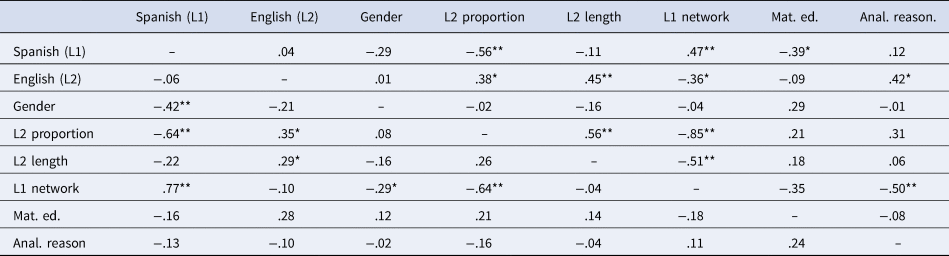
Next, we examined zero-order correlations for all variables within the TD group and the DLD group separately (see Table 2). As expected, there was a large negative correlation between the home proportion score (in English) and social network size (in Spanish) for both groups: r(30) = -.85 for the DLD group and r(45) = -.64 for the TD group. Both variables were derived from overlapping data on the ALEQ (i.e., reported input and output by home communication partners) and were thus clearly interdependent. We were interested in whether social network size would exert an independent effect on language skills after controlling for the overall home proportion. Therefore, we regressed social network size on home proportion and used the resulting residuals as the predictor variable, hereafter called social network residuals, representing social network size. Although there were other significant correlations among predictor variables, none exceeded r = .56 and none exhibited the same level of conceptual interdependence as the proportion score and social network size. Therefore, the remaining predictors were retained without adjustments.
To ensure the assumptions of linear regression were met for each model, we verified that the standardized residuals were normally distributed and that the variance of residuals did not differ systematically across the range of predicted values. Variance inflation and tolerance values were examined to verify the absence of multicollinearity. We also carefully examined the models for possible influential values. Within each model, all residuals fell within 2.4 standard deviations of the mean. We examined and interpreted Cook's distance and leverage values for each case following the guidelines of Altman and Krzywinski (Reference Altman and Krzywinski2016): cases with Cook's values above 4/n and leverage values above (2p+2)/n (where p is the number of independent variables) were considered high influence. Across all models one case met these criteria, a child in the TD group in the model predicting Spanish skills. Examination of this case indicated a less-common combination of the predictor variables that was nonetheless a valid instance of our population. Therefore, all cases were retained in each of the models.
Following these preparations we conducted multiple linear regression using a backwards elimination procedure (Blom & Paradis, Reference Blom and Paradis2015; Sorenson Duncan & Paradis, Reference Sorenson Duncan and Paradis2020). All predictor variables were entered in each initial model and nonsignificant predictors were removed to identify the optimal model, using a backwards elimination criterion of p < .05.
Results
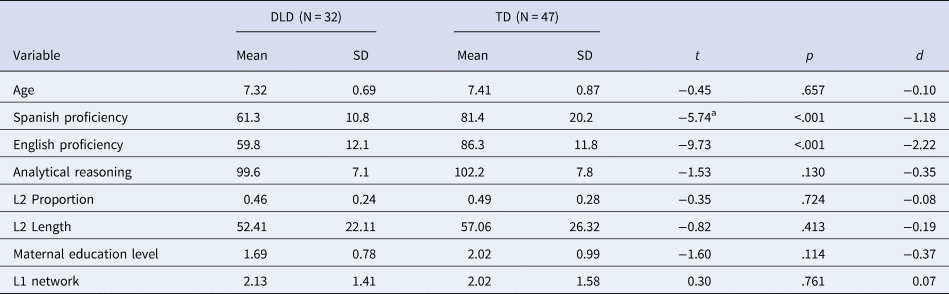
Descriptive statistics for the TD and DLD groups for age, English and Spanish language proficiency, and all predictor variables are shown in Table 1. On average, participants resided in homes in which Spanish was spoken just over half of the time, spoke Spanish more than 50% of the time to 2 different people in the house, and had been exposed to English for approximately 4.5 years, though there was wide variation in each of these measures. There were no between-group differences on these variables. Maternal education was notably low in both groups, with an average in between 1-did not complete high school and 2-high school graduate for the DLD group, and an average at 2-high school graduate for the TD group. The between-group effect size for maternal education was small and did not reach significance.
Descriptive Statistics and Comparison between the DLD and TD Groups.

Note. Age is reported in years. Spanish and English proficiency are reported as the standard Core Language scores provided by the CELF-4S and CELF-4E. Analytical reasoning is the standard score from the Test of Nonverbal Intelligence – 4th Edition. L2 proportion is the overall proportion of English used in the home, as derived from the ALEQ. L2 length is the number of months of reported English exposure. Maternal education is reported on a 5-point scale: 1 = did not complete high school; 2 = high school graduate or equivalent; 3 = some college, no degree conferred; 4 = Associate's or other two-year postsecondary degree; 5 = Bachelor's degree. L1 network is the number of people in the home the child was reported to speak Spanish to at least 50% of the time.
a Levene's test for equality of variances significant; equal variances not assumed
The groups were defined based on the presence of DLD and between-group differences in language proficiency were expected. There were indeed significant group differences with large effect sizes in Spanish proficiency and in English proficiency. In addition, there was a significant between-group difference in gender, χ2 (1) = 8.60, p = .003. The DLD group included 9 females and 23 males (28% female) and the TD group included 29 females and 18 males (62% female).
Table 2 displays the correlations among predictor variables and language proficiency measures for the DLD and TD groups. In the DLD group, Spanish proficiency was negatively correlated with the proportion of home English (p = .001) and with maternal education level (p = .029) and positively correlated with social network size in Spanish (p = .007). English proficiency was positively correlated with the proportion of home English (p = .034), the length of exposure to English (p = .009), and analytical reasoning (p = .017). English proficiency was negatively correlated with the size of the child's social network in Spanish (p = .043). As previously noted, there was a strong relationship between home proportion of English and size of the social network in Spanish (p < .001) which led to the use of the social network residuals in the regression analyses. In addition, length of English exposure correlated with proportion of home English (p = .001) and with the social network in Spanish (p = .003). Analytical reasoning was negatively correlated with Spanish social network (p = .004).
Correlations Among Variables for the DLD and TD Groups.

Note. Correlations for the DLD group appear above the diagonal (df = 30) and correlations for the TD group appear below the diagonal (df = 45). Mat. ed. = maternal education level. Anal. reason = analytical reasoning, as measured by the TONI-4.
* p < .05
** p < .01
For the TD group, Spanish proficiency correlated with social network size in Spanish (p < .001). It was also negatively correlated with male gender (p = .004) and with the proportion of home English (p < .001). English proficiency correlated with the home proportion of English (p = .015) and with the length of English exposure (p =. 049). Significant relationships among predictor variables included the negative correlation between social network in Spanish and the home proportion of English (p < .001) and between male gender and Spanish social network (p = .048).
Predicting L1 proficiency
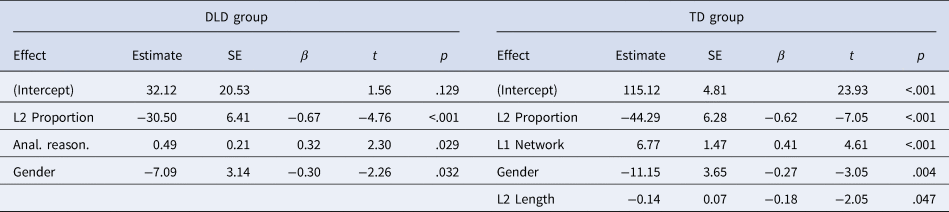
The optimal regression model predicting Spanish proficiency for each group is shown in Table 3. In the DLD group, the final model included three variables; home proportion of English and male gender were negative predictors of Spanish proficiency whereas analytical reasoning was a positive predictor. Social network residuals, maternal education, and length of English exposure were eliminated from the model. The model was significant, F(3, 28) = 9.42, p < .001, and accounted for 50.2% of the variance in Spanish proficiency scores.
Regression Models Predicting L1 (Spanish) Proficiency for the DLD and TD Groups.

Note. Female is the reference group for gender. Anal. reason = analytical reasoning, as measured by the TONI-4.
In the TD group, the final model included four variables; home proportion of English, male gender, and length of English exposure were all negative predictors of Spanish proficiency and social network residual was a positive predictor. Maternal education and analytical reasoning were eliminated from the model. The model was significant, F(4, 42) = 25.44, p < .001, and accounted for 70.8% of the variance in Spanish proficiency scores.
Predicting L2 proficiency
The optimal regression model predicting English proficiency for each group is shown in Table 4. For the DLD group, the final model included two predictors: both the length of English exposure and analytical reasoning were positive predictors of English proficiency. Home proportion of English, gender, maternal education, and social network residuals were not significant and were eliminated from the model. The final model was significant, F(2, 29) = 8.17, p = .002, and accounted for 36.0% of the variance in English proficiency scores.
Regression Models Predicting L2 (English) Proficiency for the DLD and TD Groups.

Note. Anal. reason = analytical reasoning, as measured by the TONI-4.
In the TD group, the final model included one predictor; home proportion of English was a positive predictor of English proficiency. Gender, maternal education, analytical reasoning, length of L2 exposure, and social network residuals were eliminated from the model. The model was significant, F(1, 45) = 6.42, p = .015, and accounted for 12.5% of the variance in English proficiency scores.
Discussion
This study examined a set of environmental and personal factors that may influence the means, opportunities, and motives for acquiring two languages in childhood. We contrasted a group of children with DLD to a group with TD to extend the study of influences on bilingual language acquisition in children with language disorders. It is important to interpret findings in the context of the population studied here. The Spanish–English bilinguals in this study were members of a long-standing linguistic minority group in the United States. All of the participating children were reported to have been born in the country. The percentage of Spanish used at home averaged just over 50% but varied widely amongst participating families (from 100% to 5%). Despite the established Spanish-speaking community within the U.S., opportunities for L1 use in the school environment were minimal for these children, with the L2 as the clear language of prestige in both school and community environments (Kohnert et al., Reference Kohnert, Ebert and Pham2021). Within this group, our study revealed several key findings in the relations between language proficiency and the predictors studied here.
The first main finding is that the predictors included in this study generally shared stronger relationships with Spanish, the participants’ L1, than with English within both the DLD and TD groups. This is illustrated in the regression models, which predicted substantially more variance in Spanish proficiency than in English proficiency (50.2% in Spanish vs. 36.0% in English for the DLD group, and 70.8% vs. 12.5% for the TD group). The strength of relations with the L1 likely relates to the focus on the home environment. As reported in previous work (e.g., Pham & Tipton, Reference Pham and Tipton2018), home language environments may primarily influence the L1 of school-age children when the L2 is the language of the school and community. Our study replicates this finding for TD children and extends it to children with DLD. The proportion of home L2 use had a particularly strong detrimental effect on L1 skill in both groups (without providing a comparably large benefit to the L2). This finding underscores the importance of consistent L1 use at home to maintain L1 skills within a minority L1-majority L2 context (e.g., Bedore et al., Reference Bedore, Peña, Summers, Boerger, Resendiz, Greene, Bohman and Gillam2012; Hammer et al., Reference Hammer, Komaroff, Rodriguez, Lopez, Scarpino and Goldstein2012; Pham & Tipton, Reference Pham and Tipton2018). However, there is no indication in this study that children with DLD experienced a greater impact of home L2 use on L1 skill; this pattern might have been expected as children with DLD may be more likely to experience first language loss (Kohnert et al., Reference Kohnert, Ebert and Pham2021). As prior studies of the predictors of language development in bilingual children with DLD did not measure the L1 (Blom & Paradis, Reference Blom and Paradis2015; Govindarajan & Paradis, Reference Govindarajan and Paradis2019; Smolander et al., Reference Smolander, Laasonen, Arkkila, Lahti-Nuuttila and Kunnari2021), these findings cannot be compared to prior work and additional replication is needed.
The second notable finding was a gender effect (i.e., female advantage) in L1 proficiency in both the TD and DLD groups. Regression results indicated that female gender was associated with a boost of approximately 7 points in the standard score on the CELF-4S in the DLD group, and a boost of approximately 11 points in the TD group. This gender effect in the L1 is consistent with several prior studies of typically-developing, school-age Spanish–English bilinguals (Bohman et al., Reference Bohman, Bedore, Peña, Mendez-Perez and Gillam2010; Duursma et al., Reference Duursma, Romero-Contreras, Szuber, Proctor, Snow, August and Calderón2007; Rojas & Iglesias, Reference Rojas and Iglesias2013). The reasons for gender differences in L1 outcomes are not immediately apparent. Gender did not correlate significantly with measures of home L2 use or age of L2 exposure in either group, indicating that quantitative opportunities to hear and speak the L1 were comparable for girls and boys in this study. It is possible, however, that emotional factors within the home environment (i.e., motives) promoted Spanish for girls, as suggested by Portes and Hao (Reference Portes and Hao2002). We did not have a direct measure of the emotional value either parents or children attached to Spanish. Finally, it is possible that differences in one or more aspects of the means to learn and retain an L1 (such as phonological memory, as reported by Lauro et al., Reference Lauro, Core and Hoff2020) drove gender differences in this study.
The female advantage in the L1 was seen in both groups. The gender disparity across the groups (TD: 62% female; DLD: 28% female) should also be noted. Epidemiological studies of monolingual children (e.g., Norbury, Gooch, Wray, Baird, Charman, Simonoff, Vamvakas & Pickles, Reference Norbury, Gooch, Wray, Baird, Charman, Simonoff, Vamvakas and Pickles2016; Tomblin, Records, Buckwalter, Zhang, Smith & O'Brien, Reference Tomblin, Records, Buckwalter, Zhang, Smith and O'Brien1997) have generally found small sex differences in the prevalence of DLD, with ratios of affected males to females falling around 1.25:1. Boys are, however, generally more likely to attract clinical concern for DLD (Norbury et al., Reference Norbury, Gooch, Wray, Baird, Charman, Simonoff, Vamvakas and Pickles2016) and therefore may have been more likely to have met our inclusion criterion for functional language difficulty. Another possibility is that biological differences between the sexes in the mechanisms that drive DLD are exacerbated within the language learning context in this study. For example, when two languages need to be learned in the face of limited L1 support and stronger familial emphasis on language learning for girls, boys with limited language-learning capacities (i.e., DLD) are especially vulnerable. However, this explanation is speculative in the absence of further empirical support.
The third main finding of our study was that analytical reasoning was a strong predictor of proficiency in both languages, but only within the DLD group. Children with DLD who were better at detecting the visuospatial patterns on the TONI-4 appeared to also be better at acquiring the L1 and the L2. By definition, the children with DLD had impairments in language-learning means; it is possible that analytical reasoning was a compensatory mechanism for language learning in this group, whereas the TD group could rely on more traditional language learning mechanisms (e.g., phonological memory). Prior studies of typically developing bilinguals have had conflicting findings regarding the role of analytical reasoning in language proficiency (cf., Lauro et al., Reference Lauro, Core and Hoff2020; Paradis, Reference Paradis2011; Paradis & Jia, Reference Paradis and Jia2017; Pham & Tipton, Reference Pham and Tipton2018), and to our knowledge no studies of bilingual children with DLD have considered this factor. In monolingual children with DLD, Norbury et al. (Reference Norbury, Gooch, Wray, Baird, Charman, Simonoff, Vamvakas and Pickles2016) found that lower nonverbal IQ scores were associated with lower expressive language composite scores, though this relationship was not significant for other language scores in the study. A definitive determination of the role of analytical reasoning in L1 and L2 proficiency among bilingual children with DLD would require a longitudinal approach that measures multiple cognitive abilities that could relate to language learning. Our finding suggests only that it may play an important role within this group.
Another difference across the TD and DLD groups was the role of the social network in maintaining a minority home language. For the children in the TD group, there was a clear positive effect of speaking Spanish to a greater number of people, even when the overall quantity of input and output in Spanish (i.e., the home proportion score) was constant. In the DLD group, the size of the Spanish social network was positively correlated with Spanish skills but the influence of social network was no longer significant when the effects of the home proportion score were removed. The effects of social network size on L1 skills in the TD group were notable given that only members of the household were included in our measure of social network. Peers may be particularly influential for school-age developing bilinguals (e.g., Rojas et al., Reference Rojas, Iglesias, Bunta, Goldstein, Goldenberg and Reese2016). For the DLD group, social network effects within the home were insufficiently powerful to influence the L1 in the context of internal influences (analytical reasoning and gender) and the general negative impact of home L2 use.
Study limitations
The dataset for this study had limitations that merit discussion. First, our measures of L1 and L2 usage were restricted to the home environment. It is clear that school environments and peer relationships offer important opportunities and motives for school-age children to use their languages. An optimal study would capture all environments. Such a study would likely require additional reporters to accurately capture different environments (e.g., teachers), or possibly the use of wearable technology that can directly capture and analyze language usage patterns (e.g., Kan, Miller, Cheung & Brickman, Reference Kan, Miller, Cheung and Brickman2020).
The size of our participant sample is also a limitation, especially for the DLD group. A larger group would strengthen confidence in our regression models. Given the lack of information on language influences for bilingual children with DLD, however, we consider this study to be an important first step. We also note key strengths of our DLD sample: we used a rigorous procedure that combined direct assessment of both the L1 and the L2 with parent and school report to qualify children for the DLD group. Many studies of bilingual children with DLD rely on prior clinical diagnosis of the disorder rather than a standardized qualification procedure, and the L1 is often not assessed. We directly assessed both languages in this study, increasing the rigor of our procedures to distinguish between typical language development and DLD, and providing the opportunity to study influences on both languages in a single sample.
Summary and implications
In summary, we found several similarities in predictors of language proficiency across the DLD and TD groups. Some may be unsurprising (e.g., that home usage of the L2 is negatively associated with proficiency in the L1) and others less expected (e.g., that female gender predicted L1 proficiency in both groups). Notable differences across the two groups included the importance of analytical reasoning for both L1 and L2 proficiency within the DLD group, and the restriction of social network effects on L1 proficiency to the TD group. Though this study is a first step, our results have preliminary implications for clinicians working with bilingual children with DLD. Families should be informed that a shift to home L2 use may negatively affect the L1 without providing a comparable boost to the L2. Clinicians may wish to have an open discussion with families about their values and priorities, acknowledging that even unspoken preferences can shape children's motivations to acquire different languages (e.g., valuing familial ties for girls may promote the L1 even when they hear the same quantity of the L1 at home). Finally, interprofessional collaboration can enable clinicians addressing language skills (in many contexts, speech-language pathologists) to have accurate information about a child's analytical reasoning abilities (often measured by psychologists) and should be pursued. In the future, additional studies are needed to confirm the patterns seen here among bilingual children with DLD and also to explore how environmental modifications can optimize language outcomes for this population.
Competing interests
The authors declare none.
Acknowledgments
Data for this study were collected with the support of National Institutes of Health Grant R03 DC013760, awarded to K. Ebert. We are grateful for the assistance of Kayla Greifenkamp and the research staff who supported original data collection. We also thank collaborating organizations, participants, and their families