


Introduction
Uterovaginal Agenesis, also called the Mayer-Rokitansky-Küster-Hauser Syndrome (MRKH), is a congenital abnormality of the female genital tract. It is characterized by the non-formation of the vagina and the uterus, but with normal ovaries and normal secondary sexual characteristics. A proportion of affected women have other abnormalities (kidney, ear or skeletal) (Strubbe, Cremer and Willemsen, Reference Strubbe, Cremer and Willemsen1994). In the majority of cases the aetiology is multifactorial (Edmonds, Reference Edmonds2003). MRKH occurs in about 1 in 5000 female births (Aittomaki, Eroila and Kajanoja, Reference Aittomaki, Eroila and Kajanoja2001). It is the second most common cause of primary amenorrhoea after Turner's Syndrome (Edmonds, Reference Edmonds2000). Affected women are typically diagnosed in mid-adolescence after failure to menstruate (Edmonds, Reference Edmonds2003). In the past, surgical approaches to the creation of a neovagina were favoured, whereas the current treatment of choice is dilation therapy (Frank, Reference Frank1983; Nadarajah, Quek, Rose and Edmonds, Reference Nadarajah, Quek, Rose and Edmonds2005; Ismail-Pratt, Bikoo, Liao, Conway and Creighton, Reference Ismail-Pratt, Bikoo, Liao, Conway and Creighton2007). This involves the patient being taught to put pressure on the vaginal dimple using dilators of gradually increasing size for 20 minutes three times a day over several months (Edmonds, Reference Edmonds2000). Women with MRKH are infertile and having children of their own is only possible through in vitro fertilization using surrogacy (e.g. Beski, Gorgy, Venkat, Craft and Edmonds, Reference Beski, Gorgy, Venkat, Craft and Edmonds2000).
Clinicians treating this condition agree that it has a significant psychological impact, yet little is known about the precise nature of any psychological sequelae and how this might be translated into an intervention. The aims of this paper are: 1) to describe the development and content of a specific model of the core negative psychological impact of diagnosis and medical treatment of MRKH and how this is maintained; 2) to describe the development, structure and procedures of a cognitive-behavioural therapy of MRKH based on the model (CBT-MRKH); and 3) to present preliminary evidence that supports the model and treatment.
Development of a model of the psychological impact of MRKH
The work presented here was based on the Medical Research Council's (2002) framework for the development and evaluation of complex health interventions. We initially conducted a systematic review of the MRKH literature (Heller-Boersma, Edmonds and Schmidt, submitted) focusing on the psychological sequelae of the diagnosis of MRKH and its treatment, so as to develop ideas about targets for intervention. The review was limited by the poor methodological quality of many of the available papers. Out of 479 identified sources, only 16 were case reports or series (n = 1 to 79) with a primary focus on psychological, psychosocial or psychosexual aspects of MRKH. Seven further case series had a mainly medical or surgical focus but with some mention of psychological aspects of MRKH.Footnote 1 Only one series was prospectively gathered and only one study included a comparison group of healthy women. Findings were mainly descriptive and often presented without fully quantifying them (e.g. by saying “most patients” or “many patients”), thereby making it hard to distinguish between authors' impressions and data obtained from the patients. Nonetheless, several key themes emerged from the review. These are briefly described below:
(a) Immediately following diagnosis patients report a broad range of emotional responses from positive (including relief, fighting back) through to more negative responses such as shock, confusion, fear, depression and suicidality, feeling isolated, ashamed, or guilty through to more avoidant/cut-off responses such as dismissal or denial). Several authors noted that despite being given careful and detailed descriptions of their condition and its treatment, many young women were not fully able to retain the information and had major misconceptions about this.
(b) Being given the diagnosis of MRKH and the implications this has for their sexual and reproductive lives creates a major threat to these young women's sense of themselves, leading them to question their identity as a woman and to experience a sense of confusion regarding their gender, bodies, social and sexual roles. This threat gives rise to the development of negative self-beliefs, with many women seeing themselves as defective, inferior or unloveable. Surgical or dilator treatments are often experienced as shameful and may serve to perpetuate or strengthen these beliefs. Whilst the successful creation of a neovagina ameliorates some of these difficulties, MRKH often seems to have a lasting negative impact on these women's view of themselves. In particular, the infertility associated with MRKH may serve to perpetuate these women's defective sense of self.
(c) Many women seem to try to control the sense of threat to their femininity and the accompanying symptoms by using potentially maladaptive coping strategies.
(d) There is widespread agreement in the MRKH literature that psychological support or intervention for these women is important, yet there is little detail on what such an intervention might look like.
Overview over the model
Based on our review of the MRKH literature, our clinical experience and adapted from the CBT-model of PTSD by Ehlers and Clark (Reference Ehlers and Clark2000) and Ehlers, Clark, Hackmann, McManus and Fennell (Reference Ehlers, Clark, Hackmann, McManus and Fennell2005) we postulated three key mechanisms that lead to and serve to maintain a problematic adjustment to MRKH. These are: (a) a failure to “process” the diagnosis; (b) the occurrence of idiosyncratic negative appraisals of MRKH-related events that become incorporated into these women's core schemata and sense of identity as women; (c) women's attempts to control the sense of threat to their femininity and the accompanying emotional symptoms by using a range of potentially maladaptive cognitive and behavioural strategies. These processes occur in a clear developmental context, a point that is almost entirely missing from the literature on MRKH. Below, we will give details first on the developmental context, then on the processes underpinning poor adjustment to MRKH.
The developmental context of MRKH related “events”
Most of the MRKH-related “events” (diagnosis, treatment) unfold during a narrow developmental window from early into late adolescence. The onset of puberty is considered as one of the most important developmental milestones for girls to negotiate (Brooks-Gunn and Reiter, Reference Brooks-Gunn, Reiter, Feldman and Elliot1990; Stattin and Magnusson, Reference Stattin and Magnusson1990). In particular the first menstruation is considered by many to be the “single most critical event marking puberty in girls, signifying and symbolizing feminine identity and maturity, attributes that will constitute the core of the personality in subsequent development towards adult status” (Stattin and Magnusson, Reference Stattin and Magnusson1990). Adolescents' perception that they are developing “on time” or are later maturing than their peers, may be as important or even more important than actual timing of puberty and related milestones (Dubas, Graber and Peterson, Reference Dubas, Graber and Peterson1991). In the UK, the median age at menarche is now about 13 (Whincup, Gilg, Odoki, Taylor and Cook, Reference Whincup, Gilg, Odoki, Taylor and Cook2001), i.e. 3 or 4 years earlier than the typical age of diagnosis of MRKH. Thus even prior to diagnosis young women with MRKH may perceive themselves as seriously “out of sync” with their peers.
The reported mean or median age at diagnosis of MRKH is between 16.0 to 17.7 years (Heller-Boersma et al., Reference Heller-Boersma, Schmidt and Edmonds2007). This is a time when these young women are still somewhat cognitively immature (Haffner, Reference Haffner1995), i.e. may have a tendency to rule-based black-and-white thinking, which is likely to foster poor processing of MRKH related events and the development of dysfunctional beliefs and coping strategies.
Moreover, MRKH related events happen during the time when in most Western countries these young women typically are expected to take important sexual milestones of development. For example, in various Western samples, the median age at first date was 14.4 years, the median age at first petting was 15.8, and the median age at first intercourse was about 17 years (ACSF, 1992; Schalet, Reference Schalet2004; Schmidt, Evans, Tiller and Treasure, Reference Schmidt, Evans, Tiller and Treasure1995).
Processes underpinning poor adjustment to MRKH
Failure to “process” the diagnosis. It is known from work in cancer that people's memory for “bad news consultations” is often fragmented and not organized in a coherent narrative, with misconceptions about what was said and what is wrong (Fallowfield and Jenkins, Reference Fallowfield and Jenkins2004). This is on a continuum with what happens in the development of Post-Traumatic Stress Disorder, where trauma memory is poorly elaborated and not incorporated fully into the autobiographical memory base (Ehlers and Clark, Reference Ehlers and Clark2000). The literature on MRKH suggests that similar processes may be at work here. For example, one of the early authors in the MRKH field notes that, “the reaction to diagnosis is replete with painful confusion and shocked misunderstandings” (Kaplan, Reference Kaplan1968). In our clinical experience, when patients are asked to describe how they were diagnosed with MRKH, they often remember and focus on what seems peripheral detail. For example, they may describe the dress they wore on that day, its color and pattern, what the weather was like, or remember details about the consultant's appearance or their office. However, there typically are also gaps in the story, where they cannot remember what happened. These anecdotal observations point towards a re-experiencing of being given the diagnosis mainly in terms of sensory impressions rather than in the form of a coherent narrative, possibly as a result of the information being too overwhelming and painful, and associated with poor intentional recall (Ehlers and Clark, Reference Ehlers and Clark2000). This makes it hard for the person to make sense of what happened, and prevents the updating, revising and incorporation of new information and therefore the ability to adjust to the MRKH diagnosis.
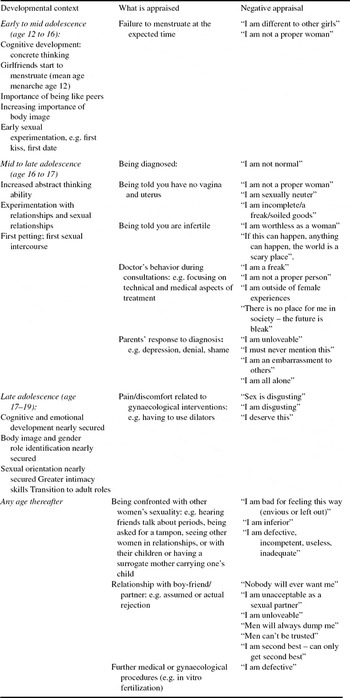
The development of idiosyncratic negative appraisals of MRKH-related events. Having congenital agenesis of the uterus and the vagina, perhaps combined with other congenital abnormalities e.g. of the kidneys, would be very distressing to anybody. Appraisals such as “I am different”, “life is not fair”, “my prospects for finding a partner are reduced” are to some extent realistic. Nonetheless, there will be many appraisals related to the events of MRKH that are overly negative and idiosyncratic, due to the cognitive immaturity, lack of experience and rule based black-and-white thinking of these young women. Table 1 shows some such appraisals in their developmental context, together with the events that might elicit them. The response of others may inadvertently strengthen and reinforce such appraisals.
Developmental context of MRKH related events and difficulties and associated negative appraisals

So far we have outlined the development of a problematic adjustment to MRKH during adolescence arising directly from the MRKH-related events as they unfold. However, in the longer term any idiosyncratic negative appraisals of MRKH-related events are likely to become incorporated into these women's core schemata concerning their body and their sense of identity as women.
For many young women with MRKH, their body schema, i.e. a woman's internal mental representation of her body on which – according to Piaget (Reference Piaget1952) – all other schemata are built, is shattered. Being given a diagnosis of an “absence of a vagina and uterus” is hard to make sense of. Incoming stimuli that confront her can no longer be coded and matched with what she previously knew about her body and its integrity. Learning about other abnormalities that occur in the context of MRKH, such as renal abnormalities, may further compound the threat to the body schema and further alienate her from her body. In parallel, the young woman's schema of herself as a developing woman who can have sexual and love relationships and children is shattered, with the future seeming bleak or at least very uncertain.
To this a new MRKH-related schema is added. We say this because many of our patients talk about how the MRKH becomes their major preoccupation and identity, through which all other experiences are filtered and coded. The body, feminine and MRKH related schemata, which are closely linked, become imbued with a negative meaning of being different, defective, sexually inadequate, worthless, unloveable, out of control or even outside human experience. The exact nature and cognitive/emotional colouring of this is likely to depend on a number of factors such as other pre-existing experiences and/or schemata. One powerful contributing factor is the meshing of the view of self with culturally derived beliefs about what it means to be a woman, where self-worth or value becomes narrowly linked to the presence of a vagina, the ability to have sex, to have a womb and give birth to children.
Use of potentially maladaptive cognitive and behavioural strategies for the reduction of threat. Women are likely to attempt to control the sense of threat to body and their femininity and the accompanying emotional symptoms by using a range of potentially maladaptive cognitive and behavioural strategies. The strategies chosen are likely to be meaningfully linked with the individual's appraisals of a particular situation (Ehlers and Clark, Reference Ehlers and Clark2000). For example, a young woman with a core belief of “I am inadequate and defective as a woman” may develop a rule such as “I will only be acceptable to people if I present as the perfect woman”. This might make her spend huge efforts to try to improve her appearance and make herself desirable as a woman, in terms of dress, make-up or a perfect figure. At times when this becomes too exhausting she may flip into alternative behaviours, abandoning her striving for perfection and she may binge eat, generally neglect her appearance and abandon efforts to appear feminine.
Alternatively, women may act in keeping with their beliefs about themselves. An example would be a woman with MRKH who chooses partners who she recognizes are unsuitable and allows herself to be used and treated badly by them because she believes “No one else would want me, I am unacceptable and unlovable”. This woman might react with suspicion when a good man shows interest in her and so reject him because she believes “there must be something wrong with him if he shows interest in someone as defective as me”.
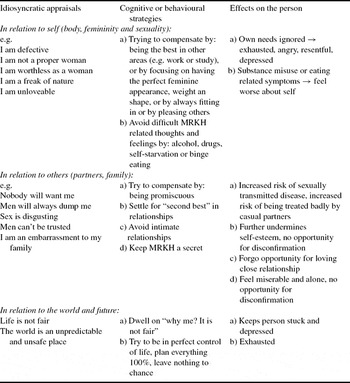
These strategies intended to reduce the threat of MRKH are maladaptive because they maintain the threat associated with MRKH by three mechanisms: (1) directly producing psychological symptoms; (2) preventing change in negative appraisals of MRKH or its sequelae; and (3) preventing change in the processing of the diagnosis (cf. Ehlers and Clark, Reference Ehlers and Clark2000). Table 2 shows how idiosyncratic beliefs may relate to cognitive and behavioural strategies and the effects this has on the person.
Idiosyncratic beliefs and their relationship to cognitive and behavioural strategies used to compensate and the effects this has on the person

Additional considerations
Appraisals and emotional responses. Adjustment reactions to bad news are typically characterized by intense and mixed emotions, such as anger, fear, and depression, often rapidly alternating (Moorey, Reference Moorey and Salkovskis1996). Particular emotions are meaningfully linked to particular appraisals (Ehlers and Clark, Reference Ehlers and Clark2000). One salient feature of MRKH is that many women constantly compare themselves (negatively) against other women and this is associated with appraisals such as “I am inferior”, “I am not a proper woman”. Emotions aroused by situations involving social comparison where there is a threat to rank prominently include shame, guilt, envy or jealousy (Gilbert, Reference Gilbert2001). These emotions are generally seen as socially unacceptable and people tend to keep such emotions to themselves. They also have the potential for contributing to and intensifying a person's sense of themselves as a bad person and as harbouring something that needs to remain hidden.
Triggers
Schema-level beliefs and associated rules or assumptions can lie dormant but become activated by salient triggers. In the case of MRKH, triggers or critical events often are related to dating/courtship or to relationship break-ups, which bring down a carefully built up “façade” and activate the woman's negative beliefs about herself. Alternatively, events such as a friend or a sister having a baby may also serve to activate MRKH-related schemata, as may the medical procedures accompanying in vitro fertilization using surrogacy. Overtime, an increasingly greater range of triggers that are only peripherally or not at all related to MRKH may come to elicit women's beliefs and compensatory strategies.
Differences between poor adjustment to MRKH and PTSD
There is a key difference between what happens in people with a problematic adjustment to MRKH and what happens in PTSD. In PTSD the sense of current severe threat is, above all, maintained psychologically through the nature of the trauma memory, the resulting negative appraisals, and the strategies intended to control threat or symptoms (Ehlers and Clark, Reference Ehlers and Clark2000). In contrast, in MRKH, in addition to these processes it is the unalterable presence of the actual physical impairment that underpins and feeds into the sense of current threat.
Developing a CBT treatment of the psychological sequelae of MRKH (CBT-MRKH)
Several potential targets for psychological intervention follow from our model: First, treatment should revisit women's experience of being diagnosed and the events surrounding this with the aim of helping them to fully process what has happened and. integrate it “into the context of the individual's preceding and subsequent experience. . .” (Ehlers and Clark, Reference Ehlers and Clark2000). Second, treatment should help women to examine their problematic self-appraisals and beliefs that have arisen in the context of their MRKH treatment and relationship history and help them to challenge and modify these as they maintain the current sense of threat to their sense of themselves (see Ehlers and Clark, Reference Ehlers and Clark2000). In particular, these women need to be helped to develop a more positive view of their own femininity. This may mean helping women to shift from a narrow, caricatured view of femininity as derived from the possession of a vagina and womb to a broader, more balanced and more accepting view of what makes a woman loveable, acceptable and competent. Third, they need to develop a more positive, accepting view of their MRKH as something that is no longer a shameful secret, but something that can be thought and talked about and lived with. This work towards greater acceptance of things that can not be changed needs to include an acknowledgement and mourning of the losses incurred as a result of MRKH. Finally, treatment should address any maladaptive compensatory or coping strategies that may serve to maintain unhelpful self-beliefs.
Structure of CBT-MRKH
We decided that a group intervention would be preferable to individual therapy, as this would help women to challenge the commonly held belief that they are “abnormal” or “a freak”. The idea of a group intervention is also supported by the MRKH literature, which highlights the importance of women having the chance to communicate with others with this diagnosis (for review see Heller-Boersma et al., submitted).
Overview of contents of CBT-MRKH
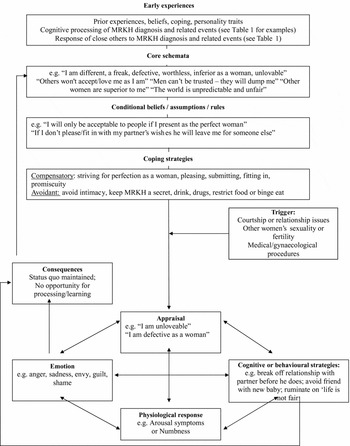
A formulation-based approach. The intervention centres around a longitudinal cognitive-behavioural case conceptualization (Beck, Reference Beck and Salkovskis1996; Padesky; Reference Padesky1994) that serves as an overall working model, and is used to explain the CBT model and to guide the therapy. Each woman produces her own formulation, tailored to her particular circumstances. Figure 1 shows an example conceptualization diagram.
Conceptualization of problems in adjustment to MRKH

Re-processing diagnosis. Treatment starts with a focus on the central life event of being diagnosed, and aims to help women move from poorly processed patchy memories and associated misconceptions to a more manageable and coherent evaluation of the experience. This work involves getting women to expose themselves to feared and avoided emotions and thoughts, identifying and challenging unhelpful appraisals, and systematically confronting and reappraising the event, challenging the negative conclusions drawn about themselves, others and the world, and core beliefs and rules or assumptions developed from it, or earlier beliefs about the self that are reinforced by it.
Cognitive restructuring and decentering. In later sessions other MRKH related events and problems (e.g. dilator treatment, issues around sexual and romantic relationships and infertility) are used to help women to process previously avoided thoughts and feelings, to identify and challenge unhelpful beliefs and behaviours and to develop a more adaptive view of themselves, the world and their future (Janoff-Bulman, Reference Janoff-Bulman1992; Rothbaum and Fao, Reference Rothbaum, Foa, van der Kolk, McFaerlane and Weisaeth1996). Moreover, there is also an attempt to help women find meaning in their experience. This involves acknowledging the real possibilities of both good and bad things happening, of MRKH being a source of strength not of weakness in oneself, of personal triumph and mastery, of relishing the good life, notwithstanding its shortcomings, and emerging from the experience somewhat sadder but wiser (Janoff-Bulman, Reference Janoff-Bulman1992). It also involves letting go of the maladaptive schemata about the experience and regaining a sense of wholeness, and integrity, through a process of reassembly, where the confusion regarding the self is cleared and the interruption to body image, psychosexual differentiation and its varied parts is overcome and the body, the self and the condition cease to be an ongoing source of anxiety.
Dealing with maladaptive coping strategies and building new skills. Participants are also taught to identify unhelpful coping strategies that often make a person feel better in the short-term (e.g. starving or comfort-eating, promiscuity, pleasing, pretending that everything is “more than normal”, or using drink or drugs) but have negative longer-term consequences and replace them with more adaptive strategies. These include expressing difficult thoughts and feelings through sharing them with a close other, writing about them or using self-soothing strategies. Moreover, there is also a focus on building interpersonal skills, particularly in romantic and sexual relationships, e.g. how to mention MRKH to a new partner, when and what to tell, how to look after one's interpersonal needs in a relationship, and how to have mutually satisfying sexual experiences.
Building new and more adaptive self-schemata. To help participants strengthen the alternative/more adaptive self schemata developed in therapy guided imagery is used: At the end of each session a guided imagery tape is played that follows the steps of: tuning into the body, creating a wise and compassionate figure, letting go of the negative images, reinforcing the alternative self schema, as described in Garner and Garfinkel (Reference Garner and Garfinkel1997) and adapted to MRKH.
Furthermore, participants are asked to keep a positive data log of observed events or activities that they have engaged in that were in keeping with/reinforcing of their newly formed schema of themselves. The aim is to focus on the positive, away from the negative, and to slowly make this newly acquired “head-knowledge”, a “heart knowledge”, i.e. something that they really believe in about themselves without needing to question it.
Therapeutic writing tasks. In between sessions this work is supported by specifically designed homework tasks that use the tool of therapeutic writing. There is a large and sound body of research supporting the use of writing about traumatic or negative life events as a tool for processing these (see Pennebaker Reference Pennebaker1997, Reference Pennebaker2004; Nicholson, Reference Nicholson1995; Lange, Reference Lange and Zeig1994, Reference Lange1996; Schoutrop et al., Reference Schoutrop, Lange, Duurland, Bermond, Sporry and Goederen1997). As MRKH is often a shameful secret for women that they do not find easy to talk about, it was thought that writing might be a useful way of helping them process and make sense of what had happened to them. A number of MRKH related writing exercises were constructed based on Pennebaker (Reference Pennebaker2004). (Details can on request be obtained from the authors).
Evidence supporting the model and treatment
Broad support for this model and treatment comes first from a cross-sectional survey that compared women with MRKH (N = 66) with healthy control women recruited from the community (N = 31) of comparable age and socio-economic background (Heller-Boersma et al., in press) and second from the first ever randomized controlled trial of psychological treatment in women with MRKH conducted by our group and comparing the new CBT-MRKH group treatment with waiting list (Heller-Boersma et al., Reference Heller-Boersma, Schmidt and Edmonds2007).
On the Impact of Events Scale (Horowitz, Wilner and Alvarez, Reference Horowitz, Wilner and Alvarez1979), which measures symptoms of intrusion or avoidance after a major traumatic life event or life change, women with MRKH had mean scores in the moderately severe (clinical) range when asked to think about being diagnosed with MRKH as the event (Heller-Boersma et al., Reference Heller-Boersma, Schmidt and Edmonds2007). Women with MRKH were significantly more psychologically distressed than controls on the Symptom Checklist SCL-90-R (Derogatis, Reference Derogatis1992; Heller-Boersma et al., in press). The scores of MRKH women were between population norms for non-patients and psychiatric outpatients (Derogatis, Reference Derogatis1992). Together this lends some support to the notion that there was failure to “process” the diagnosis on a spectrum similar to what happens in PTSD.
Women with MRKH also had significantly lower self-esteem than control women on the Rosenberg Self-Esteem Scale (RSE; Rosenberg, Reference Rosenberg1965), although the mean RSE scores for both groups were in the normal range, and had significantly higher (pathological) scores on the Eating Disorders Inventory total score and several of the sub-scales (EDI; Garner, Olmstead and Polivy, Reference Garner, Olmstead and Polivy1983; Heller-Boersma et al., in press). The EDI measures both disordered eating behaviours and related cognitive and emotional aspects. Three of the subscales on which the MRKH women performed significantly poorer than control women related to self-efficacy and self-worth (i.e. “ineffectiveness subscale”), the ability to form close trusting relationships (i.e. “interpersonal distrust” subscale), and the inability to identify emotions and physical needs and sensations, such as hunger or satiety (i.e. “interoceptive awareness” subscale). In addition, one of the subscales on which MRKH women had significantly higher scores than controls was the “bulimia” subscale, which relates to overt eating disorder symptoms. These findings lend support to the notion that women with MRKH have a negative view of themselves, and may avoid intimacy and emotions and resort to maladaptive strategies, such as binge eating, to cope with their difficulties.
In the RCT (Heller-Boersma et al., Reference Heller-Boersma, Schmidt and Edmonds2007), 39 women with MRKH were randomly allocated to group CBT (n = 19) or waiting-list (n = 20). Outcomes were assessed at pre-treatment, post-treatment (7 weeks) and at 3-month follow-up. Women who received group CBT-MRKH, reported significantly reduced psychological distress, improved self-esteem, and a lessened impact of diagnosis at the end of treatment, with further gains at follow-up, whereas women on the waiting list remained unchanged. Effect sizes were medium or large.
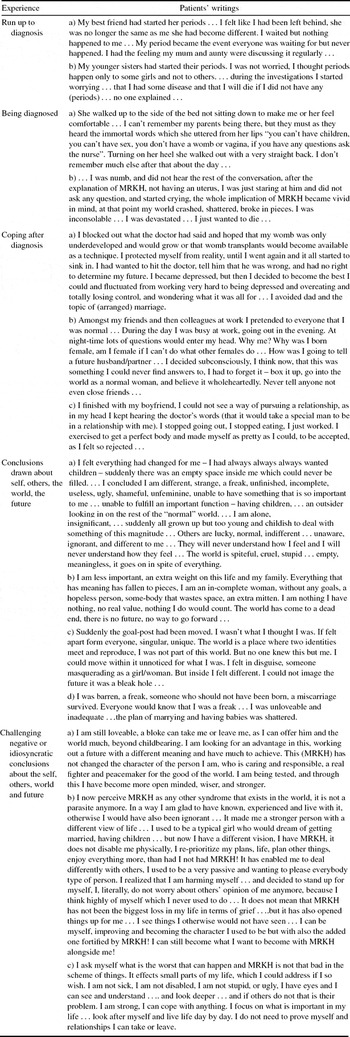
Additional validation of the model comes from the therapeutic writings of RCT participants allocated to CBT-MRKH. Table 3 shows some typical excerpts from participants' homework writing assignments, illustrating the profound impact that MRKH has had on their lives at various stages and the change in their views as they begin to question unhelpful beliefs during therapy.
RCT participants' homework writings about their experiences and therapy

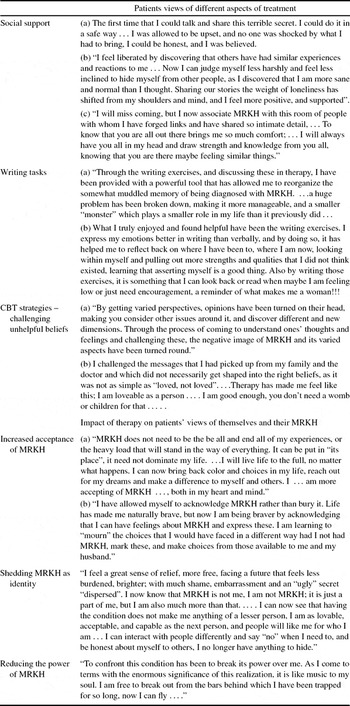
Table 4 shows some illustrative quotes from participants' “goodbye letters” describing their experience of therapy. These suggest that participants valued the group support, but also the specific techniques used, such as the therapeutic writing tasks and the cognitive restructuring of extreme and unhelpful beliefs. The quotes also illustrate the marked positive changes these women experienced in terms of their view of themselves and their MRKH.
Participants views of different aspects of the treatment and on how treatment has altered their view of themselves

Discussion
This paper describes a novel cognitive-behavioural conceptualization of how a problematic adjustment to MRKH arises in a particular developmental context and how this is maintained, and a cognitive behavioural treatment approach based on this model. The strengths of the model are that it is underpinned by a systematic review of the MRKH literature and validated by two empirical studies including both quantitative and qualitative data. The iterative process involved was based on the MRC framework for the development of complex interventions.
A novel feature of our model is that it takes into account the developmental context in which the events of MRKH typically unfold, in terms of these young women's cognitive and emotional development and the typical developmental tasks that they have to negotiate. This is something that might be of interest to researchers and clinicians working with conditions arising in adolescence.
However, further research is needed to refine the model and treatment. Our own studies, on which the model is based, are limited by the fact that they are based on women from an MRKH register in a specialist tertiary care centre, i.e. they include mainly women who have been diagnosed many years earlier. To the best of our knowledge there are no prospective longitudinal studies of psychological adjustment of women with MRKH. Such studies would give a more nuanced insight into the kind of psychosocial problems that develop and might also shed more light on who is particularly at risk of developing problems and what factors might reduce vulnerability and foster a more adaptive adjustment (Moorey, Reference Moorey and Salkovskis1996).
Our RCT, which compared group CBT for MRKH with waiting list, found that women receiving the active treatment made lasting improvements. However, without adding a comparison intervention to this, consisting of an unstructured support group, we cannot be sure that it was the active ingredients of the intervention that made a difference or whether it was just non-specific factors such as re-moralization and group support that helped. Patients' own writings suggest that they found some of the specific techniques used helpful and something to fall back on at times of future difficulties.
MRKH is a relatively rare condition, and the question may therefore arise of what the significance is of this work for a wider audience. However, the model of treatment presented here is applicable or adaptable to a number of other congenital or acquired gynaecological conditions, such as premature ovarian failure, breast cancer, early onset endometrial cancer, female genital mutilation, Turner's Syndrome, ovarian dys/agenesis or Complete Androgen Insensitivity Syndrome, all of which have a psychological impact not dissimilar to MRKH in terms of women's sense of self and femininity. Thus, the model and therapy described are of relevance to CBT practitioners working in a broad range of clinical settings from general practice through to different medical/hospital settings (paediatrics, gynaecology, endocrinology) and in other clinical psychology, psychiatry or mental health settings.
Acknowledgements
We thank A. Lavender, H. Startup and M. Rooney for their helpful comments on the manuscript.



Comments
No Comments have been published for this article.