1 Introduction
Contrast is a key lexical relationship (e.g. Cruse Reference Cruse1986; Murphy Reference Murphy2003). Much of the work on lexical contrast has particularly focused on antonymyFootnote 2 or oppositeness, which involves a binary contrast between two items. One of the findings of this work is that lexemes’ potential to be construed as contrasting is context-driven. Language users can create contrast and opposition between ideas and entities in order to communicate about their perceived differences and do so to meet particular discourse goals (e.g. Jeffries Reference Jeffries2010; Davies Reference Davies2012).
While the most salient examples of contrast involve binary opposition, lexical contrast is a broader phenomenon that can relate non-binary sets such as the co-hyponyms tulip, rose, lilac, sunflower etc. Contrast can also be created between lexemes whose meanings are not conventionally incompatible. A special case of context-dependent lexical contrast occurs when a lexeme that more conventionally functions as a hyperonym is contrasted with one of its hyponyms, as in (1) and (2).
-
(1) Well, I'm not being completely accurate here – he was only 10 weeks old at the time, so he was a puppy, not a dog (Koskela Reference Koskela2014: 270)
-
(2) New books and dictionaries are expected to contain the new spellings (BNC ABD 1985–1994, Davies Reference Davies2004–)
In these contexts, dog and book cannot be interpreted in their hyperonymous senses. Instead, their senses are narrowed down and the lexemes are construed as co-hyponyms to puppy and dictionary, respectively.
Here, the narrower reading of the hyperonym is viewed as a distinct sense, which is to say that hyperonym/hyponym contrast gives rise to vertical polysemy (Koskela Reference Koskela2014). This view stems from a dynamic construal approach to lexical meaning (e.g. Geeraerts Reference Geeraerts1993; Croft & Cruse Reference Croft and Cruse2004; see also Tuggy Reference Tuggy1993), which assumes that word senses are construed in context, as opposed to being stable units of meaning associated with word forms. Polysemous senses can be distinct to varying degrees, but a particular reading can be viewed as a distinct sense if it exhibits at least some symptoms of autonomy. The fact that the broader and narrower readings of the hyperonym contract different lexical relations with other lexemes (i.e. hyperonymy vs co-hyponymy) is one symptom of their autonomy (Koskela Reference Koskela2014). The distinctness of narrower senses triggered by hyperonym/hyponym contrast is often very low; they would fall close to the ‘vagueness’ end of the ambiguity–vagueness continuum. They are often also context-dependent and some may only emerge in contexts involving explicit contrast with the hyponym.
The focus of this article is hyperonym/hyponym contrast and the factors that may motivate it. The first half of the article (section 2) considers how hyperonym/hyponym contrast is construed in context. One respect in which hyperonym/hyponym contrast differs from the contextual creation of opposites is that it is more constrained. Given enough contextual support, almost any two expressions may function as opposites, whereas not all hyperonym/hyponym pairs are amenable to contrast.
To shed light on the factors that may motivate and constrain hyperonym/hyponym contrast, the second half of the article (section 3) presents a case study of hyperonyms and hyponyms pertaining to the clothing category. Drawing on data from the Corpus of Global Web-based English (GloWbE; Davies Reference Davies2013), the study investigates which clothing terms (e.g. coat, bra, jeans) may be contrasted with the hyperonyms clothes and clothing. Overall, the findings suggest that the creation of hyperonym/hyponym contrast is motivated by specific discourse concerns that make the hyponym salient, and that highlight potential dimensions of difference between the meanings of the hyperonym and the hyponym.
2 Hyperonym/hyponym pairs and lexical contrast
Lexical contrast involves construing the meanings of two or more items as similar but different. That contrasting items need to be construed as similar may seem counterintuitive, since the essence of contrast is difference. However, as has often been pointed out, mere incompatibility between very different concepts (e.g. feminism and canal boat) is relatively uninteresting and does not lead to the kind of lexical contrast that has a significant role in lexical structure and language use (e.g. Cruse Reference Cruse1986: 93; Murphy Reference Murphy2003: 171).
The co-hyponyms tulip, rose, lilac and sunflower contrast because their referents are similar by virtue of being flowers, while differing in terms of their species (and, consequently, the shape and colour of their blooms, etc.). Antonymy has in particular been defined as involving maximal similarity together with minimal difference (e.g. Murphy Reference Murphy2003). The antonyms man and woman are similar as they both describe adult human beings, but they differ with respect to the designation of gender. Boy and woman are not as good a pair of antonyms because they are not minimally different, given that they also differ with respect to the person's age. A pair of co-hyponyms can also function as opposites: for instance, within the contrast set fork, knife and spoon, the pair fork/knife can be construed as antonyms. They are maximally similar as the two items of cutlery that are commonly used simultaneously and minimally different in that one is typically held in the left, the other in the right hand.
Jones et al. (Reference Jones, Lynne Murphy, Paradis and Willners2012: 3) point out that defining antonymy in terms of maximal similarity and minimal difference allows for the context-dependence of opposition, to the extent that the relevant differences and similarities may vary by context. The opposite of fork could be spoon if the relevant difference is whether the food is solid or more liquid, or chopsticks when comparing ways of eating noodles. In (3), whale music and an epidural are construed as opposites because they are similar as potential childbirth pain-relief methods, while differing with respect to their perceived ‘naturalness’ or how non-interventionist vs medicalised they are.
-
(3) . . . says she hopes for a natural birth, ‘though I'll probably start off with whale music and end up with an epidural!’ (Jeffries Reference Jeffries2010: 91)
Objectively, whale music and epidural anaesthesia have little in common, but considered in relation to giving birth, their similarities become salient. Their opposition can then be construed against this similarity.
In the construal of contextual opposition, the focus is often on finding the similarities, as the lexemes are usually clear incompatibles. But when a hyperonym/hyponym pair is contrasted, as in (1) and (2), their similarity is a given due to the conventional inclusion relationship that holds between the lexemes. By the traditional definition, a hyponym has all the semantic features of its hyperonym, plus some additional features that differentiate it from other hyponyms (e.g. Lyons Reference Lyons1977: 291). The definition of book, for instance, is ‘a bound volume of printed pages’, and dictionary adds to this the fact that dictionaries contain alphabetical lists of words and their definitions. Because the narrowed sense of a hyperonym is a hyponym of the broader sense (cf. Horn's (Reference Horn and Schiffrin1984) term autohyponym), the similarity that holds between a contrasting hyperonym/hyponym pair is provided by the hyperonym's broader sense.
Consequently, hyperonym/hyponym contrast revolves around finding a potential difference that can form the basis of the contrastive relationship and help delimit the hyperonym's narrower sense. When book and dictionary are contrasted (as in (2)), their meanings differ with respect to how the volume is structured and used. Book refers to volumes of continuous prose that are typically read from cover to cover, unlike dictionaries with their list-like structure. The context in (2) further motivates the contrast insofar as a dictionary would provide a normative model for the new spellings, while a book would apply those spellings to the relevant words. These differences in the semantics of contextual opposites and hyperonym/hyponym pairs are also reflected in the meaning construal processes involved in creating the contrast.
2.1 The construal of hyperonyms and hyponyms in contrast
Hyperonym/hyponym contrast involves going against conventional constraints for the construal of sense boundaries, while the construal of contextual opposites rarely does so. Within the dynamic meaning construal account, word meaning emerges through a process where a context-specific sense is delimited from the word's meaning potential or purport (Croft & Cruse Reference Croft and Cruse2004). Although words are therefore not associated with fixed senses, the construal of senses is constrained by linguistic conventions. For instance, there are conventional constraints that privilege the hyperonymous ‘canine animal’ construal of dog. Consequently, in construing the meaning of dog in contrast with puppy, as in (1), these conventional constraints are disregarded and the sense of dog is construed more narrowly as ‘adult canine animal’. The narrower senses of some hyperonyms can also become conventionalised (at least to some degree) by virtue of their frequency in language use. For instance, shoe occurs fairly frequently in contrast with boot (see (5) and (6) below) and thus its narrower sense is relatively well established (Koskela Reference Koskela2014). If a hyperonym is conventionally vertically polysemous, the narrower construal must override the broader one in order to enable the contrast with the hyponym.
In this respect hyperonym/hyponym contrast differs from lexical contrast between contextual opposites. In (4), litigate and copulate function as contextual opposites, aided by their co-occurrence with the canonical antonyms day and night. Construing litigate and copulate as opposites does not involve adjusting either word's conventional sense boundaries because the concepts the terms refer to are already conventionally incompatible.
-
(4) . . . parties to a case of divorce may not litigate by day and copulate by night (BNC BP4 1990, cited in Murphy, Jones & Koskela Reference Murphy, Jones and Koskela2015: 5)
Instead, their oppositeness is achieved by profiling a particular dimension for comparison (i.e., the contextually relevant similarity between the concepts) and imposing a configuration of a bisected domain on that dimension (Paradis & Willners Reference Paradis and Willners2011). For copulate and litigate, what is profiled is how the two concepts relate to the dimension of marriage. Their opposition is then construed through comparison whereby copulating is viewed as being associated with continuing and litigating with ending a marriage (Murphy et al. Reference Murphy, Jones and Koskela2015).
The cognitive process of comparison is also involved in hyperonym/hyponym contrast, in order to find at least one dimension along which the concepts can be construed as different and which will then motivate the appropriate narrowing of the hyperonym's sense. In (5), shoes differ from the other items of footwear in how much of the lower limb they cover.
-
(5) Every sandal, sneaker, shoe and boot made by FitFlop is expertly engineered (GloWbE, lifestyle.com.au)
As (5) demonstrates, contrast between a hyperonym and a hyponym is not necessarily binary, but rather involves the non-binary contrast of co-hyponymy. Even if a hyperonym is contrasted with just one hyponym, the terms are not necessarily construed as opposites. If (5) instead read every shoe and boot made by FitFlop. . ., shoe and boot are not automatically interpreted as opposites – in part because coordination with and does not always induce an oppositional construal (see section 2.2 below). Binary contrast can, however, be imposed on a hyperonym/hyponym pair. In (6), shoe and boot are construed as opposites that contrast in terms of whether the footwear provides ankle support or not.
-
(6) To support his damaged ankles he always wore boots rather than shoes (GloWbE, teara.govt.nz)
The oppositional reading of shoe/boot in (6) is helped by the X rather than Y structure, which is a stronger trigger for oppositeness than the X and Y construction.
2.2 Contrastive constructions
The construal of opposition – and lexical contrast more generally – is often supported by lexico-grammatical structures that trigger the contrastive interpretation. Antonyms have been shown to typically co-occur in particular syntagmatic structures (Mettinger Reference Mettinger1994; Jones Reference Jones2002), which have consequently come to be associated with inherently contrastive semantics (Murphy Reference Murphy2006). Such structures can therefore trigger a contrast between terms that are not normally construed as contrasting. The contrastive frameworks identified by Jones (Reference Jones2002; see also Jones et al. Reference Jones, Lynne Murphy, Paradis and Willners2012) include ones expressing coordination (e.g. X and Y; X or Y; both X and Y; X and Y alike), negation (e.g. X, not Y), transition (e.g. turning X to Y), choice between options (X or Y?), comparison (e.g. more X than Y) and difference (e.g. the difference between X and Y). Another important contrastive context is the ‘ancillary antonymy’ structure illustrated in (4), where the opposition between one pair of opposites is supported by the presence of another, canonical antonym pair. Parallelism in both phonetic and syntactic form can also support lexical contrast – consider the phonic similarity of litigate and copulate and their occurrence in the same [V by N] syntactic structure in (4) (Murphy et al. Reference Murphy, Jones and Koskela2015).
While these constructions are all associated with contrastive semantics, they are not equally strongly contrastive. In particular, simple and-coordination of the form X and Y involves only a weak degree of contrast. The main function of X and Y is to link two or more items and express some contextually relevant commonality between them, not to highlight their differences (Jones Reference Jones2002). Nevertheless, the construction is generally contrastive in that it requires that the coordinands be construed as incompatibles (Lang 1984; Wälchli Reference Wälchli2005).Footnote 3 This is why the coordination of a hyperonym and a hyponym induces the narrowing of the hyperonym's sense.
Furthermore, while there are coordination constructions that specifically encode a relationship of binary contrast (e.g. both X and Y, X and Y alike – see Haspelmath Reference Haspelmath and Shopen2007), the meaning of the simple X and Y construction is not necessarily oppositional. Davies (Reference Davies2012) found that and-coordination rarely triggers new opposites: when opposites occur in the simple X and Y construction, they are usually canonical antonyms (e.g. light and dark) and thus their opposition is not derived from the semantics of the construction (see the discussion of (5) above).
The weak, non-oppositional contrast signalled by the X and Y construction means that some hyperonym/hyponym pairs that sound anomalous in more strongly contrastive contexts can nevertheless occur within an and-coordination structure (Rohdenburg Reference Rohdenburg1985). Book and dictionary are acceptable in the X and Y construction (2), even though they can sound odd in a more strongly contrastive context (7). Other pairs can occur comfortably in even strongly contrastive constructions – consider dog and puppy in the negated context in (1).
-
(7) ? These are not books, they are dictionaries.
However, some hyperonym/hyponym pairs’ contrast potential is so limited that they cannot occur even in an X and Y construction:
-
(8) ? She keeps animals and cats.
-
(9) ? I like fruit and bananas. (Cruse Reference Cruse1986: 94)
The contextual creation of opposition between conventionally incompatible expressions is not constrained in the same way. It seems that almost any two expressions can be construed as opposites in the right context – and opposed even in a strongly contrastive construction. For instance, Davies (Reference Davies2012: 53) discusses a slogan written on a protester's placard, Clotted cream, not ruptured spleen. Here the strongly contrastive X, not Y construction creates an opposition between clotted cream and ruptured spleen as symbols of peace and violence, respectively. The contrast potential of hyperonym/hyponym pairs, on the other hand, may be constrained by how the terms and their meanings relate to each other.
2.3 Constraints on hyperonym/hyponym contrast
Some general constraints on vertical polysemy have been proposed in the literature on the phenomenon. Kempson (Reference Kempson, Greenbaum, Leech and Svartvik1980) reformulates the traditional semantic markedness principle as a lexical rule for vertical polysemy. The rule states that a hyperonym can be used in a narrower sense that is complementary to the sense of another lexeme if that lexeme is the hyperonym's only hyponym on some semantic dimension. That is, dog can be used in a narrower ‘male canine’ sense in contrast with bitch, which is its only hyponym on the ‘sex’ dimension. By this rule, dog can also contrast with puppy, its only hyponym on the ‘age’ dimension.
However, this rule is too strict. Firstly, it effectively assumes that hyperonym sense narrowing is only possible if the hyperonym/hyponym pair can be construed as binary opposites – which, as discussed in section 2.1, is not always the case. Vertical polysemy is also not limited to cases involving only a single hyponym. Shoe has more than one hyponym on the dimension of how much of the lower limb is covered: boot and sandal (and perhaps flip-flop), but as (5) above shows, shoe can nevertheless be used in a narrower sense that excludes both boots and sandals.
Kempson (Reference Kempson, Greenbaum, Leech and Svartvik1980: 15) justifies her ‘single hyponym’ constraint with the observation that book cannot be narrowed to contrast with novel (#That's not a book; it's a novel). According to her, this is because book has several hyponyms, including novel, textbook, biography etc. But another explanation for the awkwardness of contrasting book and novel lies in the prototype structure of categories. We struggle with construing book minus novels as a coherent category because novels are prototypical books. On the other hand, as seen in (2), the meaning of book can exclude dictionaries, which are atypical books. The difficulty of excluding prototypical members from a category would also explain the oddness of (8) and (9).
The prototype structure of categories is likely to be a strong motivating and constraining factor on hyperonym/hyponym contrast. Lehrer (Reference Lehrer and Tsohatzidis1990) observes that even though mugs may be included in the cup category (see Labov Reference Labov, Bailey and Shuy1973), their atypicality means that cup is often used with a meaning that excludes mugs. Similarly, Rosch et al. (Reference Rosch, Mervis, Gray, Johnson and Boyes-Braem1976) note that since beanbags are very atypical chairs, chair and beanbag can be construed as sister categories. Prototypical/marginal contrast has also been identified as a cross-linguistically important motivator of vertical polysemy in ethnobiological nomenclature (e.g. Berlin Reference Berlin1972).
This suggests that the sense of a hyperonym can be narrowed down to a prototypical subset, in contrast with a hyponym that designates atypical or marginal category members. Or, if viewed from an onomasiological, rather than semasiological, perspective (see Geeraerts et al. Reference Geeraerts, Grondelaers and Bakema1994), prototypical category members are more likely to be designated with the category label, whereas marginal members might instead be labelled with a more specific term – which may lead to hyperonym/hyponym contrast. Both perspectives, however, lead to the same hypothesis regarding lexical contrast: the more prototypical the member, the weaker its potential for contrasting with the hyperonym.
To test this hypothesis and to examine how discourse factors may motivate and constrain hyperonym/hyponym contrast, what is needed is a systematic consideration of the phenomenon in language use. To that end, the rest of this article presents a case study of the hyperonyms and hyponyms associated with a single category, clothing. It asks:
-
• Which hyponyms can be contrasted with their hyperonym?
-
• How are dimensions of difference exploited to create contrast?
-
• How may contrast be motivated by discourse goals?
3 Hyperonym/hyponym contrast in language use: a case study of the clothing category
The clothing category can be designated by clothing or clothes, both of which are conventionally construed as hyperonyms to various clothing terms (shirt, coat, sock, hat, bra etc.). Using corpus data, the first part of this study (sections 3.1 and 3.2) establishes which hyponyms can be contrasted with clothes or clothing, whether the potential for contrast relates to prototypicality and how perceived differences can motivate contrast in context.
The study also offers an opportunity to investigate whether the two hyperonyms’ potential for contrast with specific hyponyms differs. Some authors have viewed clothes and clothing as essentially synonymous (e.g. McCawley Reference McCawley1975; Ware Reference Ware and Pelletier1979), but Wierzbicka (Reference Wierzbicka1988) argues that clothes is more likely to refer to sets of garments that could clothe a person fully, while clothing can refer to any collection of miscellaneous items. Section 3.3 investigates whether such differences in the hyperonyms’ meanings are reflected in their potential for contrast with particular hyponyms.
3.1 Clothes/clothing and hyponyms: methodology
3.1.1 Clothing hyponyms
To ascertain which hyponyms of clothes/clothing can be contrasted with their hyperonyms, a list of hyponyms – specific clothing terms – was needed. Each hyponym also needed to be associated with a measure of its typicality, in order to test the hypothesis that prototypicality affects the potential for contrast. Although the prototype structure of a category is to some extent context-dependent (e.g. Roth & Shoben Reference Roth and Shoben1983; Barsalou Reference Barsalou and Neisser1987 – although see Hampton, Dubois & Yeh Reference Hampton, Dubois and Yeh2006), context-neutral typicality ratings can be used as a reference point, under the assumption that they reflect frequent construals of the category and its structure in the participants’ experience. The clothing hyponyms were therefore drawn from the category members used in two typicality-rating studies involving the clothing category: Uyeda & Mandler (Reference Uyeda and Mandler1980) and Hampton & Gardiner (Reference Hampton and Gardiner1983). Importantly, the clothing terms included in these studies were themselves based on normative category membership data (Battig & Montague Reference Battig and Montague1969).Footnote 4 Category membership norms are collected by asking subjects to list as many members of a category as they can within a time limit. There is therefore an empirical basis for regarding the terms included in the current study as hyponyms of clothes/clothing.Footnote 5
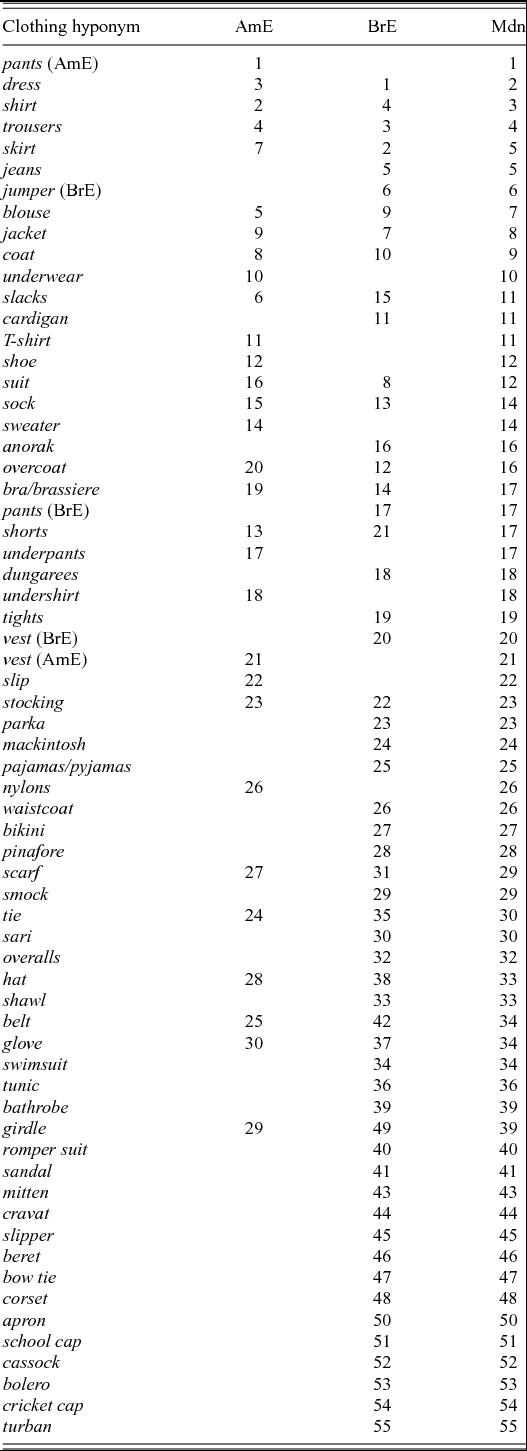
The clothing terms from Uyeda & Mandler (Reference Uyeda and Mandler1980) and Hampton & Gardiner (Reference Hampton and Gardiner1983) were combined to form the set of 65 clothing hyponyms in table 1. The participants of the first study were American and the second British; therefore the clothing terms used in these studies included some dialectal variants, such as pants and trousers. Clothing terms with different senses in BrE and AmE (e.g. vest) were considered separately. The American and British spellings pajamas and pyjamas and the terms bra and brassiere were treated as synonyms, but each variant was searched for separately in the corpus.
The clothing hyponyms used in the study, ordered by their median typicality ranking in the Uyeda & Mandler (Reference Uyeda and Mandler1980) (AmE) and Hampton & Gardiner (Reference Hampton and Gardiner1983) (BrE) studiesFootnote a

a Uyeda & Mandler included 30 items and Hampton & Gardiner 55; for any items not included in both studies, the ‘median’ ranking reflects the results of just one study.
The table gives the typicality ranking for each item in the Uyeda & Mandler (Reference Uyeda and Mandler1980) and Hampton & Gardiner (Reference Hampton and Gardiner1983) studies, as well as a median ranking across the two studies. Although the median rankings neutralise potentially important cultural differences (see Brown Reference Brown1978), they are useful for making a general distinction between the more typical and more marginal members of the clothing category.
3.1.2 Corpus searches
The aim of the study was to establish which hyponyms of clothes/clothing can be contrasted with their hyperonym, even if the contrast is only weak and purely context-dependent. As discussed in section 2.2, the X and Y construction involves only a weak degree of contrast; consequently, it can allow hyperonym/hyponym contrasts that might not be acceptable in more strongly contrastive contexts. In other words, if a hyponym can be contrasted with its hyperonym to any degree, that contrast can be realised at least within the X and Y construction, even if it could not occur in other contexts. In the data for Koskela (Reference Koskela2014), 53 per cent of the co-hyponymous uses of hyperonym/hyponym pairs involved the X and Y construction, which suggests that it is generally a common context type for hyperonym/hyponym contrast. Consequently, the corpus searches focused on the X and Y construction.
The corpus used for the study was the Corpus of Global Web-based English (Davies Reference Davies2013), primarily chosen for its size (1.9 billion words), to increase the likelihood of finding even rare instances of hyperonym/hyponym contrast. The corpus was searched for occurrences of each of the 65 clothing hyponyms (as nominals, including both singular and plural forms) with either clothes or clothing within the and-coordination construction. Both orders of the coordinands were searched for (i.e. coats and clothes and clothes and coats).
To allow the second coordinand to include determiners and some pre-modifiers (as in (10) and (11)), the search looked for [clothes/clothing and] followed by a hyponym within a window of four words – that is, allowing for a maximum of three intervening words between and and the hyponym. For the reverse order, the search term was [hyponym and] followed by clothes or by clothing within four words.
-
(10) . . . always wears brown clothes and a brown hat. (GloWbE, chrisroutledge.co.uk)
-
(11) It is cold in England, but I have a coat and warm clothes (GloWbE, fairtrade.org.uk)
The data were then manually checked to remove contexts where clothes/clothing did not genuinely contrast with a hyponym. This included contexts where clothes/clothing clearly functions as a hyperonym, such as jeans and other clothes or silk shirts and other clothing.
Some contexts where the hyperonym was modified, such as (12)–(14), were also excluded.
-
(12) He usually gets some new jeans, a shirt and some sports clothes. (GloWbE, dooyoo.co.uk)
-
(13) . . . Eddie Izzard, who alternates between wearing conventional ‘male’ clothes and dresses (GloWbE, theory.org.uk)
-
(14) . . . you must bring a couple summer clothes and a thick jacket to keep you warm. (GloWbE, facts-about-hong-kong.com)
In (12), a contrast is drawn between jeans, a shirt and the compound sports clothes – that is, the implication is that shirts and jeans are not members of the subclass sports clothes. Sports therefore functions as a restrictive modifier in the sense that it restricts the designatum of the hyperonym clothes to a class that is incompatible with the hyponym(s) on the other side of the coordinator. The modifiers male and summer are similarly restrictive in (13) and (14) – they explicitly indicate which subset of clothing is contrasted with dresses and thick jacket. In selecting the data, a modifier was deemed to be restrictive if the hyponym would not be construed as belonging to the subset designated by the modified hyperonym. Such contexts do not invite the language user to search any further for a way of construing the hyperonym and hyponym as incompatibles and therefore do not involve the relevant type of hyperonym/hyponym contrast. Thus, contexts with a restrictive modifier were not included in the final data set.
Contexts where the hyperonym occurred with a non-restrictive modifier were, on the other hand, included. In (11) above, warm is not a restrictive modifier – the contrast between the coordinands does not rely on the interpretation that coats are not warm clothes. Indeed, in other contexts coats are included within the class of warm clothes, as (15) illustrates.Footnote 6
-
(15) Homeless people welcome donations of warm clothes, including coats, scarves, hats, gloves and socks during winter (www.transformhousing.org.uk)
This suggests that in (11), coat and clothes are construed as incompatibles independently of the modifier warm. The coordination of a coat and warm clothes necessitates a process of meaning construal whereby the language user looks for a way of interpreting the meanings of coat and warm clothes as incompatibles. The process is the same as when the hyperonym is unmodified – that is, one needs to identify a dimension of difference between the meanings of the hyperonym and the hyponym. In (11), the dimension is the layer of clothing and thus clothes is construed as designating non-outer garments. The role of the non-restrictive modifier warm, then, is to specify that those garments are warm. Contexts with a non-restrictive modifier, including cases such as (11) and (16)–(18) were included in the data set.
-
(16) It freezes and it is very windy on top of the mountain, so gloves and good clothes are required. (GloWbE, bahatitravel.com)
-
(17) Old clothes and gloves are recommended (GloWbE, fotothing.com)
-
(18) . . . wearing a trendy hat and extravagant clothes as if he was coming straight from Milan's catwalks. (GloWbE, avantourists.com)
Contexts including a modified hyperonym made up 33.8 per cent of the final database (512 out of 1,515 contexts). This includes both instances where the modified hyperonym is the second coordinand (e.g. (16)) and those where it is the first (e.g. (17)). When the first coordinand is pre-modified (or the second post-modified), the context is always potentially structurally ambiguous: the modifier could apply to one or both of the coordinands. However, for determining whether the hyperonym and hyponym contrast, the scope of the modifier is irrelevant. In (17), regardless of whether or not the gloves are old, they are construed as something different from clothes.
Some hyponyms (e.g. swimsuit, anorak) contrasted with clothes/clothing in just one context. These were left out of consideration; the final database only included cases where the hyponym was found in contrast with clothes/clothing in at least two distinct contexts. This was to increase the likelihood that there was a genuine semantic motivation for the hyperonym/hyponym contrast, as opposed to it being a simple language user error. Also excluded from the database were any unclear or unintelligible contexts. The ‘trousers’ and ‘underpants’ senses of pants were also differentiated during the manual check, based on the context and the dialectal variety of the corpus example. Only the AmE sense of pants contrasted with clothes/clothing more than once.
The final database included 1,071 contexts where the hyperonym was clothes and 444 contexts where it was clothing. Almost all the hyponyms in the database were found in contrast with both hyperonyms, clothes and clothing. Jumper (BrE), overcoat, trousers and underpants occurred with just clothes, but the data set included just two contexts for each of these terms. The discussion in section 3.2 does not differentiate between the hyperonyms; this is addressed in section 3.3.
3.2 Clothes/clothing and hyponyms: results
3.2.1 The hyponyms’ potential for contrast
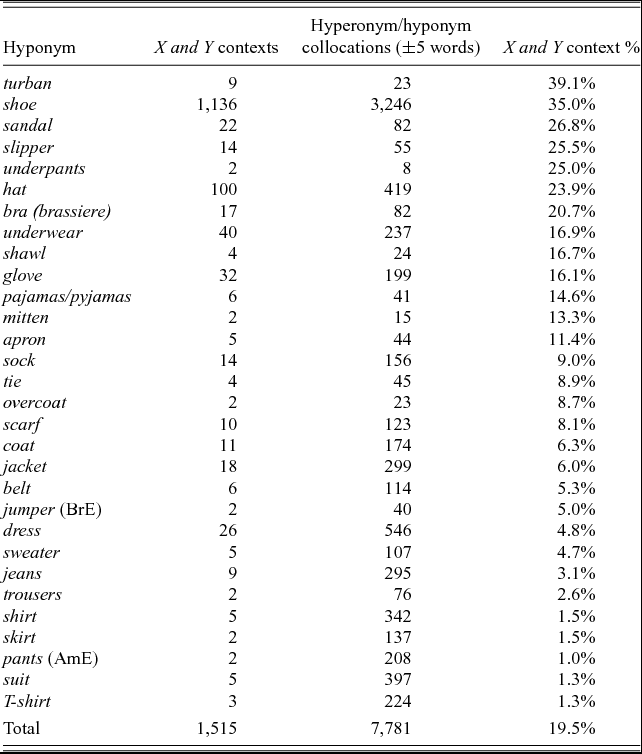
Of the 65 hyponyms, 30 contrasted with clothes/clothing within the X and Y construction in at least two distinct contexts. Some hyponyms contrasted with clothes/clothing very frequently while others only sporadically. Table 2 shows the number of contrastive X and Y contexts found for each hyponym. It also shows the total frequency of contexts in the GloWbE corpus where each hyponym simply co-occurs with clothes/clothing within the same length word window as employed in the X and Y searches. The final column shows the percentage that the X and Y contexts make up of the overall collocative contexts. This measure takes into account the differing frequencies of the hyponyms in the corpus and allows for a simple comparison: out of all the opportunities that a hyperonym/hyponym pair has for contrast within a given span, how frequently do they actually contrast in the X and Y construction?
The frequencies of X and Y and total collocative contexts for the clothing hyponyms and hyperonymsFootnote a

a The hyponyms are ranked by the percentage that the X and Y contexts make up of the total number of collocative contexts.
The percentages provide some information about the different hyponyms’ potential for contrasting with clothes/clothing: a higher percentage suggests a stronger contrast potential. This is, admittedly, an imperfect measure. The total collocative contexts are likely to include noise, such as uses of some of the words in irrelevant senses (e.g. jacket in the ‘book's dust cover’ sense). The British and American English senses of pants are also undifferentiated. The contrastive potential of some hyperonym/hyponym pairs may also be underestimated because apart from and-coordination structures, the pairs may also occur within other contrastive constructions, such as or-coordination or negation constructions (e.g. pyjamas or clothes, underwear instead of clothing).
Nevertheless, the data suggest that less prototypical hyponyms are more likely to occur within the X and Y construction with their hyperonym. There is a strong negative correlation between the ranking of the hyponyms according to the percentages shown in table 2 and their relative ranking for prototypicality based on the median typicality rankings in table 1 (ρ(29) = −0.673, p = 0.000063).Footnote 7 This supports the idea that marginal category members are easier to exclude from the category. At the same time, nearly half (30/65) of all the hyponyms considered were found in contrast with clothes/clothing at least twice – including the most prototypical hyponyms pants (AmE), dress, shirt, trousers and skirt, even if only sporadically.
The order of the coordinands within the X and Y construction did not appear to be a significant factor in the construal of contrast, even for prototypical hyponyms. In nearly 70 per cent of the coordination contexts (1,049/1,515), the hyperonym was mentioned first (e.g. clothing and hats). One might expect prototypical hyponyms to occur preferentially as the first coordinand (e.g. shirts and clothes), as this would make the hyponym more salient and thus potentially aid the construal of contrast. Of the most prototypical hyponyms, shirt always occurred as the first coordinand, but trousers was always the second coordinand and pants (AmE), dress and skirt occurred roughly equally frequently in both positions. There was generally no significant correlation between the hyponyms’ ranking for typicality and their ranking according to the relative frequency of hyponym-first contexts (ρ(30) = −0.128, p = 0.502088).
Overall, the data show that contrast with the hyperonyms clothes and clothing is possible throughout the category. Although marginal hyponyms have a stronger potential for contrast, even prototypical hyponyms can in certain contexts contrast with their hyperonym within the X and Y construction. However, there was a difference in how the contrast was created with prototypical hyponyms, compared to other hyponyms.
3.2.2 Dimensions of difference
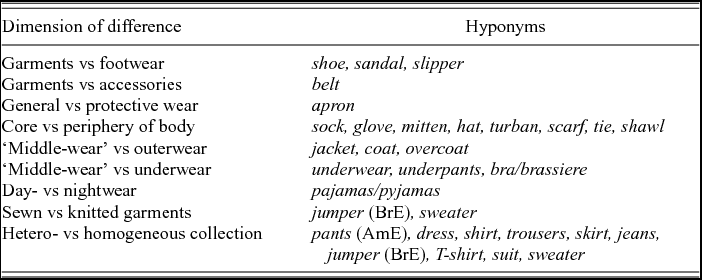
As discussed above, hyperonym/hyponym contrast relies on finding a dimension of difference to create the contrast. In the data, contrast between clothes/clothing and the hyponyms utilised various dimensions of difference, as shown in table 3.
The main dimensions of difference between the clothing hyperonym/hyponym pairs

That terms for footwear (shoe, sandal, slipper) and accessories (belt) contrasted with clothes/clothing was unsurprising. Contexts such as (19) and (20) are unremarkable and fully conventional – contexts where clothes functions as a hyperonym to sandal or belt would be more unusual (e.g. clothes, including sandals or belts and other clothes).
-
(19) He was a gaunt and skinny man with dirty clothes and broken sandals (GloWbE, vickyflipfloptravels.com)
-
(20) How about clothes and belts that no longer fit (GloWbE, foodtalk.com.au)
Footwear and accessories are usually perceived as only marginal members of the clothing category (see table 1). They differ from other items of clothing in many ways, including their function and the material they are generally made from. Aprons are similarly marginal members of clothing, given that they are worn over other items to protect them from soiling, rather than to cover the body for warmth and modesty. This motivates the contrast in (21).
-
(21) Bussers and runners are often found in aprons and clothing which suggests the kitchen more than the front of house (GloWbE, wisegeek.org)
For the less marginal clothing hyponyms, the area of the body where the garment is worn formed a major dimension of difference for hyperonym/hyponym contrast. Clothes/clothing can refer to items that cover just the core of the body, in contrast with garments worn on the feet, hands, head and neck/shoulders – as in (22)–(24).
-
(22) . . . an older person should be kept warm with blankets, warm clothes and socks in cold weather (GloWbE, irishhealth.com)
-
(23) . . . cover up with clothing and a hat, and apply sunscreen to all exposed areas of skin (GloWbE, betterhealth.vic.gov.au)
-
(24) I had a last minute idea and I just gathered a pirate look from my own clothes and scarfs (GloWbE, journals.worldnomads.com)
The layer of clothing represented another important dimension of difference. Both terms for underwear and outerwear contrasted with clothes/clothing, as in (25)–(26).Footnote 8
-
(25) I hadn't really unpacked so it was just a case of throwing in some clean clothes and underwear and I was good to go (GloWbE, celeryandcupcakes.com)
-
(26) I [have] gotten all the clothes and coats I need for winter (GloWbE, livingonadime.com)
The meaning of clothes/clothing can be narrowed to exclude underwear or outerwear items – and often both, so that clothes/clothing comes to refer to ‘middle-wear’ (i.e., tops, skirts and trousers). This is the case at least in (25), although sometimes the exact boundaries of the hyperonym's narrowed sense are unspecified. In (26) it is unclear if the clothes one needs for winter also include winter underwear. In (27), which is a Holocaust survivor's description of being forced to undress, clothes is understood to include underwear.
-
(27) . . . we were told to hang up our coats and clothes. Margo passed on the order to undress and leave everything, including our blankets, on the trolleys (GloWbE, obrien.ie)
The time when the garments are worn and their constitution were also utilised as dimensions of difference to create contrast. In (28), clothes refers to items worn during the waking hours, in contrast with nightwear, while in (29), clothing refers to woven, rather than knitted garments.
-
(28) . . . phone and laptop chargers topped the list of belongings most likely to be left in a hotel room. Pyjamas and clothes came in second (GloWbE, dailymail.co.uk)
-
(29) I really like the new trend of turning old sweaters and clothing into throw cushions (GloWbE, athriftymum.com)
Example (29) demonstrates the context-driven nature of hyperonym/hyponym contrast. In this context, the garments are to be used as craft materials and consequently the differences between knitted and woven fabrics become salient. This difference is then utilised to contrast sweaters and clothing. Notably, sweaters are usually construed as fairly typical items of clothing (see table 1), but in a context where their distinct constitution is highlighted they can be construed as something different and excluded from the clothing category.
However, as discussed in section 2.3, prototypical members are generally hard to exclude from a category. In fact, when prototypical hyponyms were contrasted with clothes/clothing, the sense of the hyperonym was not necessarily narrowed down. In (30) and (31), the categories designated by the hyperonym and hyponym are not construed as incompatibles – this is seen explicitly in (30), where it is evident that the clothing companies also produce jeans. Instead, in these contexts the hyperonym clothing is construed as referring to a heterogeneous class of garments, in contrast with a homogeneous class of garments of one type.
-
(30) Most jean and clothing companies offer at least one pair of jeans that feature a print or design (GloWbE, onlineshoppingusa.com.au)
-
(31) . . . in Alanya its a constant bombardment of people trying to sell you fake t shirts and clothing (GloWbE, tripadvisor.com.my)
Contexts such as (30) and (31) involve a competition between the contrastive semantics of the X and Y construction and the conventional constraints for construing the sense of clothes/clothing as including the prototypical garments. The conventional constraints are too strong to overcome and so the contrast is drawn in relation to a dimension that does not require an adjustment of the hyperonym's sense boundaries. Many superordinate-level terms, including clothes and clothing, refer to heterogeneous collections (e.g. Markman Reference Markman1985; Wierzbicka Reference Wierzbicka1988), whereas the classes designated by their hyponyms are usually perceived as being more homogeneous (e.g. Rosch et al. Reference Rosch, Mervis, Gray, Johnson and Boyes-Braem1976). There is therefore always a potential contrast between the hyperonyms clothes and clothing and a hyponym along the dimension of hetero- vs homogeneity. This difference forms part of the contrast in some of the other contexts – consider, for instance, the contrast between clothes and coats in (26). In this context, however, hetero- vs homogeneity is not the primary dimension of difference, as clothes and coat can also be construed as differing in a way that allows them to function as incompatibles.
3.3 Clothes vs clothing
Although the hyperonyms associated with the clothing category, clothes and clothing, are near-synonymous, their uses and meanings differ in subtle ways. Grammatically, they differ in their countability type: clothing is a mass noun, while clothes is a plurale tantum term. This grammatical difference was reflected in the forms of the coordinating hyponyms. Clothes coordinated more frequently with a plural hyponym than clothing. The hyponym was in the plural form in 91.4 per cent of the contexts where the hyperonym was clothes and in 82.9 per cent of the contexts involving clothing, The difference in the occurrence of singular vs plural hyponyms with clothes and clothing is statistically significant (χ2 (1, N = 1454) = 28.83, p < .0001).Footnote 9 This appears to be a form of grammatical parallelism (e.g. Dubey et al. Reference Dubey, Keller and Sturt2008): clothes looks like a plural count noun (even though it is not a true countable) and therefore language users are more likely to coordinate it with a plural count noun.
The grammatical difference between clothes and clothing may also have subtle semantic consequences (Wierzbicka Reference Wierzbicka1988). Clothes may highlight its referents’ heterogeneity more, given its resemblance to plural count nouns. Plural nouns generally designate multiple individuated entities (consider dogs, pillows), whereas the referents of typical mass nouns (e.g. water, sugar) have an internally undifferentiated structure (e.g. Jackendoff Reference Jackendoff1991). Unlike typical mass nouns, clothing refers to a collection of discrete items, but its mass noun status may nevertheless lead to a less strongly heterogeneous construal of its referents than clothes.
One might therefore expect hetero- vs homogeneity to be exploited as a dimension of difference more frequently with clothes than with clothing when contrasting prototypical hyponyms. Hetero- vs homogeneity was the primary dimension of difference in 3.8 per cent (41/1,071) of the clothes contexts and 4.1 per cent (18/444) of the clothing ones. This difference is not statistically significant (χ2 (1, N = 1,515) = 0.04, p = 0.8415), which suggests that hetero- vs homogeneity can be used as a dimension of difference equally with clothes and with clothing. The meanings of clothes and clothing may, however, differ in other ways: they may have different boundaries and a different potential for contrast with specific hyponyms.
Wierzbicka (Reference Wierzbicka1988) maintains that clothes is more likely to refer to a set of items that fully clothe a person, whereas clothing can refer to any collection of garments. Her argument is that if a friend asked you to bring them some clothes from their wardrobe, they would not be satisfied with a selection of scarves and hats. But if they had asked you to bring some clothing, scarves and hats could be acceptable. If the meanings of clothes and clothing differ along these lines, one would expect a difference in how the two hyperonyms contrast with particular hyponyms. Clothes should contrast more readily with hyponyms that refer to items that are not required to be fully clothed.
In order to compare the contrast potential of clothes and clothing with specific hyponyms, an investigation that includes all types of contrastive context was needed. As noted in section 3.2.1, X and Y contexts alone do not give a full picture of how frequently a hyponym contrasts with its hyperonym. Therefore, a small number of clothing hyponyms was selected for a more comprehensive investigation.
3.3.1 Clothes vs clothing: methodology
A subset of eight clothing hyponyms was selected: belt, sock, hat, coat, underwear, bra, pajamas/pyjamas and jeans. They were selected to represent a range of types of clothing; as table 3 shows, they had been found to contrast with clothes/clothing with respect to various dimensions of difference.
To investigate how frequently the selected clothing terms function as co-hyponyms versus as hyponyms to clothes and to clothing, I retrieved all contexts where clothes or clothing co-occurred with these hyponyms from the GloWbE corpus. The search included all uses of the terms as nominals, both in the singular and plural. The co-occurrence window was ±9 words – the largest permitted by the online corpus interface – to allow for as many relevant contexts to be retrieved as possible. The contexts were then coded manually for whether the meaning of clothes/clothing included or contrasted with that of the specific clothing term.
A context was coded as ‘Contrastive’ if clothes/clothing and the clothing hyponym occurred in any of the constructions discussed in section 2.2. This method therefore captured the uses of the hyperonym/hyponym pairs in a wider variety of contrastive contexts, including (32)–(34).
-
(32) I'm thinking about going down to his office in a coat with no clothes on, maybe that will spice things up? (Negation) (GloWbE, menshealth.com)
-
(33) I wish they made clothing with cup sizes like they do with bras (Comparison) (GloWbE, thepunch.com.au)
-
(34) . . . clothes and sheets in the cupboards, socks in the drawers (Parallelism) (GloWbE, apieceofmonologue.com)
Context types that are known to commonly house hyperonym/hyponym pairs (see Hearst Reference Hearst1992) were coded as ‘Inclusive’. This includes constructions such as Ys and other Xs and Xs including Ys and copulative statements (Y is X ). Cases of anaphoric reference (as in (35)) were also coded as ‘Inclusive’, as were contexts where the hyponym specifies or illustrates the meaning of clothes/clothing ((36)).
-
(35) . . . the boy's hat covered his ears. The offending item of clothing was removed (GloWbE, streathambrixtonchess.blogspot.com)
-
(36) . . . many brands of designer clothing from jeans to shirts (GloWbE, bunmagazine.com)
Duplicated contexts (the exact same context from the same website) were counted just once. Unclear contexts where it was not possible to interpret the meaning of clothes/clothing or its relationship with the clothing hyponym were set aside.
3.3.2 Clothes vs clothing: results
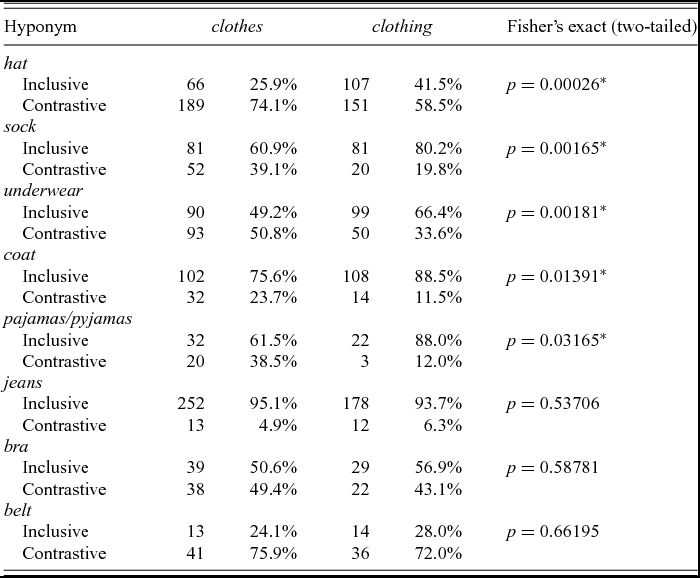
Most of the hyponyms investigated contrasted with clothes more frequently than with clothing. For instance, table 4 shows how sock and clothes contrasted in nearly 40 per cent of the contexts where the two words co-occurred, whereas sock and clothing contrasted in just under 20 per cent of the contexts examined.
The frequencies of ‘Inclusive’ and ‘Contrastive’ uses of clothes and clothing in relation to the selected hyponymsFootnote a

a The p-values marked * indicate a significant difference (at p<0.05) between clothes and clothing.
Hat, coat and pajamas/pyjamas refer to garments that are not necessary for a person to be considered fully dressed or that are only worn in specific circumstances. The fact that they contrasted significantly more frequently with clothes than with clothing would therefore support Wierzbicka's description of the difference between the meanings of clothes and clothing. However, sock and underwear, which refer to items that would be worn by a fully dressed person, also contrasted more frequently with clothes than with clothing. This suggests that rather than designating items that you expect to wear to be fully dressed, the meaning of clothes is focused on the larger, visible items that stop you appearing undressed – that is, tops, trousers and so on.
Three of the selected hyponyms did not differ significantly in the frequencies at which they contrasted with clothes compared to clothing: jeans, belt and bra. Both clothes and clothing almost always functioned as hyperonyms to jeans – as expected, given the hyponym's prototypicality. Conversely, belt contrasted with both clothes and clothing in over 70 per cent of the contexts considered. The differing function and material of belts therefore provide a ready basis of contrast between belt and both clothes and clothing.
Given that bras are items of underwear, one might expect bra to pattern like underwear and contrast more readily with clothes than with clothing. But bra was found to contrast equally with both hyperonyms. This may be due to the existence of more points of potential difference between bra and the clothing category. Unlike other items of underwear, bras are not just worn to cover intimate areas of the body for modesty and hygiene; they also provide support for the breasts. Consequently, correct fit is important and bras are measured in unique sizes with a band and a cup measurement (see (33)). Their supporting function also means that bras are often not just made from fabric, but also include metal wires or other reinforcing materials. For this reason, they are readily construed as something different from items of clothing, more like accessories (cf. belt, which also contrasted as readily with clothing as with clothes).
The contrast between bra and clothes/clothing was commonly realised in specific discourse contexts, such as ones concerned with garment sizing (e.g. (33)), large breast size and the resulting health and other difficulties (e.g. (37)) and pregnancy and breastfeeding (e.g. (38)):
-
(37) [My breasts are] big enough that it makes working out and shopping for normal clothing and bras a fucking hassle and a half (GloWbE, thehairpin.com)
-
(38) When going to buy maternity bras and clothes in stores, you will have to move from one store to the other looking for the design and color that you love. (GloWbE, edsnanquil.com)
In such contexts, bra becomes onomasiologically salient (Geeraerts et al. Reference Geeraerts, Grondelaers and Bakema1994). That is, the language user is more likely to use the label bra to name women's undergarments used to support the breasts. Thus (38) specifically mentions bras, as opposed to just using the term maternity clothes in the hyperonymous sense, which would cover bras as well. Furthermore, as the context highlights the points of difference between bras and other items of clothing, the language user is motivated to present bra and clothes/clothing as contrasting terms, rather than as a hyperonym/hyponym pair. The author of (33) could have instead written I wish they made other clothing with cup sizes like they do with bras , but the contrastive phrasing allows her to better highlight the uniqueness of bra sizing and its importance for ensuring good fit.
Hyperonym/hyponym contrast appears to be generally driven by a mechanism where the discourse context makes a hyponym salient and also highlights the potential difference between the hyponym and the hyperonym. The language user then communicates this difference through lexical contrast. For instance, in (22) (warm clothes and socks in cold weather), the reference to cold temperatures highlights the importance of keeping the peripheral parts of the body warm and increases the onomasiological salience of sock. In (24) the reference to pirates (a pirate look from my own clothes and scarfs) increases the salience of scarf. Similar arguments could be made for the other contexts discussed above.
4 Discussion and conclusion
Contrast between a hyperonym and a hyponym represents a special case of context-dependent lexical contrast. Hyperonym/hyponym contrast differs from contextually construed opposition because it involves finding a dimension of difference between the terms’ meanings, rather than a dimension of similarity against which the terms can be construed as opposites. In hyperonym/hyponym contrast, the perceived difference also usually triggers an adjustment of the hyperonym's sense boundaries to allow the terms to function as incompatibles.
Because hyperonym/hyponym contrast therefore involves going against the terms’ conventional inclusion relationship, it is more constrained than contextual opposition. A case study of hyperonym/hyponym contrast within the clothing category showed that hyponyms designating marginal category members have a stronger potential for contrast with the hyperonym than prototypical hyponyms. However, contrast is possible throughout the category and even prototypical hyponyms can be contrasted with the hyperonym, even if only rarely. The case study therefore exemplifies the flexibility and context-dependence of category boundaries in natural language use and also demonstrates the potential value of corpus linguistic methods for cognitive psychologists studying categorisation.
When prototypical hyponyms were contrasted with the hyperonym, the contrast was often drawn in relation to the dimension of hetero- vs homogeneity in a way that did not involve narrowing the hyperonym's sense. Given that heterogeneity is a particular characteristic of superordinate-level categories, it is likely that this dimension of difference can only be exploited when a superordinate-level term is contrasted with a basic-level term. This type of contrast is not limited to the clothing category – in (39), flowers refers to bouquets of mixed flowers, in contrast with ones consisting of just roses (a typical Valentine's Day gift).
-
(39) Spoil your loved one this Valentine's Day with beautiful red roses and flowers! (www.petalsnetwork.co.uk)
The function of hetero- vs homogeneous contrast in language use therefore represents a worthwhile direction for further research.
The main corpus study sought to identify the clothing hyponyms that can contrast, even minimally, with clothes/clothing. It therefore focused on hyperonym/hyponym contrast within the weakly contrastive X and Y construction. However, hyperonym/hyponym contrast is further constrained in that not all hyperonym/hyponym pairs can readily occur in more strongly contrastive contexts (e.g. X, not Y and both X and Y), even if they are possible within the X and Y construction. Rohdenburg (Reference Rohdenburg1985) posits that the acceptability of stronger contrasts is not dependent on the conventionality of the hyperonym's narrower sense. This leaves for further research to establish which factors do underlie the possibility of stronger contrast; whether it is related to prototypicality or to other semantic and discourse factors.
The comparison of the hyperonyms clothes and clothing demonstrated how examining the potential for hyperonym/hyponym contrast may help identify meaning differences between near-synonyms. Many clothing terms were shown to contrast more readily with clothes than with clothing, which suggests that the sense boundaries of clothes are generally narrower and focused around garments that stop you appearing undressed.
Although hyperonym/hyponym contrast differs in important ways from lexical contrast between opposites, it is similarly context-driven and motivated by particular discourse goals. A context may make a subordinate category and its linguistic label especially salient. A language user can then highlight the category and the way in which it differs from other members of the superordinate category by contrasting the meanings of the hyponym and the hyperonym. This mechanism is a key driver of lexical contrast between hyperonyms and hyponyms.