Introduction
The world is currently witnessing a high rate of human-induced climatic change deteriorating people’s lives and livelihoods (Ekwueme et al. Reference Ekwueme, Lasisi and Eluwole2022; Alola et al. Reference Alola, Bekun and Sarkodie2019). Climate change manifests in various ways, including droughts, insect outbreaks, reduced agricultural yields, reduced water availability, and floods. The risk of disasters is spreading all across the globe and, sadly, the impact of climatic change is becoming less predictable. The effect will likely worsen, especially in geographical areas with high vulnerabilities. Hence, it justifies why topics related to environmental problems have become a significant issue of concern in the global environment. The European Commission report on ‘Pathway to a Healthy Planet for All’ called for an urgency to act due to the hazards associated with environmental degradation (European Commission 2021). The report also stated that, in 2015, pollution accounted for over 9 million premature deaths worldwide (16% of all deaths). And so far, the EU countries are working assiduously to attain carbon neutrality.
The impact of environmental degradation is distributed unevenly amongst countries; different groups bear the effects of environmental deterioration more than others. For example, middle and low-income countries are more prone to pollution-related illnesses and death than developed countries with suitable coping mechanisms (Ekwueme et al. Reference Ekwueme, Zoaka and Alola2021). Vulnerable groups such as the elderly, children, those with disabilities, and people with health conditions are likely to suffer the most from the impacts of environmental degradation. Environmental degradation not only leads to the extinction of species and the dilapidation of biodiversity, but it also hinders global economic enhancements (Ekwueme Reference Ekwueme2020; Alola et al. Reference Alola, Dike and Alola2022). Therefore, to operate within a safe environment and prevent the negative repercussions of unrestrained global warming on human economies and civilizations, emissions must be drastically reduced (Meyer-Ohlendorf Reference Meyer-Ohlendorf2020; Zoaka et al. Reference Zoaka, Ekwueme, Güngör and Alola2022; Ekwueme Reference Ekwueme2020). Overall, the fight against environmental degradation is a fight for the sustainability of humans, plants, and all other species. Combating the problems of climatic change requires a collective approach from all sectors and nations of the world. The 1994 United Nations Framework Convention on climatic change provides a premise for combating and adapting to climatic change in the international environment (UNFCCC 1992).
To stay within a ‘well below 2 degrees’ climate change track, the Paris Agreement and Sustainable Development Goals (SDG13) on Climate Action call for a global decrease in Green House Gas (GHG) emissions. Consequently, various institutions, including the European Union (EU), are drawing their guidelines from the United Nations Framework Convention on Climate Change (UNFCCC) to address the problems of climate change. Thus, the objective of this study is to examine environmental reactions in three EU countries in terms of waste recycling, eco-innovation, and policy regulations, also referred to as WEP, in this research. The authors also explained how collective identity might act as a decarbonizing tool in the EU states. This study employs the arguments of Stephanie Bergbauer, who emphasizes the impact of collective identity in decision-making (Bergbauer Reference Bergbauer2018, p. 2). The study further emphasizes that a collective identity among the EU states would foster collective actions toward reducing global warming. The case of the EU countries was selected as the EU is among the world’s top third-largest emitters behind China and the US, contributing about 22% to the total global emissions in 2020 (IEA 2021). Additionally, with the European Green Deal (EGD) in place, the EU targets becoming the first climate-neutral continent by 2050. This study utilizes the three-pointers, waste recycling, eco-innovation, and policy regulation (WEP), to measure the EU’s performance towards reaching ‘net-zero’ emissions by 2050 (see Figure 1).
An assessment of the EU nations and decarbonization strategies

Several studies have been conducted to identify the various aspects of the environment that should be decarbonized under the EU’s zero-emission plan. For example, using BC indexes, Bodnar et al. (Reference Bodnar, Cameletti, Fasso and Schmid2008) compared air quality in Italy, Germany, and Poland. They also discussed how these states respond to environmental sustainability. Bodnar et al. (Reference Bodnar, Cameletti, Fasso and Schmid2008) argue that agriculture is the most challenging sector to decarbonize due to residual emissions compensations that need to be made to the sector. Their research further showed that changing the energy paradigm in agriculture is the primary way to achieve climate neutrality by the year 2050, especially for Italy. Thollander et al. (Reference Thollander, Backlund, Trianni and Cagno2013) approached environmental sustainability in the EU from a different direction. Their case study was focused on seven countries – Finland, France, Germany, Italy, Poland, Spain and Sweden. Their study emphasizes energy efficiency improvement in the foundry industries (Thollander et al. Reference Thollander, Backlund, Trianni and Cagno2013). For them, management of the foundry industry will benefit the energy industry and promote sustainable development. The closest case study to our current study is that of Bodnar et al. (Reference Bodnar, Cameletti, Fasso and Schmid2008), who compared air quality in Italy, Germany and Poland.
As far as we are concerned, the current study is one of the two feasibility environmental studies focused on comparing Germany, Italy and Poland, and the only one focused solely on analysing waste recycling, eco-innovation, and policy regulation (WEP). The other study (Bodnar et al. Reference Bodnar, Cameletti, Fasso and Schmid2008) analysed an environmental case study of Italy, Germany and Poland, focusing only on the air quality of the selected countries. In addition, despite contributing to the debate on net zero emission, their study needed to reflect a circular economy, which is vital in the journey to zero-emission and sustainability. One of the significant benefits of our research is that it employed three variables – waste recycling, eco-innovation, and policy innovation in conducting a comparative analysis. Bodnar et al. (Reference Bodnar, Cameletti, Fasso and Schmid2008) use the BC index methodology to compare pollution severity and toxicity of selected countries; however, our current study utilizes a deductive approach using data from the Eurostat index. Finally, we analyse three European Union member states’ strategies and track records regarding decarbonization. We also compared the collective efforts of the participating nations and found that collective identity could help the EU realize its goal of zero carbon emissions.
This research is aware that most EU member states are widely varied (in terms of technological basis, low-carbon investment affordability, and governance). It is also important to note that actions on decarbonization are motivated and organized differently in different cities (Fuso Nerini et al. Reference Fuso Nerini, Slob, Ericsdotter Engström and Trutnevyte2019: 2). In other words, what is effective in one State may be ineffective in another. In addition, some countries rely more on coal than others; for example, Poland relies on coal for 80% of its electricity (The Guardian 2021). As a result, we expect varying emission responses and commitment levels to environmental sustainability. Also, another indispensable factor to consider is that some States with a higher Gross Domestic Product (GDP) can emit more greenhouse gases since their economies rely on pollution-producing activities (Neligan Reference Neligan2018). This study, in a bid to explain this underlining disparity in pollution levels, samples three EU countries: Germany, Italy and Poland
The selection of these countries is justified on the following grounds. First is that they represent different parts of Europe: Poland (Eastern Europe), Germany (Western Europe), and Italy (Southern Europe) within their respective locations; these countries have different geo-meteorological characteristics and different population densities, also giving markedly different pollution levels (Bodnar et al. Reference Bodnar, Cameletti, Fasso and Schmid2008). Therefore, they exhibit different responses and outcomes in the three pointers; waste recycling, eco-innovation, and policy regulation (WEP) employed in this study to measure the EU’s performance towards reaching ‘net-zero’ emissions by 2050. Second is because they have varying positions on the European eco-innovation scoreboard; Germany ranked as an eco-leader between 2012 and 2021, Italy ranked as an average eco-performer within the same duration, and Poland was one of the nine countries catching up with eco-innovation (Eurostat 2022a). In addition, Germany has a higher energy balance in terms of production, consumption, and CO2 emissions than Italy, and Italy has a higher energy balance than Poland (Worlddata.info, n.d.). Therefore, their selection justifies the need to contrast energy balance with eco-innovation performance. Third, these countries are selected based on their respective recycling rates for municipal waste. Between 2004 and 2020, Germany’s municipal waste recycling rates were the highest (European Environment Agency, n.d.). Poland and Italy, however, had significant increases in recycled waste between 2004 and 2020 of over 20% and 30%, respectively (European Environment Agency, n.d.). Finally, all three countries adopted zero carbon plans in response to climate change and line with the European Union’s zero emissions goal. However, it is projected that Germany, Poland, Italy and the Czech Republic will account for 70% of all emissions from electricity generation in the EU by 2030 (Ember 2020).
The following section will discuss the targets set by Germany, Italy and Poland for reducing greenhouse gas emissions, which are in line with the general targets set by the European Union to reduce greenhouse gas emissions through the Kyoto Protocol.
Germany’s Zero Carbon Plan
Germany has taken various steps in response to the issue of climate change; these include the establishment of the Federal Climate Change Act with targets set to reduce greenhouse gas emissions by at least 65% by 2030 (Federal Ministry for the Environment, Nature Conservation, Building and Nuclear Safety 2014). Furthermore, according to a report by the German Federal Ministry of Finance, Germany has set an ambitious goal of reducing greenhouse gas emissions by at least 40% by 2020, below 1990 levels. This goal is reinforced by the Climate Action Program (CAP) 2020 and the Climate Action Programme 2030 (Federal Ministry of Finance 2022). Germany’s emissions of CO2 by 2020 must fall from about 1250 million tonnes (megatonnes) to about 750 million tonnes to meet the goal of the Climate Action Programme (Federal Ministry of Finance 2022). According to the Federal Ministry of Finance (2022), the German government’s Climate Action Programme aims to support people in taking action to protect the climate. CAP provides financial and other support to help people avoid experiencing higher costs due to the effects of climate change. Moreover, CAP is enshrined in the Climate Protection Act as part of its comprehensive climate change strategy – which calls for the country to reduce greenhouse-gas emissions to around 65% by 2030 and reach climate neutrality by 2045 (Federal Ministry of Finance 2022).
Besides implementing these measures, the German government has also been working on other initiatives to reduce greenhouse gas emissions. One of these is the installation of energy-efficient central heating systems. According to the Federal Environment Agency, the energy sector accounts for over 32% of emissions in Germany; hence, property owners are given financial incentives through a government programme to replace their old oil-fired central heating systems to enhance energy efficiency. Germany has experienced a GDP growth of 30.2% in the past two decades, compared with Italy’s at 7.9% and Poland’s at 5.7%. Germany’s GDP per worked hour also grew by 21.3%, while Italy’s grew by 4.2% (Real Instituto Elcano 2021). These values show that Italy’s GDP per worked hour has been slower than Germany’s, posing a social impact on society, health, and the economy. Most Germans support moving toward sustainability, as many companies and individuals are shifting their investments into climate-conscious measures in response to climate change (Real Instituto Elcano 2021). Although statistics show that Germany has made various efforts to address the climate change issue, the country still has a long way to go in achieving its goal of becoming climate neutral. The next decade will be crucial for Germany as it will be able to determine if it can achieve climate neutrality and mitigate the impact of its actions on society and the economy (Real Instituto Elcano 2021).
Italy’s Zero Carbon Plan
According to the 2022 World Population Review, Italy’s population is estimated to be 59,028,024, which is 13.4% of the EU’s population. Italy also has negative net migration and a higher mortality rate than its birth rate (World Population Prospects 2022). Italy emits 11.4% of the EU’s greenhouse gas (GHG) emissions (Liselotte Reference Liselotte2021). Recently, emissions in Italy dropped compared with 2005 levels, when they peaked. From 2005 to 2019, emissions declined across all Italian economic sectors, with the agriculture sector seeing the lowest decreases (Real Instituto Elcano 2021).
Like other EU countries, the Italian government unveiled a post-Covid-19 plan to reach the goals of the 2050 EU’s climate change strategy, which calls for implementing long-needed reforms. The programme, known as the National Recovery and Resilience Plan (NRRP), is a part of the country’s efforts to address its environmental problems (Real Instituto Elcano 2021). NRRP, which has a budget of around €191.5 billion, is considered the biggest in Europe. Three horizontal dimensions – climate change, digital impact, and national cohesion – guide the plan’s six main missions (Real Instituto Elcano 2021). The six critical missions are, first, digitalization, innovation, competitiveness, and culture; second, the green revolution and ecological transition; third, infrastructure for sustainable mobility. Fourth is education and research. Fifth is inclusion and cohesion, and health is the sixth (Real Instituto Elcano 2021). See Figure 2 for a detailed representation.
Italy’s National Recovery and Resiliency Plan (NRRP)
Source: Author’s representation Real Instituto Ecano (2021) report.

Despite being touted as the most extensive environmental programme in Europe, the NRRP has yet to be able to implement many of its goals. According to a study conducted by the Real Instituto Elcano (2021), the government’s plan does not have the necessary resources to fund transformational projects that are related to climate change.
The Italian recovery strategy might have been a missed opportunity for the country’s climate change efforts, considering the various projects proposed under the programme (Real Instituto Elcano 2021). The country’s high national debt exposure might also affect the public’s support for the targets. Not only did Italy’s gross domestic product grow at a slower rate of 7.9% during the past two decades compared with Germany’s 30.2%, but its productivity rate increased by 4.2% per hour worked, slower than the EU average. Like Germany, Italy’s national plans will be necessary for the next decade as they will determine if it can achieve its climate neutrality target while mitigating the effects of its actions on society (Real Instituto Elcano 2021). The plans also include measures to help the country’s industries reduce carbon emissions. In spite of its challenges, decarbonization offers significant benefits, so failure is not an option, especially in the long run.
Poland’s Zero Carbon Plan
Poland’s massive dependence on hard coal and lignite makes it one of the leading CO2 emitters in the world. The five main sectors contributing to Poland’s greenhouse gas emissions are transport, industry, agriculture, power and buildings. Most of these sectors use coal, a primary source of greenhouse gas emissions. Poland also lacks natural gas resources, and it is challenging to import natural gas due to the country’s geopolitical and geographical limitations. For this comparative study, it is essential to note that Poland has a relatively old and inefficient power plant network; it lacks rivers for extensive hydro energy generation, and the total number of sunny hours is only 1400–19,003 per year (half of California’s). Despite the complexity of the country’s efforts to cut greenhouse gas emissions, it will take a long time to reach its goal of reducing emissions by 30% within the next three decades. Hence, to achieve climate neutrality, priority must be given to climate policy, and there must be an execution of bold action in different sectors. One of the most effective steps to reduce greenhouse gas emissions is to improve the efficiency of buildings. Aside from installing insulation, other steps that can improve the energy efficiency of buildings include using low-carbon heating and cooling systems.
In February 2021, the Polish government adopted Poland’s Energy Policy by 2040 (PEP2040). PEP2040 is a revision of the country’s 2009 energy plan. It is a comprehensive energy transformation strategy that aims to reduce the country’s reliance on coal and establish a new nuclear power plant. In addition, the plan aims to introduce more renewable energy sources and significantly decrease the country’s coal-based power generation mix from 80% to 60% by 2030 (Ministry of Climate and Environment 2022). The plan aligns with the European Commission’s 2030 targets, in which Poland submitted a document to the organization stating its intention to meet these goals. Figure 3 illustrates these goals and other strategic actions included in the project.
Targets of the PEP 2040 project
Source: Author’s representation based on Ministry of Climate and Environment (Poland) report.

This study’s novelty lies in analysing Germany, Italy and Poland’s performance in meeting the goal of reducing greenhouse gas emissions using the waste recycling, eco-innovation, and policy regulation (WEP) model. It also focuses on the EU’s policies and initiatives for tackling global warming and climate change while arguing that a collective identity among the EU member states would considerably encourage joint action to combat global warming. Various policies for improving the environment are also discussed based on carbon dioxide removal strategies employed in the Polish, German and Italian administrations to understand state political actions and their fundamental motivations.
The article structure is as follows: the first section is the introduction and the justification of the selected countries. The second section discusses the materials and methodology used in this study. The third section analyses the findings based on the three pointers – waste recycling, eco-innovation and policy regulation, which we refer to here as WEP. The fourth section provides an in-depth discussion of the EU’s climatic policies in line with decarbonization strategies. The fifth section analyses the limitations, policy implications and prospect for further studies. The article concludes by recommending collective identity as a fundamental tools for combatting global warming and reaching the EU’s zero-emission goal.
Research Design and Methodological Assumptions
With a rise in the global population and an increase in consumer demand, companies across the globe require more raw materials for production. Consequently, there is a need to ensure that these materials are readily available; however, the lack of a reliable and steady supply of sustainable materials can lead to high costs for these companies. Therefore, nations need a solid plan that helps to make the environment more sustainable through a reliable and steady supply of eco-friendly and sustainable raw materials for production activities (Ellen MacArthur Foundation 2009). In March 2020, the European Commission unveiled a circular economy action plan to help promote more sustainable products and reduce waste. Furthermore, in February 2021, the European Parliament adopted a resolution calling for implementing additional measures to make the circular economy more sustainable. These measures include establishing binding targets for the consumption and use of materials and introducing stricter recycling rules. This concept differs from the traditional linear economic model, which uses a take, make and throw away pattern. See Figure 4.
The butterfly diagram: visualising the circular economy
Source: Ellen MacArthur Foundation (https://ellenmacarthurfoundation.org/circular-economy-diagram).

This literature employs three pointers to reflect on the national action plans, roadmaps, and strategies which aim to make the circular economy more attainable. In the WEP model, waste recycling (W) reflects the national plan and tracks the process concerning waste recycling. Eco-innovation (E) reflects the national and regional plans that aim to improve the efficiency and effectiveness of the circular economy by developing new technologies and improving the cooperation between industry and scientific communities. Policy innovation (P) emphasizes national policies and government initiatives to tackle global warming.
In addition, since the EU produces over two billion tonnes of waste annually, we applied several methods to examine how the selected countries have performed and the uniqueness of each country’s environmental policies. First, we made a selection of three EU countries: Poland (Eastern Europe), Germany (Western Europe) and Italy (Southern Europe), within their respective locations in the EU zone. Second, by using waste recycling, eco-innovation, and policy regulation (WEP), we examined the extent to which the sample countries are engaged in ensuring a reduction in greenhouse gas emissions and the attainment of net zero carbon goals in line with a circular economy blueprint. We ended up with three variables (WEP) because it improves our assessment of the selected countries’ diverse responses towards environmental sustainability. In this context, we used Eurostat to inspect the data visually. The analysis of the study spans the period of 2014 to 2020. We employed annual data from the Eurostat indicator to assess and compare Poland, Italy and Germany’s response to ‘WEP’. Third, we leveraged empirical evidence from process tracing and policy analysis of the European Commission’s official publication on the European Green Deal regarding the established Green New Deal. We drew its relevance from several academic sources, such as valid academic journals and recognized report sites. We also examined national net zero policies and the goals of the selected countries.
Findings from our study show that Poland is in a unique situation regarding its energy sources, which are heavily reliant on coal, and this is reflected in the country’s slow response to EU climate policy. Hence, it is interesting to understand the selected states’ geographical, economic, recovery plans, and domestic policies toward reducing EU greenhouse gas emissions. For example, in Italy, several Ministries contributed to the green process, including the Ministry of Environment, Land and Sea, the Ministry of Economic Development, and the Ministry of Infrastructure and Transportation (Bodnar et al. Reference Bodnar, Cameletti, Fasso and Schmid2008). In comparison, Germany is a high performer in achieving these goals. Lastly, we concluded that a collective identity is paramount to ensuring environmental sustainability in the EU region.
Theoretical Perspective
Recently, states are only willing to support a motion that suits their identity and interests. As a result, this study adopts a collective identity approach both as a movement and as a fundamental approach in dealing with the impact of global warming and specifically as a strategy to attain the EU’s 2050 global neutrality plan. It suggests that shared identity allows unexpected partners in terms of cultural, historical, or religious criteria. For example, Scandinavians, Mediterranean Europe men’s rights advocates, and conservative women who believe in gender equality, despite their differences, can collaborate to achieve a common goal, such as environmental protection (Bergbauer et al. Reference Bergbauer, Bergbauer and Glaeser2018).
This study attempts to use the strength of collective identity as a theory to elaborate on the framework for environmental cooperation. Using the EU as a case study, it emphasizes that identity cooperation could spill over to other aspects, such as ecological issues. The study hinges on the idea that the European Union’s policies may positively contribute to the battle against climate change and global warming.
The European Green Deal (EGD) provides a collective growth strategy to transform the EU into a fairer and thriving space while combating global warming. So far, the EU strategies for its citizens and the EU in dealing with the degrading environment and global warming have been a collective approach. Therefore, this study argues that the EGD posits a collective legislative roadmap to carbon neutrality by 2050 in the EU. We diverge from the opinions of Samper et al. (Reference Samper, Schockling and Islar2021), whose analysis portray the European Green Deal as a capitalist tool to achieve hegemony and extend the neoliberal hegemonic formation within European climate politics. Instead, this research focuses on the strength of EGD, how it has provided a collective legal framework for the EU, and its focus on making Europe climate neutral by 2050.
EU Decarbonization Strategies
Regarding decarbonization strategies, the EU policies focus on carbon reduction rather than the Carbon Removal Strategy (CDR); removing carbon dioxide is an additional step to reduction. Unlike emission reduction measures, which aim to reduce the amount of CO2 in the atmosphere, removal actively gets rid of greenhouse gas from the atmosphere. The EU’s discussion on CDRs is picking up steam, but there are still a lot of unanswered questions. For example, it does not address the liability issues surrounding the likely reduction process. In other words, who is liable if the extracted carbon dioxide gets back into the atmosphere? Second, natural CO2 sinks are fragile, and this primary concern remains unaddressed (Tagesspiegel Background 2022). Nils Meyer-Ohlendorf also observed that:
Despite this new momentum, discussions in the EU are still deficient. The political debate in the EU has not addressed the strategic role of CDRs in EU climate policies in detail. The contributions of CDRs to achieving the 2050 climate neutrality target remain unaddressed. With the exception of the LULUCF Regulation, the discussions on regulating CDRs are still in an early phase. The broader public seems largely unaware of the need for CDRs and negative emissions. International discussions are also underdeveloped; the political economy of CDR and net negative emissions has received little attention in the post-Paris negotiations, and the concept of ‘carbon debt’ has not gained traction yet. NDCs from developed countries hardly contain CDR commitments. (Meyer-Ohlendorf Reference Meyer-Ohlendorf2021)
Removing carbon dioxide from the atmosphere is still in its infancy in the EU, and its integration into the overall framework still needs to be determined. Even though the various laws and regulations related to it are already in place, most of the implementation decisions still need to be made since the European Commission still needs to clarify these issues. This section compares three EU states based on three frameworks (WEP), as seen in Figure 5. It buttresses our model on how the EU states are working to attain climate neutrality in the next 30 years and to align with the 2050 reduction strategies.
Case of Poland, Italy, and Germany’s response to net zero carbon goals concerning WEP

Waste Recycling
From Figure 6, waste management through recycling is one of the initiatives mentioned in this study that aims at decarbonizing the EU. The United States Environmental Protection Agency defined recycling as ‘the process of collecting and processing materials that would otherwise be thrown away as trash and turning them into new products’ (USEPA 2021a, 2021b). Waste management emphasizes using waste as a resource rather than an undesirable burden to be thrown away (Sözen et al. Reference Sözen, Orhon, Dinçer, Ateşok, Baştürkçü, Yalçın and Yağcı2017: 1542). Recycling also helps the environment by conserving resources and reducing pollution by minimizing the need to collect fresh raw materials (European Commission 2021). While recycling has many economic benefits, this section focuses on its environmental benefits and how the sample EU countries have responded to this cause.
Eco-innovation from 2014 to 2019
Source: Author’s computation from Eurostat (2021, selected years).

Material reuse and recycling align with the EU’s new waste management strategy. The EU has three primary recycling schemes; municipal, packaging, and electrical and electronic waste. Out of all the waste streams in the EU, municipal waste accounts for around 10% of the total (Eurostat Statistics Explained, 2021). Major mineral wastes, including construction and demolition debris, soils, and dredging spoils, grew by only two percentage points from 2010 to 2014. The study does not include these types of waste because they reflect overall trends in the waste stream rather than total amounts of waste. Additionally, this study focuses on municipal and packaging waste (the only two wastes for which time series data are available) based on the Waste Framework Directive (2008/98/EC). As part of the Waste Framework Directive, countries must recycle 50% of municipal waste by 2020, 55% by 2025, 60% by 2030, and 65% by 2035. Further goals include packaging waste by 65% by the end of 2025 and a minimum of 70% by the end of 2030 (European Environmental Agency 2021). We used Eurostat data in this study to calculate the sample country’s compliance with the regulation.
Using the Eurostat indicator, we examined the share of EU countries’ recyclable waste from 2014 to 2020. Several studies show that Germany has an excellent average recycling rate in Europe, with 65.5% of recovered and reused domestic waste (Europorter 2021; Sustainability 2021). Since implementing its recycling programme, the government has cut overall waste by 1 million tons annually.
Findings
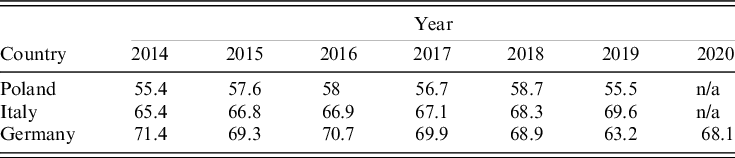
Tables 1 and 2 show the waste recycling rates of three countries within the EU: Poland, Italy and Germany, from 2014 to 2020. The unit of measurement is expressed in percentage (%) in an annual period. Recycling municipal waste includes various activities such as material recycling, anaerobic digestion, and composting. Although municipal waste mainly comprises garbage generated by households, it may also include waste by public institutions and small businesses (Eurostat 2022a, 2022b). Table 1 reveals that Poland’s waste recycling rate increased from 26.5% in 2014 to 38.7% in 2020, representing a 12.2% increase in its municipal waste recycling performance. Italy’s waste recycling rate increased from 2014 to 2019; however, data for 2020 were unavailable. Germany was able to significantly recycle its waste within the periods under observation, performing considerably better than Italy and Poland and maintaining the highest waste recycling rate in the Eurozone. Germany experienced a decrease from 69.9 to 63.2% and picked up to 68.1% in 2020. Despite the 2019 decrease in Germany’s rate, the country still leads the way in the European Union regarding recycling. It has achieved a recycling rate of 66%, which is significantly higher than the average of 46% in the EU.
The recycling rate of municipal waste from 2014–2020

The recycling rate of packaging waste from 2014–2020

Source: Author’s computation from Eurostat (2022, selected years).
Like municipal waste, packaging waste varied among the selected countries. In Poland, we noticed a decrease from 58.7 to 55.5% between 2018 and 2019. On the other hand, Italy experienced growth from 68.3 to 69.6% within the same timeframe; however, data for 2020 were unavailable for Italy and Poland. Several countries, such as Lithuania, Italy, Poland and the UK, are below the European Union’s average recycling rate but are still trying to catch up. These countries should be able to reach their targets by 2035, provided they can keep up with the rapid pace of the past decade (Neligan Reference Neligan2018). In that regard, Poland and Italy are equally producing different national waste recycling initiatives, resolutions, and revolutions to shift from a linear to a circular economy; a typical example is ‘Towards a circular economy model for Italy – framework and strategic document’ in April of 2017 (European Environmental Agency 2021). The EU Circular Economy Package pushes forward the concepts of ‘recycle, repair, and reuse’ as well as waste avoidance (see Neligan Reference Neligan2018). From Tables 1 and 2, we can say that Germany is currently leading the way in the European Union regarding recycling. It has achieved a recycling rate of 66%, which is significantly higher than the average of 46% in the EU. Germany is on track to reach its goal of having a recycling rate of 55% by 2025, assuming it will continue improving its recycling efforts. Apart from Germany, most European Union countries have been able to reduce the amount of municipal waste per head, including Poland and Italy. We shall look into the various factors contributing to the disparity between the recycling rates in Italy and Germany. First, we will discuss two reasons that have aided Germany’s implementation of the circular economy ((i) and (ii)). Second, we will look into three factors ((iii), (iv) and (v)) that have contributed to the increase in Poland and Italy
-
(i) Availability of financial and technical resources: Financial and technical resources are vital for implementing, accelerating, and sustaining a circular economy. Compared with other sampled countries (Poland and Italy), Germany possesses more technological and financial resources to improve recycling and combat climate change. According to the World Bank Richest European Countries 2022 Indicators, Germany’s gross domestic product is at $3.8 trillion, Italy’s is at $1.9 trillion, and Poland’s is at $594.2 billion (World Bank, 2022a). Due to this advantage, Germany has maintained its high position in the circular economy performance over Italy and Poland.
-
(ii) Germany’s exportation of waste to less developed countries: Despite Poland’s efforts to deal with garbage and promote a circular economy, its illegal importation of waste from Germany has not supported its efforts. As a result, Germany maintains its position as a top performer due to its exportation of waste:
despite Germany’s green reputation, there is a darker side to the country’s implementation of increasingly strict waste management rules … German experts predicted a high risk of illegal waste exports from Germany to Poland and the Czech Republic. (Vail Reference Vail2008)
Waste returned to the recycling process by German consumers exceeded the country’s capacity to recycle, resulting in collection companies dumping waste in landfills. Even though recyclable materials are tradable within the EU, parties still trick the system by engaging in the illegal activity of waste dumping and export to countries such as Poland (Vail Reference Vail2008; Deutsche Welle 2021; Earth.org 2021). In 2018 alone, Germany exported approximately 250,000 tons of waste to Poland; notably, 70% of Poland’s waste imports come from Germany (Deutsche Welle, 2021). According to a Polish ecologist, ‘the government should ban the import of waste from other countries because Poland can no longer appropriately process its waste’ (Deutsche Welle 2021). The argument is that the people who produce the waste should take responsibility for its disposal rather than shifting the burden to developing countries.
-
(iii) Poland and Italy are refurbishing their waste policies to meet the circular economy goals. Responses have accelerated in both countries to promote waste recycling, such as enacting several laws to improve municipal waste management in Poland, including the Act of 14 December 2012, the Act of 25 January 2013, and the Act of 23 January 2020 (Smol et al. Reference Smol, Duda, Czaplicka-Kotas and Szołdrowska2020). Moreover, these amendments aim to address various technical and financial issues.
-
(iv) Likewise, the government approved various policies in Italy to improve the country’s environmental conditions and manage municipal waste. In implementing these policies, the government attempts to align the country’s municipal waste segregation system with the European Union’s. In 2015, the government enacted several policies to implement the Common Environmental Policy (CE) such as National Law ‘221/2015’ (Ghisellini & Ulgiati Reference Ghisellini and Ulgiati2020). The positive responses of Italy and Poland can be attributed to their efforts in implementing a circular economy. It is evident by the values and procedures that they have both recently enacted. The policies aim to promote green energy use and limit the excessive use of natural resources.
-
(v) Generally, the more prosperous countries emit more GHG: This explains why Germany, despite being a high-performer leader in the circular economy, also has a higher carbon footprint than Poland and Italy. In Tables 1 and 2, the data presented indicate a substantial increase in waste recycling in Poland and a relatively substantial increase in Italy. In contrast, the increase in the case of Germany is somewhat limited. Germany’s higher consumption rate means it has more work to do in recycling, allowing Poland and Italy to catch up in the waste recycling index. As Adriana Neligan observed,
countries with high per-capita GDP still tend to produce more waste per head than those with low levels of per-capita GDP. Hence Germany, Denmark, and Ireland still tend to produce more municipal in the EU. Germany generated 626 kg of municipal waste per person in 2016. Within the European Union (482 kg per head), only Denmark (777 kg)… (Neligan Reference Neligan2018)
Despite the differences in carbon output (which Poland supersedes), Germany still produces more municipal waste than Poland and Italy. To maintain its place as the leading country in the circular economy, Germany must work harder than countries with lesser footprints.
Eco-Innovation
Through overharvesting, overfishing, forests, and high emissions of CO2, humanity today consumes more natural resources than the world can maintain. In the long term, we have used more ecological resources and services than nature can renew for us. For example, the European Commission reports that: eco-innovation is any form of innovation aiming at significant and demonstrable progress towards the goal of sustainable development through reducing environmental impacts or achieving more efficient and responsible use of natural resources, including energy (European Commission 2013).
Eco-innovation, according to research, necessitates more collaboration than other types of innovation due to its systemic and complex nature (Chistov et al. Reference Chistov, Aramburu and Carrillo-Hermosilla2021).
Findings
As an eco-innovation leader, Figure 6 shows that Germany performs significantly higher than the EU average (i.e. >114) between 2014 and 2019. The unit of measurement adopted is the Eurostat Index, EU=100, and just like the recycling rate of municipal waste, the time frequency for eco-innovation is annual. The indicator is based on 16 sub-indicators in five sub-categories from eight different contributors, which is intended to show how well each member state has performed (Eurostat 2021). These thematic areas are described by the European Commission (2022) as follows: eco-innovation inputs consist of financial and human resources geared towards triggering eco-innovation activities. Eco-innovation activities comprise indicators deployed to monitor the scope and scale of eco-innovation activities carried out by companies. Eco-innovation outputs describe the immediate outcomes of eco-innovation activities. Eco-innovation socio-economic outcomes look at the far-reaching effect of eco-innovation activities on society and the economy. Eco-innovation resource efficiency outcomes relate to a broader set of impacts of eco-innovation on resource productivity. Figure 7 gives a synopsis of 16 sub-indicators of the respective thematic areas.
Eco-innovation thematic areas and sub-indicators
Source: Author’s representation based on European Commission (2022).

A report by Eurostat (2021) shows Germany to be among the top seven eco-innovation leaders in the eco-innovation ranking. In 2019, Germany was sixth after Sweden, Austria, Finland, Denmark, and Luxembourg (European Commission 2019a). Italy is an average eco-innovation performer with scores around the EU average of 100 (i.e., between 85 and 114). The country’s index increased between 2014 and 2017 but still falls short of the EU average for eco-innovation leaders by a marginal difference of 1.0 in 2019. According to the EU Eco-Innovation Index of 2019, Italy was eighth behind Germany and the United Kingdom and above three countries (the Netherlands, France and Spain) in the EU average of 100. Poland is the fifth least performer in the eco-innovation index and 12 places away from the EU average of 100. Poland’s status as a country catching up with eco-innovation is not farfetched; the country faces significant obstacles to eco-innovation of economic nature. These impediments include high implementation costs, frail fiscal and financial frameworks, inconsistent investment returns, and difficulty obtaining capital (European Commission 2019b).
Policy Innovation
It is clear from the EU Framework for CO2 Removals Targets and Commitments that factors other than science motivate carbon dioxide reduction initiatives, and the legal system plays a crucial role in protecting the environment (Meyer-Ohlendorf Reference Meyer-Ohlendorf2020; Alola et al. Reference Alola, Dike and Alola2022). In this context, we explain that achieving carbon dioxide reduction is possible through eco-innovations and the supporting roles of policies. This research also considers the sample states’ responses to the EU’s 2030 climate target and climate neutrality by 2050. Thus, this part of the research discusses some underlying EU policies on environmental sustainability. On 9 July 2021, the EU announced its European Climate Law which came into effect on 29 July 2021. The law establishes a legally obligatory goal for net-zero greenhouse gas emissions by 2050. In addition, it codifies the European Green Deal’s objective and several other means for the EU to achieve climate neutrality. It also intends to strengthen the existing green policies by establishing a long-term goal of achieving carbon neutrality by 2050. In this section, we address the measures for combating climate change through European regulations and policies.
The European Green Deal (EGD)
In 2019, the European Commission adopted a set of proposals to make the EU’s climate, energy, transport, and taxation policies fit for reducing net greenhouse gas emissions by at least 55% by 2030, compared with 1990 levels (European Commission 2019a) which was 23%. The EGD strategy can be summarized as follows.
No net emissions of greenhouse gases by 2050. To achieve that, they
-
put in place short-term higher targets by 2030,
-
provide support for EU industries to enable them to cope with this transition,
-
decarbonize heating, transport, and industry,
-
invest €1 trillion in the vision.
This strategy provides a blueprint for the EU and its citizens. They are responses to the deteriorating atmosphere and global warming and highlight growth strategies to transform the EU into a fairer and thriving space while trying to reduce global warming. This study, therefore, argues that the EGD posits a collective legislative roadmap to carbon neutrality by 2050 by the EU.
Emission Trading System (ETS)
The ETS is the cornerstone of the EU’s climate change strategy and a powerful instrument for lowering greenhouse gas emissions. It is a carbon market established by the European Union in 2005 – the world’s first and largest carbon market. With the ETS, States are given emission limits as part of the plan; a firm can sell its extra carbon permits for cash if it can reduce its emissions sufficiently below its limit. On the other hand, a firm will have to purchase further permits if it cannot reduce its emissions. So far, there has been about a 43% reduction in emissions in the sectors covered by the ETS (power and heat generation, energy-intensive related sectors, and commercial aviation within Europe) since adopting the ETS in 2005.
On the contrary, Poland pursues an alternative pathway, which sees climate policy as a threat to competitiveness (Biedenkopf Reference Biedenkopf2021). In 2018, Polish President Andrzej Duda stated, ‘As long as I am the president, I won’t allow anyone to murder Polish mining’. President Andrzej Duda’s administration is the only European Union country to oppose the Green Deal 2050 carbon-neutrality objective. Duda has pledged to keep the coal sector. Poland is the only EU country that has declined to commit to climate neutrality by 2050, owing to its reliance on carbon-intensive coal. Coal power is the primary energy source in Poland; it generates around 75% of Poland’s electricity. Poland is the EU’s second-largest coal user and has the second-highest CO2 emissions per capita. The EU Carbon Trading Scheme (ETS) imposes a financial burden on pollution to place a price on CO2 emissions. As a result, EU countries will have to pay a financial penalty for their emissions. Poland is already paying a daily fee of €500,000 to the European Court of Justice (ECJ) to keep its coal mines open. Poland’s pollution levels surpass European air quality guidelines, with Poland accounting for 38 of the EU’s 50 most polluted cities. Its CO2 emissions are not only harmful to the health of its citizens but also have a financial cost. Katja Biedenkopf adduces the need for transposing the EU climate policy into member-state policy; however, this is challenging when the government does not support the overall EU goals (Biedenkopf Reference Biedenkopf2021). Poland must commit to net zero to get the funds allotted under the just transition initiative (Times 2020).
Climate Action Regulation (CAR, aka Effort Sharing Regulation)
While the ETS covers areas such as power and heat generation, energy-intensive related sectors, and commercial aviation within Europe, CAR is a measure used by Europe to decrease the climate impact on industries not included in the EU’s ETS (Carbon Market Watch 2018). The industries covered by CAR include transport, buildings, agriculture, and waste. This policy sets legally enforceable reductions on national emission goals for sectors such as transportation, buildings, agriculture, and waste for 2021–2030 (Carbon Market Watch, 2018). Despite how promising this policy appears, its effectiveness will depend on each member state’s policies. Concerning the scheme, the wealthiest member states would have to cut their emissions by 40% below 20.
Discussion
The main insights of our finding that account for the disparity in WEP performance are twofold. First, external drivers (that is, international influence) influence countries, and second, internal drivers (that is, domestic or national influence) play a significant role in implementing waste recycling, eco-innovation, and policy innovation. Notably, external drivers comprise the international community, available funds, and international regulatory pressure, while the internal drivers are sources of electricity, financial implications, and heterogeneous approach among domestic decision-makers.
By comparing the sampled countries’ efforts and the EU goals, this section will explain how Germany, Poland and Italy have responded to EU policies on climatic change – beginning with Germany, which is the third-largest Organisation for Economic Co-operation and Development (OECD) economy. Germany is a leader in implementing ambitious environmental protection laws domestically and internationally. The country’s significant environmental policy does not just make it a leader in environmental preservation and sustainable development but models how a healthier, lower-carbon economy may cope with development. Furthermore, this study shows that Germany has taken action in line with green growth; its national policies support the EU’s collective measures in dealing with climatic change. For example, the ‘German Resource Efficiency Programme’ is a detailed initiative to ensure the long-term usage of raw materials in Germany. Germany also adopted the ‘National Strategy for Sustainable Development’. All these are to decrease the strain on the environment and improve the economy’s long-term viability and competitiveness (OECD 2021).
In line with Italy’s effort to attain environmental sustainability, the government has set up laws such as the Environmental Consolidated Act (ECA) and National Law ‘221/2015’ (Ghisellini and Ulgiati Reference Ghisellini and Ulgiati2020). This legislation covers areas such as water resource management, waste recycling, Integrated Pollution Prevention and Control (IPPC), and air protection (Chilosi et al. Reference Chilosi, Martelli and Miranti2019), as well as the Legislative Decree No. 166/2010: ambient air quality (Chilosi et al. Reference Chilosi, Martelli and Miranti2019). ‘Some of the major environmental concerns of the country are comprised of (a) air pollution (resulting from energy and heating, transportation); and (b) water pollution’ (Mishra Reference Mishra2021). In addition, Italy is under obligation by the Effort-Sharing Decision (ESD) to cut its non-ETS GHG emissions by 13% between 2013 and 2020 and cut its emissions by 33% from 2005 levels under the Effort Sharing Regulation (ESR) spanning 2021–2030. So far, Italy has lowered its emissions by 13% between 2005 and 2020 due to EU effort-sharing regulations, and it anticipates meeting the 33% target for 2030. Although it sounds promising, it does not devote enough financial resources to transformative and innovative projects pertinent to the national decarbonization strategy. Hence, this scheme is unsuccessful in achieving national climate targets. Regarding waste recycling, findings show that Italy has improved its performance to promote a circular economy; this is attributable to its national policies. In 2015, the government enacted several policies to implement the Common Environmental Policy (CE) such as National Law ‘221/2015’ (Ghisellini and Ulgiati Reference Ghisellini and Ulgiati2020). Our findings show that Poland significantly improved its waste recycling between 2014 and 2020. However, Poland is the leading EU country that outright opposes the EU zero emission measures on environmental protection. Owing to its heavy reliance on coal as an energy source, it has maintained its position as the EU state with the most carbon-intensive electrical industry. Coal has long been the country’s primary power source, posing a significant obstacle in the transition to climate neutrality and raising energy security worries in the EU. Poland also aims to avoid dependency on Russian gas to assert its stance on defending its vital national interest. In addition, six Polish regions have received €136 million to help them battle the coronavirus epidemic and foster digital and green transformation. However, as Katja Biedenkopf observed, it is still up to Poland and the other member states to determine how to use the funds (Biedenkopf Reference Biedenkopf2021).
Poland is the largest coal producer and the second-largest producer of lignite in Europe (International Energy Agency 2021; European Parliamentary Research Service 2021). The United Nations Environment Programme (UNEP 2017) recommends reducing coal combustion in the coming decades to prevent hazardous levels of global warming of 1.5°C or 2°C. A careful observation of the report by Poland’s National Energy and Environment Department reveals a lack of ambition to limit the production and consumption of coal (European Parliamentary Research Service 2021). However, Poland’s Energy Policy until 2040 assumes that Poland will reduce its reliance on coal to 56% by 2030 (International Trade Administration (ITA) 2022) and cease its extraction of brown coal by 2044 and hard coal by 2049 (Euractiv 2022). Poland hopes to reduce greenhouse gas emissions by 30% by 2030 and increase energy efficiency by 23% (European Commission 2019a).
Despite these plans on paper, Poland is yet to find a matching substitute for electricity – one suitable enough to cater to all its energy needs and guarantee energy security. Within the scope of this research consideration, which ranged from 2014 to 2020, among the EU’s 28 member states, Poland has the lowest electricity generated from renewable sources, at 17%; fossil fuels provide 83% of the country’s electricity – ranking first in the EU (Ember 2022). A previous report by Ember (2020) further reveals that Poland and Belgium will generate over half of their electricity from fossil fuels by 2030, and coal will continue to dominate Poland’s electricity mix. In 2021, Poland’s electricity generation was mainly by hard coal (84.0 TWh), lignite (46.0 TWh), RES (30.4 TWh), and natural gas (15.3 TWh). Renewable energy sources (RES) contributed 30.4 terawatt hours (TWh) – of which the largest were onshore wind (16.5 TWh), biomass (4.7 TWh), and photovoltaics (3.8 TWh). The production of renewable energy sources (RES) increased by 80% over the past decade. Electricity production from photovoltaics recorded a considerable increase (+95% y/y, +1.9 TWh) which signifies a doubling of its 2020 value; also, onshore wind by 5% y/y; however, the share of RES in the electricity generation mix declined from 17.7% in 2020, to 16.7% in 2021 (Forum Energii 2022). In 2021, coal-fired capacity generation and lignite increased due to an increase in electricity demand as coal-fired generation substituted gas-fired plants (Forum Energii 2022). Figure 8 shows Poland’s energy mix from 2010 to 2021.
Electricity generation by source, Poland (in Terawatt hours, TWh)
Source: Own elaboration based on data from Forum Energii (selected years).

Poland’s over-reliance on coal-fired energy stems from the lack of sophistication and expansion of alternative electricity-generating units to guarantee energy security (ITA 2022). Natural gas-fired generation proved costlier than coal-fired generation resulting in a fall in the use of the former and a rise in the use of the latter (ITA 2022). Notably, the cost implication of erecting alternative energy infrastructure is worth considering. The estimated cost of implementing the energy transition in Poland until 2030 is around €135 billion; this includes developing new infrastructure and maintaining existing ones (Euractiv 2022). The ITA (2022) reports that the country’s energy transformation needs are around $250 billion, as stipulated by the Polish government. The European Commission report (2019b) reveals that Poland intends to build a nuclear power plant (1–1.5 GW), which will be built by 2033 and extended until 2043. The Polskie Elektrownie Jadrowe (PEJ) estimates that nuclear power would cost about $45 billion – in addition to the construction of new infrastructure, the country will also need to invest over €25 billion on the distribution and transmission grid to support energy transition (Euractiv 2022). In addition, the pace of the energy transition slowed due to an increase in the price of gas (Euractiv 2022). The war in Ukraine and sanctions against Russia have stalled the import of natural gas from Russia, which it depended on for 55% of its natural gas needs (ITA 2022). Another hindrance to the total coal phase-out and a transition to more sustainable substitutes is that around 100,000 people in Poland work in the coal mining sector, which is about half of Europe’s total coal mining workforce (Euractiv 2022).
As part of its overall strategy, Poland intends to take advantage of the significant potential of wind energy by 2030 (European Commission 2019b). However, the prohibitive ‘10H’ law, a limitation on the operation of onshore wind energy in Poland, is a significant factor that prevents this type of energy from being carried out (Euractiv 2022). The ‘10H’ law passed in 2016 has de facto imposed a moratorium on new onshore wind projects by restricting zoning in various parts of the country (ITA 2022). This law may have limited the complete adoption of this source in energy generation.
Conclusion, Policy implications and Prospect for Future Research
Limitations of the EU Climatic Neutrality Target
Several measures have been put in place for the EU to become a climate-neutral zone by 2050. Nevertheless, in practical terms, only a few EU states are committed to the requirements to meet this target. For instance, the EU has established cooperation mechanisms to reduce global warming, although mechanisms such as the EGD have yet to impact certain regions significantly. The lack of impact in certain regions is because some governments need to support most EU goals. In contrast, others are reluctant to give up specific emission sectors, especially when the EU’s strategy does not fit the states’ priority. For example, as our study shows, Poland has yet to show much commitment to giving up its coal sectors. The region has yet to find a matching substitute for electricity generation. Hence, the EU climate policy must translate into member state policy which can be challenging, particularly when the domestic institutions/governments need to consider the EU’s mode as a key to moving forwards. The EU has consistently failed to phase out fossil fuels, which impedes climate goals. Notably, phasing out fossil fuels is one of the most prolonged and stalled environmental challenges in the EU zone, making it difficult to attain zero emissions. However, the Conference on the Future of Europe has the potential to reignite this stalled discussion (Spasova and Meyer-Ohlendorf Reference Meyer-Ohlendorf2021).
Another critical gap that limits climate neutrality in the EU is that the EU lacks legally binding climatic targets. The 2030 and 2050 emission target is a mere envisagement that is not binding by local states; therefore, states decide whether to comply. It is worth considering this core aspect in the EU climatic law.
Policy Implication
This study illuminates the shadows and lights of the WEP performance in the EU. The results indicate that the region has significantly reduced its carbon emissions, but Poland’s carbon emissions remain a concern. Based on the discussion of findings, we can draw some policy implications. First, the national reality in Poland is quite heterogeneous. For instance, while talking about coal emissions, the policymaker has to show some degree of similarity in dealing with the issue. At the same time, the study’s findings are vital to policymakers in identifying areas of their country where they can make improvements in the fight against climate change. For instance, they can use the findings to develop effective measures to help the environment in the context of the EU regulatory framework. In line with the EU’s green energy goals, it is evident that coal is no longer the best option for Poland. In addition, the conflict between Russia and Ukraine has made it clear that the EU can no longer rely on Russian oil alone. New policies should encourage using renewable energy sources such as solar, wind and biogas. Besides reducing the EU’s dependence on Russia, green energy could also promote the development of new industries. The study also reveals that there is a potential for every state in the EU to adopt net zero emission policies. Therefore, Germany, Italy and Poland’s environmental performance can improve using the study’s results to develop effective measures and policies. In addition, the intriguing outcome of this study has the potential to suggest some helpful policy designs for the EU environmentalists and government actors. The study also highlights the importance of collective identity in the fight against climate change and how policies implemented in the EU can help support achieving the WEP goals. The implementation of collective policies can help the international and European communities work together seamlessly. In addition, the national policies reflect the EU’s goals and efforts in the fight against climate change.
Prospect for Future Research
Being the world’s strongest supranational organization, the EU is not often associated with institutional weakness. However, this study reveals that despite the existing policies on environmental sustainability that guide the region, some member states still embark on national interest rather than a joint approach to combat environmental changes – this form of non-compliance and non-alignment causes harm to the environment. We can claim that the results of this study and the WEP model used in our study can be adopted in future studies to analyse other countries’ contexts, thus allowing EU states and international comparisons.
Further studies can adopt the collective identity approach as a resiliency framework in dealing with climate change and propose it to be at the core of the institutional framework of EU net zero policies. At the same time, future studies can also take this course as a precondition for transitioning to a low-carbon energy system. The concept of collective identity can also foster a joint approach to addressing the various challenges related to climate change and disaster risk.
Competing Interest
The authors confirm that they have no conflicts of interest to disclose. Additionally, this research did not receive any specific grant from funding agencies in the public, commercial, or not-for-profit sectors.
About the Authors
Mehmet Direkli is currently Chair of the Department of International Relations and Political Science at Cyprus International University. His main research areas are the Cyprus conflict and European integration. He has conducted many expert interviews regarding the Cyprus conflict, primarily with Mr Günter Verheugen, Mr Alvaro De Soto, and Ms Katie Klerides. He holds a bachelor’s degree in International Relations from Gazi University, a master’s degree in European Law from Saarland University, and a PhD in Political Science from the University of Vienna.
Glory Chiyoru Dike is a PhD candidate in the Department of International Relations, Cyprus International University, Faculty of Economics. She received her bachelor of Religious and cultural studies from Ignatius Ajuru University, Nigeria, and a master’s in International Relations from Eastern Mediterranean University, Cyprus. She is currently a PhD candidate in International Relations at Cyprus International University. She is interested in Environmental sustainability, transnational communities, European Union politics, globalization, and climate change.