Cranberry tipworm, Dasineura oxycoccana (Johnson) (Diptera: Cecidomyiidae), is an established pest in areas of the United States of America where cranberry (Vaccinium macrocarpon Aiton (Ericaceae)) cultivation originated (Franklin Reference Franklin1948; Marucci Reference Marucci1954; Eck Reference Eck1990) and in Quebec, Canada (Landry et al. Reference Landry, Roy and Turcotte2002). In 1998, cranberry tipworm was observed for the first time on cranberry in British Columbia (BC), Canada (British Columbia Ministry of Agriculture and Lands 2009).
Mated female tipworms deposit eggs on the inner leaves of cranberry shoot tips that have just begun elongation (Cockfield and Mahr Reference Cockfield and Mahr1994). First-generation larvae attack vegetative shoot tips that are above the flowers, and therefore do not directly damage the current year's crop (Marucci Reference Marucci1954). The apical meristem dies as a result of feeding by larvae and the shoot produces lower secondary branches with vegetative shoot tips that can be infested by subsequent generations (Mahr and Perry Reference Mahr and Perry2006). Ovipositing females usually avoid shoot tips containing flower buds (Mahr and Perry Reference Mahr and Perry2006). Indirect damage to the next year's crop occurs in mid- to late summer of the current year, when larvae infest vegetative shoot tips that might otherwise set a fruit bud for the following year (Mahr and Perry Reference Mahr and Perry2006). In Maine and northern Wisconsin, United States of America (Mahr and Perry Reference Mahr and Perry2006), and in BC, the majority of damaged shoot tips do not flower in the next year, so growers consider tipworm a significant pest. During the growing season, many pupae remain within the cupped leaves of affected tips (Franklin Reference Franklin1948) but, in autumn, larvae descend to overwinter in the layer of detritus or soil beneath the plants (Voss Reference Voss1996).
Chemical insecticides are the basis for management of cranberry tipworm (Marucci Reference Marucci1954; Mahr and Perry Reference Mahr and Perry2006) and, consequently, little is known about its parasitoids. Voss (Reference Voss1996) reported that parasitoids from two families, Eulophidae and Platygastridae (Hymenoptera), were reared from tipworm larvae in Wisconsin. More is known about parasitoids of D. oxycoccana on cultivated blueberry in the southeastern United States. Five species of solitary hymenopterous endoparasitoids have been identified there (Sampson et al. Reference Sampson, Stringer and Spiers2002, Reference Sampson, Rinehart, Liburd, Stinger and Spiers2006): a species each of Aprostocetus Westwood (Eulophidae), Inostemma Haliday, and Platygaster Latreille and two lineages of Synopeas Förster (Platygastridae). In New Jersey, two hymenopterous parasitoids, Aprostocetus sp. and Lyrcus nigroaeneus Ashmead (Pteromalidae), are known from D. oxycoccana on cultivated blueberry (C. Rodriguez-Saona, Rutgers University, personal communication).
During a study of seasonal behaviour of cranberry tipworm, we discovered two species of hymenopterous parasitoids emerging from tipworm-infested cranberry shoots collected from a farm in Pitt Meadows, BC (49°13.577′N, 122°45.378′W). Our objectives were to identify these parasitoids and record their abundance in relation to cranberry tipworms and insecticide applications.
Shoots were collected weekly from May through August in 2009 and 2010. Shoots collected in May had no signs of tipworm damage (i.e., no cupped leaves indicative of third instars or pupae) but were expected to contain tipworm eggs and early instars. Later collections included shoots with and without cupped leaves, to maximise the probability of collecting eggs and all immature stages of cranberry tipworm. Shoots were placed in containers made from two glass scintillation vials. The bottom vial was filled with water and capped with a layer of Parafilm® through which the shoot stem was inserted. The top vial was inverted over the foliage of the shoot and sealed with sticky tape to the bottom vial. Vials maintained enough humidity for cranberry tipworms and parasitoids, and allowed easy viewing of emerged insects. One, two, or three collected shoots per vial were maintained at 21–23°C during photophase (16 hours) and 18°C during scotophase (8 hours). Emerged insects were removed every day or two for 5 weeks. Parasitoids were placed in 70% ethanol; cranberry tipworms were used in other studies. We did not open shoot tips to search for larvae, because doing so disrupts the microenvironment and often results in insect death.
The two species of parasitoids that emerged were identified by J. Huber as Aprostocetus sp. (near Aprostocetus marylandensis (Girault)) and Platygaster sp. Adults of Aprostocetus sp. and Platygaster sp. were 0.8–1.8mm and 0.8–1.2 mm long, respectively. Voucher specimens are in the Canadian National Collection of Insects (Ottawa, Ontario) and at the Royal British Columbia Museum (Victoria, BC). Further study is needed to determine if these parasitoids are the same as those found by C. Rodriguez-Saona (Rutgers University, personal communication) on cultivated blueberry in New Jersey and by Sampson et al. (Reference Sampson, Rinehart, Liburd, Stinger and Spiers2006) in the southeastern United States.
The registered insecticide diazinon (Mahr and Perry Reference Mahr and Perry2006) was applied by the grower when recommended by consultants. In 2009, diazinon was applied on 28 May, 12 June and, after pollination, on 10 July. Cooler temperatures in April and May 2010 delayed and prolonged the development of cranberry tipworm and also the development and pollination of flowers, therefore diazinon was applied at the beginning of tipworm development on 14 May and after pollination on 15 and 27 July.
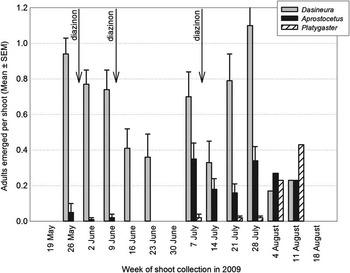
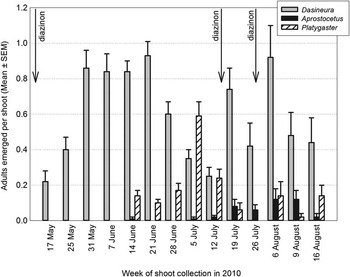
The mean number of emerged cranberry tipworm adults ranged from 0.17 to 1.1 per shoot per week. In 2009, the mean number of tipworms per shoot tended to decrease after each diazinon application (Fig. 1), but in 2010, the mean number tended to increase after each application (Fig. 2). Further investigation is needed to determine if the inconsistent effects of insecticide are due to technical issues or to resistance in the tipworm population.
Mean number (± standard error of mean [SEM]) of adults of cranberry tipworm, Dasineura oxycoccana, and parasitoids Aprostocetus sp. and Platygaster sp., which emerged from cranberry shoots collected from a farm in Pitt Meadows, British Columbia, Canada in 2009. Number of shoots collected per week: 0, 62, 96, 53, 39, 45, 0, 43, 40, 99, 96, 30, 30, 0, respectively. SEM not calculated for 4 and 11 August. Arrows indicate diazinon applications.

Mean number (± standard error of mean [SEM]) of adults of cranberry tipworm, Dasineura oxycoccana, and parasitoids Aprostocetus sp. and Platygaster sp., which emerged from cranberry shoots collected from a farm in Pitt Meadows, British Columbia, Canada in 2010. Number of shoots collected per week: 54, 105, 69, 76, 170, 158, 120, 150, 130, 50, 50, 50, 50, 50, respectively. Arrows indicate diazinon applications.

In 2009, adult Aprostocetus sp. and Platygaster sp. emerged from 14.2% and 4.0%, respectively, of 633 cranberry shoots (χ 2 = 36.7, df = 1, P < 0.0001); in 2010, the percentages were 2.1 and 16.5, respectively, from 1282 cranberry shoots (χ 2 = 144.4, df = 1, P < 0.0001). In 2009, adult Aprostocetus sp. emerged from shoots collected in late May, early June, July, and August, whereas most adult Platygaster sp. emerged from shoots collected in August (Fig. 1). In 2010, that pattern was reversed, with Platygaster sp. predominating from June through July, and Aprostocetus sp. emerging from shoots collected in July and early August (Fig. 2).
Differences in parasitoid abundance through the season and between years are probably a result of insecticide applications and perhaps also competition between species. The two applications of diazinon in spring 2009 may have killed adult Platygaster sp. searching for cranberry tipworm hosts, and prevented the buildup of Platygaster sp. seen in 2010 (Figs. 1, 2). Applications of diazinon in July (one in 2009, two in 2010) may have killed Aprostocetus sp. adults in 2009 (Fig. 1) and adults of both species in 2010 (Fig. 2). Competition between parasitoid species has been reported in blueberry, where playtgastrids parasitise cecidomyiid eggs and neonates, and Aprostocetus sp. parasitises third instars (Sampson et al. Reference Sampson, Rinehart, Liburd, Stinger and Spiers2006). In blueberry, half the cecidomyiid hosts that received Aprostocetus eggs already contained platygastrid larvae (Sampson et al. Reference Sampson, Rinehart, Liburd, Stinger and Spiers2006). On the BC cranberry farm, Aprostocetus sp. may have been more numerous in 2009 because the two spring applications of diazinon reduced competition from Platygaster sp. (Fig. 1) whereas, in 2010, Platygaster sp. would have been able to parasitise eggs and early instars, and to compete with Aprostocetus sp. in third instar hosts (Fig. 2). Our results suggest that, to conserve Aprostocetus sp. and Platygaster sp. on cranberry in western North America, repeated applications of broad-spectrum insecticides should be avoided, especially after early July.
Acknowledgements
Funding was provided by BC Cranberry Marketing Commission, BC Cranberry Growers Association, and Agriculture and Agri-Food Canada. M.A. Cook assisted with collection of cranberry shoots, R. Kurniawan assisted with observations, and S. Mathur provided technical expertise on preservation of specimens. This is publication 796, Pacific Agri-Food Research Centre, Agassiz, BC, Canada.