Background
In recent policy initiatives community involvement, community participation and, increasingly, social capital have been the subject of discussion and debate regarding their potential contribution to social regeneration practice. The concept of social capital has become relevant to policy making at a number of different levels. For example, in the context of the ‘Third World’ social capital has directly entered into the policy discourse of the World Bank, with the Bank describing it as the missing link in development (Harriss and de Renzio, Reference Harriss and De Renzio1997). Focusing upon social capital as an endowment of society, and arguing that the ways in which actors organise themselves is important in explaining economic growth and development, has led to the World Bank's view (World Bank, 1997a). Furthermore, at the European level there has been an initiative to develop ‘local social capital’ because of the recognition of its role within regional development. The role of European structural funds in increasing social capital has also been highlighted; the EU-sponsored ‘Pathways’ programme for Merseyside strengthened different types of social capital within neighbourhoods and built relations of trust between community members (Hibbitt et al., Reference Hibbitt, Jones and Meegan2001). Thus the importance of cultivating local social capital within regeneration policy is clear (Waddington, Reference Waddington2003).
Social capital can be linked to regeneration settings in a number of ways. Involvement and empowerment are central to much regeneration practice whilst associating together and engaging in community affairs are crucial to social capital development. The concept may be useful in explaining collective action in terms of mutual involvement and the creation of alliances to achieve group and community goals. Hence, associational linkages have an important role to play in creating successful regeneration by potentially mitigating against area effects in deprived places (Atkinson and Kintrea, Reference Atkinson and Kintrea2004; Boix and Posner, Reference Boix and Posner1998; Coleman, Reference Coleman1998; Putnam, Reference Putnam2000).
There are three different types of social capital networks discussed within the literature; bonding, bridging and linking with communities needing all three types for sustainable development (Putnam, Reference Putnam2000; Stone and Hughes, Reference Stone and Hughes2001). Bonding social capital is essentially related to common identity with group members having some factors in common yet too much can serve to create exclusivity. Bridging social capital refers to the weak connections between people such as business associates and acquaintances and so is likely to be greater in organisations that have a collaborative approach. Effective bonding and bridging ties are required to avoid social exclusion. Finally, linking capital refers to connections made to those in positions of power by those less powerful and so is useful in terms of enlisting and engaging support from key agencies and key players within regeneration contexts (see Jochum, Reference Jochum2003; Narayan, Reference Narayan1999). Thus, effective networking can enhance both regeneration practice and its associated outcomes.
Furthermore, social capital arguably greases the wheels of communities in that it enables them to run more smoothly. Putnam (Reference Putnam1993) argues that where people are trusting and trustworthy and regularly interact with those around them, social transactions are less costly, greatly facilitating social relationships. Indeed, Fukuyama (Reference Fukuyama1999: 16) primarily presents social capital as trust by defining the concept as ‘a set of informal values or norms shared amongst members of a group that permits co-operation between them’. Trust leads to co-operation and therefore makes both groups and networks operate smoothly. Central to this conceptualisation is the radius of trust, where it is argued that the further trust expands outside of the family then the more likely it is to be based upon moral resources and ethical behaviours. Therefore, expanding the radius of trust within deprived areas can enhance regeneration practice via increasing co-operation and enhancing network operation.
Social capital seems to offer a number of benefits to regeneration initiatives. What is important is that regeneration networks and the interactions occurring throughout them potentially facilitate different levels of linkages as well as the enhancement of trust. The creation and operation of networks within regeneration allows collective action to function within regeneration settings and therefore can be argued to have a positive impact upon social capital formation.
However, despite these potential contributions and the surge of policy interest in social capital, there are a number of criticisms of the concept, which will impact and influence the concept in all settings including regeneration. Several theorists argue that social capital as a concept is nothing new and that it is simply being exported wholesale from America to the UK, which ignores the cultural context of its conceptualisation within research studies (Harper, Reference Harper2001). The concept has been described as gender blind, ethnocentric and narrow in its focus (Davies, Reference Davies, Desai and Potter2002; Walker and Wigfield, Reference Walker and Wigfield2003). These are just some of the broader criticisms of social capital, other general criticisms focus upon the definitional diversity of the concept, its precision, issues with its measurement and its functionalist theoretical underpinnings (see Atkinson and Kintrea, Reference Atkinson and Kintrea2004; Flora, Reference Flora1998; Hooge and Stolle, Reference Hooge and Stolle2003; Portes and Landolt, Reference Portes and Landolt1996; Schuller et al., Reference Schuller, Baron and Field2000). This range of general criticisms associated with social capital formation and use may well have an influence within social regeneration settings, begging the question of whether policy should encourage its development within such contexts.
Context
Using social capital as a frame to measure the success of regeneration work in the form of community-based research, this study operated within the context of the Objective 1 Programme within South Yorkshire. Objective 1 is a programme set up by the European Union to provide investment funds to help reduce inequalities in social and economic conditions, within and between member countries. The context for its development has been the continuing pace of globalisation and the growth of weightless economies, the enlargement of the European Union and consolidation of its agenda; and a changing national set of UK policies. Objective 1 South Yorkshire is one of three such programmes in the UK alongside Cornwall and Merseyside. All programmes are targeted at areas where the Gross Domestic Product (GDP) per head of the population is seventy five per cent or less of the European average. South Yorkshire qualifies for Objective 1 funding because it has a weak economy, which under performs. South Yorkshire declined economically between 1979 and 1995 due to a massive loss of work especially in the old manufacturing industries such as steel and coal. In 1981 Sheffield had the third highest employment dependence of any urban area in Britain on mining, iron and steel (Taylor et al., Reference Taylor, Evans and Fraser1996). In addition, hundreds of pits across the country, many in South Yorkshire were threatened and then closed. The scale and pace of the loss of industry led to high unemployment, migration, environmental decline and had an impact upon the local community (Francis et al., 2002). Therefore, Objective 1 was established with the aim of tackling this decline in the economy through regeneration activity.
Focus
This research considered and examined the links between social capital, community-based research and regeneration within the Objective 1 South Yorkshire context. The aim of the research was to examine and evaluate the use of community-based research. The project was exploratory with research questions investigating the benefits and pitfalls of the use of such approaches as well as asking if any links were evidenced between the use of such community-based research and the production of social capital. Arguably if social capital is produced as a result of community-based research then the work can be positively evaluated as a success.
The study focused upon consultation carried out as part of a community action plan process. Across South Yorkshire, Objective 1 had ring-fenced funding for forty communities. In order to access this funding the communities had to research and develop a community action plan. This study specifically examined the consultation aspect of the action plan process. This consultation was a community needs assessment allowing community members to contribute. Collecting data within specific geographical locations, volunteers and professionals working within community partnerships were able to identify local issues and potential solutions in order to create a document demonstrating a map of community need, used to support applications for funding: a community action plan. Thus, the consultation was done prior to the development of the action plans so that the needs in the document were defined at the grass-roots level. The consultation formed an evidence-base for the action plan document.
Due to the large number of areas creating action plans and the time, funding and resource limitations of this study, it was not possible to examine all action plan areas. Thus, eight areas developing action plans were sampled as part of a comparative case study to qualitatively assess the community-based research undertaken. The eight areas sampled were from four different local authority wards with different demographic characteristics, issues, histories and partnerships. The areas were also at differing stages in terms of community development experience. These areas were sampled for inclusion in this study because of these differences. Examining different areas with varying levels of expertise and a range of factors influencing the context of the community-based research, allowed for more interesting comparisons to be drawn from the data. A combination of forty telephone interviews, twenty-five in-depth semi-structured interviews, observation and documentary analysis were used to gain understanding of the process of community-based research from the perspective of participants including volunteers, paid support staff and Objective 1 stakeholders. In order to qualitatively assess the social capital impact resulting from the development of the action plans, the in-depth interviews explored the creation, development and expansion of networks (specifically bonding, bridging and linking connections) occurring as a result of the action plan process and the perceived impact that participants felt that both these networks and community-based research had upon trust.
The formation of social capital as a product of community-based research
The perceptions of those interviewed about the impact that community-based research has upon trust were firstly that local grass-roots research is trusted more than external professional research and ultimately this can result in higher levels of engagement and involvement. Community-based approaches can be better received than traditional research as they work to address any existing research fatigue.
There are lots from other agencies but I was pleasantly surprised by the really positive response of people. (worker – interview 22)Footnote 1
However, in terms of the development of social capital, it is the very nature of the research result rather than who does it which is important. Research needs to achieve impacts such as funding, projects, buildings and activities which then leads to a cycle of increased involvement and engagement. Those who trust each other more are able to work together more easily because if people believe that they will see a concrete impact from participating in research they are, as a consequence more likely to engage with it.
Many participants felt that the results of the research were as important as the research process itself. Therefore, to enhance trust within social regeneration by using community-based approaches, the research needs to result in a positive and visible local impact as well as the results being widely disseminated so that local people feel well informed.
and I think the fact that we had a couple of quick wins helped us to win over local people and to get them to trust us . . .Yeah, looking at the bigger picture . . . they do . . . people's trust does grow but it is a slow process and you need to build relationships and word of mouth . . . people want quick wins so they are visible and build onto a bigger picture, they need faith. (worker – interview 18)Footnote 2
The development of social capital trust corresponds to research-related community development outcomes because local perceptions of success increase levels of trust in both workers and their organisations such as community partnerships. If people are simply consulted repeatedly with little dissemination of results or visible impact then irrespective of the type of research used, it is likely that such an approach will simply raise expectations and then deflate them. This can result in a social capital deficit due to the creation of mistrust of both future research and development work activity.
Another perception held by participants was that the context in which regeneration takes place is also important in the formulation and development of trust. For example, within some geographical locations higher levels of trust may already exist ensuring that such research is more positively accepted than in comparative areas with lower levels of trust. Several participants within the community-based research recognised that context was important.
I think it has been positive and I think it has also been to do with the history of VILLAGE so . . . I think, yes the partnership has most certainly created a structure to produce and that generates some interest . . . So there has been a positive contribution to the village. (vicar – interview 25)Footnote 3
However, even in areas where low levels of trust already exist, many participants were still in favour of the use of community-based research believing that it can still enhance trust and so produce positive social capital outcomes,
the short answer is yes because it is local people working with their communities to produce research that will identify issues of interest. . ..it is not some professional coming in. The balance is greatly in favour of local people doing the research themselves. (worker – interview 11)Footnote 4
for local people to be the researchers actually might start to overcome some of that . . . I do believe that people, the respondents are much more likely to trust local researchers. I think that's a generalisation . . . so it doesn't always follow and you have to be a bit careful . . . but I just think there is a principle involved that is really really important that if you get out and ask questions about your local area, you need to ask questions yourself. (volunteer – interview 12)Footnote 5
Therefore, community-based research can enhance trust within regeneration settings but this is context dependent and related to the visible and demonstrable outcomes of research and development work. So although locally directed regeneration policy can serve to encourage the development of trust in some cases, this is not necessarily always the case and as failed policy can leave a trust deficit, policy-makers do not have an easy task.
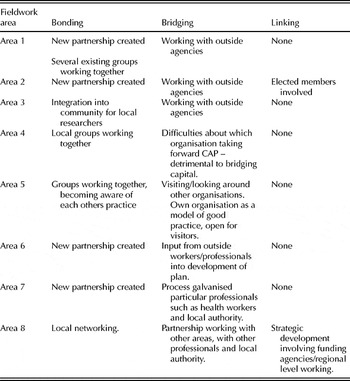
Community-based research can also have a positive impact upon networking within regeneration settings, contributing to both the development and continuation of different associational linkages, thus fostering social capital (see Table 1 for the full overview of social capital formation in each area). Volunteers and workers involved within the community-based research and the development of the action plans created new network connections. Within all eight areas, bonding social capital was enhanced through people working together through the process of community-based research. Within some local areas new partnerships were created and in others new working groups engaged in order to develop and conduct the consultation.
Community-based research and the creation of networks

Community-based research as a process also had a positive impact in terms of building bridging social capital between existing groups undertaking consultation to help people to create links with others both inside and outside of their geographical location.
So by that I was picking up information myself . . . talking to people . . . picking their brains to be quite honest. And having said that, going out and about in other communities talking to other groups. (volunteer chair – interview 24)Footnote 6
Obviously it makes the groups actually in AREA aware of what we are doing and what they are doing, we know that the situation is and we know what the situation is if we want to work together. Rather than them doing one thing and us doing one thing. . ..we are aware of what's happening. (volunteer chair – interview 3)Footnote 7
Some respondents also illustrated that community-based research can help in creating linking social capital, that is links to people in powerful positions. However, this was only evidenced in a limited way.
As the table demonstrates engaging in community-based research can enhance networks and so contribute to social capital development on a number of levels. In general, it appears that community-based research is especially useful for creating bonding and bridging social capital. It can also have an impact upon linking social capital, however participants described this less frequently.
Social capital creation: some issues within regeneration
Despite the positive findings regarding increased trust and more networks within several South Yorkshire communities undertaking community-based research, some issues remain. Firstly, trust within any neighbourhood is not guaranteed. The impact of historical divisions within areas, contemporary housing policies, intense deprivation and the sudden presence of streams of money can undermine trust between individuals and groups within neighbourhoods (Hibbitt et al., Reference Hibbitt, Jones and Meegan2001). History within some South Yorkshire areas did have a negative impact upon trust. If an area had experienced previous community development work that did not achieve its aims, this resulted in feelings of cynicism and influenced views of current regeneration practice and as such views of community-based research supporting such regeneration.
but I think because of the history people are cynical. There is apathy and cynicism due to the past promises and the history of the past partnership and what happened when it was dissolved. People are cynical . . . would it achieve anything? (Vicar – interview 20)Footnote 8
This cynicism reflects what Fukuyama (Reference Fukuyama2001) calls in-group solidarity, a narrow radius of trust where people's ability to co-operate with outsiders is reduced. In this case, this was the result of failed development work serving to support and strengthen in-group solidarity. So can successful community-based research expand trust outside of narrow community circles? Areas that had been successful with gaining funding in quick succession to their research and had publicised their success felt that trust in their organisation had increased as a result.
The actual results because it has enabled us to get funding for different projects has obviously had a great impact, there has been quite a few projects that have come out of the results of the survey. (volunteer – interview 23)Footnote 9
Therefore, community-based research can expand trust where visible results are clearly demonstrated. Hence, action must follow research. Although for Fukuyama (Reference Fukuyama2001) weak ties are important to expand the radius of trust, and are necessary in regeneration, visible outcomes such as gaining funding and running projects are also important in increasing trust within geographically deprived areas.
Second, the question of suitability arises. Tailored and integrated responses are necessary in addressing neighbourhood problems: because social capital is highly context dependent, different neighbourhoods have varying combinations of factors that affect how they work (Jochum, Reference Jochum2003). Where processes for effective communication and inclusive participation are inadequate a real sense of alienation can develop in a community (Simpson et al., Reference Simpson, Wood and Dows2003), thus not all development work will foster positive social capital creation. Community-based approaches in some circumstances can create a culture of mistrust and have a negative influence on existing stocks of social capital. This study found that the issue of how the community perceives both research and any results ensuing from its application are, in practice, difficult to judge.
What we don't know is how, whether people in the village realise how much the survey has impacted on it. (volunteer – interview 23)
Even if the involvement of locals in community-based research mitigates against a narrow circle of trust within communities, the lack of realisation of how research influences development work, may mean mistrust is still not overcome through community-based research.
Third, experience emerged as an issue in that community-based research, in order to have a positive impact upon levels of social capital, requires key people to drive forward the approach. In some South Yorkshire areas, key people were present to drive forward community-based research approaches; however, other areas do not necessarily have individuals with the skills, time or commitment needed to successfully complete the process. Furthermore, experience is fundamentally tied to involvement and so does not guarantee positive outcomes. Putnam's (1993) understanding suggests that if engagement does not happen then neither will social capital development. Engagement can also be affected by the operation of networks. However, if people are unable to tap into networks then engagement is consequently limited and inclusion becomes an issue.
Thus, inclusiveness can be problematic in terms of developing social capital. If voluntary organisations are a source of social capital and contribute to building social capital, the question must be asked about whose social capital it is that they develop. If such groups wish to produce positive outcomes then they need to encourage diversity and inclusiveness (Jochum, Reference Jochum2003). However, within all eight South Yorkshire areas only a small number of committed people developed research. If this small group of participants develops social capital as a result of their work then it may not be positive and inclusive in relation to the wider community, rather it may just be the social capital of their group. Diversity is not necessarily accommodated within partnership practices. This has implications for social capital development because any social capital created is unlikely to benefit all community members.
Conclusion
The role of social capital is important in achieving success within regeneration contexts (MacGillivray and Walker, Reference MacGillivray, Walker, Baron, Field and Schuller2000) in terms of creating increased trust, building different networks and building capacity for change. Bourdieu's (1999) use of networks as a resource and Putnam's (Reference Putnam2000) bonding, bridging and linking conceptualisation allowed community-based research within the South Yorkshire Objective 1 context to be explored in relation to community-based research as a process through which to enhance stock of social capital. Social capital was therefore one of the frames used to measure the success of community-based research as a development tool.
Within the South Yorkshire areas examined, community-based research did have a positive impact upon networking and therefore contributed to both the development and continuation of different associational linkages primarily bonding and bridging thus, fostering social capital. These networks produced in the eight case study areas were fostered in the broader context of forty partnership areas producing action plans across South Yorkshire. These neighbouring areas were carrying out research for the same purposes of developing a community action plan at similar points in time, all in order to gain funding. Thus, the prospect of gaining funding for development work purposes galvanised community members into working together, through conducting community-based research. This ties into some of the wider arguments in the literature, for example social capital effectively viewed as connections and social obligations in Bourdieu's (1986) understanding can be converted under certain conditions into economic capital. However, whether community-based research alone without ring-fenced funding at the end of the process would have the same effect remains open to question. If community-based research is applied elsewhere in isolation without the result of funding then the social capital benefits that emerge may be different to those described here, if indeed any do emerge. Moreover, within these networks, key community activists were responsible for driving forward the community-based research and the development of the action plans. Purdue (Reference Purdue2001) suggests that community leaders play a crucial role in accumulating internal social capital through their work at the grassroots level and are also at the forefront of developing external social capital through partnerships with outside elite groups, and this argument is certainly borne out here. However, not all areas have good, experienced and capable activists or indeed development workers, leaving the social capital impact of other community-based research again open to question. So further investigation is required into how networks develop from the use of community-based research across other regeneration contexts.
This study also found that trust can be enhanced by carrying out community-based research specifically when the research has clearly visible and positive outcomes such as accessing funding and developing projects. The research results also need to be clearly and strongly disseminated so that local people feel well informed about events within their area to further enhance levels of trust. If people are consulted repeatedly with little dissemination of results and no visible impact, then irrespective of the type of research used, expectations will be raised and then deflated. The partnership areas in the Objective 1 context, with a history of failed development work, exhibited higher levels of mistrust and more in-group solidarity as a result of their experience. Indeed, research if associated with failed development work can also produce negative effects in terms of higher levels of mistrust and so have a negative impact upon stocks of social capital.
Clearly, despite the increased discussion of social capital within the policy making arena and the recognition of its impact within regeneration initiatives, the building and enhancement of it are not unproblematic. The use of community-based research as a tool within development is not new and its impact in relation to social capital development, although in general positive within the South Yorkshire areas examined, raises some issues. However, two general lessons for policy makers can be drawn from the South Yorkshire context when applying community-based research as a tool from which to build social capital stocks:
• If commissioners of research are aiming to create increased social capital through using community-based research, the existence of funding in place to allow partnerships and researchers to act upon their research findings is important in galvanising people and in producing outcomes, which ultimately enhance local levels of trust.
• Community-based research can also be a useful tool to enhance networking, particularly bonding and bridging linkages where community activists work with a variety of others to achieve research and development outcomes. However, such approaches must be treated with caution because bonding linkages can serve as exclusionary in certain circumstances and if this were to be the case then the regeneration outcomes would be less positive.
Thus, the formation of social capital through regionally directed policy interventions, although possible, remains somewhat problematic. Indeed, the use of community-based research can achieve some positive social capital outcomes however this is certainly not without its challenges.