Chlorhexidine is a bisbiguanide antiseptic commonly used for skin disinfection.Reference Milstone, Passaretti and Perl 1 Daily bathing of intensive care unit (ICU) patients with chlorhexidine has been associated with decreased central-line–associated bloodstream infections and decreased acquisition of healthcare-associated pathogens,Reference Vernon, Hayden, Trick, Hayes, Blom and Weinstein 2 , Reference Climo, Yokoe and Warren 3 although a recent pragmatic cluster-randomized trial did not demonstrate reduced healthcare-associated infections.Reference Noto, Domenico and Byren 4 Chlorhexidine is also commonly used for preoperative bathing to reduce the risk of surgical site infections.Reference Milstone, Passaretti and Perl 1 – Reference Climo, Yokoe and Warren 3 However, a recent Cochrane Collaboration review called into question the efficacy of preoperative chlorhexidine showering.Reference Webster and Osborne 5 One potential limitation of many studies that have evaluated preoperative chlorhexidine bathing is that monitoring has not been performed to assess patient adherence to instructions for chlorhexidine application.Reference Chlebicki, Safdar, O’Horo and Maki 6 Moreover, a recent study suggested that self-application of chlorhexidine by patients may often be suboptimal.Reference Caffrey, Woodmansee and Crandall 7
In research studies, a colorimetric assay is often used to measure chlorhexidine concentrations on skin.Reference Edmiston, Krepel and Seabrook 8 Using this method, it has been demonstrated that the presence of inhibitory concentrations of chlorhexidine on skin correlates with reductions in bacterial pathogens.Reference Edmiston, Krepel and Seabrook 8 , Reference Popovich, Lyles and Hayes 9 Popovich et alReference Popovich, Lyles and Hayes 9 and Kumaraswamy et alReference Kumaraswamy, Flannery, Cadnum, Nerandzic and Donskey 10 proposed that this assay could be useful in monitoring compliance with and quality of chlorhexidine bathing. Here, we examined the utility of measuring chlorhexidine concentrations on skin as part of an intervention to improve preoperative chlorhexidine bathing and daily chlorhexidine bathing in the ICU.
METHODS
Patients undergoing major surgery at the Cleveland VA Medical Center are prescribed chlorhexidine bathing to be performed the evening before surgery. Chlorhexidine is applied either as a 4% solution (Betasept, Purdue Products, Stamford, CT) or with 2% chlorhexidine cloths (Sage Products, Cary, IL), based on provider choice. We conducted an evaluation of the effectiveness of chlorhexidine application before and after an intervention to improve bathing. The study protocol was approved by the hospital’s institutional review board.
During a 4-month baseline period, surgical patients prescribed preoperative chlorhexidine bathing were enrolled on the morning of surgery. Interviews and chart review were conducted to determine preoperative chlorhexidine skin disinfection practices (ie, shower vs bed bath, frequency and timing, areas of application) and to identify factors that might limit effective application (eg, devices, pain, decreased mobility or cognition, inadequate education). Cotton-tipped swabs moistened with water were used to sample 5×5 cm2 areas of the neck, chest, abdomen, arm, and leg. To measure chlorhexidine concentrations, a blinded technician applied 120 µL of freshly prepared solution containing 5 parts cetyltrimethylammonium bromide (Sigma, St. Louis, MO) and 1 part sodium hypobromite (Sigma) to the swab tip. The color change was assessed within 30 seconds by comparison to a standard curve (Figure 1). The limit of detection was ~5 parts per million (ppm).
Standard curve showing color change on cotton-tipped swabs due to decreasing concentrations of chlorhexidine ranging from 40,000 to 0 parts per million. The limit of detection was ~5 parts per million.

During a 6-month period, an intervention was conducted that included education of nurses and patients and monitoring of chlorhexidine application with feedback to nursing staff. During the intervention, nurses received education on preoperative bathing and feedback on chlorhexidine levels on patient skin. Nursing staff educated surgical patients on the importance of preoperative bathing and appropriate methods for bathing using a standardized information sheet. A convenience sample of patients was selected for measurement of chlorhexidine levels and for interviews on the education they received regarding bathing. Fishers’ exact test was used to compare the percentages of positive skin sites before vs during the intervention.
Point prevalence surveys were conducted to determine levels of chlorhexidine on the skin of surgical and medical ICU patients prescribed daily chlorhexidine bathing. The nursing staff received education and feedback on the results of these surveys.
RESULTS
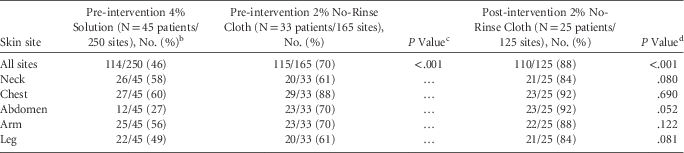
The mean age of the patients in this cohort was 65 years (range, 27–89 years), and all were male. Table 1 shows the percentages of skin sites with detectable chlorhexidine during pre- and post-intervention periods. In comparison to chlorhexidine solution, the no-rinse cloths were associated with a greater percentage of skin sites with detectable chlorhexidine in the pre-intervention period (46% vs 70%, respectively; P<.001); 6 of 45 patients (13%) using solution and 3 of 33 patients (9%) using cloths had no detectable chlorhexidine at any site. For positive sites, the average chlorhexidine concentration was higher with cloths vs solution (65.4 vs 20.8 ppm; P<.01).
Percentages of Skin Sites with Detectable Chlorhexidine During the Pre- and Post-intervention Periods in Patients Prescribed Preoperative Chlorhexidine BathingFootnote a

a Limit of detection, 5 parts per million.
b 42 patients applied the 4% solution by showering and rinsing and 3 participants applied it via bed bath.
c Comparison of 4% solution vs 2% no-rinse cloths during the pre-intervention period.
d Comparison of pre- and post-intervention values for 2% no-rinse cloths.
In pre-intervention interviews, 20 of 78 patients (26%) indicated that they either did not receive instructions on chlorhexidine application or did not understand the instructions. For example, patients using the cloths with undetectable chlorhexidine levels on their neck stated that their understanding was that chlorhexidine should be applied below the neck rather than from the neck down. None of the patients felt that decreased mobility, weakness, pain, or devices limited their ability to bathe.
During the intervention period, the hospital began to use chlorhexidine cloths for all preoperative bathing; therefore, the comparison of pre- and post-intervention bathing only included data with the use of cloths. The intervention was associated with a significant increase in the percentage of skin sites positive for chlorhexidine (70% vs 88%; P<.001).
In the initial point-prevalence evaluation in the medical and surgical ICUs, no patients had detectable chlorhexidine on skin. Daily chlorhexidine bathing had been implemented 2 years earlier, but the nursing staff had stopped using chlorhexidine cloths for unclear reasons. After re-education, chlorhexidine was detected on the skin of between 70% and 84% of ICU patients in subsequent point-prevalence surveys.
DISCUSSION
In this study, a colorimetric assay provided a simple and rapid method of monitoring the performance of chlorhexidine bathing. In our facility, use of the assay identified deficiencies in both preoperative bathing and daily ICU bathing. Notably, nursing staff in the ICUs had abandoned chlorhexidine bathing altogether without the knowledge of the infection control program. Providing intermittent feedback to nursing staff based on the assay resulted in improved chlorhexidine application. Our experience suggests that routine monitoring and feedback on chlorhexidine application may be beneficial in facilities that use chlorhexidine for skin disinfection. The reagents needed to detect chlorhexidine are commercially available, and the assay can be performed easily by nursing staff or swabs can be sent to a laboratory for processing.
The finding that application of chlorhexidine bathing using no-rinse cloths resulted in more frequent and higher levels of detection of chlorhexidine on skin is consistent with previous studies.Reference Milstone, Passaretti and Perl 1 – Reference Climo, Yokoe and Warren 3 , Reference Edmiston, Krepel and Seabrook 8 – Reference Popovich, Lyles and Hayes 9 However, the absence of detectable chlorhexidine on skin was relatively common during the pre-intervention period, even with this method of application for preoperative bathing. Based on interviews, the primary factor contributing to inadequate application was lack of education or inadequate education. For example, patients using the cloths were not applying chlorhexidine on their necks because their understanding of the instructions was that they should bathe below the neck. This deficiency was easily corrected through education of nurses and modification of patient information sheets. The average concentration of chlorhexidine detected on the skin of a patient using the no-rinse cloths was lower than that detected in volunteersReference Edmiston, Krepel and Seabrook 8 but was consistent with levels detected in ICU patients.Reference Popovich, Lyles and Hayes 9
Our study has some limitations. The study included a small number of subjects from 1 hospital and an all-male patient cohort. Feedback focused on the presence of chlorhexidine rather than a target concentration. Popovich et alReference Popovich, Lyles and Hayes 9 found that >18.75 ppm of chlorhexidine may be required to suppress Gram-positive skin flora. However, Edmiston et alReference Edmiston, Krepel and Seabrook 8 found that the minimum inhibitory concentration of chlorhexidine for staphylococcal skin isolates was 4.8 ppm, which is approximately the lower limit of detection of our assay.
ACKNOWLEDGMENTS
Financial support. This study was supported by the Department of Veterans Affairs and by a grant from CareFusion to CJD.
Potential conflicts of interest. CJD has received research grants from STERIS, 3M, Clorox, GOJO, Cubist, and AvidBiotics, and he has served on scientific advisory boards for 3M, Merck, and Cubist. All other authors report no conflicts of interest relevant to this article.