

I. Introduction
The rapid rise of the local foods movement has garnered the attention of mainstream food retailers and policymakers as consumers’ increased awareness of product origin provides both marketing and economic development opportunities (Bazzani et al., Reference Bazzani, Caputo, Nyaga and Canavari2017; Dobis et al., Reference Dobis, Reid, Schmidt and Goetz2019; Meyerding, Trajer, and Lehberger, Reference Meyerding, Trajer and Lehberger2019; Printezis and Grebitus, Reference Printezis and Grebitus2018). This growing popularity has also created controversy over the boundaries of “local.” The term has been applied to a variety of contexts—from foods produced in the same country as the final consumer to those produced within a certain predefined distance (Bazzani et al., Reference Bazzani, Caputo, Nyaga and Canavari2017). Furthermore, since at least Wendell Berry's (Reference Berry1977) seminal Unsettling of America, researchers have qualitatively connected local food systems with gains in social capital, although few studies have attempted to quantify how the embeddedness of this “attachment value” might induce shifts in consumer demand curves. That is, when social relationships become embedded in or associated with an object, they enhance the object's value in addition to its value connected to its physical properties (Oliver and Robison, Reference Oliver and Robison2017; Robison and Ritchie, Reference Robison and Ritchie2016).
The open question central to this debate is how consumers’ valuations change as their distance and relationship to a product's location of origin changes. Characterizing this relationship is key for food retailers’ and governments’ understanding of local food demand. If consumers’ choice for local food within a state-boundary, for example, is relatively insensitive to distance between the point of production and consumer location, then this would suggest a relatively homogenous state-wide local food marketing or development policy. Contrastingly, if the tendency to choose local food declines rapidly as this distance increases, then retailers and policymakers seeking to tap into the local foods movement may benefit from developing more heterogeneous, micro-targeting programs. In this article, we address this question by analyzing the heterogeneity in consumers’ preferences for a local food product by individual travel distance and social attachment value.
This article contributes to the literature in three ways. First, we estimate the relationship between travel distance and production location. Many past studies of this relationship use geographic labels such as “grown nearby” or specific travel distance labels such as “local within 160 km” or “traveled 1,000 km.” While these types of experimental designs are illuminating, they rely on fictitious product labeling. In this study, we solicit Michigan consumers’ preferences between two hard cider alternatives using the product labeling of actual brands, one in-state and one out-of-state. This allows us to explore the consumer choice for the local, travel-distance relationship in a realistic context. We explore whether distance has a measurable effect on the probability that a consumer chooses a local product without distance-specific marketing. Our study also contributes to past literature through our distance measure. Many past studies of travel distance either rely on hypothetical distance measures or do not allow distance heterogeneity to vary by individual residence. In this study, we investigate the local choice-travel distance relationship based on the Google Maps driving distance from each individual's GPS location to the local product's point of production. This measure is a more consistent measure of localness, as a simple distance measure has the potential to incorrectly overlook the role of geographic barriers such as the Great Lakes and the Huron Mountains. Thus, our approach allows us to more accurately analyze individual-specific travel distance heterogeneity in consumer choice.
Second, we use social capital theory to empirically demonstrate how attachment value is more embedded in a locally sourced product than in a non-locally sourced product. Just as strong collective social identities induce higher investments in local food systems (Alho, Reference Alho2015), the motivations for craft beverage producers are also linked to attachment value and a desire to connect with their communities (Argent, Reference Argent2018; Feeney, Reference Feeney2017). Even though a local product might have more attachment value than a non-local alternative, changes in that attachment value might not have a significant effect on consumer choice. By including a measure of attachment value in our indirect utility function, we make a second, and perhaps more interesting contribution. Namely, we quantify the role of attachment value in consumer preferences for local food choice.
By focusing on consumer demand for hard cider, we contribute to the literature in a third way as local demand is a key driver of growth in this industry. Although annual U.S. cider sales declined slightly in dollar value in 2016 relative to 2015, local/regional craft cider saw a 39% increase in sales in this period. Similarly, the industry saw a 7.7% volume growth over this period when excluding the top three cider brands. With volume more than twice that of packaged, draft cider in particular is driving this volume growth in the hard cider industry (Brager and Crompton, Reference Brager and Crompton2017). These trends highlight both the rising importance of local demand in this industry and the potential significance of travel distance for consumer choice. Few studies have focused on marketing issues in hard cider despite growing interest from consumers as evidenced by articles in the popular press claiming, “Hard Cider Is Having A Moment” (Keri, Reference Keri2015). Instead, they have focused on the role of sensory attributes in consumer willingness to pay (Tozer et al., Reference Tozer, Galinato, Ross, Miles and McCluskey2015), and on the role of agritourism in craft cider markets (Cloutier, Renard, and Arcand, Reference Cloutier, Renard and Arcand2019; Kline and Cole, Reference Kline, Cole, Kline, Slocum and Cavaliere2017). Our analysis helps fill a gap in understanding of consumer choice in an understudied market segment and brings the study of travel distance effects to a product type where local demand is a key driver of growth. Michigan hard cider makes a strong empirical case study as motivations toward purchasing craft beverages has been attributed to non-utilitarian motives such as the “quest for authenticity” (Gómez-Corona et al., Reference Gómez-Corona, Escalona-Buendía, García, Chollet and Valentin2016). Michigan is home to the second-most cider makers in the country (Cyder Market, Reference Market2018), and groups such as the Michigan Cider Association provide a substantial number of activities that create opportunities for the creation of social capital.
The remainder of the article is organized as follows. First, we provide a background of the literature on the role of distance and attachment value on consumer preferences for local food with an emphasis on how it relates to the U.S. hard cider industry. We then describe the methods used to analyze cider choice as a function of travel distance and attachment value. Third, we describe how our sample of Michigan consumers were selected and their characteristics. We explain our results and robustness checks in the third section. We conclude in the final section with a summary of key findings, limitations, and areas of future research.
II. Background
Many prior studies have investigated consumer valuation for local food (e.g., Darby et al., Reference Darby, Batte, Ernst and Roe2008; Hu et al., Reference Hu, Batte, Woods and Ernst2012; Grebitus, Lusk, and Nayga, Reference Grebitus, Lusk and Nayga2013; Gracia, Reference Gracia2014; Lim and Hu, Reference Lim and Hu2016; Bazzani et al., Reference Bazzani, Caputo, Nyaga and Canavari2017; Meas et al., Reference Meas, Hu, Batte, Woods and Ernst2017). In a recent review of this literature, Feldmann and Hamm (Reference Feldmann and Hamm2015) found that consumers are generally willing to pay a premium for local food even though they do not necessarily view local food as more expensive. Instead, key barriers to local food adoption are inconvenience and limited availability. Findings on how location and distance effect consumers’ evaluation of local food products are mixed. For example, Darby et al. (Reference Darby, Batte, Ernst and Roe2008) found no statistical difference in Ohio consumers’ valuation of fresh strawberries labeled as “grown in Ohio” and “grown nearby,” but the sample of consumers did value strawberries with either of these labels over those labeled more generically as “grown in U.S.” Contrastingly, Meas et al. (Reference Meas, Hu, Batte, Woods and Ernst2017) found that Ohio and Kentucky consumers did not place added value on processed blackberry jam labeled with their respective “State Proud” logos, but did place higher value on jam labeled with sub-state regional labels. Despite the sub-state preference, consumers in this study did not exhibit preference for jam from their own sub-state region, although there may have been some confusion over the boundaries of the sub-state regions. Thus, in one case consumers did not differentiate between the state boundary and products “grown nearby” whereas in the other consumers valued sub-state labeling over differentiation based on the state boundary.
A study on Canadian consumer preferences for beef assigned with different geographic labels further highlights the mixed findings of studies exploring the valuation-distance relationship (Lim and Hu, Reference Lim and Hu2016). Relative to labeling beef generically as “local,” labeling beef as “local from within 160 km” did not have a statistically different effect on consumer preference whereas labeling beef as “local from within 320 km” was perceived negatively. This suggests that 160 km may be within the bounds of this sample of consumers’ delineation of “local” whereas 320 km exceeds it. In contrast to Meas et al. (Reference Meas, Hu, Batte, Woods and Ernst2017), consumers in Lim and Hu (Reference Lim and Hu2016) exhibited strong preferences for beef produced in their province of residence relative to the “local” label.
The mixed results of these studies could be due to differences in the product types examined (e.g., fresh vs. processed). The interaction between product type and travel distance is explored in a study of German consumers’ preferences for apples (fresh) and wine (processed) using labels indicating the distance each product traveled from 20, 1,000, 11,000, and 18,000 kilometers (Grebitus, Lusk, and Nayga, Reference Grebitus, Lusk and Nayga2013). This study finds a sharp drop in consumer valuations as the label for kilometers traveled increased, with a sharper drop for apples than wine, a difference they attribute primarily to the perishable nature of apples relative to wine.
A. Attachment Value
While the earlier studies have estimated the effect of distance on consumer preferences for “local,” fewer studies have sought to empirically evaluate the role of attachment value in a consumer's decision process (Bauermeister, Reference Bauermeister2016; Brinkley, Reference Brinkley2017; Clendenning, Dressler, and Richards, Reference Clendenning, Dressler and Richards2016; Crespo, Réquier-Desjardins, and Vicente, Reference Crespo, Réquier-Desjardins and Vicente2014; Ramirez et al., Reference Ramirez, Bernal, Clarke and Hernandez2018). For our purposes, we follow Robison et al. (Reference Robison, Shupp, Jin, Siles and Ferrarini2012), who define five social capital motives which depend on both physical and socio-emotional needs to create “attachment value.” The motive most consistent with neoclassical utility theory is “own consumption,” which overlooks social capital incentives in favor of the selfish value of the choice to that individual person (Manski, Reference Manski2000). Taken to its extreme, the own consumption motive focuses on the “virtue of selfishness” (Rand, Reference Rand1964), and might imply that consumers exclusively choose a product just because it tastes the best.
The other four motives in the Robison et al. (Reference Robison, Shupp, Jin, Siles and Ferrarini2012) social capital model derive from social capital motives. First, Robison et al. (Reference Robison, Shupp, Jin, Siles and Ferrarini2012) consider the need for internal validation, which motivates consumers to act consistently with their moral emotions (Frank, Reference Frank and Zak2008). We label this motive as “self-respect” since it is related to self-control (Battaglini, Díaz, and Patacchini, Reference Battaglini, Díaz and Patacchini2017; Kocher et al., Reference Kocher, Martinsson, Myrseth and Wollbrant2017). This motive can also be considered an “own social capital” motive as choices consistent with one's ideal self are viewed as investments in one's own social capital. This motive is consistent with consumers’ decisions to purchase a product because it makes the consumers feel best about what the purchase says about themselves and is tied to the literature on self-control and impulse buying (Baumeister, Reference Baumeister2002; Hoch and Loewenstein, Reference Hoch and Loewenstein1991).
Second, Robison et al. (Reference Robison, Shupp, Jin, Siles and Ferrarini2012) define one's need for external validation as a key motivation to act in ways that might gain the approval of others. In this article, we label this motive “good-will,” as the good will of others can be viewed as the social capital from which a person receives external validation. This motive is also consistent with the conspicuous consumption literature, as consumers sometimes choose a product to imply their own belonging within a group (Sexton and Sexton, Reference Sexton and Sexton2014).
Third, Robison et al. (Reference Robison, Shupp, Jin, Siles and Ferrarini2012) consider the “belonging” motive, which is firmly rooted in the tribal nature of human evaluation (Greene, Reference Greene2014; Haidt, Reference Haidt2012) and motivates one's feelings of empathy toward other people, causes, and organizations, especially when one lacks the ability or resources to change the empathetic feelings and attitudes others have toward others. In other words, this motive calls for people to increase the social capital they have for other people, and can be induced by effective marketing strategies, as some brands can induce product-specific tribalism (Veloutsou and Moutinho, Reference Veloutsou and Moutinho2009).
Finally, Robison et al. (Reference Robison, Shupp, Jin, Siles and Ferrarini2012) define people's social capital (empathetic) connections to others as internalizing into their own well-being. This motive, referred to here as the “sharing” motive, is rooted in the value of reciprocity (Becker and Clement, Reference Becker and Clement2006). Additionally, the sharing motive might also be considered a “fairness” or “justice” motive, which has been found to motivate anomalous behavior in economics experiments (Lopes, Reference Lopes2008). It also might explain why people become unhealthy when the health status of their loved one deteriorates (de Mello and Tiongson, Reference de Mello and Tiongson2009). The sharing motive can also be referred to as the altruism motive that leads persons to act in the interest of others. This motive has particularly profound implications for modern consumers, as sharing and collaborative consumption have become increasingly common (Belk, Reference Belk2014).
III. Methods
A primary objective is to test whether consumers’ valuations for a processed agricultural product change as their distance from the product's location of origin increases. Our model is based on McFadden's (Reference McFadden and Zarembka1974) model of random utility maximization (RUM), which posits that an individual's choices maximize a utility function that, while known to the individual, is unknown to the analyst. Individuals participated in a “branded” choice experiment where they were asked to choose between Angry Orchard Hard Cider from New York and Blake's Hard Cider from Michigan. These two ciders were selected as they are commonly available across the state of Michigan, so our participants were likely to be familiar with them. Angry Orchard is the largest cider brand in the country, which implies that any time a Blake's Hard Cider label is offered, it is highly likely that Angry Orchard will also be available. Concurrently, Blake's is one of the largest national cidermakers and ranks as the largest family-owned cider maker in the state of Michigan (Brewbound, 2017).
To allow for heterogeneity in perceptions of distance and other hard cider characteristics across consumer groups, we model utility as:

where U ijs|c is the utility of consumer i from a cider j in choice set s given membership in a latent class c, ASC jc is the alternative specific constant for cider j among consumers in latent class c, PRICE j is the price of cider j, SWEET j is one if cider j is classified as sweet and zero if dry, ABV j is cider j’s alcohol by volume, DIST ij is the driving distance from individual i to cider maker j, ATTACH ij is participant i’s attachment to cider j, α c, β c, γ c, δ c, and σ c are the latent-class specific parameters for PRICE j, SWEET j, ABV j, DIST ij, and ATTACH ij, respectively, and ε ijs|c is the iid type I extreme value unobservable component of utility. Letting V ijs|c denote the deterministic portion of utility, we estimate the parameters in Equation (1) via a latent class logit model where the probability that individual i chooses a cider j in a choice set s conditional on membership in latent class c is:

Although individuals know their class, class assignment is not observable by the analyst. Thus, we estimate the probability that individual i belongs to latent class c as:

where z i and θ c are individual characteristics and the latent-class specific parameters respectively (Hensher, Rose, and Greene, Reference Hensher, Rose and Greene2015). Our hypotheses of interest here are the null hypothesis that driving distance does not enter the latent class c consumer utility functions and the null hypothesis that attachment value does not enter the latent class c consumer utility functions.
By estimating a latent class logit model, we allow for unobserved heterogeneity to result in different travel distance and attachment value (i.e., perceptions of local) depending on class assignment. For example, this model specification allows for the possibility that one group of consumers place more (less) value on ciders in closer geographic proximity while another consumer group makes no such distinction. Another advantage of our identification strategy is the level of precision of the real distance measure. As our study's individual-specific travel distance measure is based on the Google Maps driving distance from the consumer's GPS location to the Blake's Hard Cider Company, measurement error is likely to be small (Google, 2018).
A. Survey Design
We identified the most important attributes to include in the model via a pilot survey, which was completed by 138 likely cider consumers via Amazon's Mechanical Turk (Mason and Suri, Reference Mason and Suri2012). The pilot survey indicated that the key attributes for hard cider demands were alcohol content, price, sweetness, and localness, which were retained for our discrete choice experiment. To determine whether “localness” is a relevant characteristic in determining consumers’ ordinal utility rankings of hard cider, we included the distance between the consumer and a cider's location of origin as an explanatory variable. The driving distance measure is constructed by calculating, for each individual, the optimal Google Maps driving route from the individual's GPS location to the GPS location of the cider maker. The length of this optimal route in miles determines DIST ij (Google, 2018).
We use a branded discrete choice experimental design, where consumers were asked to choose between two branded products where we systematically varied the attributes of alcohol content, price, and sweetness. If the attributes were to all be presented in a full factorial design, our experiment would require 26 = 64 individual questions. In order to minimize this burden, we generated an orthogonal fractional factorial design, which required each participant only respond to eight individual choices. The brands, true state of origin of each respective cider, and the neither option remained constant across each choice set. Each participant made a series of eight choices between Angry Orchard Hard Cider, Blake's Hard Cider, and the neither option with varying price, sweetness, and alcohol by volume (ABV) characteristics. Each cider was labeled as sweet or dry with an ABV of 4.5% or 8.5% and a price of $3.25 or $5.25.
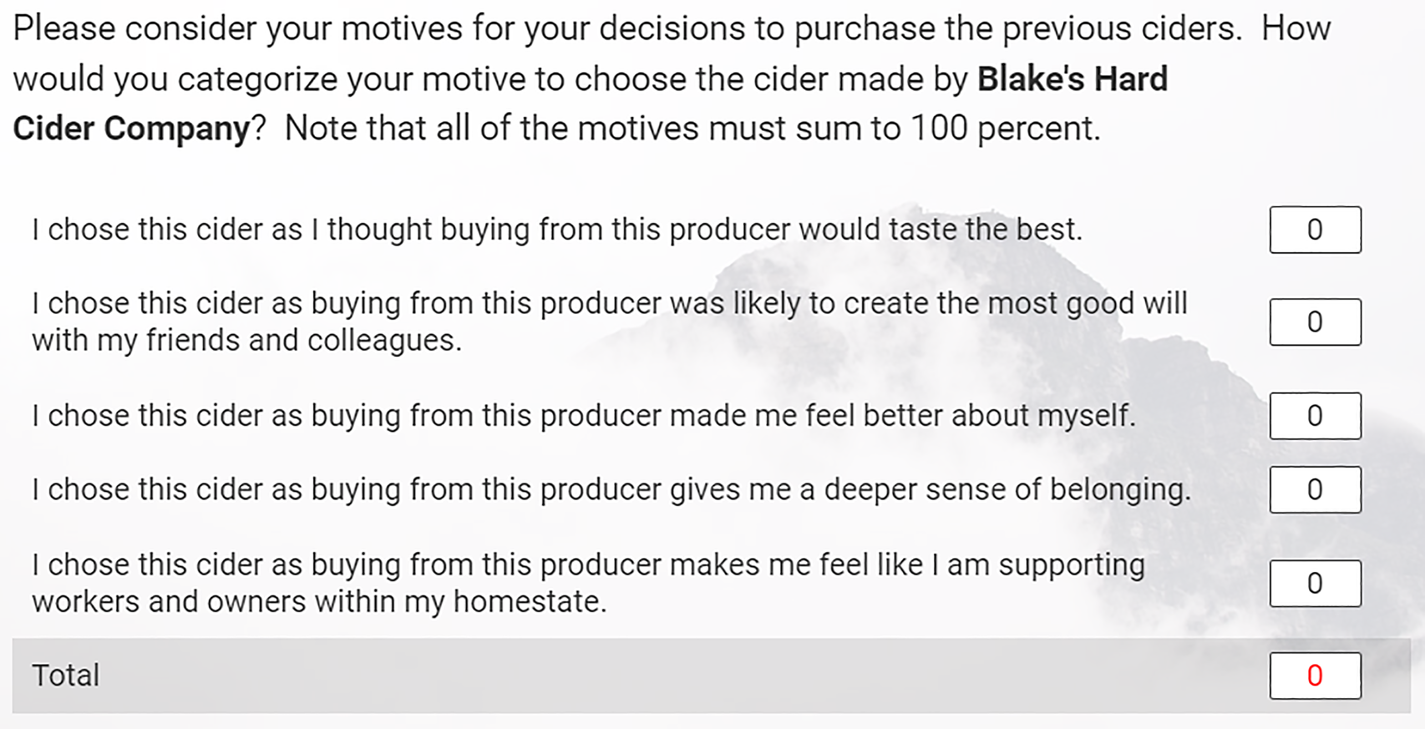
After the choice questions, we asked each participant to, “Consider your motives for your decisions to purchase the previous ciders.” Cider is likely to be a “relational good,” which means that social relationships are likely to be embedded in a consumer's cider-buying decision. To capture this attachment value, we presented participants with descriptions of social motives identifying how much attachment value a consumer places on the good they are purchasing (Robison et al., Reference Robison, Shupp, Jin, Siles and Ferrarini2012). Figure 1 displays an example of the social motives questions. The most important component for this analysis is the sharing motive defined as, “I chose this cider as buying from this producer makes me feel like I am supporting workers and owners within my homestate.”
Example of the Attachment Value Motives Question

Following Malone and Lusk (Reference Malone and Lusk2017), we then included each participant's response to the social motive question into the participant's utility function. By including these motives into our indirect utility function specification, we can estimate an “attachment value elasticity.” These elasticities allow us to make predictions and comparisons of likely changes in consumer demand when the attachment value associated with the product increases or decreases. The own-attachment value elasticity can be interpreted as, “if attachment value were to increase by 1%, we would expect the quantity demanded to decrease by X%.”
B. Description of the Data
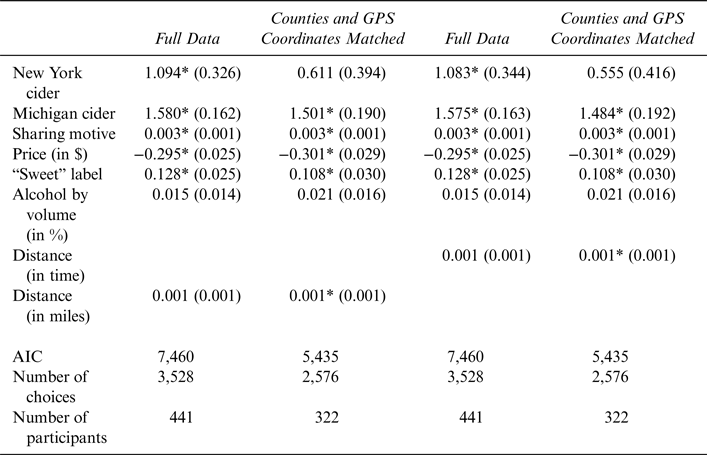
Data were collected in June 2018, via an online survey designed in Qualtrics® and distributed via the professional sampling company SSI®, who maintain a panel of likely cider drinkers in Michigan. Participants were asked to provide their consent by both SSI® as well as by the researchers. The survey took an average of 12 minutes, 41 seconds to complete. To reduce concerns about regional variation in alcohol consumption patterns (Hart and Alston, Reference Hart and Alston2019, Reference Hart and Alston2020), we collected responses from 508 participants who identified Michigan as their state of residence. Of these 508 participants, 67 are excluded from the analysis due to missing Michigan-GPS coordinates. For the analytical sample of 441 participants, the distances between each participant's GPS location at the time of the web-survey and each cider makers GPS location were calculated via the Google Maps optimal driving route. Thus, the distance variable is based on a precise measure of geographical proximity. For robustness, we also create an alternative geographic proximity measure based on the optimal route's estimated driving distance in minutes, which is reported in the Appendix. This alternative measure considers variation in road speeds along the optimal route (Google, 2018). We also cross-checked the location of the survey participants with their stated county of residence. Of the 441 residents who were in Michigan, 73% of them responded to the survey in the county where they lived. Omitting the participants whose location did not match did not significantly alter the results (Appendix).
IV. Results
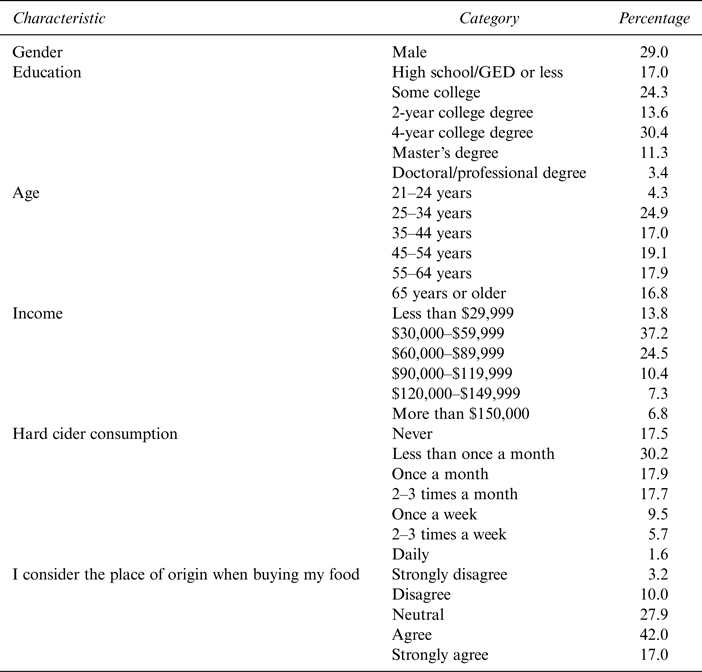
Demographics are presented in Table 1. Relative to Michigan's overall population, this sample over-represents females and persons with higher education (U.S. Census Bureau, 2018), which is consistent with our findings of likely hard cider drinkers in the pilot sample. The sample is roughly evenly split between those that drink hard cider less than once a month (including never) and those that drink hard cider once a month or more. A majority (59%) of respondents agreed with the statement “I consider the place of origin when buying my food,” suggesting that a food product's location of origin enters into their food consumption decisions. The average respondent completed the survey 174.5 minutes away from Blake's Hard Cider and 653.5 minutes away from the Angry Orchard Cidery.
Sample Demographics

Note: Total number of observations = 441.
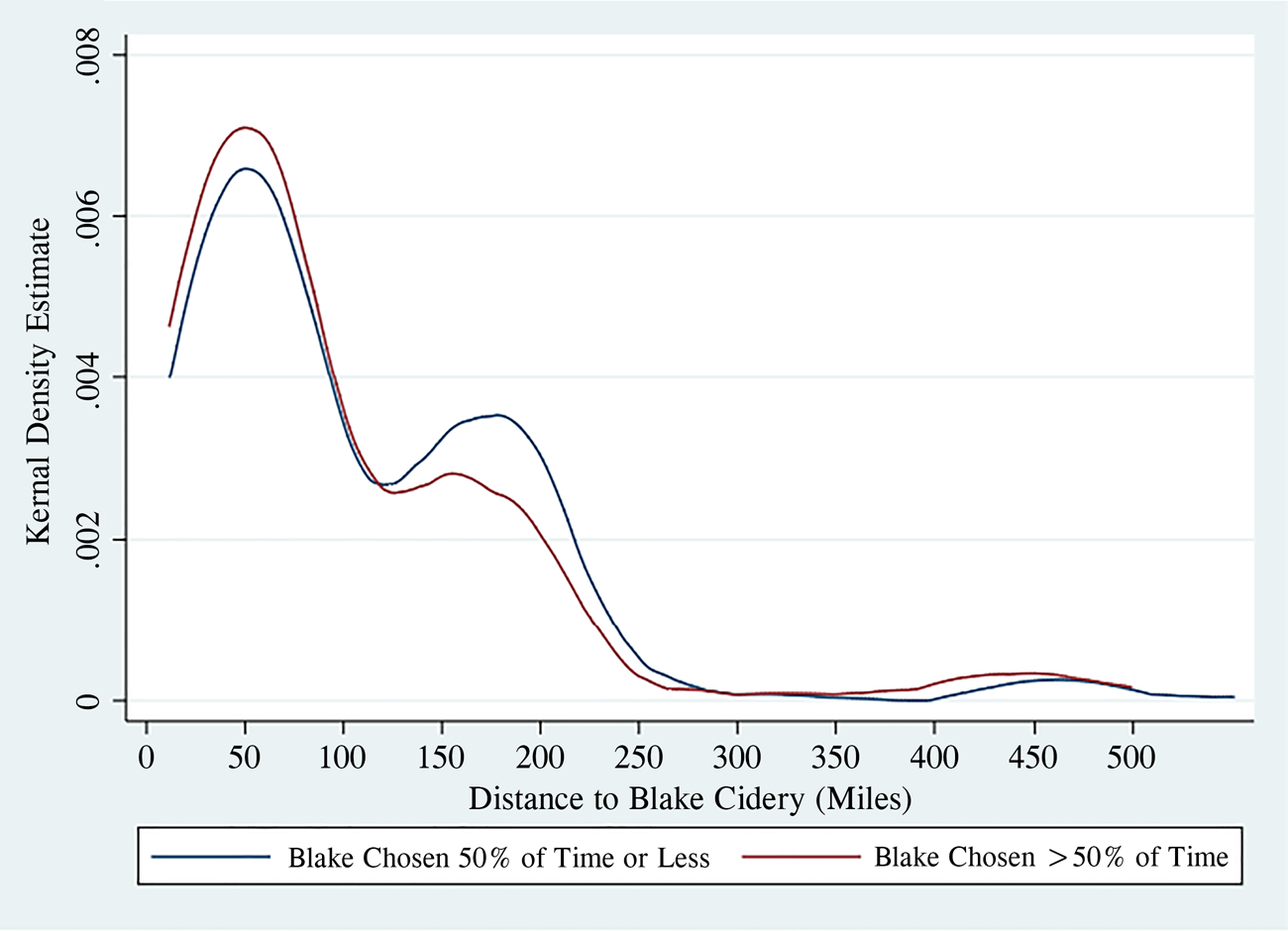
Kernel density estimates for the distributions of driving distances to Blake's Hard Cider Company, the local hard cider option, for respondents that chose Blake's Hard Cider Company 50% of the time or less and those that chose Blake's Hard Cider Company more than 50% of the time are shown in Figure 2. This non-parametric comparison suggests that the respondents that chose the Michigan cider option a majority of the time are more likely to be within 100 driving miles of the cider maker than the roughly 68% of respondents that did not exhibit a clear preference for the Michigan cider. The simple comparison also indicates substantial heterogeneity in the local-distance relationship. Respondents that did not exhibit a clear local cider preference were more likely to be in the mid-range of the Blake's travel distance relative to those with a stronger local preference, but not necessarily in the far-right extreme. In the right tail of the distance distribution, the respondents that chose the Michigan cider option a majority of the time were more likely to be more than 350 miles from Blake's Hard Cider Company than their counterparts. Although this comparison of empirical distributions is not causal evidence of the travel distance relationship, it suggests that the underlying relationship is heterogeneous.
Kernel Density Estimates for the Distribution of Distances to Blake's Hard Cider Company

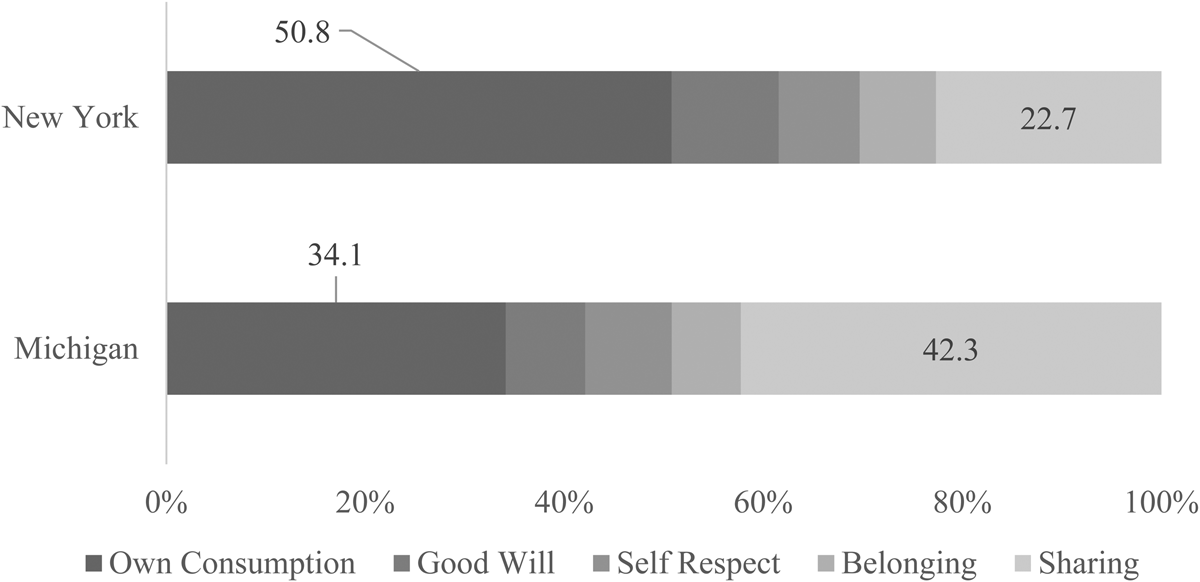
Figure 3 displays the mean attachment value motives associated with the New York cider and the Michigan cider. On average, participants ascribed the “own consumption” motive to 50.8% of their decision to purchase the New York cider, while only 34.1% of the decision to purchase the Michigan cider was affiliated with the own consumption motive. This was largely driven by an increase in the sharing motive, which explained 42.3% of the average participant's decision to choose the Michigan cider as opposed to the 22.7% affiliation with the New York cider. This substantial increase in the sharing motive supports our hypothesis that local hard ciders are embedded with significantly more attachment value.
Average Attachment Value Motives for the Michigan and New York Ciders

A. Parametric Results
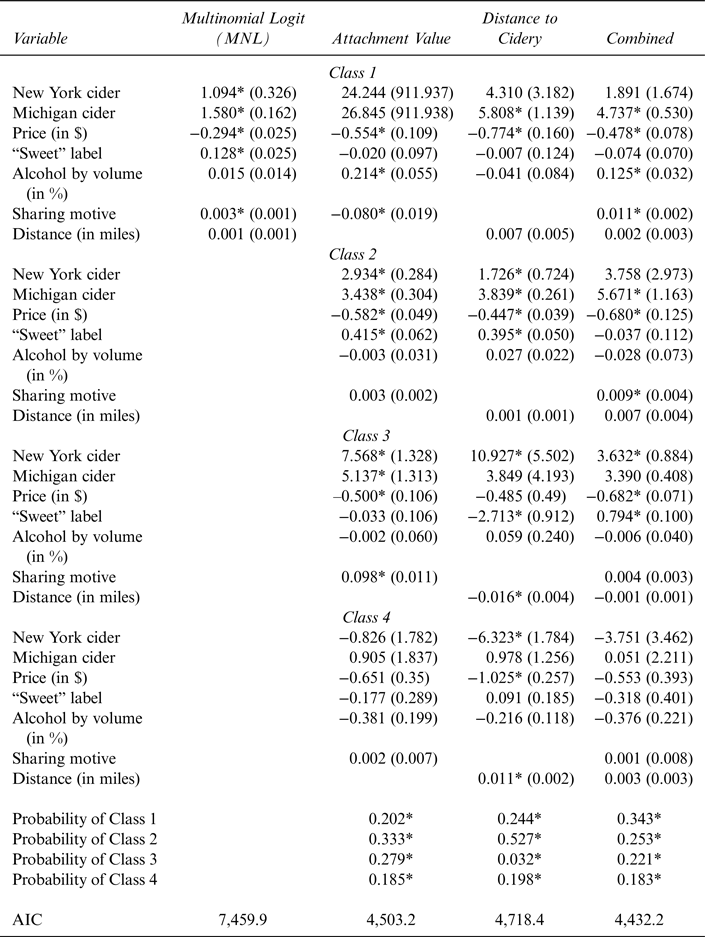
Latent class logit model estimates are provided in Table 2. We selected four as the optimal number of latent classes as four classes minimized the Akaike information criterion (AIC) without creating model convergence issues. All model specifications indicate that including four classes fit the data better than including just one class, suggesting heterogeneity in the utility function. Relative to the travel distance model, the AIC is lower when the model exclusively considers the sharing motive from the attachment value framework. The AIC is lowest when both the distance and the sharing motive are included in the model specification, indicating that this more robust model better represents the underlying data.
Latent Class Logit Model Estimates

Notes: Number of observed choices is 3,528. Number of respondents is 441. a Asterisk represents statistical significance at the α = 0.05 level. b Standard errors are in parentheses.
Michigan respondents appear to have a non-distance based definition of local for cider choice. At the 5% significance level, we cannot reject the null that these classes do not consider cider travel distance in their decision making after controlling for other relevant hard cider attributes. The distance coefficients are small in magnitude for all classes, suggesting that distance is not an economically significant predictor of cider choice. The insignificance and small magnitudes of the distance parameter estimates are indicative of “local” preferences based on geopolitical boundaries (e.g., the state of Michigan) and not distance. Furthermore, the sharing motive parameters are positive and significant for two of the four groups, representing approximately 59.6% of the sample. In other words, the higher the attachment value for the product, the more likely the consumer would choose the product.
While the statistically significant sharing motive parameter is interesting, it does not tell us much about the comparison of the role of attachment value for local and non-local products. To identify these differences, we report sharing motive elasticities, which identify changed in demand when the sharing motive increases by 1%. Table 3 reports sharing motive elasticities. Our analysis suggests that changes in attachment value related to the sharing motive are more important to increasing demand for local ciders than they are for non-local ciders. By extension, our study lends credence to the notion that local food producers might benefit by focusing more marketing efforts on the positive ways they support their patrons via the local community.
Attachment Value Elasticities

Note: Interpreted as the effect of a 1% change in the attachment value of the row item on the quantity demanded of the column item.
V. Conclusion
This article explored the role of geographic distance and attachment value in consumer preferences for local foods. Our measure of travel distance is based on the optimal driving route between each consumer's GPS location and the GPS locations of the cider makers. Consumer valuations are estimated via a “branded” discrete choice experiment where the respondents chose between an in-state hard cider, an out-of-state hard cider, and a no buy option. We model consumer choice via a latent class logit model, which allows for unobserved heterogeneity to result in different travel distance relationships depending on class assignment. Our findings suggest that, among our sample of Michigan consumers, most respondents do not factor travel distance into their local cider choice. Contrastingly, approximately 58% of Michigan consumers in our sample consider the sharing motive when purchasing hard cider. These findings suggest that definitions of “local” may be based more strongly on geopolitical boundaries and not physical distance measures.
An important limitation of these findings is our inability to exogenously vary consumer travel distance to the cider makers. As we base our analysis on precise measures of the actual distances between each consumer's location and the cider maker locations and not hypothetical distance labels, we cannot rely on exogenous attribute level variation from the experimental design. However, by exploiting the variation in travel distances across alternatives and consumers and including alternative specific constants for each cider maker, we can estimate the distance effect while controlling for latent factors based on cider makers location. This article empirically identified the role of attachment value in local food demand. Our results not only suggest that attachment value is higher for a locally produced hard cider, but also that the effect of changes in attachment value are more pronounced for the local label over the non-local alternative.
Consumers’ perceptions of “local” have substantial implications for local food marketing and development policy. Based on our sample of Michigan consumers’ hard cider choices, our findings indicate that a majority of the respondents’ choices for this local, processed food product are insensitive to the distance between point of production and consumer location. This is consistent with consumer perceptions of “local” hard cider based on geopolitical boundaries and not food miles. Given this relative homogeneity, hard cider marketing and development policy may benefit from a focus on broad, statewide appeals such as “Pure Michigan.”
Some limitations remain. First, we classified “local” as being produced from within the same state as where the consumer resides. Future research would benefit by evaluating the role distance plays in a consumer's choice to purchase something produced within the state. Although the model specifications presented in this article allow for substantial heterogeneity in individual utility functions, these estimates are based on observational data on driving time between the respondents and the cider makers of interest. Unlike studies of the local-distance relationship relying on hypothetical distance labels, these distances are real and precise representations of the relationship. An important limitation of our use of these measures, however, is that we are unable to exogenously vary driving distance between the respondents and the cider makers. Thus, we cannot rule out the possibility of other unobservable factors correlated with distance which impact cider choice. Additionally, although this research contributes to the local food literature in general, the way in which distance enters into consumers’ utility functions is likely to vary by location and product type.
Despite these limitations, our findings have important implications for producers and local governments. Where other studies have highlighted the ways craft beverage producers preserve local heritage and repurpose local folklore (Feeney, Reference Feeney2017), our results suggest that this marketing strategy is likely to pay off for producers. This is also consistent with the business strategies pursued during the mergers and acquisitions in the U.S. craft beer industry, as large producers are unwilling to sacrifice the attachment value that would be forfeited if a brewery's acquisition were to be common knowledge (Howard, Reference Howard2017; Malone and Lusk, Reference Malone and Lusk2019). While this research contributes to the understanding of complex consumer perceptions of local, future work should apply precise distance measures to analyze the effect of travel distance on consumers’ perceptions of other local foods. In addition, GPS-based distance measures should be used to analyze the local-distance relationship in other locations. A comparison of local food choices between food types, for example, could reveal how sensitivity to GPS-based local food miles differs between the types of food considered. Similarly, a comparison across regions could explore regional heterogeneity in how consumers’ local food choices are impacted by actual food miles.
Appendix
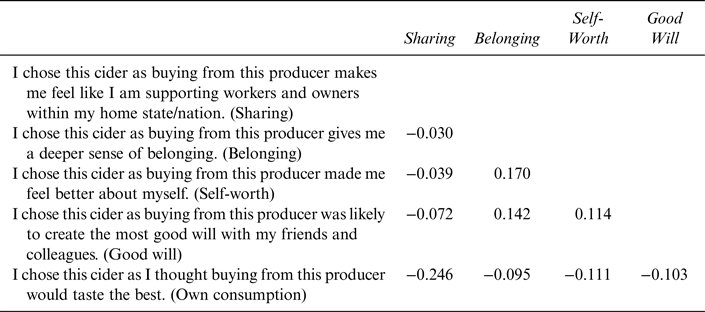
Correlation Matrix between Attachment Value Motives

Distance Measures

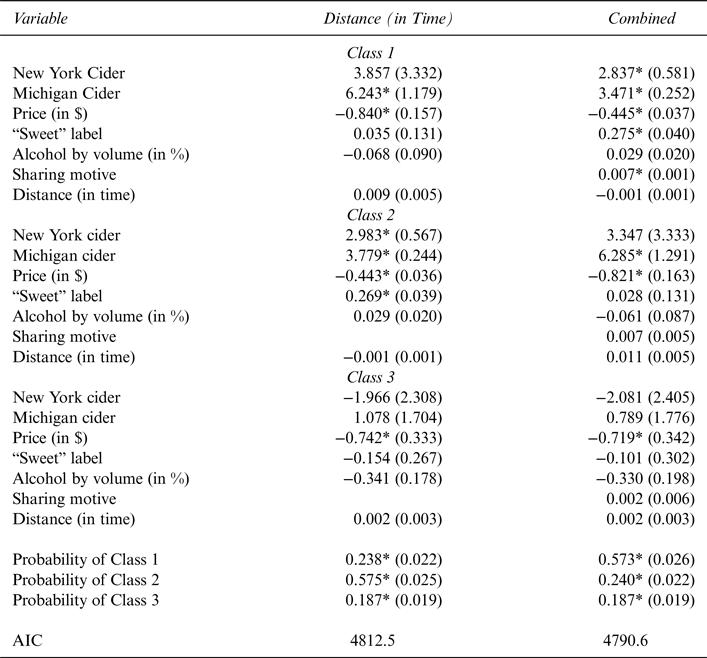
Auxiliary Latent Class Logit Model Estimates Including a Distance Parameter Measured as Drive Time

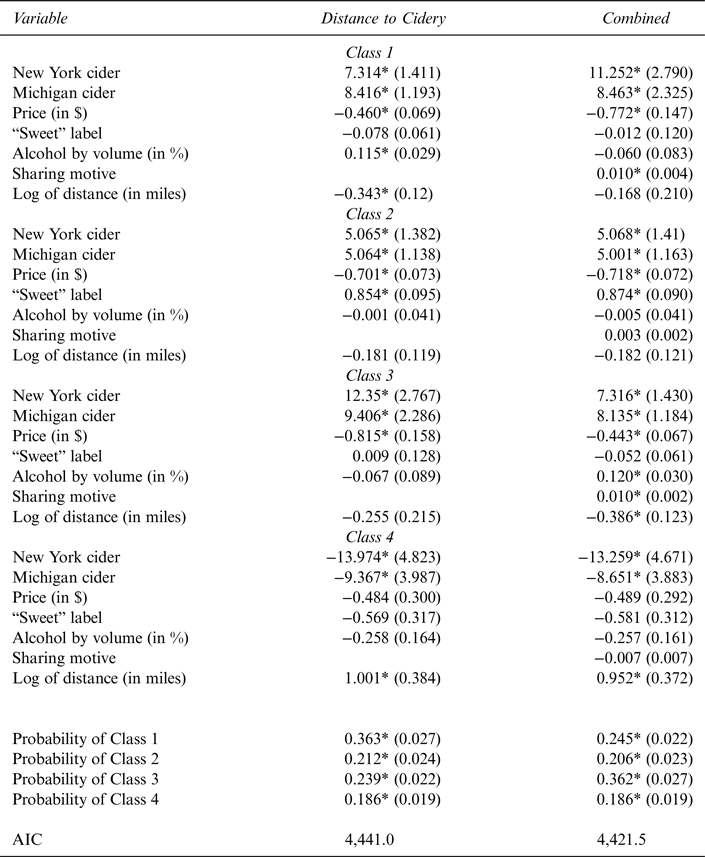
Auxiliary Latent Class Logit Model Estimates Including a Log-Distance Parameter

Auxiliary Models Where Participant GPS Coordinates Do Not Match Stated County of Residence