Introduction
Trichinella zimbabwensis, a non-encapsulated species, was discovered in 1995 in the muscles of Nile crocodiles (Crocodylus niloticus) on crocodile farms in Zimbabwe, and 7 years later it was described as a new species (Pozio et al., Reference Pozio, Foggin, Marucci, La Rosa, Sacchi, Corona, Rossi and Mukaratirwa2002). This represented the first observation of a reptile species infected naturally with Trichinella and the first observation of parasites of this genus in poikilothermic animals. Furthermore, experimental studies demonstrated that this parasite can infect not only reptiles, but also rodents, pigs, carnivores and primates (Pozio et al., Reference Pozio, Foggin, Marucci, La Rosa, Sacchi, Corona, Rossi and Mukaratirwa2002, Reference Pozio, Marucci, Casulli, Sacchi, Mukaratirwa, Foggin and La Rosa2004; Pozio & Murrell, Reference Pozio and Murrell2006; Mukaratirwa et al., Reference Mukaratirwa, Dzoma, Matenga, Ruziwa, Sacchi and Pozio2008). In nature, this parasite species has been detected in Nile crocodiles and Nile monitors (Varanus niloticus) of Zimbabwe, and in Nile crocodiles of Ethiopia, Mozambique and South Africa (Pozio et al., Reference Pozio, Foggin, Gelanew, Marucci, Hailu, Rossi and Gomez Morales2007; La Grange et al., Reference La Grange, Marucci and Pozio2009). However, in spite of surveys to identify Trichinella taxa circulating in mammals of Africa, T. zimbabwensis was never detected, whereas the encapsulated taxa Trichinella britovi, Trichinella nelsoni and Trichinella T8 were detected in North and West Africa, in East and South Africa and in West and South Africa, respectively (Pozio et al., Reference Pozio, De Meneghi, Roelke-Parker and La Rosa1997, Reference Pozio, Pagani, Marucci, Zarlenga, Hoberg, De Meneghi, La Rosa and Rossi2005; Marucci et al., Reference Marucci, La Grange, La Rosa and Pozio2009).
The aim of this work was to describe the first detection of T. zimbabwensis in a naturally infected lion (Panthera leo). The discovery of this parasite species confirms the experimental results on the wide host spectrum of T. zimbabwensis, encompassing both poikilothermic and homoeothermic vertebrates.
Materials and methods
Parasite detection and isolation
In August 2008, an adult male lion was captured by officials of the Mpumalanga Tourism and Parks Agency (MTPA) in a private game camp situated on the southern border of the Kruger National Park (KNP) near Komatipoort (longitude 31°57′16″E, latitude 25°24′08″S). The animal was moved to a holding facility on a MTPA reserve and tested by the Chief State Veterinarian, Nelspruit, for tuberculosis (Tb) using the comparative intradermal test for Tb. The animal was found to be positive for Tb and subsequently euthanized on 29 August 2008. During routine necropsy examination, muscle samples were collected for Trichinella sp. testing as part of an ongoing survey to establish the prevalence of Trichinella sp. infection in both susceptible mammalian and reptilian hosts in the province.
Muscle samples were collected from the tongue, masseter, pterygoides, intercostal, anterior tibial, triceps brachii and caudal femoral muscles. Equal amounts of tissue were collected from each of the muscle groups and pooled together to form a total sample of 100 g. The muscle tissues were artificially digested in accordance with a published protocol (Nöckler & Kapel, Reference Nöckler, Kapel, Dupouy-Camet and Murrell2007). After digestion, the nematode larvae were harvested, preserved in absolute ethyl alcohol and referred to the International Trichinella Reference Centre (ITRC, www.iss.it/site/Trichinella/index.asp) for species identification.
Molecular identification of larvae
Larvae were identified individually at the species level by a multiplex polymerase chain reaction (PCR), following a previously published protocol (Pozio & La Rosa, Reference Pozio and La Rosa2003). The PCR amplicon from ten individual larvae of the Expansion Segment V (ESV), a highly variable non-coding sequence of the large subunit ribosomal RNA of the genus Trichinella (Zarlenga & Dame, Reference Zarlenga and Dame1992), was sequenced to investigate the presence of mutations, which allows the use of this DNA region as a molecular marker. Single larvae from five reference strains belonging to taxa circulating in Africa, were used for the comparison: Trichinella spiralis (ISS003), T. britovi (ISS002), T. nelsoni (ISS029), Trichinella T8 (ISS124) and T. zimbabwensis (ISS1029).
Results and discussion
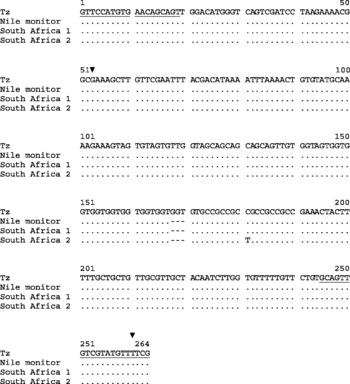
The pooled samples yielded 0.2 larvae/g (lpg) but the larval burden of the individual muscle groups was not determined. After multiplex PCR amplification of the ESV sequence, the 14 larvae collected from the lion muscles displayed a band of about 264 bp which is unique for T. zimbabwensis (isolate code ISS2231). The ESV sequence of larvae from the lion (GenBank accession no. FJ572074) was quite similar to the ESV sequence of larvae from a crocodile isolate (ISS1910) (GenBank accession no. FJ572071) from the same locality, Komatipoort, but both isolates differed from that of the reference strain (ISS1029), which had originated from a Nile crocodile from a farm in Chiredzi (Zimbabwe) (GenBank accession no. DQ861370), for a GGT repeat deletion in the microsatellite region. In addition, the lion isolate showed a C to T substitution at the 129 position of the ESV (fig. 1). The detection of a GGT repeat deletion in the microsatellite region of both the lion and crocodile isolates originating from the same locality (Komatipoort), suggests a common origin of the infection. This GGT deletion was already detected in T. zimbabwensis larvae originating from a monitor lizard from Victoria falls (Zimbabwe, ISS1596) (GenBank accession no. DQ859047). When a congruent number of isolates from different hosts and regions becomes available, the study of this or other microsatellite regions could help us to understand the transmission pattern of this parasite.
Alignment of the expansion segment five (ESV) of the large-subunit ribosomal RNA of the reference strain (ISS1029) for Trichinella zimbabwensis (Tz) (GenBank accession no. DQ861370), the isolate (ISS1596) from the Nile monitor (Varanus niloticus) from Victoria Falls (GenBank accession no. DQ859047), the isolate (ISS1910) from the Nile crocodile (Crocodylus niloticus) of Komatipoort (South Africa 1) (GenBank accession no. FJ572071) and the lion (Panthera leo) isolate (ISS2231) from Komatipoort (South Africa 2) (GenBank accession no. FJ572074). The primer sequences are underlined. Conserved bases are represented by dots and gaps by dashes. The arrowheads show the ESV region.

This result confirms evidence from experimental infections that mammals are indeed susceptible to T. zimbabwensis infection, and suggests that the natural host distribution of this parasite is not limited to reptiles, but may also include mammalian hosts that present predatory or scavenger behaviour. The results further suggest that mammalian hosts may play a significant role in the natural epidemiology of this parasite and that both reptiles and mammals may be sources of infection to each other.
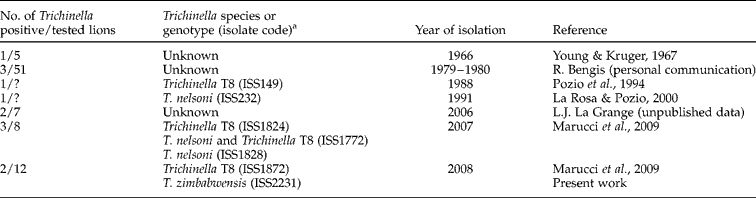
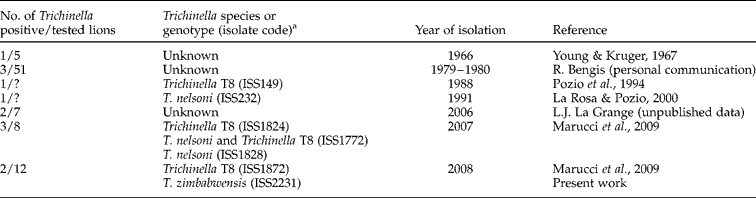
The KNP, covering an area 18,989 km2, appears to be a very important place in Africa for the circulation of three taxa of the Trichinella genus (T. nelsoni, Trichinella T8 and T. zimbabwensis). The presence of three different taxa in the KNP, where the original wild fauna of South Africa is preserved, does not appear to be a random event but seems to confirm the previous reports indicating that Trichinella sp. worms are primarily parasites of wild animals and their natural cycles today only occur in protected areas where the original biocenosis can survive. The lion, which is one of the apex carnivore species, is confirmed to be an excellent host for all three taxa currently known to be circulating in the KNP (table 1). At the same time, the detection of these three Trichinella taxa in the same host species suggests that the host species probably did not play an important role in the evolution and speciation of this parasite genus.
Reports of Trichinella species or genotypes in lions (Panthera leo) of the Kruger National Park (KNP) of South Africa. Since 1966, Trichinella sp. larvae have been detected in 13 lions of about 85 tested (prevalence 15%) from the KNP.
a International Trichinella Reference Centre (www.iss.it/site/Trichinella).
Acknowledgements
We wish to thank the Mpumalanga Tourism and Parks Agency for their kind assistance in the capture of the lion. We wish to thank the Chief Directorate Veterinary Services for the financial and technical support supplied to the survey. The work carried out in Rome, Italy, was supported by the European Commission (contract SANCO/2006/FOODSAFETY/032).