Introduction
There are four known palladium telluride minerals: kotulskite (PdTe), merenskyite (PdTe2), telluropalladinite (Pd9Te4) and keithconnite (Pd3–xTe). There are also known occurrences of minerals with possible compositions of Pd13Te3 and Pd3Te2 (e.g. Arnason et al., Reference Arnason, Bird, Bernstein and Kelemen1997). However, these minerals have not yet been fully characterised. Among palladium tellurides, kotulskite (Genkin et al., Reference Genkin, Zhuravlev and Smirnova1963) and merenskyite (Kingston, Reference Kingston1966) belong to the most abundant platinum group minerals, commonly found together with other platinum-group minerals and Cu–Ni–Fe sulfides. Palladium tellurides are generally found in Cu–Ni–PGE mineral deposits, associated with mafic and ultramafic igneous rocks. They also occur in other types of deposits, enriched in PGE, like porphyry copper/gold systems, sedimentary hosted massive sulfides or metalliferous black shales.
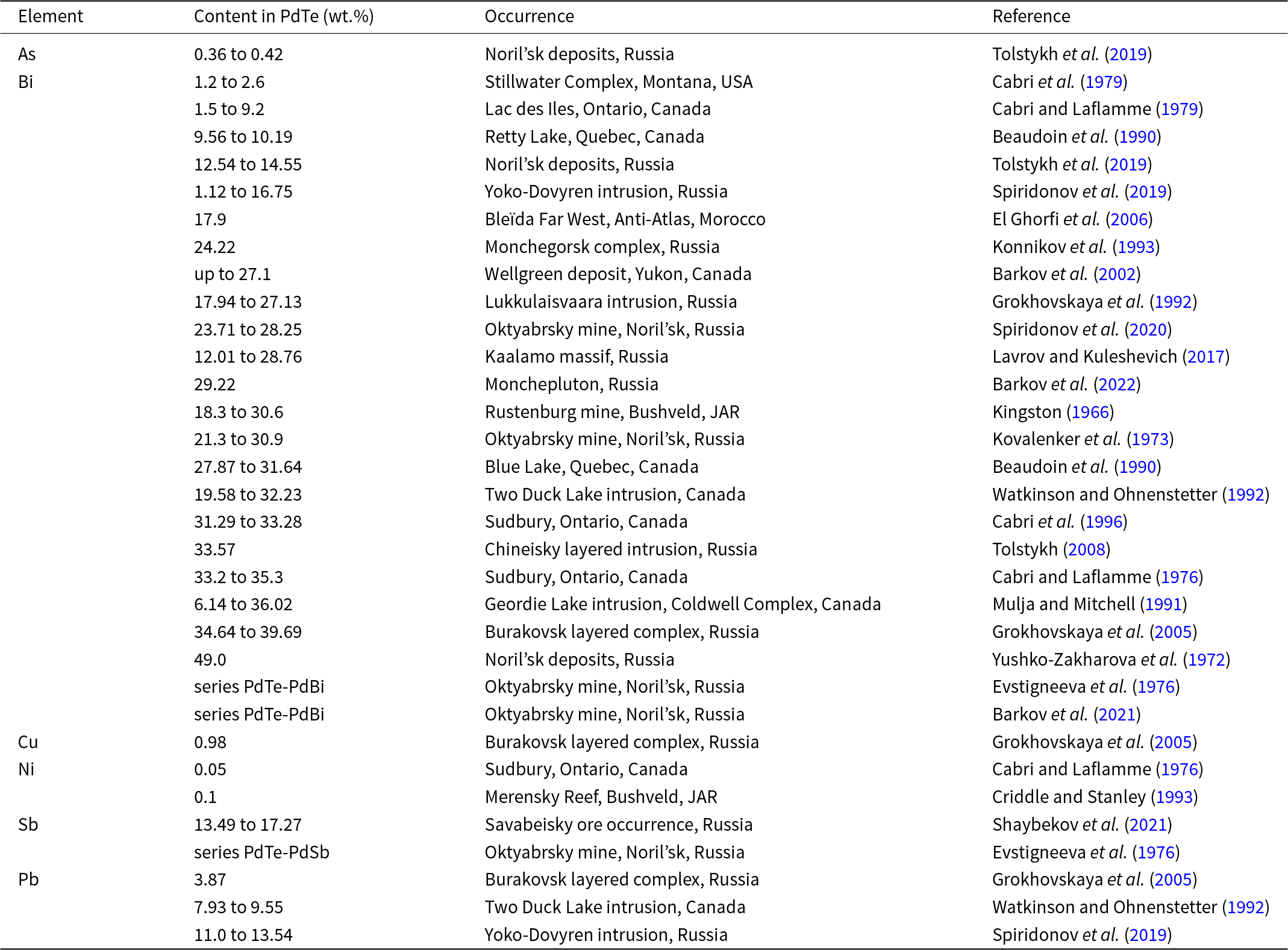
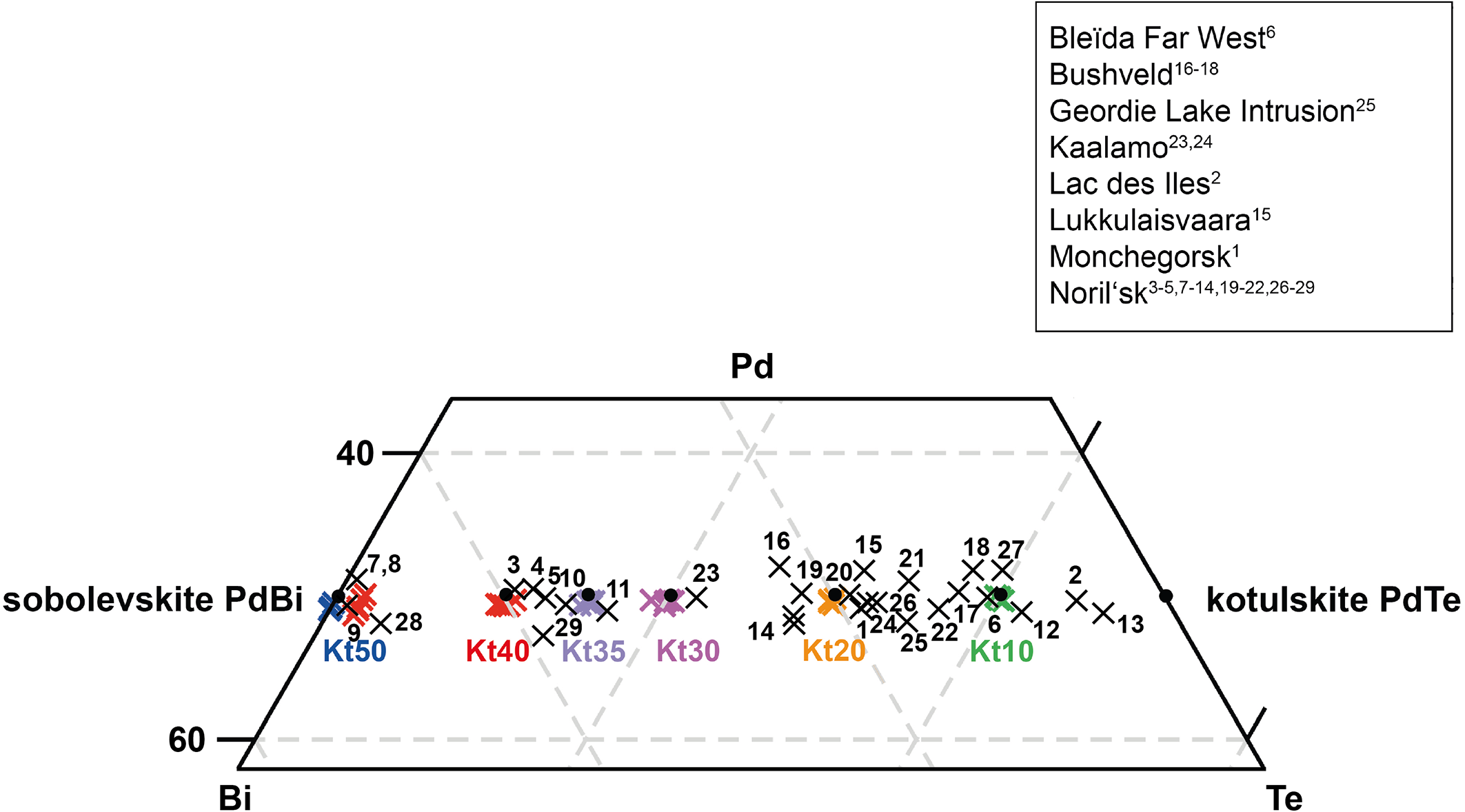
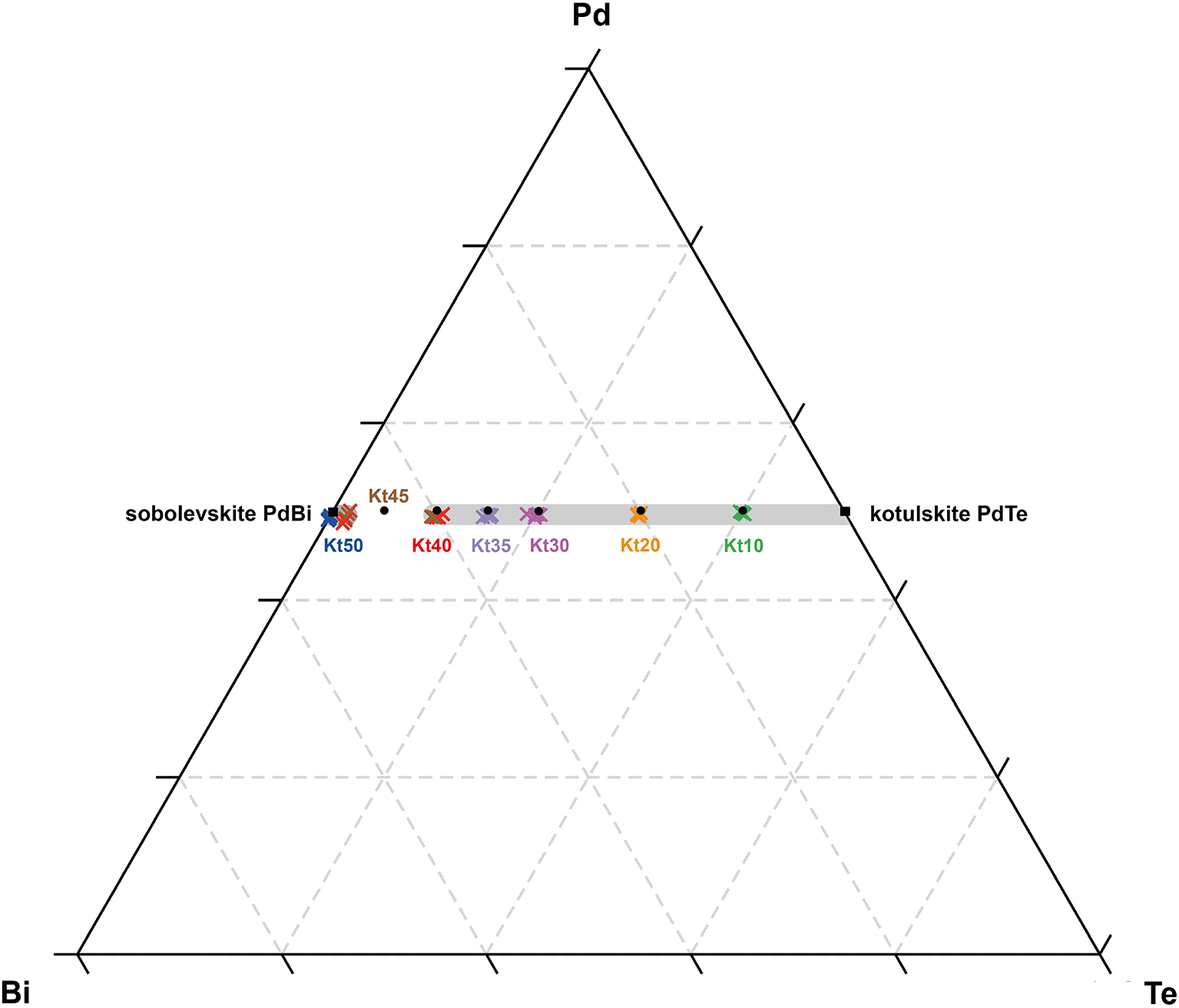
In nature, kotulskite rarely occurs as a purely PdTe phase. It commonly contains an admixture of other elements. Probably the most common is the substitution of Pt for Pd and Bi for Te. The solubility of Bi is well established and some literature data suggest there is almost a complete solid solution between kotulskite (PdTe) and sobolevskite (PdBi), e.g. Cabri (Reference Cabri and Cabri2002, pp 59–61) and Evstigneeva et al. (Reference Evstigneeva, Genkin and Kovalenker1976). However, in most cases, this is only supported by electron probe micro-analyses (EPMA) or scanning electron microscopy (SEM) data; no further XRD data or structural data are available. A compositional set of Bi solubility in kotulskite from various ore deposits is summarised in Table 1 and plotted in Fig. 1. The solubility of other selected elements in kotulskite in nature is also summarised in Table 1. Kotulskite can dissolve As (0.42 wt.%, Noril’sk deposits, Russia, Tolstykh et al., Reference Tolstykh, Zhitova, Shapovalova and Chayka2019). It also dissolves Cu (0.98 wt.%, Burakovsk complex, Russia, Grokhovskaya et al., Reference Grokhovskaya, Lapina, Ganin and Grinevich2005). Kotulskite with Pb (up to 14 wt.%) has been observed from various localities worldwide such as the Noril’sk deposits (Kovalenker et al., Reference Kovalenker, Laputina, Vyal’sov, Genkin and Evstigneeva1973, Sluzhenikin, Reference Sluzhenikin2011); Burakovsk complex (Grokhovskaya et al., Reference Grokhovskaya, Lapina, Ganin and Grinevich2005); Kondyor complex (Barkov et al., Reference Barkov, Shvedov, Polonyankin, Martin and O’Driscoll2017); Yoko–Dovyren intrusion in Russia (Spiridonov et al., Reference Spiridonov, Orsoev, Ariskin, Nikolaev, Kislov, Korotaeva and Yapaskurt2019); Two Duck Lake intrusion in Canada (Watkinson and Ohnenstetter, Reference Watkinson and Ohnenstetter1992); and the Stillwater Complex, Montana, USA (Cabri et al., Reference Cabri, Rowland, Laflamme and Stewart1979). It commonly dissolves Sb, suggesting the formation of a complete solid solution between kotulskite and sudburyite (PdSb), e.g. Evstigneeva et al. (Reference Evstigneeva, Genkin and Kovalenker1976), Cabri (Reference Cabri and Cabri2002, pp 59–61).
Solubility of As, Bi, Cu, Sb and Pb in kotulskite from various occurrences reported in literature.

A plot (in at.%) of kotulskite dissolving Bi from various localities. Black dots show starting composition of experiments performed, in colour are given EPMA data. References: 1Barkov et al. (Reference Barkov, Nikiforov, Barkova and Martin2022); 2Cabri and Laflamme (Reference Cabri and Laflamme1979); 3–5Cook et al. (Reference Cook, Ciobanu, Merkle and Bernhardt2002); 6El Ghorfi et al. (Reference El Ghorfi, Oberthür, Melcher, Lüders, El Boukhari, Maacha, Ziadi and Baoutoul2006); 7–14Evstigneeva et al. (Reference Evstigneeva, Genkin and Kovalenker1976); 15Grokhovskaya et al. (Reference Grokhovskaya, Distler, Klyunin, Zakharov and Laputina1992); 16–18Kingston (Reference Kingston1966); 19–22Kovalenker et al. (Reference Kovalenker, Laputina, Vyal’sov, Genkin and Evstigneeva1973); 23,24Lavrov and Kuleshevich (Reference Lavrov and Kuleshevich2017); 25Mulja and Mitchell (Reference Mulja and Mitchell1991); 26Spiridonov et al. (Reference Spiridonov, Belyakov, Korotaeva, Egorov, Ivanova, Naumov and Serova2020); 27Tolstykh et al. (Reference Tolstykh, Zhitova, Shapovalova and Chayka2019); and 28,29Yushko–Zakharova et al. (Reference Yushko-Zakharova, Avdonin, Bykov, Kulagov Ye, Lebedeva, Chernyayev and Yurkina1972).

In order to define the range of substitution in kotulskite we have experimentally investigated the solubility of selected elements (Ag, As, Bi, Cu, Pb, Sb and Sn) in the synthetic analogue of kotulskite at 400°C. At this temperature the equilibrium is attained in sufficient time (in months), and is close to the post magmatic conditions for formation of such assemblages in nature. At higher temperatures the reactions would be faster due to better kinetics and the solubility would probably increase. However, in most cases within the systems studied, a liquid phase appears. Therefore, only the solubility of Bi in kotulskite was studied additionally at 500°C.
Further, we determined the extent of the kotulskite solid solution and characterised it in terms of unit-cell parameters and volume. We also tentatively explored the stable association of kotulskite solid solution (ss) in the corresponding ternary systems. A comparison of experimental results with natural occurrences is briefly discussed. In nature, kotulskite often incorporates more than one element such as Pd(Te,Bi,Sb) (e.g. Beaudoin et al., Reference Beaudoin, Laurent and Ohnenstetter1990; Cabri and Laflamme, Reference Cabri and Laflamme1976; Tolstykh, Reference Tolstykh2008) or Pd(Te,Bi,Pb) (e.g. Evstigneeva et al., Reference Evstigneeva, Genkin and Kovalenker1976; Spiridonov et al., Reference Spiridonov, Orsoev, Ariskin, Nikolaev, Kislov, Korotaeva and Yapaskurt2019). However, experimentally it is difficult to attain equilibrium within a multicomponent system so in this study we deal with one element solubility. The incorporation of additional elements will be a matter of further studies.
Methods and techniques
Experimental
The silica-glass tube method was used for this study. Charges of ∼300–400 mg were carefully weighed out from the native elements (palladium powder, 99.95% purity; tellurium ingot, 99.999% purity; and selected elements Ag, As, Bi, Cu, Pb, Sb and Sn of 99.999% purity). Then, the silica-glass tubes with charges were sealed under vacuum and the starting mixtures were melted at 1000°C for several hours. The run products were ground in an agate mortar using acetone and reheated at 400°C (for 3 to 4 months), additionally at 500°C for the Pd–Te–Bi system, and some other attempts with Sb and Sn were made. After heating, samples were quenched by dropping the capsules in cold water. The run products were studied initially using powder X-ray diffraction, and polished sections were examined under reflected light and subsequently analysed using EPMA.
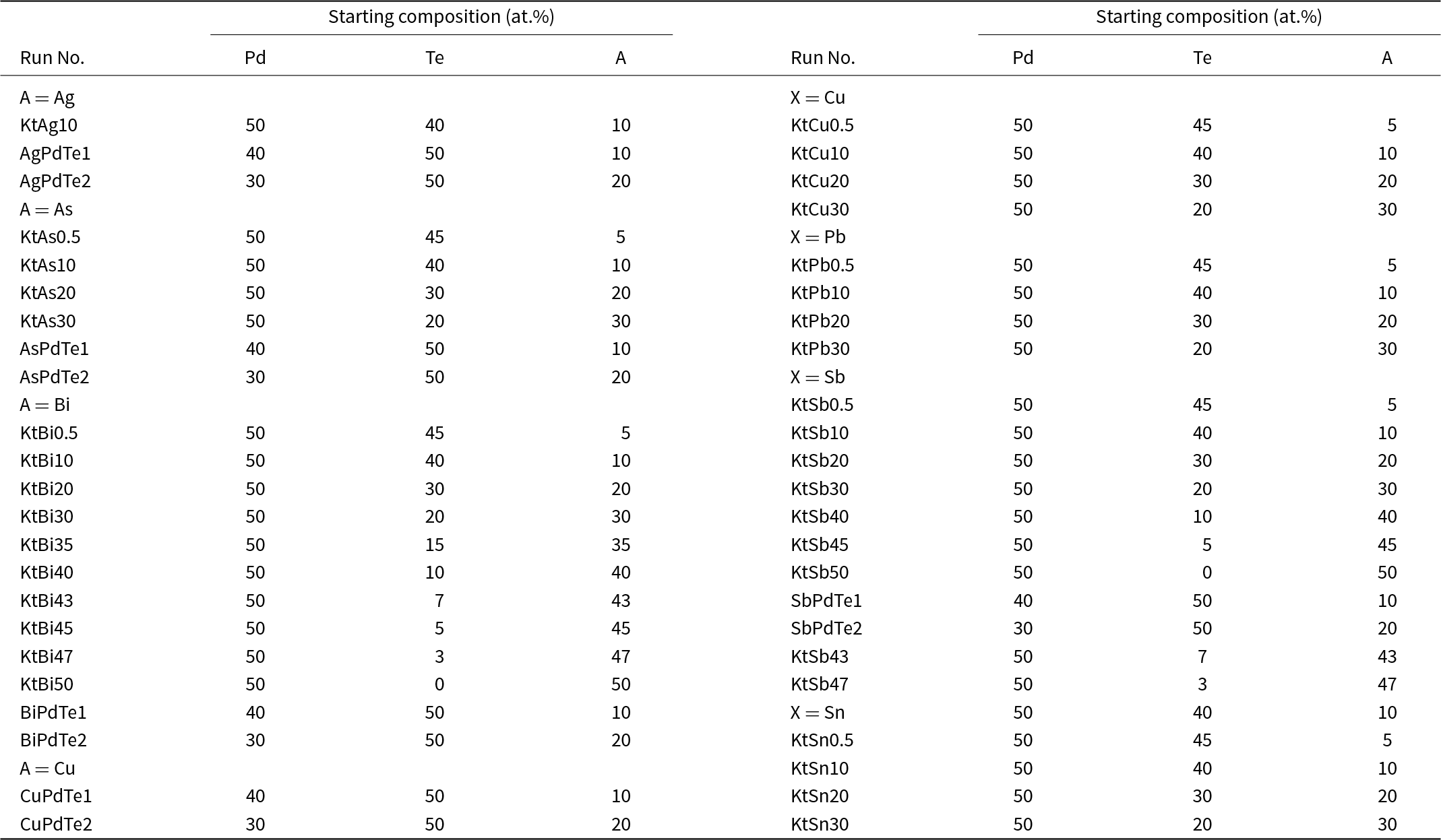
We performed the experimental runs in Pd–Te–A systems, where A = Ag, As, Bi, Cu, Pb, Sb or Sn; with a compositional step from 5 to 10 at.%. The experimental runs were studied on the line PdTe–PdA with a compositional range Pd50(Te50–xAx) with x = 5, 10, 20 and 30. In addition, the solubility of Bi and Sb were studied in a detail for the range with x = 5, 10, 20, 30, 35, 40, 45 and 50. Some additional runs were also performed towards the line PdTe–ATe within the range (Pd50–xAx)Te50, with x = 10 and 20. The list of experiments conducted is given in Table 2.
A list of experiments performed.

X-ray diffraction analyses
The X-ray diffraction patterns (XRD) were collected in Bragg–Brentano geometry on a Bruker D8 Advance diffractometer equipped with the Lynx Eye XE detector and CuKα radiation source. The data were collected in the angular range from 10 to 140°2θ with step size of 0.015°2θ and 1.2 second counting time per step. Qualitative phase analysis of samples was performed using the HighScore program 3.0c (PANalytical, Reference PANalytical2012) and the PDF-2018 database. A subsequent Rietveld refinement, carried out by Topas 5 (Bruker AXS, Reference Bruker2014), was used for calculation of unit-cell parameters of the kotulskite solid-solution series. The crystal structure data of Gronvold and Rost (Reference Gronvold and Rost1956) for synthetic PdTe were used in our refinements. Crystal structure models of other minor phases detected in our experiments were adopted from the Inorganic Crystal Structure Database (Zagorac et al., Reference Zagorac, Müller, Ruehl, Zagorac and Rehme2019). In general, the Rietveld refinements involved refinement of scale factors, unit-cell parameters, and isotropic size and isotropic strain parameters. As all atoms in the kotulskite structure are in special positions, there are no structural parameters to refine. The background was determined employing a Chebyshev polynomial function of the 6th order.
Electron-probe microanalyses
The EPMA analyses were performed with a JEOL JXA 8230 electron probe microanalyser in wavelength-dispersion mode using an electron beam focussed to 1–2 μm. Pure elements were used as standards. Concentrations were quantified on the Lα lines for Pd, Te, As, Sb, Se, Sn, Pb; Lβ for Ag; Kα for Cu and Mα for Bi; with an accelerating voltage of 15 keV, and a beam current of 10 nA. Compositional data were collected from several grains within a polished section of the sample.
Results and discussion
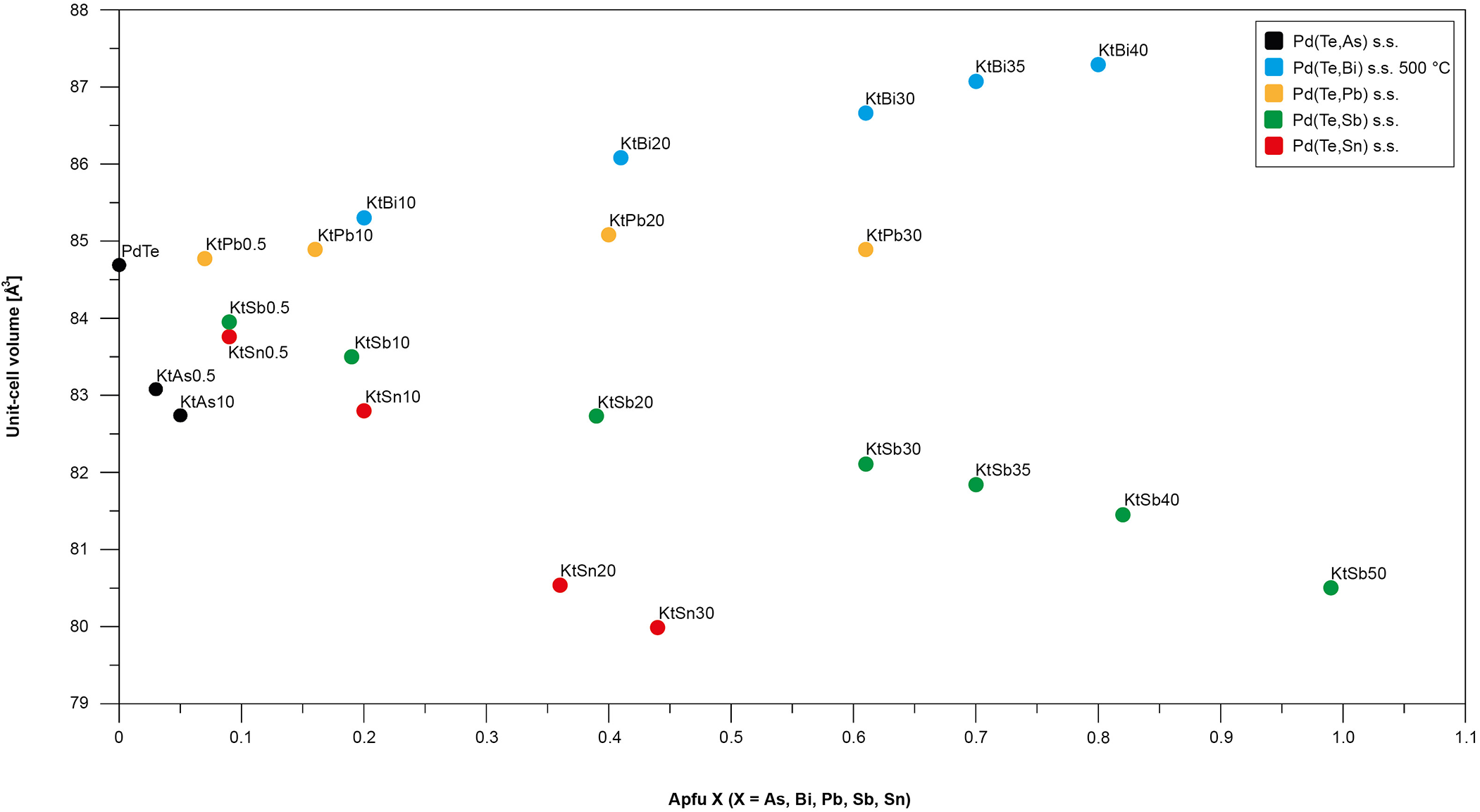
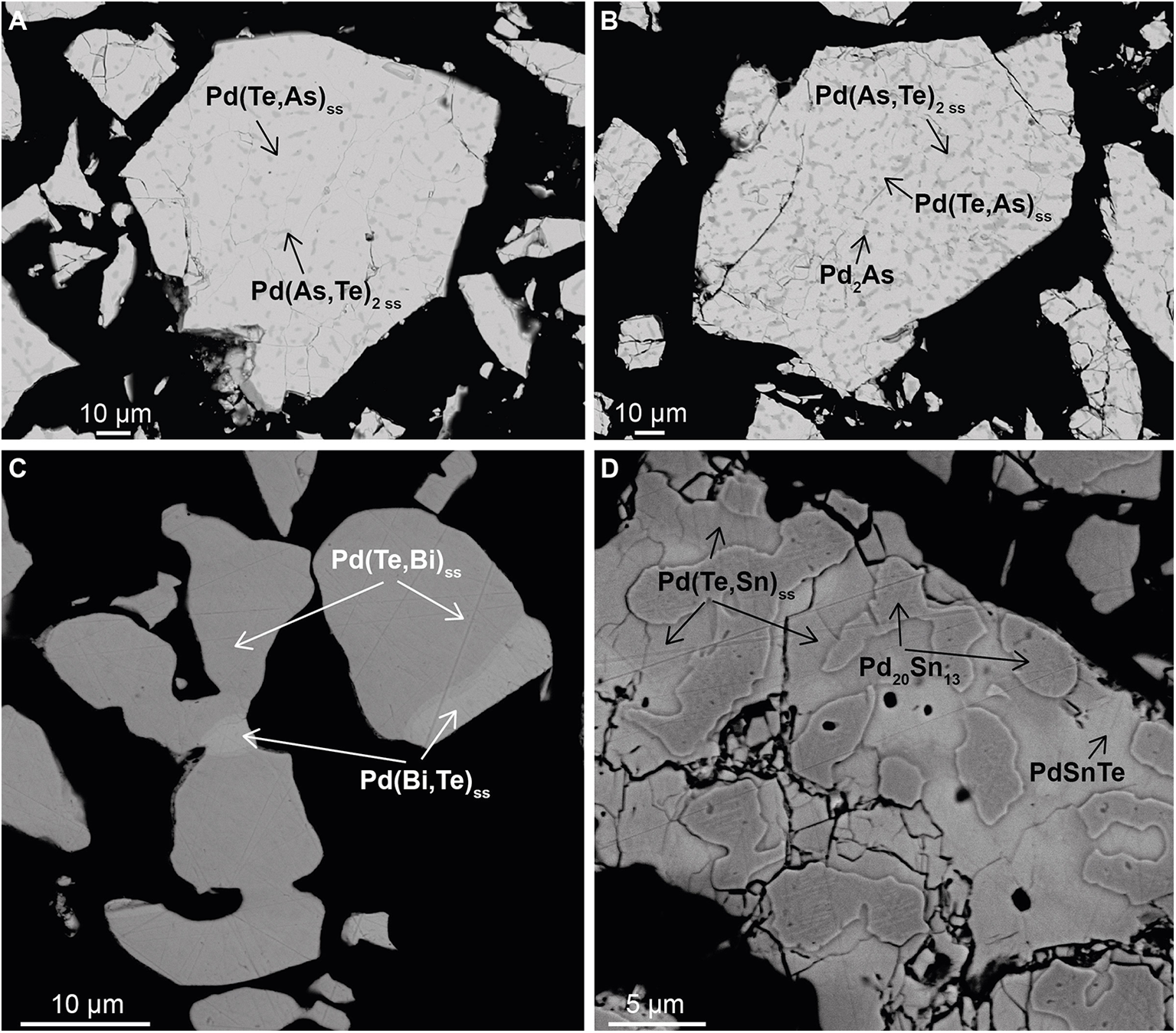
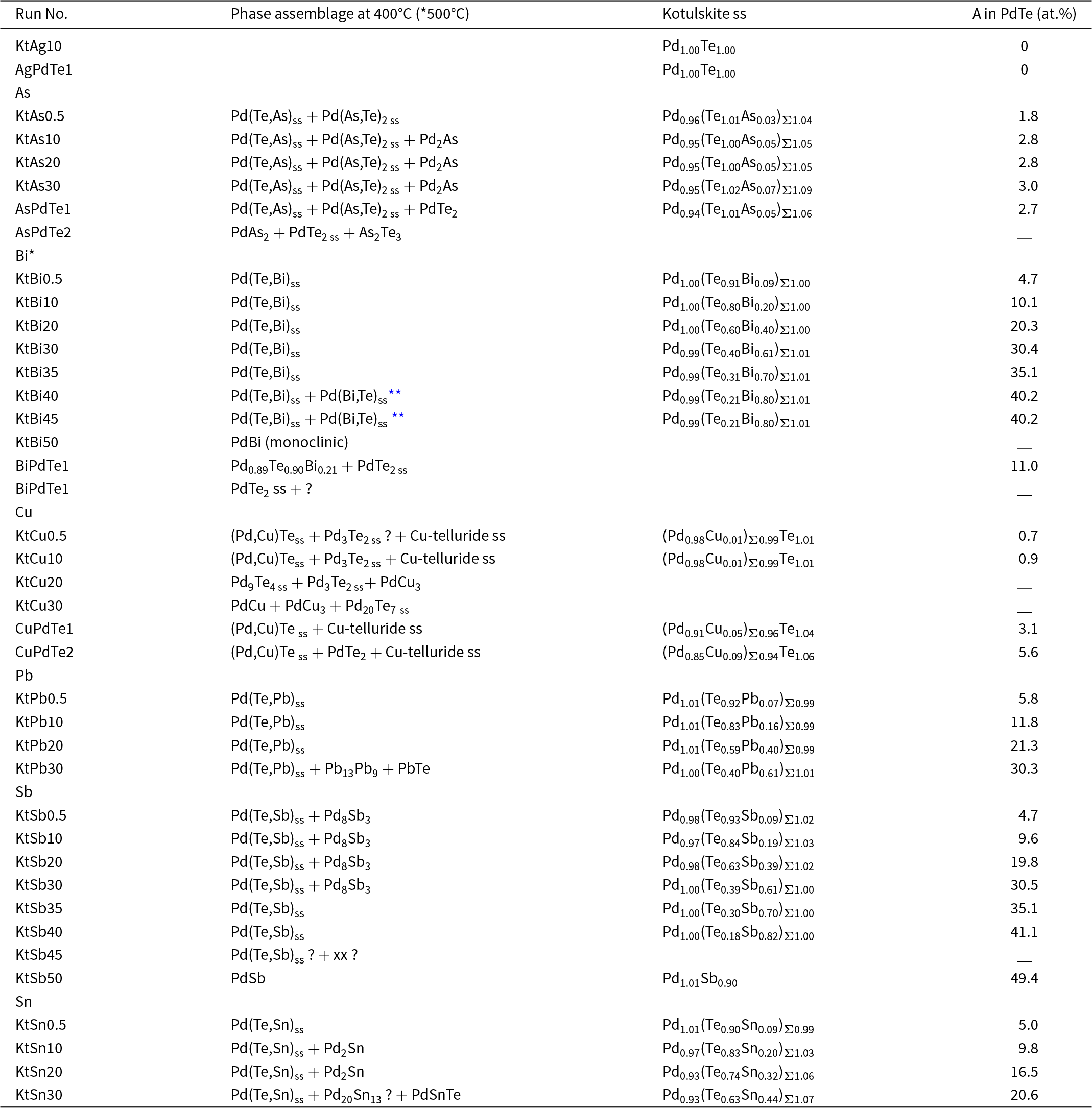
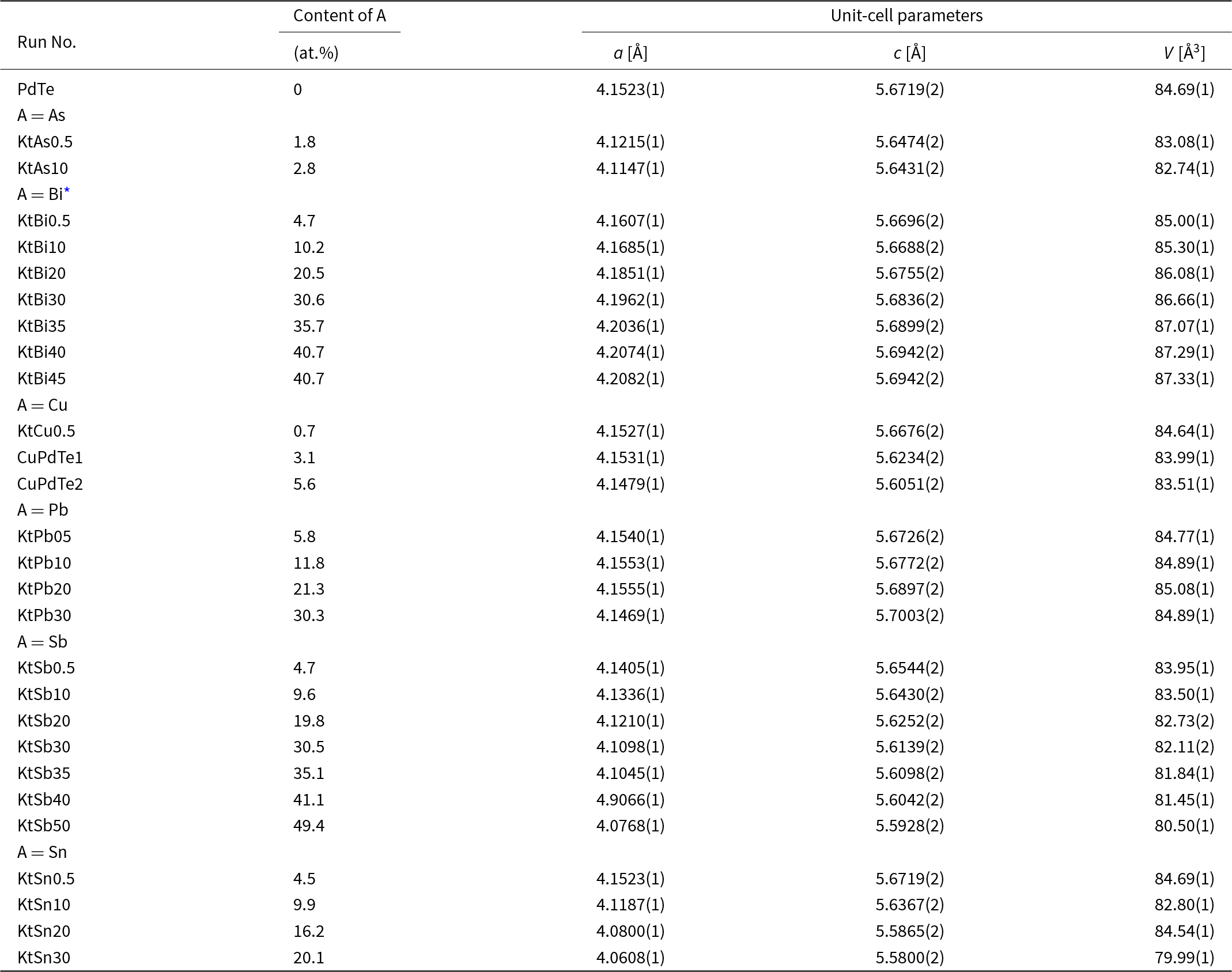
The list of experimental runs performed is summarised in Table 2. Phase assemblages observed in the experimental products and the composition of kotulskite solid-solution series samples are given in Table 3. The unit-cell parameters of kotulskite solid-solution samples are summarised in Table 4, and the change of unit-cell volume is plotted in Fig. 2. Selected experimental run products with kotulskite ss are shown in Fig. 3.
The unit-cell volume of kotulskite solid solutions.

Back-scattered electron images of synthetic analogue of kotulskite: (a) PdTe dissolving 1.8 at.% As (Pd0.96(Te1.01As0.03)Σ1.04) in association with Pd(As,Te)2 ss; (b) PdTe dissolving 2.8 at.% As (Pd0.95(Te1.00As0.05)Σ1.05) in association with Pd(As,Te)2 ss and Pd2As; (c) PdTe dissolving 40.2 at.% Bi (Pd0.99(Te0.21Bi0.80)Σ1.01) in association with PdBi dissolving 1.6 at.% Te; (d) Sn-rich PdTe dissolving 20.1 at.% Sn (Pd0.93(Te0.63Sn0.44)Σ1.07) in association with Pd20Sn13 and PdSnTe phases.

Phase assemblages in the experimental runs and the composition of kotulskite solid-solution series, based on XRD and EPMA data (A = As, Bi, Cu, Pb, Sb or Sn).

** monoclinic PdBi (dissolving 1.6 at.% Te), ss - solid solution
The unit-cell parameters of the kotulskite solid-solution series.

* 500°C
Silver solubility
Kotulskite does not dissolve Ag at 400°C which is in agreement with the experimental study of the system Ag–Pd–Te at 350 and 450°C (Vymazalová et al., Reference Vymazalová, Laufek, Kristavchuk, Chareev and Drábek2015).
Arsenic solubility
The ternary system As–Pd–Te was studied by El-Boragy and Schubert (Reference El-Boragy and Schubert1971) at 480°C. According to their phase diagram PdTe dissolves up to 20 at.% As at 480°C, however more detail data are not available. Our experimental study has shown the maximum solubility of As in kotulskite up to 3 at.% at 400°C. Kotulskite ss forms a stable association with palladoarsenide (Pd2As) and phase PdAs2 at 400°C (Fig. 3a,b). It also coexists with PdAs2 and merenskyite (PdTe2).
Minute incorporation of As (up to 0.05 apfu) results in a decrease of the unit-cell volume from 84.69 to 82.74 Å3.
Bismuth solubility
The system Pd–Bi–Te has been preliminarily studied by Evstigneeva et al. (Reference Evstigneeva, Nickolsky, Geringer, Vymazalová, Nekrasov and Chareev2019) in the temperature range 350–550°C. Their results suggest a limited solubility of Bi in kotulskite. Kotulskite–sobolevskite-series minerals have been widely reported from a number of Cu–Ni–PGE mineral deposits associated with mafic and ultramafic igneous rocks (e.g. Evstigneeva et al., Reference Evstigneeva, Genkin and Kovalenker1976; Cabri, Reference Cabri and Cabri2002; Cook et al., Reference Cook, Ciobanu, Merkle and Bernhardt2002; Barkov et al., Reference Barkov, Nikulin, Nikiforov, Lobastov, Silyanov and Martin2021; among others). Figure 1 shows the solubility of Bi in kotulskite from various natural occurrences.
At 400°C the Bi-rich experimental products display a certain degree of inhomogeneity therefore the experiments were further heated at 500°C for 1 month. This inhomogeneity was evident in the powder X-ray diffraction patterns of experimental runs KtBi30, KtBi35 and KtBi40 (Table 2), which showed apparent broad and asymmetric peaks. These diffraction patterns could not be fitted in the Rietveld refinement by a single hexagonal kotulskite-based phase. The heating at 500°C temperature improved the homogeneity of the run products and led to diffraction patterns with sharp peaks. Our experimental results at 500°C do not support a complete solid solution PdTe–PdBi. Kotulskite dissolves up to 40.3 at.% Bi, Pd0.99(Te0.21Bi0.80)Σ1.00 and at this maximum the solid solution breaks and there is a gap up to the composition Pd1.00(Bi0.96Te0.04)Σ1.00, which is the formation of PdBi dissolving 1.6 at.% Te (Fig. 3c and Fig. 4). Experiment no. KtBi45 (Fig 4, Table 3) clearly shows the presence of two phases Pd0.99(Te0.21Bi0.80)Σ1.00 + Pd1.00(Bi0.96Te0.04)Σ1.00. It is interesting to note that the experimental products with PdBi composition prepared at 400°C and 500°C show monoclinic structure with P21 space group described by Bhatt and Schubert (Reference Bhatt and Schubert1979). This phase, also denoted as α-PdBi by Okamoto (Reference Okamoto1994), transforms at 210°C to an orthorhombic structure of β-PdBi (Zhuravlev, Reference Zhuravlev1957). This transformation seems to be martensitic and the orthorhombic phase is not quenchable (Bhatt and Schubert, Reference Bhatt and Schubert1979). Sobolevskite was originally described by Evstigneeva et al. (Reference Evstigneeva, Genkin and Kovalenker1976) as hexagonal, isostructural with nickeline. However, its diffraction pattern contains nine additional reflections, which cannot be explained by the hexagonal NiAs structure-type, but nevertheless are consistent with the monoclinic P21 structure of α-PdBi (Bayliss, Reference Bayliss1990). The exact symmetry of sobolevskite is not fully clear and requires further examination.

The unit-cell parameters of kotulskite solid solutions synthetised at 500°C are summarised in Table 4. Figure 2 shows the evolution of unit-cell volume. The incorporation of Bi into the kotulskite structure results in a significant increase of the unit-cell volume from 84.69 Å3 to 87.29 Å3. Bismuth substitutes for Te.
Copper solubility
Kotulskite dissolves up to 5.6 at.% Cu at 400°C. Kotulskite ss forms a stable association with merenskyite (PdTe2) and Cu-telluride ss. The Cu for Pd substitution in the Cu-kotulskite solid solution results in a decrease of unit-cell volume from 84.69 to 82.57 Å3.
Lead solubility
Kotulskite forms an extensive solid solution dissolving Pb, up to 30 at.% Pb (Vymazalová and Drábek, Reference Vymazalová and Drábek2011) where it breaks because the PdTe structure cannot accommodate any more Pb. Lead substitutes Te in the solid solution. The incorporation of Pb has a negligible impact on the unit cell volume, which remains approximately constant within the solid solution.
Antimony solubility
The solubility of Sb in kotulskite was confirmed up to the composition Pd(Te0.18Sb0.82)Σ1.00, PdTe dissolving 41.1 at.% Sb, run no. KtSb40 (Table 3). The experiments at the compositional range Pd(Te0.18Sb0.82)Σ1.00 – Pd(Sb,Te), runs KtSb43, KtSb45, KtSb47 (Table 2) are not conclusive. The products of these experiments, based on SEM and EPMA observations, seem to be inhomogeneous. Therefore, we cannot satisfactorily confirm a complete solid solution. Neither long-term heating (and the repetition of the same experiments) nor heating at higher temperature (450 and 500°C) improved the experimental products to be able to confirm the kotulskite-based hexagonal structure. Furthermore, heating at 500°C resulted in the appearance of a liquid phase in the system.
Kim and Chao (Reference W–S and G.Y1991) at 600°C, and El-Boragy and Schubert (Reference El-Boragy and Schubert1971) at 400°C, reported a complete PdTe–PdSb solid solution. However, their study is based on powder X-ray diffraction phase analysis (i.e. no Rietveld refinement was performed) and hence the appearance of two nearly similar kotulskite-based phases might have been overlooked in their study.
Incorporation of Sb into the kotulskite structure, in the compositional range Sb from 4.7 to 40.1 at.% led to lowering of unit-cell volume from 84.69 to 81.85 Å3, Fig. 2.
Tin solubility
Our experimental study confirmed the solubility of Sn in kotulskite, up to 20 at.% Sn, as suggested by Vymazalová and Drábek (Reference Vymazalová and Drábek2010). At this composition the solid solution breaks, the stable association Pd20Sn13 + ternary phase PdSnTe + kotulskite ss forms (Fig. 3d). The Sn for Te substitution results in a significant decrease of the unit-cell volume from 84.69 to 79.99 Å3 (Fig. 2). It is interesting to note that vacancies occur on the Pd position in this solid solution as we detected a change in the Pd stoichiometry [i.e. from Pd1.00Te1.00 to Pd0.93(Te0.65Sn0.42)Σ1.07]. The introduction of vacancies on the Pd sites in the Sn-kotulskite solid solution very likely contributes to the lowering of the unit cell volume.
Conclusions
The solubility of selected elements in the synthetic analogue of kotulskite (PdTe) was investigated experimentally. The ranges of solid solutions in the systems Pd–Te–A, with A = Ag, As, Bi, Cu, Pb, Sb and Sn at 400°C (at 500°C for Bi) were constrained.
Kotulskite does not dissolve Ag. Kotulskite may dissolve up to 3 at.% As, up to 5.6 at.% Cu, up to 20 at.% Sn and up to 30 at.% Pb. Continuous complete solid solution between kotulskite – sudburyite and kotulskite – sobolevskite has not been confirmed within this study. The synthetic analogue of kotulskite dissolves up to 40 at.% Bi and at this composition Pd0.99(Te0.21Bi0.80)Σ1.01 the solid solution breaks and forms a gap up to the composition Pd1.00(Bi0.97Te0.03)Σ1.00. This observation was further supported by additional heating of experimental series at 500°C. The coexistence of Pd0.99(Te0.21Bi0.80)Σ1.01 and Pd1.00(Bi0.97Te0.03)Σ1.00 with their contrasting phase boundaries are clearly visible in back-scattered electron (BSE) images. The solid-solution series PdTe–PdSb are also limited, the synthetic analogue of kotulskite dissolves up to 41.1 at.% Sb and at this composition some inhomogeneity appears.
Copper substitutes for Pd whereas As, Bi, Pb, Sb and Sn substitute for Te in the crystal structure of kotulskite.
The assessed ranges of kotulskite solid-solution series at 400°C and the determination of the maximum solubility of selected elements, supported by EPMA and XRD data, may enhance the data interpretation observed in natural conditions. In particular, a misinterpretation of parts of the solid-solution series as potential and distinct new minerals. The end-members Pd(Te0.2Bi0.8), Pd(Te0.4Pb0.6), Pd(Te0.2Sb0.8) and Pd(Te0.6Sn0.4) of solid solutions found in nature and ternary compounds that do not fall in the solid solution field may represent potential new minerals. The results obtained present the end-members of selected solid solutions of kotulskite, incorporating As, Bi, Cu, Pb, Sb and Sn under the laboratory conditions at 400°C (500°C for Bi).
The established solid-solution series and proved stable associations can be found in Cu–Ni–PGE mineral deposits associated with mafic and ultramafic igneous rocks and probably exist at other types of deposits rich in PGE and Cu, Bi, Pb, Sb, Sn-enriched fluids.
The knowledge of solid-solution series in the systems studied may also be applied in mineral processing, in particular for the extraction of certain elements from the ore-concentrates.
Kotulskite crystalises in the NiAs structure type, which is very stable and a common structure for AB minerals/phases with chalcogen and a transition metal. The structure can adopt various substitutions by changing the unit-cell parameters. Also, a non-stoichiometry on metallic and chalcogen sites can occur to a certain extent, which makes the structure even more flexible and allows various minor elements to be accommodated. Kotulskite may play a role as the container of minor elements.
Acknowledgements
Constructive comments made by reviewers Louis J. Cabri, Nadhezda D. Tolstykh and an anonymous reviewer are greatly appreciated; they improved the quality of the manuscript. The editorial handling by Stuart Mills is also acknowledged. The authors are grateful to Z. Korbelová (Geological Institute of the Czech Academy of Sciences, v.v.i.) for performing the electron-microprobe analyses.
Financial Statement
Financial support through the Project No 22-26485S from the Czech Science Foundation (GACR) is gratefully acknowledged.
Competing interests
The authors declare none.