ELECTORAL handouts—cash payments, small gifts, community projects, and the like—are a core feature of election campaigns in many countries. Political scientists typically conceptualize such distributions as clientelism: the contingent exchange of material resources for political support. The literature offers varying explanations for the efficacy of clientelist practices and for their prevalence. Dominant readings emphasize two dimensions: targeting, and monitoring and enforcement. Arguments based on targeting suggest that to maximize effectiveness and efficiency, parties prioritize voters or brokers most likely to respond favorably to payments. Works focused on monitoring and enforcement start from the insight that it can be difficult to enforce clientelist exchange; they consider factors, such as social networks, electoral malfeasance, institutions, or social norms, that might ensure that recipients of handouts deliver votes. A focus on one or both of these dimensions is common to both vote-buying and turnout-buying approachesFootnote 1 and to broader discussions of broker-mediated clientelism.Footnote 2
Much of this literature explicitly or implicitly centers around political parties as key actors, with two common assumptions. The first is that parties are reasonably strong, meaningful organizations; the second is that partisanship is salient among the electorate. Where these assumptions hold, candidates can sort voters according to ideology or partisanship and so target core or swing voters. Party loyalties help lower the costs of monitoring and enforcement by conveying information about which voters are most likely to defect and by cultivating brokers’ interest in the party's success.Footnote 3
Yet strong parties are often absent. As Ernesto Calvo and Maria Victoria Murillo note, “Assumptions of organizational encapsulation and programmatic party linkages that characterize the Western European sociological tradition do not adequately reflect the behavior of voters and the dynamics of party competition in most new democracies.”Footnote 4 Our work is part of a growing literature that seeks to understand the dynamics of electoral clientelism in weak-party states.Footnote 5
Our goal is to probe how to conceptualize electoral handouts in polities without strong parties—that is, where party loyalties are too anemic and voting too candidate-centered to present identifiable core constituencies, or where party machines cannot reliably mobilize votes on behalf of candidates. Indonesia exemplifies such a polity. With few exceptions, and influenced by candidate-centric electoral rules, parties there are weak, opportunistic personal vehicles.Footnote 6
In this article, we develop a new theory, which we dub the personalized broker model, to explain how electoral handouts operate among weak parties. Weak parties are present in a number of political and institutional contexts, and where parties are weak, candidates tend to develop largely nonpartisan, individualized, and often tenuous networks of support. A candidate's core of support is personal: it comprises those voters to whom they have familial or other ties, perhaps due to some associational link or past provision of patronage. But that core is rarely sufficient to secure electoral victory; to expand it, candidates must recruit brokers, generally without easy recourse to party faithful. With party an unreliable cue among voters or brokers, the primary purpose of handouts is neither to persuade swing voters (as vote-buying models assume) nor to spur core supporters to the polls (as in turnout-buying models). Rather, the distribution of cash serves three main purposes. Most importantly, it purchases the personal networks of local brokers (broker buying); along the way, it signals to those brokers as well as to voters that candidates are serious contenders (credibility buying); and it helps to secure the votes of weak loyalists (turf protection).
At the center of candidate strategy sit brokers. It is not that candidates are unconcerned with attracting voters—nearly all they do is toward that end. But to make sense of candidate strategies, the focus needs to be on the critical mediators in these exchanges: brokers. We are not the first, of course, to direct attention to brokers. The seminal work of Susan Stokes and colleagues helped to reorient work on electoral clientelism around questions of broker behavior.Footnote 7 Subsequent studies have built on this foundation.Footnote 8 But scholars have only recently begun to examine carefully the dynamics of brokerage where parties are weak.Footnote 9 In such contexts, to wage a viable campaign, candidates must win over diligent, well-connected brokers who can reach voters beyond the candidates’ circles. Electoral systems that foster intraparty competition further amplify brokers’ significance. Competing against members of their own party obliges candidates to rely on their own networks and teams, rather than on the party structure. But where brokers have only tenuous ties to candidates, they have little a priori reason to be loyal agents. In this environment, electoral handouts reinforce the standing and line the pockets of the brokers who distribute them. They also help tie voters to brokers (whom voters are backing with their vote), while doing little to create lasting loyalty toward candidates or parties.
We develop our theory of electoral exchange in weak-party systems using data drawn primarily from a large-scale election study in Indonesia in 2014. Our starting point was partly inductive. Finding existing theory insufficient to explain Indonesian practice that we observed on the ground, we searched for clues. Qualitative interviews helped us develop and refine plausible explanations. We next evaluated these explanations/hypotheses systematically using new data sources, including surveys, brokers’ voter lists, and focus groups, with a largely deductive logic.
In the following section we lay out our argument, sketching our theoretical contributions, the observable implications of our argument, and our scope conditions. We then outline Indonesia's electoral context, after which we explain our methods. Last, we highlight our key findings. We find little evidence of contingency-based electoral clientelism. Instead, candidates buy brokers more than they buy voters. Unable to rely substantially on voter loyalty or party brand, candidates seek to establish credibility among, and by way of, well-networked brokers. Those brokers then offer token payments to their own presumed bloc of voters as a form of turf protection.
The Personalized Broker Model
Our theoretical point of departure is clientelist systems with strong parties. Much of the literature on clientelism presumes strong parties. This focus makes sense. The study of party-based machines was an intellectual progenitor of this literatureFootnote 10 and recent, agenda-setting work focuses heavily on relatively strong-party systems, such as those in Argentina and Mexico.Footnote 11 Systems with strong parties share three characteristics that facilitate clientelist mobilization strategies. First, parties have the organizational capacity to mobilize voters through local operatives. Second, parties are distinct from one another. For our purposes, the basis of this distinction—ideological, ethnic, regional, or leadership—does not matter, as long as voters and candidates distinguish among parties on some politically salient dimension. Third, in strong-party systems, voters are partisan; many are reliably attached to parties, making it possible to identify core supporters, diehard opponents, and swing voters.
The absence of strong parties complicates electoral clientelism in three principal ways. First, rather than relying on an established party machinery to mobilize voters, candidates must assemble their own personalized networks of mobilizers. Typically, candidates start by tapping into alternative networks. Largely unable to rely on party-based machinery or loyalties, they aim to recruit brokers with whom they have close, often personal, ties, and on whose loyalty they can rely. These include family and friends, as well as individuals connected to candidates through enduring clientelist ties. Where such personal networks are sufficiently large, we would expect electoral clientelism to function in much the same way as in systems with strong parties, but with brokerage networks centered around candidates rather than parties. In most instances, however, the pool of reliably loyal potential brokers is insufficient to win. When this is the case, candidates must turn to brokers-for-hire—brokers with weak or no personal ties to the candidate, who view their job through an instrumental lens. Although loyalist brokers may see the election as punctuating a long-term relationship, brokers-for-hire may have little expectation of future interactions with or benefits from the candidate. As we discuss below, this perspective has important consequences for the effectiveness of brokers, the voters they target, and the efficiency of electoral handouts.
Second, degrees of partisanship and party organizational capacity directly affect the cost of the monitoring and enforcement expected under contingent electoral clientelism. Party machinery and partisan loyalists feature prominently in accounts of these functionsFootnote 12 for which personalized networks of support are a poor substitute. The need to include brokers-for-hire generates greater risk that brokers will shirk (work inefficiently) or defect (work for a rival candidate).Footnote 13 Further, where partisan attachments are weak, risks of voter defection increase: voters may not show up to vote, they may abstain or vote for someone else for reasons unrelated to handouts, or they may accept handouts from more than one candidate for the same office.Footnote 14 In addition, weak partisan attachment makes monitoring more costly for brokers. They cannot simply observe whether a weakly loyal party voter shows up to vote but must also somehow ascertain whether that person voted as instructed.
Third, it becomes difficult for candidates and their brokers to distinguish between core supporters and undecided or swing voters. If parties are insufficiently differentiated, nearly everyone is a potential swing voter. Likewise, even if parties are meaningfully distinct from one another, if most voters are not reliably attached to those parties, then candidates cannot even assume the support of their supposed core constituents.
In short, where party differences are negligible, partisan attachment weak, and party organizations feeble, viewing electoral handouts through the lens of electoral clientelism—contingent exchange that is monitored and enforced—may obscure as much as it enlightens.Footnote 15 But if targeting individual voters with offers of money is not electoral clientelism as we typically understand it, what is it?
Brokers are the key. Candidates rely almost entirely on these intermediaries to recruit and mobilize supporters. Departing from conventional models, however, we do not see the primary utility of brokers as sources of local information (for example, identifying core and swing voters) or as agents helping with monitoring and enforcement. Rather, the paramount value of a broker is the broker's personal network—close friends and family who may plausibly respond to appeals from that broker to vote for a given candidate, especially if those appeals are accompanied by a handout. Thus, these constellations of personalized broker networks are essential. Lacking sufficient party or personal ties of their own to voters, candidates purchase as many brokers as they can afford in the hope of securing access to those brokers’ personal networks. Whether brokers’ voter catchments follow is largely beyond candidates’ control. We label this process of purchasing access to personal broker networks as broker buying and elaborate on it more in the next section.
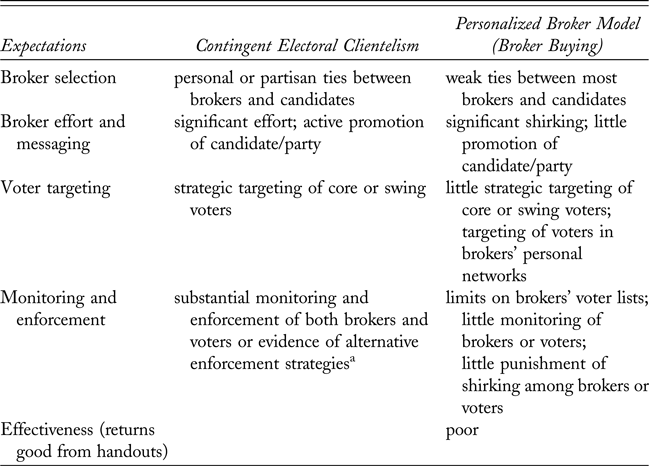
Our model recommends rethinking the role and character of candidates’ campaign spending and, specifically, their payments to brokers and voters. Four dimensions are especially revealing: how candidates select the brokers in their teams, what messages brokers present, how candidates target voters for handouts, and the extent to which candidates emphasize monitoring and enforcement. We turn next to exploring the observable implications of our model across these four dimensions.
Broker Selection
Weak parties force candidates to develop independent networks of support. At their core are individuals with personal connections to the candidate based on family or other networks (for example, school cohort, religious community, birthplace), or, as Simeon Nichter and Michael Peress describe, arising from ongoing clientelist relationships.Footnote 16 This core comprises the candidate's loyalists: brokers with a low risk of shirking or defecting, regardless of other inducements. Candidates prefer these brokers.
But these personalized cores are rarely large enough to win an election, requiring candidates also to turn to brokers with whom they lack direct connections. In hiring these brokers, candidates seek access to their personal networks. Overlapping networks would be less useful than complementary ones, so these supplementary brokers are unlikely to move in the same circles as the candidate. Candidates will seek to attract brokers with loyal personal followings, which, like those of candidates, comprise relatives, friends, or other associates, and brokers will pursue or accept employment not necessarily from candidates with the best ideas, but from those who pay well or reliably or to whom their own personal acquaintances have links. An implication of this argument is that many brokers will have tenuous ties, at best, to the candidate for whom they canvass.
Broker Effort and Messaging
Once candidates have their networks in place, how diligent should we expect brokers to be and what messages might we expect them to deliver to voters? First, given the weak ties between many brokers and candidates and a lack of investment in monitoring and enforcement (discussed below), we expect many brokers to exert minimal effort to woo voters. This stands in contrast to strong-party systems in which the possibility of future party position deters broker shirking.Footnote 17 We anticipate that brokers will not always speak to voters before adding them to their handout lists, let alone take pains to tout candidates and their qualifications.
Second, where few parties are programmatically differentiated, party programs are not worth promoting because a candidate or broker cannot use them to distinguish the candidate from rivals. Nor is there reason to expect a given candidate's brokers to express party loyalty; the core team is a personal one. Under these circumstances, when brokers exert effort to persuade voters, we should expect them to emphasize the personal qualities of the candidate. But there's a catch. The core team knows and supports the candidate; the extended team of brokers-for-hire often does not. We might therefore expect these brokers to tout themselves—to urge voters simply to follow their lead in casting their vote. All told, if our expectation that candidates focus mainly on buying access to brokers’ networks is correct, we should expect little information about party or programs in broker appeals and little, too, about the candidate from brokers outside the core. Rather, we should see brokers pulling personal strings, sweetening and sealing deals with payments from the candidate.
Voter Targeting
Meanwhile, absent reliable partisan cues, candidates must determine to whom they will distribute their handouts, a decision made iteratively with the decision about which brokers to recruit. We expect candidates’ highest return to come from voters with whom they have personal ties. But, assuming that winning requires far more votes than that pool provides, most distribution will occur through the candidate's network of brokers. We expect that brokers, too, will first target their own personal core—closely connected family and friends—to minimize transaction costs and because resources directed toward this group may redound to the broker's benefit, either by augmenting family or community resources or because being the one to distribute largesse conveys social rewards. Resources permitting, we expect brokers-for-hire to distribute electoral handouts in concentric circles, expanding from their personal core to more extended networks.
Thus, most brokers do not target voters for their attitudes toward the candidate or the candidate's party, but for their relationship with the broker. Lacking recourse to partisan cues, a voter without personal ties to a competing candidate will consider voting for a broker-proposed candidate. Candidates, meanwhile, hope that their payments to voters through their brokers will ensure that enough distal voters neither shirk nor double-deal, though they expect little proactive loyalty from voters. This argument implies that we should see less strategic targeting of voters than we would expect under standard models of electoral clientelism. Instead, brokers indiscriminately target as many in their personal networks as resources allow.
Monitoring and Enforcement
Because brokers and voters have weak ties to candidates, the risks of shirking and defection are high. To minimize such behavior would require candidates to invest in monitoring and enforcement. But how much monitoring and enforcement should we anticipate? If the distribution of cash and goods to voters is contingent clientelism, mobilizing core supporters through turnout buying, or persuading swing voters through vote buying, then a voter who accepts money will be expected to reciprocate by voting for the candidate. Candidates will thus monitor brokers and voters, tying future rewards (for example, jobs or other forms of patronage) to broker performance and voter behavior (whether they voted and, so far as possible, how they voted). Brokers will have an incentive to target the most reliable supporters—either core voters or those especially likely to feel morally or socially obliged to vote for someone who gives them a handout.Footnote 18 By contrast, in our broker-buying model, handouts do not primarily serve as contingent exchange. Rather, in addition to purchasing brokers’ networks, they facilitate credibility buying and turf protection.
credibility buying
Handouts are the price that candidates pay to be considered credible, viable contenders—in effect, an entry fee. This credibility buying resembles what scholars have observed in other contexts where politicians reward voters who attend campaign events.Footnote 19 One important distinction is that those studies find distribution to be relatively untargeted. By contrast, in our model, credibility buying, on its face, looks much like contingent electoral clientelism; benefits are distributed through a network of brokers with only some voters targeted. Moreover, as Eric Kramon finds in election rallies in Kenya, handouts in Indonesia convey important information to key audiences. Like in Kenya, these handouts signal viability; but unlike in Kenya, the primary audience includes brokers, not just voters, and signaling occurs one-on-one rather than at large public rallies. Particularly where candidates cannot rely on their party to vouch for them, candidates who fail to distribute handouts will find it hard to recruit brokers and to maintain their loyalty, and brokers and voters are likely to dismiss them as serious contenders.
turf protection
The inconstant loyalty of even presumed core voters—the conditional loyalty of which Thad Dunning and Stokes write, or the endogeneity of partisan loyalty as conditional on benefits received that Alberto Diaz-Cayeros, Federico Estévez, and Beatriz Magaloni discuss—is a known dilemma for parties.Footnote 20 But this problem is even more acute among voters with weak partisan attachments, or whose partisan attachments will not assure a vote for a particular candidate (as in an open-list system). Outside a candidate's narrow core (family and close friends), no voter's electoral support can be taken for granted. This uncertainty applies even to voters connected through past patronage exchange; without electoral inducements to seal the deal, these contingent loyalists cannot be relied upon. With that in mind, we would expect token electoral handouts to these contingently core voters to double as a form of turf protection. Even a candidate's presumed loyalists are vulnerable to poaching. Hence, the need to direct payments their way in an effort to insulate them from competing offers, not necessarily by outbidding other candidates, but by signaling that the candidate remembers and values these voters.
Implications of the Model
If our argument is correct, much of what on its face looks like vote buying or turnout buying is actually not contingent distribution of money to voters but rather a strategy intended to signal viability and to keep voters from straying. These strategies may not be efficient in an objective sense, but eschewing payments altogether guarantees defeat. Candidates averse to money politics are thus trapped in a classic prisoner's dilemma game; if they defect from the game that voters, brokers, and other candidates are playing, they will surely lose.Footnote 21
Contingent and noncontingent electoral handouts present different implications for monitoring and enforcement. Contingent electoral clientelism requires campaigns to monitor voter behavior before and on election day, tasks made easier and less costly where party organization and partisanship are strong. Noncontingent credibility buying and turf protection do not require similar investment. In fact, the choice of such strategies may be endogenous to the degree of organizational capacity to monitor and mobilize voters.
What about monitoring broker behavior? Where parties or local machines are robust and enduring organizations, brokers’ expectations of future rewards, tied to campaign-period performance, reduce incentives to shirk or defect. By contrast, where candidates construct personalized networks relying heavily on brokers-for-hire, risks of broker defection are acute. Thus, we expect candidates to invest some effort in minimizing the risks of shirking. Specifically, candidates should be wary of giving substantial sums to individual brokers to distribute, lest a disloyal broker expropriate funds intended for voters. Candidates can hedge by decentralizing distribution—engaging many brokers, each responsible for recruiting a small number of voters. But we do not expect much beyond that. Lacking exclusive access to party infrastructure, candidates are unlikely to attempt excessive monitoring. And given the one-off nature of the candidate-broker relationship, we expect to see little in the way of postelection rewards or punishment. In short, candidates can do relatively little to oblige loyal diligence on the part of brokers. And again, because of limited capacity or enduring partisan ties, we expect to see very little in the way of monitoring or enforcement when it comes to voters.
All told, we expect to see small sums dispersed over a network of many brokers with less assiduous monitoring of voter and broker compliance than where handouts represent contingent clientelism. Given the large number of brokers-for-hire and the implausibility of effective monitoring, we expect substantial shirking. Likewise, we expect the lack of personal or party ties connecting most voters and candidates to correspond with low voter loyalty. If affinity to the broker from whom they receive a handout drives voters’ support, the further away voters are from that broker, the more likely they are to shirk, just as brokers more distant from the candidate will be less loyal. We also expect electoral handouts to be inefficient as a result of shirking by voters and brokers, yielding low returns on investment.
Table 1 summarizes our expectations. To test the extent to which practice conforms to these expectations, we draw on the rich, original data from Indonesia described in the next two sections. Before we turn to that task, however, we address some of the limitations and scope conditions of our argument. First, our argument is built on an assumption that candidates, brokers, and voters operate in an environment with weak parties that cannot serve as significant assets for mobilization, monitoring, or enforcement, and where party labels are not useful cues for voters or candidates. Where parties exist that serve these functions, we would expect to see different patterns than the ones we describe. To be sure, parties’ handouts might well also serve functions similar to those served by candidate-centered credibility buying and turf protection, but structural mechanics matter. Parties are by nature enduring and aggregated and have at least some institutional identity, allowing coordination among copartisan candidates, differentiation from rivals from other parties, and economies of scale and longer time horizons to facilitate both monitoring of and alternative strategies to electoral clientelism.
Expectations

a For example, targeting reciprocal voters (Finan and Schechter Reference Finan and Schechter2012) or self-enforcing clientelism (Gallego Reference Gallego2015; Magaloni Reference Magaloni2006; Mares and Young Reference Mares and Young2018; Hicken and Nathan Reference Hicken and Nathan2020).
We do not present a theory of how or why strong or weak parties emerge, and we are agnostic about the relative role of, for instance, electoral institutions, social structure, or historical sequencing in shaping how a party system develops.Footnote 22 As we explain below, however, multimember districts with candidate-centered voting rules in Indonesia have unquestionably exacerbated party weakness; we thus do not and cannot disarticulate assumptions regarding electoral rules from those about parties. Our personalized broker model also applies best in environments where candidates lack alternative ways of building strong and enduring ties with large numbers of voters. To the extent that candidates can develop substitutes for partisan ties (for example, through exclusive access to ethnic or religious networks or by leveraging access to patronage to build durable patron-client ties with voters), we expect our model to have lower utility in explaining the distribution of electoral handouts.Footnote 23
The Indonesian Context
We evaluate our argument in the context of elections in Indonesia, where parties are, overall, weak. Although some Indonesian parties have deep historical roots and appeal to distinct constituencies, most are poorly differentiated, form promiscuous coalitions, and are highly personalized.Footnote 24 Moreover, the introduction of open-list proportional representation (pr) in 2009 generated an impetus toward candidate-centered elections, further undermining parties’ local-level organizational capacity.Footnote 25
Partisanship is weak among Indonesian voters. As of the 2019 election, fewer than 2 percent were party members and only around 10 percent reported being close to a party.Footnote 26 Most candidates rely on personalized networks of support, forging multitiered campaign teams known as tim sukses (success teams) with minimal assistance from their party.Footnote 27 These teams are familiar-looking pyramidal organizations; the candidate and core team are at the top and local brokers are at the bottom.Footnote 28 Electoral handouts flow down to voters through these pyramids.
Our focus on Indonesia contributes to a growing body of scholarship examining the recruitment and behavior of nonparty brokers. Lucas Novaes, for example, explores recruitment of local-level nonpartisan candidates to work as party brokers in Brazil, explaining how their disloyalty fuels party fragility.Footnote 29 Alisha Holland and Brian Palmer-Rubin distinguish among party brokers, organizational brokers (representatives of interest associations not permanently attached to a party), hybrid brokers (representatives of interest associations linked to a party), and independent brokers (local notables not linked to any larger organization), and explore how each type behaves in Mexico and Colombia.Footnote 30
As in the contexts these studies highlight, the recruitment of nonparty brokers is central to campaigning in Indonesia but with two important differences. First, party organizations are less important in broker recruitment. Even in the underinstitutionalized party systems of Brazil and Colombia, parties recruit and manage brokers, which is rarely the case in Indonesia, as we describe below. Second, the composition of brokerage teams is different. The local brokers whom Novaes studies are mostly candidates for local office, whereas those on whom Holland and Palmer-Rubin focus are mostly linked to either parties or interest associations. In Indonesian legislative elections, few brokers are local candidates or officials; some are attached to associations, but not at a dramatically higher rate than voters. Many are not even local notables, although these are certainly present.
A second theme that emerges in recent literature is the importance of candidate rallies and similar campaign events in the absence of a reliable party infrastructure and stable core of partisan voters. Paula Muñoz finds that candidates in Peru use handouts to induce poor voters to attend rallies; a large turnout broadcasts a candidate's prospects to donors, activists, media, and other voters.Footnote 31 Kramon discusses the handouts distributed at rallies in Kenya, arguing that candidates use them to signal capability and generosity to voters.Footnote 32
We observe a different pattern in Indonesia. The handouts that Muñoz and Kramon describe are largely nontargeted (given at rallies or to induce people to attend a rally), and are distributed well before an election. But in Indonesia, as we discuss in detail below, handouts target particular individuals and households, usually just one or two days before an election. Are the handouts and gifts that shroud the electoral landscape intended to develop specific candidate brands and signal viability, to buy purely opportunistic support, or to perform some other function?
To answer, we draw on data collected in conjunction with Indonesia's fourth national legislative election of the post-Suharto era, in April 2014. At stake were around twenty thousand seats in the national People's Representative Council (dpr, Dewan Perwakilan Rakyat) and Regional People's Representative Council (dprd, Dewan Perwakilan Rakyat Daerah) at the provincial and district levels. Because Indonesia uses open-list pr, in some electoral districts, voters selected one out of 144 candidates from twelve national parties. The patterns we describe for 2014 are broadly consistent with what we observed and what was reported in subsequent national and local elections, with a few exceptions, as noted below.
Data and Methods
We compiled and analyzed these data through a multifaceted research strategy. First, in cooperation with local partners, we deployed a team of fifty field researchers across a representative sample of constituencies, spanning twenty provinces nationwide, for the month before and a short time after the election. Researchers interviewed candidates and brokers and observed campaigns, and where possible, shadowed candidates and brokers as they interacted with voters. Team members conducted more than fifteen hundred interviews and generated reports on hundreds of campaign events.Footnote 33 From these qualitative data, we developed the explanatory framework we present here. To test it, we compiled seven additional sources of data:
-
—1. National voter surveys. We conducted preelection and postelection, random-sample, face-to-face surveys, each of roughly twelve hundred voters nationwide. Each posed a variety of questions relating to electoral handouts and voters’ behaviors and attitudes. We draw here primarily on the postelection survey (designated “national survey”), which asked a series of direct, indirect, and experimental questions about electoral handouts.Footnote 34
-
—2. Provincial and district candidate survey. In the wake of the 2014 election, Burhanuddin Muhtadi organized face-to-face surveys with roughly three hundred randomly selected successful provincial and district dprd candidates in four provinces: Central Java, East Java, North Sulawesi, and West Sumatra.Footnote 35 These surveys explored clientelist strategies, recruitment of brokers, targeting strategies, and related issues.Footnote 36 Recognizing that winning campaigns may differ from losing campaigns, we take care to highlight any disparities between these data and data from our national and broker surveys.
-
—3. Brokers’ voter lists. Candidates who distribute cash to voters in Indonesia require their brokers to draw up lists of targeted voters that candidates then collate. These are not lists of all voters in the district, but only of those the campaign intends to provide with a cash gift. Some candidates compile these data in spreadsheets; most keep them as bundles of paper documents. During our interviews, some candidates freely showed our partner researchers and us these lists. Realizing that they were an important data source, we selected a single electoral constituency and asked our partners there to request copies of lists from candidates after the election, with assurances of anonymity and protection of sensitive information.Footnote 37 We selected the Central Java III constituency (cj3) because cash distribution to voters, at amounts from US$0.50 to $5.00 per voter, was especially open there and because our field teams enjoyed excellent access to candidates. See the supplementary material for details of this constituency, including how it compares to constituencies elsewhere in Indonesia.Footnote 38 Suffice it to say that this rural, rice-growing area, dotted with towns and industrial pockets, is fairly typical.
Eleven of the approximately twelve hundred candidates running for office at the three legislative levels in cj3 agreed to share their voter lists. To the best of our knowledge, these candidates are, like cj3 itself, typical. They include winning and losing candidates from a range of political parties. Our interviews with these and other candidates and campaign teams did not suggest any systematic differences between the campaigns that shared their lists with us and those that did not, apart from, perhaps, higher levels of trust between the list-sharing campaigns and the research team. Regardless, given the nonrandom nature of the sample, we are careful with the inferences we draw and use these data mainly to validate findings from other data sources. We obtained these lists with the full knowledge and consent of the candidates within sixty days of the election. The full lists that these campaign teams compiled varied in size from three thousand names for a district dprd candidate to more than three hundred thousand names for a dpr candidate, reflecting the much larger number of voters in the latter constituency.Footnote 39 In most cases, we were unable to collect the full lists because of limited resources and time constraints. (The largest list, on loose-leaf pages, filled a 2 meter × 3 meter storage cupboard.) Instead, we focused on specific administrative regions, usually subdistricts, within cj3, collecting the relevant parts of each list. We are therefore able to compare candidates’ voter lists with the votes they attained in a sample of villages and to identify the brokers working for the candidates in those villages. Although each campaign claimed that its voter lists were complete and accurate for the regions we targeted, we have limited ability to confirm whether that is true. We dropped one list because of too much missing and incomplete data, leaving us with ten lists, eight from district dprd candidates and one each from a dpr candidate and a provincial dprd candidate. We digitized the information we had for voters and brokers on each list. We assigned each broker and voter a unique code, then conducted all analyses on a data set stripped of personal information and containing 2,288 brokers and 94,437 voters.
-
—4 and 5. cj3 surveys of brokers and voters. We used our digitized list of brokers and voters as a sampling frame for a random-sample, face-to-face survey of the voters and brokers appearing on the lists (labeled “cj3 survey”). We surveyed 383 voters and 332 brokers three months after the election. Voters were told neither that they appeared on a voter list nor that we would be surveying brokers. Brokers were told that we had received their names from a given campaign, but not that we had received the voter list or that we were also surveying voters.Footnote 40
-
—6. Survey of brokers for winning candidates. We also draw on additional face-to-face surveys that Muhtadi conducted with nine hundred randomly selected brokers who worked for the winning candidates surveyed in his four targeted provinces, discussed above.Footnote 41 We refer to this survey as the “winning-broker survey,” and, again, indicate where this survey diverges from our survey of winning and losing brokers in cj3.
-
—7. Focus-group discussions. From our cj3 lists, we randomly selected one hundred-fifty brokers to participate in one of six focus groups and one hundred voters to join one of four focus groups. Slightly less than 50 percent of those selected attended, receiving modest compensation for their time. Voter focus groups were all female, all male, or mixed gender. Broker focus groups included brokers working for the same party and, in most cases, for the same candidate, although one involved brokers working for rival candidates in the same subdistrict. Moderators fluent in local languages (Indonesian and Javanese) asked participants to reflect on their campaign experiences, brokers’ techniques for mobilizing voters, the meaning of cash gifts for voters, and related matters. We used the transcripts to supplement our understanding of how participants viewed these voter-mobilization efforts.
None of these data sources are perfect, but all told, this unique mix of varied quantitative and qualitative data allows us to evaluate our empirical expectations from different perspectives, cross-checking respondents’ subjective characterizations with more objective measures.
Findings
We break our findings into the five broad categories sketched in Table 1 above: broker selection, broker effort and messaging, voter targeting, monitoring and enforcement, and effectiveness. First, however, we describe our surveyed brokers.
Broker Characteristics
During our field research across Indonesia, the political candidates we interviewed described their ideal success-team member in similar terms. Consistent with the comparative literature on clientelism, most candidates said that they tried to recruit, to quote one candidate on the island of Bangka, “people who [had] influence in their immediate neighborhood.” Candidates then typically reeled off a list of categories of influential people who made good success-team members, often naming village and neighborhood heads (especially influential because they handled the paperwork for access to government welfare programs, ran community-level development programs, and resolved community disputes), religious leaders, and leaders of associations and clubs of various sorts. Indonesians are known to have high levels of associational affiliation, with manifold community groups in both rural and urban areas,Footnote 42 so most communities offer rich pickings in this regard. But candidates typically also stated that people who exercised any sort of informal influence, such as village elders or community problem-solvers, also made desirable brokers.
Although we lack theoretical priors about broker characteristics, our cj3 broker and winning-broker surveys help us develop a rough profile. The strongest and most consistent finding across our two sets of broker surveys is a pronounced gender bias; 87 percent of brokers in the cj3 survey and 91 percent in the winning-broker survey were male, versus just under 50 percent of voters. The average broker in the winning-broker survey was slightly older than the average voter, although our cj3 broker survey showed no significant age gap. The two surveys also present interesting differences between brokers’ social status and that of most voters. The winning-broker survey reveals brokers to be somewhat wealthier and better educated and to have more organizational connections than the average voter, whereas this not the case for brokers in the cj3 survey. But in both surveys, brokers were considerably more likely than voters to be party members. For example, 22 percent of brokers in the cj3 survey reported a party affiliation, compared to fewer than 5 percent of voters. But we should be cautious in taking the former figure at face value. Not only is party membership a loose concept in Indonesia—some brokers may have simply been expressing their affiliation with a candidate rather than with the candidate's party—but the winning-broker survey also suggests that most respondents who became a party member or sympathizer did so during an election year, implying that that many do so only after being recruited as brokers. Indeed, both our quantitative and qualitative evidence suggests that party affiliation often follows from being engaged as a broker and is considered temporary, lasting only as long as the campaign.Footnote 43
At the end of the day, although candidates no doubt attempt to recruit influential individuals, their efforts produce mixed results. Even among winning campaigns, many brokers closely resemble the voters they are targeting. What we think best explains this disjuncture is the mass nature of the brokerage effort and the huge competition for brokers in Indonesia's open-list pr system. Recall that the voter lists we compiled in cj3 contained the names of 2,288 brokers and 94,437 voters, a ratio of about one broker for every forty-one voters. Most constituencies saw about eighty district dprd candidates competing. Were they all recruiting brokers at this rate and avoiding overlap, brokers would have outnumbered voters—not even accounting for provincial and national candidates who were also seeking brokers. Although we obviously do not believe competition was this extreme (some candidates were not serious contenders and made minimal effort to recruit brokers), it was clearly intense. Thus, although it is certainly true that candidates prefer to target socially influential, high-status individuals, such persons are hard to get. Such brokers also tend to be able to select more competitive, wealthier, and better-resourced candidates, which is consistent with the differences between respondents in our winning-broker survey and the mix of winning and losing brokers in our cj3 survey. Most candidates have to build teams composed primarily of ordinary individuals with little social influence to offer beyond their immediate connections.
Broker Selection
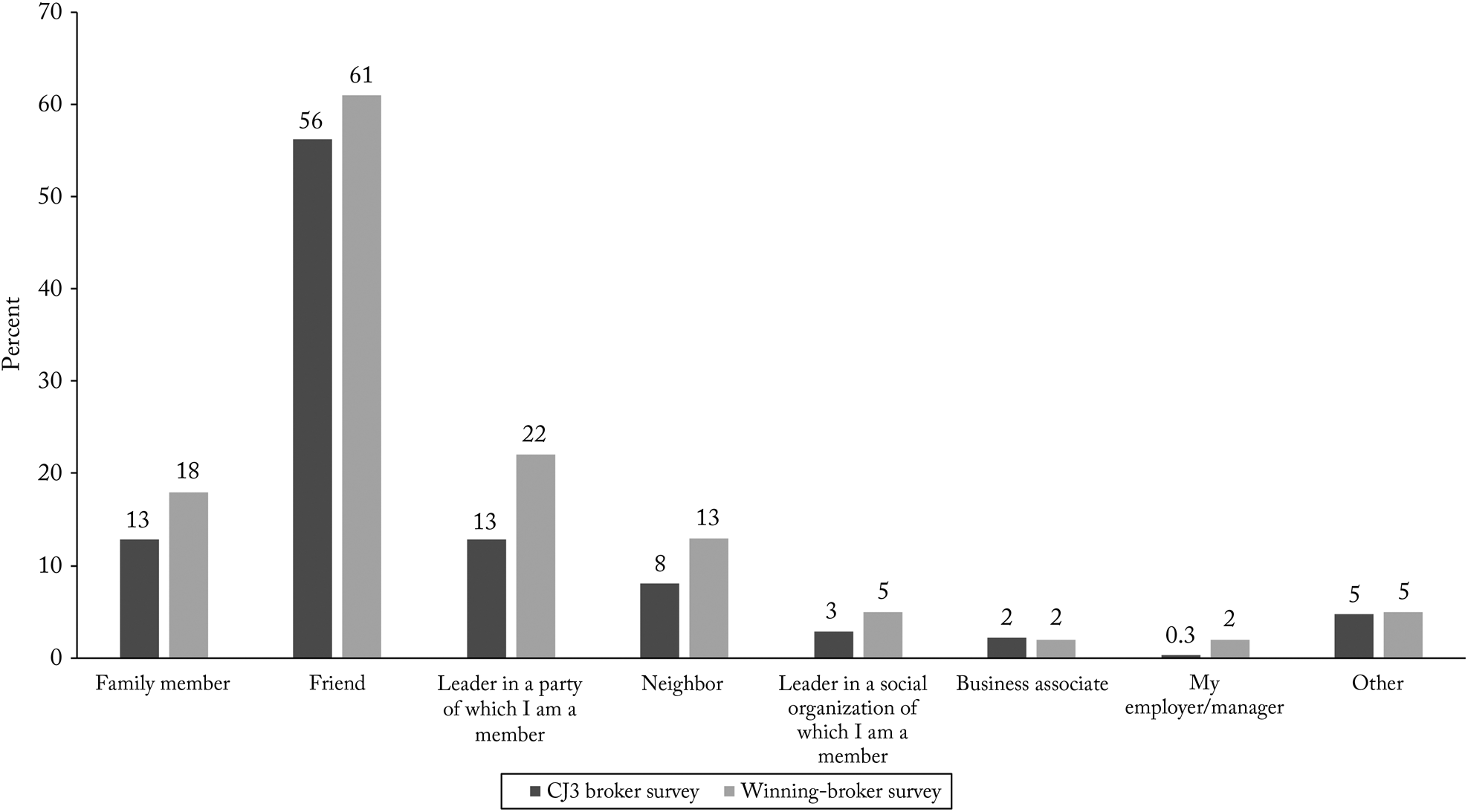
We turn now to our first set of expectations. Recall that we anticipate a core of brokers with close personal links to the candidate, complemented by brokers-for-hire lacking such ties. To test these predictions, our broker surveys explored how brokers joined success teams. The majority—nearly 70 percent in our cj3 survey and nearly 80 percent in our winning-broker survey—said they said were recruited by individuals they categorized as family or friends (Figure 1). Organizational networks, often presumed to be a key campaign asset,Footnote 44 played only a minor role in broker recruitment. Note, too, the minimal role of party officials. Brokers working for winning teams were more likely to have been approached by party leaders, but overall, parties were less important than personal connections. This pattern corresponds with the story we heard repeatedly from candidates. With few exceptions, parties played a minimal role in election campaigns, whether financial, advisory, or coordinating.
Broker Relationship with the Person Who Invited Them to Join the Success Team

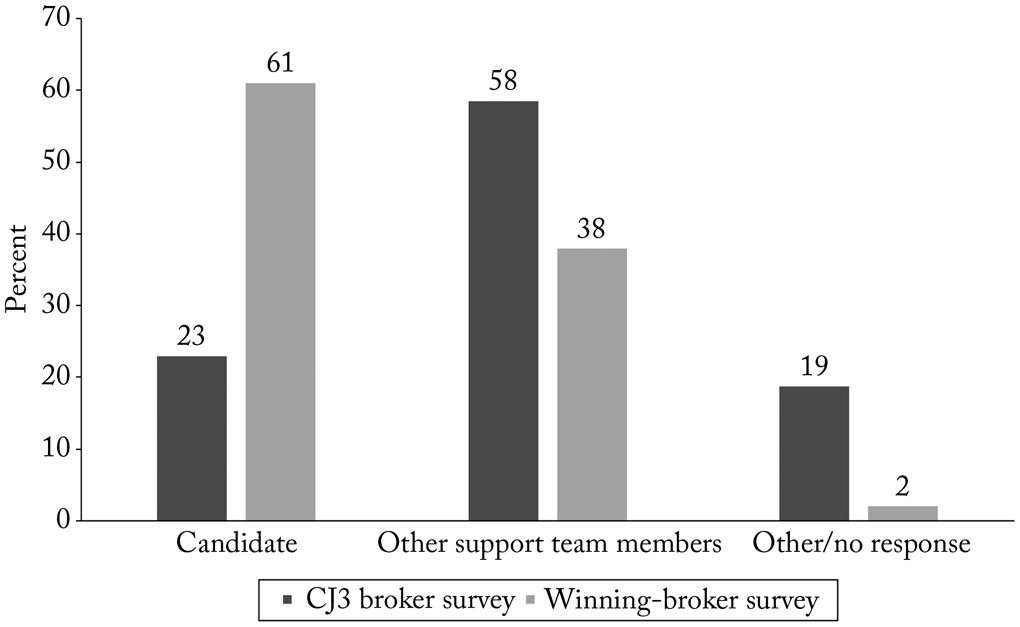
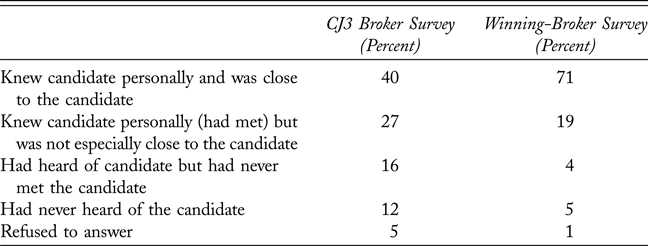
Figure 2 sheds further light on the relationship between candidates and brokers. When recruiting brokers, candidates start with individuals with whom they have close ties. But they soon run out of such people; in our cj3 broker survey, only 23 percent of respondents said that the candidate personally recruited them. The number was substantially higher—61 percent—for candidates in the winning-broker survey, offering support for our assumption that brokers with personal connections to a candidate are more likely to work diligently for that candidate. We see a similar difference in the extent to which brokers knew the candidate before joining a success team. Only 40 percent of brokers in our cj3 survey reported being close to the candidate for whom they worked (Table 2), versus 71 percent in our winning-broker survey, which may help explain why they were successful. Still, that means that even in the latter teams, nearly one-third of brokers lacked strong ties to the candidate for whom they worked—and about the same proportion in our cj3 survey had never even met the candidate.Footnote 45
Who Invited the Broker to Join the Success Team?

How Close Was the Broker to the Candidate?

Together, these data paint a picture of how success teams are built. Candidates recruit individuals with whom they have personal ties to be campaign staff and brokers, who in turn enlist people with whom they enjoy similar ties. Close ties arise primarily through family and friendship, although sometimes they develop through ongoing clientelism. Once the team is assembled, many members have connections with the candidate that are more pragmatic and transactional than personal. Brokers’ expectations confirm this premise. Unlike in clientelist systems built upon ongoing, often party-based, relationships, few Indonesian brokers (fewer than 7 percent in our cj3 survey) expected to be rewarded with postelection jobs or patronage, 63 percent were paid for their time, and only around 30 percent (those who had the closest personal ties to the candidate) reported working without pay.
In sum, our findings are consistent with our expectations regarding broker selection. Beyond a loyal core, most brokers support candidates on a contractual basis as guns-for-hire. The share of loyalists is higher in winning teams, however, confirming that proximity to the candidate affords an added punch. We turn next to examining the work these brokers do: communicating with voters and distributing handouts.
Broker Effort and Messaging
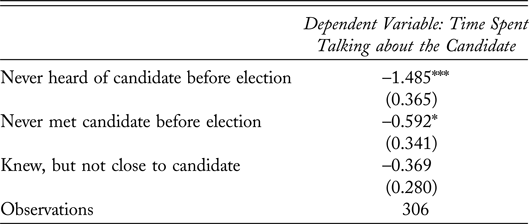
Given the large number of guns-for-hire, we expected to find widespread broker shirking. Indeed, that is what the surveys show. Our cj3 survey examined how much effort brokers exerted in persuading voters, including whether they spent time discussing the candidate with voters before adding them to their voter lists. Consistent with our prediction, 81 percent of brokers reported spending little or no time talking to voters about their candidate. Also consistent with our expectations, brokers personally close to the candidate spent more time promoting the candidate than brokers with no ties, but even the most diligent made only minimal efforts (Table 3).
Does Knowing the Candidate Affect How Much Brokers Talk about Them?a

* p < 0.1; *** p < 0.01
a Reference group is brokers who knew and were close to the candidate before working as a broker. Ordinal logistic regression with ordered independent variable.
Our qualitative data support the idea that it is the messenger that matters, not the message. One broker explained his relatively high success rate: “I managed to get those votes just because my relatives were looking at me; they don't even know [the candidate]. They know me. They would have felt awkward [not to vote for my candidate].”Footnote 46 Another used similar language, explaining that she implored her voters, most of them relatives and close friends, to consider her reputation when she gave them the candidate's cash gifts: “Don't you look at [the candidate]; after all, you know nothing about politics. But look at me. If I work and I produce nothing, how will it look?”Footnote 47 Candidates and brokers agree, of course, that local notables and associational leaders—especially those with some discretionary authority over the material circumstances affecting voters’ lives, such as the village head who decides who can access subsidized rice, or the head of a farmers’ group who determines which members get to use the group's hand tractors—are the ideal brokers precisely because their circles of social influence are much wider than those of the average broker. But as we have explained, such individuals are the exception rather than the rule in the massive brokerage teams we have examined.
Voter Targeting
We expected that candidates and brokers would prefer to concentrate handouts to voters in their personal core and that, inasmuch as such cores are distinct, many voters receiving handouts would be loyal to the broker, not the candidate. Our data align with expectations. Most candidates we interviewed reported that their priority targets were their base (basis). And yet they distributed most of their funds to voters with whom their ties were tenuous at best. How do we make sense of this seeming contradiction?
In interviews, candidates defined their base widely to include personal, patronage, and brokerage networks, which only occasionally coincided with associational and party networks. These networks comprise overlapping concentric circles around the candidate. Outer circles encompass more voters, but with diminishing loyalty to the candidate.
The nucleus of a candidate's core comprises personally loyal family members and friends. These individuals can be expected to support the candidate whether or not they receive a handout. Even these voters generally expect a token payment, however, as a reminder that their candidate is serious and remembers them. Making up the outer circle are voters connected to the campaign only through a broker. Although candidates refer to these voters as part of their base, in practice, candidates frequently have little confidence in their loyalty, as we discuss below.
Between these two circles are voters connected through patronage networks. These are voters whom candidates have helped in the past, whether as individuals, families, or groups (for instance, as members of a sports team that received uniforms or residents of a village in which the candidate built a mosque). Typically, these voters are connected to the candidate by brokers who play some sort of associational or community leadership role, like the aforementioned village head or farmers’ group leader. Comparative literature would suggest that such voters view electoral handouts as part of an ongoing clientelist relationship.Footnote 48 In Indonesia, we found that candidates target such voters, believing them more likely than typical voters to be loyal; 66 percent of candidates in the provincial and district candidate survey and 51 percent of brokers in the winning-broker survey believed that “a lot” or “quite a lot” of their votes came from voters the candidate had assisted in the past. These estimates are likely exaggerations, and we find it intriguing that although candidates considered such voters to be relatively loyal, they also understood that this loyalty was not assured—it had to be reinforced with handouts during elections, in what we label turf protection.
In short, uncertainty about voter loyalties, even among those voters whom candidates consider their core, drives much candidate behavior.Footnote 49 Most candidates and brokers stressed that they offered loyalists the same payment as nonloyalists to discourage defection, a practice our provincial and district candidate survey confirms; 86 percent of these winning candidates believed that at least some loyalists would defect to rivals if not provided payments. Their brokers were even less sanguine; 44 percent predicted at least “quite a lot” of defections in the absence of handouts. These findings suggest that candidates and brokers understood payments to this category of voters less as contingent vote buying or turnout buying than as turf protection: reassurances of the candidate's loyalty to voters.
Whom brokers choose to target thus matters immensely. Candidates have their brokers draw up lists of targeted voters. In deciding which names to include, the broker's strategy, endorsed by the candidate, is clear and consistent: target those you know. Broker efforts are neither party-centered nor candidate-centered; they are broker-centered. Our interview and focus-group data suggest that brokers rarely ask themselves which voters are more or less likely to support the candidate or which could be convinced to do so. The key question is “Who am I close to?” That a voter appears on a broker's list has little to do with the voter's characteristics, party affiliation, or relationship to the candidate and everything to do with that person's relationship with the broker.
Indeed, almost all the brokers we interviewed in focus groups or individually identified their targets in personal and relational terms. The majority identified relatives, neighbors, and close friends as their preferred targets, in roughly that order. One summed up: “We prioritize, number one, family. You can almost certainly rely on your family, let's say you can be 99 percent sure you'll get their votes. Then, second, it's close neighbors or close friends. Only then others, sometimes they are people you know, but not all.”Footnote 50
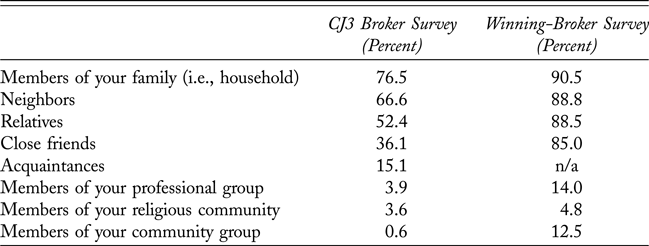
Our surveys confirm this pattern. More than three-quarters of the brokers in our cj3 survey included immediate family in their lists (Table 4). Their next most frequent targets were neighbors, other relatives, and close friends. Hired only to bring in votes, not to promote a program and not expected to recruit a lengthy list or trusted with funds to do so (more on this below), brokers rarely targeted individuals outside these circles. Our winning-broker survey presents an even more pronounced pattern. Notwithstanding variations across the four provinces, 90.5 percent of those brokers targeted close family members, followed by neighbors (88.8 percent), other relatives (88.5 percent), and friends (85.0 percent).
What Sorts of People Are on Brokers’ Lists?

The comparative literature suggests that close connections between brokers and voters serve two purposes. First, they enable brokers to gather detailed information about voters’ political preferences and material needs and to target their assistance accordingly.Footnote 51 This logic came through in a few focus groups and interviews, but far from universally. Some brokers noted that they would not list voters they knew to be committed to another broker or candidate, but only a few thought of themselves as playing intermediary roles in long-term clientelist or service-based relationships. Thus, few saw any point in identifying voter needs. Most brokers saw their task as simply identifying individuals who they felt might be willing to vote for the candidate, putting their names on a list, and giving them cash. The relationship, explained one broker in a focus group, was more short-term and transactional than long-term and contractual.
Second, brokers’ personal relations with voters underpin the effectiveness of electoral handouts. Voters typically feel greater obligation to follow through when they accept a payment or gift from someone with whom they have close social relations, and brokers more deeply entrenched in voters’ social networks are more likely to be able to assess and encourage compliance.Footnote 52 This dynamic is critical in Indonesia. In our focus-group discussions, many brokers struggled to articulate reasons for prioritizing relatives and other close associates, apparently considering this choice self-explanatory. Those who could explain mostly cited voter compliance. As one broker insisted, “I handed out [money] to my grandchildren, to my nieces and nephews. If it's me who gives it to them, they will be reluctant to break their promise [to vote for the candidate].”Footnote 53
Given the nature of broker networks, brokers’ preference for targeting voters with whom they have personal ties means that most recipients of handouts have no personal loyalty to the candidate. This pattern reverses what Stokes and colleagues observe in Argentina.Footnote 54 They find that parties attempt to target swing voters, but that due to brokers’ incentives to maintain their own bases of influence to capture greater rents, they end up distributing mostly to core supporters. By contrast, in Indonesia, candidates talk as if they are targeting their core supporters, but ultimately direct most of their funds to only tenuously loyal voters.
To be clear, these payments do buy votes among a small share of voters. Handouts, though, rarely buy turnout; more than 97 percent of respondents in our cj3 voter survey said that they would have turned out on election day regardless of monetary inducement. But Muhtadi, assessing local survey results from 34 provinces and 513 districts from 2006 through 2015, found that 20.8 percent of voters who deemed taking cash handouts acceptable said that they would vote for the candidate who gave them the most.Footnote 55 In our cj3 voter survey, 25.5 percent of targeted voters said that they would change their votes as a result of handouts, whereas 74.5 percent would support the same candidate regardless of payment. Keep in mind that despite the relative ubiquity of cash handouts, only a minority of Indonesian voters receive them. Various surveys indicate that between one-quarter and one-third of all voters receive handouts; our own national survey places the number at 25.1 percent.Footnote 56 Thus, assuming that voters in the cj3 survey are reasonably representative, payments induce only about 7 percent of voters nationwide to change their votes.Footnote 57 This number is not trivial, particularly for candidates close to the vote threshold for a seat, but it suggests that other factors do more to sway voters’ decisions and that these payments primarily perform other functions.
What are those functions? First, channeling payments through hired brokers constitutes broker buying; candidates purchase access to brokers’ personal connections. We tend to think of elections as quintessentially contestant-focused affairs in which voters evaluate parties or candidates either retrospectively or prospectively, or programmatically or clientelistically. In the elections studied here, the most compelling appeals have little to do with candidates or parties; voting decisions often turn on personal connections between brokers and voters. Second, as predicted, we find that brokers speak of handouts as the price of admission candidates must pay to be considered credible rather than as contingent exchanges. Commented one broker, “If you don't have money, you can't stand.”Footnote 58 What we see with handouts is less a market for votes than barriers to entry that help brokers and voters screen out unserious employers and contenders, respectively; handouts are a form of credibility buying. Third, payments serve as turf protection. In an environment of pervasive uncertainty about the loyalty even of base voters, and one in which other candidates also mobilize brokers and distribute cash, candidates need to shore up their support against the ever-present threat of defection.
Monitoring and Enforcement
Recognizing this broker-centered reality, we expected candidates to focus their monitoring efforts more on reducing broker shirking than on reducing voter defection—but also to emphasize risk-mitigation, given scant capacity for close scrutiny or sanction. Our qualitative and quantitative evidence supports this expectation; candidates seek to hedge their exposure to shirking. Candidates repeatedly told us that they viewed overly large voter lists (beyond around thirty names per broker) with suspicion, as they doubted the ability of brokers to secure commitment from voters outside their immediate circles. Campaigns often limited the number of voters per list, verified individuals’ location and voter-registration status before disbursing funds to brokers, and confirmed that voters did not appear on more than one broker's list. For more systematic evidence, we analyzed our ten cj3 brokers’ lists. A majority (55 percent) included no more than thirty names; 76 percent had fewer than fifty. If we exclude one provincial candidate who had few brokers because he was sharing those of district-level candidates from his party, the average number of voters per broker was thirty-three, near the stated upper target.
Even so, brokers have abundant opportunities to shirk, not just by falsely inflating their voter lists or failing to promote their candidate, but also by simply failing to hand payments to voters.Footnote 59 In the next section we look at survey evidence of broker shirking, but almost all the candidates we interviewed during our fieldwork admitted that it was a serious problem. That prevalence confirms our expectation that for most brokers, enlisting voters is merely a job, and that skimming from handouts is compensation for many. To ameliorate this risk, the most important step candidates could take was to recruit trustworthy senior brokers—when possible, people personally loyal to them or dependent on them for future business deals or other favors—and hope that these brokers would recruit equally reliable or similarly dependent individuals down the chain. Many also claimed to have elaborate provisions for cross-checking and monitoring brokers. Candidates said that they tried to check at least some of the lists that their brokers provided; some claimed to employ “invisible teams” (tim siluman) to monitor brokers in the field by visiting or telephoning voters on their lists to check whether they had been contacted by the broker; a few even hired a polling firm to check their brokers’ voter lists. In focus groups, some brokers said that they were aware of these efforts, but few were troubled by them. The one candidate we encountered who applied a mechanism overtly designed to minimize broker cheating at the point of distribution was also the only candidate whom brokers explicitly criticized in focus groups. Instead of entrusting field-level brokers with cash and rice packets to distribute, this candidate employed a special team to distribute this material. Several of his brokers said that this approach suggested that the candidate did not trust them; they blamed his poor performance on that perceived disrespect. If our presumptions about incentives are true, the issue was not just distrust, but also brokers’ reluctance to mobilize their personal networks absent anticipated rents.
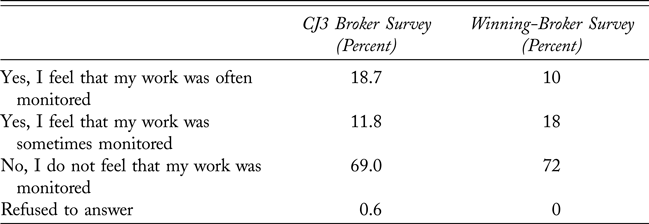
To be clear, candidates do care about their brokers’ performance; many of them spoke bitterly and with a deep sense of personal betrayal about the perfidy and unreliability of their team members. In the final analysis, however, most candidates admitted that they had few mechanisms for disciplining wayward brokers precisely because they were so weakly connected to them and because competition among candidates for brokers was so high. Our survey results confirm that overall, few ground-level brokers felt that their work was monitored—only 30.5 percent in our cj3 survey and 28 percent in our winning-broker survey (Table 5). Nor did brokers fear being held accountable for subpar performance; fewer than 5 percent of the cj3 brokers feared punishment for poor results. Indeed, candidates had few levers available. They could bar deceitful or underperforming brokers from further election campaigns or future patronage, but most brokers worried little about such penalties.
Did You Feel Your Work Was Monitored?

As we explained above, brokers are in high demand. As long as they do not develop a public reputation for absconding with campaign funds, they can expect future brokerage work from some candidate, even if they are not re-employed by a candidate they let down. Incumbent legislators have some access to patronage resources—for allocations to farmer or fisher groups, assistance for microenterprises, donations to social organizations, and for small-scale infrastructure projects—and our interviews suggest that brokers who have links to such organizations and who work for such candidates are much less likely to abscond with funds or to shirk.Footnote 60 But these individuals are the exceptions who prove the rule; most brokers dismissed threats to withhold future patronage. Most knew that their candidates stood a significant chance of losing and were not tied to them by way of parties or organizations that could significantly affect their future personal advancement or material well-being.Footnote 61 Harsh punishment of a broker, such as public condemnation, threats, or violence, might alienate the broker, the broker's family, and other associates, thus undermining the candidate's support base, without providing electoral benefit. When candidates did uncover evidence of shirking or cheating, therefore, they would most often quietly exclude those brokers from their list for distribution of cash payments and make a note not to employ them again. Similarly, few brokers expected rewards for good performance. We did hear of schemes to reward high-performing brokers with bonuses, but these were relatively rare. Only 8.9 percent of our cj3 brokers surveyed thought that excellent performance would be rewarded.
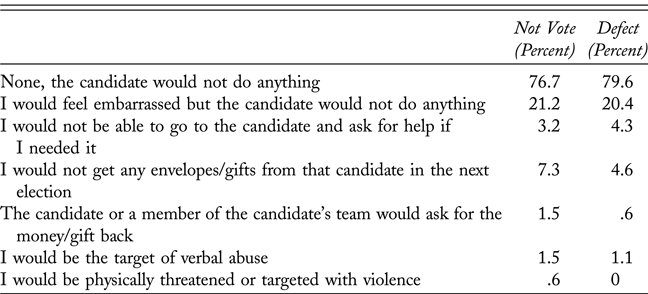
However minimal campaigns’ investment in monitoring brokers, it far outstrips their effort to monitor voters. One worry with clientelism is that it may produce what Stokes calls “perverse accountability,” allowing politicians to hold voters accountable for their behavior, rather than the reverse.Footnote 62 There is little sign of such a pattern here. To help with last-minute mobilization efforts, brokers sometimes tried to track who turned out to vote, but no campaigns reported systematically collecting or acting on such information. Moreover, across all our voter surveys, large majorities reported believing that their votes were secret. For example, in our postelection national survey, only 2.4 percent believed that a candidate could work out how they had voted. Respondents to our cj3 survey of voters who appeared on brokers’ lists were more likely to feel monitored. Still, only 18.3 percent believed that it was at least “possible” for a campaign to learn how they had voted, and 75 percent of that total said it may be by their willingly telling, if asked. Regardless, voters evinced almost no fear of reprisal (Table 6). Large majorities in our cj3 voter survey believed that a candidate would do nothing if they failed to turn out (76.7 percent) or voted for a rival (79.6 percent). About 20 percent said that they would feel embarrassed for not voting as promised, but few feared consequences beyond that. Brokers echoed that belief; 87 percent in our cj3 broker survey saw no way to punish noncompliant voters.
Suppose You Received an Envelope or Foodstuffs/Goods from a Candidate but Did Not Turn out to Vote/Voted for a Different Candidate on Election Day. What Might the Consequences Be?a

a Respondents could select more than one option, so columns total more than one hundred.
In sum, our findings show that candidates make some effort to reduce broker opportunism by limiting the scope of their voter lists or by verifying the identity of those listed, but that few attempt broker monitoring or enforcement. They expend even less effort on monitoring or enforcement directed at voters. That lack of investment is consistent with our broker-buying reading of electoral handouts as signals of credibility and turf-protection measures, and inconsistent with contingent vote buying or turnout buying.
Effectiveness of Electoral Handouts
If our broker-centered framework is correct, candidates have limited ability to control the relative efficiency of electoral handouts and little reason to expect a high rate of return. The sheer number of candidates contesting in any local area makes it likely that any given voter will be close to more than one broker, and such proximity is what sways vote choices. Even so, campaign teams strategize details ranging from the market rate for votes to the best time to distribute payments for maximum effect.Footnote 63 Central to these calculations is the thorny question of how effective electoral handouts are. Our expectation is that the payoff rate is likely to be low, given broker shirking and voter defection. Even so, candidates pay because doing so will surely garner at least some votes in a context with few more viable options to differentiate themselves and in which even a small supplemental personal vote might yield a win.Footnote 64
In line with this expectation, brokers’ own assessments of the effects of electoral handouts are inconsistent. In surveys, they projected confidence; 53 percent of our cj3 brokers thought that more than 75 percent of the voters they listed for payment voted for their candidate. Nearly 70 percent in our winning-broker survey were at least “quite certain” that the handouts they delivered could influence their neighbors’ voting decisions. But in interviews and focus groups, brokers expressed greater doubt. In those settings, most brokers agreed that a return in votes above 50 percent was a good result.
Candidates we interviewed presented an even more pessimistic view of the returns from handouts. All expected what they termed a margin error, or gap between the number of names listed for payments and votes received. One national dpr candidate, for instance, who secured around 123,000 votes—enough to get elected—after distributing 450,000 envelopes of cash explained, “There is a consensus among candidates: If you only get a third of the total envelopes you distribute, that's a good result. First, set your target. If you want to receive 100,000 votes to get elected, you must distribute envelopes tripling that. That's the rule.”Footnote 65
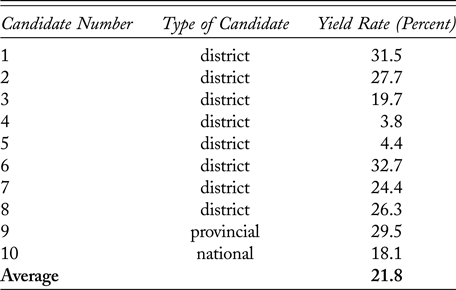
Beyond interviews and focus groups, two sources of data allow us to probe the relative efficacy and purpose of electoral handouts: yield rates from the voter lists (for example, whether the number of names listed tallies with votes received) and our preelection and postelection voter surveys, which included survey experiments to explore what drives voter decisions.
First, we examine our broker lists and vote results. Table 7 displays yield rates by candidate in our cj3 sample calculated by comparing the total names on a candidate's broker lists with the number of votes they received. We sum broker lists and votes received across all villages in our sample for a given candidate, then divide by votes for a yield rate.Footnote 66 Yield rates in our sample tend to be much lower than the brokers’ hoped-for 50 percent; all missed even the candidate target of 33 percent, averaging less than 22 percent. These rates mask enormous variation across villages and brokers. Nearly all candidates had at least one village where, despite distributing cash, they failed to capture a single vote. More than half the candidates could boast of villages where they received more votes than one would expect given the number of names on their broker lists (that is, yield rates above 100 percent).
List Yield by Candidate

We therefore have substantial evidence that yield rates were lower than either brokers or candidates claimed, consistent with significant shirking by brokers and voters. Our data also allow us to investigate how and why that shirking happens. Candidates and their top coordinators worried about brokers pocketing money intended for voters, hence their preference for brokers with close ties to the candidate. These fears were well grounded. In interviews, candidates gave examples of brokers absconding with funds. Asked directly, 12 percent of brokers in our winning-broker survey who acknowledged receiving money to give to voters admitted to such skimming.
Our cj3 voter survey offers further insight. In theory, all the voters we surveyed should have received payments. The reality, at least as voters reported it, was that only 53 percent did so. If respondents told the truth, that means only about half the targeted voters received funds. But were voters truthful? Some of the discrepancy between what brokers and voters report may result from underreporting of frowned-upon behavior. In our qualitative interviews we found that most voters and brokers spoke frankly about electoral handouts, but to evaluate whether voters prevaricated for social-desirability reasons, we included an unmatched-count list experiment in our national surveys to measure the magnitude of this bias among voters.Footnote 67 The resulting estimate is that 27.3 percent received payments, a finding that closely mirrors that for the direct question about payments (25.1 percent), suggesting minimal social-desirability bias, on average.
Taken together, we have ample evidence of brokers shirking by pocketing some money meant for voters. But they can shirk in other ways, too. As we discussed above, candidates worried that brokers would pad their voter lists, and thus often limited the number of voters per list. Our findings suggest that concern had merit. Some voters in our focus-group discussions, for example, were surprised to learn that they had been on brokers’ lists at all. Perhaps the most dramatic case was a participant whose name appeared on a candidate's voter list but who turned out to be a subdistrict coordinator for, and close confidante of, a rival candidate. Moreover, 30 percent of brokers in the cj3 survey and 22 percent in the winning-broker survey reported adding names to their lists without first consulting those voters. In focus-group discussions, several brokers said that they felt no need to consult with family members or voters otherwise close to them.
Even when brokers did talk to voters before adding them to the list, as explained above, brokers more distant from the candidate were less likely to talk up the candidate and more likely to center their messaging on the broker's personal connection to the voter. How much proximity between voters and brokers matters, though, is less clear. Unfortunately, we lack systematic data on how close voters were to the brokers who approached them. But if we assume that, ceteris paribus, the distance between a broker and the average voter on their list increases with list size, we can use list size as a rough proxy for distance. Our data from the cj3 broker-voter lists allow us to examine how list size relates to yield rates. For each village, we have counts of brokers and of names on each of their lists; we use these to calculate average voter-list size per village. We next examine the village-level relationship between list size and yield rate. As hypothesized, we find a negative correlation between average list size and yield rate, significant at the .05 level. Interestingly, our survey data suggest that brokers themselves consider less-close voters less reliable. Brokers with larger lists estimated significantly lower yield rates than brokers with smaller lists.
In sum, we find substantial evidence of shirking by voters and brokers, particularly among weakly attached brokers-for-hire, producing lower yields than either brokers or candidates claim to expect.
Conclusion
Our examination of electoral handouts in Indonesia paints a picture that differs from those that normally emerge from the comparative literature. In the standard view, handouts are fundamentally about clientelism—contingent exchange, whether understood as a one-time transaction or as a signal of benefits to come. Herbert Kitschelt and Steven Wilkinson, for example, insist that in such exchanges, “voters dedicate their votes only to those politicians who promise to deliver a particular mix of goods and services to them as individuals or small groups in return” and that “it is the contingency of targeted benefits, not the targeting of goods taken by itself, that constitutes the clientelistic exchange.”Footnote 68 Stokes and colleagues offer a similar test, whereby an exchange is clientelist when “receipt of benefits” is “contingent on [an] individual's political support.”Footnote 69
But scholars increasingly recognize that contingent exchange is rarer than we may have assumed.Footnote 70 The monitoring and enforcement that such exchange requires is costly and difficult. This is doubly true where parties are weak. Much of the existing literature points to parties as equipping candidates for these purposes, or assumes that they are doing so. Parties, by sorting the population into identifiable sets of loyal, swing, and opposition voters, help candidates, however imperfectly, to direct their handouts to the recipients most likely to deliver votes. Parties also provide the machinery with which to monitor the efficacy of the exchange itself, both by disciplining brokers (for example, withholding rewards from those who underperform) and by encouraging voters to turn out and vote appropriately (for example, by threatening that the party will withhold future benefits from precincts that fail to deliver). Even though this literature on electoral clientelism can trace its origins in part to earlier works on highly personalistic, dyadic, and face-to-face relationships,Footnote 71 in the context of mass democracy, parties provide the machinery that powers electoral clientelism.
Our personalized broker model and evidence from Indonesia underscore the need to modify this standard view of electoral handouts to account for candidate-centered voting and party weakness; these handouts stretch the concept of clientelism. Of course, contingency is not completely absent from Indonesia. A minority of voters in our surveys indicated that cash gifts influenced their vote choice, and some were enmeshed in iterative exchange relationships with candidates. But not most voters. When distributing cash, candidates clearly hoped that voters would reciprocate, but they knew that many would not.
Instead, lacking better alternatives, candidates distribute cash with little chance of ascertaining the alignments of most recipients, let alone of monitoring or enforcing these exchanges. Candidates can almost always count on a core of loyalists to whom their connection is typically personal rather than partisan, but those ranks are quickly exhausted. Beyond this core are voters who have received past benefits and might hope for more. But in the outer ring, linked to the candidate only through the intermediation of brokers and their personal networks, voters’ reliability can be tenuous indeed. Rather than either vote buying or turnout buying, in this context we see very different underlying logics to the distribution of electoral handouts. Candidates engage in broker buying, employing brokers’ personal networks to distribute money to voters as a marginal signaling device (credibility buying) and to shore up their core support (turf protection). Such handouts lack the contingency of vote buying or turnout buying and fall far short of guaranteeing votes, as the low yields we uncover show. Taken together, our data suggest that money primarily enables candidates to build larger, stronger networks of brokers. And brokers, not parties, are at the center of Indonesian elections. Electoral handouts arguably hinge more on mobilizing brokers than on mobilizing voters.
As we have described it, this system seems highly disadvantageous to candidates who, to a significant degree, are at the mercy of their brokers. They have little recourse when brokers take their money but fail even to try to deliver votes in return. It is natural to ask, then, why they continue with the practice. Candidates are acutely aware of the disadvantages of the current system, but our interviews suggest that most feel trapped in a prisoner's dilemma in which opting out of the system of brokers and payments would doom them to defeat. At the same time, they lack the organizational tools to discipline their brokers. In addition, however objectively inefficient a strategy for mobilizing votes, electoral handouts are still more efficient than all the other feasible alternatives.Footnote 72
Of course, candidates, learning from experience as Indonesia's electoral rules have evolved,Footnote 73 do what they can to improvise new solutions. It is possible that some candidates will come to invest more in invisible teams to monitor broker performance, although they will still lack leverage over brokers without strong ongoing ties and expectations of future rewards. Incumbent legislators are increasingly trying to overcome this problem by gaining more control over local budgets, hoping to use projects and other benefits to reward supporters and thus enhance voters’ loyalty at election time.
One direction for future work is to explore how the dynamics that we have described shape national electoral outcomes. At first glance we perceive a seeming disconnect: rampant distribution of cash amid weak parties at the local level, but relatively stable electoral results at the national level. It seems germane that, although Indonesian parties differ (for instance, some are highly personalistic, whereas others seek to carve out distinct ideological positions), they share three facts in common. They operate within an electoral landscape in which, first, very few voters consider themselves aligned with any particular party; second, members of the same party fight over the same purported strongholds (given the incentive structures of multimember districts and open-list pr) rather than working to expand the party's base; and third, all parties distribute electoral handouts. The last detail is particularly notable. Over the course of our extensive research, although we found the odd, usually losing candidate who eschewed money politics (whether for moral reasons, because the candidate was operating in middle-class urban constituencies where the practice was less common, or, more often, because the candidate could not afford it), our team found no discernible differences across parties. Candidates from every party distribute electoral handouts, even those from parties espousing anticorruption rhetoric, like the Islamist Prosperous Justice Party. Indeed, our argument suggests that they must do so to be considered credible and viable. With all candidates distributing handouts, their efforts tend to cancel each other out in aggregate.
Also worth noting is that given open-list pr, intraparty rather than interparty competition is paramount. Due to the way in which brokers are recruited—first drawn from within candidates’ personal networks, then from those of higher-level brokers, all the way down the line—teams are likely to come from similar organizational (including partisan) or ideological networks. The individuals and households to whom brokers disburse handouts are also likely to share those affinities—but so will brokers and voters aligned with other candidates for that party in that constituency. Although further research is needed, this pattern could help to explain why electoral handouts do not appear to affect national-level electoral outcomes. Handouts may do more to determine which candidate within a party prevails than which party voters choose, yielding a negligible effect on party votes nationally.
Our research has implications for the study of electoral handouts in other contexts. In countries with weak parties—like the contemporary Philippines or Thailand in the 1980s and 1990s—lavish cash distribution characterizes campaigns. The literature often describes such distribution as vote buying, even while noting voters’ and candidates’ resultant uncertainty. These studies present a picture of fluid relations between candidates and voters and of the deployment of large teams of personal brokers that resemble our description of the Indonesian case in such countries.Footnote 74 Our approach might also have implications for cases in which parties are important actors but are highly personalized or weakly differentiated in programmatic or identity terms. On the ground, campaigners working for such parties may act more in accordance with the expectations of our personalized broker model than with those of the contingent-clientelism model, offering their personal networks to the party rather than operating as cogs in machines for inducing turnout among a party core or for monitoring and disciplining clientelist exchange. In short, homing in on the intermediary stratum that conveys and frames handouts makes clear the unlikelihood of contingent exchange.
Supplementary Material
Supplementary material for this article can be found at https://doi.org/10.1017/S0043887121000216.
Data
Replication files for this article can be found at https://doi.org/10.7910/DVN/SCXPHI.
Acknowledgments
We would like to thank our numerous research partners in Indonesia for helping to make this project possible, with special thanks to Noor Rohman, Zusiana Elly Triantini, and David Efendi. We greatly benefitted from our collaboration with Universitas Gadjah Mada, especially with Mada Sukmajati, Amalinda Savirani, Wawan Mas'udi, the late Cornelis Lay, and the other members of the Research Centre for Politics and Government (PolGov); Indonesian Political Indicators (Indikator Politik Indonesia); and Lembaga Survei Indonesia. We are also grateful for research assistance from Michael Davidson and Dotan Haim. We thank participants in panels at the American Political Science Association, the Asian Studies Association of Australia, and the Association for Asian Studies conferences, and at workshops at the Center for Southeast Asian Studies at Kyoto University and at Chiang Mai University, as well as the three anonymous reviewers for their feedback. All errors and omissions are our own.
Funding
Funding for this project came from the Australian Research Council through a Discovery Grant (DP140103114).