Introduction
Vitamin D, a group of several active compounds with antirachitic activity, displays many important functions in live organisms, whereby it regulates the functions of genes essential for calcium absorption. There are two main forms of vitamin D; ergocalciferol (vitamin D2) and cholecalciferol (vitamin D3). Ergocalciferol is a compound of plant origin and is synthesised from ergosterol (plant steroid), whereas cholecalciferol is synthesised from precursor 7-dehydroxycholesterol, which is present exclusively in animal tissues. The synthesis of vitamin D3 from its precursor occurs in the skin under the influence of UV irradiation, however for modern poultry flocks that are kept entirely indoors (without indirect sunlight), vitamin D must be supplied in the dietary.
Cholecalciferol is biologically inactive in this form in animal organisms, so it must be converted by sequential hydroxylations to 25-hydroxycholecalciferol (25-OH-D3) in the liver and then to 1,25-dihydroxcholecalciferol (1,25-(OH)2-D3) in the kidney to become active (DeLuca, Reference DELUCA2004). This active, hormonal form of vitamin D3 acts through a nuclear receptor to express its many functions in the organism, including Ca and P intestinal absorption, bone homeostasis, Ca mobilisation in the bone and Ca reabsorption in the kidney (DeLuca, Reference DELUCA2004). Vitamin feed premixes for poultry are rich in cholecalciferol, but levels higher than the requirement of vitamin D3 generally have no beneficial effect on performance or the eggshell and bone calcification processes (Keshavarz, Reference KESHAVARZ2003). However, the occurrence of rickets and dyschondroplasia in chickens fed D3-rich diets may suggest that the transformation of cholecalciferol in the liver and kidney (to 25-OH-D3 and 1,25-(OH)2-D3) can be insufficient (Koreleski and Swiatkiewicz, Reference KORELESKI and SWIATKIEWICZ2005b). This subsequently results in poor eggshell quality and leg problems - as often observed in modern intensively producing laying hen flocks.
One of the strategies to alleviate these problems can be stimulation of bone and eggshell mineralisation through nutritional methods, such as using increased dietary levels and active forms of vitamin D3. Moreover, the results of some recent poultry studies have indicated that vitamin D3 is essential not only for mineral utilisation but is also important in other processes in the bird's body, for instance immune response as well as muscle proliferation and development. The aim of this paper is to review and discuss the results of recent poultry studies on the efficacy of different dietary sources and levels of vitamin D3.
The effects of different sources of vitamin D3 on performance indices and eggshell and bone quality
broiler chickens
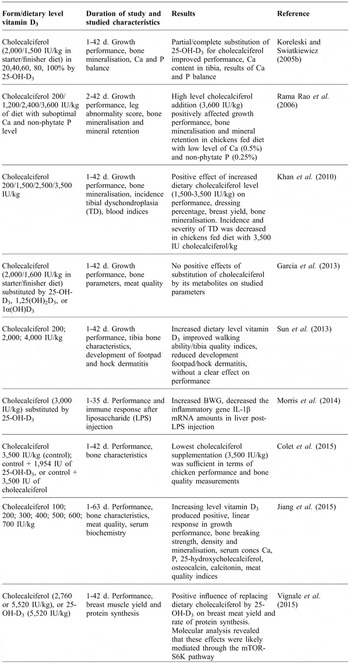
Findings from several experiments indicated that the requirements of broiler chickens for vitamin D3 is markedly higher than NRC recommendations (NRC, 1994), i.e. more than 200 IU/kg (5 mg/kg) ( Table 1 ). For example, Fritts and Waldroup (Reference FRITTS and WALDROUP2005) observed an improvement in body weight gain (BWG) in broilers fed a diet containing 4,000 IU/kg of cholecalciferol compared with those fed 1,000 IU/kg. Sun et al. (Reference SUN, YAN, ZHAO, LIN and GUO2013) showed that an increased dietary level of cholecalciferol (2,000 or 4,000 IU/kg) improved walking ability and bone quality characteristics, and decreased the intensity of footpad and hock dermatitis in broilers. Gómez-Verduzco et al. (Reference GÓMEZ-VERDUZCO, MORALES-LÓPEZ and AVILA-GOZÀLEZ2013) reported that chickens fed diets supplemented with 2,000 IU cholecalciferol/kg improved growth performance and immune response in comparison with birds fed according to NRC (1994) recommendations. Mabelebele et al. (Reference MABELEBELE, NG'AMBI and NORRIS2013) showed that a high dietary level of cholecalciferol improved the tenderness, juiciness and flavour of the aged meat of indigenous naked neck chickens, probably due to increasing the muscle calcium, which in turn enhances the activity of calpains,. The beneficial effects of feeding higher levels than NRC (1994) recommended dietary cholecalciferol levels on performance indices, dressing percentage, breast meat yield, bone mineralisation and lower incidence of tibial dyschondroplasia in broilers were reported by several other authors (Whitehead et al., Reference WHITEHEAD, MCCORMACK, MCTEIR and FLEMING2004; Rama Rao et al., Reference RAMA RAO, RAJU, PANDA, SUNDER and SHARMA2006; Reference RAMA RAO, RAJU, PANDA, SHYAM SUNDER and SHARMA2009; Khan et al., Reference KHAN, SHAHID, MIAN, SARDAR and ANJUM2010). Green and Persia (Reference GREEN and PERSIA2012) reported a positive influence of a high dietary level of cholecalciferol (7,500 or 15,000 IU/kg) on P retention, however this was not reflected in growth performance. Similarly, Colet et al. (Reference COLET, GARCIA, ALMEIDA PAZ, CALDARA, BORILLE, ROYER, NAAS and SGAVIOLI2015) found that cholecalciferol dietary supplementation levels higher than 3,500 IU/kg had no additional beneficial effect on growth performance or bone measurements in broilers.
Results of several studies showed that 25-OH-D3 has higher biological activity and is a more efficient source of vitamin D3 in poultry diets than cholecalciferol. For instance, Yarger et al. (Reference YARGER, SAUNDERS, MCNAUGHTON, QUARLES, HOLLIS and GRAY1995) reported that substitution of cholecalciferol by 25-OH-D3 in chickens’ diet improved BWG and feed conversion ratio (FCR). Similarly, Koreleski and Swiatkiewicz (Reference KORELESKI and SWIATKIEWICZ2005b) observed positive effects of partial or complete replacement of cholecalciferol by 25-OH-D3 on broiler performance and tibia Ca concentration. Michalczuk et al. (Reference MICHALCZUK, PIETRZAK, NIEMIEC and MROCZEK2010) reported a beneficial influence of partial substitution of vitamin D3 in the chicken diet by 25-OH-D3 on growth performance and meat quality. Ledwaba and Roberson (Reference LEDWABA and ROBERSON2003) found that 25-OH-D3 addition significantly decreased the incidence of tibial dyschondroplasia induced by a low-Ca diet.
In more recent studies, the positive effect of supplying 25-hydrocholecalciferol via drinking water was reflected in lower incidence of lameness in broilers (Naas et al., Reference NAAS, BARACHO, BUENO, DE MOURA, VERCELINO and SALGADO2012; Wideman et al., Reference WIDEMAN, BLANKENSHIP, PEVZNER and TURNER2015) or increased BWG and Ca tibia concentration (Santiago et al., Reference SANTIAGO, DAVID, ALEXANDRA, EDUARDO and JIMMY2016). Morris et al. (Reference MORRIS, SHANMUGASUNDARAM, LILBURN and SELVARAJ2014) reported that replacing cholecalciferol (3,000 IU/kg) by 25-OH-D3 decreased the inflammatory immune response and, in this way, improved growth performance in chickens after liposaccharide (LPS) injection. Han et al. (Reference HAN, CHEN, WANG, ZHANG, QU, ZHANG, YAN and CHENG2016) evaluated relative bioactivity of 25-OH-D3 and showed that, on the basis of slope ratio analysis of mineralisation of the femur, tibia, and metarsus, that 25-OH-D3 was approximately twice as active as cholecalciferol in promoting BWG and bone strength in broilers.
Bar et al. (Reference BAR, RAZAPHKOVSKY, VAX and PLAVNIK2003) did not observe any positive effect of replacing cholecalciferol by 25-OH-D3 in standard broiler diets, however 25-OH-D3 limited the negative effects of moderate P restriction on BWG and bone mineralisation. Similarly, no effect of a partial (50%) substitution of dietary cholecalciferol by 25-OH-D3 on the performance of growing turkeys was found, while the influence on tibia quality indices was dependent on the Ca dietary level, and occurred mainly when Ca content exceeded NRC (1994) recommendations (Tatara et al., Reference TATARA, KRUPSKI, JANKOWSKI, ZDUŃCZYK, JANKOWSKI and STUDZIŃSKI2011). In growing Japanese quail, a positive effect of dietary 25-OH-D3 was reflected in better growth performance and tibia mineralisation (Sahin et al., Reference SAHIN, BALCI, KUCUK, SMITH and SAHIN2009).
The goal of the study by Vignale et al. (Reference VIGNALE, GREENE, CALDAS, ENGLAND, BOONSINCHAI, SODSEE, POLOCK, DRIDI and COON2015) was to evaluate the effect of substitution of a high dietary level of cholecalciferol (5,520 IU/kg) by 25-OH-D3 on performance, breast meat yield and muscle protein synthesis. No differences in growth performance were observed, however 25-OH-D3 increased breast meat yield, muscle protein synthesis as well as higher plasma 25-OH-D3 concentration. Based on genomic analysis, these authors indicated that the molecular mechanisms of 25-OH-D3 on chicken muscle proliferation and development were mediated through the mTOR-S6K pathway. Experiments by Hutton et al. (Reference HUTTON, VAUGHN, LITTA, TURNER and STARKEY2014) showed that the mechanism of a positive effect of 25-OH-D3 on breast meat yield in broilers involved improvement of vitamin D3 status in the organism and stimulation of skeletal muscle satellite cells activity in the pectoralis major muscle.
Positive results have been obtained for other vitamin D3 derivatives, i.e. 1α-hydroxycholecalciferol (1α-OH-D3), whereby addition to a low Ca and P diet increased BWG and tibia breaking strength in broiler chickens (Ebrahimi et al., Reference EBRAHIMI, SHARIATMADARI and KARIMI TORSHIZI2016). Edwards et al. (Reference EDWARDS, SHIRLEY, ESCOE and PESTI2002) reported, based on the analysis of BWG, plasma Ca, rickets incidence and bone ash, that the relative bioactivity of 1α-OH-D3 was higher, i.e. from 1.88 to 21.2 (approximately eight fold), compared to cholecalciferol. The results of studies by Han et al. (Reference HAN, YANG, ZHANG, LI, LI, ZHANG and YAO2009, Reference HAN, WANG, QU, LIANG, ZHANG, SHI, DONG and CHENG2012) showed that 1α-OH-D3, by increasing phosphate absorption, can improve meat quality, bone indices and growth performance of chickens fed a P-deficient diet. Garcia et al. (Reference GARCIA, MURAKAMI, DUARTE, ROJAS, PICOLI and PUZOTTI2013), however, found a toxic effect of the complete substitution of cholecalciferol by high dietary levels of 1α-OH-D3 (2,000 and 1,600 IU/kg in the starter and finisher diet), leading to a decrease of growth performance indices in broilers.
Results of the selected studies on the effects of form and level of vitamin D3 addition to broiler diets.

laying and breeder hens
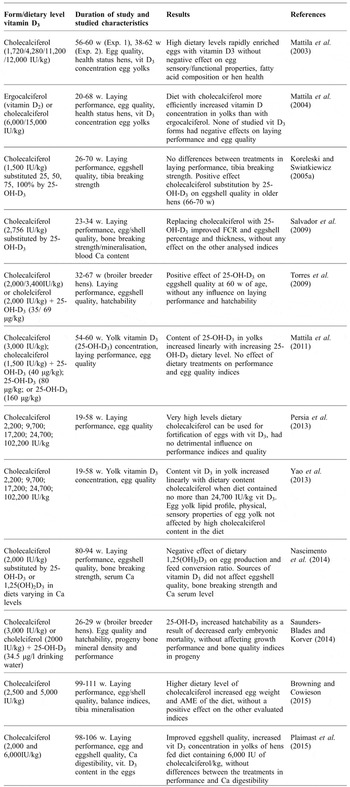
The results of experiments on the effects of different levels and forms of vitamin D3 addition to laying hens diets are summarised in Table 2 . Browning and Cowieson (Reference BROWNING and COWIESON2015) found that a high dietary level of cholecalciferol (5,000 IU/kg) increased egg weight without any other positive effects on laying performance, eggshell quality or tibial mineralisation. Plaimast et al. (Reference PLAIMAST, KIJPARKORN and ITTITANAWONG2015) observed improved eggshell quality in aged layers fed diets containing 6,000 IU/kg, however high vitamin D3 level did not improve performance and Ca digestibility.
In older layers the activity of renal 25-hydroxylase and the production of active vitamin D3 metabolites are often decreased, so the rate of cracked eggshells can be high. Therefore, the goal of one study with Hy-Line Brown laying hens (Koreleski and Swiatkiewicz, Reference KORELESKI and SWIATKIEWICZ2005a) was to evaluate the influence of partial or complete substitution of dietary cholecalciferol (1,500 IU/kg) by 25-OH-D3. There were no differences in laying performance between the experimental treatments; however, partial or complete substitution of cholecalciferol by 25-OH-D3 improved eggshell quality in older hens (66-70 wk). Salvador et al. (Reference SALVADOR, FARIA, MAZALLI, ITO, FARIA FILHO and ARAÚJO2009) reported that the complete substitution of cholecalciferol by 25-OH-D3 improved FCR and increased eggshell percentage (of the whole egg) and thickness. Kappeli et al. (Reference KAPPELI, FROHLICH, GEBHARDT-HENRICH, PFULG, SCHAUBLIN, ZWEIFEL, WIEDMER and STOFFEL2011a; Reference KAPPELI, GEBHARDT-HENRICH, FROHLICH, PFULG, SCHAUBLIN and STOFFEL2011b) observed increased 25-OH-D3 serum concentrations in hens after partial replacement of cholecalciferol by 25-OH-D3, but this was not reflected in laying performance, eggshell quality, keel bones fractures or deformities. Similarly, Nascimento et al. (2014) did not show any positive effects of cholecalciferol substitution by 25-OH-D3 in diets for older laying hens on egg production, eggshell quality or bone breaking strength. Morris et al. (Reference MORRIS, SHANMUGASUNDARAM, MCDONALD and SELVARAJ2015) found that a high dietary levels of 25-OH-D3 (100 μg/kg) had a positive influence on immune response and BWG in layer chickens after a coccidial challenge.
The aim of the study by Atencio et al. (Reference ATENCIO, EDWARDS and PESTI2005a) was to evaluate the effect of increasing levels (0-4,000 IU/kg) of vitamin D3 in broiler breeder diets on performance and bone mineralisation in progeny chicks. The authors observed that an increasing level of vitamin D3 enhanced BWG and tibia ash concentration, and reduced the incidence of rickets and tibial dyschondroplasia in their progeny. It was concluded that the diet should contain between 2,000 to 4,000 IU vitamin D3/kg to produce good quality chicks. However, no significant differences in progeny performance were found when breeders were fed with different sources of vitamin D3 (cholecalciferol or 25-OH-D3) (Atencio et al., Reference ATENCIO, PESTI and EDWARDS2005b). The results of a subsequent study showed that the requirement of broiler breeders aged 27 to 36 weeks old was 1,400 IU of D3 per kg of feed, taking into account egg production, egg weight and specific gravity, egg hatchability, embryo mortality, body weight and body ash of the progeny (Atencio et al., Reference ATENCIO, EDWARDS, PESTI and WARE2006).
Saunders-Blades and Korver (Reference SAUNDERS-BLADES and KORVER2014) reported that adding a high content of cholecalciferol with 25-OH-D3 to breeder hen diets positively affected the hatchability of eggs, by decreasing early embryonic mortality. However, any carry-over effect of maternal supplementation was insufficient to achieve improvements in progeny growth performance or bone quality indices. The results of a further experiment (Saunders-Blades and Korver, Reference SAUNDERS-BLADES and KORVER2015) showed that the substitution of cholecalciferol by 25-OH-D3 in the broiler breeder hens’ diet not only increased the eggs hatchability but improved the progeny's immune system i.e. enhancing the bactericidal activity of leukocytes and phagocytic and oxidative burst response.
Other trial results from broiler breeder hens showed that diet supplementation with 25-OH-D3 showed that this can improve eggshell quality without an influence on laying performance or hatchability (Torres et al., Reference TORRES, VIEIRA, REIS, FERREIRA, SILVA and FURTADO2009). Duarte et al. (Reference DUARTE, MINAFRA, SANTOS and PERIM2015) reported that inclusion of 25-OH-D3 (simultaneously with canthaxanthin) into the breeder layers’ diet decreased embryonic mortality and increased hatching percentage. Peng et al. (Reference PENG, DING, BAI, LUO, ZHU and ZHANG2013) found that 25-OH-D3 addition to broiler breeder hens’ diet containing 3,000 IU cholecalciferol/kg increased the mineralisation of bones in progeny, without having any effect on fertility and hatchability indices. More recently, a beneficial influence of 25-OH-D3 dietary supplementation on eggshell quality was seen in duck breeders (Ren et al., Reference REN, JIANG, ZENG, DING, BAI, WANG, LUO, SU, XUAN, YAO, CISNEROS and ZHANG2016).
Results of the selected studies on the effects of the form and level of vitamin D3 addition to laying hens diets.

Vitamin D3 fortification of eggs
In Western countries outdoor activities and sun exposure may be, in many cases, not enough to synthesise adequate amounts of vitamin D3 in humans. Vitamin D deficiency is common in North Europe and America during the winter and can lead to several health problems. Therefore, the intake of vitamin D3 from dietary sources, mainly from foods of animal origin such as fatty fish, milk and eggs, is of great importance. Nutritional methods of fortification of eggs, as a one of few natural sources of vitamin D3, can be an important way of increasing intake in humans. To this end, various feeding trials have examined the influence of laying hen diet supplementation, and consequent levels in table eggs.
An experiment was conducted using High-Line layers (Yao et al., Reference YAO, WANG, PERSIA, HORST and HIGGINS2013) to investigate the efficacy of high dietary cholecalciferol levels (9,700 - 102,200 IU/kg) in the enrichment of egg yolks with vitamin D3. Results showed that yolk vitamin D3 level increased rapidly and linearly with dietary concentrations of cholecalciferol for the first three weeks and then stabilised over a period of 40 weeks. Such vitamin D3 enrichment of yolks did not show any reduction in sensory, functional or compositional characteristics of the eggs (Yao et al., Reference YAO, WANG, PERSIA, HORST and HIGGINS2013). Similarly, Mattila et al. (Reference MATTILA, ROKKA, KONKO, VALAJA, ROSSOW and RYHANEN2003) reported that a high level of cholecalciferol in laying hens diet (12,000 IU/kg) effectively enriched egg yolks with vitamin D3 without any negative influence on the health status of birds, or in egg quality, measured as sensory and functional characteristics, eggshell indices and fatty acids composition. Further work was conducted to compare the efficacy of diet supplementation (6,000 and 15,000 IU/kg) with different sources of vitamin D (vitamin D2 (ergocalciferol) and D3) in the enrichment of yolks eggs (Mattila et al., Reference MATTILA, VALAJA, ROSSOW, VENALANEN and TUPASELA2004). Both forms significantly increased vitamin D3 yolk concentrations in comparison to the unsupplemented control group, without any detrimental effect on laying performance and quality, but dietary vitamin D3 was much more efficient in such enrichment than vitamin D2.
More recently, Browning and Cowieson (Reference BROWNING and COWIESON2014) reported that a high level of supplementation simultaneously with cholecalciferol (10,000 IU/kg) and 25-OH-D3 (2760 IU/kg) in laying hen diets enhanced not only cholecalciferol but also 25-OH-D3 content in egg yolks, without any detrimental effect on performance indices. The authors concluded that a single egg produced in this way contained 478 IU vitamin D3, meeting the recommended human requirements for daily intake. Similarly, Mattila et al. (Reference MATTILA, VALKONEN and VALAJA2011) showed that yolk 25-OH-D3 concentration enhanced linearly with increased levels added to layering hen diets, and was an efficient method of egg enrichment with 25-OH-D3.
Conclusions
The requirement of modern broiler chickens, breeders and laying hens flocks for supplemental vitamin D to optimise mineral digestibility, performance, immunity indices, bone health, and eggshell quality is about 3,000 IU/kg, i.e. much higher than NRC (1994) recommendations. The results of some recent experiments have indicated that 25-hydroxycholecalciferol is more efficient in commercial poultry nutrition than the basic form of vitamin D3 (cholecalciferol). In addition, it is possible to create value added eggs, which are higher in vitamin D and therefore beneficial to human consumers.
Conflict of interest statement
The authors confirm that this work has no conflict of interest.