Introduction
Amomum Roxb. is the second largest genus in the Zingiberaceae (after Alpinia Roxb.), with about 150–180 species, and is widely distributed in Southeast Asia (Xia et al., Reference Xia, Kress and Prince2004). In India the members of the genus are mainly distributed in NE India, Peninsular India and the Andaman–Nicobar Islands. Sabu (Reference Sabu2006) reported six species of Amomum from South India. Thomas et al. (Reference Thomas, Sanoj, Sabu and Prasanth2009) and Thomas et al. (Reference Thomas, Sabu and Prabhu Kumar2012) added Amomum fulviceps Thwaites and A. nilgiricum V.P.Thomas & M.Sabu respectively from the Western Ghats. During a revision of Indian Zingiberaceae the authors collected two interesting specimens of Amomum from Agastyamalay in the Western Ghats and after critical study they proved to be new species. These species are described and illustrated here. The total number of species of Amomum in South India is thus raised to 10.
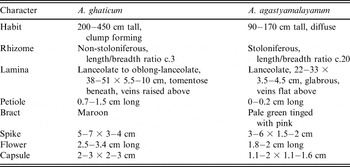
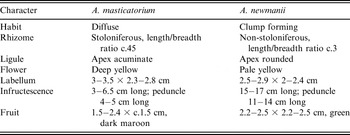
Amomum agastyamalayanum is allied to A. ghaticum K.G.Bhat of South India (Table 1). Amomum newmanii is similar to A. masticatorium Thwaites (Table 2).
Comparison of Amomum ghaticum and A. agastyamalayanum

Comparison of Amomum masticatorium and A. newmanii

The length/breadth ratio of the rhizome was determined by calculating the average length of the rhizome between two leafy shoots/average thickness of the rhizome.
Species Descriptions
Amomum agastyamalayanum V.P.Thomas & M.Sabu, sp. nov.Figs 1, 3.
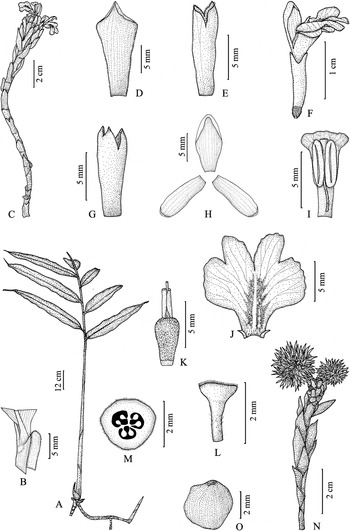
Fig. 1.Amomum agastyamalayanum V.P.Thomas & M.Sabu. A, habit; B, ligule; C, inflorescence; D, bract; E, bracteole; F, flower; G, calyx; H, corolla lobes; I, stamen; J, labellum; K, ovary with epigynous glands and style; L, stigma; M, c.s. of ovary; N, infructescence; O, seed.

Amomum agastyamalayanum is allied to A. ghaticum K.G.Bhat of South India in having similar small and yellow flowers, but differs from the latter in its smaller, diffuse habit, slender and stoloniferous rhizome, glabrous leaves with flat veins, shape and size of the lamina, smaller size of the petiole, slender inflorescence, and smaller flowers and fruits. – Type: India, Kerala, Thiruvananthapuram Dist., Agastyamalay, Athirumala, 2 iii 2008, V.P. Thomas & A.V. Prasanth 103039 (holo CALI; iso CAL, MH).

Rhizome stoloniferous, slender, 0.5−1.2 cm thick, length/breadth ratio c.20, creamy-white inside, covered with scales; scales triangular, chartaceous, margin ciliate, apex acute to rounded, glabrous on both surfaces. Leafy shoots 90−170 cm tall, slender, diffuse; sheath c.2.5 cm wide at base, green, margin membranous, glabrous on both surfaces. Leaves 8−23 per shoot; lamina lanceolate, 22−33 × 3.5−4.5 cm, dark green above, pale beneath, base cuneate, margin glabrous, apex acuminate and curled, glabrous on both surfaces; midrib glabrous; veins flat above; petiole 0−0.2 cm long, green, glabrous. Ligule entire, 0.3−0.5 cm long, green tinged with pink, coriaceous, margin ciliate, apex rounded, glabrous. Inflorescence 7−23 × 1.5−2 cm, many-flowered, arising from the rhizome underground; peduncle 4−17 cm long. Bract obovate to obovate-oblong, 1.2−1.7 × 0.5−0.9 cm, pale green tinged with pink, coriaceous, margin ciliate, apex acute, puberulous towards base externally, glabrous internally. Bracteole tubular, 0.9−1.2 × 0.2−0.3 cm, equally 2-lobed, membranous, pale green tinged with pink, unilaterally split, margin ciliate, pubescent externally, glabrous internally. Flower 1.8−2 cm long, yellow. Calyx 2- or 3-lobed, ecuspidate, 0.9−1 × 0.25−0.3 cm, pale green tinged with pink, unilaterally split, pubescent towards base and apex externally, glabrous internally. Corolla tube 0.8−0.9 cm long, c.0.2 cm wide at mouth, pale yellow, pubescent externally, villous towards mouth within and glabrous towards base; dorsal corolla lobe oblanceolate, c.1.1 × 0.5 cm, pale yellow with pink-tinged apex, margin ciliate towards base, apex hooded and ecuspidate, puberulous towards apex externally, glabrous internally; lateral corolla lobes oblong, c.1 × 0.3 cm, pale yellow, margin ciliate towards base, puberulous towards apex externally, glabrous internally. Labellum obovate, 3-lobed with cleft midlobe, 1.3−1.6 × 1.2−1.4 cm, pale yellow towards periphery and dark towards centre, with a red patch in the throat, margin entire, pubescent towards base internally. Lateral staminodes small, subulate, c.0.1 cm long, yellow, glabrous. Stamen 0.7−0.9 cm long; filament 0.2−0.3 × c.0.1 cm, pale yellow, puberulous; connective glabrous; crest fan-shaped, slightly lobed, c.0.1 × 0.35−0.45 cm, pale yellow, glabrous; anther thecae oblong, 0.35−0.4 cm long, creamy-white, base rounded, apex rounded, pubescent; dehiscing throughout their length. Epigynous glands 2, oblong, 0.3−0.4 cm long, cream coloured, apex slightly lobed, glabrous. Ovary ovate-oblong, c.0.4 × 0.3 cm, pubescent externally; locules 3; ovules many on axile placentae; style c.1.5 cm long, pubescent; stigma cup-shaped, c.0.05 cm across, white, mouth ciliate, opening terminal. Infructescence 8−14 cm long; peduncle 6−10 cm long, 3−7 capsules per spike. Capsule globose to slightly oblong, 1.1−2 × 1.1−1.6 cm, echinate, red to maroon, calyx persistent. Seeds many, angular, 0.4−0.5 × 0.3−0.4 cm, black, aromatic, arillate; aril white.
Distribution. Agastyamalay hills, Kerala. The plant has a stoloniferous rhizome and is found in small patches spreading over a small area.
Ecology. Found growing as undergrowth in evergreen forest at 900–1300 m altitude. Flowering and fruiting: February−July.
Proposed IUCN conservation status. Critically Endangered CR B1ab(i,ii,iii)+B2ab(i,ii,iii) (IUCN, 2001). This species is known only in Agastyamalay. A continuing decline is projected in the extent of occurrence, the area of occupancy and the quality of habitat due to continuous human interference. The area receives a great deal of foot traffic, especially during the pilgrimage season, which may damage the existing population. Mass collection of these plants, along with similar plants, for thatching of temporary sheds is also a threat to the population. The species is habitat specific and found only above 900 m.
Etymology. The specific epithet ‘agastyamalayanum’ indicates the place of collection, Agastyamalay.
Additional specimens examined. India. Kerala: Thiruvananthapuram Dist.: Agastyamalay, Athirumala, c.1000 m, 1 iv 1989, N. Mohanan 5511 (TBGT); ibid., 12 vii 1999, M. Dan 36229 (TBGT); way to Meenmutty, 1200 m, 27 ii 1991, N. Mohanan 10401 (CALI, TBGT); Athirumala, 6 ii 1991, N. Mohanan 9427 (CALI, TBGT); near Attayar, 7 ii 2006, E. Sanoj 86182 (CALI); Athirumala, E. Sanoj 86192 (CALI); Agastyamalay, near Athirumala, 2 iii 2008, V.P. Thomas & A.V. Prasanth 103024 (CALI).
Amomum newmanii M.Sabu & V.P.Thomas, sp. nov.Figs 2, 3.
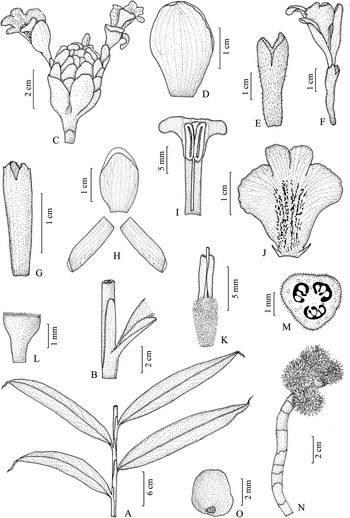
Fig. 2.Amomum newmanii M.Sabu & V.P.Thomas. A, part of leafy shoot; B, ligule; C, inflorescence; D, bract; E, bracteole; F, flower; G, calyx; H, corolla lobes; I, stamen; J, labellum; K, ovary with epigynous glands and style; L, stigma; M, c.s. of ovary; N, infructescence; O, seed.
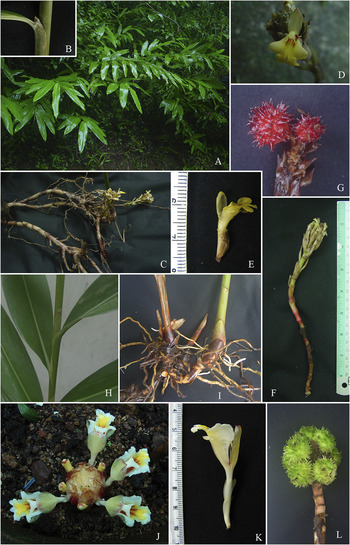
Fig. 3.A–G: Amomum agastyamalayanum. A, habit; B, ligule; C, rhizome; D & E, flowers; F, inflorescence; G, infructescence. H–L: Amomum newmanii. H, ligule; I, rhizome; J, inflorescence; K, flower; L, infructescence. (See online for a colour version of this figure.)
Amomum newmanii is similar to A. masticatorium Thwaites in having a long ligule and trilobed labellum with a cleft midlobe and echinate capsule, but differs from it in the stout, clump-forming habit, non-stoloniferous rhizome, long ligule with rounded apex, pale yellow flowers, smaller labellum, longer peduncle, and green fruits. – Type: India, Kerala, Thiruvananthapuram Dist., Agastyamalay, 8 km from Athirumala towards Bonnacaud, 2 iii 2008, V.P. Thomas & A.V. Prasanth 103042 (holo CALI; iso CAL, MH).


Rhizome non-stoloniferous, stout, robust, c.1.5 cm thick, length/breadth ratio c.3, creamy-white inside, covered with scales; scales chartaceous, glabrous, margin ciliate. Leafy shoots 100−200 cm tall, robust, clump forming; sheath c.2 cm wide at base, green, margin ciliate, apex rounded, pubescent externally, glabrous internally. Leaves 20−30 per shoot; lamina lanceolate, 22−37 × 4−6.5 cm, sessile, dark green above, pale beneath, base cuneate, margin glabrous, apex acuminate and pubescent, glabrous on both surfaces; midrib green, glabrous; veins flat above. Ligule entire, lanceolate, 2.8−3.8 cm long, membranous, usually not caducous, pale green, margin ciliate, apex rounded, puberulous to glabrous externally. Inflorescence c.7.5 cm long, many-flowered, arising from the rhizome underground; peduncle c.2 cm long. Bract obovate, 1.7−2.3 × 1.2−1.8 cm, chartaceous, maroon, margin ciliate, apex rounded, puberulous externally, glabrous internally. Bracteole tubular, 1.5−1.7 × 0.45−0.5 cm, 2- or 3-lobed, membranous, white, unilaterally split, puberulous externally, glabrous internally. Flower 5−5.5 cm long, pale yellow. Calyx 1.4−2 × c.0.5 cm, 2- or 3-lobed, membranous, white, unilaterally split for c.0.5 cm, puberulous externally, glabrous internally; each lobe with a minute subapical cusp, apex slightly emarginate and ciliate. Corolla tube 2.3−2.4 cm long, pale yellow, c.0.35 cm wide at mouth, pubescent externally, villous towards mouth within and glabrous towards base; dorsal corolla lobe ovate, 1.9−2 × c.1.1 cm, pale yellow with pink-tinged apex, margin ciliate, apex hooded and ecuspidate, glabrous on both surfaces; lateral corolla lobes oblong, 1.9−2 × 0.5−0.55 cm, pale yellow, margin ciliate towards apex, apex slightly folded, glabrous on both surfaces. Labellum obovate, 3-lobed with cleft midlobe, 2.5−2.9 × 2−2.4 cm, pale yellow towards periphery, deep yellow in middle with red streaks at centre, margin wavy and crumpled, pubescent near throat inside. Lateral staminodes subulate, c.0.3 cm long, base reddish and pubescent. Stamen 1.8−1.9 cm long; filament 0.9−1.1 × 0.25−0.3 cm, pale yellow, pubescent externally, glabrous within; connective pubescent; crest c.0.3 × 1.3 cm, truncate, slightly lobed, pale yellow, glabrous; anther thecae oblong, 0.6−0.65 cm long, creamy-white, base rounded, apex nearly diverging, pubescent; dehiscing throughout their length. Epigynous glands 2, oblong, c.0.4 cm long, creamy-white, apex nearly truncate, glabrous. Ovary obconic, c.0.5 × 0.2−0.3 cm, pubescent externally; locules 3; ovules many on axile placentae; style c.4 cm long, pubescent; stigma cup-shaped, c.0.1 cm across, yellow-white, mouth ciliate, opening terminal. Infructescence 15−17 cm long, 8−12 capsules per spike; peduncle 11−14 cm long. Capsule globose, densely echinate, 2.2−2.5 × 2.2−2.5 cm, green, calyx not persistent. Seeds many, angular, 0.2−0.3 cm, brown, aromatic, arillate; aril white.
Distribution. Known only from the type locality, Agastyamalay. Only two patches from a single locality were located.
Ecology. Growing as undergrowth in evergreen forest above 1000 m. Flowering and fruiting: February−July.
Etymology. Named in honour of Dr M. F. Newman of the Royal Botanic Garden Edinburgh for his contributions to systematic studies on Zingiberaceae.
Proposed IUCN conservation status. Critically Endangered CR B1ab(i,ii,iii)+B2ab(i,ii,iii) (IUCN, 2001). This species is known only in Agastyamalay. A continuing decline is projected in the extent of occurrence, the area of occupancy and the quality of habitat due to continuous human interference. The area receives a great deal of foot traffic, especially during the pilgrimage season, which may damage the existing population. Survival of this species in ex situ collections is low.
Additional specimen examined. India. Kerala: Thiruvananthapuram Dist., Agastyamalay, 8 km from Athirumala towards Bonnacaud, 5 vii 2009, V.P. Thomas & K.M. Prabhu Kumar 115584 (CALI).
Acknowledgements
The authors are grateful to the Department of Biotechnology and Department of Science and Technology, New Delhi for their financial assistance for research projects on Indian Zingiberaceae (BT/PR6735/PBD/16/605/2005 dtd. 29.09.2006 and SP/SO/PS-115/2009 dtd. 10.05.2010). We are also grateful to Dr Mark Newman, Royal Botanic Garden Edinburgh for critical comments on the identity of the species and other valuable comments; to Mr A. V. Prasanth, Mr K. M. Prabhu Kumar and Dr E. Sanoj for their help during specimen collection; and to the Forest Department, Government of Kerala for the necessary permissions.