In 1998, a rumor spread in East Java, Indonesia, that conspirators or masked ninjas were behind an “outbreak” of killings of putative sorcerers and that they were beginning to attack innocent people. Believing the rumors, local residents throughout East Java established guards, attacked, and even killed people who were suspected to be ninjas. Previous analyses of the ninja rumors have highlighted three features.
First, rumor was important in the 1965–66 massacre of Communists and in the 1998 ninja phenomenon. Prior to the massacre, the Communist Party was rumored to have initiated a bloody coup and committed other evils.Footnote 1 Members of the party's women's organization allegedly danced naked around the bodies of the generals killed on the night of the “coup.” These rumors contributed to the killing of hundreds of thousands of purported party members and sympathizers. As will be demonstrated, rumor functioned similarly in the 1998 ninja killings (George Reference George and Whitehead2004; Retsikas Reference Retsikas2006).
Second, the moment and context are crucial in understanding the spread of the ninja rumor in 1998. Reformasi—the reform movement—culminated in May with the resignation of President Soeharto and the end of his New Order regime. Rumor seems more significant during uncertain, anxious times, perhaps because “standards of plausibility” change (Cohen Reference Cohen1997, 147, 160, 161; Smith Reference Smith2006, 408). Accordingly, Fadjar I. Thufail sees the ninjas as a “manifestation” of “anxiety” about the “larger political transition” (2005, 155). Additionally, the relaxation of press control resulted in articles that implicated the state and elite. Furthermore, new levels of public action—demonstrations, overrunning of police stations, and killings of suspected “sorcerers” and ninjas—occurred.
Third, in the 1998 ninja phenomenon, national-level events were contextualized in local experience, and vice versa (George Reference George and Whitehead2004; Retsikas Reference Retsikas2006, 84–85; Thufail Reference Thufail and Zurbuchen2005). This was a process of both parochialization and nationalization. Alleged violence by, and against, ninjas in East Java's locales was “read as a national issue”; when suspected ninjas were sighted, a national threat was directly experienced at the local level (George Reference George and Whitehead2004, 42–43).Footnote 2 I argue here that these processes were assisted by the interaction of two methods of communication: newspapers and face-to-face gossip. In this article, I assume that rumors can be transmitted by word of mouth and through the press, and I demonstrate that both spoken and printed rumor can interact in a constructive and creative manner.
Two Methods of Communication
Newspapers generally are passively consumed, nonlocalized, constant over time and distance, centralized, “vertical,” and controlled by the elite. They are passively consumed in that most people participating only read and do not produce newspapers. The nonlocalized attribute is that participants may be socially and geographically distant. Newspapers are constant over time and distance because as an article travels, it does not change. They are centralized inasmuch as they circulate from a central printing press. The “vertical” nature of newspaper content is its tendency to spread from those who have power to those who do not (Smith Reference Smith2006, 424). Related to this is the elite control of newspapers. The costs associated with the mass production and distribution of newspapers tend to ensure that control of production is limited to capitalist or state bureaucracies with large amounts of capital.
The assertion of authority by the ruling class primarily through the media is described in Stanley Cohen's influential idea of “moral panic” (1980, xxii). A “moral panic” is characterized by a period of intense public concern over a perceived threat to society by “folk devils.” In 1960s England, for example, reported fighting between members of two subcultures—Mods and Rockers—sparked fears of a youth crisis. As Cohen notes, “in industrial societies,” deviancy, such as that of “folk devils,” “arrives already processed by the mass media” (1980, 16).
Gossip is a form communication that often involves sharing information (I will refer to this information as “rumor”).Footnote 3 Gossip tends to be oral rather than written, so it is particularly important in pre- or semiliterate societies. It is also participatory, localized, distance and time sensitive, and democratic or subaltern. Gossip's participatory characteristic, noted by Max Gluckman (Reference Gluckman1963, 315) and Homi K. Bhabbha (Das Reference Das2007, 118), is the strong impulse to pass rumors on. Like correspondence by letters, there is no gossip without people actively participating. Most of us are oral rumormongers, and indeed, gossiping can solidify social ties between its practitioners. Gossip is localized inasmuch as it is often interpersonal and intimate; it spreads easily within communities or groups whose members are in close physical proximity. The distance and time sensitivity of gossip is that the information changes through time and as it travels, often in accordance with gossipers' hopes and fears (Bubandt Reference Bubandt2008, 807; Scott Reference Scott1990, 145). Gossip is decentralized, as it usually spreads every which way. It is also “horizontal” in that it is usually considered more appropriate between people of similar status and power, than, for example, between a priest and a layperson (Smith Reference Smith2006, 424). Finally, gossip has democratic or subaltern potential. Although gossip is sometimes associated with social control, some scholars have noted that it also articulates “popular resistance,” with the power to mobilize crowds and to spread subversion (Bubandt Reference Bubandt2008, 795; Das Reference Das2007, 118–19; Smith Reference Smith2006, 406, 424). Furthermore, because of the gossiper's anonymity, the state is hampered in detecting its source and controlling its transmission (Smith Reference Smith2006, 424).
The localized and distance-sensitive attributes of gossip are changing with the introduction of communications technologies, such as telephone and e-mail. Nevertheless, gossiped information can spread widely, unmediated by modern communication technologies. George Rude's analysis of the Great Fear of 1789 in France explains that peasants held a “deep-grained belief … in the existence of an aristocratic plot … ‘brigands’ … were being armed to ravage the countryside and to destroy the peasants' property … the rumor spread … and … inflamed the rural population. So the peasants armed and awaited the invaders. But the ‘brigands,’ the product of panic and excited imagination, failed to materialize” (Reference Rude1981, 103). Suspicion was directed against the still relatively powerful aristocracy.
In this article, I analyze the interaction of oral and written rumors. Henrietta Harrison (Reference Harrison2000) describes this interaction in China in 1890–1929. When newspapers were introduced, oral news still reached rural areas faster than newspapers. Even when newspaper distribution became more rapid, oral news still played a role, as newspaper information was distrusted (Harrison Reference Harrison2000, 203). However, oral and written accounts do not necessarily contradict one another. Nils Bubandt (Reference Bubandt2008) demonstrates that in North Maluku in 1999–2000, leaflets that contained oral rumors circulated. The information—conspiracy theories about Christian or Muslim “enemies”—was already hearsay, but gained authority through being written in the leaflets, and was a trigger for communal violence.Footnote 4 I will analyze the East Java ninja rumor and the ensuing violence as the interaction of local gossip and the press, focusing on the inversion of authority. I begin with a discussion of local gossip.
Face-to-Face Gossip and “Sorcerer” Killings
Face-to-face chatter is conspicuous in social life in rural East Java, where I undertook fieldwork (2000–2002) in Tegalgaring village. Mass communication of local events was limited to calls to prayer, announcements of bereavements, and sermons at Friday prayers amplified from mosques. No newspapers were sold in the village, and there was no coverage of local events. The same lack of local coverage applied to radio and television. Landline telephones were rare, and mobile phones had no reception.
Instead, knowledge about local happenings was “news spread by the wind,” or kabar angin, as it is euphemistically called in Indonesian. Almost all local information was communicated face to face, whether mundane (“a wedding is taking place in the northeast corner of the village”), salacious (“the village head is having an affair”), or sensational (“Yasin has been killed”). This was reinforced by etiquette—it was considered arrogant (sombong), and almost impossible, to pass one's neighbors, acquaintances, and family without chatting or gossiping. Research participants referred to the gossip pejoratively as gosip, rumor, isu (rumor), or fitnah (slander). In practice, however, they seemed to accept its veracity. Moreover, this information functioned not merely as idle chatter or salacious scandal. On the basis of gossip, one could be identified as a “sorcerer” and be killed for that reason.Footnote 5
Community killings of suspected sorcerers had been occurring intermittently in Banyuwangi since at least colonial times. However, in 1998, a sense of opportunity arose to attack sorcerers with impunity. About 100 sorcerers were killed in Banyuwangi, peaking in September, and coming to a halt within a few days of a government crackdown on October 1.Footnote 6 National and district-level events provide the context (Herriman Reference Herriman2006, Reference Herriman2007, Reference Herriman2008b).
Nationally, Reformasi was accompanied by violence throughout Indonesia. In rural Banyuwangi, people interpreted the demonstrations televised from Jakarta and other cities as indicating a breakdown of control by the authorities, providing an opportunity to “right” the past “wrongs” committed by the sorcerer.
At the district level, in 1998, the Banyuwangi district head (bupati) instructed subdistrict officials to help move suspected sorcerers away from danger in their local villages by assisting them in relocating. Relocation included visits to the police station, where, according to rumor, the sorcerers were photographed. These actions further confirmed local communities' suspicions regarding the sorcerers. Killings began. The authorities were perceived to be slow in reacting, providing killers with a sense that they could “get away with it.”
At the local level, gossip played a crucial role. In Watukebo village, Sikin and Yasin were killed. Sikin's neighbors had become sick, and sorcery was suspected. A “victim” went to a shaman (dukun), who determined that the sorcery had come from the direction of Sikin's house—“what [the shaman] said grew through entire village.”
The other victim was Yasin. I interviewed Idris, an ex–village head called Mahmud,Footnote 7 and one of Yasin's killers. Idris told me that all of Yasin's nine victims had lived within about 400 meters of Yasin's house. Yasin “was envious of people who got rich through their work … he used his sorcery against people so that they were sick.” One victim, a neighbor, “was sick and was taken to a shaman.” This shaman “provided the direction [in which Yasin's house was located, he] mentioned Yasin's house.” Mahmud corroborated that Yasin “had been accused by his neighbors of being a sorcerer.”
Yasin allegedly denied that he was a sorcerer—my research participants' opinions about his sorcery were derived from gossip and suspicion. For example, following the directive from the district head, Yasin's sorcery was discussed at a village meeting. Mahmud admitted, “I was not present,” at the village meeting, “but,” he added, “I know [what happened].” Similarly, although he was not in attendance, he maintained that Yasin “was photographed by the police, and the police themselves knew that Yasin was a sorcerer.” His certainty of Yasin's guilt thus seems based on gossip.
Eventually, on the night of September 14–15, 1998, when the killings throughout the district were at their height, Mahmud took part in the killing of Yasin. Idris related how the killing came about:
[M]any people, the people from here, the community … threw rocks at his house and window. His door was banged on, and he came out. He tried to defend himself, [the killers] used knives, and [one] hit him using a torch … he was hit with wood and rocks.
Subsequently, the Surabaya Post (October 12, 1998, “Pembantaian Mereka”) identified Yasin as a kiai (religious scholar). This article related that another twenty-eight kiai and prayer teachers had been killed. Another kiai was quoted saying, “several kiai have become victims, including KH Yasin.” Furthermore, Yasin was the head of the village executive branch (Ketua Tanfidyah) in the predominant traditionalist Muslim organization, Nadhatul Ulama (NU). Yasin was thus construed to be a kiai or an NU leader who had been killed as an “operational target.”
According to local participants, however, Yasin was a sorcerer who had been killed by local residents. The community, rather than a formal institution, gradually bestows the title kiai on a man who attracts students, is considered sage and supernaturally powerful, and so on. But it seems that members of the community did not consider Yasin to be a kiai. Mahmud maintained “the wife [of Yasin] wrote that her husband was not a kiai, not a prayer teacher.… But the police and the judge said Yasin was a kiai.” The ex–village head corroborated that Yasin had only given a few informal speeches (ceramah). Idris confirmed that Yasin had been the head of the NU executive in the village—however, not much stock was placed in being a village-level leader. Local residents had killed this “sorcerer” because they “knew” he was a sorcerer, and this “knowledge” had been spread and reinforced through face-to-face gossip.
Both Sikin and Yasin were victims of rumor. Local people became convinced that one among them was a sorcerer, and then took it upon themselves to kill that person. Despite the national or district-level events that are part of the background to the 1998 killings, each of the many killings that I researched originated in local, face-to-face gossip. This was largely overlooked in press articles (published mostly in October and November), which explained the killings as a conspiracy.
Conspiracy Theories
Conspiracy theories dominated the two major East Javanese dailies. The Jawa Pos and Surabaya Post are written in Indonesian, have the widest circulation in East Java, and have little outside competition.Footnote 8 Being based in, and catering to, East Java, among the Indonesian print media, these two newspapers provide the most in-depth coverage of East Javanese events.Footnote 9
Conspiratorial ideas in the Jawa Pos and Surabaya Post coverage are mostly sourced to “commentators,” usually spokesmen or people prominent in public life. Commentators also included spokesmen and leaders from:
1. The NU, the National Commission for Missing People and Victims of Violence (Kontras), the National Commission for Human Rights (Komnas HAM), and other nongovernmental organizations
2. Fact-finding teams established by such organizations to research the killings of “sorcerers.”
Many of the examples I provide are either sourced to, or direct quotations from, these commentators.
Conspiratorial ideas regarding the killings are mostly amorphous, insinuated, and vague. I paraphrase the general narrative as follows: Nonlocal people, usually elite power brokers or groups, undertook a secret plan with political ends. The alleged conspirators used hatred toward “sorcerers” as a means to incite violence. These conspirators either employed “outsiders” to undertake killings, or used “provocateurs” to “stir up” local people, who then undertook the killings themselves. The targets of the killings then moved from “sorcerers” to people who were identified by the conspirators for political reasons. The violence would appear to be a case of spontaneous community vengeance against sorcerers, which then spread from one village to another. Despite the appearance of spontaneity, the killings were in fact a systematic, secret, and centrally planned operation. The various conspiracy theories have several threads in common. These are considered in the following paragraphs, and in more detail in Nicholas Herriman (Reference Herriman2008a 173–82, 323–52; 2008b).
The most repeated claim was that many or all of the killings in Banyuwangi had been organized or coordinated by forces outside the villages. The Surabaya Post (October 10, 1998, “LBH Surabaya”) recorded, for example, that the Legal Aid Institute of Surabaya found that “the butchery is … undertaken by an organized group.” Press articles recorded evidence of operational characteristics, including blackouts, that preceded or accompanied some of the killings. The “blackout” apparently resulted from power being switched off at the grid, or power lines being brought down because the conspirators wanted to hide their operations and identities under the cloak of darkness. Additionally, killers were masked and dressed in black apparel. Such reports were probably the origin of the rumored involvement of ninjas, discussed later. Moreover, lists of people to be killed were deliberately circulated or used by killers.
Aside from operational characteristics, conspiracy theories focused on the perpetrators of the killings. They were said to be “outsiders” (orang luar) who either undertook killings or recruited local people for this purpose. In other reports, they were provokator (provocateurs) who incited local residents to kill. Such a usage was frequent in official pronouncements regarding the killings. Additionally, the perpetrators were conceived of as oknum, which in this context means something like “mysterious or unknown agent.” Invariably, it refers to a government—usually military—officer, and it always has a negative connotation. NU commentators repeatedly made reference to the involvement of oknum in the killings. Finally, the perpetrators were said to be part of an organization called Gantung. The name “Gantung” is evocative because it literally means “to hang,” and supposedly the letters formed an acronym for the Anti-Sorcery Movement (Gerakan Anti-Tenung). An NU commentator told the Surabaya Post (October 15, 1998, “Soal Pembunuhan”) that after Gantung had been “discovered,” the movement switched its name to Ganti. “Ganti” means “change” (as if the name of the movement had changed), but was also putatively an acronym for the Anti-kiai Movement (Gerakan Anti-kiai). This change of name implied that the conspirators were now targeting Islamic scholars—kiai. Footnote 10
The victims, according to conspiracy theories, were not sorcerers, but rather traditionalist Muslims—the religious majority in East Java. In the Jawa Pos (October 4, 1998, “Soal Santet”), NU leader Gus Dur claimed that the victims of the killings were members of the NU. My research suggests that they were associated with the NU, but it should also be noted that the killers themselves were equally associated with the NU (Herriman Reference Herriman2006). Not only traditionalist Muslims, but also guru ngaji (neighborhood teachers of Islamic religion) were targeted, according to other reports. Finally, kiai (Islamic scholars) also were targeted, according to many articles.
Frequently, the Communist Party of Indonesia (PKI) or the army was said to be behind the killings. In the 1950s and 1960s in East Java, traditionalist NU Muslims viewed the PKI as an atheistic enemy. The PKI was also thought to be stealing land from kiai and pilgrims (haji) as part of its unilateral land-requisitioning program (aksi sepihak). After an alleged coup attempt in Jakarta in 1965, there was open slaughter and persecution of hundreds of thousands of PKI members and associated people. This massacre was particularly thorough and brutal in East Java (Langenberg Reference van Langenberg and Robert1990, 47–52; Retsikas Reference Retsikas2006, 65, 81). One version of the PKI conspiracy theory held that descendants of the PKI victims of the 1965–66 massacres undertook reprisal killings in 1998 in Banyuwangi. They targeted those NU members who had previously killed Communists in 1965–66.
Army involvement was implied in the many Jawa Pos and Surabaya Post articles that referred to oknum. According to an influential political doctrine—“dual-function” (dwifungsi)—the armed forces should be involved in administering the domestic affairs of the nation. This doctrine was promoted and, to a certain extent, put into practice by the Soeharto regime, but was criticized and partially rolled back after his fall. As recorded in the Jawa Pos (October 7, 1998, “Pangab Perintahkan”), the purpose of the killings was “to give the impression that the area is unstable so that there is a reason for the military apparatus to enter … it would give a reason or legitimacy for the military apparatus to descend [turun] and revive the social-political role [of dual function].” “Evidence” of this was the army's slow response to the killings. An idea that army deserters, most probably from the Special Forces, were behind the killings embellished this theory.
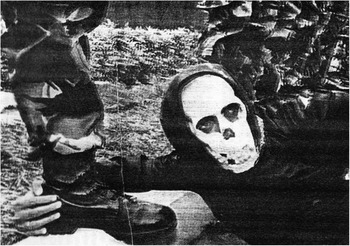
In response, demonstrations protested the army's alleged involvement in the killings. Demonstrators at the army Area Headquarters in Malang demanded that the apparatus “must defend the people and not … defend the elite, which pulls wool over the eyes of the people,” as recorded in the Surabaya Post (October 20, 1998, “Jangan Korbankan”). The Jawa Pos (October 29, 1998, “Aksi Ninja”) reported that in Surabaya, along with other political demands, a demonstration called for the apparatus to handle the issue (figure 1).
A photograph of a student demonstrator dressed in a ninja-like fashion grasping a soldier's boot, which appeared in the Jawa Pos on October 29, 1998. The accompanying caption reads, “One of the hundreds of student demonstrators at the Youth Oath Day (Hari Sumpah Pemuda) yesterday [which was] characterized by ‘ninja actions’ at the provincial government office in Surabaya City” (Kantor DPRD KMS).

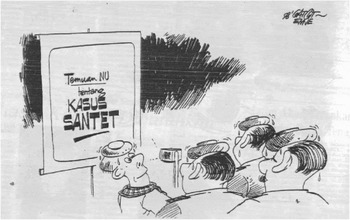
These were not the only reactions to the conspiracy. The NU announced a deadline for the apparatus to solve and settle the killings (October 29, 1998, “Kasus Banyuwangi”). Humorous cartoons in the Surabaya Post on December 3 and 9 depicted men in uniform, representing the army or apparatus, being adversely affected by the findings of the NU regarding the “sorcery case”—as if the NU findings would reveal what was really going on—namely, that the army was involved in the killings (figure 2).
A cartoon that appeared in the Surabaya Post on December 9, 1998. It depicts a projection on a screen that reads, “NU Findings Regarding the Sorcery Case.”

The Ninja Rumor
For a short time, the most gripping conspiracy theory was that the killings in Banyuwangi had been undertaken by ninjas, and these ninjas were also targeting traditionalist Muslims and their leaders. During October 1998, after the killings of sorcerers had subsided, this idea seems to have quickly spread throughout Banyuwangi, and then East Java.
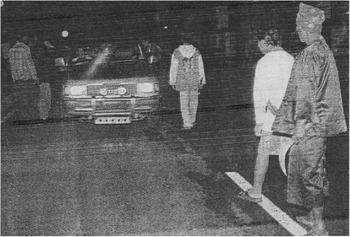
The notion that brigades of black-clad assassins were roaming the countryside provoked an alarmed response. Terrified of these ninjas, local communities began posting guards in villages and cities all around East Java (Figure 3). “Ninjas” were sighted, caught, and even killed. In the recollections of my participants, these events eclipsed the outbreak of killings of sorcerers such that the entire period is remembered as the “ninja period” (waktu ninja).
This photograph of local guards searching passing vehicles for ninjas in Jember appeared in the Surabaya Post on October 13, 1998. Note the knife (clurit) in the left hand of the man pictured in the foreground, as well as his style of dress, which is associated with martial arts.

Newspaper coverage provides a sense of how the rumor about ninjas developed. In September, articles related that ninja-like perpetrators had been responsible for the killings of sorcerers. In the Surabaya Post, the perpetrators were “dressed as ninjas” (September 18, 1998, “Dituduh Jadi”), “wore masks like ninjas” (September 27, 1998, “Isu Santet”), and “wore clothes a la ninja” in the Jawa Pos (October 10, 1998, “Bupati Banyuwangi Dituduh”). By mid- to late October, instead of being like ninjas, press reports related that the perpetrators were ninjas. The Jawa Pos (October 15, 1998, “NU Satukan”) reported on “the massacre and terror by ninjas.” By November's end, all of the evidence against the ninjas had been uncovered, according to the Surabaya Post (November 30, 1998, “Tim NU Serahkan”).
The ninja rumor merged with the conspiracy theory that the NU was being victimized. NU commentators asserted in the Jawa Pos (October 8, 1998, “Pembantaian ‘Dukun …’”) that ninjas were targeting traditionalist Muslims and their guru ngaji and kiai. This conspiracy theory seems to have developed quickly. Muslim leaders all over East Java reported receiving death threats (October 22, 1998, “Ulama Magetan”), being followed while driving (e.g., October 16, 1998, “Teror Kiai”), or receiving threats by telephone. “Mysterious” or unidentified people approached Islamic boarding schools or asked about local kiai (October 17, 1998, “Diduga Ninja”).
These ninja were conceived as having miraculous or supernatural powers. The Surabaya Post reported cases of ninjas who had been sighted but had disappeared into thin air (October 13, 1998, “Ninja Teror”; October 15, 1998, “Geropyok ‘Ninja’”; October 20, 1998, “‘Ninja’ Tembakkan”; October 21, 1998, “Polda Amankan”), put on masks and disappeared (October 14, 1998, “Warga Berjaga”), disappeared after jumping into a drain (October 16, 1998, “Gara-gara Isu”), or disappeared behind banana trees (October 13, 1998, “Dikira Ninja”). In some cases, after ninjas disappeared among banana trees, anxious local residents destroyed the trees (October 16, 1998, “Gara-gara Isu,” “Teror Kiai”). And, in one case, after a ninja transformed himself into a cat, cats were killed (October 16, 1998, “Gara-gara Isu”).Footnote 11
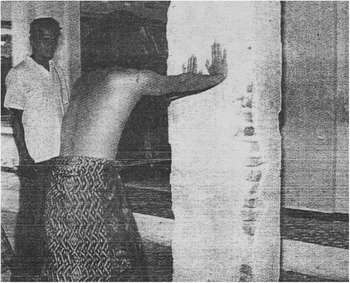
Perhaps the most comprehensive story, which appeared in the Surabaya Post (October 17, 1998, “Dari Isu”), can be summarized as follows: Someone at a Muslim boarding school saw two ninjas running fast and carrying chains. Two pedicab drivers (tukang becak) also saw two ninjas jump on top of a shop at the back of the boarding school. Young children in the boarding school saw two figures (sosok) that seemed to be flying over the tiles. One of the boarding school caretakers (pengasuh pondok) saw the ninjas teasing the students by jumping from one wall to another, and on top of trees. The ninjas then apparently stuck to a tree, and then disappeared. The students and local residents attacked the poinciana and banana trees. The police were called, and, unable to find the ninjas, they fired warning shots.Footnote 12 After the police left, the ninjas reappeared. The students managed to corner them before they stuck to a wall and disappeared again. Local citizens and students then attacked the wall. After touching the wall, two students fell into a kind of trance, as if electrocuted (figure 4).
This photograph appeared in the Surabaya Post on October 14, 1998. The photograph depicts the wall onto which two ninjas allegedly stuck themselves. The student in the foreground reenacts touching the wall that putatively gave students a shock. Brickwork showing through the plaster is possible evidence of an attack on the column.Footnote 13

In spite of their powers of invisibility and invulnerability, in almost all cases, the ninjas did not physically attack religious leaders. The few religious leaders who claimed to have been attacked also claimed to have successfully defended themselves, which implied that they had greater (supernatural) powers than those attributed to the ninjas (October 10, 1998, “Jember Mencekam”; October 18, 1998, “Guru Ngaji”). In all such cases, however, the ninjas left no trace or evidence of their “attacks,” or the evidence was discounted by the police.Footnote 14
Local residents vigilantly guarded their villages and kiai throughout the night (October 3, 1998, “Seorang Lagi”; October 11, 1998, “Massa Bunuh”; October 16, 1998, “Gara-gara Ninja”; October 17, 1998, “Diduga Ninja”). This increased surveillance was supported by state officials, including East Java's military command and the NU leadership, according to the Jawa Pos (October 1, 1998, “Pangdam Minta”), and by the governor, according to the Surabaya Post (October 16, 1998, “Dandim: Segera”). Spokespeople for traditionalist Islamic organizations urged the utmost commitment. The Surabaya Post (October 21, 1998, “Antisipasi Ninja”) recorded that residents in Gresik consulted martial arts experts and kiai to obtain invulnerability (ilmu kebal) and inner strength (tenaga dalam) in order to face the ninja.
Many “forms” were reputedly sighted during this period. I was told that a ninja had arrived in Tegalgaring, accompanied by the screams of local girls. Local residents gave chase, but it flew out over the rice paddies that surround the village before disappearing. This is consistent with ninja sightings in other places (October 16, 1998, “Diamankan, Orang”; October 17, 1998, “Isu Teror”).
Although ninjas could allegedly disappear, fly through the air, and stick to walls, some “ninjas” were caught with apparent ease by local residents. The Surabaya Post (October 21, 1998, “Polda Amankan”) reported that a mentally ill person had been caught and handed over to the police. In Sidoarjo, two “mysterious people” had been handed over to the police, according to the Surabaya Post (October 22, 1998, “Lima Ninja”). More than a week later, local residents seized two “ninjas” in Semarang, but the police managed to take the two into custody before they were attacked. These people were comparatively lucky (Figure 5).
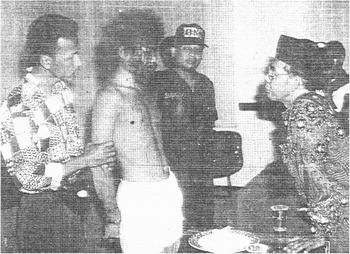
This photograph appeared in the Surabaya Post on October 20, 1998. It apparently portrays a man with a bloodied face being restrained while a kiai questions him. It also appears that a plate of food and drink is placed before him on a table. The accompanying caption reads, “A kiai questions an unknown person who was caught in Kalipare and is suspected of being a ninja.”

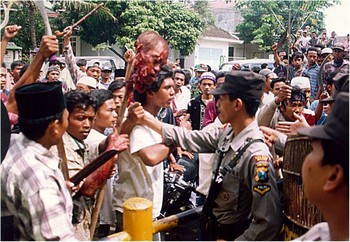
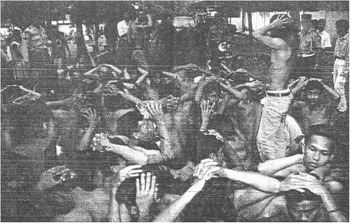
The crudely decapitated head shown in figure 6 most probably belonged to a “ninja” who was killed and then beheaded in Turen Subdistrict, Malang District (October 19, 1998, “Massa Makin”). A large “convoy” (konvoi) of motorcycles then paraded the head around several subdistricts of Malang. Fifty-four men from this convoy were subsequently arrested on October 19 (October 20, 1998, “54 Tersangka”) (figure 7). It appears the victim was Zaenal Arifin, who had come from Malang city and had a mental illness (sakit ingatan) (November 12, 1998, “BAP Pembantai”; October 21, 1998, “Pembawa Kelapa”; October 23, 1998, “Algojo ‘Ninja’”; October 29, 1998, “Tim Kejari”). By October 22, the Malang District Police had identified twenty-five people who had been either killed or victimized under suspicion of being ninjas (October 22, 1998, “Daftar Korban”). Newspapers recorded similar attacks and killings in other districts (Figure 8).
This photograph apparently portrays a decapitated head being surrendered to the police and a policeman's hand being shaken. As this image was only distributed on the Internet, many people in East Java probably did not see it. Some Internet images of violence in Indonesia from this period were of dubious authenticity or attribution (Tay Reference Tay and Coppel2006). Nevertheless, the image accords with an eyewitness description that I heard.

A photograph published in the Surabaya Post on October 20, 1998. The accompanying text explains, “The people who took part in the convoy which took a part of an unknown body who was considered to be a “ninja.””

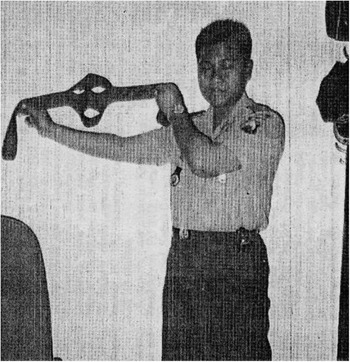
This photograph appeared in the Surabaya Post on October 29, 1998. It portrays a ninja mask being held up by a policeman. The caption reads, “A ‘ninja’ mask which was found on Raya Rungkut Industri Road, Wednesday (28.10) early in the morning, being examined by the Head of Rungkut Police.”

It appears that some of the “ninjas” killed by vigilant local residents were strangers. The Jawa Pos (October 13, 1998, “Dua Korban”) reported that two “strangers” in Balung Lor village had been taken to the village hall (balai desa). While detained there, it seems the rumor that the two were ninjas spread and intensified. Local residents then raided the village hall and beat the two to death. Other “strangers” appear to have been travelers who were stopped at roadside guard posts and requested to provide personal identification. If they failed to provide official documents, they were subject to suspicion. The Surabaya Post (1998, “Nasib Tiga”) also reported that beggars (pengemis) and itinerant workers were being taken for ninjas.Footnote 15
Many ninjas were also subsequently identified by family members or by the authorities as having been mentally ill (October 20, 1998, “‘Ninja Gila’”; October 24, 1998, “Psikiater Polda”; October 29, 1998, “‘Ninja’ Diklarifikasi”; October 29, 1998, “Dibanjiri Pasien”; October 30, 1998, “Sebanyak 36”). In East Java, mentally ill drifters (sometimes known as wong gembel) are a common sight, as they tend not to be institutionalized. While they might be teased or laughed at, their presence is generally accepted. As the ninja rumor spread, some local residents believed that the ninjas had metamorphosed into madmen. Local guards believed they were attacking ninjas, while to the police and victims' families, the guards were killing mentally ill itinerants. Surprisingly, in the Surabaya Post (October 22, 1998, “Banser Gresik”), an NU paramilitary (Banser) leader seems to have implied that the victims were not ninjas. He suggested that the police and government round up mentally ill people in order to “avoid the incorrect capture which results in pointless killing or assault.”
As Paul Cohen (Reference Cohen1997, 151) notes, rumors can remain intact in spite of contradictory evidence. Confronted with evidence that many of the victims were mentally ill, another conspiracy theory developed: when the mentally ill people were caught, other mysterious agents would arrive and defend them, and it was these mysterious agents who planned to attack kiai. Another embellishment of this conspiracy theory was that the madmen were “dropped” by mysterious agents (October 20, 1998, “‘Siapa yang …’”). Or, in yet another version, the “ninjas” captured by people and handed over to the police were then swapped for madmen. And, finally, in the Surabaya Post (December 9, 1998, “Khatib Suriyah”), the NU argued that the rumor of ninjas itself was an attempt to terrorize the NU.
Discussion
History furnishes us with many precedents for the events in Indonesia. For example, rumors also spread among war-weary Britons during the Great War that Germans had used a live priest as a church bell clapper in Belgium, and also that Russian reinforcements had passed through England with “snow on their boots.” A. J. P. Taylor attributes some of these rumors to fabrications by “ingenious journalists for want of better material,” but “most sprang from the general conviction that war was like that” (Reference Taylor1966, 57). This seems to point to the importance of oral communications in the spread of such rumors.
Among the Tiv of Central Nigeria, for example, several movements arose to identify people who had obtained power (tsav) through cannibalism, including one in 1939 called Yambua, or “Beef.” One report described a guard kept over a corpse: “There was a scare that a witch had come to eat the body; the guard pursued the supposed witch for some time; it turned into various shapes … It finished up as a goat on the edge of … town” (Bohannan Reference Bohannan1958, 7). In China during the Boxer Rebellion (1900–1901), rumors spread that Christians threatened the entire population. For fearful villagers, “every bush and every tree” appeared as the Christian-Western enemy, against whom the Boxers or “Heavenly Soldiers” offered supernatural protection. This sense of persecution helped the Boxers garner support (Cohen Reference Cohen1997, 158, 162, 168). Believing similar rumors in different contexts, people armed themselves and awaited armed Christians planning to gouge eyeballs, or anticipated Communists intent on indescribable evil in 1965–66 in Indonesia, or expected groups of French aristocrats tearing across the country bent on wanton pillaging during the Revolution.
State and Local Sovereignty
In defending themselves against “ninjas” and conspiratorial forces, local residents' actions were subversive. Clearly, if the attacked ninjas were humans, then the actions of the residents contravened state laws pertaining to assault and manslaughter. Additionally, local residents assumed powers associated with the state.
Checkpoints are, for Das and Poole, “sites where the state exerts its own seemingly arbitrary claims to sovereignty” (2004, 18). However, during October 1998, local residents established checkpoints throughout East Java. The subversive potential of this “arrogation” of power was reflected in a Surabaya Post (October 12, 1998, “Pembantaian Mereka”) report that the district head of Banyuwangi had been stopped at a roadblock. The head of the executive of Banyuwangi was thereby subjected to the impromptu authority of local residents.
Identification such as identity cards, passports, and birth, death, and marriage certificates are forms of documentation by which “the state claims to secure identities” (Das and Poole Reference Das, Poole, Veena and Deborah2004, 15). During the ninja period, local guards used documentation in a manner contrary to state control. The Surabaya Post (October 21, 1998, “Polda Amankan”) reported that a driver was found not to have an identity card or license and was taken to be a ninja. He was escorted to a police station, where his employer later confirmed his identity. The Jawa Pos (November 1, 1998, “Mobil Reserse”) reported another case in which a car with a number plate that was deemed suspicious was chased. It turned out to be undercover policemen, who, after showing their identity papers, were released.Footnote 16 Officers of the state were thereby subjected to a local authority that appropriated state documentation for its own purposes.Footnote 17
Finally, the state has the power to create certain bodies as killable. For example, the Nazi state first stripped Jews of citizenship then sent them to concentration camps (Das and Poole Reference Das, Poole, Veena and Deborah2004, 13). Possibly, some ninja killers did not suspect that they were attacking supernatural beings, but rather humans who were a form of “bare life.” If this were the case, it would seem that local residents “arrogated” state power, as the power to decide who lives or dies is usually associated with the state. Local residents undertook these subversive actions in a climate of fear. But what made their fears about ninjas and conspiracies so credible?
Credibility of Conspiracy Theories
The conspiracy theories might have been plausible because army, police, and political leaders espoused them. The East Java regional commander implied that those arrested for the killings of “sorcerers” were acting on orders from a higher authority. He stated that it was necessary “to catch the head, not the tail” (October 24, 1998, “Pangdam: Yang”), and that the conspirators were experimenting in East Java and intending to use these techniques elsewhere (October 27, 1998, “Isu Santet”). Similar opinions were attributed to, among others, East Java's police chief (October 10, 1998, “Setelah Penjarahan), East Java's governor (October 22, 1998, “Saya Yakin”), and a national minister (October 15, 1998, “Menko Polkam”). Furthermore, almost all of the officials whom I met, including police, army, and government officials, agreed that there was a conspiracy.
Spokesmen from the army, police, and executive, among others, seemed to blame other arms of government. For example, in a Jawa Pos article (October 8, 1998, “Pembantaian ‘Dukun …’”), the governor of East Java “maintained that he had not received a report regarding the two armed forces oknum who were involved in the butchery.… Indeed [their involvement] is possible. But, I have yet to receive a concrete report. I know because I read about it in the newspaper. It was your newspaper that wrote about that issue,” said [the governor] answering questions from the Jawa Pos.” This phenomenon could be attributed to higher levels of fragmentation and vulnerability apparent within the ruling class/elite during Reformasi. Furthermore, the “authorities” lost control of information—the governor sought information from the newspaper, which was seeking information from him. Whatever the reasons for it, the authorities' acceptance of a conspiracy may have influenced other people to believe it.
Another factor that possibly made the conspiracy theories credible is their murkiness and flexibility (Bubandt Reference Bubandt2008, 812). Although I have analyzed conspiracy ideas such as the “army conspiracy,” “Communist Party,” and “ninja rumor” as separate ideas, while circulating in October and November 1998, elements of these and other conspiratorial ideas apparently melded together and morphed, surviving almost by virtue of their murkiness. Inconsistency among the various theories did not seem to count against their credibility. Similarly, ninjas, as they were imagined during this period, encompassed mentally ill drifters, mysterious and magical assassins, clandestine paramilitary or army forces, undercover policemen, travelers without proper identification, chickens, cats, and so on.Footnote 18
Perhaps the clearest evidence of the vagueness and changing manifestation of the ninja rumors pertains to the killers of sorcerers in Banyuwangi. Some wore sarongs or T-shirts around their heads when killing sorcerers. Mahmud, for example, reported that some of Yasin's other killers had done this. They may have been influenced by the head coverings (a T-shirt or sarong tied around the head) sometimes worn by protestors in big demonstrations during the Reformasi period. They may also have been concealing their identities. Additionally, they may have been eager to exploit the sense of a mysterious, deadly, and supernatural power that “ninja” conveys. Whatever the reason for wearing head coverings, in all of the killings I researched, the killers were simply local people who killed other local people whom they believed to be sorcerers. Nevertheless, such killers were subsequently equated with ninjas. None had any inclination to kill Muslim leaders. Like Mahmud, who was involved in “guarding religious leaders” in Watukebo, they established checkpoints to protect against ninjas. Apparently, they were unaware that their wearing “ninja masks” may have been the source of the rumor about ninjas—perhaps they could not identify themselves as evil and supernatural killers of kiai. Yet during interrogations, the police accused some of them of being ninjas. After being incarcerated for the murder of a sorcerer, one participant reflected that during “the ninja rumors the entire community (masyarakat) was on guard. [Yet] all the people in prison were thought to be ninjas.” Imron, who was jailed for the murder of the sorcerers Basir and Hairyah, complained that after the two were killed, “then there was the ninja rumor … I was on guard [against ninja] for thirty days, and yet I was detained as a ninja … those police pigs said ‘Yeah you're all ninjas.’” In this way, some of the same people who participated in guarding against ninjas were eventually called “ninjas.” Like the putative ninjas themselves, the stories about them could “morph” and were seemingly invulnerable.
Commentators from nongovernmental organizations and parties may also have lent credibility to conspiracy theories. The NU, in particular, was portrayed as vigilantly seeking to uncover the source of the alleged conspiracy. It obtained privileged status as the most popular “oppositional” organization and a legitimate news source. The Surabaya Post (December 3, 1998, “Soal Investigasi”) reported that “the NU will strive to get to the bottom of this case, whatever the political risk this is a most serious issue.” NU claims regarding the extent of the conspiracy, and evidence of it, became increasingly extravagant. At the end of November, an NU spokesman announced in the Surabaya Post (November 30, 1998, “Tim NU Serahkan”) that the organization had “located the training grounds for the ninjas, [personnel] who had been recruited by the ninjas, and so on.” This evidence was never released. Although the press and the leaders of the East Java executive, police, and army requested the details, over the next few days, the leaders seemed to be unavailable to the Surabaya Post (December 2, 1998, “Kapolda Minta”), or to avoid the question when it was put by the paper (November 30, 1998, “Tim NU Serahkan”; December 3, 1998, “Ketua PW NU”; December 3, 1998, “Choirul Anam”; December 4, 1998, “Gus Dur Membenarkan”). Gus Dur reportedly stated in the Surabaya Post (December 4, 1998, “Gus Dur Membenarkan”), “the data that has been exposed still hasn't covered all of the truth.” Later, the Surabaya Post (December 7, 1998, “Soal Investigasi NU”) reported, “The proof collected by the NU's Investigation Team, among other things includes a recording of a confession of an armed forces mysterious agent (oknum) who admitted to training provokator, video clips of the occurrences, [and] the location where junior provokator were trained.” Finally, the NU released a report (Lakpesdam-NU 1998), but it received little attention. It contained no evidence to corroborate the NU claims and provided only a large amount of innuendo. Nevertheless, the NU's reputation of “defending the truth” (membela yang benar) probably lent it an authoritative voice in this affair.
Having been marginalized during the New Order period, the NU was one of many organizations that were jockeying to occupy new positions of power with a parliamentary session and elections imminent (Gerry van Klinken, personal communication, 2008). Indeed, the NU's political arm, the Partai Kebangkitan Bangsa (People's Awakening Party), obtained a large share of the vote in the 1999 election both in East Java and nationally. Going by the press reports, it is possible that the NU was actively engaged in spreading, if not creating, the rumor: Bubandt refers to Gus Dur as “an ardent trafficker in conspiracy theory” who used these theories as a “political weapon” (2008, 808). Nevertheless, although the NU's political arm may have benefited from being portrayed as the victim of a conspiracy, this is not conclusive evidence that the organization consciously engineered the ninja rumor.
The operation of the press is also important in understanding the credibility of these rumors. Jawa Pos and Surabaya Post articles are generated almost entirely from commentators. Reporters and editors do not often undertake their own research or verify commentators' opinions. Nor, it seems, are they expected to. As has been demonstrated, the commentators mostly espoused conspiracy theories. Out of hundreds of articles, I found only a few that printed commentators' opinions that were nonconspiratorial. For instance, in the Surabaya Post (October 15, 1998, “Sutarmas Menyeslakan”), the speaker of the East Javanese parliament questioned the conspiracy theories, and in the Jawa Pos (October 18, 1998, “Gus Dur: Dalang”), a member of Komnas HAM asserted that local people (not outsiders) had admitted to being the killers of sorcerers. But these were exceptions.
Where they were printed, opinions from editors and reporters were equivocal: on the one hand, reporting that the existence of ninjas was a rumor (without attempting to establish its veracity) and, on the other, reporting as if it were fact. Headlines were even more blatantly conspiratorial than the content of the articles. A typically evocative Surabaya Post (October 22, 1998, “Lima Ninja”) headline announced, “Five Ninjas to Be Charged for Criminal Offences” (“Lima Ninja Akan Dipidanakan”). The detail of the article records that police had identified the five men as drifters and were intending to hand them over to the Social Affairs Department. The Surabaya Post and Jawa Pos thus helped spread the rumors to a large audience, and contributed to their plausibility.
However, the important issue is not what was written, so much as how readers responded. This response would have been tempered by a skepticism aptly expressed in a participant's opinion that, “as for the Jawa Pos, they see something black and call it white. Not even half [of what they write] actually occurred.” Nevertheless, it seems it was one thing to profess such skepticism, but quite another to put it into practice.
The plausibility of conspiracy theories might also be tied to their general popularity in Indonesia. The idea of “elite instigation” has become so “pervasive and legitimate” in both “folk and intellectual” explanations of political and violent phenomena that “everybody was a conspiracy theorist” (Bubandt Reference Bubandt2008, 807, 809). The Indonesian state, particularly the army, had covertly used extralegal violence in the past. For Bubandt, conspiracy theories are thus “sensible” (2008, 810). Furthermore, the army was, in some ways, thought to represent all that was wrong with the Soeharto regime. A conspiracy, particularly an army conspiracy, thus might have seemed plausible.
As for the specific idea of ninjas, this might have been credible for different reasons. In this period, members of the Indonesian army (Aditjondro Reference Aditjondro and Sluka2000, 172; Kammen Reference Kammen, Benedict and O'G2001, 167–68, 172), among others, were reputed to have dressed as ninjas in some operations. The killings in Banyuwangi seemed to point to a similar style of operation. Ninjas also fitted into preexisting conceptions. East Javanese people generally believe in supernatural agents such as genies and sorcerers. Movies and television shows that portrayed ninjas as deadly assassins may also have contributed to the image.Footnote 19
These factors might help explain a contradiction that I have identified. Local research participants knew the killers of a local sorcerer because these killers were other local residents, yet the same participants were sure a that conspiracy lay behind killings in other villages. Many did not provide any reason, whether valid or not, to indicate a conspiracy. Others, such as Mahmud, did provide reasons for believing that a conspiracy lay behind the killings. With other local residents, and without “outside” interference, he undertook the killing of Yasin. He and other killers were arrested after ridding the village of a sorcerer who had, after all, “killed” people. Furthermore, the police and judge said that the sorcerer Yasin was a kiai. For him, this was evidence that “it was all engineered by the police.”
Other participants provided hearsay evidence. For example, the head of a neighboring village related that local residents of “his” village “thought that the military was involved in [the killings of sorcerers in] Tegalgaring,” my fieldwork location. In fact, the killers in Tegalgaring were all local people acting on their own initiative. Such hearsay evidence of a conspiracy probably contributed to the spread of conspiracy theories in East Java.
The credibility of ninjas seems more ephemeral. For local residents, ninjas who were sighted were apparently mysterious and nameless. Skepticism has now largely replaced the terror of the sighting.Footnote 20 By contrast, no participants doubted the guilt of the local sorcerers and the conviction of their guilt remained decades after the sorcerers died or were killed.
Rumor: Mass Media and Word of Mouth
The newspapers' representations of conspirators and ninjas are reminiscent of what Cohen describes as a “moral panic” (1980, 9–10). He is concerned with the labeling of groups of people (particularly from the lower classes) as deviants or folk devils, and maintains that class struggle underlies moral panic. The ruling class directs suspicion toward the lower classes through its agents—the media, the police, and the courts.
The 1960s England that Cohen described was a comparatively organized, industrialized, and stable society. Radio, newspaper, and television (the “old” media) had become a major, perhaps the predominant, form of communication. The social groups that controlled the broadcast stations and printing presses had pervasive influence over the communication of ideas, and thus were capable of creating “folk devils” and moral panic, according to the argument.
This concept of a society in which the mass media are accepted as a credible source of information and local communication plays only a minor role is only partly applicable to East Java in 1998. The role that nongovernmental organizations played indicates that the development of the rumor did not follow a simple model of the ruling class controlling or influencing the lower class. Moreover, in many East Javanese villages, newspapers were not sold, but they were brought in. The contents of any papers were likely to be spread, not only by passing on the paper but also, more significantly, by talking. Hence, the main difference in East Java was the role of face-to-face communications in covering local, regional, and national events. Kabar angin or “news spread by the wind” drove the local rumor mills, and information about conspiracy theories and ninja sightings was also transmitted in this fashion. The rumors spread in a decentralized manner, through networks of connections (one person meeting and chatting with another), thus creating a “Great Fear.” Regardless of where the rumors emanated from, in the generation of the conspiracy and ninja theories in 1998, it seems that the two forms of communication interacted—the press fed into local gossip, and vice versa. Not only were the conspiracy theories received pre-processed from the media, but also they were generated and interpreted at a local level, and fed back into the media. This local involvement helps explain how the rumors could be directed against the government and the elite. While in 1960s England, the mass media were “the major promoters of moral panics” against the lower classes (Cohen Reference Cohen1980, xxii), in East Java in 1998, suspicion was directed “upward.” This great rumor mill was generated by the conjunction of the “wind” of local gossip and the turning of the printing press.
Acknowledgments
Thanks to Greg Acciaioli, David Bourchier, Raelene Wilding, Robert Cribb, and Ariel Heryanto.