CHD is the most common birth defect in the United States of America. CHD-related mortality has decreased for the past two decades, and most CHD patients live well into adulthood. Reference Razzaghi, Oster and Reefhuis1 Children with CHD consume a disproportionate share of healthcare resources – nearly $6 billion in annual spending. Prior work studying resource use in CHD patients has considered age- and disease-related factors, but the relationship of race and ethnicity with resource use remains understudied. Reference Edelson, Rossano and Griffis2 There is growing evidence that race and ethnicity may be associated with CHD outcomes. Reference Grines, Klein and Bauser-Heaton3 We identified associations between race, ethnicity, and resource utilisation in children with CHD using self-reported National Health Interview Survey data.
Methods
This study did not require Institutional Review Board approval as all data used were de-identified and publicly available. Data supporting the findings of this study are available on request from the corresponding author.
We analysed National Health Interview Survey data for years 2010–2018. The National Health Interview Survey is a representative, cross-sectional survey of United States of America households and includes data on one random child (age ≤17 years) per household surveyed. Reference Razzaghi, Oster and Reefhuis1 Children with self-reported CHD and Non-Hispanic Black race, Non-Hispanic White race, or Hispanic ethnicity were included. We identified each child’s sex, age, region of residence, comorbidities, and four measures of resource utilisation for the prior year: 1) primary place of care visited when sick, 2) if the child received well-child checkups, 3) number of emergency department visits, and 4) number of office visits (visits to a clinic/doctor’s office to be seen by a physician or other provider). For primary places of care, “Clinic or Health Center” includes company/school clinics, community/rural/migrant clinics and centres, and public hospital outpatient clinics. “Doctor’s Office or HMO” includes private doctor’s offices and clinics, HMOs, and prepaid groups. For all group-specific proportions, 95% confidence intervals were tabulated using the Wilson method. Differences in distribution and proportions across racial and ethnic groups were tested with Kruskal–Wallis and Fisher’s exact tests, as appropriate. We then determined associations between race, ethnicity, and likelihood of having an emergency department visit by fitting a multivariable logistic regression model. The dependent variable was a binary variable indicating if a child had ≥1 emergency department visits during the study period. The independent variables were sex, age, region of residence, presence of Down Syndrome, presence of anaemia, Black race, and Hispanic ethnicity. Cerebral palsy and cystic fibrosis were excluded as covariates due to low frequencies in the overall sample. All analyses were performed using R software, version 4.1.0 (R Foundation). p ≤ 0.05 was considered significant.
Results
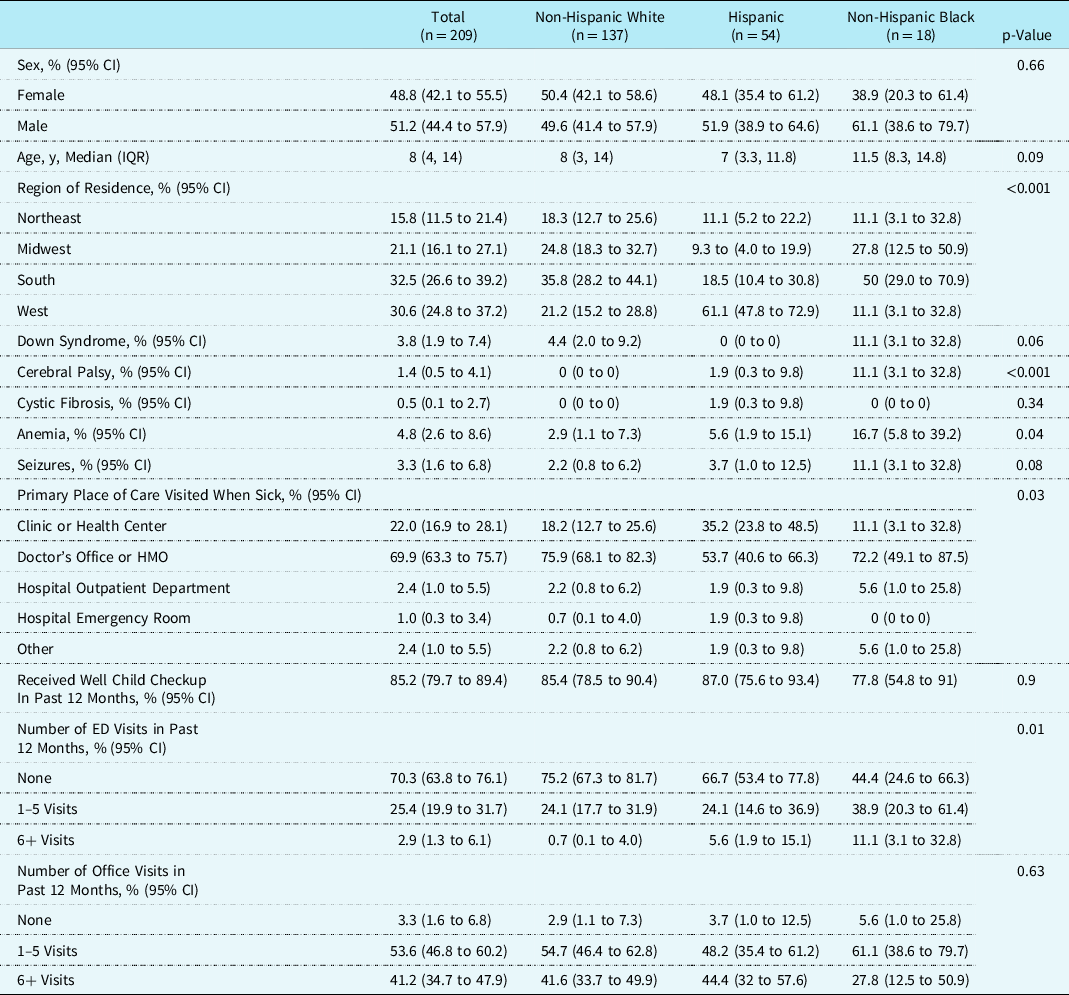
Of 104,154 children in the National Health Interview Survey in the study period, 232 had self-reported CHD and 209 were Non-Hispanic Black, Non-Hispanic White, or Hispanic. CHD respondents were 51.2% (95% CI, 44.4–57.9%) male and median 8 years of age. Race and ethnicity were significantly associated with geography, as 50% (95% CI, 29.0–70.9%) of Non-Hispanic Black children resided in the South, compared to 35.8% (95% CI, 28.2–44.1%) and 18.5% (95% CI, 10.4–30.8%) of Non-Hispanic White and Hispanic children, respectively. Non-Hispanic Black children had higher rates of cerebral palsy and anaemia than Non-Hispanic White and Hispanic children. There were no significant differences in well child checkups and office visits. However, 11.1% (95% CI, 3.1–32.8%) of Non-Hispanic Black children had ≥6 emergency department visits in the prior year, compared to only 0.7% (95% CI, 0.1–4.0%) and 5.6% (95% CI, 1.9–15.1%) of Non-Hispanic White and Hispanic children, respectively (p = 0.01). Further, 72.2% (95% CI, 49.1–87.5%) of Non-Hispanic Black children and 75.9% (95% CI, 68.1–82.3%) of Non-Hispanic White children primarily received care in doctor’s offices/HMOs, compared to 53.7% (95% CI, 40.6–66.3%) of Hispanic children (p = 0.03). Hispanic children had higher rates of care received at clinics/health centres (35.2%; 95% CI, 23.8–48.5%) than Non-Hispanic Black and Non-Hispanic White children (Table 1).
Demographic characteristics, comorbidities, and selected health outcomes of paediatric respondents of the NHIS with CHD, 2010–2018.

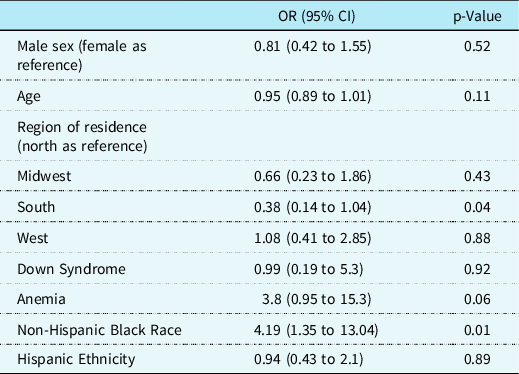
The results of the logistic regression model assessing relationships between race, ethnicity, and likelihood of having an emergency department visit are provided in Table 2. Black race was associated with significantly higher odds of having an emergency department visit than White race (OR = 4.19, 95% CI: 1.35–13.04, p = 0.01). Hispanic ethnicity was not significantly associated with emergency department visit.
Association between sex, age, region, comorbidities, race, ethnicity, and likelihood of ED visit among children with CHD surveyed in NHIS 2010–2018.

Discussion
In this study, we found that race and ethnicity were significantly associated with primary locations of care and number of emergency department visits in the preceding year among National Health Interview Survey respondents with CHD. We also found that Black race was associated with increased odds of having an emergency department visit relative to White race, despite zero Non-Hispanic Black respondents indicating that their child’s primary source of care when sick was the emergency department. This finding, in particular, may suggest a pattern of overall increased resource utilisation or a pattern of increased referrals to the emergency department following office visits. Prior studies have used database and/or multi-centre data, so this evaluation of self-reported National Health Interview Survey data offers a novel and potentially more generalisable assessment of race, ethnicity, and resource utilisation. Our findings underscore racial and ethnic disparities in resource use among paediatric CHD patients. Such disparities likely reflect differences in insurance rates/types, socio-economic status, maternal education, and prenatal CHD diagnosis across racial/ethnic groups. Reference Grines, Klein and Bauser-Heaton3,Reference Kucik, Nembhard and Donohue4 While the National Health Interview Survey does not provide data on proximity to locations of care, geographic variation in our findings on race/ethnicity may be explained by factors like driving time to nearest health centre. Efforts to improve access to long-term follow-up care for minority and rural communities are warranted. Reference Lopez, Morris, Sexson Tejtel, Espaillat and Salemi5,Reference Lopez, Baker-Smith and Flores6
This study has several limitations. National Health Interview Survey data does not specify type of CHD, and resource use may vary by lesion complexity. However, racial disparities in CHD outcomes have been observed across many lesion types, suggesting an independent association between socio-demographic factors, outcomes, and resource use. Reference Lopez, Morris, Sexson Tejtel, Espaillat and Salemi5,Reference Peyvandi, Baer and Moon-Grady7 Further, CHD prevalence in our sample is relatively low, which is likely due to the cross-sectionality and self-reporting bias of National Health Interview Survey data. However, the National Health Interview Survey offers a representative cohort of CHD patients that is diverse across geography, age, race, and ethnicity, whereas most prior studies have relied only on select CHD populations. Our results highlight persistent racial and ethnic disparities in resource use despite overall improvements in CHD mortality, suggesting that systemic factors in access to and utilisation of healthcare resources must be considered in addressing these inequities. Further work is needed to evaluate the role of insurance, socio-economics, and structural barriers in perpetuating racial and ethnic disparities in resource use among CHD patients.
Acknowledgements
None.
Financial support
This research received no specific grant from any funding agency, commercial, or not-for-profit sectors.
Conflicts of interest
None.