INTRODUCTION
Relative clauses (RCs) have been studied extensively in developmental and adult psycholinguistics (Gibson, Reference Gibson1998; Kidd, Reference Kidd2011). A common theme in experimental studies has been comparisons of performance on subject and object relative clauses. A well-established finding in the literature is that, with some qualification, subject RCs such as (1) are acquired earlier and are easier to process than object RCs, as in (2) (e.g., Diessel & Tomasello, Reference Diessel and Tomasello2000, Reference Diessel and Tomasello2005; Gibson, Reference Gibson1998).
(1) The horse that __ kissed the cow.
(2) The horse that the cow kissed __.
Numerous formal and functional explanations have been put forward to explain this result. Formal syntactic approaches predict a universal subject-over-object preference in RC acquisition (e.g., Friedmann, Belletti & Rizzi, Reference Friedmann, Belletti and Rizzi2009). Following Chomskyan theory (Chomsky, Reference Chomsky1995), the approach assumes that syntactic derivation does not differ qualitatively across languages; therefore the subject-over-object advantage is predicted to hold cross-linguistically.
Alternatively, processing accounts predict that comprehension is the outcome of the integration of multiple constraints on interpretation, both syntactic and non-syntactic (Bates & MacWhinney, Reference Bates, MacWhinney, MacWhinney and Bates1989; Gennari & MacDonald, Reference Gennari and MacDonald2008; O'Grady, Reference O'Grady and Kidd2011). These accounts argue that object RCs like (2) are difficult in languages such as English because they are distributionally infrequent and as such incur a large processing cost. Consistent with this argument, studies that have tested children on distributionally frequent object RCs report no or an attenuated subject–object asymmetry (e.g., Arnon, Reference Arnon2010; Brandt, Kidd, Lieven & Tomasello, Reference Brandt, Kidd, Lieven and Tomasello2009; Kidd, Brandt, Lieven & Tomasello, Reference Kidd, Brandt, Lieven and Tomasello2007). Operationalizing complexity with respect to distribution predicts cross-linguistic differences in acquisition. Data from Basque (Gutierrez-Mangado, Reference Gutierrez-Mangado2011), Cantonese (Chan, Matthews & Yip, Reference Chan, Matthews, Yip and Kidd2011; Yip & Matthews, Reference Yip and Mathews2007), Japanese (Ozeki, Reference Ozeki and Kidd2011; Suzuki, Reference Suzuki2011), and Quechua (Courtney, Reference Courtney2006) show that children acquiring these languages either exhibit a clear preference for object RCs or do not experience any difference in difficulty between subject and object RCs, suggesting that the subject–object asymmetry is not universal.
In the current study we investigated Persian-speaking children's comprehension of subject and object RCs. Persian is a null-subject head-final language with Subject-Object-Verb (SOV) word order (Karimi, Reference Karimi2005). Persian RCs are post-nominal, only allow gaps in subject RCs (3), but allow either a gap, resumptive pronoun, or object clitic in object RCs, as shown in (4)–(6) (for more general information about Persian RCs see Rahmany, Marefat & Kidd, Reference Kidd2011).
(3) sæg-i ke ___ æsb ra gereft
dog-rm that ___ horse om grab past 3sg 3
‘The dog that grabbed the horse’
(4) sæg-i [ke [æsbe gereft __ ]]
dog rm [that [horse grab past 3sg __ ]]
‘The dog that the horse grabbed’
(5) sæg-i [ke [æsbe u ra gereft]]
dog-rm [that [horse it-resumptive pronounom grab past 3sg]]
‘The dog that the horse grabbed’
(6) sæg-i [ke [æsbe gereft-eš ]]
dog-rm [that [horse grab past 3sg- it resumptive clitic ]]
‘The dog that the horse grabbed’
Persian RCs are introduced by a relative marker (RM) -i attached to the head noun, as in (3). Persian does not have relative pronouns: the RC is always introduced by the relative complementizer ke. Thus the complementizer is invariant; it takes the same form regardless of the animacy, gender, grammatical function, or number of the head. Resumptive pronouns and clitics are marked for number, and in 3PS contexts resumptive pronouns make an animate/inanimate distinction (i.e., s/he vs. it). Finally, in Persian verbs are inflected for number and person, and specific objects are marked by râ, ro, or o (OM=object marker). The OMs are restricted in distribution: they are obligatory in gapped subject RCs and in object RCs containing resumptive pronouns, but are ungrammatical in gapped object RCs and object RCs containing a resumptive clitic. The three forms are allomorphs: râ is used in the formal register; ro and o are used in colloquial speech.
Persian RCs are interesting for two reasons. First, gapped subject and object RCs constitute a minimal pair distinguished only by the overt OM in subject RCs. This means that children must delay thematic role assignment until they identify the presence/absence of the OM. Since both arguments come before the verb, several processing theories predict no subject–object asymmetry (Gibson, Reference Gibson1998; O'Grady, Reference O'Grady and Kidd2011). Second, Persian allows optional resumptive pronouns and clitics in object RCs, which processing approaches predict facilitate comprehension (Arnon, Reference Arnon, Brugos, Clark-Cotton and Ha2005). We next consider this latter prediction in more detail.
Resumptives in the acquisition of RCs
Early discussions on the role of resumption in acquisition focused on whether or not their presence in children's productions of non-subject RCs were indicative of a problem with movement in child grammar (Guasti & Shlonsky, Reference Guasti and Shlonsky1995; Labelle, Reference Labelle1990; Pérez-Leroux, Reference Pérez-Leroux1995; see also Friedmann et al., Reference Friedmann, Belletti and Rizzi2009). The results of other studies suggest that resumptives might serve a functional purpose; specifically, they might allow children to track and assign thematic roles in syntactically complex contexts, an effect which may have motivated their use even in languages where they are considered to be ungrammatical. We review this evidence below.
McKee and McDaniel (Reference McKee and McDaniel2001) reported on three studies that investigated English-speaking children's and adults' production and comprehension of a range of sentences containing resumptive pronouns. A detailed description of the study is beyond the scope of this paper; however, two results are relevant. First, children aged 3;5–8;11 produced resumptive pronouns in object RCs (and other complex syntactic environments) at significantly higher rates than adults. Similar effects were observed in a grammaticality judgement task. McKee and McDaniel argued that the effects were due to developmental differences in parsing, suggesting that children ‘shunt’ clauses out of active memory earlier than do adults, and therefore produce and accept resumptives at a greater rate in order to reactivate a head. Recent on-line processing research has reported similar effects for English-speaking adults, suggesting that resumptives continue to alleviate complexity in the adult system (Hofmeister & Norcliffe, Reference Hofmeister, Norcliffe, Hofmeister and Norcliffe2013).
Arnon (Reference Arnon, Brugos, Clark-Cotton and Ha2005) investigated four- to five-year-old Hebrew-speaking children's comprehension and production of subject and object RCs using both comprehension (picture-pointing) and elicited production. Unlike in English, the use of resumptive pronouns in object RCs is a permissible (although infrequent) grammatical option in Hebrew. Arnon observed an intriguing pattern of results across the two tasks: those children who produced the most resumptive pronouns in the elicitation task (in 80% of all object RC contexts) performed almost at floor on gapped object RCs in the comprehension task (15% correct). Across the entire sample, the tendency to use resumptives strongly correlated with errors in comprehension (r=0·57). A small follow-up study tested children (N=7) who performed poorly on the comprehension component of the main study by directly comparing the comprehension of gapped object RCs and object RCs containing resumptive pronouns using picture-pointing. The presence of a resumptive pronoun doubled the children's correct responses and significantly reduced their tendency to make errors of thematic role assignment. For instance, the presence of a resumptive pronoun significantly reduced the tendency for children to interpret the granny in the granny that the girl kisses as the agent rather than the patient. Overall, these data suggest that the use of resumptive pronouns in production is associated with difficulty comprehending gapped object RCs, whereas their presence in the input facilitates comprehension by aiding thematic role assignment.
Overall, past results suggest that resumptives might serve a useful function, helping children to reliably monitor participant roles in production, as well as alleviating the traditional difficulty associated with long-distance dependencies in comprehension. The current study investigated three- to six-year-old Persian-speaking children's comprehension of (i) gapped subject and object RCs, as well as object RCs that contained either (ii) a resumptive pronoun or (iii) an object clitic. Two comparisons were of interest. First, our primary aim was to determine whether resumption facilitates comprehension of object RCs. Following Arnon (Reference Arnon, Brugos, Clark-Cotton and Ha2005), we predicted that object RCs with resumptive pronouns and clitics would be comprehended significantly better than gapped object RCs. A secondary aim was to compare children's comprehension of gapped subject and object RCs. Processing theories that define complexity as the linear distance between verbs and their arguments predict no asymmetry in Persian, since gapped subject and object RCs have the same NNV word order (Gibson, Reference Gibson1998; O'Grady, Reference O'Grady and Kidd2011). Previous work on Persian reported a subject advantage in acquisition (Rahmany et al., Reference Rahmany, Marefat and Kidd2011); however, this previous study did not present the test sentences with a supportive discourse context, which significantly affects children's performance (see Corrêa, Reference Corrêa1995). In the current study we presented sentences to children in a felicitous discourse context; we therefore predicted no subject advantage.
METHOD
Participants
Sixty-four (N=64, 39 female) monolingual Persian-speaking children aged 3;2–6;0 (M=4;8, SD=0;8) were recruited from a nursery school in Tehran. This age range was chosen because past studies have shown that children of this age are likely to both frequently use resumptives and benefit from their presence in comprehension (Arnon, Reference Arnon, Brugos, Clark-Cotton and Ha2005; McKee & McDaniel, Reference McKee and McDaniel2001). All participants were typically developing with no noted language impairments, hearing deficits, neurological difficulties, or social, emotional, or behavioral problems.
Materials and procedure
The children were tested in a quiet room of their nursery using the referent selection task developed by Brandt et al. (Reference Brandt, Kidd, Lieven and Tomasello2009). They were introduced to pairs of toy animals (bear, horse, elephant, cow, dog), which were distinguishable by color (e.g., a brown dog and a white dog). During a warm-up session the children were asked to name each animal type; all children knew every animal.
The referent selection task presents two narrated background scenes to children that provide a felicitous discourse context for use of a restrictive relative clause (for a discussion of the importance of context, see Corrêa, Reference Corrêa1995; Kidd, Reference Kidd2003). In the current study the background scenes also provided a felicitous context for the use of resumptives, since their status as pronominal elements requires that they have antecedents in discourse. For example, in one item there was a dog, a cat, and two horses. The background scenes proceeded as in (7).
(7) ‘The dog kisses this horse. The dog pushes the other horse.’
The experimenter simultaneously narrated and acted out each background scene. They were immediately followed by a distractor scene; for example, ‘Now the dog goes swimming’. The function of the distractor scene was to provide a buffer between the background scenes and tests scenes, which served to minimize recency effects when children were required to choose between the two tokens of the head upon hearing the test sentence. The test sentence was then presented, as in (8).
(8) ‘Can you give me the horse that the dog kissed?’
The child's task was simply to choose the appropriate token of the head referent, thereby demonstrating that they had processed the RC as a noun modifier. The experimenter repeated the test sentence once if the child did not pick up or unambiguously point to a referent. After one repetition the experimenter continued with the next item. The referents and their positions were counterbalanced so that half of the time the target referent was introduced in the first background scene and the other half of the time it was introduced in the second background scene. Similarly, half of the time the target appeared on the left side of the table and the other half of the time it appeared on the right side. In addition, the order of presentation was pseudo-randomized such that test sentences from the same condition did not appear twice in a row. The verbs used were ‘wash’, ‘pull’, ‘grab’, ‘hit’, and ‘kiss’, all of which are one-part Persian verbs (i.e., no compound verbs were used). The task consisted of twenty-one items (4 subject RCs, 4 gapped object RCs, 4 object RCs containing a resumptive pronoun, 4 object RCs containing a resumptive clitic, and 5 fillers).
RESULTS
Each response was coded as correct or incorrect. Table 1 shows the children's average performance on each structural type. Overall, the children performed similarly on subject RCs and gapped object RCs, but their performance on both object RCs with a resumptive pronoun and an object clitic was approximately 10% higher than both gapped structures.
Mean proportion correct and standard deviation for each structural type

note: N=64.
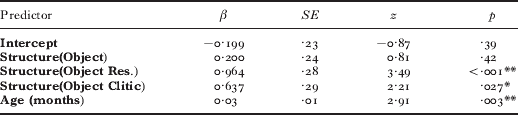
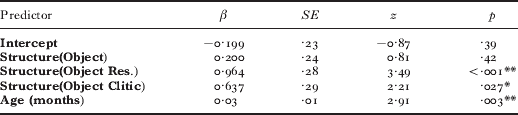
The data were analyzed using Generalized Linear Mixed Models (GLMM) (Jaeger, Reference Jaeger2008), which were calculated using the lme4 package for Linear Mixed Effects (Bates & Maechler, Reference Bates and Maechler2010) in R (version 2.14.2; R Core Development Team, 2008). Structural type (4 levels: subject, object, object–resumptive pronoun, object–object clitic) and age (in months) were included as fixed effects. Structural type was centered with a mean of 0 and range of 1; age was mean centered. Participants and items were included as random effects in order to account for by-subject and by-item variation. Additionally, by-subject random slopes were included for structure type to control for individual variability in performance across conditions. Both random effects and the by-subject random slopes significantly contributed to model fit. However, the structure by age interaction term did not and was therefore removed (χ2(3)=·75, p=·86). The final model is shown in Table 2.
Summary of the final model (reference level for fixed effect of structure type: subject RC)
notes: * p<·05, ** p<·01, *** p<·001; log likelihood=−666·1.
Table 2 shows a positive main effect of age, reflecting the fact that accuracy increased with age. The children did not differ in their performance on gapped subject and object RCs; however, they were significantly more accurate on object RCs with either a resumptive pronoun or an object clitic than on subject RCs. Subsequent analyses showed that the children's performance on object RCs with resumptives was significantly better than their performance on gapped object RCs (β=0·51, z=2·66, p=·008). The difference between object RCs containing a resumptive clitic and gapped object RCs was marginal in the same direction (β=0·35, z=1·92, p=·055). Performance on object RCs with resumptive pronouns did not differ from performance on object RCs with resumptive clitics (β=0·16, z=84, p=·4).
Error analysis
Children tend to make two errors in the referent selection task: (i) ‘Head Token’ errors, where they choose the incorrect token of the head referent, and (ii) ‘NP-other’ errors, where they select the non-head NP-referent in the sentence (i.e., the sheep, in ‘the horse that the sheep bumped’). The former error was most prevalent, accounting for 34·8% of responses; the latter error type occurred less often, accounting for only 5·7% of total responses. These frequencies are similar to error rates in English- and German-speaking children (Brandt et al., Reference Brandt, Kidd, Lieven and Tomasello2009). Table 3 shows the mean proportion of both error types by condition.
Mean proportion of error types by condition (SD in brackets)

note: N=64.
Table 3 shows that children made fewer Head Token errors on object RCs with resumptive elements than on gapped subject and object RCs. The distribution of NP Other errors was flatter. The data were again analyzed using GLMMs. For Head Token errors the results were almost identical to the accuracy data, except that the main effect of age was marginal and was therefore removed (β=−0·12, z=−1·68, p=·09). The difference between gapped subject and object RCs was not significant (β=−0·02, z=−0·09, p=·93), but children made fewer Head Token errors on object RCs containing either a resumptive pronoun or a resumptive clitic than on both subject RCs (Obj. Res. vs. Subject RC: β=−0·58, z=−3·09, p=·002; Obj. Clitic vs. Subject RC: β=−0·52, z=−2·8, p=·005) and gapped object RCs (Obj. Res. vs. Object RC: β=−0·57, z=−3, p=·003; Obj. Clitic vs. Object RC: β=−0·51, z=−2·71, p=·007). The difference between the two types of object RCs with resumption was not significant (β=−0·06, z=−0·30, p=·77). The analysis of the NP Other errors yielded no significant effects.
DISCUSSION
Both hypotheses were supported: resumption significantly facilitated comprehension of object RCs, and we observed no subject–object asymmetry in gapped subject and object RCs. Each result is discussed in turn.
First, the pattern of results suggests that resumption reduces the ambiguity associated with thematic role assignment, thus improving children's performance. This interpretation is supported by both the accuracy and error data. Specifically, resumption significantly reduced the tendency to make head token errors, where children selected the incorrect token of the head referent. This error type is not strictly an error of thematic role assignment; however, its reduction in resumptive contexts provides an indication of how resumption might be important for this process. Recall that gapped Persian RCs require thematic role assignment to be delayed until the children can identify the presence or absence of the OM before the verb. Object RCs with resumptive pronouns circumvent this problem by placing the resumptive pronoun before the OM; object RCs with resumptive clitics reduce any residual ambiguity at the verb by providing an additional overt cue. Both elements provide local cues to grammatical role assignment. This interpretation is consistent with Arnon (Reference Arnon, Brugos, Clark-Cotton and Ha2005), who reported that resumptive pronouns in Hebrew object RCs both increased accuracy and reduced errors involving thematic role assignment. The results support processing-based interpretations of sentence difficulty in acquisition (Arnon, Reference Arnon2010; Kidd et al., Reference Kidd, Brandt, Lieven and Tomasello2007; O'Grady, Reference O'Grady and Kidd2011).
It appears that resumptive elements facilitate comprehension despite the fact that resumption is not a frequently used strategy in naturalistic speech. We coded 100 RCs extracted from the speech of Minu (aged 4;9–5;2) from the Family Farsi corpus (Family, Reference Family, Chandlee, Franchini, Lord and Rheiner2009), as well as 100 RCs identified in his caregiver's speech from the same period (available on CHILDES; MacWhinney, Reference MacWhinney2000). This period was chosen because it approximately maps onto the mean age of our sample. Gapped RCs were frequent: Minu produced more subject than object gapped RCs (47% versus 33%); the distribution of gapped RCs in the input was more even (38% subject, 42% object). Strikingly, no object RCs contained resumptive pronouns, and very few contained object clitics (Minu=4%; Input=3%). The four instances of resumptive clitics in Minu's speech all occurred in instances where there was a long distance between the head noun and the gap, supporting our contention that resumption helps speakers track participant roles in syntactically complex contexts. It is notable that there were few resumptive elements in CDS. Given that resumption aids children's comprehension, their infrequent use by caregivers suggests that they are not used for the benefit of the language learner. Instead, they seem to be used entirely for the benefit of the speaker; their function as a comprehension aid might be an unintended by-product of this production strategy.
Consistent with our second hypothesis, we did not observe a difference between subject and gapped object RCs. This result is predicted for Persian by processing theories that compute complexity on the basis of the linear order of arguments and their distance from verbs (e.g., Gibson, Reference Gibson1998; O'Grady, Reference O'Grady and Kidd2011). However, it is unclear from our data whether this result is due to the unique structural properties of Persian, or because our method presented the test sentences within a supportive discourse context. A previous acquisition study did find a subject advantage for Persian (Rahmany et al., Reference Rahmany, Marefat and Kidd2011), but this study used the arguably more difficult picture-pointing technique, and did not present the test sentences in a supportive discourse context. Thus, it is possible that the use of a supportive discourse context in the current study aided the children's processing of gapped object RCs. Although the subject–object asymmetry is consistently observed when children are not tested on sentences presented in a felicitous discourse context, the presence of a supporting context has been shown to eliminate the subject–object asymmetry in past studies. For instance, Kidd and Bavin (Reference Kidd and Bavin2002) did not observe a significant effect of extraction site in right-branching RCs in English-speaking children aged three to five years. Similarly, Brandt et al. (Reference Brandt, Kidd, Lieven and Tomasello2009), who used the same referent selection task used in the current study, observed no difference between subject and object RCs that contained two animate NPs in young three-year-old English-speaking children, but did in German-speaking children of the same age. Furthermore, Roland, Mauner, O'Meara, and Yun (Reference Roland, Mauner, O'Meara and Yun2012) recently reported that a supporting discourse context neutralized the subject–object asymmetry in adults. Therefore, the result is not without precedent, but has not received as careful empirical scrutiny in the literature as perhaps it should (see Weighall, Reference Weighall2008). Since some accounts of the acquisition of RCs are crucially hinged upon the expectation that certain types of object RCs will always be more difficult than subject RCs (e.g., Friedmann et al., Reference Friedmann, Belletti and Rizzi2009; cf. Goodluck, Reference Goodluck2010), determining the exact influence of discourse context is a priority for future research.
CONCLUSION
Consistent with past acquisition research on Hebrew (e.g., Arnon, Reference Arnon, Brugos, Clark-Cotton and Ha2005), we have shown that resumptive elements significantly improve Persian-speaking children's comprehension of object RCs. Additionally, we did not observe a subject–object asymmetry in gapped subject and object RCs, a result that could be due to unique structural properties of Persian as well as the method we employed. We argued that resumptives serve a disambiguating role in comprehension, acting as a local cue to thematic role assignment. Since resumptives also facilitate on-line processing of complex structures in adults, we suggest that the result is best explained as a parsing effect, supported processing based accounts of syntactic acquisition (e.g., Bates & MacWhinney, Reference Bates, MacWhinney, MacWhinney and Bates1989; O'Grady, Reference O'Grady and Kidd2011).