The unfortunate fate of Chamworth Lyster, Esq., a Queen’s County (present-day Laois) landlord, and agent to other landlords, illustrates the potential difficulties early nineteenth-century Irish landlords could encounter in the management of their estates. A local newspaper reported in November 1831 that as Lyster was
[o]n horseback at his own gate, on the high road between Attanna and Durrow, at two o’clock in the day, two men came up – one of them took off his hat to salute Mr. Lyster, when the other fired a pistol at him – providentially without effect. Mr. Lyster having fallen from his horse is supposed to have been the means of saving his life, for the assassin it is thought, conceiving his murderous purpose effected, fled. Mr. Lyster was armed, but it does not appear he made any resistance.Footnote 1
At the same time as two men alleged to be the assailants in that incident were being sentenced at the Maryborough assizes, there was a further attack directed at Lyster.Footnote 2 His house was broken into, locks smashed, firearms requisitioned, and word left that he should quit the country. These events were just part of a wider campaign of violence which saw, between October 1830 and May 1832, assaults on Lyster’s employees: herdsmen were ordered to quit his employment,Footnote 3 a Scottish steward was attacked – he subsequently fled,Footnote 4 in May 1832 another steward was killed;Footnote 5 as well as attacks on Lyster’s property – a house was set on fire;Footnote 6 and on his wider economic interests – a boycott of his corn mill was demanded.Footnote 7 In response, Lyster took to living in Dublin, and sought to rent out his house and personal farm in the Queen’s County, and put up for auction his house contents, farm equipment and livestock.Footnote 8
Lyster’s case is one among numerous attributed to the Whitefeet, a peasant movement active in the late 1820s and early 1830s,Footnote 9 principally in Kilkenny and the Queen’s County, but also in adjacent parts of the East Midlands and South-East regions. This article is based on a case study of the Whitefeet in the south-east of the Queen’s County – the area to the immediate east of Lyster’s estate. This local study throws light on the impact of peasant resistance on landlord–tenant relations. Namely, that landlord control over their properties was to a degree limited by the actuality or potentiality of that resistance. At least this was the case in a particular region – a central and southern area encompassing parts of east Munster and south Leinster – this was the whiteboy heartland.Footnote 10
The article will discuss a string of properties in the south-east of the Queen’s County under the headings of absolute conflict and negotiated conflict. Absolute conflict, where landlords, middlemen or agents conducted their affairs as if there were no competing claims on the land, as if they had de facto absolute rights as well as de jure ones, and so encountered violent peasant opposition and the condemnation of state officials. Negotiated conflict where agents counselled a cautionary, restrained, piecemeal approach precisely to mitigate the extent of any potential opposition. Therefore, it is argued here, that, to some degree, successful, and socially acceptable, proprietorship necessitated the curtailment of any project to rapidly and radically reorder an estate.
Introduction
From 1815 onwards there was a long-term decline in the market value of farm produce, coupled with a retraction of household textile production. There was consequential pressure on rental incomes.Footnote 11 Therefore, there was a new impetus towards estate reorganisation on part of rent receivers. The classic case of early nineteenth-century estate reform was that where an eighteenth-century middleman lease terminates (that is, a long-term lease held for subletting), and subtenants are cleared to make way for consolidated farm holdings. This was the situation on the Lansdowne estate as detailed below, was probably also the situation on the Cosby estate also detailed below, while similar processes were ongoing on the Wandesforde estate (just over the border into county Kilkenny).Footnote 12 However, in some parts of the country, particularly those less advantaged in terms of both social and physical geography, landlords continued to seek to maximise rental income through maximising tenant numbers.Footnote 13
Additionally, as we shall see, some estates remained alienated from their actual owners, who were just passive rent receivers, with the more active role played by middlemen. For instance, in the following discussion of properties in the midst of landlord–tenant conflict, two of them – the holdings of Hackett and of the Grand Canal Company, were substantial leaseholdings on the Hartpole (or Bowen and Lecky) estate.
Improvement, is of course a concertina term, in the context of early nineteenth-century Ireland it meant, as much as anything else, a replication of British social change – a new social system of consolidated holdings held by capitalist farmers employing wage labourers. There was of course also a regionality to this – relatively large holdings and wage labour were in fact already a pronounced feature of the Irish agrarian scene – particularly in the east.Footnote 14 It is this proposed social change that was at the heart of the contemporary discourse as much as the introduction of new techniques.
Historian E. D. Steele explained the agenda of the central state thus:
Before 1870 government and Parliament, select committees and Royal Commissions, like Lord Devon’s [in the mid-1840s], proceeded on the assumption that the spirit of the landlord–tenant relationship in Ireland was being anglicized, however slowly, as the letter had been two hundred years earlier … Irish landlords were expected to consolidate holdings below variously specified levels up to 50 acres, and move towards the creation of a well-affected rural middle class such as Britain had – and to do so without inhumanity and without stirring up strife. These expectations rested on an underestimate of the Irish will to resist assimilation which is scarcely credible, even when every allowance is made for the contemporary belief in British institutions.Footnote 15
Landlords had an interest in transforming their estates, and they inhabited a discursive world in which they were the owners of the soil – as opposed to being merely receivers of tribute – and they were expected to be improvers. On the other hand, they were also expected to not rouse up a force of opposition.
The difference between absolute conflict and negotiated conflict is not one between improvement and paternalism, as we shall see improvement could be couched in the language of paternalism. But negotiated conflict can clearly be interpreted in terms of moral economy. Giving attention to negotiated conflict highlights the less overt and dramatic forms of conflict, while the obverse usually tends to attract more attention. Turning the focus to negotiated conflict underscores the extent of the problem faced by Irish landlords. Not simply the headline-grabbing couplet of the assassin’s bullet and the gallows tree but a far more pervasive meeting of force and counterforce. The argument of this article is that this contention generated a moral economy.
The moral economy concept has received increasing scholarly attention in Irish historiography,Footnote 16 but mostly in relation to food rioting rather than agrarian class relations. That said food rioting and agrarian conflict should not be regarded as absolutely separate phenomena – links between the two have been identified, for instance in Tipperary and lowland Scotland in the eighteenth century.Footnote 17
What did the moral economy of agrarian class relations consist of? In a study of one of the earliest agrarian movements, James S. Donnelly wrote of the ‘traditional usage under which the sitting tenant received a preference at the end of his term without public advertisement of the re-letting of his holding’.Footnote 18 Regarding pre-Famine Roscommon Michael Huggins wrote of the ‘collective customary consciousness among the rural poor’ revolving around a right to subsistence, often, but not exclusively, meaning access to land.Footnote 19 This is different from Thomas Bartlett’s pre-1760s moral economy, based around ‘long leases, low rents, tolerance of arrears’.Footnote 20 Moral economy was a shifting set of processes and not an inert thing.
We might consider a nineteenth-century moral economy focused on a tenant’s right of occupancy, conversely it might be argued that nonetheless loss of access to land did take place, that is, evictions. Recognising this does not preclude a moral economy approach – moral economy is an unstable equilibrium, a truce line being probed. Eviction was circumscribed in the pre-Famine period and arguably minimal in the post-Famine period,Footnote 21 while prevalent only with the very particular balance of forces of the Great Famine.Footnote 22 Local historian Denis G. Marnane wrote of the neighbouring county of Tipperary:
As the 1840s gave way to the ‘50s, many landlords dared to do what they might have wished to do in earlier years but did not for fear of rousing Captain Midnight’s wrath, namely, clear their property of pauperised tenants. An examination of crime statistics for the Famine years indicates that starvation and want served to curb the propensity of the Tipperary peasant for violent reaction.Footnote 23
During the Great Famine the population loss in the Queen’s County was, at 28 per cent, one of the most pronounced population declines in any county in the country.Footnote 24 The experience of the late 1840s underscores that moral economy, at least in this period and in this place, cannot be conceived of as a free-floating paternalist ethic. Rather moral economy was the outcome of implicit processes of negotiation – processes that hinged on the popular capacity to resist.
Some researchers of early nineteenth-century Ireland have recognised the constraint imposed on landlords by the contentious collective action of subaltern social groups. The foremost scholar on social conflict in this period, James S. Donnelly, claimed that the ‘cold fear of provoking agrarian outrage restrained many landowners altogether and narrowly restricted the operations of others’.Footnote 25 According to Michael Beames, author of the only published book-length survey of whiteboy movements, they ‘played an essential role in maintaining the hold of the peasantry on the land’.Footnote 26 Historical-geographer L. J. Proudfoot likewise argued ‘the collective action taken by agrarian groups such as the Oakboys and Steelboys in Ulster and the Whiteboys in Munster’ constituted a ‘powerful constraint on landowners’ managerial independence in the later eighteenth and nineteenth centuries’.Footnote 27 Similarly, historian of policing Stanley H. Palmer claimed that lack of economic alternatives meant that: ‘the people clung to their bit of land, “literally for life”, and improving landlords and agents had to fear for theirs. The success of the popular resistance was remarkable.’Footnote 28
Many modern researchers are disposed to draw a distinction between early nineteenth-century agrarian social conflict, characterised by conflict between different social groups among the tenantry, and late nineteenth-century agrarian social conflict, characterised by a relatively more unified opposition to the landlord class.Footnote 29 However, the evidence from the case of the Whitefeet suggests that the earlier period saw both conflict among the tenantry and conflict between tenants and landlords. Indeed, much violence directed at tenants aimed to curb landlord power. For clarity this does not mean a wholesale adoption of the Beames position in which the central, almost exclusive, focus of agrarian conflict in the early nineteenth century was a struggle between landlords and tenants.Footnote 30 That struggle is the topic of this article, and was seminal to the development of the Whitefeet movement. However, the period saw a myriad range of social conflicts – including those between different strata of tenants, those between farmers and labourers and those over tithe.
While the restriction on landlord command over their estates has been recognised in the literature, this has not, hitherto, been the subject of a detailed examination on a local level. Research on whiteboy movements has tended to be based on newspapers and on the records of the constabulary and the magistracy, but available estate papers can offer more revealing insights into how peasant resistance was influencing elite planning. For instance, the situation in Newtown colliery, detailed below, would not be apparent without access to the records of the Grand Canal Company (leaseholders of the colliery). Conflict there did not escalate to the level that would have attracted the attention of state functionaries and so it produced little in the record of ‘crime’. Furthermore, this level of detail is more accessible to research on a local rather than regional scale. In addition, there may simply be a greater level of documentation for the Whitefeet than for earlier movements. There were more local newspapers from the late 1820s onwards. A parliamentary select committee convened in 1832 had insurgency in the Queen’s County as central to its remit.Footnote 31 Over the next decade-and-a-half there were two major state investigations into conditions in Ireland – the Poor Inquiry and the Devon Commission.Footnote 32 These years also saw a greater centralisation and professionalisation of the state’s apparatus of repression and consequently most likely an increased production of documents. Bringing all these sources into play allows a more comprehensive view.
Case study: peasant resistance in the south-east of the Queen’s County
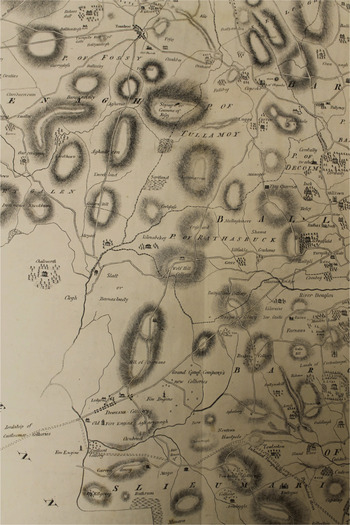
The following sections are a study of landlord–tenant conflict in one particular area – the south-east of the Queen’s County.Footnote 33 The study area is varied in terms of physical geography and the natural endowment for farming (see Figure 1). Broadly speaking, the more valuable farmland is to the north and east, the upland area to the south is an area of poorer soils, but the upland district was densely populated at this time – in part because it was a coalmining area. The hilly territory, Slievemargy or the Castlecomer plateau, was known as the Leinster colliery district and ran over the border into county Kilkenny and, to a lesser extent, into county Carlow. The eastern perimeter of the study area is part of the Barrow valley, adjacent to county Kildare. In the late 1820s and early 1830s this district was one of those where there was a Whitefeet presence.
Detail from ‘A map of the Queen’s County from an actual survey for the Grand Jury by Daniel Cahill, engineer, 1805’. Area shown is approximately sixteen kilometres from north to south.

The Whitefeet were the latest of a long series of peasant movements stretching back into the eighteenth century.Footnote 34 There was a contiguous area of mobilisation along the western side of the river Barrow from Portarlington to Rosbercon and westward through the borderlands of Kilkenny and the Queen’s County.Footnote 35 The Whitefeet name originated with a Queen’s County fighting faction.Footnote 36 Faction fighting was large groups of young men assembling for combat, usually with sticks. Factions united along lines of kin, confession, territory, occupation or class.Footnote 37 Other names were used within the mobilisation, for instance, further south into county Kilkenny, threatening letters were frequently signed with the nom de guerre Gentlemen Regulators. Also frequently used in threatening letters were terms associated with other movements, in other times and places, such as Captain Rock and Terry Alt.Footnote 38
Although there was a good deal of conflict between tenants, the Whitefeet movement began with, and gained further impetus from, landlord–tenant disputes on individual estates. What happened in particular estate-wide conflicts shows how the prospect of provoking subaltern violence restrained landlords and thereby impeded estate reform. We can see this in two ways. Firstly, often estate owners who met violent opposition were regarded by other elite figures, fellow landlords and/or the state-officials known as magistrates, as having brought the situation on themselves. As this article will show in practice there were sharp limitations to the apparent absolute rights proprietors (of either land or leaseholds) had over their properties. The norm was that the possibility of resistance had to be factored in when considering the administration of one’s estate. Failure to do so earned the anger of the magistracy.
The only apparent exceptions to their constant condemnatory refrain are in cases involving particularly powerful magnate families. There were radical alterations carried out or attempted on major estates – on the Cosby estate (to the north of the colliery district) and on the Wandesforde estate (the southern portion of the colliery district), and while these episodes were certainly part of the story of the Whitefeet, they did not draw negative commentary from the magistracy to any great extent. In the following we will see elite disdain for particular estate management policies on the relatively small Gregory and Cassan estates and on the Hackett and Hanlon middleman leaseholds. Presumably the political influence of the owners of large estates was too great for them to be criticised.
Secondly, the restrictive impact of subaltern opposition is most apparent in instances where there was a clear backing down, where landlord programmes of reform were cancelled, put on hold, or mitigated. These instances are somewhat obscured by the fact it is the more violent episodes, often where there were little or no concessions, were precisely those that produced more records (that is, police/magistrate records and media reports). But the only way to understand the impact of the more overt and explicit insurgent violence is to understand the ripples from it, the knock-on effects of inspiration and intimidation it created in relatively quieter locales. This more negotiated form of conflict will be explored through cases of the Lansdowne estate and the Newtown colliery. While it must be acknowledged that in this case study condemnation of individual landlords or of middlemen was principally found in the statements and documents emanating from state officials (stipendiary magistrates and constabulary officers), something that might point to a divergence of interest between the state and local landlords, in the second category, that of negotiated conflicts, we see estate agents displaying essentially the same attitude as the magistrates as to the proper way of proceeding.
However, this was not a contestation that had only one potential outcome, there was an earlier successful clearance on the Cosby estate, in an area just to the north of the coalmining district and to the west of the Lansdowne estate. This contributed to the rise of the Whitefeet, but any violent response specifically to it has gone unrecorded.
Absolute conflict: the Cassan, Hanlon, Gregory and Hackett properties
The ‘burning began in 1829 on Major Cassan’s estate’, according to the Rev. Nicholas O’Connor, parish priest of nearby Maryborough (present-day Portlaoise).Footnote 39 The stipendiary magistrate D. O’Donoghue likewise located the infancy of the Whitefeet movement in that estate, and ascribed its birth to estate rental policies claiming that ‘in fact while he persists in the rack rent system he pursues nothing better is to be expected’.Footnote 40 That is to say Cassan’s apparent policy of leasing to the highest bidder/raising rents would inevitably meet a militant reaction. O’Donoghue went on to describe the situation on the Cassan property in early 1830, a description that gives some sense of what was involved in this kind of land occupancy dispute:
Some of his tenants who had recently taken ground from which former ones were ejected received threatening notices lately in the name of Captain Rock, immediately to surrender the same or abide the consequences. These violent threats have been quickly followed up by a general attack past nights by armed banditti.Footnote 41
The Captain Rock referred to was a fictive figurehead, whose pseudonymous signature adorned the so-called threatening letters, which groups like the Whitefeet used to issue their demands.
A commentary similar to that employed in the case of the Cassan estate, is in the private correspondence of the police and magistracy regarding the Hanlon colliery, the locality of the first stirrings of the movement specifically within the colliery district. ‘Captain Rock has got into the collieries’ was the observation of Sir John Harvey, head of the Leinster police force, in a letter to William Gregory, Under-Secretary at Dublin Castle, in May 1829.Footnote 42 He was commenting on the thorough destruction of some of the premises of the Modibeadh colliery and partial destruction of the projected residence of its owner a man named Hanlon.
Hanlon had recently acquired some farmland adjoining the colliery and the twenty-three families who lived on the land perceived a threat to their possession of it.Footnote 43 Regarding another incident later that year, where one of Hanlon’s tenants was taken into custody for threatening him in a conflict over rent, Chief Constable Clancie of the Stradbally police described Hanlon as a man ‘whose management if I am rightly informed will I fear cause himself, the Magistrates and the Police endless trouble’.Footnote 44 Less trouble as it turned out than his neighbour minor local landlord Thomas Gregory.
On an August evening in 1831, while returning to Carlow from Ballylehane accompanied by his clerk, Gregory was ambushed and shot.Footnote 45 There were over half-a-dozen men in the assailing party, one struck the horse that was carrying Gregory’s gig in the head with a pitchfork, one landed a blow on the clerk, while another blasted Gregory with a shotgun. The horse bolted, taking the wounded Gregory with him and the attackers followed in unsuccessful chase. Gregory died of his injuries shortly afterward and later that night a policeman was wounded while in pursuit of those suspected of being Gregory’s assassins. Gregory’s case offers the most egregious example of the condemnation of the victims of retaliatory agrarian violence for their impolitic dealings. Not only was Gregory killed, as opposed to, for instance, just having his tenants threatened or his outbuildings burned, not only that, but, while much elite dissension with the actions of particular estate holders was expressed in private communication, Gregory was posthumously condemned publically before a parliamentary select committee.
The Hovenden property in the townlands of Ballylehane Upper and Ballylehane Lower was subject to a complicated process of litigation involving mortgage holders and potential heirs.Footnote 46 Thomas Gregory was party to this, a legal professional and husband of one of the potential heirs; he seems to have been exercising de facto ownership.Footnote 47
Fifteen tenants were served with notice to quit, which including their families would amount to perhaps in the region of one hundred persons to be ejected.Footnote 48 Neighbouring magistrate and mine owner Hovenden Stapleton succinctly summed it up like so: ‘whether he turned them out or not I do not know; I believe he did not live long enough’.Footnote 49
Contemporary commentary strongly suggests that Gregory dug his own hole, that he breached informal codes. Stapleton described him as: ‘excessively harsh to the people’; and said that he: ‘committed several acts upon the unfortunate people there that I should be sorry to be guilty of, and acts of injustice’;Footnote 50 his ‘conduct was oppressive and must tend to discontent and excitement’.Footnote 51 This condemnation is emphasised by the fact that Stapleton tended to minimise any apparent grounds for genuine grievance (there is a distinction here between public communication, for example, before the Select Committee, and private communication, for example, in letters to Dublin Castle, and probably also between paid professional stipendiary magistrates and local gentry magistrates like Stapleton). Queen’s County-based stipendiary magistrate D. O’Donoghue wrote of Gregory that he was:
an attorney of some eminence … although a man of great tact and cleverness in professional matters, he appears to have managed his private concerns with little discretion. Through some acts of oppression he rendered himself exceedingly obnoxious to his tenants and neighbours, so much so that a conspiracy against his life has been for some time past concocting.Footnote 52
This is a repeating theme in elite understanding of subaltern violence, particularly in the interpretations offered by state officials: the irresponsibility of particular gentlemen leads to grievances and the inevitable rebellious attempts to address those grievances.Footnote 53 In practice, elites accepted a type of tenants’ right, accepted that there was a customary right to possession held by the occupying tenant, because any breach of it could potentially be met by violent sanctions. Accordingly, any reform of agricultural production and of agrarian class relations, any putative improvement, had to proceed in a piecemeal and ameliorative fashion. For example, on the Ormonde estate, south of the study area, in counties Kilkenny and Tipperary, a long struggle was waged against ‘superfluous occupants’.Footnote 54 This seems to have comprised of, in individual case after individual case, the payment of passage for particular tenants to America, while reassigning their lands to neighbouring farmers.
Similar problems and similar condemnation faced Michael Hackett, a middleman on the Bowen and Lecky estate, whose lands were described by stipendiary magistrate Matthew Singleton as ‘the cause of much disturbance and discontent’.Footnote 55 In the spring and early summer of 1832 Hackett lost control of his leaseholding, a passing evocatively, if perhaps exaggeratedly, described by Stapleton thus: ‘they levelled all his fences, and all the cattle of the country were turned in upon his ground’.Footnote 56 On 8th January 1832 one of Hackett’s tenants was attacked and sworn to quit his holding and again on 29th January 1832 Hackett’s bailiff was attacked and Hackett’s herdsman sworn to quit his employment.Footnote 57 Constable Robert Wright of the Towlerton (Tolerton) station commented in his report on the latter incident that Hackett had left some of his lands ‘untenanted for the last few years, and the cause, a repetition of similar events’.Footnote 58 It was typical for campaigns against particular landlords to involve attacks on their tenants and employees, essentially enforcing what would be later called a boycott.
Hackett’s eviction of two tenants named Duggan, who were probably in arrears, is to what he ascribed his problems.Footnote 59 However, Hackett appears to have been a particularly obstinate landlord and it is likely he alienated more people than just that. In September 1832 in a letter to Dublin Castle, Singleton gave a flavour of Hackett’s practice as a landlord:
During the week Mr. Hackett sent down from Dublin a man to serve several tenants on his property ejectment notices, such proceedings on his part just now I consider very indiscreet, and is sufficient to add fuel to the flame amongst the inhabitants in that part of the Country, he has complained frequently during the summer to the government, and to me, that he could not exercise any ownership over his property in that part of the Country, and I was myself, with the aid of the police, obliged to take possession of his estate since I came to the District, if he should persist in these proceedings he will find it impossible to manage his property here, the Gentleman that is now on the lands and superintending the leases sent the process server back to Dublin with the notices, & denounced such conduct as most mischievous.Footnote 60
Negotiated conflict (1): the Lansdowne Luggacurren estate and John Price
Agent on the portion of the Lansdowne estate located at Luggacurren, Queen’s County, was John Robinson Price. Price was agent to the Ossory/Castletown/Fitzpatrick estate, the Warneford estate and the Queen’s County part of the Lansdowne estate. The Lansdowne estate consisted of 121,000 acres, principally in the south-western county of Kerry. The Petty-Fitzmaurice family were the owners of the Lansdowne estate, Petty referring to seventeenth-century political-economist Sir William Petty, founder of the estate, which the Fitzmaurices acquired through marriage.Footnote 61 A relatively small proportion of the estate was located in Luggacurren, Queen’s County.
Price commented on the delicate business of conducting improvement without provoking resistance:
I think it would improve an estate to increase the size of farms according to the capital to be expended; but there is another duty which the landlord has to consider: he is not to excite a blaze in the country, and call upon the neighbouring landlords to pay for the abuses he may have created in the controlling or arrangement of his own property.Footnote 62
This was what he had to balance on the Luggacurren Lansdowne estate, where the programme of change was on the classic model where attempts at transformation are occasioned by the expiring of an eighteenth-century middleman lease, and there is an effort to upscale the farm holdings, weeding out the so-called pauper tenants.
The Rev. James Delaney, of nearby Ballynakill parish, claimed that ‘the feeling amongst those who have entered into combination’ is that by doing so they have a deterring effect on any landlord’s possible intent to turn them out. He cited the experience of the Lansdowne estate as evidence that combination did indeed make for deterrence.Footnote 63
Price’s own words bear out Delaney’s analysis:
In the year 1830 I received the possession of 1,700 acres of Lord Lansdowne’s estate, on which there were not less than 130 families located; this land was let to a middle-man in the year 1756; … there were 56 tenants deriving under the middle-man. I set land to those 56 tenants and others for six months only, to give me an opportunity to survey the land, and to divide it into farms; … Changes and considerable alterations were made; but instead of retaining only 56, I found it expedient to keep 85 tenants, and the remainder, as many of them as were willing, were sent to America, at a very great expense to Lord Lansdowne; the only condition was that they were to throw down their cabins before they started.Footnote 64
So concessions had to be married to the agenda of farm consolidation – a further twenty-nine tenants were retained and some of the remainder were given passage to America. Assisted emigration schemes were one solution to the peasant problem taken up on some estates, with some government pilot programmes and with strong advocacy by some political-economists such as Robert Torrens.Footnote 65 Indeed, public funds to assist the emigration of evicted tenants was one of the recommendations of the Select Committee on the State of Ireland.Footnote 66
In this episode we also see something of the layers of tenure and subletting – there was a middleman holding on a long lease, fifty-six tenants of his and plus another seventy or so – who would have been subtenants of the fifty-six, or their cottiers (that is, who paid a labour rent), or in family partnership agreements (that is, where one of the fifty-six is the actual leaseholder but in reality the leaseholder shares the property with his brothers).
Price thought it necessary to distance the expellees from any claim on the Lansdowne estate, calling them the ‘the refuse of other estates’, claiming they were ‘not what are called the residenters of the land, but in general persons who were evicted from other estates’.Footnote 67 This rhetorical strategy, suggests that it was perceived that tenantry did have a customary right to possession.
Despite Price’s efforts, which gave him the ‘impression that no disturbance would or could occur’, two years later in 1832 the situation was to change again:
such tenants as got possession of any portion of other people’s lands were attacked at night, and obliged to give up or abandon the fields that they got thus, even though from their next door neighbours.Footnote 68
Eventually the lands were ‘restored to their rightful owners’, something Price ascribed to the impact of the Special Commission at Maryborough, an extraordinary court sitting to deal with Whitefeet related offences. He concluded ‘I think law and order will prevail in future there, and be henceforth respected.’Footnote 69
Price was to run into further difficulties of a lesser magnitude in the 1840s. In that decade he attempted to implement a drainage scheme with imported Scottish experts, something that provoked some opposition to the particular form it took: after several bad harvests tenants were expected to work off their rents on the scheme, they had wanted rent abatements.Footnote 70 The Lansdowne estate at Luggacurren was to experience further pronounced social conflict in the late nineteenth century with an aftermath reaching into the 1920s.Footnote 71
To some degree, it is best to conceive the outcome of contention as this sort of steady wearing away of the more ambitious programmes of restructuring as opposed to thinking in terms of outright victory for the smallholding tenantry. After all they remained, if they were successful, in the position of exploited tribute payers.
Negotiated conflict (2): Newtown colliery and John Edge
The leasehold of Newtown colliery and the adjoining townland of Clonbrock had been held by the Grand Canal Company since 1803.Footnote 72 The townland included a farm, also called Clonbrock, which was directly operated by the company as well as lands sublet to subtenants. In 1830 in a process of retrenchment occasioned by heavy debts the company sought to surrender their lease. However, the proprietors, Bowen and Lecky, demanded that the lands be cleared of subtenants before it was returned to them.Footnote 73 Most of the residents of the 191 tenements to be cleared were colliery workers and their families.Footnote 74 The company issued notices to quit and it appears met immediate opposition. John Edge was then manager of Newtown colliery and Clonbrock farm for the Grand Canal Company and acted as its agent in serving the notices.
In a letter of 8th September 1830, Edge, far from raising objections to the clearance, actually argued for this course of action,Footnote 75 but he seemed to backtrack after he had delivered the notices to quit. In a letter of 24th September 1830 Edge predicted that ‘turning out so many people will be the cause of serious disturbance in the country’.Footnote 76 It is likely that while serving the notices Edge was made very aware firsthand the extent and depth of opposition a mass eviction was likely to face. The larger part of the tenantry was to give up possession on 25th March 1831, but all the tenants bar five refused to leave their homes.Footnote 77 Around this time Edge painted a very forbidding picture of the situation writing that:
there are considerable numbers of bad tenants on the land, who have not, nor will they not, pay rent, in fact they have nothing, and they not only keep possession, but are a continual pest to their neighbours, their chief support being plunder, it would be best to turn out such by a few at a time, and although much loss and annoyance would be caused by suffering bad characters to remain for a time, still it would be preferable to insurrection.Footnote 78
In the refusal of the subtenantry to give up possession of their tenements we see something of land occupancy conflict before it escalates into the sort of violence that would attract the attention of the police, the magistrates and the press, these being the producers of the bulk of surviving source material on the topic.
It is possible Edge was manoeuvring himself at this point into becoming the leaseholder of the colliery, farm and townland as he was to become later in 1831 and these intimations of danger were part of an elaborate ploy. But the simplest and likeliest explanation is that Edge was reacting to events on the ground, namely the response he received when issuing the notices to quit. However, even if Edge was involved in subterfuge this does not contravene what is being claimed here, for if he was involved in some subterfuge he would have couched his argument in such a fashion as to appeal to his audience, namely the directors of the Grand Canal Company. Consequently, Edge’s writings still give us an indication that sections of the elite understood that it could become necessary to precede with caution less a reaction is provoked.
In April 1831 Edge reached an agreement with the proprietors Bowen and Lecky for him to take on the leasehold of Newtown colliery and associated royalties, as well as Clonbrock farm and townland.Footnote 79 So there was no vacant possession given to Bowen and Lecky and the subtenants remained in their places. This most likely made Edge more popular, indeed he claimed there were celebratory bonfires when he took on the lease,Footnote 80 which is unsurprising, and he did not flee the area for safety during the most intense period of Whitefeet activity unlike Hovenden Stapleton, the proprietor of a neighbouring colliery, who moved into the nearby town of Carlow.Footnote 81 Also it is notable that a so-called threatening letter found in Clonbrock from October 1831 is conciliatory in its attitude towards Edge. There was an issue with Edge seeking rent arrears, which is mentioned in the letter, which opens thus:
Mr. John Edge, take no erairs [arrears] of rent any mor from the pore tennans, any man who will pay it he shall be no more; but let him pay his half-year’s rent, and If he does not he must lose house and land, and I will essist [assist] Mr. Edge with seven hundre men.Footnote 82
Note the respectful tone and use of the honorific title, coupled with conciliatory content offering compromise and assistance with policing compromise, all of which is quite different from many ‘threatening letters’. Edge appears to have acceded to the demand not to claim rent arrears.Footnote 83
The Lordship of Timahoe: an exception?
The Cosby estate was centred in Stradbally and included an area known as the Lordship (or Manor) of Timahoe – which was just beyond the northern perimeter of the colliery district. In the summer of 1832 many of the local witnesses before the Select Committee on the State of Ireland spoke of evictions off the Cosby estate. Those witnesses were Roman Catholic clergymen the Rev. James Delaney (of Ballinakill), the Rev. Nicholas O’Connor (of Maryborough) and the Rev. Michael Keogh (of Abbeyleix), as well as magistrates Hovenden Stapleton (of Tolerton) and Colonel Ralph Johnson (of Stradbally) and, finally, mining entrepreneur John Edge. According to Delaney ‘a vast number of persons’ were ejected from the Cosby estate – in all one hundred families – and many of the evicted went on to become ‘notorious leaders amongst the Whitefeet’,Footnote 84 while according to O’Connor most of the evicted ‘become very violent Whitefeet’.Footnote 85 Stapleton claimed the only expulsions of tenants ‘on a large scale’ took place on the Cosby and Lansdowne estates.Footnote 86
The experience of the Cosby estate is at variance with the other estates addressed in this article in a number of ways. Firstly, evictions on that estate seem to have happened before the development of the Whitefeet movement – and there is little evidence of the evictions meeting a direct violent response, at least initially. Secondly, unlike in the case of many of the above landlords and middlemen there was no magisterial condemnation of Thomas Cosby, who was by 1832 deceased but who had owned the estate in the 1820s. In fact, Edge and Stapleton sought to justify the Cosby clearances.
It is also unclear when the changes on the estate took place; to Keogh the clearances happened ‘since the year 1814’,Footnote 87 to Stapleton ‘a good many years back’,Footnote 88 to Johnson ‘seven years ago’ – a timeframe he shares with Delaney.Footnote 89 Likely then this was a staggered process rather than a discrete event. Something of it can be traced in surviving estate records and other documents. An 1811 document called ‘Rental and Observations & etc. on the Lordship of Timahoe’ is a survey of the potential new rental income to be derived from Timahoe with the then imminent termination of what looks like a series of eighteenth-century middleman leases.Footnote 90 By 1818 this entire section of the estate was being advertised for re-letting.Footnote 91 Dating from January 1821 are thirty-three new leases on the Lordship of Timahoe, leases that display a pattern of farm consolidation – over half the leases are for holdings of above forty acres, most of that half are for holdings of above fifty acres, while the largest is for a little over one hundred acres (that is, of a size to be a farm as opposed to a townland for subletting).Footnote 92
Additionally, John Robinson Price counted the Cosby estate along with the Lansdowne estate as among the few in the Queen’s County where the occupiers held directly from the head landlord.Footnote 93 This is suggestive of a process of estate reform on the Cosby estate similar to that on the Lansdowne estate. A further surviving piece of evidence is an architectural plan for the radical redevelopment of Timahoe village. The unrealised design would have turned Timahoe into a model estate village – the crescendo to a project of estate transformation.Footnote 94
One of the places on the Cosby estate subject to clearance and consolidation was the Commons of Fossey. Commons, in this context, referring to areas of upland pasture with use rights shared among the inhabitants of a particular place.Footnote 95 Commons in this period were subject both to enclosure by landlords and, in situations where there were disputes over ownership or little elite control, to enclosure by squatters (both processes were likely to have been present in Fossey successively). In this instance, the colourful descriptions are of the inhabitants as opposed to the evicting landlord. Of the Commons of Fossey Stapleton said:
I can go back as far as the year 1798 [that is, to the republican insurrection of 1798]; that was a place the resort of the principal rebels and robbers of the Queen’s County; if you wanted to catch a desperate character that was the place to go to, and I think I recall 18 fellows out of it being convicted at Maryborough at one assizes.Footnote 96
Similarly, Edge pronounced it as ‘a place notorious for bad characters’.Footnote 97 Of course this is an emphasis intended to mitigate the Cosby clearance. So what accounts for the difference in readings of these different events of dispossession or threatened dispossession? In the first instance the Cosby family possessed infinitely more political capital than minnows like Hackett or Gregory (their estate was many many times larger). Secondly, the Cosby clearance happened before the stipendiary magistrates O’Donoghue and Singleton were on the scene – it is at least possible they might have had something to say of it, at least in private communication. Thirdly, the apparent absence of conflict and controversy suggests that any changes were conjoined with an ameliorative effort, as was the case on the Lansdowne estate.
The seeming lack of resistance on the Cosby estate is both puzzling and instructive. Instructive in that it shows that efforts to transform estates were not entirely unrealistic – and hence it makes explicable the actions of landlords who attempted to do so – and met opposition. Puzzling in that Timahoe was in some respects a Whitefeet territory,Footnote 98 and it was a series of mass evictions that led to the development of the movement. Most likely discontent about the Cosby estate manifested itself in actions that have gone unrecorded or in ways that have yet to be comprehended. There is a report of the spread of oath taking in the district late in 1821,Footnote 99 and the events of the late 1820s and early 1830s happened in the area all around the Cosby estate, but there is little record of attacks on the estate, its personnel or those of its tenants with new or expanded holdings. Whatever was at play it is likely not to be the passage of time – there are instances elsewhere of incoming tenants being attacked many years after their arrival. It is not necessarily the case that the decisive factor was an inauspicious moment for mobilisation – if clearance commenced in the late 1810s and early 1820s then it would have been coincidental with an insurgent uprising at least as great as that of the early 1830s, if not in fact greater.Footnote 100
Conclusion: the making of moral economy
We turn now to considering, by way of conclusion, this limitation to landlord control in terms of moral economy. The great advantage of moral economy as a concept is in its synthetic nature, encompassing culture, social structure and agency. In one aspect, moral economy is cultural, referring to norms and expectations and acceptable standards. In another, it is agentic, concerned with the actual shaping of society by different groups of people. E. P. Thompson considered moral economy as involving ideal models of behaviour and customary practices ‘in a particular balance of class or social forces’.Footnote 101 Likewise to James C. Scott, the precolonial moral economy of Southeast Asia rested on abundant land – and hence the ability of producers to flee from too onerous tribute demands – coupled with the limited capacity of states to enforce those demands.Footnote 102 Moral economy can be understood as the outcome of social conflicts: ‘the sediment of movement struggles’ or ‘a truce line’, one that will be ‘continually probed for weaknesses by both sides and repudiated as soon as this seems worthwhile’.Footnote 103 Moral economy in this more expansive fashion addresses ‘the way in which class relations are negotiated’,Footnote 104 or the ‘bargaining between unequal social forces in which the weaker still has acknowledged claims upon the greater’.Footnote 105 This approach is one that sees social conflict as structuring social order, rather than as a by-product of a breakdown in social order. Thompson stressed custom as in constant flux, a field of change and conflict,Footnote 106 and argued against ‘over consensual and holistic notions’ of custom.Footnote 107 From this perspective, moral economy, as well as being about culture and agency, is also about structure, recurrent patterns of social relations, precisely because it highlights one aspect of the shaping of those relations. To return to culture, moral economy shines light on how those structural social relations can be in experienced in cultural terms ‘as a pattern of moral rights or expectations’.Footnote 108
Thompson’s original formulation of moral economy was of course concerned with dearth, food rioting and the politics of provisioning. It was centred on the eighteenth-century transition from Tudor and early Stuart protectionist legislation and associated customs to the dominance of laissez-faire political economy. The early modern system of rights and regulations was conceived as originating in social conflict, but this only received passing attention in Thompson’s original 1971 article. Thompson wrote that the late Tudor/early Stuart Book of Orders setting out the market regulation legislation was ‘in part a response to the pressure of the poor’.Footnote 109 Moments of rupture were the focus of the use of moral economy as a scholarly concept right from the beginning.
However, moral economy was always a multifaceted set of processes: here double-sided – as well the breaking of moral economy, there is the making of moral economy. A process of conflict within which is established an acceptable standard – acceptable perhaps for the absence of an alternative. In the agrarian Irish context, central to moral economy was the tenants’ right to continued possession of their holding and hence their right to subdivide it; to leave it in inheritance; to apportion it in a marriage settlement; and to sell their interest in it.Footnote 110
Some insight is offered by the threatening letters or threatening notices that emanated from the subaltern side to land disputes. These bestow ownership rights on tenants or dispossessed ex-tenants, designate an illegitimate activity called land taking – its practitioners called land takers or land pirates, or, even, in one instance, a ‘Land ferrit’, and disdain the treatment of land as a commodity – specifically referring to canting and land jobbing.Footnote 111 One notice issued to someone considering taking on the position of agent to the aforementioned Hackett lays down a series of conditions: ‘first is that you will restore to the Duggin family a portion of their land at a fair value that will enable them to rear their familys’.Footnote 112 Note that it is referred to as ‘their land’. Now this could be considered just a matter of phrasing, but for the fact that this rhetoric of ownership abounds throughout threatening letters on land occupancy. More examples: ‘we further say if you had all the police in the Barony without making sufficient recompense with that poor object that you wrongfully robbed you may rest assured that your life is at an end’;Footnote 113 and ‘if we do not find the right oner [owner] of the property in full poseson [possession] of the Houses and land goods and chattels and the lace [lease] of the land gave up to him’.Footnote 114
The full text of one such notice is as follows:
Notice to the Public
There is a monster at Kilmoney by name George Neil who has coveted a poor mans property, and is determined to turn him out of his little holding and is to cant him in a few days, This monster is indebted to this poor man if he gives him a fair Settlement. Any person that bids one farthing for this poor mans property, death, fire and pestilence will invade his House and property
Legion March 17th 1832.Footnote 115This is the same tenant-right advocated for by the Tenant Right League in the early 1850s, or to give it another name, the fixity of tenure fought for in the Land War (1879–82). In the early nineteenth century the demand had much less priestly or parliamentary veneer, and was relatively more associated with more plebeian strata among the tenantry.
Rather than the forces of improvement rending apart an old patriarchal order, to an extent advocates of agrarian improvement saw their role quite differently. Some recognised the challenge posed by resistance. Some authors of agrarian improvement literature saw themselves as the architects of a new order of paternalism and deference. Only if they could get tenant buy-in were their schemes workable, only if they could demonstrate such buy-in were their schemes believable to their readership. Hence John Wiggins, agent and pamphleteer, wrote of his apparent successes on the Limerick/Kerry border:
in less than ten years after the reign of Whiteboyism being superseded by improvement, sixty of these ardent and warm-hearted people, tenants and others, sat down to a handsome public dinner, entirely got up by themselves, in celebration of their lord and lady’s return after some months’ absence abroad; that they conducted this banquet so respectably, that my Lord himself could for a time join in their well-chosen and loyal toasts and their well regulated mirth, though bonfires blazed around, and whiskey was more plentiful than water; and all this in the very town which these people used to ‘fright from its propriety’ at every fair, and these are monthly.Footnote 116
Similarly, Henry Hoyte advocated for the provision of four- to six-acre cottage gardens for farm labourers, writing that:
The depression of that useful and necessary class of men, industrious cottiers, is calculated to produce a dissatisfaction on their parts which is pregnant with evils to themselves, their families, and the country at large: for what else can be expected from those who have nothing to look at but the four bare walls of their wretched and solitary cabins – no resources to fly to after the labours of the day? This induces them too frequently to associate together and to express their sentiments to each other, the result of which is often the perpetration of crimes, which a more ameliorated condition would make them shudder to think of, much less commit.Footnote 117
Rather than having one moral economy broken apart in processes of modernisation, we could have a succession of moral economies, produced by different successive balances of class forces. This would explain the disjunction in which Irish historians find the end of moral economy in one period and yet it, or something similar, is still present in a later period. For instance, to Bartlett the ‘tacit understanding’ between ‘governor and governed’ ‘broke down irretrievably’ in the 1793 Militia riots,Footnote 118 while McKenna ascertained a ‘paternalistic social contract’ in the 1850s.Footnote 119 Moral economy was rent asunder at one time and restored, altered, at another, custom is not static tradition, it is a conflict filled flux.
While the customary consciousness of English food rioters evoked the legislative framework of the past, the customary consciousness of Irish agrarian rebels presaged the legislative innovation of the future. The tenant’s right to their holding, embodied in customary practices, expressed with bloodcurdling fervour in threatening letters, defended with determined violence, moved, as a concept, into the parliamentary arena from the middle of the century onwards. In the early nineteenth century we see the antediluvian form of moral economy, with the tenant purchase Land Acts from 1885 to 1932, the gap between customary practice and legal text was bridged through the legislative euthanasia of the landlord class and, paradoxically, the real establishment of private property.