Electromagnetic interference (EMI) can mimic cardiac signals and cause inappropriate implantable cardioverter-defibrillator shocks. Reference Pai, Abedin and Rawling1 EMI can be caused by the normal operation of electrical equipment or alternating current leakage. Reference Chan and Wai-Ling Ho2,Reference Sabaté, Moure, Nicolás, Sedó and Navarro3 The present patient had an inappropriate implantable cardioverter-defibrillator shock when he touched a refrigerator. This was due to electrical interference that was wrongly detected as ventricular fibrillation.
Case presentation
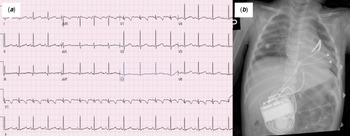
A 4-year-old boy who had a cardiac arrest 2 years ago, was diagnosed as having long QT syndrome in our centre (Fig 1a). As secondary prophylaxis, an epicardial implantable cardioverter-defibrillator (Medtronic, Cardia VR D384VRG) and lead (Medtronic 6947 Sprint Quattro Secure, Medtronic 4968 CapSure® Epi) was implanted (Fig 1b). The ventricular fibrillation (VF) detection rate was programmed as 207 bpm for at least 30 of 40 beats. The sensed VF wave amplitude was measured as 4.4 mV during implantation and the sensitivity was set as 0.25 mV. The patient was under regular follow-up at the paediatric arrhythmia clinic.
( a ) 12-lead ECG of the patient with long QT syndrome. Notice the QT prolongation. The QTc is about 482 ms. ( b ) An epicardial ICD and leads are showned in chest x-ray image.

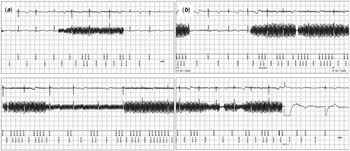
The patient presented to our clinic due to the implantable cardioverter-defibrillator alarming twice in the last 24 hours. The implantable cardioverter-defibrillator controls revealed 6 VF records lasting 1–3 seconds without any shock delivery. However, when the device intracardiac electrogram (EGM) records were examined, only short electromagnetic interference records with 50 Hz frequency was seen (Fig 2a). The impedance, sensitivity, and threshold measurements of the lead were in the normal range (right ventricle pacing impedance of 513 ohms, right ventricle defibrillation impedance of 60 ohms, pacing threshold of 0.25 V at 0.40 ms) and also there was no fracture or stretching of the lead seen on the radiography.
( a ) Intracardiac electrocardiogram at 25 mm/second. A typical electromagnetic interference in the ventricular channel due to 50 Hz alternating current. ( b ) A typical electromagnetic interference in the ventricular channel due to 50 Hz alternating current wrongly detected as ventricular fibrillation, resulting in delivery of an inappropriate shock.

His parents reported that the child had often been hiding behind the refrigerator in recent days. The parents were warned to be careful about any possible electricity leakage from the refrigerator and to have it checked by an electrician. Three days later, the patient presented to our clinic for a short syncope attack. He was found lying on the floor behind the refrigerator unconscious and awakened shortly after. When the device records were examined, it was found that the patient was shocked with 35 J once with an inappropriate diagnosis of VF lasting 24 seconds (Fig 2b). The EMG records again revealed typical electromagnetic interference of 50 Hz frequency in the ventricular channel, consistent with alternating current. On the next day, an electricity leakage from the refrigerator was detected by an electrician, which was repaired.
The parents were advised to close the space between the refrigerator and the wall to prevent further accidents in the future. The patient is still under follow-up without any similar problems.
Discussion
Inappropriate implantable cardioverter-defibrillator shock is a common and important problem in paediatric patients diagnosed with channelopathy, cardiomyopathy and congenital heart disease. Reference Garnreiter, Pilcher, Etheridge and Saarel4 The most common causes of inappropriate shocks are supraventricular tachycardia, lead malfunction, sinus tachycardia, T wave oversensing, and external noise. Reference Garnreiter, Pilcher, Etheridge and Saarel4–Reference Garnreiter6 There are cases in the literature of electromagnetic interference being caused by handheld radiofrequency remote controls, electric razors, electronic article surveillance systems, power drills, washing machines, refrigerators, and slot machines. Reference Al Khadra, Al Jutaily and Al Shuhri7
This patient experienced an inappropriate implantable cardioverter-defibrillator discharge due to an electrical leakage from the refrigerator. Electrical leakage problems causing such a potential hazard to patients are seen when electrical appliances are not adequately grounded. Reference Al Khadra, Al Jutaily and Al Shuhri7 In Turkey, the domestic supply of alternating current has a voltage of 230 V and a frequency of 50 Hz. An alternating current leakage can be sensed as ventricular fibrillation and result in inappropriate shock. In this patient, the intracardiac electrocardiogram clearly showed that he was in normal sinus rhythm and the baseline perturbations due to 50 Hz alternating current were falsely detected as VF.
Conclusions
EMI is one of the rare causes of inappropriate shock in patients without device and electrode failure, which we can diagnose with detailed anamnesis and EGM records. Patients with implantable cardioverter-defibrillator devices must be educated to be careful while using electrical appliances. In this way, inappropriate shock from EMIs can be avoided.
Acknowledgements
None.
Financial support
This research received no specific grant from any funding agency, commercial or not-for-profit sectors.
Conflicts of interest
None.
Ethical standards
The authors assert that this work complies with the ethical standards of the relevant national guidelines on human experimentation and with the Helsinki Declaration of 1975, as revised in 2008. This case was approved by the patient’s family.