Introduction
Severe acute respiratory syndrome coronavirus-2 (SARS-CoV-2) infection represents a worldwide emergency given its exponential spread and associated clinical picture (coronavirus disease 2019 (Covid-19)),Reference Sohrabi, Alsafi, O'Neill, Khan, Kerwan and Al-Jabir1,2 which is sometimes very severe, and can lead to respiratory failure and death.
On 21 February 2020, the first case of Covid-19 in Italy was diagnosed at the Codogno Hospital.Reference Capelli and Gatti3 The causative agent is a new coronavirus defined by the International Committee on Taxonomy of Viruses as SARS-CoV-2.
Coronavirus disease 2019 is a new pathological entity that is still not fully understood; it is characterised by several clinical manifestations.Reference Cascella, Rajnik, Cuomo, Dulebohn and Di Napoli4 It confronts us with difficult choices regarding the diagnostic and therapeutic approaches.Reference Van der Poel, Mansbach, Loundon, Russell, Vanderveken and Boudewyns5 Initially, low-grade fever, asthenia, malaise and cough were considered the typical symptoms of the disease. Later gastroenterological symptoms such as diarrhoea were also considered pathognomonic.Reference Cascella, Rajnik, Cuomo, Dulebohn and Di Napoli4 Several studies have since demonstrated the association between anosmia and SARS-CoV-2 infection.Reference Klopfenstein, Kadiane-Oussou, Toko, Royer, Lepiller and Gendrin6–Reference Vroegop, Eeckels, Van Rompaey, Vanden Abeele, Schiappoli and Alobid9
We observed an exponential increase of patients with olfactory deficit in the territory of southern Lombardy (the site of the first European Covid-19 outbreak) between the end of February and the beginning of March, and we consequently described the first series in Europe of patients affected by anosmia during SARS-CoV-2 infection.Reference Capelli and Gatti3 Klapfenstein et al.Reference Klopfenstein, Kadiane-Oussou, Toko, Royer, Lepiller and Gendrin6 conducted a study on 114 patients affected by Covid-19, in which 54 (47 per cent) were affected by anosmia. They found that symptom onset occurred about 4 days after infection, with an average duration of about 9 days. Ninety-eight per cent of patients had recovered function within 28 days. Moein et al.Reference Moein, Hashemian, Mansourafshar, Khorram-Tousi, Tabarsi and Doty7 published a case–control study in which the olfactometric test results of Covid-19 patients and healthy patients were compared, with evident olfactory deficits in the former group.
The continuous succession of studies demonstrating the relationship between anosmia and SARS-CoV-2 infectionReference Lechien, Chiesta-Estomba, De Siati, Horoi, Le Bon and Rodriguez10–Reference Vaira, Deiana, Fois, Pirina, Madeddu and De Vito12 has led the World Health Organization (WHO) to consider anosmia as a specific symptom of Covid-19.Reference Otte, Eckel, Poluschkin, Klussmann and Luers8 Once this association was clarified, researchers’ efforts were directed towards understanding the pathogenetic mechanisms of anosmia, as described in a paper by Bilinska and Butowt.Reference Bilinska and Butowt13
The long-term evolution of neurological symptoms – and of anosmia in particular – associated with Covid-19 remains to be understood. Several studies in the literature illustrate the trend of anosmia in the weeks following the infection,Reference Otte, Eckel, Poluschkin, Klussmann and Luers8,Reference Vaira, Deiana, Fois, Pirina, Madeddu and De Vito12,Reference Hopkins, Surda and Kumar14 but very few present long-term follow-up data. We collected data for the population of the first European outbreak and monitored the trend of olfactory disfunction, with an observational period of eight months.
Materials and methods
We conducted a retrospective study on patients suffering from anosmia in the territory corresponding to the first epidemic outbreak in Europe in the months following the first European case of Covid-19 (21 February 2020).
The authors assert that all procedures contributing to this work comply with the ethical standards of the relevant national guidelines on human experimentation, and with the Helsinki Declaration of 1975, as revised in 2008.
The criteria for inclusion in the study were: adult patients aged over 18 years; symptoms suggestive of Covid-19 (fever, asthenia, cough, sore throat and myalgia); resident in the territory of the first European outbreak of Covid-19 (i.e. in the city of Codogno and neighbouring regions); and patients with good knowledge of the Italian language, able to correctly understand the doctor's instructions and requests.
Patients with minor symptoms, those suffering from previous disturbances of smell, acute bacterial rhinosinusitis, acute allergic rhinosinusitis, nasal polyposis, granulomatous sinonasal pathologies, sinonasal neoplasm, neurodegenerative diseases or other pathologies of the central and peripheral nervous system, and patients treated with high-flow oxygen through non-invasive ventilation (continuous positive airway pressure) were excluded from the study.
We analysed the anamnestic data from our database and collected the details for 55 patients suffering from anosmia between February and March 2020. There were 20 males (36 per cent) and 35 females (64 per cent), aged 18–75 years (average age of 44 years).
The patients were all contacted by telephone and interviewed about the recovery (or not) of their olfactory function eight months later. When interpreting the results, we considered some variables such as gender and age, and tried to understand their possible role in olfactory functional recovery.
This novel study aimed to observe the trend and evolution of anosmia in subjects with Covid-19 symptoms over an observational period of eight months, without considering the therapeutic variables.
Statistical analysis
Statistical analysis was performed using the chi-square test with a significance level of 5 per cent. The analysis aimed to verify the recovery of olfactory function in a population affected by anosmia, eight months after the onset of symptoms. We also used the chi-square test to verify the relationship between male and female gender and olfactory recovery, and to verify the influence of the subject's age in functional recovery.
Results
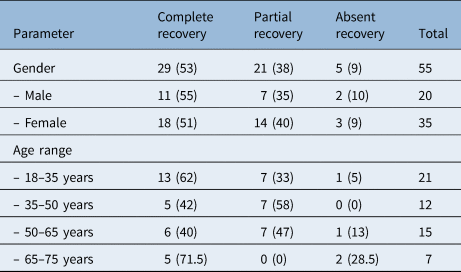
The results observed in this study are summarised in Table 1.
Descriptive data for the population after eight months’ follow up

Data represent numbers (and percentages) of cases
The first aspect we wanted to investigate was the recovery (total or partial) of olfactory function, compared to the initial condition of anosmia, in the studied population. We found that 50 patients showed some form of olfactory recovery from the initial condition of anosmia after eight months. This means that a patient with post-infectious anosmia had a 91 per cent empirical probability of olfactory recovery. Of these patients, 29 achieved total recovery while 21 had partial recovery (i.e. with an empirical probability of recovery of 53 per cent and 38 per cent, respectively). The empirical probability calculated for the five patients with persistence of anosmia after eight months is 9 per cent.
We then tried to understand the role of some variables such as age and gender on olfactory recovery in our population. We initially considered the 91 per cent of the population that showed some form of olfactory recovery. We found a statistically significant difference in functional recovery associated with gender. Specifically, females recovered more olfactory functionality than males, as evidenced by the chi-square test results (Table 2).
Difference between males and females in olfactory recovery population

Chi-square test with alpha of 0.05
We then divided our sample into four age groups (less than 35 years, 35–50 years, 50–65 years and more than 65 years). In this instance, we observed the greatest recovery in the two younger groups (patients aged less than 35 years and 35–50 years). This finding was statistically significant, as demonstrated with the chi-square test (Table 3).
Difference between age groups in olfactory recovery population

Chi-square test with alpha of 0.05
Finally, we studied the 53 per cent of the population that reported total olfactory functional recovery. In these patients, we observed that males had greater recovery (Table 4), with better recovery in the youngest (less than 35 years) and the oldest (more than 65 years) groups (Table 5). Again, the statistical analysis was performed with a chi-square test.
Difference between males and females in complete olfactory recovery population

Chi-square test with alpha of 0.05
Difference between age groups in complete olfactory recovery population

Chi-square test with alpha of 0.05
Discussion
The first European cases series of patients affected by anosmia in Covid-19 dates back to the last week of February.Reference Capelli and Gatti3 Since then, many studies have confirmed the hypothesis that anosmia is a characteristic symptom of Covid-19.Reference Vroegop, Eeckels, Van Rompaey, Vanden Abeele, Schiappoli and Alobid9,Reference Gane, Kelly and Hopkins15–Reference Vaira, Hopkins, Sandison, Manca, Machouchas and Turilli17 Anosmia was subsequently confirmed by WHOReference Hopkins, Surda and Kumar14 to be a distinctive symptom of Covid-19 and an early indicator of the disease. On the basis of this belief, the Italian researchers Mazzatenta and colleaguesReference Mazzatenta, Neri, D'Ardes, De Luca, Marinari and Porreca18 have experimented with a rapid test for the recognition of olfactory disturbances in patients with suspected SARS-CoV-2 infection. We now know that anosmia is the most frequent manifestation among those with SARS-CoV-2 in the nervous system.Reference Ahmed, Hanif, Ali, Haider, Kherani and Memon19,Reference Mao, Jin, Wang, Hu, Chen and He20
In a review published in May 2020, Ahmed et al.Reference Ahmed, Hanif, Ali, Haider, Kherani and Memon19 precisely described the neurological manifestations resulting from infection with SARS-CoV-2 and the possible routes of access by the virus to the central nervous system. It is thought that the binding between angiotensin-converting enzyme-2 (ACE2) receptors and SARS-CoV-2 protein S may be the basis of neuronal and vascular damage within the central nervous system.Reference Meng, Deng, Dai and Meng21 Mao et al.Reference Mao, Jin, Wang, Hu, Chen and He20 believe that the damage to olfactory neurons (rich in ACE2 receptors) can be induced by the direct entry of the virus through the cribriform plate.
Hopkins et al.Reference Hopkins, Surda, Whitehead and Kumar16 surveyed 382 patients affected by olfactory alteration during the Covid-19 pandemic. The work was important in demonstrating the frequent and rapid recovery of olfactory function. Of the patients studied, 86.4 per cent presented with complete anosmia and 11.5 per cent had severe olfactory loss. After only 7 days, 80.1 per cent showed an improvement in symptoms and, of these, 11.5 per cent reported complete recovery. The follow-up period, however, was very short and does not allow us to understand the long-term trend of the symptoms.
• Anosmia is a frequent symptom in coronavirus disease 2019
• Patients suffering from anosmia complain of significant quality of life impairment
• Recovery of functional deficit is common
• There are no data available on the long-term deficit trend
• This study is the first to evaluate the course of anosmia after eight months
• The relationships between olfactory recovery and age and gender were investigated in a sample of the first European outbreak population
The need for long-term observational results is supported by Otte et al.,Reference Otte, Eckel, Poluschkin, Klussmann and Luers8 who acknowledge that there is currently no literary work evaluating the trend of post-infectious olfactory disorder from SARS-CoV-2 several months after onset. In fact, the same authors followed a series of 80 patients for only two months.
Our study aimed, albeit with some limitations, to examine the population relating to the first European outbreak of coronavirus with a follow up of eight months. The main limitations of our study are: the lack of objective instrumental evidence regarding the loss or recovery of olfactory function; and the fact that not all anosmic patients at the time of infection were able to undergo serological tests or identification of viral RNA by polymerase chain reaction, on samples taken using nasal swabs. However, the patients studied presented a clinical picture suggestive of Covid-19 and were resident in an area with a high rate of infection.
Given the limited availability of diagnostic tests in relation to the high number of affected subjects, between the end of February and the beginning of March 2020, in the territory where the study was carried out, many patients were not given the opportunity to undergo diagnostic tests and to have certain confirmation of the very probable SARS-CoV-2 infection. Only 40 per cent of the patients studied had the opportunity to undergo serological or polymerase chain reaction testing, and in all cases SARS-CoV-2 positivity was confirmed.
Regarding this last aspect, we must remember that the group of patients studied represents a sample of the first severely affected population in Europe (first European epidemic outbreak), and in it the percentage of individuals affected by Covid-19 was very high. We believe that although serological positivity to SARS-CoV-2 had not been confirmed in all anosmic patients, it is highly probable that the onset of olfactory alteration in the epidemic peak phase and SARS-CoV-2 infection are closely related,Reference Capelli and Gatti3 and we therefore believe the population sample to be congruent with the purposes of the study.
On 21 February 2020, the first Italian case of Covid-19 was diagnosed at the Codogno Hospital. The territory of Lower Lodigiano (around Codogno) has been the scene of numerous cases of infection, and can thus be considered epidemiologically to be the site of the first European outbreak. In this area, between the end of February and the beginning of March 2020, we observed a considerable number of cases of anosmia (55 patients), and we monitored the trend of the olfactory deficit in the eight months following the onset of the infection. Table 1 shows the data for the patients followed.
The results obtained appear comforting, as we observed that 38 per cent of the population showed partial olfactory recovery and 53 per cent reported total recovery eight months after onset. Overall, 91 per cent of the population showed an improvement in olfactory function eight months after onset of the olfactory deficit. Our results show higher recovery percentages at eight months than Hopkins et al. who evaluated patients over a few weeks of follow up (80.1 per cent). This would suggest possible functional recovery even after a long time, and at least a stability of functional recovery if it occurs early.
We also observed that, after eight months, the probabilities of functional recovery differed only minimally in relation to gender, with females slightly more advantaged in terms of the possibility of recovery in general, but with males more advantaged in terms of total recovery.
Furthermore, our data suggest that the population aged under 50 years has the greatest probability of olfactory recovery. We observed total or partial recovery in 100 per cent of patients aged 35–50 years, and in 95 per cent of patients aged under 35 years. The percentages of olfactory recovery decrease with increasing age. However, interestingly, the highest percentage of total olfactory recovery was recorded in the oldest group, aged over 65 years (71.5 per cent).
Therefore, the youngest group (aged less than 35 years) and the oldest group (aged over 65 years) had an advantage in terms of their capacity for complete olfactory recovery. This datum, confirmed by statistical significance with the chi-square test, is not easy to interpret. We could hypothesise that, in the younger population, greater neuroplasticity favours better functional recovery; however, it is currently difficult to explain the good functional recovery achieved by the older population. We could postulate that, in older subjects, factors such as a less hectic lifestyle, a greater habit of observing prescribed medical therapies, the lack of intense professional activity (typical of middle-aged subjects), and consequently a lower exposure to psychophysical stress, may contribute to the higher probability of complete olfactory functional recovery.
An interesting finding worthy of future studies is the partial but subjectively satisfactory olfactory recovery, of cacosmia or recurrent parosmia, reported by 14 patients (equal to 25.4 per cent of the population studied). Although the mechanisms are not completely clear at present, we believe this finding may somehow be attributable to the neurotropism of SARS-CoV-2 and to its potential neurodegenerative activity.Reference Meng, Deng, Dai and Meng21 This belief was instigated by the findings of a study by Bilinska and Butowt, which describes the alleged pathogenetic mechanism through which SARS-CoV-2 would induce damage to the olfactory structures and the consequent anosmia, based on results obtained from patients and animal models.Reference Bilinska and Butowt13
This hypothesis is in turn aligned with the considerations of Mao et al.,Reference Mao, Jin, Wang, Hu, Chen and He20 who were among the first to describe the various neurological manifestations resulting from SARS-CoV-2 infection. These authors describe the manifestations related to central nervous system involvement (such as dizziness, ataxia, headache and convulsions), manifestations of the peripheral nervous system involvement (such as anosmia) and neuromuscular manifestations.
It seems that SARS-CoV-2 can reach and affect nervous system structures through different pathways: by a hematogenous route, by a direct sensorineural route and by a retrograde neuronal route.Reference Ahmed, Hanif, Ali, Haider, Kherani and Memon19 Once the infection comes into contact with these, it binds to their ACE2 receptors (present on the cell surface), and then penetrates into nerve cells and causes neuronal damage.Reference Bilinska and Butowt13,Reference Zhao, Zhao, Wang, Zhou, Ma and Zuo22 Yan et al.Reference Yan, Faraji, Prajapati, Boone and DeConde11 also underline the neuroinvasive potential of SARS-CoV-2, as described in myocardial complications by Zheng et al.Reference Zheng, Ma, Zhang and Xie23
Based on the numerous studies in the literature, it is now considered certain that SARS-CoV-2 causes neurological damage as well as there being tropism towards the neuro-olfactory epithelium. We are studying and understanding more and more the pathogenetic mechanisms that determine this neuroinvasiveness.Reference Freni, Meduri, Gazia, Nicastro, Galletti and Aragona24,Reference Li, Bai and Hashikawa25 Little is known about the future development of post-infectious neurological deficits.Reference Avcı, Karabulut, Farasoglu, Boldaz and Evman26 With reference to the loss of the olfactory function, we believe that further studies will improve our knowledge regarding its recovery.
Conclusion
The SARS-CoV-2 infection can manifest itself through various clinical pictures. In most cases, it begins asymptomatically or mildly symptomatically. Loss of olfactory function is a typical and frequent manifestation of Covid-19. However, we still know little about this pathology and the probabilities of functional recovery of the sensorineural deficits associated with it.
Hence, we performed a study on the anosmic population of the first epidemic outbreak in Europe, with the aim of understanding the probabilities of post-infectious functional recovery. We observed that in most cases the olfactory deficit is followed by total or partial recovery of function eight months later. The findings of this study, conducted on a small population, will have to be confirmed by others that incorporate larger numbers, but it represents one of the first studies characterised by a long follow up.
Acknowledgements
The authors would like also to thank Ornella Ponzoni for her valuable support and Dr Matilde Grecchi for her contribution to the statistical analysis and data presentation.
Competing interests
None declared