Since its publication in 2011, Richard Cohn’s Audacious Euphony has rightly attracted high-level critical attention. It is, in several respects, a milestone publication. It constitutes a landmark contribution to the harmonic theory that has burgeoned around the re-discovery of Hugo Riemann’s ideas, initially under David Lewin’s stimulus, and subsequently encompassing a broad constituency of transformational, set-theoretical and geometrical attitudes.Footnote 1 As his first monograph, it also ramifies concepts that Cohn has developed piecemeal over the last two decades. And as a study of nineteenth-century harmony, it gathers diverse music-theoretical mechanisms into a historically focused body of institutional norms. Audacious Euphony has elicited robust critical reactions from Henry Klumpenhouwer, Kenneth Smith and Scott Murphy, complemented by less trenchant response from Jason Yust and Steven D. Mathews, amongst others.Footnote 2 These commentators address important theoretical and historical issues attending Cohn’s work, which I both gloss and supplement, whilst also providing a synopsis of Cohn’s theory for the uninitiated.
Cohn’s objective is to build a model of nineteenth-century triadic practice unconstrained by common-practice tonal theories, particularly roman numeral analysis, figured bass and Schenkerian theory, which, for Cohn, are problematic because they ‘share at base in the late-eighteenth-century classical harmonium, from which they reach out to lay claim to the chromatic triadic music of the nineteenth century’ (p. 11). As his earlier work anticipates, Cohn’s preference is to theorize triads as chromatic as well as diatonic phenomena – that is, as arising from systems founded on both diatonic and chromatic pitch collections – thereby generating a dualism, which it is the book’s main purpose to explore: the triad has ‘two natures’, one informed by diatonic asymmetry, the other by chromatic symmetries, especially those arising from modes of limited transposition. Triads can consequently be understood as ‘homophonous diamorphs’: single phenomena having two distinct functions. This premise is developed in light of recent harmonic thought, but Cohn also lends it a kind of historicist legitimacy, by rooting his approach in recovered nineteenth-century theoretical attitudes from Fétis to Riemann; as Cohn explains, the book ‘reconstructs conceptions of triadic distance that were proper to nineteenth-century harmonic thought but have since been stripped from music theory’s inheritance’ (p. ix).Footnote 3
This agenda is prosecuted in two broad stages. Chapters 1 to 6 operate cumulatively, introducing concepts that are successively combined. Cohn first of all establishes voice-leading work (measured as the semitonal distance between pitches of successive triads) and common-tone retention as basic markers of triadic proximity, with the goal of securing a conceptual framework independent of root motion or function. This is applied in Chapter 2 to the properties of hexatonic systems, or the triadic progressions arising from the pitch-class set 6-20,Footnote 4 which have a special status thanks to the parsimony of voice-leading work guiding their relationships.Footnote 5 Chapter 3 then introduces the notion of reciprocity, or the reflexivity of paired triads, which Chapter 4 unites with the hexatonic model to generate the Weitzmann region, a gamut of triads shared between adjacent hexatonic systems, related by their derivation through minimal perturbation of an augmented triad. In Chapter 5, hexatonic systems and Weitzmann regions are combined, producing a ‘unified’ model of pan-triadic syntax referencing the ‘Cube Dance’ developed by Jack Douthett, the topography of which is explored in more detail in Chapter 6.Footnote 6 Cohn builds upon this model in Chapters 7 to 9, folding in dissonance by using a variant of Cube Dance to relate ‘Tristan-genus’ chords (diminished, half-diminished and dominant sevenths) within an octatonic context, exploring ways in which diatonic and chromatic ‘universes’ interact, and mapping the historical progression of triadic practice from the eighteenth to the twentieth century. All of this is supported by a companion website, which provides longer scores, recordings and animations of Cohn’s ever-ingenious topographical analyses.
Whatever one’s attitude towards neo-Riemannian theory, it is hard to imagine a more lucid, humane and persuasive exposition of its basis and application. Cohn steers a cautious course through the theory’s mathematical apparatus, rendering the book pleasingly reader-friendly and divesting it of the scientistic mystique, which often simultaneously legitimizes and obscures music theory’s claims.Footnote 7 By way of critical engagement, I offer four constructive counterpoints, at different levels of discourse. I first of all subject a foundational manoeuvre in the book’s theoretical strategy – the interaction of Weitzmann regions and hexatonic systems – to scrutiny, before challenging Cohn’s underlying dualism, some of the historical assumptions that flow from it, and the ontology of geometrical representations.
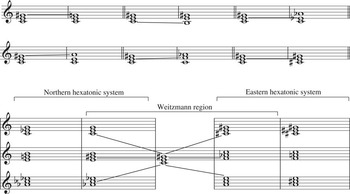
The Weitzmann region supplies a good example of Cohn’s historicism, deriving as it does from a reading of Carl Friedrich Weitzmann’s 1853 study Der übermässige Dreiklang.Footnote 8 Weitzmann explored triadic relationships arising by semitonal displacement of the pitches of the augmented triad. In contrast to the conventional perception that augmented triads result from the voice-leading alteration of major or minor triads, he suggested that we should regard major and minor triads as orbiting their shared augmented triads. For Cohn, a Weitzmann region is formed from all those nearly even triads obtainable by efficient voice leading from a single augmented triad, and above all by minimal perturbation, that is, by moving one member pitch through a semitone. For the augmented triad C–E–G♯, this produces three major triads (C, E and A♭) and three minor triads (a, f and c♯), which the augmented triad in effect mediates.Footnote 9 In Example 1, I illustrate this Weitzmann region and its hexatonic contexts.
Cohn offers two typically engaging visual analogies for this phenomenon: a waterbug, having six legs (the triads) and a central body (the augmented triad); a corridor (the augmented triad) to which six rooms (the triads) are adjacent (p. 60).
A given Weitzmann region encompasses several voice-leading operations facilitating triadic progression. In Example 1, motion from C major to E major applies the transformation LP: the parallel of the Leittonwechsel, or leading-note change followed by the transformation of a major into a minor triad over the same root (C moves to B to produce E minor; G moves to G♯ to produce E major). C to A♭ requires its inverse PL: the Leittonwechsel of the parallel (E moves to E♭ to produce C minor; G moves to A♭, leading us to A-flat major). The progression C–a involves the transformation R (the relative: G moves upwards to A); C–c sharp applies S (a SLIDE transformation, or movement between semitonally adjacent triads); and C–f is a Nebenwerwandt (N), or motion between triads having one common pitch (C) and two semitonally displaced neighbours (F and A♭). Although motion within a Weitzmann region is less constrained by cyclical logic than that within hexatonic space, triadic cycles can nevertheless be extracted. Cohn singles out the alternating application of N (Nebenverwandt) and R (‘Relative’), which permits movement through a Weitzmann region’s triadic gamut: E (N) = a; a (R) = C; C (N) = f; f (R) = A♭; A♭ (N) = d♭/c♯; c♯ (R) = E.
The ramification of hexatonic and Weitzmann spaces constitutes one of Audacious Euphony’s signal achievements.Footnote 10 Crucial to this is the perception, illustrated by Example 1, that a Weitzmann region’s triads comprise half of the triads in adjacent hexatonic systems: C, E and A-flat derive from what Cohn has elsewhere called the ‘Northern’ hexatonic system (founded on B, C, E♭, E, G, A♭); c-sharp, f and a arise from the ‘Eastern’ system (founded on C, C♯, E, F, A♭, A).Footnote 11 The four transpositions of the augmented triad therefore together mediate the four hexatonic systems: C–E–G♯ relates Northern and Eastern systems; C♯–F–A mediates Eastern and Southern systems; D–F♯–B♭ mediates Southern and Western systems; and E♭–G–B mediates Western and Northern systems. By uniting Weitzmann regions and hexatonic systems, Cohn provides a theoretical basis for understanding all progressions within those domains; as he explains, this ‘supplies, for the first time, a way to model progressions that move between regions, which is the usual case’ (p. 85).
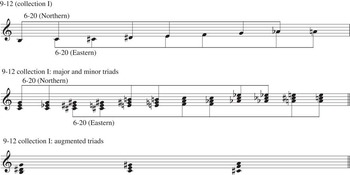
The explanatory power of this insight is considerable, furnishing a single model for mapping diverse triadic progressions in chromatic tonality. Its elegance however conceals problems. In the first place, it relies on the assumption that Weitzmann triads do not themselves comprise one system. We can, however, theorize each Weitzmann region as a system, if we assume that its origins are nonatonic. Specifically, semitonally adjacent hexatonic collections are subsets of the nonatonic set [0,1,2,4,5,6,8,9,10] or 9-12, which encompasses not only all the triads of a given Weitzmann region, but also its mediating augmented triad: to take Cohn’s initial example, the triads C, c sharp, E, A-flat and a, and the augmented triad on C, all belong to nonatonic collection I, as it is described in Example 2.
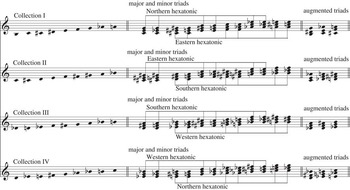
Because this collection houses both Northern and Eastern hexatonic collections, it comprises all of their major and minor triads (C, c, C sharp, c-sharp, E, e, F, f, A-flat, a-flat, A, a) as well as two additional augmented triads (on B and C-sharp). We can therefore understand one nonatonic system as half of Cohn’s hyper-hexatonic system (the triadic universe arising from all four transpositions of 6-20); the other half is supplied by the union of the Southern and Eastern systems, which generates the nonatonic collection on D-flat. Set 9-12 is however a mode of limited transposition, yielding four discrete forms (given in Example 3 on B, C, D flat and D, or collections I–IV). The total nonatonic universe therefore comprises the four systems illustrated in Example 3:
Collections I and III encompass the two halves of the hexatonic universe; II and IV mediate between them, the former sharing the triads of the Eastern and Southern systems, the latter those of the Western and Northern systems, as Example 3 displays.Footnote 12
My aim here is not to replace Cohn’s Cube Dance with a nonatonic model, but rather to get at the more basic issue of how we should police the discretion of collection-based systems.Footnote 13 Since all hexatonic materials are also nonatonic, what grounds do we have for defining any triadic progression by major third as specifically hexatonic? Or, to put it another way, for any progression that is both hexatonic and nonatonic, how do I know which macro-harmony prevails? The principles of near-evenness and minimal perturbation, which Cohn marshals to establish the pedigree of hexatonic systems (p. 34), cannot help us here, because the same properties inform the nonatonic universe: the nearly even triadic content of both hexatonic and nonatonic progressions result from the minimal perturbation of a conceptually underlying augmented triad. The foundational status accorded to augmented triads is also critically affected by these considerations. In Cube Dance, augmented triads stand outside the hexatonic systems they relate; in the nonatonic context, they stem from the same collection as their surrounding triads.
Such macro-harmonic ambiguities have implications for the dualism on which Cohn’s model is predicated. Altogether, he sees the triad’s dual nature as generating a double syntax, modelled in Chapter 8 as a ‘convertible’ Tonnetz, or topographical map of triadic relations, characterized as a mode of orientation along the path from the centrality of the single pitch to the universality of the total chromatic.Footnote 14 In a diatonic context, ‘the triadic tones orient the diatonic ones, which in turn orient the chromatic ones, leading to the expanded expression chromatic (12+) → diatonic (7) → triad (3) → tonic (1)’. In chromatic space, the orientation is reversed: ‘the triads at the interior of that same passage are released from the diatonic capsule and the enharmonic seam breached, [as a result of which] they are referred to the entire chromatic collection for their meaning’ (p. 204).Footnote 15 The problem, however, is that a single triad or triadic progression can inhabit multiple non-diatonic systems: it is not simply that C, once liberated from its diatonic responsibilities, flips into a chromatic parallel universe, but rather that it can occupy numerous modes of limited transposition, between which the dispersal of diatonic context does not help us to choose. In short, we are not really faced with a straight choice between diatonic and pan-triadic alternatives, but between all possible symmetrical or asymmetrical pitch collections that are capable of generating triads, some of which share progressions, either because one is a subset of the other (for example 6-20 and 9-12), or because collections hold triadic subsets in common.
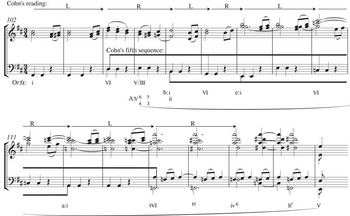
The matter can be clarified through scrutiny of a passage from Brahms’s Symphony No. 2, which Cohn selects in Chapter 5 to illustrate a perfect-fifth chromatic sequence (pp. 92–4), shown in Example 4.Footnote 16
Cohn distinguishes between the diatonic domain of F-sharp minor that bars 102–105 occupy and the ensuing descending-third chain, which settles in bar 114 on a bass F, which by bar 117 has become the root of an Italian sixth in A. He explains this as an L/R chain, or alternating application of Leittonwechsel and relative transformations, which temporarily suspends tonic identity by mapping out the fifth progression D–G–C–F (see the upper bass beam in Example 4).
The boundary between diatonic and chromatic space in this passage is however not so easily located.Footnote 17 To begin with, the consistency of L/R succession in bars 102–106 is problematic: the description of the D–b progression between 104 and 106 as R passes over the chord in bar 105, which is E embellished with an accented 6–4 (I take the bass A at this point in Cohn’s Figure 5.9 to be a typographical error). When we factor in the chord of E, the progression here makes more sense as a simple motion from F-sharp minor to V of its relative A, in relation to which the B minor triad in bar 106 can still be heard as ii. From here, the ensuing progression could be understood as having its fifth stations at b, e and a, with the intervening thirds comprising locally applied VI chords (see now the lower bass beam in Example 4): b–VI/b; e–VI/e; a–VI/a. In these terms, the sense of ‘free fall’ that Cohn describes is hardly so acute. The whole passage emerges as a modulation from F-sharp minor to V/A, which is expanded by a downward motion from ii to the local tonic a minor via its dominant minor, and then onwards to It.6–V. We have, to be sure, a case of modal mixture, but hardly a transition into free chromatic space. Altogether, the music projects at least two competing syntactic allegiances: L/R succession within the unified Cube Dance; and a prolongation of V expanded by modal mixture and a series of local submediants. Employed in succession (b–G–E flat, for instance), L firmly implies hexatonic or nonatonic origins; but b–G, e–C and a–F are all both diatonic and hexatonic; and none of the information Brahms supplies allows us to make a categorical judgement one way or the other.
Coordination of hexatonic systems within a Weitzmann region.

Hexatonic content of set 9-12.

The four nonatonic systems.

Brahms, Symphony No. 2, first movement, bars 102–118.

My claim here is not that Cohn’s dualism should be rejected in favour of a monism that makes symmetrical systems responsible to diatonic authority, but rather that it should be reframed: we either regard the total chromatic as elaborative of a particular collection, or we regard all symmetrical and asymmetrical collections as options available within the total chromatic. Classical tonality privileges the former perspective, encouraging the sense that chromaticism is always ultimately subordinate to a diatonic macro-harmony. Nineteenth-century tonality encourages the latter perspective, exploiting diatonic, modal and symmetrical systems as possible resources derivable from the chromatic scale. Symmetrical systems may still encourage some notion of centricity, either by marshalling alternative cadential concepts (for instance common-tone cadences), or by promoting salience or octave equivalence as referential means. In brief, for nineteenth-century music, we might revise Cohn’s orientation sequence as chromatic (12+) → a given subset (of cardinality 5-9) → triad (3) → tonic (1).
These considerations open up the wider question of dualism’s historical implications. Cohn’s argument is broadly evolutionary: modifying an observation of Patrick McCreless, who draws in turn on Stephen Jay Gould, Cohn sees triads as ‘pre-adapted’ phenomena, the properties of which facilitate an evolutionary process of syntactic and lexical change (p. 206).Footnote 18 This process is narrated in four stages: from the starting point of efficient voice leading in diatonic space, we pass through the prioritization of common-tone preservation and chromatic parsimony to the emergence of symmetrical systems, and eventually to the conditions of Second Viennese atonality, which subsumes all chords as subsets of the total chromatic (pp. 206–8).
The enabling assumption here is that biological and cultural processes are analogous: the triad does a kind of evolutionary labour resembling that undertaken by Richard Dawkins’s notion of the meme, a unit of cultural rather than genetic transmission recently explored music-analytically by Stephen Jan.Footnote 19 This view flirts with a kind of historical determinism: tonality’s development is conditioned by the triad’s over-determination, which is also the basis of its pre-adaptation. In short, the argument proceeds from physical properties, through the generation of musical systems to historical change, and therefore has the character of a historical master narrative, which construes atonality as an inherent but unrealized property of diatonic tonality (the triad is pre-adapted to a pan-triadic context, even if it initially inhabits a diatonic one).
Referencing at a distance Michel Foucault, I would argue instead for an epistemological view, which makes changes of musical practice responsible to epistemic shifts.Footnote 20 The new musical syntax of the early nineteenth century arises within a constellation of cultural forces, which together signify the passage into a new episteme. The emancipation of music from function; the rise of autonomy; the development of music’s ‘mercantile’ character (as Carl Dahlhaus termed it) and its attendant performance culture; the ascent of the urban bourgeoisie and the post-revolutionary ideals they espoused: all of these mutually reinforcing factors propel and compel the practices inhabiting Cohn’s narrative.Footnote 21 This shift is epistemological, not physical: it is rooted in a fundamental change in the way human beings ‘know’ the world, not in a property of the materials with which they work. In these terms, the triad’s pre-adaptation is not the source of music’s historical development, but a resource, which does compositional labour commensurate with the priorities of its cultural circumstances.
The spatial metaphors underpinning Cohn’s theory generate a rather different set of concerns. In general, neo-Riemannian theory’s heavy investment in its topographical and geometric paraphernalia means that the problem of that paraphernalia’s ontology is hardly ever addressed. Certainly, aside from occasional debates about the relative merits of Cube Dance and Tonnetz portrayals, it is rarely questioned in Audacious Euphony.Footnote 22 It is however worth stressing that music is not easily characterized as a spatial art form; neither is harmony spatially tractable in an empirical sense. Of course, triads literally occupy space acoustically, but it is not at all clear what the geometry of this acoustical presence might be (where is the triad in these terms?). To those immersed in the neo-Riemannian universe, such objections may seem trivial. But the metaphorical status of spatial harmonic representations needs to be remembered: the ‘geometry’ of music is the geometry of a spatial analogy (the triad represented as a triangle, or a point on a plane), not a physical object. This is not to argue that such representations are inappropriate: they remain useful tools for conceptualizing harmonic and tonal relations, and other musical parameters as well. But the difference between a metaphor and a theorization of inherent properties should be borne in mind: geometry, at least in the Oxford English Dictionary’s terms, is ‘the branch of mathematics concerned with the properties and relations of points, lines, surfaces and solids’, a remit that categorically excludes harmony, as a phenomenon embodying none of those characteristics.
The better question is why spatial metaphors have become so widespread in current music theory: they are central not only to neo-Riemannian and pitch-space theories, but also to sonata theory, with its array of spaces, zones, modules, vectors and rotations.Footnote 23 One answer has been proffered by Michael Spitzer, who, referencing David Harvey, relates music theory’s spatial turn to the perception that postmodernity entails a crisis in the experience of time and a concomitant recourse to spatial representation.Footnote 24 To put this succinctly: if Schenkerian theory’s temporal projections are typically modern, then recent preoccupations with topographical metaphors constitute theory’s response to the postmodern condition. Yet acceptance of the efficacy of these metaphors (which Cohn deploys with unparalleled virtuosity) does not obviate the problem of music’s temporality, which remains ontologically essential, even if it is intellectually unfashionable.
None of this however detracts from the superlative quality of Audacious Euphony. As a synthesis of Cohn’s various lines of thought, as a landmark expression of music theory’s recent condition, as a model of music-theoretical writing, and as a platform for future research, it is altogether an achievement of the first order. Indeed, it is precisely the book’s synthetic scope that allows the discourse it stimulates to range so widely. To those comfortable with its theoretical first principles, Audacious Euphony will surely become a benchmark text; to those seeking alternative models of nineteenth-century harmony, it serves as an indispensable point of departure.