INTRODUCTION
The presence of a child with a life-threatening illness has numerous repercussions for the family. This situation is known to upset the balance of the entire family unit, not just that of the parents and the sick child (Institute of Medicine [IOM], Reference Fields and Behrman2003; Knapp & Contro, Reference Knapp and Contro2009; Lane & Mason, Reference Lane and Mason2014). Siblings are identified as silent witnesses to the ordeal, and their vulnerability appears to be exacerbated by an inadequate response to their specific needs (O'Brien et al., Reference O'Brien, Duffy and Nicholl2009; Brennan et al., Reference Brennan, Hugh-Jones and Aldridge2012).
Clinicians and researchers in the field lack reliable and valid tools with which to assess the needs of siblings (IOM, Reference Fields and Behrman2003; Wolfe & Siden, Reference Wolfe, Siden and Goldman2012). Such measures would enable practitioners to offer family interventions tailored to the specific needs of the sick child's siblings. Furthermore, with the appropriate measurement tools, the scientific community would be better equipped to document the specific situation of these vulnerable young people. Researchers and clinicians working with this population would benefit from such a needs assessment tool that illuminates the reality of the siblings of children afflicted with any life-threatening illness.
The present article reports the initial development and validation of a new instrument to measure the unmet needs of the adolescent siblings of children with a life-threatening illness, that is, the Inventaire des Besoins de la Fratrie d'Enfants Malades Sévèrement (IBesFEMS) [Needs Inventory for Siblings of Critically Ill Children]. We describe the first steps involved in the conceptualization, development, and content validation of the initial version of the instrument. A second article examines the psychometric properties of the IBesFEMS (Olivier-d'Avignon et al., Reference Olivier-d'Avignon, Dumont and Valois2016). Adolescence was the period chosen because of the similarities in cognitive capacities for youths between 12 and 18 years of age, compared to school-aged children of 5 to 12 years, where many more differences can be observed (Piaget & Inhelder, Reference Piaget and Inhelder1966). Moreover, most children of this age have achieved a mature conception of death (Speece & Brent, Reference Speece and Brent1984).
The Siblings of Children with a Life-Threatening Illness
In Canada, 3,472 infants, children, and adolescents died from various causes in 2014–2015 (Statistics Canada, 2015). These deaths, while representing a small proportion of all deaths in Canada, are nevertheless vitally important when considering all psychosocial issues related to pediatric death. Serious pediatric illness and death during childhood present emotional and even spiritual challenges to those who love and care for these patients (Feudtner et al., Reference Feudtner, Zhong and Faerber2015). There is no international consensus on the definition of a life-threatening illness (IOM, Reference Fields and Behrman2003; Lenton et al., Reference Lenton, Goldman, Eaton and Goldman2006). However, certain organizations have identified important criteria for recognizing this population:
Life-threatening conditions are those that (1) carry a substantial probability of death in childhood, although treatment may succeed in curing the condition or substantially prolonging life, and (2) are perceived as potentially having a fatal outcome. Life-shortening conditions describe those children and young people that have a health condition for which there is no reasonable hope of cure and from which children or young people will die, especially during childhood. (IOM, Reference Fields and Behrman2003, p. 37)
For the purposes of this article, the term “life-threatening illness” will be used to refer to any illness or condition that threatens or shortens the life of a child. The prognosis for these illnesses is difficult to establish, and they can evolve over the course of several years, affecting the family in many different ways (Lenton et al., Reference Lenton, Goldman, Eaton and Goldman2006; Feudtner et al., Reference Feudtner, Hexem, Rourke and Wolfe2011). Support for the family of a child whose life is threatened is an essential part of pediatric palliative care (IOM, Reference Fields and Behrman2003; World Health Organization [WHO], 2010; Jones et al., Reference Jones, Gilmer, Parker-Raley and Wolfe2011). In the clinical or research context of pediatric palliative care, it is therefore important that special attention be paid to the experience and situation of the sick child's siblings.
Brothers and sisters of children with a life-threatening illness are often forgotten in the midst of such trying family ordeals (Sidhu et al., Reference Sidhu, Passmore and Baker2005; Dighe et al., Reference Dighe, Jadhav and Muckaden2008; Long et al., Reference Long, Alderfer and Ewing2013). The consequences they face can be significant, for they are recognized as being at greater risk of developing psychological problems than the general population (Ballard, Reference Ballard2004). The scientific literature shows that their needs are important and that when they go unmet, serious affective, developmental, and behavioral consequences can ensue in the short, medium, and long terms (Williams, Reference Williams1997; Stillion & Papadatou, Reference Stillion and Papadatou2002; IOM, Reference Fields and Behrman2003; Ballard, Reference Ballard2004; Hynson, Reference Hynson and Goldman2006; Lewis & Prescott, Reference Lewis, Prescott and Goldman2006; Hutson & Alter, Reference Hutson and Alter2007; O'Brien et al., Reference O'Brien, Duffy and Nicholl2009; Hashemi & Shokrpour, Reference Hashemi and Shokrpour2010). Every aspect of the siblings' lives can be affected, disrupting both their academic and family life (Jones et al., Reference Jones, Gilmer, Parker-Raley and Wolfe2011; Olivier-d'Avignon, Reference Olivier-d'Avignon2006; Reference Olivier-d'Avignon2013).
The hypothesis that the brothers and sisters of children with a life-threatening illness have special needs is reinforced by the many changes the ordeal imposes on their daily lives, the emotions it generates, and the behaviors and coping strategies observed (Stallard et al., Reference Stallard, Mastroyannopoulou and Lewis1997; Williams, Reference Williams1997; Sloper, Reference Sloper2000; Ballard, Reference Ballard2004; Nolbris & Hellström, Reference Nolbris and Hellström2005; Sidhu et al., Reference Sidhu, Passmore and Baker2005; Jones, Reference Jones2006; Olivier-d'Avignon, Reference Olivier-d'Avignon2006; Brennan et al., Reference Brennan, Hugh-Jones and Aldridge2012). Furthermore, it appears that, among members of families who have a child with a life-threatening illness, it is the siblings who suffer the most in terms of quality of life, and whose emotional needs are most often overlooked (Zeltzer et al., Reference Zeltzer, Dolgin and Sahler1996; Murray, Reference Murray1999; Sloper, Reference Sloper2000; Lähteenmäki et al., Reference Lähteenmäki, Sjöblom and Korhonen2004; von Essen & Enskär, Reference von Essen and Enskär2004; Kenney, Reference Kenney2010).
The failure to respond to the needs of siblings can stem from their parents' anxiety about the demands placed on them by the life-threatening illness, a certain confusion in the roles played by healthcare professionals, a lack of awareness among some actors as to the importance of meeting sibling needs, or the reluctance of the siblings themselves to express their needs openly in an attempt to protect their parents or mask their guilt with regard to the ill child (Stillion & Papadatou, Reference Stillion and Papadatou2002; Olivier-d'Avignon, Reference Olivier-d'Avignon2006; Woodgate, Reference Woodgate2006; O'Brien et al., Reference O'Brien, Duffy and Nicholl2009; Hashemi & Shokrpour, Reference Hashemi and Shokrpour2010; Brennan et al., Reference Brennan, Hugh-Jones and Aldridge2012; Lapwood & Goldman, Reference Lapwood, Goldman and Goldman2012; O'Shea et al., Reference O'Shea, Shea and Robert2012; Long et al., Reference Long, Alderfer and Ewing2013).
Recognizing that the needs of siblings are specific and different from those of the parents and the sick child is crucial to the development and introduction of effective interventions to support them and promote their well-being (O'Brien et al., Reference O'Brien, Duffy and Nicholl2009; Lane & Mason, Reference Lane and Mason2014). To our knowledge, only a few questionnaires measuring the needs of the siblings of severely ill children have been developed, and some of them have methodological limits. The Sibling Cancer Needs Instrument (SCNI) (Patterson et al., Reference Patterson, Millar and Visser2011; Reference Patterson, McDonald and Butow2014) is an assessment tool developed recently by an Australian team. Its purpose is to identify the unmet needs of young people between the ages of 12 and 23 who have a sibling with cancer. Though similar to the SCNI in some respects, the IBesFEMS is designed for a broader population. Moreover, it was developed using a typology of specific needs based on evidence collected from these siblings and their parents, and uses a validation process that is consistent with the technical guidelines in the Standards for Educational and Psychology Testing (American Educational Research Association, American Psychological Association, and National Council on Measurement in Education, 2014). The differences between the two measures are examined in the discussion section of this article.
TOWARD A SIBLING LIFE-THREATENING ILLNESS (UNMET) NEEDS ASSESSMENT TOOL
General Methods
This new tool to assess the unmet needs of the adolescent siblings of children with a life-threatening illness was developed using classical test theory, which offers the stringent conceptual and methodological foundations required to develop and validate concepts with nonhierarchical indicators (DeVellis, Reference DeVellis2012; Crocker & Algina, Reference Crocker and Algina2006; Streiner & Norman, Reference Streiner and Norman2008). This condition is central to the concept of need, which in our study is viewed from a clinical perspective whereby it is defined as the difference between an actual and desired state (Baldwin, Reference Baldwin1998). With that perspective, needs can be defined as the gap between a situation experienced and the required minimal level of satisfaction. This gap becomes the standard by which to recognize the existence of a need. Moreover, this situation of need should be qualified as important for the individual (Hassanein, Reference Hassanein1988).
The inspiration for the development and validation of the IBesFEMS came from the process for developing and validating new assessment instruments recommended by Streiner & Norman (Reference Streiner and Norman2008) and DeVellis (Reference DeVellis2012). Our study involved three phases: (1) production of a typology of needs, (2) validation of the content of the initial pool of items, and (3) preliminary validation of the first version of the IBesFEMS with the target clientele. Both the methods and results for each phase are presented together, before description of the next phase.
It is worth noting that the choice of the title of the questionnaire was motivated by ethical considerations. Even though the questionnaire is intended for siblings of children with a life-threatening illness, we felt it was important to leave this term out of the title. It is up to the parents to decide whether or not to share this information with their children. However, siblings who are old enough to complete the questionnaire are able to understand the seriousness of their sick brother or sister's illness or condition. This assessment instrument was developed and validated in French with a population of French-speaking siblings residing in Québec, Canada.
Sibling Population and Sampling
The term “sibling” was defined for the purposes of this study as all brothers, sisters, half-brothers, and half-sisters who share a blood relationship with the sick child, as well as stepbrothers and stepsisters who are not related but whose respective parents are together in a new conjugal relationship. These brothers and sisters may or may not have cohabited with the sick child. Siblings were aged 12 to 18 with a brother or sister older than 1 year who was diagnosed with a life-threatening illness. In addition, siblings had to reside in Canada and be able to speak, read, and write in French. Adolescents themselves suffering from a life-threatening illness, cognitive impairment, or psychiatric disorders were excluded from the study.
PHASE 1: CONCEPTUALIZATION OF THE NOTION OF NEEDS FOR THIS POPULATION: DEVELOPMENT OF A TYPOLOGY OF NEEDS
Perspectives and Method
The goal of the first phase was the development of a typology of the needs of adolescent siblings of children with a life-threatening illness. This typology played an important theoretical role in the development of the new instrument by paving the way for a detailed description of the study concept.
The conceptual framework for the development of this typology of needs draws on three theoretical contributions. The first is Piaget's (Reference Piaget1977) theory of cognitive development, which provides a means to recognize a child or teen's main developmental challenges and to associate them with certain needs. These fundamental needs were then studied in the context of life with a child suffering from a life-threatening illness. The second theoretical contribution is the theoretical model of children's concepts of death, depending on their age (Lonetto, Reference Lonetto1980; Speece & Brent, Reference Speece and Brent1984). Given the distinct possibility that the ill child will die, this model offers a number of precise concepts to help identify the specific needs required to prepare siblings for that eventuality. Lastly, Bronfenbrenner (Reference Bronfenbrenner1979), in his human bioecological theory, proposed a socioenvironmental analysis of the issue under study. With this theoretical contribution, the consequences and needs of the siblings in relation to the condition of the sick child are studied in a systemic manner that goes beyond the family environment.
The typology was developed using a retrospective qualitative study that allowed the researcher to obtain the point of view of the siblings and parents with regard to the difficulties and needs experienced by siblings when the child was at the end of his or her life. Siblings and parents were recruited with the collaboration of Leucan, a support organization for the families of children with cancer. These collaborators briefly presented the study to families of children deceased 12 to 24 months prior the study and obtained permission to pass along their contact information. The interested families were then contacted by the first author, who obtained written informed consent if they were willing. Ethical approval was obtained in advance from the research ethics committee at Laval University. Separate focus groups were held with the siblings and parents of deceased children, each on average two hours in length. Two group sessions were held with brothers and sisters aged 14 to 18, with 3 participants in each group (n = 6) and 2 with parents with 4 participants in each group (n = 8). The average age of the sibling group was 16 years. This group consisted of four boys and two girls. The most common diagnosis of the sick child was acute lymphocytic leukemia (ALL). The average duration of illness of the deceased children was 25 months. For four participants in this group, the end of life of the sick child was carried to the hospital, compared to two participants who testified about the end of life of the sick child at home. The selected parents had an average age of 43 years. This group consisted of seven women and one man. The most common diagnosis of the sick child was ALL. The average duration of illness of deceased children was 38 months. For six participants in this group, the end of their child's life took place in a hospital, compared with two parents who experienced the end of their child's life at home. A thematic content analysis conducted according to the steps recommended by Mayer and colleagues (Reference Mayer, Ouellet and Saint-Jacques2000) identified the various needs experienced by the siblings, on one hand, and the parents' perceptions of these needs on the other.
Content analysis was employed to categorize the various themes and ideas according to a mixed procedure whereby certain predetermined categories were borrowed from the theoretical referents of Piaget's theory, the model of children's concepts of death at different ages, and Bronfenbrenner's theory, while others emerged during an inductive analysis.
Results
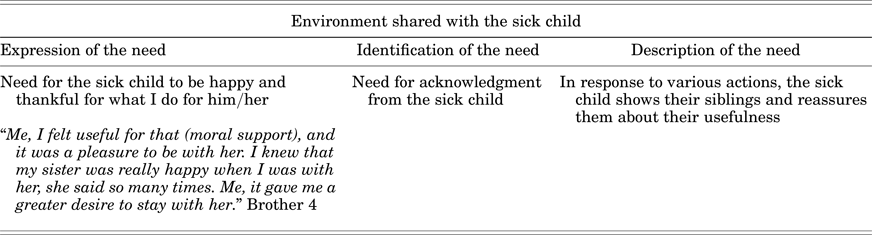
A typology of 43 nonhierarchical needs in 10 different living environments was created, ranging from basic needs associated with the sibling's developmental stage to specific needs related to the context of a serious childhood illness (see Appendix A). These specific needs included those associated with death and the anxieties it engenders. The environments in which the various needs are felt are those associated with the young person's ontosystem (their intrinsic experience), their relationship with the sick child, and with school, parents, family, significant adults, peers, recreational activities, hospitals, associations, and the community. The typology breaks down each need into three different forms, so that it is easier to make the connection between the way the need is expressed verbally, the identified need, and the described need (see Table 1).
Example of a need taken from the typology of needs of the siblings of children with a life-threatening illness

PHASE 2: VALIDATION OF THE CONTENT OF THE INITIAL POOL OF ITEMS
Perspectives and Method
An initial list of items or questions measuring needs was drawn up. More specifically, for each of the 43 needs identified in the typology, 3 to 4 items aimed at measuring the same need, but worded differently, were written. Thus, a total of 135 items were created, each specifically associated with one of the siblings' living environments. The goal of this second phase was to select the items that were clearest and most relevant, based on expert opinion. In addition, this second phase allowed for comprehension of the selected items and prevented redundancy between each one.
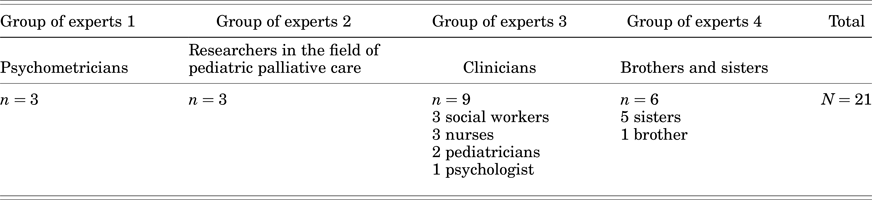
The content of this initial pool of items was validated by four groups of experts selected according to the recommendations of Grant and Davis (Reference Grant and Davis1997). They included groups of psychometricians, researchers in pediatric palliative care, clinicians working with children with a life-threatening illness, and siblings of children with a life-threatening illness (see Table 2). These experts were recruited on a volunteer basis, and the names of the experts in the first three groups were obtained by the first author using the snowball technique. The siblings were recruited with the collaboration of nurses and social workers at a university pediatric hospital and through a support group for families of children with cancer. These collaborators briefly presented the study to families with both a child with a life-threatening illness and a healthy teen and obtained permission to pass along their contact information. The interested families were then contacted by the first author, who obtained written informed consent if they were willing. Ethical approval was obtained in advance from the institution's research ethics committee.
Overview of the sample for the content validity study

All experts except the siblings evaluated the items using a self-administered questionnaire. The siblings completed the questionnaire during a face-to-face meeting with the first author. The psychometricians assessed the clarity of the items and were asked to comment on their structure. The researchers, clinicians, and siblings gave their opinions on the relevance and clarity of each item—for example, “I need to have some time to have fun with the members of my family.” The scales used had four response levels. The response options for relevance were: (1) irrelevant, (2) somewhat relevant, (3) relevant, and (4) highly relevant. The response options for clarity were: (1) unclear, (2) somewhat clear, (3) clear, and (4) very clear. Subsequently, they identified any items they felt were lacking, with a view to improving the comprehensiveness of the questionnaire. Finally, they were asked to identify any terms the study population might have difficulty understanding (Lynn, Reference Lynn1986).
The questionnaires used to gather data from the experts were inspired by the Content Validity Index (CVI) developed by Waltz and Bausell (Reference Waltz and Bausell1981), recognized as an appropriate procedure for quantifying the judgment of experts (Lynn, Reference Lynn1986). The CVI uses a score to quantify the level of agreement between experts with regard to characteristics assessed (i.e., relevance and clarity in the present study) for each item (Item–CVI or I–CVI) and for the entire instrument (Scale–CVI or S–CVI) by calculating the average of the I–CVIs (Polit et al., Reference Polit, Beck and Owen2007). The threshold of 0.80 is considered the lower acceptable limit when constructing a new instrument (Davis, Reference Davis1992). This means that 80% of the experts consulted recognized the item as relevant or highly relevant, and as being clear or very clear. The I–CVI calculation allowed us to identify the items that experts believed should be removed so as to keep only those with the greatest clarity and relevance.
Results
From the initial pool of 135 measurement items, 6 were removed because their wording generated discomfort among respondents in the sibling group. A total of 52 items were removed because the I–CVI was below the desired threshold, either in terms of relevance or clarity. In the case of items that were highly similar and had an identical I–CVI above 0.80, the choice of which item to keep depended on the responses obtained from the sibling group so as to ensure that the selected items offered the greatest degree of clarity and relevance in the eyes of the brothers and sisters from the population the IBesFEMS is intended for. Some 39 items were eliminated in this way. Following this step, the pool of items was reduced to 38, or 28% of the initial pool. Two other items were removed because their content was deemed too similar by the principal researcher (M.O.-d'A.) and the psychometrician (P.V.), who took part in the final item review. For the remaining 36 items, the S–CVI for relevance was 0.93, while the S–CVI for clarity was 0.89. Finally, to ensure adequate representativeness of the content for each environment, 12 items to measure factors deemed lacking by the experts consulted were added to the list, for a total of 48 measurement items. The relevance and clarity of these newly added items were not assessed at this stage in the development and validation of the IBesFEMS. In sum, this second phase of research yielded the first version of the IBesFEMS. It assessed needs in the 10 living environments in which they are likely to be experienced. These environments represent the dimensions of the questionnaire.
The first version of the IBesFEMS consists of two subscales. The first measures the importance (I) of each need, while the second measures the degree to which each is satisfied (S). Each was rated on a 4-point scale. A few items may not apply to a respondent's specific situation, in which case they have the option to respond “does not apply to me.” The total score per item, or for the entire instrument, is calculated based on items for which a response applies to the respondent.
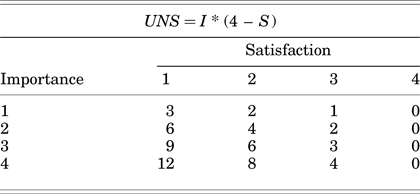
The IBesFEMS score is calculated according to a procedure proposed by Hassanein (Reference Hassanein1988), who emphasized the importance of obtaining a single score for each item by combining the two subscales. The algorithm that allows us to obtain a single score per item, referred to here as the “unmet need score” (UNS), consists of attributing a weight to the scale of satisfaction based on perceived importance of the need. The algorithm used is UNS = I * (4 – S). The higher the UNS single score, the more the item with which it is associated indicates an important unmet need, that is, important, but not satisfied. Item UNS values can range from 0 (all needs completely satisfied) to 12 (all needs important and unsatisfied). For example, a UNS of 8 is obtained on a specific item by combining a score of 4 on the subscale assessing the importance of a need and 2 on the subscale assessing the degree to which the need is satisfies: 8 = 4 * (4–2). The individual's total score is the sum of all the 48 UNS scores; therefore, the instrument's total score can range from 0 to 576. A high score indicates a large number of unmet needs. Table 3 shows how an item's single score can be broken down according to sibling responses with regard to the importance and satisfaction subscales. Score values are distributed between 1 and 4 in each subscale, where 1 means not important or not satisfied and 4 means very important or very satisfied.
Score breakdown based on need importance and satisfactiona

a Score values are distributed between 1 and 4 in each subscale. 1 = not important or not satisfied; 4 = very important or very satisfied.
PHASE 3: ASSESSMENT OF THE ADMINISTRATION PROCEDURES OF THE FIRST VERSION OF THE IBESFEMS
Perspectives and Method
The goal of this phase was to assess the administration procedures and acceptability of the questionnaire in its proposed form. This phase provided information on optimal conditions of use for this new questionnaire and offered a means to identify problems and make the desired changes (Waltz et al., Reference Waltz, Strickland and Lenz2005). To achieve this goal, 5 brothers and sisters who had siblings with a life-threatening illness and were between the ages of 12 to 18 were recruited. To do so, collaboration from nurses and social workers was requested after approval from the pediatric hospital research ethics committee had been received. The siblings expressed their agreement by signing an assent form, while their parents signed a consent form. The teenagers had access to a password-protected website where they could complete the questionnaire online. Soon afterwards, the researcher contacted each participant to ask about how easy they found it to complete the online questionnaire, any problems they experienced in completing it without assistance, the clarity of the instructions, the layout, and any other questionnaire-related issues they found problematic. Table 4 provides an overview of the sample recruited to assess the administrative procedures of the questionnaire.
Characteristics of adolescent participants and sick children

Results
The results obtained during the assessment of the administration procedures confirm that the questionnaire lends itself well to self-administration. The siblings reported that the clear instructions and wording allowed them to complete the questionnaire on their own. Furthermore, some of the siblings mentioned that they appreciated the fact that the questionnaire was self-administered and confidential, as they felt it gave them more freedom in their responses. A few siblings reported that their responses would have been different if their parents had been at their side. They also mentioned that the online procedure for completing the questionnaire was appropriate. Consequently, no changes were made to the questionnaire at this stage.
DISCUSSION
The principal conclusions drawn in phase 1 of this study relate to the typology of needs produced, composed of 43 needs of the sibling population of children with life-threatening illnesses. The Bronfenbrenner bioecological theory allows for a needs classification based on 10 sibling living environments (Olivier-d'Avignon, Reference Olivier-d'Avignon2006). Usually, the primary environments considered in needs assessment initiatives for adolescents are family and clinical settings (hospitals). The original contribution from this study now allows for a systemic analysis, considering siblings' needs over a broader perspective (Wood, Reference Wood and Goldman2006; Contro & Scofield, Reference Contro, Scofield and Goldman2006; Reference Contro, Scofield and Goldman2012). These results are consistent with certain needs that have already been identified by researchers or clinicians in serious pediatric illness environments (Ballard, Reference Ballard2004; Contro & Scofield, Reference Contro, Scofield and Goldman2006; Gaab et al., Reference Gaab, Owens and MacLeod2013; Nolbris & Ahlstrom, Reference Nolbris and Ahlstrom2014). However, the typology is person-centered in that it also includes broader needs associated with the developmental stage of adolescence, not just those related to the specific experience of illness (Adams & Deveau, Reference Adams and Deveau1987; Lapwood & Goldman, Reference Lapwood, Goldman and Goldman2012). This approach provides the opportunity for a comprehensive analysis of the needs of brothers and sisters, both in the nature of these needs and in the living environments and specific actors related to these needs.
The second phase of this study led to a significant reduction in the initial items generated from the typology. This phase generated an appropriate indicator for content validation: the CVI that quantifies expert judgment (Polit et al., Reference Polit, Beck and Owen2007). The 36 items retained at the end of the process obtained a CVI of 0.93 on the relevance scale and 0.89 on the clarity scale. This is above the recommended threshold of 0.80 (Davis, Reference Davis1992; Waltz et al., Reference Waltz, Strickland and Lenz2005). The different steps in the development of the IBesFEMS were consistent with the standards set out by the joint committee of the American Educational Research Association, the American Psychological Association, and the National Council on Measurement in Education (2014). In fact, at certain stages the procedures employed went beyond the recommended guidelines. For instance, during the content validation stage in phase 2, 21 experts, rather than the 5 recommended by Lynn (Reference Lynn1986), were consulted to assess the relevance, clarity, and representativeness of the items.
The results observed in the third phase indicate that the procedure for administration of the IBesFEMS is optimal. Several past studies addressing the needs of the siblings of children with life-threatening illnesses have used proxies (Ballard, Reference Ballard2004; von Essen & Enskär, Reference von Essen and Enskär2004; Jones, Reference Jones2006; O'Shea et al., Reference O'Shea, Shea and Robert2012). The evidence obtained suggests that self-administered procedures are relevant and important to the respondent and allow for more freedom in their response. Therefore, it seems preferable to obtain the testimony directly from the brothers and sisters concerned (Guide et al., Reference Guide, Lobato and Kao2004; Houtzager et al., Reference Houtzager, Grootenhuis and Caron2005; Lapwood & Goldman, Reference Lapwood, Goldman and Goldman2012).
One of the concerns throughout the instrument development process was to ensure consistency between the selected items and the actual situation of the siblings of children with a life-threatening illness. The contribution of members of the study population is considered essential to the development of self-administered questionnaires to ensure that they are detailed and comprehensive (Haynes et al., Reference Haynes, Richard and Kubany1995; Klassenet al., Reference Klassen, Strohm and Maurice-Stam2010). The recognized expertise of the families was therefore sought right from phase 1, while in the second phase experts from the scientific community were approached. In this way, measurement item development and selection were enhanced by triangulating data culled from the experience of siblings and their parents, the scientific literature on the population in question, and the opinions of research and clinical experts.
The originality of the IBesFEMS lies in the theoretical construct of “need” according to which a need is the gap between an actual and a desired state (Baldwin, Reference Baldwin1998; Bonuck, Reference Bonuck1996). This definition of the concept of need is then operationalized using an algorithm to provide a single score that reflects not only the extent to which each need is satisfied, but also the importance attributed to it by the respondent. This differentiates the IBesFEMS from other measures of needs in adolescent siblings of children with life-threatening illness (i.e., Patterson et al., Reference Patterson, McDonald and Butow2014) and is, we believe, an improvement in measurement. Furthermore, due to its generic nature, the IBesFEMS appears consistent with clinical reality in pediatric palliative care as it is not exclusive to the field of pediatric oncology. Pediatric palliative care teams worldwide are faced with considerable heterogeneity in the diagnoses of the children they treat (Duncan et al., Reference Duncan, Spengler and Wolfe2007; Together for Short Lives, 2009; Feudtner et al., Reference Feudtner, Hexem, Rourke and Wolfe2011; McNamara-Goodger & Feudtner, Reference McNamara-Goodger, Feudtner and Golman2012). For instance, in Canada, pediatric cancers account for only 20 to 22% of the ill children in the care of palliative care specialized teams (Widger et al., Reference Widger, Davies and Drouin2007; Vadeboncoeur et al., Reference Vadeboncoeur, Splinter and Rattray2010). Access to a non-disease-specific measure is therefore highly desirable.
The IBesFEMS addresses a number of other concerns of the pediatric palliative care community, where the care philosophy revolves primarily around the family. For example, parents' ability to meet the needs of all their children is valued and recognized (CHPCA & CNPCC, 2006). The IBesFEMS provides the opportunity to help them put their expertise to the most effective use. Parents should not, however, be identified as the only ones responsible for satisfying the needs of their children, since this task also involves, to varying degrees, the members of the care team and school professionals. The IBesFEMS's multidimensional environmental perspective provides a global assessment. The goal is to support and promote the involvement of the various actors working with siblings, making it easier to identify and address their specific needs in all their environments.
Finally, the IBesFEMS may have a preventative function with the education of and outreach to parents regarding their children's needs. For professionals, using the IBesFEMS could facilitate discussion and information about siblings' needs with parents. The potential preventative use of the IBesFEMS deserves to be considered, and the effectiveness of this use should be evaluated. This could be especially useful in cases where the choice is made to integrate a palliative approach from the moment the child is diagnosed with a life-threatening illness (CHPCA & CNPCC, 2006). The IBesFEMS provides an opportunity to assess the unmet needs of siblings on a regular basis and when important changes occur in the sick child's care trajectory.
With regard to subsequent IBesFEMS validation steps, a fourth stage in the research project was carried out to validate the psychometric qualities of this new questionnaire. This step is described in the companion paper to this article (part 2). The fourth phase of the research involved collecting evidence from a larger sample so as to assess the construct validity and the reliability of the IBesFEMS, both for the instrument as a whole and for its various dimensions.
The preliminary steps in the development and validation described herein have certain limits. First, it is worth keeping in mind that they were carried out in a population of young, French-speaking Québécois with the collaboration of healthcare professionals working in Québec pediatric hospitals. The presence of a potential cultural bias must therefore be taken into consideration. In addition, recruitment efforts were hampered by the limited access allowed to young brothers and sisters in certain care units, including pediatric intensive care, which led to underrepresentation of this population. Moreover, female siblings were underrepresented in the sample recruited to assess the administration procedures of the questionnaire, with four males and one female.
The introduction of this new measurement instrument could provide clinicians with a better tool for working with families who have a child with a life-threatening illness because of the wide range of needs it allows them to assess. As a result, they will be able to better target their interventions with the child's siblings and create a collaborative partnership with other actors surrounding the child.
CONCLUSIONS
It is well known among clinicians and researchers alike that children with a life-threatening illness and their families have important needs that are likely to exacerbate their psychological distress if they are left unmet (Contro et al., Reference Contro, Larson and Scofield2004; Knapp & Contro, Reference Knapp and Contro2009). Furthermore, pediatric palliative care is a field based on still-emerging practical, methodological, and theoretical knowledge. Given this, the IBesFEMS has a role to play in better identifying the specific needs of siblings and supporting the development of practices and research in this field.
ACKNOWLEDGMENTS
M.O.-d'A. is grateful for the support of a doctoral studentship provided by a joint initiative of the Canadian Institutes of Health Research and the Canadian Cancer Society Research Institutes (the Strategic Training Program in Palliative Care Research). The study was also funded by other doctoral studentships provided by the Social Sciences and Humanities Research Council of Canada and the Fonds de Recherché du Québec–Société et Culture.