Nosocomial transmission of Mycobacterium tuberculosis has been documented in a variety of resource-limited country settings,Reference Bock, Jensen, Miller and Nardell 1 , Reference Granich, Binkin and Jarvis 2 largely due to lack of implementation of effective tuberculosis (TB) infection control (IC) measures. Most high-income countries screen healthcare workers (HCWs) for latent TB infection (LTBI) and provide treatment for those with LTBI as part of their TB IC programs. These practices, however, are not yet widely implemented in resource-limited settings.Reference Jensen, Lambert, Iademarco and Ridzon R 3 , 4 In Georgia, as in other resource-limited, high-TB–burden countries of Eastern Europe, TB IC measures in healthcare facilities (HCFs) are very limited. Patients with infectious TB have historically been diagnosed and treated in inpatient and outpatient TB facilities organized by the National TB Program (NTP), although persons with undiagnosed TB or suspected cases of TB may be seen at a non-TB primary healthcare center (PHC) and referred to a TB facility later. No routine programs are in place to screen HCWs for LTBI in Georgia.Reference Mirtskhulava, Kempker and Shields 5 , Reference J, Mirtskhulava and Kipiani 6
In 2012, the estimated TB prevalence in Georgia was 58 per 100,000 population and the estimated rates of TB cases with multidrug-resistant (MDR) TB were 9% among new cases and 31% among previously treated cases. 7 A higher prevalence of LTBI among HCWs was reported among those who worked in TB facilities (55%) than among those who worked in non-TB HCFs (31%) in Georgia. Furthermore, a high rate of recent infection was reported among Georgian HCWs at TB facilities when tested with a commercially available interferon-γ release assay (22.8/100 person years).Reference J, Mirtskhulava and Kipiani 6 These findings suggest a high rate of ongoing TB transmission in Georgian TB facilities. Implementation of effective TB IC measures, including HCW training and education regarding TB and TB IC, is essential in preventing the nosocomial transmission of TB.Reference Granich, Binkin and Jarvis 2 , 4 , 8 We conducted an anonymous survey of Georgian HCWs to provide baseline data on their knowledge, beliefs, and behaviors related to TB IC. These data will be used for the development and implementation of TB IC interventions and/or programs at Georgian HCFs.
METHODS
Study Setting and Participants
A cross-sectional evaluation of HCW knowledge, beliefs, and behaviors toward TB IC measures was conducted between July and December 2011 among HCWs in the country of Georgia. HCWs from the Georgian NTP, including the National Center for TB and Lung Diseases (NCTLD) in Tbilisi, its affiliated TB outpatient clinics from whole country, as well as HCWs from PHC, were eligible to enroll. Inclusion criteria were (1) age ≥18 years old and (2) employment as an HCW in an HCF. Those eligible to participate included 1,400 HCWs employed by the NTP and 3,085 HCWs employed by PHCs. Convenience sampling was used; HCWs undergoing TB education at the NCTLD between July and December 2011were approached with information about the survey before the TB educational sessions. The NTP provides TB education for the NTP and PHC HCWs from the entire country on a biennial basis at the NCTLD. HCWs provided oral consent for study participation. The study was approved by the Emory University Institutional Review Board and Georgian NCTLD Ethics Committee.
Data Collection
An anonymous, self-administered, 55-question survey (Online Supplementary Material) was provided to all participants in the Georgian language (Kartuli). The survey was piloted with 10 HCWs from the NCTLD; these HCWs were not included in the final sample. The survey was developed based on the Health Belief Model (HBM) conceptual framework.Reference Carpenter 9 – Reference Green and Murphy 12 The survey collected information about respondents TB knowledge, their health-related behaviors, and their willingness to engage in health-related behavioral change with respect to the following: respirator use, UV lights, willingness to be annually screened for LTBI, and their willingness to be treated for LTBI if tested positive by LTBI diagnostic tests. In addition, the survey measured the following HBM constructs: perceived susceptibility to and perceived severity of LTBI and TB disease, including multidrug-resistant (MDR) and extensively drug-resistant (XDR) TB, perceived benefits of IC measures, perceived barriers to implementing IC measures, and cues to action such as availability of respirators and instructions from managers related to using the respirators. Likert-type scales were used to assess HCW beliefs and behaviors.Reference Flaskerud 13 , Reference Komorita 14 Perceived susceptibility to TB infection was measured using a 5-level variable for which 1 indicated no perceived possibility and 5 indicated very good chance of being infected with TB. Perceived severity of TB infection was also assessed using a 5-level variable for which 1 indicated strong agreement and 5 indicated strong disagreement with the statements of concerns about acquiring LTBI and TB disease. We also asked various sociodemographic questions to further characterize the study population.
Statistical Analysis
The survey data were entered and managed using a REDCap electronic data capture tool.Reference Harris, Taylor, Thielke, Payne, Gonzalez and Conde 15 Statistical analysis was performed in SPSS Statistics version 19 (SPSS, Inc., Chicago, IL, USA). We first calculated frequency distributions. If <10% of participants responded to a question item, that item was excluded from further analysis. Furthermore, 5-level variables measuring HCW beliefs about TB IC measures were reduced to 3-level variables for multivariate analysis. We used binomial logistic regression to estimate the association between HCW demographic characteristics and knowledge of TB; ordinal (when proportional odds assumption was met) or multinomial logistic regression was used to estimate the association between HCW beliefs and their IC-related behaviors.Reference Kleinbaum, Klein and Pryor 16 In multivariate models, we adjusted for variables that met statistical and epidemiological criteriaReference Kleinbaum, Klein and Pryor 16 and were congruent with the HBM framework. Collinearity was assessed for multivariate models; variables with significant collinearity were removed from final models. We used the Mann-Whitney U-test to compare the median scores of HCW beliefs between 2 independent groups: HCWs who answered a TB-related knowledge question correctly and HCWs who answered the question incorrectly.Reference McCrum-Gardner 17
RESULTS
Study Participants
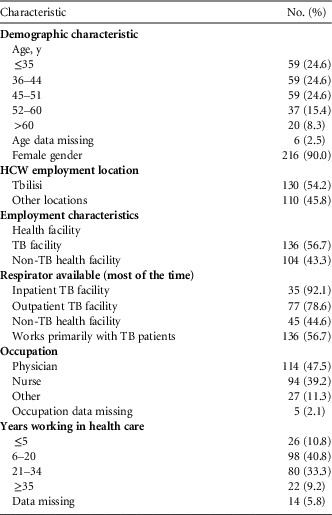
A total of 298 HCWs were approached to enroll in the study; 240 (81%) agreed to participate. The characteristics of the study population (N=240) are described in Table 1. The mean age of HCWs who participated was 44.3 years (standard deviation [SD], 11.4 years). The majority of the participants were female (90%), reflecting the makeup of HCWs at the NTP and affiliated institutions. Respirators were available for 82% of HCWs from the NTP and for only 45% of HCWs from the PHCs. The mean number of years in health care was 19.7 (SD, 10.9 years).
Demographic Information for Healthcare Workers Surveyed (N = 240)

NOTE. HCW, healthcare worker; TB, tuberculosis.
The HCW overall average knowledge score was 61%. HCWs who worked with TB patients knew more about TB (69% overall average score) compared with HCWs who did not (49.16% overall average score; P<.01). Nearly all HCWs (98%) knew that TB is transmitted by an airborne route, and 70% of HCWs knew epidemiological, clinical, and laboratory characteristics of LTBI. However, only 43% of HCWs knew the risk of LTBI progression to TB disease, and only 30% were able to correctly identify high-risk groups for LTBI progression to TB disease. The majority of HCWs (85%) knew the preferred regimen for LTBI treatment, but fewer (66%) knew the justification for latent TB therapy.
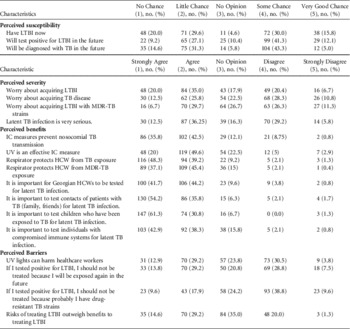
With respect to HCWs, perceived threat of TB infection and perceived benefits and barriers of TB IC, 53% of HCWs in this study thought that they were at risk of having LTBI at some point in the future; 36% of the study participants were concerned about acquiring LTBI with MDR-TB strains; 48% thought of LTBI as a serious health condition; but 43% of HCWs did not want to receive treatment for LTBI because they believed that they would be exposed to TB again (Table 2).
Healthcare Worker Beliefs about Latent Tuberculosis Infection and Tuberculosis Infection Control (N = 240)

NOTE. HCW, healthcare worker; LTBI, latent tuberculosis infection; TB, tuberculosis; MDR-TB, multidrug-resistant tuberculosis; IC, infection control; UV, ultraviolet.
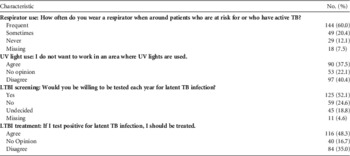
A total of 78% of HCWs from the NTP and only 36% of HCWs from the PHCs reported frequent use of respirators when they were around patients who were at risk for or who had active TB. TB IC–related behavior and willingness to implement TB IC–related behavioral change is outlined in Table 3.
Tuberculosis Infection Control Related Behavior or Willingness to Exhibit Tuberculosis Infection Control Related Behavior (N = 240)

NOTE. TB, tuberculosis; IC, infection control; UV, ultraviolet; LTBI, latent tuberculosis infection.
Predictors of HCW Knowledge about TB
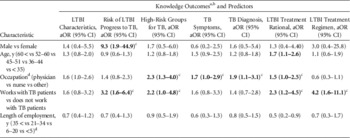
In our multivariate analysis, physicians were more likely to know symptoms suggestive of TB disease (aOR, 1.7; 95% CI, 1.0–2.9), TB diagnostic methods (aOR, 1.9; 95% CI, 1.1–3.1), high-risk groups for TB disease (aOR, 2.3; 95% CI, 1.3–4.0), and LTBI treatment rationale (aOR, 1.5; 95% CI, 1.0–2.5) than nurses (Table 4). HCWs who worked primarily with TB patients were more likely to know about the risk of LTBI progression to TB disease (aOR, 3.2; 95% CI, 1.6–6.4), high-risk groups for TB disease (aOR, 2.2; 95% CI, 1.0–4.8), LTBI treatment rationale (aOR, 2.3; 95% CI, 1.2–4.5), and LTBI treatment regimen (aOR, 4.2; 95% CI, 1.6–11.1) than those who did not work with TB patients (Table 4).
Multivariate Analysis for Predictors of Healthcare Worker Tuberculosis Knowledge

NOTE. TB knowledge variables were coded as correct versus incorrect answers.
aOR, adjusted odds ratio; CI, confidence interval; HCW, healthcare worker; TB, tuberculosis; LTBI, latent tuberculosis infection.
a Definitions of the correct answers are presented in Table 2.
b Binary logistic regression was used.
c Statistically significant effect.
d Ordinal variables.
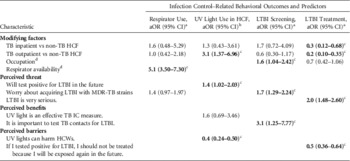
Multivariate Analysis for Predictors of Tuberculosis Infection Control–Related Behaviors

NOTE. Occupation was coded as “physician” or “nurse” or “other.” Respirator availability was coded as “always,” “most of the time,” “sometimes,” “rare,” or “never.” Respiratory use was coded as “frequent,” “sometimes,” or “never.” UV light use in HCF, LTBI screening, and LTBI treatment were coded as “yes,” “undecided,” or “no.”
aOR, adjusted odds ratio; CI, confidence interval; UV, ultraviolet; HCF, healthcare facility; TB, tuberculosis; LTBI, latent tuberculosis infection; MDR-TB, multidrug-resistant tuberculosis; IC, infection control; HCW, healthcare worker.
a Ordinal logistic regression was used.
b Polytomous logistic regression was used.
c Statistically significant effect.
d Ordinal variable.
Association Between HCW TB Knowledge and Beliefs
HCWs who knew the risk of progression from LTBI to TB disease (P<.03) and the high-risk groups for TB disease (P<.01) were more likely to worry about acquiring LTBI with drug-resistant strains than HCWs who did not have this knowledge. HCWs who knew LTBI treatment rationale (P<.01) and TB diagnostics (P<.05) were more likely to think that screening of TB contacts for LTBI is important than those HCWs who did not demonstrate this knowledge. HCWs who knew LTBI characteristics (P<.04), LTBI treatment rationale (P<.01), and TB diagnostics (P<.01) more likely felt that immunocompromised individuals should be screened for LTBI than those who did not have this knowledge. Only those HCWs who knew LTBI characteristics (P<.01) perceived LTBI as a serious infection. As expected, HCWs who worked primarily with TB patients considered themselves more susceptible to LTBI than HCWs who did not (P <.01).
Predictors of TB IC–Related Behaviors
HCWs who indicated that they worried about becoming infected with drug-resistant TB (aOR, 1.7; 95% CI, 1.29–2.24), HCWs who thought it was important to screen TB contacts (aOR, 3.1; 95% CI, 1.25–7.77), and HCWs who were physicians (aOR, 1.6; 95% CI, 1.04–2.42) were more likely to be willing to undergo annual screening for LTBI (Table 5). HCWs were more likely to refuse treatment for LTBI if they worked in TB facilities (inpatient TB facility: aOR 0.3; 95% CI, 0.12–0.68; outpatient TB facility: aOR, 0.2; 95% CI, 0.10–0.35), and they perceived a high personal risk of TB reinfection (aOR, 0.5; 95% CI, 0.36–0.64). Those who thought that LTBI was a potentially serious health condition were more willing to be treated for LTBI (aOR, 2.0; 95% CI, 1.48–2.60) (Table 5). Availability of respirators in HCFs was the only significant predictor of routine use of respirators (aOR, 5.1; 95% CI, 3.50–7.30). In multivariate analysis, employment in a TB outpatient facility (aOR, 3.1; 95% CI, 1.37–6.96), perceived susceptibility to LTBI in the future (aOR, 1.4; 95% CI, 1.02–2.03), and the perception that UV germicidal radiation was unlikely to harm HCWs (aOR, 0.4; 95% CI, 0.24–0.50) were identified as independent predictors of willingness to use UV lights in HCFs (Table 5).
DISCUSSION
In our survey conducted among HCWs employed in the NTP and PHCs in Georgia, physicians had greater knowledge related to TB and TB IC measures than did nurses. In addition, HCWs who worked primarily with TB patients were more educated about TB and related IC activities compared with HCWs who did not see TB patients regularly. HCWs knowledgeable about TB and TB IC measures were more likely to perceive their susceptibility to TB infection, severity of TB disease, and TB IC intervention benefits and barriers. Moreover, HCWs who perceived their susceptibility to TB infection and net benefit of TB IC measures were more likely to comply with IC interventions.
Evidence from several studies shows that knowledge is a facilitator of compliance with interventions.Reference Jensen, Lambert, Iademarco and Ridzon R 3 , Reference Palanduz, Gultekin and Kayaalp 18 , Reference White, Tulsky, Goldenson, Portillo, Kawamura and Menendez 19 Nurses who work mainly with TB patients should be targeted for TB IC training, given their high risk of TB infectionReference J, Mirtskhulava and Kipiani 6 and the lack of knowledge on this topic. Furthermore, Georgian HCWs who work in non-TB HCFs need training regarding TB and TB IC because persons with undiagnosed TB or suspected cases of TB may be seen at these facilities.Reference J, Mirtskhulava and Kipiani 6 This need is especially pertinent because TB services are currently being integrated at PHCs as part of the ongoing health system reforms in Georgia.
Our survey data were analyzed based on the HBM. This model suggests that individuals conduct an internal assessment of the net benefits of changing their behavior, and then decide whether or not to act. The model identifies 4 aspects of this assessment: (1) perceived susceptibility to ill health (risk perception), (2) perceived severity of ill health, (3) perceived benefits of behavior change, and (4) perceived barriers to taking action.Reference Green and Murphy 12 Consistent with the HBM, UV light use is well accepted by HCWs who believe that they are at risk of TB infection, but HCWs who think that UV lights can be harmful leads to their reluctance to use UV lights in HCFs. Perceived LTBI threat predicted HCW readiness to receive LTBI treatment, whereas concern for reinfection with TB after LTBI treatment predicted HCW refusal to be treated for LTBI. Given the high rates of occupational acquisition of TB infection (22.8/100 person years) in a study we conducted in the country of Georgia in 2009–2011,Reference J, Mirtskhulava and Kipiani 6 it is not surprising that Georgian HCWs believe that they remain at risk of TB even after treatment for LTBI. We also found that respirators are not always available for all HCWs, especially in non-TB HCFs. These findings emphasize the need to strengthen IC measures in Georgian HCFs and the need to provide important baseline information to the Georgian Ministry of Health, Labor, and Social Affairs, which is currently implementing IC interventions in HCFs.
Our study has several limitations. One limitation of our study is that TB IC–related behaviors were self-reported rather than observed. For instance, respirator use was measured by HCW responses to anonymous questions rather than by observations of this behavior by the study team. Another limitation of our study is that convenience sampling was used, and 19% of those who were approached did not agree to complete the survey. Most of the nonresponders (53 of 58 HCWs) were nurses from the NTP, potentially introducing selection bias. The physician-to-nurse ratio in TB services and in PHCs is ~1:1 in Georgia; therefore, we expected nearly equal proportion of nurses and physicians in our study population. Physicians comprised 48% of our population and nurses comprised 40%; therefore, our study slightly overrepresented physicians compared to nurses. A major strength of our study is that it included various types of HCWs across the whole country.
In summary, our study is the first survey about HCW knowledge, beliefs, and behaviors regarding TB IC and LTBI screening and treatment in Georgia. We were able to identify specific knowledge gaps and beliefs that can be addressed during the implementation of TB IC measures in Georgian HCFs. Researchers and HCF administrators should pursue the application of behavioral science methods to strengthen the implementation of TB IC measures.Reference Kanjee, Catterick, Moll, Amico and Friedland 20 Based on our survey findings, a targeted campaign is needed to raise HCW awareness about TB and about the benefits of TB IC measures to prevent the nosocomial transmission of TB and the particular threats of drug-resistant TB in the country of Georgia.
Acknowledgments
Financial support. This study was supported in part by the NIH Fogarty International Center (grant nos. D43TW007124 and D43TW007124-06S1), the Atlanta Clinical and Translational Science Institute (grant no. NIH/NCATS UL1TR000454), and the Emory Global Health Institute.
Potential conflicts of interest. All authors report no conflicts of interest relevant to this article.
Supplementary Material
To view supplementary material for this article, please visit http://dx.doi.org/10.1017/ice.2015.5