Scholars in developmental psychology and psychopathology have broadly accepted the importance of studying human development in the context of the broader ecology of the family. The belief that contextual factors, including the family's sociodemographic resources, play a significant role in unfolding developmental trajectories has become universally acknowledged, and further solidified by multiple landmark papers (Belsky, Reference Belsky1984; Bronfenbrenner, Reference Bronfenbrenner1979, Reference Bronfenbrenner1986; Taraban & Shaw, Reference Taraban and Shaw2018). Scholars in fields other than psychology have also emphasized the role of the family's sociodemographic factors as key in human socialization. For example, in sociology, Kohn (Kohn, Reference Kohn1959; Pearlin & Kohn, Reference Pearlin and Kohn1966) argued that parents’ social class (working vs. middle) was a central factor that determined their parenting values and goals.
In developmental psychology and psychopathology, voluminous research, far exceeding the scope of the present article, has examined the family's socioeconomic status (SES) as a critical context (Belsky, Reference Belsky1984; Bradley & Corwin, Reference Bradley and Corwyn2002; Burchinal, Vernon-Feagans, Cox, & Key Family Life Project Investigators, Reference Burchinal, Vernon-Feagans and Cox2008; Conger & Donnellan, Reference Conger and Donnellan2007; Hackman & Farah, Reference Hackman and Farah2009; Hoff, Laursen, & Tardif, Reference Hoff, Laursen, Tardif and Bornstein2002; Taraban & Shaw, Reference Taraban and Shaw2018). That very large literature has encompassed multiple conceptualizations and foci, including adversity, poverty, neighborhood quality, family resources and stresses, (un)employment, or ethnicity, to mention just a few. That research has identified specific sociodemographic variables associated with a host of poor child outcomes that included externalizing and disruptive problems. There is robust consensus that factors such as parents’ young age (Berlin, Brady-Smith, & Brooks-Gunn, Reference Berlin, Brady-Smith and Brooks-Gunn2002; Bornstein, Putnick, Suwalsky, & Gini, Reference Bornstein, Putnick, Suwalsky and Gini2006; Ragozin, Basham, Crnic, Greenberg, & Robinson, Reference Ragozin, Basham, Crnic, Greenberg and Robinson1982; Wakschlag et al., Reference Wakschlag, Gordon, Lahey, Loeber, Green and Leventhal2000), and low education and family's low income (Baharudin & Luster, Reference Baharudin and Luster1998; Conger, Ge, Elder, Lorenz, & Simons, Reference Conger, Ge, Elder, Lorenz and Simons1994; McLoyd, Reference McLoyd1998; O'Connor, Reference O'Connor2002) pose risks for parenting and child development.
Because contextual risks tend to co-occur, they are often studied in concert. Scholars in developmental psychopathology have proposed that a confluence of such factors is associated with poor parenting and child outcomes (Deater-Deckard, Dodge, Bates, & Pettit, Reference Deater-Deckard, Dodge, Bates and Pettit1998; Dishion & Patterson, Reference Dishion, Patterson, Cicchetti and Cohen2006; Evans, Li, & Whipple, Reference Evans, Li and Whipple2013; Lengua et al., Reference Lengua, Kiff, Moran, Zalewski, Thompson, Cortes and Ruberry2014; Sameroff, Seifer, Barocas, Zax, & Greenspan, Reference Sameroff, Seifer, Barocas, Zax and Greenspan1987; Wilson, Hurtt, Shaw, Dishion, & Gardner, Reference Wilson, Hurtt, Shaw, Dishion and Gardner2009). Measures of those co-occurring factors—multiple or cumulative risk indices—robustly predict developmental trajectories. Often, each factor is dichotomized (absent vs. present), and the summed number of risks present is considered a robust measure of early adversity. Graded or continuous variations of this approach have also proved useful (Burchinal et al., Reference Burchinal, Vernon-Feagans and Cox2008; Kochanska, Aksan, Penney, & Boldt, Reference Kochanska, Aksan, Penney and Boldt2007).
Often, scholars studying multiple early risks extended the studied factors beyond sociodemographic adversity to include also the child's difficult temperament and parents’ harsh, negative discipline as components of the “parcel” of cumulative risk (Deater-Deckard et al., Reference Deater-Deckard, Dodge, Bates and Pettit1998), consistent with the ecological perspective's multilevel approach to development (Belsky, Reference Belsky1984; O'Connor, Reference O'Connor2002; Taraban & Shaw, Reference Taraban and Shaw2018). This literature dovetails and overlaps with another large body of research on child and parent psychological characteristics and maladaptive trajectories of development (Kochanska, Kim, & Koenig Nordling, Reference Kochanska, Kim and Koenig Nordling2012). That research has often identified child “difficult temperament” as an early risk factor. The concept of difficult temperament dates back to Thomas and Chess (Reference Thomas and Chess1977), who described a set of challenging child characteristics (e.g., negative mood and low adaptability). In later voluminous research, difficult temperament has become a notoriously broad concept that has encompassed a variety of hard-to-manage child characteristics. Although many definitions exist, high negative emotionality, typically anger proneness, and poor regulation are often considered key (Bates, Reference Bates1980; Lengua & Wachs, Reference Lengua, Wachs, Zentner and Shiner2012; Rothbart & Bates, Reference Rothbart, Bates, Damon, Lerner and Eisenberg2006; Sanson, Hemphill, & Smart, Reference Sanson, Hemphill and Smart2004).
Research has also documented a path from children's difficult temperament to disruptive behavior problems, typically seen as mediated through parents’ harsh, power-assertive discipline (Bates, Schermerhorn, & Petersen, Reference Bates, Schermerhorn, Petersen, Zentner and Shiner2012; Dadds & Salmon, Reference Dadds and Salmon2003; Dishion & Patterson, Reference Dishion, Patterson, Cicchetti and Cohen2006; Lipscomb et al., Reference Lipscomb, Leve, Harold, Neiderhiser, Shaw, Ge and Reiss2011; Pardini, Reference Pardini2008; Pettit & Arsiwalla, Reference Pettit and Arsiwalla2008; Rothbart & Bates, Reference Rothbart, Bates, Damon, Lerner and Eisenberg2006; Scaramella & Leve, Reference Scaramella and Leve2004; Shaw & Bell, Reference Shaw and Bell1993). Difficult children are thought to elicit more power-assertive control, which, in turn, leads to disruptive, antisocial problems, in part due to the child's growing resentment and anger toward the parent and rejection of parental influence. The findings, however, have been far from consistent and not always replicated (Lorber & Egeland, Reference Lorber and Egeland2011; Paulussen-Hoogeboom, Stams, Hermanns, & Peetsma, Reference Paulussen-Hoogeboom, Stams, Hermanns and Peetsma2007; Putnam, Sanson, & Rothbart, Reference Putnam, Sanson, Rothbart and Bornstein2002).
Several scholars have proposed that SES can moderate associations between children's difficult temperament and the parenting they receive. In a classic paper, Crockenberg (Reference Crockenberg, Lerner and Lerner1986) argued that the impact of infant difficulty on parenting depends on the family's environment (resources, support, adversity, and SES). There is also meta-analytic evidence. Paulussen-Hoogeboom et al. (Reference Paulussen-Hoogeboom, Stams, Hermanns and Peetsma2007) examined studies that had tested associations between young children's negative emotionality and parenting. The family's SES and parents’ age were among the studied moderators. The association between more child negative emotionality and less supportive parenting was relatively strong in families with lower SES, but reversed in those with higher SES. Taraban and Shaw (Reference Taraban and Shaw2018), in a very recent review inspired by Belsky's classic paper (Belsky, Reference Belsky1984), reaffirmed the role of SES, or a family's social environment, as a potentially key moderator of relations between children's difficult temperament and parenting, and framed it as an important topic for future research.
Furthermore, empirical evidence has supported the moderating role of SES for links between child temperament and future developmental outcomes. Sentse, Veenstra, Lindenberg, Verhulst, and Ormel (Reference Sentse, Veenstra, Lindenberg, Verhulst and Ormel2009), studying Dutch families, examined family SES (an average of both parents’ education, occupation, and income) as a moderator of links between children's temperament-based risk factors, including proneness to anger at age 11, and psychopathology, including externalizing problem (aggression and rule breaking) at age 13.5. They found a significant interaction between SES and anger proneness, such that the risk effect of anger proneness for future externalizing problems was significantly higher for children in low-SES families than for those in high-SES families. There were also analogous interaction effects of SES and proneness to fear for future internalizing problems, suggesting that the moderating role of SES can be quite broad. Although this study is valuable and has many strengths, including a very large and representative sample, its limitation is reliance on parent-rated measures of children's temperament. Given that the measure of children's psychopathology was an average of parents’ and children's reports, the measures of the predictors and outcomes came, in part, from the same informants. Consequently, research that employs observational measures of child difficulty, collected repeatedly, if possible, although labor intensive, can provide valuable complementary information.
The moderation effect of the sociodemographic variables may be due to several factors. Compared to younger and less educated parents, older and more educated mothers and fathers may have a better understanding of children's emotional needs and more patience for children's challenging characteristics. Such parents may have a richer repertoire of caregiving techniques and may rely on more positive parenting practices. Families with higher incomes may have access to more resources that offset stress due to the child's difficult temperament (e.g., obtaining help from alternative caregivers). Families with lower incomes experience multiple additional stresses, such as chaos or unsafe neighborhoods. Consequently, in families with fewer sociodemographic resources, the negative cascade from child difficult, unmanageable temperament to power-assertive parenting to disruptive problems may be more likely to be triggered and maintained over time than in families enjoying sociodemographic advantages.
In the current study, to minimize shared method variance, we adopted a multimethod approach, and collected observational data on children's difficult temperament and parents’ power-assertive control. As mentioned earlier, definitions of difficult temperament vary broadly. In the context of evoking negative parenting and vulnerability to adverse circumstances, two characteristics associated with child management challenges often include high anger proneness and a low level of self-regulation, especially poor ability to delay (Lengua & Wachs, Reference Lengua, Wachs, Zentner and Shiner2012). We decided to target both in our study as markers of hard-to-manage (or unmanageable) difficult temperament.
We model the child's unmanageable temperament as a predictor, parental power-assertive control as a mediator, the child's disruptive behavior problems as the outcome, and the family's sociodemographic resources as a moderator of the mediated sequence. Integrating the extant literatures, we propose a specific longitudinal model of relations among sociodemographic factors, child temperament, and parenting. Consistent with the ecological perspective, we believe that the maladaptive cascade from child hard-to-manage temperament to parental power-assertive control for disruptive behavior problems may depend on the broader sociodemographic context in which parental socialization and development unfold. Specifically, we expect that the cascade may be particularly likely to unfold in families characterized by sociodemographic disadvantage, such as young parental age, low education, and low income. In families with more sociodemographic resources, the cascade can be much less likely to occur, and would be defused or absent. In those families, hard-to-manage children may receive more rather than less adaptive parenting (more patience, more sensitive care, more supportive and positive parenting techniques, etc.). Although informed by research on cumulative risk, our model offers a distinct advantage by proposing a specific mechanism (mediation) and the conditions under which it is triggered (moderation), thus promising a more nuanced understanding.
Although scholars inspired by the ecological perspectives have long argued for the study of both parents, and research on father–child relationships has grown substantially, gaps in our knowledge persist, with much more known about mothers and their role in development (Cabrera, Fitzgerald, Bradley, & Roggman, Reference Cabrera, Fitzgerald, Bradley and Roggman2014; Cabrera, Volling, & Barr, Reference Cabrera, Volling and Barr2018). Despite the various challenges and difficulties that emerge in studies that involve fathers, researchers continue to argue for more research on fathers’ parenting, particularly work that uses observational methods and considers the ecological context (Cabrera & Volling, Reference Cabrera and Volling2019). The current state of the literature lacks consistency and integration.
Across many areas of development, there is no consensus on how to study mothering and fathering, whether parenting constructs should be the same or different, and whether implications for children are the same or different. Fagan, Day, Lamb, and Cabrera (Reference Fagan, Day, Lamb and Cabrera2014) concluded that there was insufficient evidence to assume substantial differences in conceptualization of mothers’ and fathers’ parenting and its implications. Although similar, effects of mothers’ behavior have sometimes been stronger than fathers’ (e.g., Malmberg & Flouri, Reference Malmberg and Flouri2011; Rothbaum & Weisz, Reference Rothbaum and Weisz1994); sometimes, this depended on the type of outcomes (Belsky, Hsieh, & Crnic, Reference Belsky, Hsieh and Crnic1998; Chang, Shwartz, Dodge, & McBride-Chang, Reference Chang, Schwartz, Dodge and McBride-Chang2003). Relations among child temperament, mothers’ and fathers’ parenting, and children's outcomes are even less well understood. As recent examples, studying a relatively large and diverse sample using parent reports, Wittig and Rodriguez (Reference Wittig and Rodriguez2019) reported evocative effects of child temperament on mothers’, but not fathers’ parenting. Padilla and Ryan (Reference Padilla and Ryan2019) reported evocative effects of child negative emotionality on fathers’ observed parenting, and of child sociability on mothers’ observed parenting. Vertsberger and Knafo-Noam (Reference Vertsberger and Knafo-Noam2019) found that children's observed anger at 9 months was associated with an increase in reported negativity at 18 months for both mothers and fathers. We have examined all studied processes in mother–child and father–child dyads, but given the obvious lack of consensus in the literature, that direction of our investigation was exploratory.
Method
Participants
One hundred and two two-parent, intact families of infants, born mostly in 2001, living in a Midwestern college town, a nearby small city and surrounding rural areas, responded to flyers and ads seeking volunteers for a longitudinal study. To be eligible, the two parents had to be living together, with both willing to participate and speak English during sessions; to have a typically developing infant (a biological child); and not be planning to move in the next 5 years. Demographic characteristics varied: 25% of mothers and 30% of fathers had no more than a high school education, 54% of mothers and 51% of fathers had an associate or college degree, and 21% of mothers and 20% of fathers had a postgraduate education. In terms of income, 8% of families made less than $20,000 per year, 17% made between $20,000 and $40,000, 26% made between $40,000 and $60,000, and 49% made over $60,000. In terms of ethnic background, 90% of mothers and 84% of fathers were White, 3% of mothers and 8% of fathers were Hispanic, 2% of mothers and 3% of fathers were African American, 1% of mothers and 3% of fathers were Asian, 1% of mothers were Pacific Islander, and 2% of mothers and fathers reported other. In 20% of families, at least one parent was not White. Mothers’ and fathers’ ages ranged, respectively, from 17 to 45 years, M = 30.80, SD = 5.30, and from 19 to 49 years, M = 32.23, SD = 6.03.
Overview of design
We report data collected at 7 months (N = 102, 51 girls), 25 months (age 2, N = 100, 50 girls), 38 months (age 3, N = 100, 50 girls), 52 months (age 4.5, N = 99, 49 girls), 67 months (age 5.5, N = 92, 45 girls), 80 months (age 6.5, N = 90, 43 girls), and 100 months (age 8, N = 87, 41 girls). In addition, one covariate, early parental power-assertive control, was collected at 15 months (N = 101, 51 girls). Through age 6.5, data were collected during observational mother–child and father–child sessions, 2–4 hr long, parallel for both parents, typically within 2–3 weeks. Female experimenters (Es) conducted the sessions, video-recorded for future coding. The sessions took place in a university laboratory (at 38 months, sessions were at home and in the laboratory). At age 8, there was one laboratory session, which did not include parent–child observations (we include parent-reported data for age 8). The families who returned did not differ significantly on any of the studied constructs from those who did not return. The University of Iowa Institutional Review Board approved the study (Developmental Pathways to Antisocial Behavior: A Translational Research Program, 200107049). Parents signed informed consents and children, once they turned 7, signed assents.
Behavioral data were coded from videos. Reliability was typically established on 15%–20% of cases, followed by frequent realignments to prevent observer drift. We used kappas, weighted kappas, and alphas or intraclass correlations (note that the best practices have evolved over the course of the study). Many published articles contain details of our constructs and measures; those are referenced where appropriate.
Measures
Children's unmanageable temperament, age 2 and 3
Those measures encompassed proneness to anger (Kochanska & Kim, Reference Kochanska and Kim2012) and (poor) ability to delay (e.g., Jonas & Kochanska, Reference Jonas and Kochanska2018; Kim & Kochanska, Reference Kim and Kochanska2012; Kochanska, Murray, & Harlan, Reference Kochanska, Murray and Harlan2000; Kochanska, Philibert, & Barry, Reference Kochanska, Philibert and Barry2009). Both constructs were assessed in laboratory paradigms.
Proneness to anger was observed in Toy Retraction episodes (at age 2, twice, one during each session, and at age 3, once) from Laboratory Temperament Assessment Battery (Lab-Tab; Goldsmith & Rothbart, Reference Goldsmith and Rothbart1999). After the child became engaged with an attractive toy, E took it away and kept out of reach for 30 s (then the child was given the toy back). The 30-s period was coded for every 5-s segment for intensity of facial, vocal, and bodily anger expression, and latency to the first anger expression (κs .58 to .95, αs .99 to 1.00). Those codes were standardized and averaged into overall anger composites (Cronbach's αs at age 2 were .71 and .77, and at age 3, .66). The two episodes at age 2 correlated, r (97) = .58, p < .001, and were aggregated. This composite correlated with the measure at age 3, r (97) = .31, p < .0025, and thus, we aggregated them across ages 2 and 3 into a score of proneness to anger.
Ability to delay was observed in tasks that required the child to refrain from performing a highly attractive action. At age 2, the tasks included Snack Delay (the same task was administered in both sessions), waiting (without peeking or touching) to unwrap a gift, and waiting, in seat, for E to bring a bow. Snack Delay required waiting to reach for an M&M placed under a cup until E rang the bell (E lifted it halfway through the delay); each produced one score, ranging from 0 = eats the candy before E lifts the bell, to 4 = waits until bell is rung. Waiting to unwrap a gift produced two scores: behavior while E was wrapping it noisily behind child back (Gift Wrap), and behavior while waiting for E to bring a bow (Gift Bow). The former was coded from 1 = “fully” looking while E was wrapping, to 5 = never peeking. The latter was coded from 1 = opens gift, to 4 = never touches, and 1 = in seat for less than 30 s, to 4 = in seat for more than 2 min.
At age 3, the tasks included Snack Delay (same as at age 2), waiting to unwrap a gift (Gift Wrap and Gift Bow, same as at age 2), and Dinky Toys, which required deliberately choosing a prize from a box filled with small toys and produced one score (latency to choose the toy). Note that in some tasks (Gift Wrap and Gift Bow), the one final score represented a composite of several (standardized) coded behaviors that cohered, for example, peeking, staying in seat, touching/opening the gift, as well as latencies to peek, to open, to leave seat, and so on. In Snack Delay, the final score was a result of aggregation across trials.
Reliability, across coding teams, at age 2, κs, ranged from .77 to 1.00 and αs ranged from .88 to 1.00; at age 3, κs ranged from .71 to 1.00 and αs ranged from .81 to 1.00. The scores were aggregated at each age (Cronbach's αs were .76 and .59 at ages 2 and 3, respectively). Those composites correlated across ages 2 and 3, r (100) = .52, p < .001, and thus were aggregated into a score of ability to delay. Finally, this score was reversed, to denote poor ability to delay.
The scores of proneness to anger and poor ability to delay correlated, r (100) = .42, p < .001. We thus aggregated them into the overall score of unmanageable temperament at ages 2–3.
Parents’ power-assertive control, age 4.5 and 5.5
At each age, each mother– and father–child dyad was observed in control contexts that involved parental prohibition. During those times, the dyad was in the laboratory room. The room contained a low shelf with extremely attractive, easily accessible objects designated as off-limits for the child. At the beginning of the session, the parent was asked to keep the child from touching them. The coded times with each parent were 65 min at age 4.5 and 60 min at age 5.5 (125 min total with each parent).
The parent's control was coded for every 30-s segment during the episodes when the child became involved with the prohibited toys (the onsets and offsets of those episodes had been first identified by separate teams of coders; coding reliability, αs, ranged from .83 to .94). Each segment received a global rating: “no interaction,” “social exchange” (but no attempt to control), “gentle guidance” (subtle, gentle control), “assertive control” (matter-of-fact, somewhat assertive, decisive control), and “forceful, negative control” (control delivered with an angry, threatening, combative, negative tone). As well, in each segment, physical techniques were coded as “assertive interventions” (holding the child's hand firmly, physically preventing the child from touching the toys) or “forceful interventions” (taking away a toy abruptly, handling the child roughly). Kappas ranged from .68 to .76.
For each parent, we tallied all instances of each global and physical code and divided by the number of segments. We then weighed those scores to reflect the applied pressure (Kim & Kochanska, Reference Kim and Kochanska2015; Kochanska et al., Reference Kochanska, Aksan, Penney and Boldt2007), as follows: no interaction, –2; social exchange, –1; gentle guidance, 1; control, 2; forceful negative control, 3; physical assertive, 4; and physical forceful, 5. We then summed the weighed scores. Those scores correlated across the assessments at 4.5 and 5.5, for mothers, r (90) = .52, p < .001, and for fathers, r (88) = .61, p < .001, and thus were standardized and aggregated across both assessments into a score of power-assertive control for each parent.
Children's disruptive behavior, age 6.5 and 8
At both 6.5 and 8 years, each parent rated the child on the scales of oppositional defiant disorder (ODD, 8 items) and conduct disorder (CD, 15 items) in the Child Symptom Inventory (Gadow & Sprafkin, Reference Gadow and Sprafkin2002) and the overt aggression scale (4 items) in the Macarthur Health Behavior Inventory (HBQ; Essex et al., Reference Essex, Boyce, Goldstein, Armstrong, Kraemer and Kupfer2002). We used parents’ symptom severity ratings: 0 = never, 1= sometimes, 2 = often, 3 = very often. Cronbach's αs were as follows: ODD, for mothers, .83 and .86 at 6.5 and 8 years, respectively, for fathers, .86 and .83; CD, for mothers, .72 and .64, and for fathers, .68 and .56. At each age and for each parent, we summed the ODD and CD scales into a score of externalizing behavior problems (Cronbach's αs at the two ages, for mothers, .85 and .85, and for fathers, .84 and .81).
In HBQ, parents rated each item as 1 = never/not true, 2 = sometimes/somewhat true, 3 = often/very true. The items were averaged for each parent at each time. Cronbach's αs for overt aggression at the two ages were .67 and .62 for mothers, and .60 and .57 for fathers.
The four scores for each parent (Child Symptom Inventory externalizing behavior problems and HBQ overt aggression, each at 6.5 and 8 years) were highly coherent: Cronbach's αs for mothers .84 and for fathers, .78. They were therefore standardized and aggregated into the child's overall disruptive behavior score, as rated by each parent.
Family sociodemographic resources, age 7 months
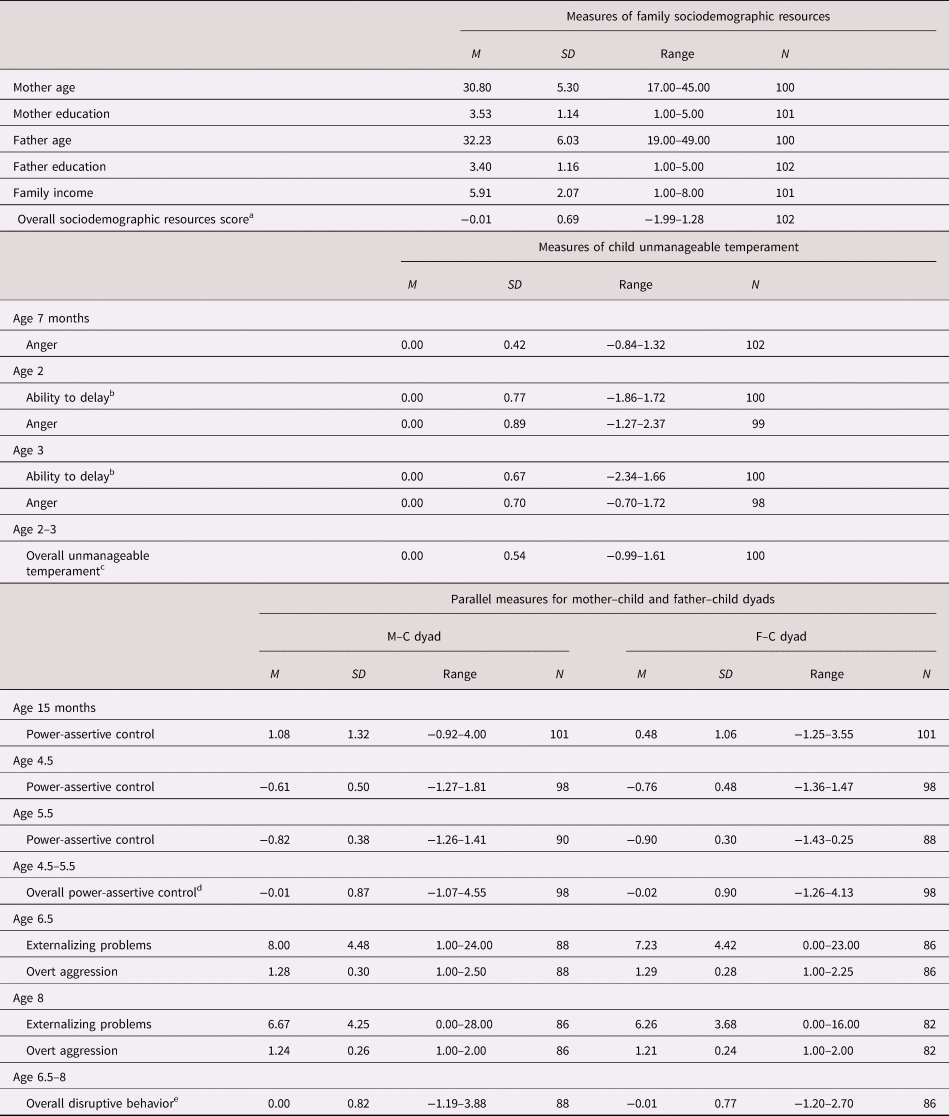
Parents reported their demographic data at the entry to the study (see Table 1). Education ranged from 1 = less than high school, to 5 = postgraduate education (more than BA/BS). Family (annual) income ranged from 1 = less than $10,000, to 8 = more than $70,000. Parents reported their ages in years. We created the family's sociodemographic resources score by averaging (after standardization) the mother's age, her education, the father's age, his education, and family income. Because approximately 30% of mothers reported being full-time homemakers and not employed outside of the home at the time, we decided not to include a measure of occupational prestige. Those scores cohered, Cronbach's α = .71; further, the correlations of each of the five scores with the other constructs in the study were extremely similar.
Descriptive data for all measures

Note: M-C, mother–child. F-C, father–child. aComposite of standardized scores of the measures of family sociodemographic resources score. bComposite of standardized scores for all the ability-to-delay tasks at each age, 2 years and 3 years. cComposite of standardized scores for proneness to anger and poor ability to delay across both ages, 2 years and 3 years. dComposite of standardized scores of power assertion across both ages, 4.5 years and 5.5 years. eComposite of standardized scores of externalizing problems and aggression across both ages, 6.5 years and 8 years.
Covariates
Children's sex, proneness to anger at 7 months, and the parents’ power-assertive control at 15 months were controlled in all analyses. Proneness to anger was observed in three brief episodes adapted from the Lab-Tab (Goldsmith & Rothbart, Reference Goldsmith and Rothbart1999): Arm Restraint, Toy Retraction, and Car Seat. All episodes involve frustration (the baby's forearms pressed gently to his or her sides as the baby is engaged with a toy, an attractive toy taken away when the baby is playing with it, and the baby buckled tightly in a car seat). The coding was analogous to that used at ages 2 and 3. The scores were aggregated into a composite of proneness to anger. The details of the paradigms, coding, and data aggregation are in Kim and Kochanska (Reference Kim and Kochanska2012). Parents’ power-assertive control was observed for 30 min with each parent, and coded for each 30-s segment in a manner analogous to that at ages 4.5 and 5.5 (κs .67 to .76). All descriptive data are in Table 1.
Results
Overview of the analyses
We first examined correlations among the studied constructs. Next, we tested the overall proposed moderated mediation models, separately for the mother–child and father–child dyads. In those analyses, the child's unmanageable temperament at ages 2–3 was modeled as the predictor, the given parent's power-assertive control at ages 4.5–5.5 was the mediator, and the child's disruptive behavior, rated by the given parent at ages 6.5–8, was the outcome. The family's sociodemographic resources score was the moderator of the entire cascade from child difficult temperament to disruptive outcomes. The child's gender, and two constructs assessed prior to the studied cascade (observed anger proneness at 7 months and the given parent's observed power-assertive control at 15 months) were covaried in all analyses, as a strategy that provides a way of controlling for continuity of the studied constructs.
We used Mplus program (Muthén & Muthén, Reference Muthén and Muthén2012) to estimate the direct and the interaction effects of the moderated mediation models. We followed up significant interaction effects using simple slopes (Aiken & West, Reference Aiken and West1991). When testing the indirect effects depending on various levels of the moderator, we utilized the Mplus code provided by Stride, Gardner, Catley, and Thomas (Reference Stride, Gardner, Catley and Thomas2015). By converting the original SPSS PROCESS macro syntax into the Mplus program, this method allows for the use of the full information maximum likelihood treatment for missing data within the framework of PROCESS (Hayes, Reference Hayes2013; note that PROCESS uses listwise deletion with regard to missing data). PROCESS relies on the nonparametric bootstrapping method to examine the moderated mediation effect. This bootstrap approach is particularly advantageous when the sample size is not large, because (a) the sampling distribution is not assumed to be normal, (b) no particular formula for the standard error is required, and (c) power is maximized while minimizing Type I error rate (MacKinnon, Lockwood, & Williams, Reference MacKinnon, Lockwood and Williams2004; Preacher, Rucker, & Hayes, Reference Preacher, Rucker and Hayes2007; Shrout & Bolger, Reference Shrout and Bolger2002). We applied the nonparametric resampling approach with 10,000 resamples drawn to derive the 95% confidence intervals (CI) for the moderated mediation effect.
Correlations among the constructs
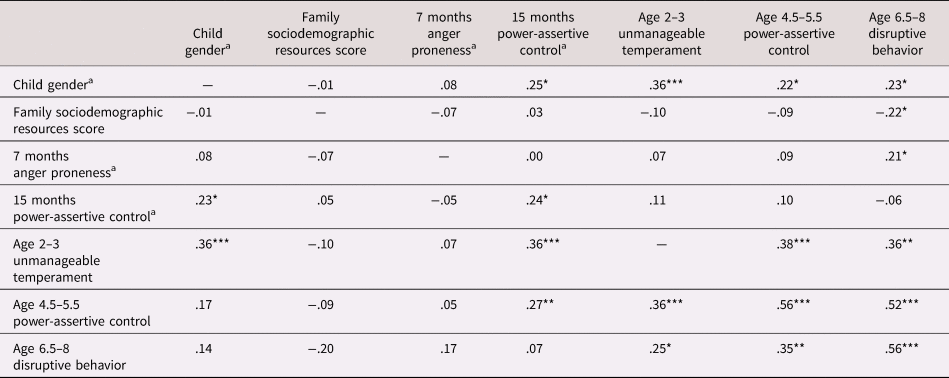
The correlations are presented in Table 2. The patterns were very similar for mother–child and father–child dyads. Children with more unmanageable temperaments received more power-assertive control and higher ratings of disruptive behavior. Parents who relied more on power-assertive control rated their children as more disruptive. The family's sociodemographic resources score was uncorrelated with any of the other measures, with an exception of one modest correlation: mothers in families with more advantageous sociodemographic resources rated their children as less disruptive. Mothers’ and fathers’ power-assertive control and their ratings of child disruptive behavior were moderately correlated.
Correlations among all measures

Note: Correlations for mother–child dyads are above the diagonal, and correlations for father–child dyads are below the diagonal. Correlations across the dyads are on the diagonal. Correlations with child gender are point-biserial. aCovariate. *p < .05. **p < .01. ***p < .001.
The testing of the proposed moderated mediation models
Mother–child dyads
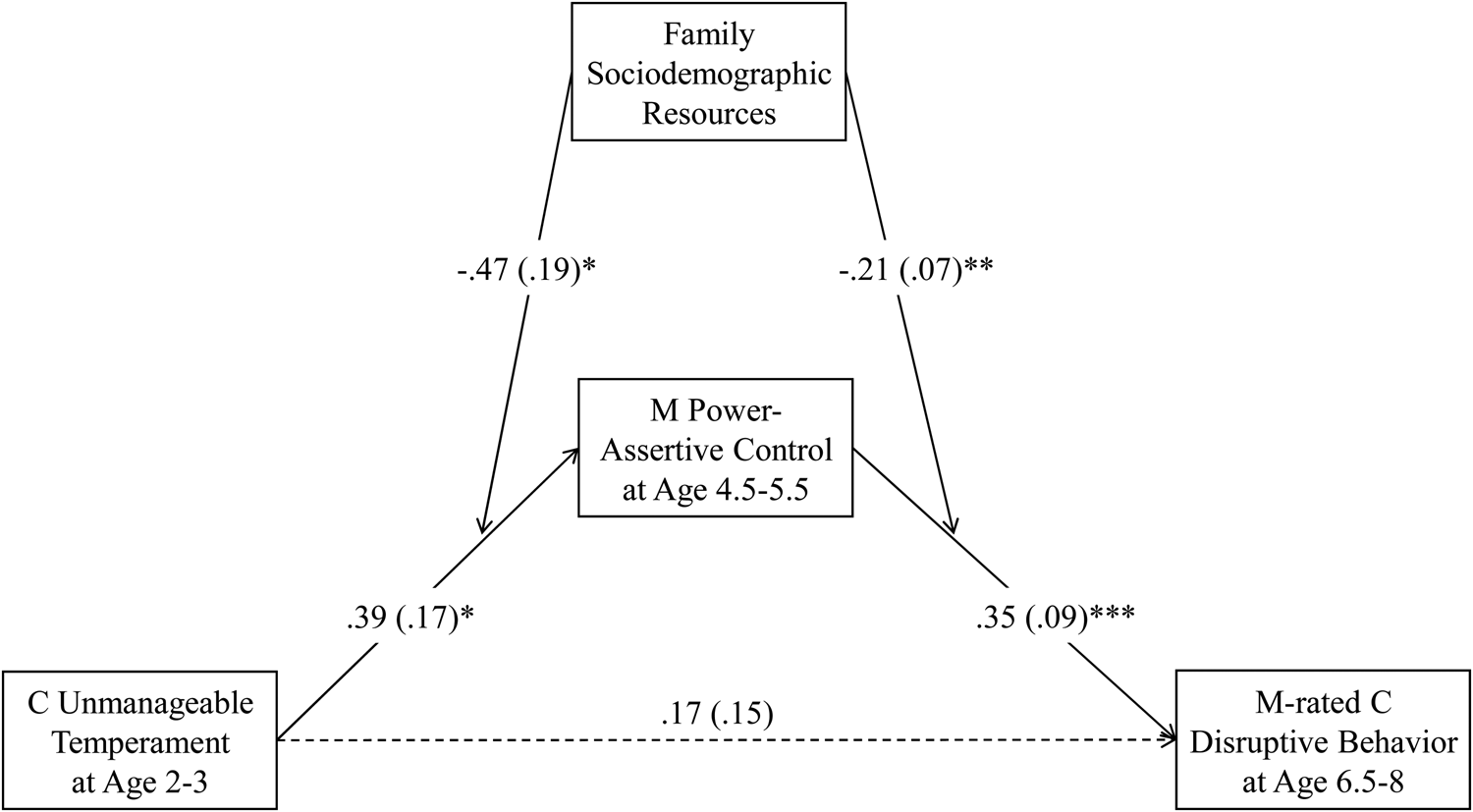
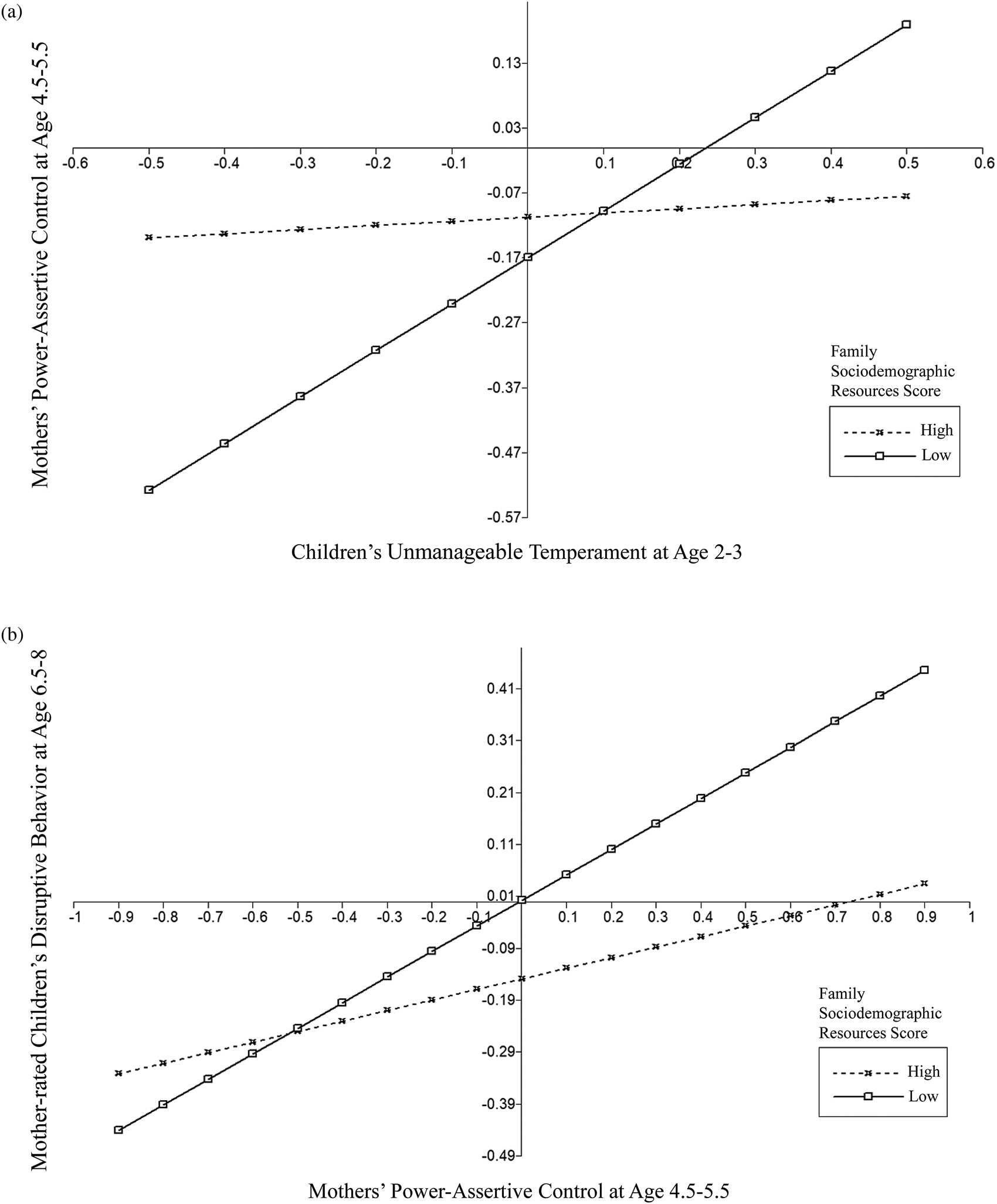
Figure 1 presents the results of the proposed moderated mediation model for mother–child dyads. Children's unmanageable temperament at ages 2–3 was significantly associated with mothers’ greater power-assertive control at ages 4.5–5.5. Higher scores in power-assertive control were in turn significantly associated with higher scores in mother-rated children's disruptive behavior problems at ages 6.5–8. Both postulated moderation effects of the family's sociodemographic resources were significant: for the link between unmanageable temperament and power-assertive control and for the link between power-assertive control and disruptive behavior problems. Those significant moderation effects are graphed in Figure 2a and 2b, respectively.
The moderated mediation model of the path from the predictor, the child's unmanageable temperament at age 2–3, to the mediator, the mother's power-assertive control at age 4.5–5.5, to the outcome, mother-rated child disruptive behavior at age 6.5–8. The family's sociodemographic resources score is modeled as the moderator. Although not depicted, the child's gender and anger proneness at 7 months and the mother's power-assertive control at 15 months are included as covariates. Solid lines represent significant effects, and dashed lines represent nonsignificant effects. Reported are unstandardized coefficients and standard errors (in parentheses). M, mother. C, child. *p < .05. **p < .01. ***p < .001.

The family's sociodemographic resources score moderates (a) the effect of the child's unmanageable temperament at age 2–3 on the mother's power-assertive control at age 4.5–5.5 and (b) the effect of the mother's power-assertive control at age 4.5–5.5 on mother-rated child disruptive behavior at age 6.5–8. The child's gender and anger proneness at 7 months and the mother's power-assertive control at 15 months are covaried. Solid lines represent significant simple slopes, and dashed lines represent nonsignificant simple slopes.

In Figure 2a, the simple slope of children's unmanageable temperament on mothers’ power assertive control was significant, B = .72, SE = .17, p < .001, when the family's sociodemographic resources score was low (–1 SD), but not significant, B = .06, SE = .25, ns, when the score was high (+1 SD). Likewise, in Figure 2b, the simple slope of mothers’ power-assertive control on mother-rated children's disruptive behavior problems was significant, B = .49, SE = .09, p < .001, when the family's sociodemographic resources score was low (–1 SD), but not significant, B = .20, SE = .11, ns, when the score was high (+1 SD).
The results of the moderated mediation analyses suggested that the indirect effect from child unmanageable temperament to power-assertive control to disruptive behavior problems in mother–child dyads varied depending on the level of the family's sociodemographic resources score. When the score was low (–1 SD), the indirect effect was present, B = .35, SE = .16, bias-corrected bootstrap 95% CI [.09, .70], but when the score was high (+1 SD), the indirect effect was absent, B = .01, SE = .08, bias-corrected bootstrap 95% CI [–.09, .22].
Father–child dyads
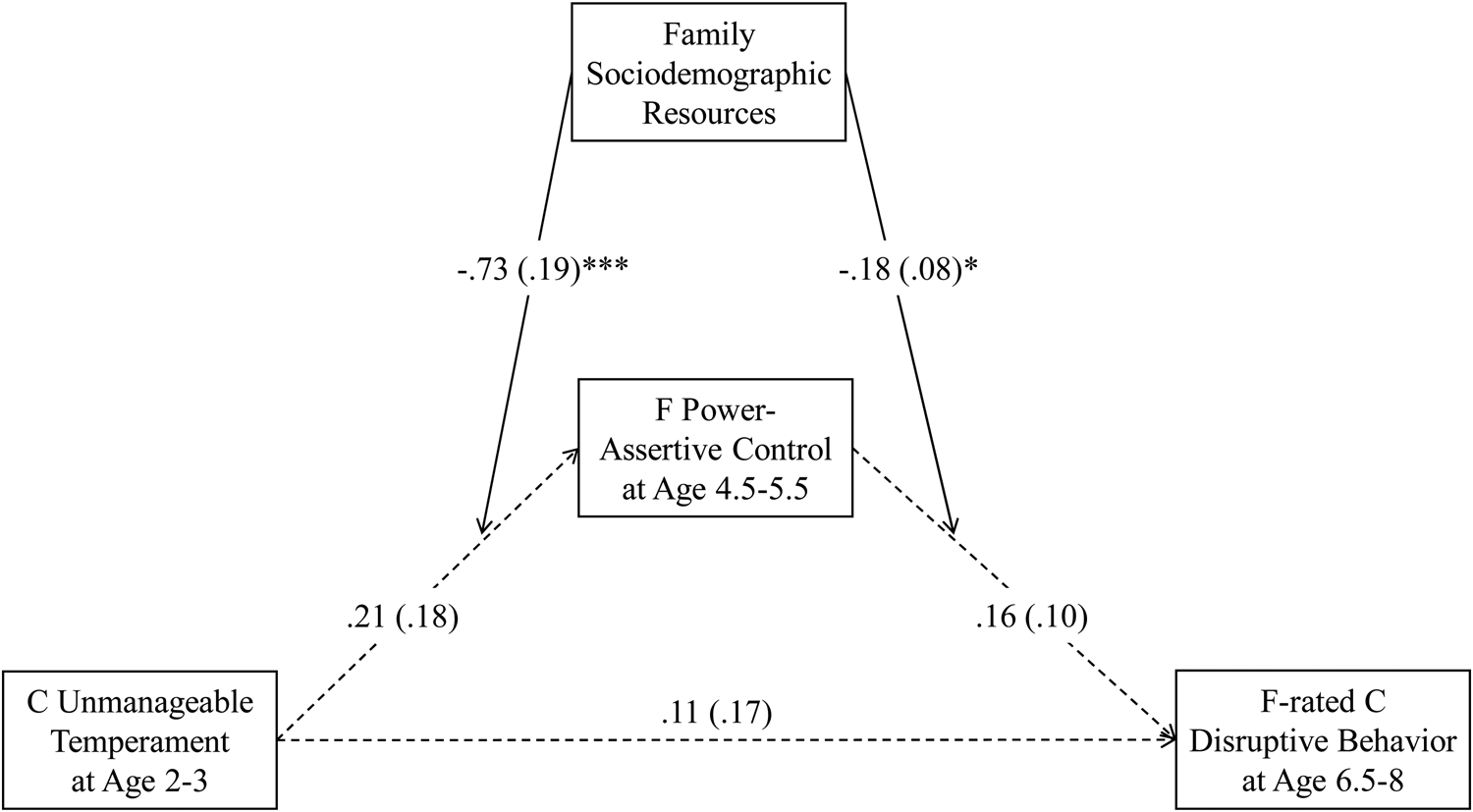
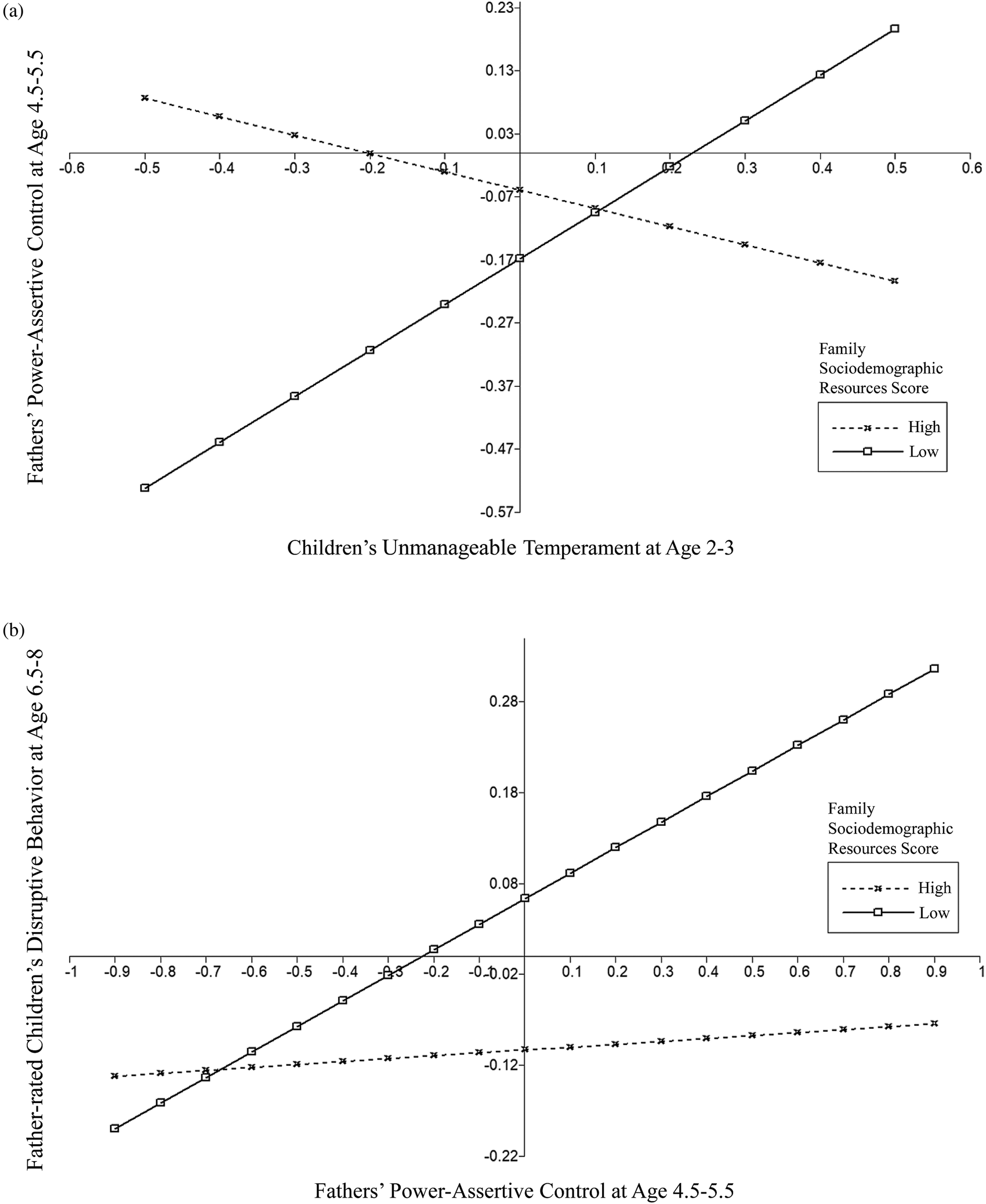
Figure 3 presents the results of the moderated mediation model in father–child dyads. In contrast to mother–child dyads, there were no significant paths from children's unmanageable temperament at ages 2–3 to fathers’ power-assertive control at 4.5–5.5 or from power-assertive control to father-rated children's disruptive behavior problem at 6.5–8. Nevertheless, as for mother–child dyads, both postulated moderation effects of the family's sociodemographic resources were significant: for the link between unmanageable temperament and power-assertive control and for the link between power-assertive control and disruptive behavior problems. Those effects are graphed in Figure 4a and 4b, respectively. They are fully consistent with the pattern of results for mother–child dyads.
The moderated mediation model of the path from the predictor, the child's unmanageable temperament at age 2–3, to the mediator, the father's power-assertive control at age 4.5–5.5, to the outcome, father-rated child disruptive behavior at age 6.5–8. The family's sociodemographic resources score is modeled as the moderator. Although not depicted, the child's gender and anger proneness at 7 months and the father's power-assertive control at 15 months are included as covariates. Solid lines represent significant effects, and dashed lines represent nonsignificant effects. Reported are unstandardized coefficients and standard errors (in parentheses). F, father. C, child. *p < .05. ***p < .001.

The family's sociodemographic resources score moderates the effect of (a) the child's unmanageable temperament at age 2–3 on the father's power-assertive control at age 4.5–5.5 and (b) the father's power-assertive control at age 4.5–5.5 on father-rated child disruptive behavior at age 6.5–8. The child's gender and anger proneness at 7 months and the father's power-assertive control at 15 months are covaried. Solid lines represent significant simple slopes, and dashed lines represent nonsignificant simple slopes.

In Figure 4a, the simple slope of children's unmanageable temperament on fathers’ power-assertive control was significant, B = .73, SE = .18, p < .001, when the family's sociodemographic resources score was low (–1 SD), but not significant, B = –.29, SE = .26, ns, when the score was high (+1 SD). In Figure 4b, the simple slope of fathers’ power assertive-control on father-rated children's disruptive behavior problems was significant, B = .28, SE = .09, p < .01, when the family's sociodemographic resources score was low (–1 SD), but not significant, B = .03, SE = .13, ns, when the score was high (+1 SD).
The results of the moderated mediation analyses produced the parallel findings with those of mothers and children. As in mother–child dyads, when the family's sociodemographic resources score was low (–1 SD), the indirect effect from child unmanageable temperament to fathers’ power-assertive control to father-rated disruptive behavior problems was present, B = .20, SE = .10, bias-corrected bootstrap 95% CI [.03, .42]. When the score was high (+1 SD), the indirect effect was absent, B = –.01, SE = .06, bias-corrected bootstrap 95% CI [–.16, .08].
Discussion
The goals of this study were to test a relatively straightforward conceptual model. The findings aligned with our expectations. As we had anticipated, the family's sociodemographic resources determined the unfolding of the oft-studied path from children's difficult, hard-to-manage temperament at toddler age to parents’ power-assertive control style at preschool age to children's disruptive behavior problems in middle childhood. That cascade was present in families with less advantageous sociodemographic resources, but absent in families with more advantageous resources. The findings for mother–child and father–child dyads were consistent. Recall that although the model of the maladaptive cascade from child unmanageable temperament to parental harsh control to externalizing problems has been broadly accepted, empirical and meta-analytic evidence is far from consistent. Consequently, identifying moderators—significant factors that may affect the probability of that cascade—is a useful research enterprise that enhances our understanding of the studied processes and contributes to the literature.
The extant research on the role of families’ ecology and SES has focused overwhelmingly on the broadly ranging detrimental effects of adversity, particularly poverty, on children's development (e.g., Evans, Reference Evans2004). Because of the multilevel consequences of poverty, from the development of children's brain and physical health, to cognitive functioning, to social-emotional and behavior competence and problems, this focus is well justified. However, as a result, our understanding of the role of the sociodemographic resources in development is incomplete. Most of our knowledge applies to the deleterious processes occurring in the lower range of SES. Consequently, the study of community families that encompasses a representative range of demographic backgrounds is a useful contribution.
Perhaps due to the relatively low-risk nature of our sample, we did not find any direct associations between families’ sociodemographic resources and children's hard-to-manage temperament, parental control styles, or father-rated disruptive problems (except for one modest negative association with mother-rated problems). Literature on links between SES and child temperament or personality is mixed. Some scholars have reported significant but small associations (e.g., Ayoub, Gosling, Potter, Shanahan, & Roberts, Reference Ayoub, Gosling, Potter, Shanahan and Roberts2018; Jansen et al., Reference Jansen, Raat, Mackenbach, Jaddoe, Hofman, Verhulst and Tiemeier2009), and some have found a small link for fearfulness, but not for anger (Sentse et al., Reference Sentse, Veenstra, Lindenberg, Verhulst and Ormel2009). Those studies have typically involved parent- or self-reported measures. A large body of research, however, across a variety of methods, has consistently documented links between lower SES and poorer self-regulation (Lengua et al., Reference Lengua, Kiff, Moran, Zalewski, Thompson, Cortes and Ruberry2014; Sturge-Apple, Davies, Cicchetti, Hentges, & Coe, Reference Sturge-Apple, Davies, Cicchetti, Hentges and Coe2017).
Note that our measure of difficult, or unmanageable temperament combined anger proneness and poor ability to delay (sometimes referred to as “hot effortful control” or “self-regulation”). Consequently, we disaggregated the composite to examine the specific links between the family's sociodemographic resources and the two separate temperament dimensions. Neither correlation was significant at p < .05; the sociodemographic resources score was marginally related with (good) ability to delay, r (100) = .19, p < .10, and unrelated with anger proneness, r (100) = .03, ns. In an additional exploratory effort, we also conducted all the main moderated mediation analyses separately with anger proneness and with poor ability to delay serving as predictors; those analyses produced findings that were compatible with the analyses for the aggregated construct.
Both mother–child and father–child analyses supported our moderated mediation model.Footnote 1 The maladaptive cascade from child hard-to-manage temperament, seen as evoking parental power-assertive control, which, in turn, was associated with more disruptive behavior problems, was present in families characterized by fewer sociodemographic resources (younger, less educated, poorer parents), but absent in families with more such resources (older, better educated, more affluent parents). In the former families, harder-to-manage children received relatively more power-assertive discipline (although we note that overall power assertion in our sample was low). This is not surprising and largely consistent with the extant literature that has emphasized the role of economic strain, limited resources, and life stress on parents as likely contributors to their less adaptive coping strategies deployed in response to a challenging toddler, compared to parents living in more advantageous sociodemographic circumstances.
The moderating effect of the sociodemographic resources on the later part of the cascade —from parental power assertive control at preschool age to children's disruptive behavior problems in middle childhood—is more difficult to explain, and the relevant research is complex. According to some scholars, power-assertive discipline is universally detrimental (Gershoff, Reference Gershoff2002). This claim, however, has often been qualified and remains controversial. First, whereas it is almost certainly true of physical punishment, milder forms of power assertion may not be harmful (Baumrind, Larzelere, & Owens, Reference Baumrind, Larzelere and Owens2010; Grolnick & Pomerantz, Reference Grolnick and Pomerantz2009). Second, the parent–child relational context can significantly alter the effects of power assertion. Warm, responsive, and secure relationships often serve to defuse and offset the detrimental effects (Kim & Kochanska, Reference Kim and Kochanska2015; Kochanska, Boldt, & Goffin, Reference Kochanska, Boldt and Goffin2019; Kochanska & Kim, Reference Kochanska and Kim2012). Third, power assertion may have different implications in varying cultural backgrounds, although the overall picture is far from consistent. Some studies suggest that harsh discipline may have fewer detrimental effects in populations in which it is perceived as normative (Chao, Reference Chao1994; Deater-Deckard & Dodge, Reference Deater-Deckard and Dodge1997; Lansford et al., Reference Lansford, Chang, Dodge, Malone, Oburu, Palmérus and Quinn2005). Some studies have reported findings consistent with ours: effects of parental harsh discipline on child aggression were substantially exacerbated among low-income families (Waller, Hyde, Klump, & Burt, Reference Waller, Hyde, Klump and Burt2018). Future research should examine specific dimensions of the family's sociodemographic resources as potential reasons for those buffering effects. Studying samples that are more ethnically diverse than ours would elucidate some of those questions. We again note, however, that our study of a community sample complements the extant research, which tends to focus on low-SES families.
Of note, we also tested a basic moderation effect of the family's sociodemographic resources on the link between child unmanageable temperament and future disruptive problems. Those effects were robust for both mother- and father-reported problems, replicating exactly Sentse et al. (Reference Sentse, Veenstra, Lindenberg, Verhulst and Ormel2009): child unmanageable temperament was related to future problems in less advantaged families, but not in more advantaged ones. The gist of the current study, however, is to expand the existing research by testing a mechanism proposed to account for those effects (i.e., moderated mediation).
This study has limitations. Recall that our two-parent community families represented a low-risk sample, and adversity levels were relatively low. Parents generally relied on gentle and positive discipline, and few, if any, children had clinically elevated levels of disruptive behavior problems. Those characteristics limit generalizability of our findings. In addition, a relatively restricted range of socioeconomic variables may have attenuated some of the relations; for example, there were no links between the sociodemographic resources and power assertion, often found in samples with broader ranges of adversity. Nevertheless, we successfully supported our model, even given the limited range of the studied constructs. It would be very desirable, however, to replicate our findings in more demographically challenged populations and in samples enriched for children's behavior problems. Including multiple measures of child disruptive behavior, such as teachers’ or peers’ ratings, would also be valuable.
Our sample size was modest. In an insightful article, Sassenberg and Ditrich (Reference Sassenberg and Ditrich2019) accurately identified the research trade-offs between two worthy goals: a large sample and labor-intensive, rigorous behavioral data. Although they were referring to social psychology, the issue is even more acutely present in contemporary developmental science. The labor-intensive nature of our measures of child temperament and parents’ discipline and the longitudinal design, whereas typically considered strengths, were also a source of constraints. Our sample size was modest, and this precluded more comprehensive moderated mediation analyses (Fritz & MacKinnon, Reference Fritz and MacKinnon2007). Future research with larger samples would make it possible to include both mother– and father–child dyads, as well as additional dimensions of temperament and parenting in the same model. This would be very useful as a way to elucidate family-level dynamics and the multilevel complexity of the studied processes. As well, a modestly sized longitudinal study cannot definitively discern effects of children's and parents’ characteristics. For example, it is possible that some children develop disruptive behaviors early and remain on problematic, stable behavioral trajectories regardless of the parenting they receive. We controlled for children's early anger proneness to reduce the possibility that simple developmental continuity accounted for the findings. Ideally, however, future larger samples would test analytic longitudinal models that account for stability and change in the studied constructs over time, for correlations among them, and for the transactional and bidirectional nature of developmental phenomena (e.g., cross-lagged designs with an autoregressive structure). A challenge for future researchers will be to combine recruiting and following large samples with obtaining rigorous, labor-intensive, behavioral measures.
Despite the limitations, this study makes a contribution to developmental research by highlighting processes accounting for differential outcomes of early risk, posed by the child's difficult temperament, for future disruptive behavior problems over a relatively long age range, thus embracing the tenets of developmental psychopathology (Cicchetti & Rogosh, Reference Cicchetti and Rogosch1996). It also potentially informs translational prevention efforts, in that it promotes a nuanced understanding of developmental risks for toddlers with difficult temperaments. Parents of those young children who are highly anger prone and poorly regulated (and who may thus often pose rearing challenges) should be particularly cautious about the use of forceful discipline tactics. Further, the presence of adverse demographic characteristics of the family's environment (parental young age, low educational level, and limited financial resources) may exacerbate risks of maladaptive developmental cascades.
Financial Support
This work was funded by Grants R01 MH63096 and K02 MH01446 from the National Institute of Mental Health and R01 HD069171 and R01 HD091047 from the National Institute of Child Health and Human Development to Grazyna Kochanska, and by the research fund of Hanyang University (HY-2017) to Sanghag Kim.
Acknowledgments
We thank many students, staff, and colleagues for their contributions to this research, and all the participating parents and children for their commitment to this study over the years.