INTRODUCTION
Exotic plant species may modify native communities by altering soil properties such as nutrient cycling (Ehrenfeld et al. Reference EHRENFELD, KOURTEV and HUANG2001), hydrology (Melgoza et al. Reference MELGOZA, NOWAK and TAUSCH1990), be allelopathic (Gentle & Duggin Reference GENTLE and DUGGIN1997a), or compete with native species for light and nutrients (Braithwaite et al. Reference BRAITHWAITE, LONSDALE and ESTBERGS1989, Woods Reference WOODS1993). Native forage species used by herbivores as food may therefore receive only limited resources due to competition with exotic plants, thus causing native species to become locally extinct or to persist at very low densities (Bedunah Reference BEDUNAH1992). Changes to the vegetation community through a decline of native forage species brought about by exotic weeds could have the potential to precipitate food-web-level, bottom-up meltdown (sensu Terborgh et al. Reference TERBORGH, LOPEZ, PERCY NUÑEZ, RAO, SHAHABUDDIN, ORIHUELA, RIVEROS, ASCANIO, ADLER, LAMBERT and BALBAS2001).
Exotic plants often require some form of disturbance for them to establish (Buckley et al. Reference BUCKLEY, BOLKER and REES2007, Duggin & Gentle Reference DUGGIN and GENTLE1998). In addition to the impact of exotic plant invasions on native plant communities, a number of studies have shown that anthropogenic disturbances can also alter plant communities (Godefroid & Koedam Reference GODEFROID and KOEDAM2004). Biotic factors such as tree density, canopy cover, grass cover and abiotic factors such as fire, distance to roads and settlements are also responsible for changes to the vegetation community (Morrison et al. Reference MORRISON, GARY, PENGELLY, ROSS, MULLINS, THOMAS and ANDERSON1995, Oliveira-Filho et al. Reference OLIVEIRA-FILHO, CURI, VILELA and CARVALHO1998).
Megaherbivores such as the Asian elephant (Elephas maximus) are adapted to live in diverse habitats and feed on a variety of plant species (Baskaran et al. Reference BASKARAN, BALASUBRAMANIAN, SWAMINATHAN and DESAI2010, Owen-Smith Reference OWEN-SMITH1988). However, despite their ability to exploit a wide range of forage species, elephants may be influenced by the establishment and spread of exotic invasive plants especially if these exotic plants are not eaten by elephant and replace native forage species (Wilson et al. Reference WILSON, GRUBER and LESTER2014). The establishment of exotic invasive plants often leads to displacement and decline of native forage species (Lym & Kirby Reference LYM and KIRBY1987).
Mudumalai Tiger Reserve (hereafter Mudumalai) in southern India forms a part of the Nilgiri Biosphere Reserve which hosts the single largest Asian elephant population. In Mudumalai, one study estimates that browse forms 15% of elephant diet while grass forms nearly 85% of elephant diet (Baskaran et al. Reference BASKARAN, BALASUBRAMANIAN, SWAMINATHAN and DESAI2010). One of the physical impacts Lantana camara L. has is the reduction of grass cover. As L. camara spreads, grass cover declines (Kumar et al. Reference KUMAR, NAGARAJAN, ILAYARAJA, SWAMINATHAN and DESAI2012). This reduction in major elephant food source could lead to detrimental effects on elephants and their habitats (Prasad Reference PRASAD2012). For large herbivores, whose populations are not regulated through natural predation, it is likely that the availability of food is the limiting resource (Owen-Smith Reference OWEN-SMITH1988, Sinclair Reference SINCLAIR1975). Thus food resources are vital to maintaining elephant health and abundance.
Lantana camara has invaded India's tropical dry forests and appears to be associated with a reduction in food species of native herbivores (Prasad Reference PRASAD2012). Elsewhere, sites invaded by L. camara generally have lower plant species richness and diversity (Prasad Reference PRASAD2010, Sharma & Raghubanshi Reference SHARMA and RAGHUBANSHI2007), and the weed is also thought to impede the growth of grass and native seedlings (Gooden et al. Reference GOODEN, FRENCH, TURNER and DOWNEY2009, Kumar et al. Reference KUMAR, NAGARAJAN, ILAYARAJA, SWAMINATHAN and DESAI2012). For these reasons, many reserves manage habitat by investing resources in L. camara removal, especially by cutting and uprooting plants (Srivastava Reference SRIVASTAVA2009). We tested the hypotheses that L. camara, along with other biotic and abiotic environmental covariates was significantly associated with (1) plant species assemblage, (2) three elephant browse plants present throughout the reserve in a plant community of seedlings/saplings 10–150 cm tall and (3) grass cover. Grass cover was examined because of the importance of grass in elephant diet (Baskaran et al. Reference BASKARAN, BALASUBRAMANIAN, SWAMINATHAN and DESAI2010, Wilson et al. Reference WILSON, GRUBER and LESTER2014). We use the term ‘association’ here because this study was not a manipulative experiment.
METHODS
Study site and sampling design
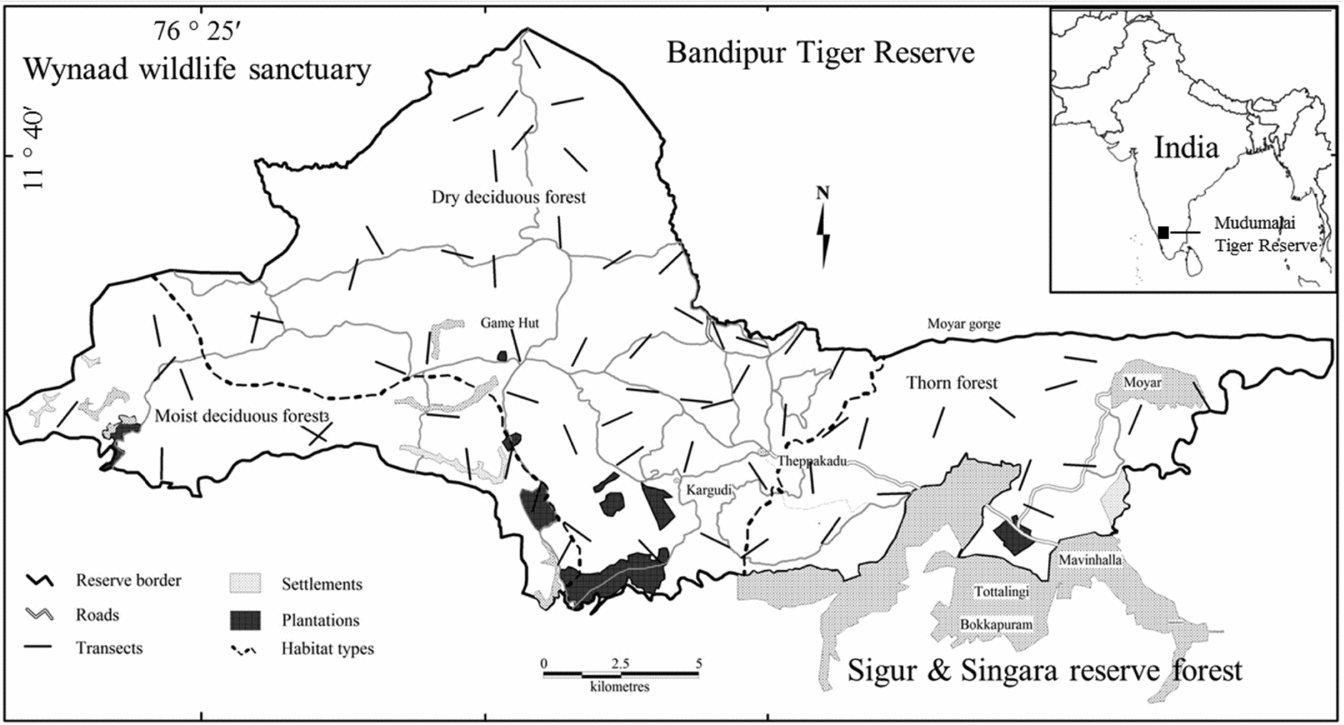
The study was conducted in Mudumalai Tiger Reserve (Figure 1) southern India. Data were collected from 10 × 1-m plots located every 100 m along 67 1-km long randomly located transects as described by Wilson et al. (Reference WILSON, DESAI, SIM and LINKLATER2013). The 10 × 1-m sampling plots located every 100 m were spaced in an attempt to ensure that the plots along each transect were independent given the size of the plots and the gap between each plot.
Mudumalai Tiger Reserve and its location in India showing the layout of 67 transects across the reserve within the three habitats. Habitat boundaries are delimited by dashed lines: moist deciduous, dry deciduous and thorn forest. Plantations are shown as black patches and settlements as grey patches. The road network within the reserve is shown.

We first recorded L. camara presence or absence within each 10 × 1-m plot along each transect to examine changes that were associated with differences in plant species assemblage and grass cover. We were also interested in whether the abundance of L. camara in a plot was associated with differences in three elephant browse plant species. To measure L. camara abundance, stem density of L. camara in each plot was recorded. To estimate L. camara invasion, the age of the stand, defined by average L. camara girth of all stems in a plot, was used because in field observations we noted that older stands had fewer L. camara plants (as few individuals dominate while others die out) as has been noted elsewhere (Swarbrick et al. Reference SWARBRICK, WILLSON, HANNAN-JONES, Panetta, Groves and Shepherd1998). By contrast, younger stands had more individual plants. The girth of all L. camara stems were measured at ground level within 10 × 1-m plots and recorded in 1-cm categories. An estimate of the average girth for each plot was derived.
Plant species (shrubs and saplings, between 10 and 150 cm) were identified from herbarium specimens, field guides and knowledgeable field assistants and counted in plots measuring 10 × 1-m located every 100 m along each transect in order to measure plant species assemblage at each plot (see Appendix 1 for a list of plant species). Biotic and abiotic environmental covariates that could potentially be associated with plant species assemblage were measured in each plot. Biotic covariates included tree density, canopy cover and grass cover. Tree density, canopy cover and percentage grass cover along each 1-km transect was estimated every 100 m in 10 × 1-m plots (Wilson et al. Reference WILSON, DESAI, SIM and LINKLATER2013). All grasses were grouped together without distinguishing the various species. The percentage of bare ground, other vegetation (trees, herbs, shrubs) and rocks, was also visually estimated at the same site. The percentage of grass occupancy (area of grass cover/area available to grass after deducting native vegetation, bare ground and rocks) was also calculated to provide a measure of the area in a plot that was actually occupied by grass or L. camara.
Abiotic environmental covariates related to anthropogenic disturbances and included distance to roads and settlements, and time since last fire burn. Linear distances between each sampling plot and the closest road and settlement were measured from 1:50000 topographic maps, using MapInfo Professional 7.8 (MapInfo Corporation, Troy, NY, USA). As the size and thus potential impact of roads and settlements varied throughout Mudumalai, we used three categorical factors for settlements: (1) if a plot fell more than 2 km from a minor settlement (≤0.1 km2); (2) if a plot fell within 2 km from a minor settlement; and (3) if a plot fell within 2 km of a major settlement (≥0.1 km2). Similarly, for roads: (1) if a plot fell more than 2 km from a forest road (grey lines, Figure 1); (2) if a plot fell within 2 km from a forest road (grey lines, Figure 1); and (3) if a plot fell within 2 km of a main/public road (grey double lines, Figure 1). Within Mudumalai, smaller forest roads that were used only by the forest department's tourist vehicles were assumed to have less impact than the main/public road and were presumed to have minimal impact on weed distribution. Data on anthropogenic fire during the 6 y prior to the study (2003–2008) in each plot were obtained using the same methods described by Wilson et al. (Reference WILSON, DESAI, SIM and LINKLATER2013).
Statistical analyses
To assess differences in plant species assemblage in plots that were invaded and uninvaded by L. camara including environmental covariates, we used PERMANOVA+ using 9999 permutations implemented in PRIMER v 6.1.11 (Clarke & Gorley Reference CLARKE and GORLEY2006). Only shrubs and saplings measuring between 10 and 150 cm in height were used. Lantana camara was excluded from the analysis of plant species assemblage, and was used only to define invaded/uninvaded groups. The data were log-transformed (log (x + 1)) prior to analyses. A Bray–Curtis index was used as a similarity measure for plant species assemblage (Clarke & Warwick Reference CLARKE and WARWICK2001). We used non-metric Multi-Dimensional Scaling (nMDS), also implemented in PRIMER to determine whether plant species assemblage differed in the three habitats of the reserve. The nMDS was run over 1000 iterations using Kruskal stress formula 1 and a minimum stress of 0.01. To investigate the association of L. camara presence/absence with plant species assemblage further, we examined the output of PERMANOVA which includes pairwise tests within each habitat comparing plots with and without L. camara. The pairwise tests were conducted by including each habitat as a factor and L. camara presence/absence as a second factor. We were therefore able to define the association of L. camara within each habitat without analysing the data habitat-wise. As there were a large number of potential interactions between various factors, we a priori decided to examine only the interaction between habitat and L. camara presence/absence.
In order to examine how individual species contributed to the differences in plant species assemblage between L. camara-invaded and uninvaded plots, we used SIMPER subroutine (analysis of per cent similarity) (PRIMER v 6.1.11) based on a Bray–Curtis similarity measure, with a log-transformation of the data (log (x + 1)). The top three elephant browse food plants (saplings between 10–150 cm tall) that contributed most to the dissimilarity from the SIMPER analysis were then used to examine the slope of the relationship with L. camara abundance using linear regression analysis conducted in SPSS Statistics, release version 20.0 (IBM SPSS Inc., Chicago, IL, USA). The effect size of L. camara on each of the species that contributed to the average dissimilarity among habitats and between invaded and uninvaded plots, were derived using ‘adonis’ function in the ‘vegan’ package in R (version 3.0.2; http://www.R-project.org).
Given the importance of grass in elephant diet (Baskaran et al. Reference BASKARAN, BALASUBRAMANIAN, SWAMINATHAN and DESAI2010, Wilson et al. Reference WILSON, GRUBER and LESTER2014), we conducted an analysis on percentage grass cover to study the association of L. camara and other environmental covariates with percentage grass cover. A Bray–Curtis index was used as a similarity measure for percentage grass cover. PERMANOVA+ was used to run 9999 permutations to test for an association of L. camara presence/absence and environmental covariates (biotic and abiotic) with percentage grass cover. Biotic and abiotic factors used as environmental covariates were L. camara presence/absence, tree density, canopy cover, impact of roads, settlements and fire. PERMANOVA was used to conduct pairwise tests to compare plots with and without L. camara within each habitat to examine these differences. As above, only interactions between habitat and L. camara presence/absence were examined and not all factor interactions.
A linear regression analysis was then conducted on percentage grass occupancy (defined as given above), to test for an association of L. camara invasion (average girth per plot) along with other environmental covariates, which included impact of roads, settlements, canopy cover, fire, tree density, DDF × L. camara interaction and MDF × L. camara interaction term with the percentage grass occupancy using SPSS Statistics, release version 20.0 (IBM SPSS Inc., Chicago, IL, USA). The TF was used as the reference category for the dummy variable and hence its interaction term with L. camara was not included in the model. Percentage grass occupancy per plot which was the outcome variable was arcsine-square root transformed for normality.
RESULTS
Lantana camara has invaded large areas of Mudumalai. Overall, 59% of the sampling plots (n = 737) were invaded by L. camara throughout the reserve. The thorn forest (TF) (n = 165) had more L. camara-invaded sampling sites than the other habitats with 88% of sites invaded by L. camara. Of the sites sampled in the moist deciduous forest (MDF) (n = 132), 43% remained uninvaded while 52% in the dry deciduous forest (DDF) (n = 440) were uninvaded by L. camara. The density of L. camara varied throughout the reserve in different habitats from no L. camara to 39 stems per 10 × 1-m plot with an interquartile range of 4 stems per 10 × 1-m plot (25th percentile = 0 stems; 75th percentile = 4 stems). Of the 737 plots, only seven plots had no plants because they were occupied by bare earth or rock or by trees, while other plots had between 1 and 53 plant species. The total number of plant species identified within the plots throughout the reserve was 136 with Catuneragum spinosa (Rubiaceae) being the most common species (340 individuals). Plant species richness was highest in two plots along two different transects with a total of 53 plant species; one of these transects was found in the DDF while the other in the MDF.
Plant species assemblage
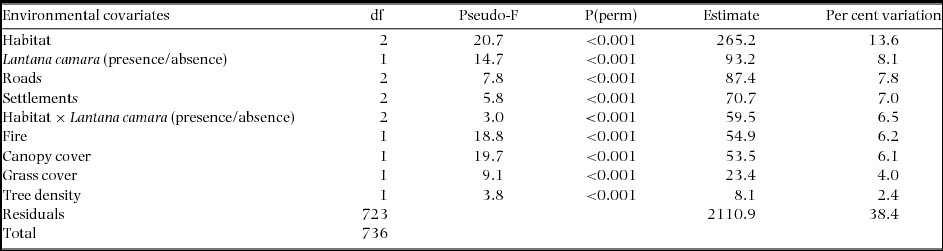
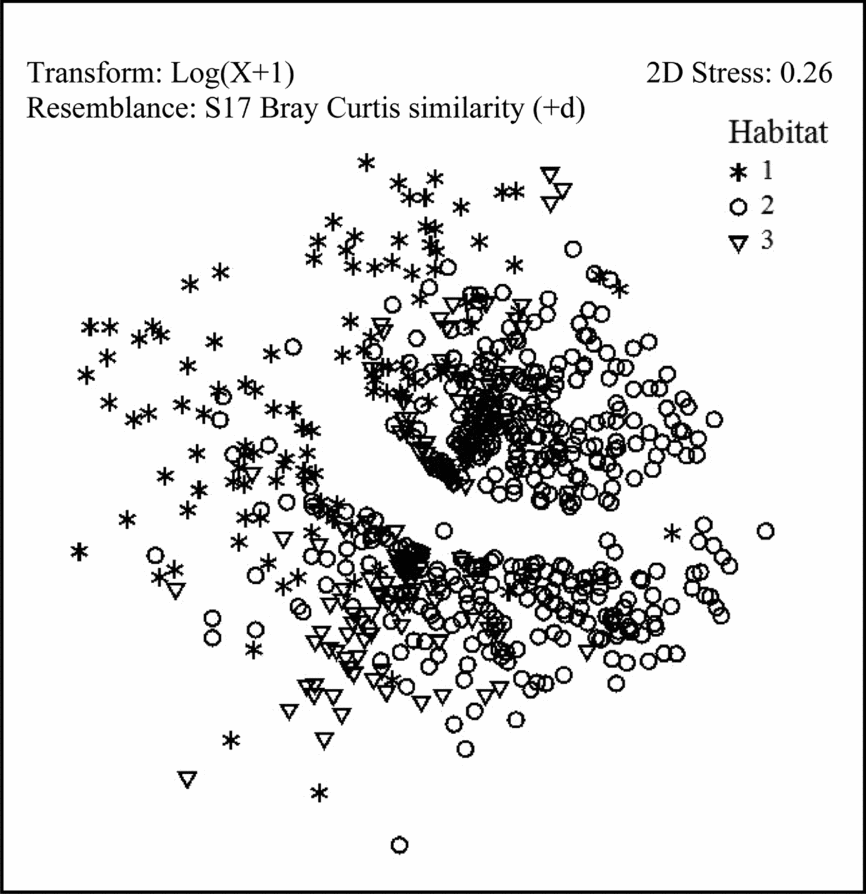
All environmental covariates, including the presence of L. camara in a plot were associated with the plant species assemblage (P < 0.001, Table 1). The largest component of variation was from habitat (14%), followed by L. camara presence/absence and roads (each 8%), settlements and the interaction of habitat and L. camara presence/absence (7%). The lowest component of variation was tree density (2%). Pairwise tests indicated that in both the MDF (t 123 = 1.51, P = 0.006) and DDF (t 430 = 4.39, P < 0.001), the presence of L. camara was significantly associated with differences in plant species assemblage, while there were no significant differences in the TF (t 157 = 1.13, P = 0.238) whether L. camara was present or not. Two-dimensional nMDS plot did not reveal clear differences in plant species assemblage in the three habitats, perhaps related to the poor fit of the data to a two-dimensional nMDS plot (Stress > 0.20, Figure 2).
Results of PERMANOVA (permutation analysis of variance) examining the association of Lantana camara presence/absence and environmental covariates with plant species assemblage in Mudumalai Tiger Reserve, India. All environmental covariates were statistically significant. PERMANOVA also gives a component of per cent variation for each predictor which is equivalent to the sum of the squared fixed effects divided by the degrees of freedom from standard ANOVA.
A non-metric Multi-Dimensional Scaling (nMDS) plot generated in PRIMER v 6.1.11 showing the dissimilarities of the various species in the three habitats of Mudumalai Tiger Reserve. The two-dimensional nMDS plot shows that there is a high stress level (0.26) which is higher than the maximum stress level of 0.20. Given the high stress level and the poor representation of the data which is highly distorted we abandoned the nMDS. The three habitats are (1) moist deciduous forest represented by a star, (2) dry deciduous forest represented by a hollow circle and (3) thorn forest represented by a triangle.
Elephant browse plants
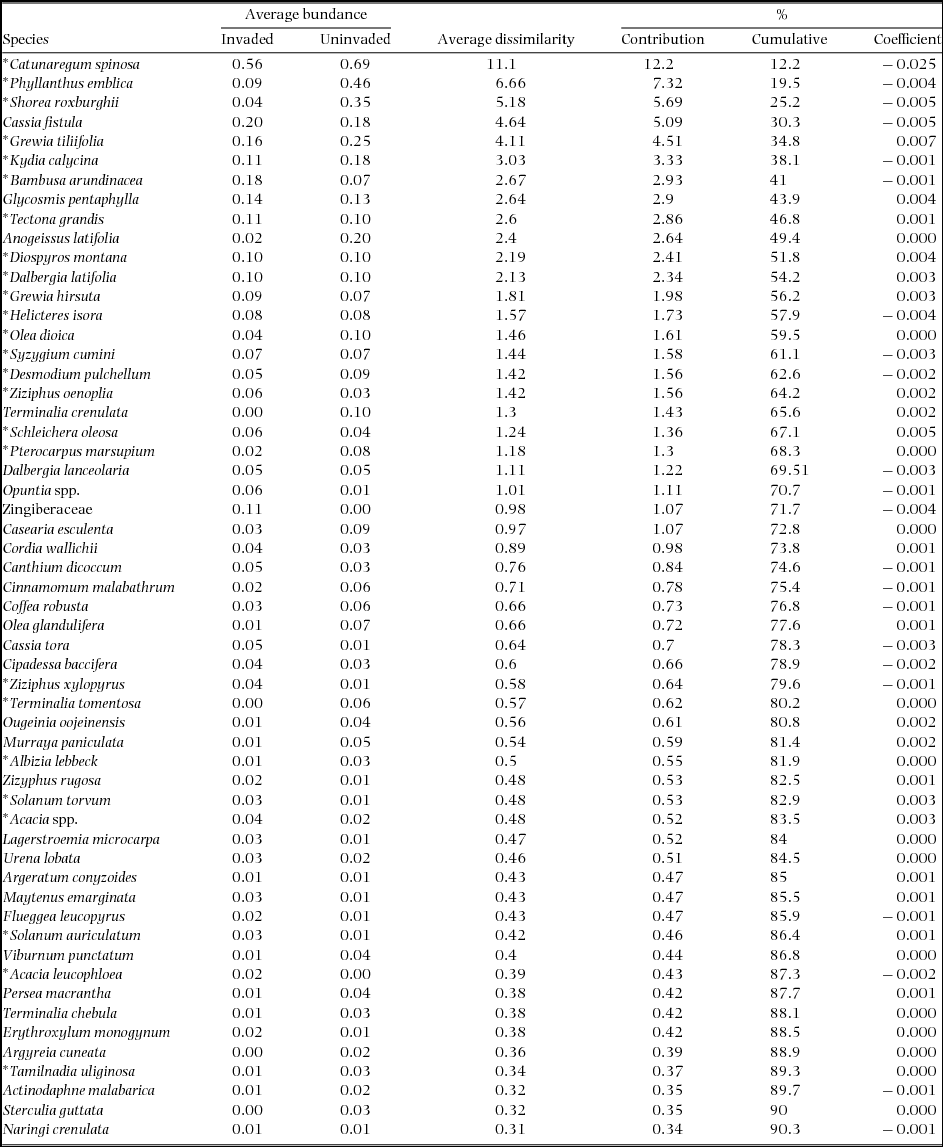
SIMPER analysis indicated that C. spinosa contributed 12.1% to the average similarity between habitats and between plots with and without L. camara, followed by Phyllanthus emblica (Phyllanthaceae) (7.3%), Shorea roxburghii (Dipterocarpaceae) (5.7%), Cassia fistula (5.1%) and Grewia tiliifolia (Malvaceae) (4.5%) (Table 2). All these plants except for C. fistula are elephant browse food plants and the most important species in differentiating those plots with and without L. camara. Of the browse species that were estimated to contribute most to elephant diet by Baskaran et al. (Reference BASKARAN, BALASUBRAMANIAN, SWAMINATHAN and DESAI2010), bamboo spp. (Gramineae) and Kydia calycina (Malvaceae) contributed only 3% to the average similarity, and only bamboo spp. were found in all three habitats.
Results of the SIMPER analysis showing the relative and cumulative contributions of various species that contributed to 90.05% of the average dissimilarity among habitats and between invaded and uninvaded plots in Mudumalai Tiger Reserve, India. The effect of Lantana camara on each of these species is shown as coefficients. Elephant browse food species are indicated with an asterisk.
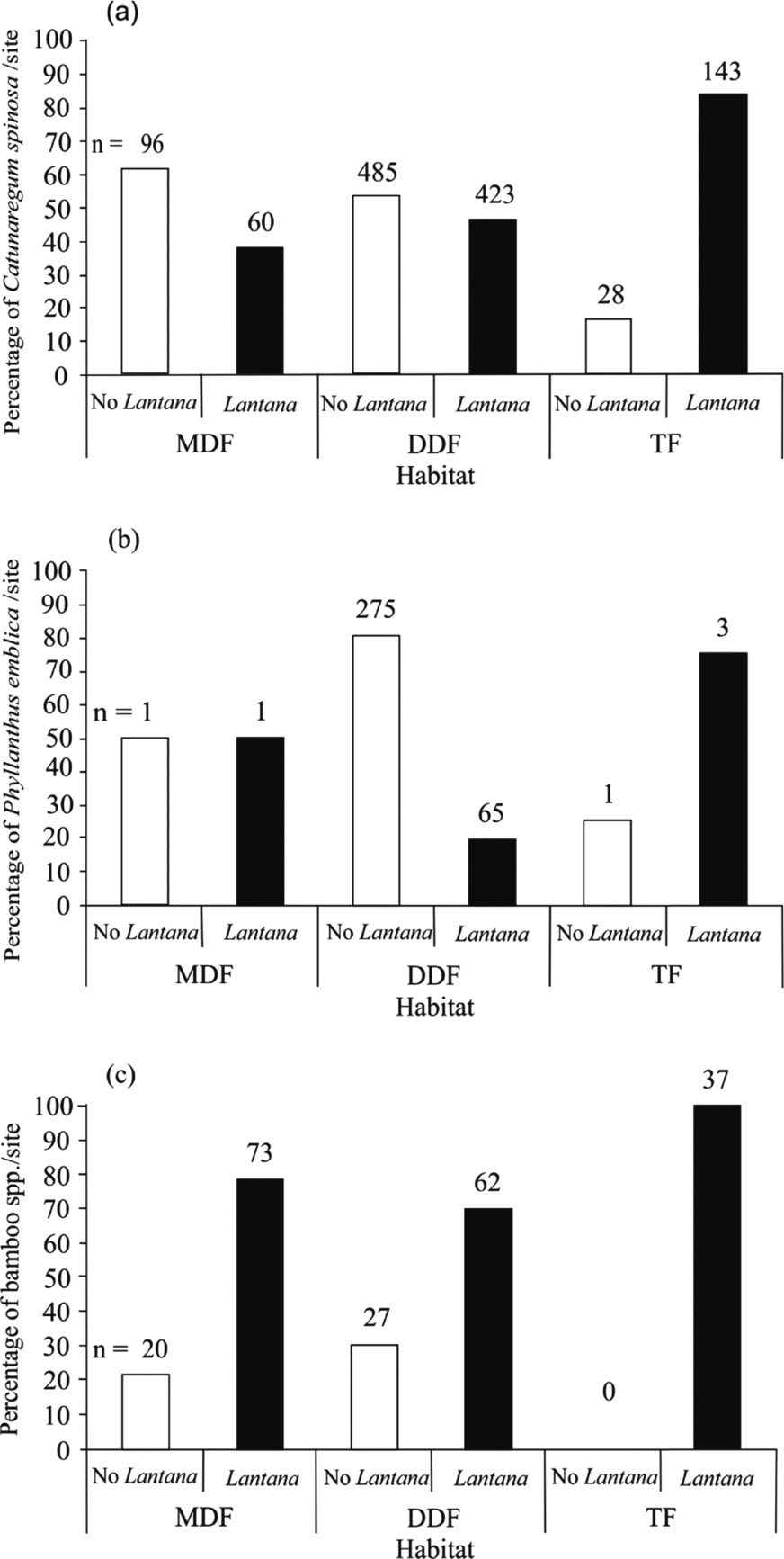
The association between L. camara presence/absence and C. spinosa in the MDF was significant (MDF: t130 = −2.38, P = 0.019), while there was no significant association between L. camara presence/absence and C. spinosa in the DDF (t438 = −0.38, P = 0.703) or TF (t163 = −1.09, P = 0.276) (Figure 3a). However, L. camara abundance was negatively associated with C. spinosa in the DDF only (t438 = −2.93, P = 0.004). Lantana camara presence/absence was significantly associated with P. emblica in the DDF (t438 = −8.09, P < 0.001), but not in the MDF (t130 = 0.20, P = 0.846) or TF (t163 = 0.80, P = 0.427) (Figure 3b). Shorea roxburghii was present only in the DDF, but was absent in the MDF and TF. Lantana camara presence/absence was significantly associated with G. tiliifolia in the DDF (t438 = −2.48, P = 0.014), but not in the MDF (t130 = 1.35, P = 0.180) or TF (t163 = 1.34, P = 0.184). Lantana camara presence/absence was significantly associated with bamboo spp. in the MDF (t130 = 2.56, P = 0.012), but not in the DDF (t438 = 1.91, P = 0.057) or TF (t163 = 1.19, P = 0.235) (Figure 3c).
Relative abundance of three plant taxa important for elephant food, in invaded and uninvaded plots in the three habitats. These plants were selected from the SIMPER analysis Catuneragum spinosa (a), Phyllanthus emblica (b) and bamboo spp. (c) in Lantana camara invaded and uninvaded plots in three habitats (moist deciduous forest (MDF); dry deciduous forest (DDF) and thorn forest (TF)) of Mudumalai Tiger Reserve, India. Numbers above the bars refer to the number of individual plants of each species in each habitat.
Percentage grass cover and occupancy
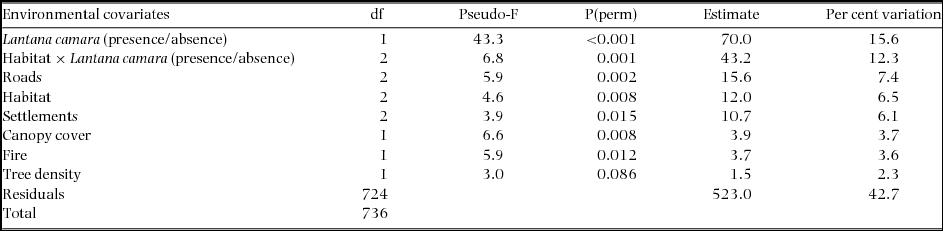
The PERMANOVA analysis indicated that percentage grass cover differed significantly according to whether a plot was invaded or uninvaded by L. camara (P < 0. 001, Table 3). In fact, the highest component contributing to the variation was L. camara presence/absence (16%), followed by the interaction term between habitat and L. camara presence/absence (12%), and roads (7%). Tree density was not a significant predictor of percentage grass cover (P = 0.086). However, all other environmental covariates were significantly associated with percentage grass cover (P < 0.015, Table 3). Pairwise tests indicated that percentage grass cover significantly differed in the MDF (t120 = 3.51, P = 0.003) and DDF (t424 = 1.97, P = 0.034) depending on whether L. camara was present or absent. However, the presence of L. camara made no difference to the percentage grass cover in the TF (t153 = 0.80, P = 0.441). Thus it is difficult to generalize on the common effects of L. camara across the different habitats.
Results of PERMANOVA (permutational analysis of variance) examining the association of Lantana camara presence/absence and environmental covariates on percentage grass cover in Mudumalai Tiger Reserve, India. The component of per cent variation (equivalent to the sum of squared fixed effects divided by the degrees of freedom from standard ANOVA) for each predictor is given. All environmental covariates except for tree density were significant predictors of percentage grass cover.
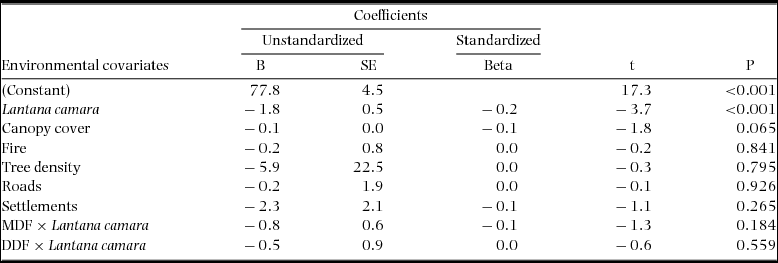
The linear regression of the L. camara invasion (average girth per plot) and environmental covariates on percentage grass occupancy across habitats was statistically significant, although explained only a small amount of variation (F 8, 736 = 6.7, R2 = 0.07, P < 0.001). Lantana camara invasion was the only significant predictor of the percentage grass occupancy (P < 0.001, Table 4), possibly indicating competition for the same space. There was a significant negative correlation between percentage grass occupancy and L. camara in all three habitats, indicating that as L. camara invasion increased, grass occupancy declined.
Results of the linear regression of environmental covariates including Lantana camara invasion (average girth per plot) predicting percentage grass occupancy in Mudumalai Tiger Reserve, India. Lantana camara invasion was the only significant predictor of percentage grass occupancy. The interaction terms, moist deciduous forest (MDF) and dry deciduous forest (DDF) with L. camara are included in the model. The interaction term thorn forest (TF) and L. camara was set to zero because of redundancies in the model.
DISCUSSION
Our results indicate a significant association between L. camara and a change in plant species assemblage, some elephant browse plants, percentage grass cover and occupancy in the moist and dry deciduous habitats of Mudumalai, but not in the thorn forest.
Plant species assemblage
While the three habitats in Mudumalai are clearly different in terms of their plant species assemblage, PERMANOVA pairwise tests of the interaction between habitat and plots with and without L. camara indicated that L. camara presence/absence made a significant difference only to the moist deciduous forest (MDF) and dry deciduous forest (DDF) of Mudumalai and not the thorn forest. In the MDF, 43% of the sampled sites had L. camara present while in the DDF, 48% of the sampled sites were invaded by L. camara. The MDF has the highest shrub and sapling density and diversity compared with the DDF and thorn forest (TF) in Mudumalai (Kumar Reference KUMAR2011). It is likely that L. camara is capable of changing the diversity and density of shrubs and saplings and hence we see an association of L. camara in the MDF because of the higher diversity and density of shrubs and saplings. The MDF is a closed-canopy forest and closed canopy is known to hamper L. camara growth (Duggin & Gentle Reference DUGGIN and GENTLE1998, Fensham et al. Reference FENSHAM, FAIRFAX and CANNELL1994). However, L. camara was recognized as a problem taking over the understorey and spreading rapidly in the Benne and Mudumalai blocks of the MDF and affecting the growth rate of teak in its early stages as early as 1924 in Mudumalai when timber extraction was carried out (Ranganathan Reference RANGANATHAN1941). The timber extractions may have opened up the canopy and facilitated L. camara invasion suggesting that L. camara may be the ‘passenger’ here, but further studies are required to confirm its role here. Nevertheless, L. camara has contributed significantly to a change in the plant species assemblage in the MDF.
Similarly, there was an association between L. camara presence and plant species assemblages in the DDF, where timber extraction continued until a ban on logging in the 1980s (Srivastava Reference SRIVASTAVA2009). Anthropogenic disturbances such as logging may have opened up the canopy which has increased the amount of light penetrating into the forest floor. Opening up of the forest canopy and allowing more light, however, is an advantage to exotic invasive species such as L. camara that are known to germinate with an increase in light availability (Gentle & Duggin Reference GENTLE and DUGGIN1997b, Totland et al. Reference TOTLAND, NYEKO, BJERKNES, HEGLAND and NIELSEN2005). Anthropogenic disturbances have also been known to facilitate exotic plant invasions (Buckley et al. Reference BUCKLEY, BOLKER and REES2007, Duggin & Gentle Reference DUGGIN and GENTLE1998) and may have facilitated L. camara invasion here.
In addition to logging, fire has also been regarded as having a major impact on native sapling regeneration in the DDF (Sivaganesan & Sathyanarayana Reference SIVAGANESAN, SATHYANARAYANA, Daniel and Datye1995). Fires have been shown to facilitate the spread of L. camara elsewhere (Hiremath & Sundaram Reference HIREMATH and SUNDARAM2005). Fires suppress native saplings and facilitate germination and spread of L. camara (Berry et al. Reference BERRY, WEVILL and CURRAN2011, Raizada & Raghubanshi Reference RAIZADA and RAGHUBANSHI2010) in the DDF. It is likely that the association of L. camara with plant species assemblage is seen in the DDF because of the impact of logging and fire in the DDF. Grasses can be fuel loads that influence fire frequency and intensity (Scholes & Archer Reference SCHOLES and ARCHER1997). In the MDF, however, fire has been suggested to have much less impact on native species regeneration because grasses in the MDF retain their moistness even in the dry season, which reduces fire frequency and intensity (Sivaganesan Reference SIVAGANESAN1991). In the TF, a lack of litter accumulation and cattle grazing results in reduced fire frequency and intensity (Daniel et al. Reference DANIEL, DESAI, SIVAGANESAN, DATYE and KUMAR1995, Sivaganesan Reference SIVAGANESAN1991). However, when interpreting the response of native species distribution and abundance to infestations of exotic plants, caution must be exercised because infrequent plants may just be rare because of their nature of being rare, or may have been displaced by weed invasions (Butler & Cogan Reference BUTLER and COGAN2004).
In addition to L. camara, the results of our study also show that biotic and abiotic environmental covariates such as tree density, canopy cover, grass cover, impact of roads, settlements and fire are also significantly associated with plant species assemblage. Elsewhere, the association of environmental covariates with plant species assemblage have also been documented indicating the role that biotic and abiotic factors have in the floristic assemblage. For example, Angold (Reference ANGOLD1997) investigated the effect of a road on adjacent heathland vegetation in the UK, and found that there was an increase in the abundance of grasses in the vegetation near the road. In Australia, fire frequency was estimated to account for 60% of the floristic variation (Morrison et al. Reference MORRISON, GARY, PENGELLY, ROSS, MULLINS, THOMAS and ANDERSON1995). In a central Brazilian deciduous dry forest, plant species abundance and distribution was significantly correlated with canopy gaps (Oliveira-Filho et al. Reference OLIVEIRA-FILHO, CURI, VILELA and CARVALHO1998). Thus, other environmental covariates are also responsible for changes in the plant community.
Elephant browse plants
Plant species are likely to respond to L. camara invasion differently, depending on different stages of its invasion (Gooden et al. Reference GOODEN, FRENCH, TURNER and DOWNEY2009). While some native species are excluded more easily than others from invaded communities, the resistance of native species to invasion varies (Standish et al. Reference STANDISH, ROBERTSON and WILLIAMS2001). For example, C. spinosa that forms only 0.15% of elephant diet in Mudumalai (Baskaran et al. Reference BASKARAN, BALASUBRAMANIAN, SWAMINATHAN and DESAI2010) was significantly associated with the presence of L. camara only in the MDF, but not in the DDF and TF, while the slope of the relationship between L. camara abundance and C. spinosa was negative only in the DDF and not in the MDF or TF. Further, bamboo spp. did not appear to be associated with L. camara presence in the DDF and TF but was significantly associated with L. camara presence in the MDF. In fact, the percentage of bamboo spp. saplings available was greater where there was more L. camara in all three habitats, and no bamboo spp. saplings were found in the TF where L. camara was absent. While this result does not indicate that this species requires L. camara to grow, it does appear to indicate that L. camara is affecting species composition by suppressing some species and facilitating the expansion of others such as bamboo spp. (A. A. Desai, pers. obs.). Such changes in the vegetation composition may have a cascading impact on the ecosystem and would potentially impact all biodiversity. Further, we hypothesized that greater bamboo spp. sapling numbers occur within L. camara areas possibly because herbivores are unable to access these saplings. Other studies have shown that native plant species can benefit from invasive plant species by growing inside stands of the invasive species thereby experiencing lower levels of herbivory (Atwater et al. Reference ATWATER, BAUER and CALLAWAY2011). This association would allow these saplings to grow but herbivores may be feeding more on certain species where there is less L. camara thereby depleting their food resources in areas without L. camara. Although bamboo spp. are often suggested as being important elephant food plants, one estimate indicates that they made up only approximately 4.4% of elephant diet in Mudumalai (Baskaran et al. Reference BASKARAN, BALASUBRAMANIAN, SWAMINATHAN and DESAI2010). Therefore, our results suggest that L. camara presence and abundance, habitat and environmental covariates are associated with the abundance of some elephant food plants, but this association varies depending on the species and in which habitat these species are found.
Percentage grass cover and occupancy
The presence of L. camara was observed to have a significant negative association with grass cover in the MDF and DDF. The DDF was reported to have the maximum grass species richness, followed by the TF (Kumar Reference KUMAR2011). In addition, the annual net primary productivity of grass was estimated to be highest (720 g m−2) in the DDF, 352 g m−2 in the TF and 110 g m−2 in the MDF (Baskaran et al. Reference BASKARAN, BALASUBRAMANIAN, SWAMINATHAN and DESAI2010). The association of L. camara may not be seen in the TF due to the lower grass biomass in this habitat when compared with the MDF and DDF.
In addition, there are other factors that could potentially contribute to the absence of any association of L. camara in the TF. For example, cattle grazing has been regarded as one of the causes of the depletion of grass in the thorn forest, and the TF has been considered as sub-optimal habitat for elephant due to low productivity of grass (Daniel et al. Reference DANIEL, DESAI, SIVAGANESAN, DATYE and KUMAR1995) allowing L. camara to invade these sites (Silori & Mishra Reference SILORI and MISHRA2001) yet not have a significant association with grass cover in the TF.
From our observations within the reserve, the most visible association of L. camara on elephant habitat appeared to be the loss of grass cover. Our analysis indicated a significant negative association between percentage grass occupancy and L. camara. This result possibly indicates competition for the same space, nutrients or water. A previous study in Mudumalai indicated that in the dry deciduous forest, 85% of elephant diet was grass, while 78% and 53% of elephant diet consisted of grass in the MDF and TF respectively (Baskaran et al. Reference BASKARAN, BALASUBRAMANIAN, SWAMINATHAN and DESAI2010). The reduction in grass cover could lead to food limitation for elephant and other herbivores that depend on grass in the reserve. Reduced grass cover could lead to a reduced carrying capacity of herbivores in the reserve. Any adverse impact on herbivores that are dependent on grass would in turn impact large carnivores such as tigers which are dependent on them (Prasad Reference PRASAD2010).
Overall the replacement of grass by L. camara could have serious conservation implications for both herbivores and their predators. Unpalatable weeds such as L. camara may render some areas unsuitable to elephant through reduced forage, limiting food to fewer patches. Such changes in carrying capacity and distribution of food resources of the reserve could also result in elephants being forced to move out in search of better forage. This movement would likely occur with high elephant densities, if food becomes more limiting. Managers in particular need to recognize that reduced carrying capacity through loss of grazing areas can force elephants to move out of the reserve and come into increased conflict with the surrounding human settlement (Ishwaran Reference ISHWARAN1993). It is important that managers take this into account and address this situation. For example, seeds of grass species such as Axonopus sp. that compete well with L. camara could be sowed to help increase forage for grazers (Kumar et al. Reference KUMAR, NAGARAJAN, ILAYARAJA, SWAMINATHAN and DESAI2012).
Conclusions
The results of our study indicate that L. camara appears capable of altering plant species assemblage, some elephant browse plants and percentage grass cover in the MDF and DDF in addition to other factors. It appears that L. camara invasion is not associated with plant species assemblage, elephant browse plants and grass cover in the TF despite the thorn forest having the highest number of invaded sites. These results suggest that L. camara may not be responsible for any changes brought about to the plant community within the TF. This lack of association also suggests that managers may instead focus on L. camara management in the MDF and DDF of Mudumalai where L. camara does have a significant association with the plant community. Nevertheless, as in many invaded systems, there is still uncertainty as to whether L. camara is the ‘driver’ of community changes or is just a ‘passenger’ that appears to be less affected by disturbance or environmental stressors and may just be an opportunistic invader (MacDougall & Turkington Reference MACDOUGALL and TURKINGTON2005). Further studies are required to empirically test whether L. camara is the ‘driver’ of plant community changes or just a ‘passenger’ that is a consequence of a disturbed habitat.
ACKNOWLEDGEMENTS
The Tamil Nadu Forest Department provided research permits (Ref. No. WL5/57210/2008) to conduct this study and we are particularly thankful to Dr Rajiv K. Srivastava, Field Director, Mudumalai Tiger Reserve and Dr N. Kalaivanan, Veterinary Assistant Surgeon, for facilitating this study. Thanks to the field trackers for their assistance with data collection and to Mr N. Mohanraj for providing maps of the study area. We are also grateful to Dr Stephen Hartley, Dr R. Nagarajan and two anonymous referees for their comments which have improved the manuscript. This project was funded by Rufford Small Grants, UK, United States Fish and Wildlife Services (96200–9-G171, Grant No. ASE-0435) and Mohammed Bin Zayed Species Conservation Fund (Project number: 1025959).
The list of plant species (shrubs and saplings measuring between 10 and 150-cm in height) identified in the plots along the 67 1-km in length transects in Mudumalai Tiger Reserve, India. Number refers to the total number of individual stems of the species counted throughout the reserve.