Different immunological changes, such as decreased levels of immunoglobulins and impaired function of neutrophils, have been reported during the transition period in cows (Herr et al., Reference Herr, Bostedt and Failing2011). Several factors might be important in impaired immune functions in the transition period, and an improved understanding of the variations and effective factors is of value for preventing common infectious and metabolic disorders at this time. Heavy metals, such as arsenic (As), lead (Pb), and cadmium (Cd), are elevated in the blood around parturition and they might have detrimental effects on body systems (Galey et al., Reference Galey, Slenning, Anderson, Breneman, Littlefield and Melton1990). Some of the complications caused by heavy metals are serious influences on the immune system, and even relatively low concentrations of toxic heavy metals, regarded as safe levels, were noted to have adverse effects (Sigel et al., Reference Sigel, Sigel and Sigel2011). Heavy metals also have the potential to play a role in oxidative damage through interaction with glutathione metabolism, binding to the active sites of enzymes involved in the antioxidant system. Moreover, Pb and Cd can replace zinc as the cofactor of these enzymes (Kowalska and Jankowiak, Reference Kowalska and Jankowiak2009). Immune cells are specifically sensitive to peroxidation because of their high non-esterified fatty acid content (Spears and Weiss, Reference Spears and Weiss2008).
As heavy metals levels increase in the blood around parturition (Galey et al., Reference Galey, Slenning, Anderson, Breneman, Littlefield and Melton1990) with potential detrimental effects on immune responses and oxidative stress, it is important to assess their impacts on dairy cows during the transition period. Despite the extensive body of literature on the influence of heavy metals on animals and humans, the evidence concerning the effects of these elements on the bovine immune system and oxidative status at this period is limited. The present study aimed to investigate the possible correlations of whole blood heavy metals (Pb, As, and Cd) with some immunological, inflammatory and oxidative factors during the transition period, and compare this with the beginning of the dry period.
Materials and methods
Animals and sample collection
The study was performed in a commercial dairy herd and thirty healthy pregnant cows were studied. The ingredients and nutritional composition of the diets are presented in online Supplementary Table S1. Blood sampling was carried out at six weeks prior to expected parturition (−6 w: mean 42 d prepartum, range: 35–45 d) which was in the early dry period and then again at −1 w (mean 7 d prior to calving, range: 2–10 d) and finally at +1 w (mean 7 d post-calving, range: 6–11 d). The early dry period was chosen as the point in the production cycle with the lowest metabolism. Detailed management and sampling information is provided in online Supplementary File materials and methods.
Biochemical analysis
Whole blood samples were analyzed for Pb, As, and Cd using inductively coupled plasma optical emission spectrometry (ICP-OES) (SPECTRO ARCOS, Germany) following nitric acid wet digestion. The levels of malondialdehyde (MDA) and total antioxidant capacity (TAC) were measured in the serum samples using commercial kits (Navand Salamat, Orumieh, Iran). The immunological markers, including immunoglobulin G (IgG), interleukin 4 (IL-4), interleukin 10 (IL-10), interferon gamma (IFN-γ), tumor necrosis factor-alpha (TNF-α) and haptoglobin (Hp) were measured in the serum samples by enzyme-linked immunosorbent assay (ELISA) using commercial bovine kits (Bioassay Technology Laboratory, Shanghai, China). Detailed information about the biochemical analyses are provided in the online Supplementary File.
Statistical analysis
All of the data were statistically analyzed using SPSS software version 22 (IBM, USA). The significance level was considered as P < 0.05 for all tests. Detailed information is provided in the online Supplementary File.
Results
Heavy metals
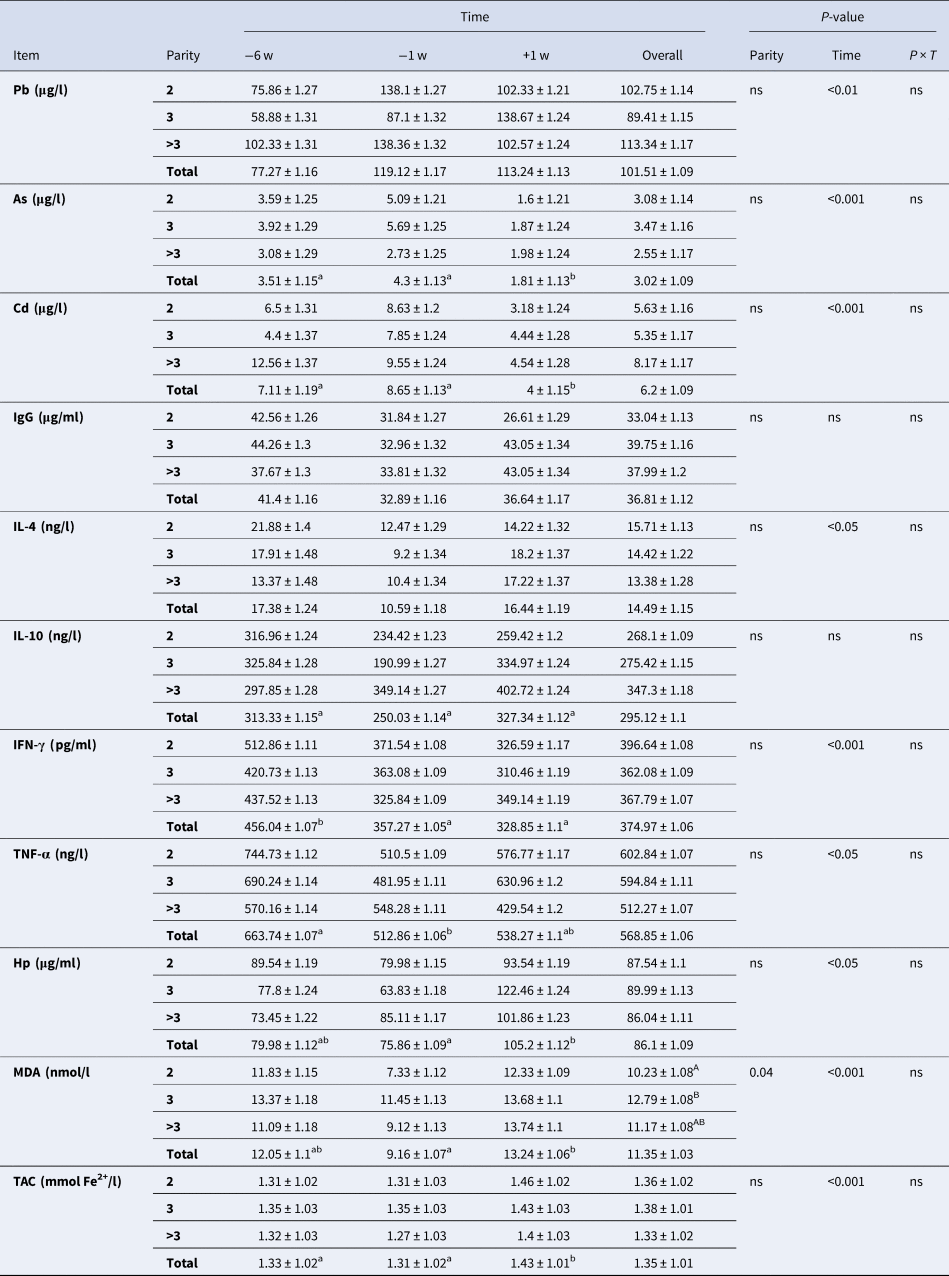
Pb, As, and Cd all had a similar trend of changes during the study and the highest levels of all the three elements were observed in late pregnancy, ie at −1 w (Table 1). Furthermore, the concentrations of these three heavy metals declined at +1 w resulting in significantly lower levels of As and Cd, compared to the two previous times (P < 0.05, Table 1). Our results showed no significant effect of parity as a between-subject factor or of time × parity interaction on heavy metals concentrations.
Concentrations of measured heavy metals, immunological and inflammatory factors as well as oxidative markers at the early dry period (−6 w), one week before expected calving (−1 w) and one week postpartum (+1 w) for cows of different parities

ns, not significant.
Values are mean ± se for cows of different parities where n = 12 for second parity, 9 for third parity and 9 for greater parities. Total is the value for all cows combined.
a, bIn each row, values with different superscript letters are significantly different (P < 0.05)
A, BIn each block column, values with different superscript symbols are significantly different (P < 0.05).
Immunological and inflammatory markers
The lowest levels of TNF-α, IgG, IL-4, IL-10 and Hp were found at −1 w, and for TNF-α the difference between this time and −6 w was significant (P < 0.05, Table 1). Our findings demonstrated the nadir of IFN-γ at +1 w with a significant difference revealed between this time and −6 w (P < 0.05, Table 1). Other immunological factors did not have a significant change at +1 w. Moreover, parity was not found to affect these variables significantly.
Oxidative markers
Both MDA and TAC reduced at −1 w followed by significant elevations at +1 w leading to the highest levels of these markers during the study (Table 1). The post hoc test for parity revealed that the MDA level was significantly higher in cows with 3 parturitions than in those with 2 parturitions (P < 0.05, Table 1). However, the impact of time × parity on oxidative markers interaction was not statistically significant.
Correlations of heavy metals with immunological and oxidative markers
According to the results of the Pearson correlation for the transformed data of healthy cows, at −6 w As was significantly (P < 0.05) correlated negatively (r = −0.366) and positively (r = 0.417) with TAC and MDA, respectively. At −1 w, Pb and As had significant inverse correlations with IFN-γ (r = −0.593, P = 0.001) and IL-4 (r = −0.377, P < 0.05), respectively. Furthermore, TNF-α was shown to have an indirect correlation with Cd (r = −0.372, P < 0.05) at −1 w. Finally, at +1 w, Pb was inversely correlated with TAC (r = −0.538, P < 0.05). Correlation data are reported in online Supplementary Table S2.
Discussion
Heavy metals
Blood lead levels of <100, 100–350 and >350 μg/l are considered as normal, high normal showing exposure to lead and clinical poisoning, respectively (Waldner et al., Reference Waldner, Checkley, Blakley, Pollock and Mitchell2002). Therefore, the concentrations observed in the current study could be categorized as normal and high normal with no case in the clinical toxicosis level. The latter finding indicates that the animals in this herd might be exposed to low levels of Pb without the risk of clinical poisoning. Furthermore, differences in methodology used in different studies should also be considered. Blood As < 50 μg/l has been proposed as the reference level for healthy cows (Bertin et al., Reference Bertin, Baseler, Wilson, Kritchevsky and Taylor2013). Therefore, the concentrations observed at all three times of the current study could be regarded as normal or safe. Regarding Cd levels, the results of healthy cows even in unpolluted regions (López Alonso et al., Reference López Alonso, Benedito, Miranda, Castillo, Hernández and Shore2000; Patra et al., Reference Patra, Swarup and Kumar2008) have been higher than our measurements showing that Cd levels in the present investigation are not clinically problematic and should not cause a health concern.
We showed that the whole blood concentrations of Pb, As, and Cd in healthy animals were elevated at −1 w, compared to −6 w. Bone has been reported to have the highest Pb accumulation among diverse bovine tissues. In addition, variable amounts of As and Cd have also been detected in bovine bone tissue (Yasmeen et al., Reference Yasmeen, Muhammad, Bokhari, Rafi, Shakoor and Qurashi2019). A transient augmentation was reported in the blood Pb of heifers at parturition suggesting that the great need for calcium at this time leads to calcium transfer from skeletal storage, which could be coupled with Pb mobilization to blood (Galey et al., Reference Galey, Slenning, Anderson, Breneman, Littlefield and Melton1990). Consequently, the elements stored in the bone might move to blood around calving due to the impact of hormonal changes related to parturition and milk production initiation. According to our findings, the blood levels of all three heavy metals decreased after calving (ie at +1 w) resulting in significantly lower measures of As and Cd, compared to before calving. Pb, As, and Cd have all been detected in bovine milk in previous investigations (Zhou et al., Reference Zhou, Qu, Zheng, Su, Wang and Soyeurt2019). As a result, the lower blood concentrations of these heavy metals after calving than before parturition could be attributed to their transfer from blood to milk, which might be even higher on the first days postpartum.
Immunological, inflammatory and oxidative markers
All of the assessed immunological and inflammatory factors declined at −1 w with a significant difference observed in TNF-α levels. The decrease in serum IFN-γ continued after calving leading to a significantly lower concentration at +1 w, in comparison with −6 w. Similar to our data, augmentation in the expression of TNF-α, as a proinflammatory cytokine, one week after parturition was reported by Lange et al. (Reference Lange, McCarthy, Kay, Meier, Walker and Crookenden2016). We also observed an elevation in the concentration of IL-10 at +1 w, again in line with this same previous study. Consistent with our data, some researchers reported the highest values of Hp one week after parturition (Graugnard et al., Reference Graugnard, Bionaz, Trevisi, Moyes, Salak-Johnson and Wallace2012). Our data confirm the inflammatory phenomenon around calving. In addition, it is assumed that IgG decline prepartum occurs as the result of immunoglobulin translocation from blood to udder tissue (Herr et al., Reference Herr, Bostedt and Failing2011).
MDA and TAC both had significant augmentations at +1 w resulting in the highest concentrations of these markers. Oxidative stress, enhanced lipid peroxidation and alterations in antioxidants after calving have been reported previously (Karimi et al., Reference Karimi, Mohri, Seifi and Heidarpour2015).
Correlation of heavy metals with immunological factors and oxidative markers
All of the immunological factors decreased at −1 w simultaneous with the highest concentrations of the three assessed heavy metals. Furthermore, our results showed that the measures of IFN-γ and IL-4 at −1 w were inversely correlated with Pb and As, respectively. This could be due to the impact of these two elements on T cell populations. Pb is believed to shift the immune responses toward Th2-derived immunity and modulate some cellular signaling pathways, which may weaken resistance to intracellular bacteria (Shen et al., Reference Shen, Lee and König2001). Decreased IFN-γ concentration might result from inhibited T cell differentiation to Th1 cells (Shen et al., Reference Shen, Lee and König2001). Similar to our results, Cho et al. (Reference Cho, Ahn, Back, Choi, Ji and Won2012) reported that arsenite lowers IL-4 secretion by murine splenocytes. Moreover, we found a negative significant correlation between Cd and TNF-α at −1 w. In line with the latter result, Cd was shown to decrease the TNF-α release and expression by peripheral blood mononuclear cells (Djokic et al., Reference Djokic, Popov Aleksandrov, Ninkov, Mirkov, Zolotarevski and Kataranovski2015).
At −6 w, As was negatively and positively correlated with TAC and MDA, respectively. Significant reductions in the levels of enzymatic and non-enzymatic antioxidants and significant MDA augmentation have been reported in cows following arsenic exposure (Rana et al., Reference Rana, Bera, Das, Bhattacharya, Pan and Das2014). We observed that Pb had an indirect correlation with TAC at +1 w. Consistent with this finding, other researchers have shown Pb exposure to be accompanied by lower antioxidants levels in cattle (Dhaliwal and Chhabra, Reference Dhaliwal and Chhabra2016). Pb is believed to induce ROS generation due to interfering with heme synthesis through elevating 5-aminolevulinic acid production resulting from the inhibition of 5-aminolevulinic acid dehydratase. Consequently, TAC declines because of the consumption of antioxidants for scavenging excessive amounts of free radicals. Moreover, Pb can disturb some antioxidant enzymes, such as superoxide dismutase by replacing copper and zinc ions needed for its activity (Dhaliwal and Chhabra, Reference Dhaliwal and Chhabra2016). Therefore, some of the immunomodulation in dairy cattle around calving might be related to heavy metal involvement and further in vivo research is recommended to show definite causations in this regard.
In conclusion, our findings revealed that dysregulated cytokine profile and alterations in antioxidant capacity and lipid peroxidation in the periparturient period, especially the changes in IFN-γ and IL-4 might, to some extent, be correlated with whole blood Pb and As concentrations. Further investigations are recommended to examine the impacts of Pb, As, and Cd exposure on different populations of bovine immune cells.
Supplementary material
The supplementary material for this article can be found at https://doi.org/10.1017/S0022029923000055
Acknowledgments
The authors would like to thank Dr Samuel Kia, Dr Zahra Noori and the central laboratory of Ferdowsi University of Mashhad for cooperating in the sampling procedure and ICP analysis. The present study was supported by Ferdowsi University of Mashhad under Grant Number 3/44869.