INTRODUCTION
Benthic communities are composed of relatively sedentary organisms capable of integrating long-term environmental conditions at a particular site (Warwick, Reference Warwick1993), and are therefore useful for marine pollution monitoring studies (Bilyard, Reference Bilyard1987). The detection and measurement of an impact in natural populations is often made difficult because of the variance in time and space of many natural systems (Underwood, Reference Underwood1989). As the interpretation of the results may be partially confounded with pre-existing site-specific differences in community structure (Smith & Simpson, Reference Smith and Simpson1995), baseline information is critical to distinguish whether an impact has caused fluctuations outside the range of natural variation (Paine et al., Reference Paine, Ruesnik, Sun, Soulanille, Wonham, Harley, Brumbaugh and Secord1996; Gelin et al., Reference Gelin, Gravez and Edgar2003). The analysis of changes in benthic community structure by means of multivariate techniques has been successfully applied to the detection and monitoring of impacts caused by oil spills or oil related activities in coastal environments (e.g. Gómez Gesteira & Dauvin, Reference Gómez Gesteira and Dauvin2005; Hernández Arana et al., Reference Hernández Arana, Warwick, Attrill, Rowden and Gold-Bouchot2005; Junoy et al., Reference Junoy, Castellanos, Viéitez, de la Huz and Lastra2005).
Benthic ecological surveys are particularly necessary at the relatively unexplored southern tip of South America, due to the scarcity of information on this subject. A study of the benthos at the eastern mouth of the Strait of Magellan showed that the subtidal benthic community was characterized by a rather simple structure and impoverished populations (Ríos et al., Reference Ríos, Mutschke and Montiel2010). A similar survey performed between Primera and Segunda Angostura, however, had previously found more than 300 species of benthic organisms (Ríos et al., Reference Ríos, Mutschke and Morrison2003). Assemblages associated with the holdfasts of the kelp Macrocystis pyrifera in the Strait of Magellan consisted of 114 species and were richer in autumn and winter than in spring and summer (Ríos et al., Reference Ríos, Arntz, Gerdes, Mutschke and Montiel2007). The highest abundance and diversity of isopod crustaceans were recorded at the eastern areas of the Strait of Magellan (Lorenti & Mariani, Reference Lorenti and Mariani1997). Polychaetes showed also relatively high biodiversity in the Magellan area, being represented by 166 species belonging to 36 families (Montiel et al., Reference Montiel, Quiroga and Gerdes2011). On the Atlantic coast of Tierra del Fuego, hard bottom stations outside Bahía San Sebastián were dominated by a rich assemblage of sessile filter-feeders, while soft bottom areas inside the bay were mainly populated by relatively few species of deposit-feeders (López Gappa & Sueiro, Reference López Gappa and Sueiro2007).
An intense activity of oil and gas exploitation and transport takes place at the eastern mouth of the Strait of Magellan, where several offshore platforms are in operation both under the jurisdiction of Argentina and Chile (Prefectura Naval Argentina, Reference Boltovskoy2008). A survey to assess the status of the benthic assemblages was performed prior to a scheduled exploratory drilling at Banco Sarmiento, a shoal located between the Argentine provinces of Santa Cruz and Tierra del Fuego (south-west Atlantic). Abundant material collected during this survey gave us the opportunity to analyse the subtidal macrobenthos. The main aims of this study are: (i) to characterize the benthic assemblages of Banco Sarmiento in order to provide baseline data about its composition and structure; (ii) to analyse the possible relationships between biodiversity and several environmental variables; and (iii) to compare the benthic assemblages of Banco Sarmiento with those of neighbouring areas.
MATERIALS AND METHODS
Study area
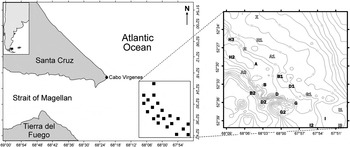
Banco Sarmiento (~52°22′–52°40′S 67°50′–68°08′W: Figure 1) is an underwater extension of Cabo Vírgenes and is located off the eastern mouth of the Strait of Magellan. The easternmost segment of the Strait is characterized by strong currents originated from semidiurnal tidal waves coming from the Atlantic Ocean that determine a macrotidal regime with an amplitude of up to 9 m during spring tides (Medeiros & Kjerfve, Reference Medeiros and Kjerfve1988). Currents between 80 and 100 cm s−1 flowing in an east–west direction have been recorded at 40 m depth in the eastern mouth of the Strait of Magellan, but velocity may be greatly reduced near the bottom due to friction (Michelato et al., Reference Michelato, Accerboni and Berger1991). These oceanographic features, however, may differ from those prevailing at Banco Sarmiento, where extreme current and tidal patterns may not occur. Mean tidal range at the Atlantic coast of Tierra del Fuego is 6.6 m at Bahía San Sebastián, where the flood and ebb currents reach a velocity of 1 m s−1 in north-west–south-east directions, respectively (Bujalesky, Reference Bujalesky2007).
Location of study area and stations. Isobaths in metres. Black script, stations of Group 1; white script, stations of Group 2 (see Results).

Sample collection and processing
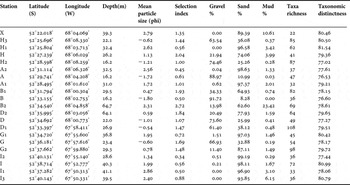
Sampling took place on-board the PSV ‘Golondrina de Mar' on 27–28 October 2006. Twenty-one stations were sampled along an area of 13.0 × 33.4 km. Stations were evenly spaced so as to cover the whole study area, except for station X, which was placed outside the bank. Geographical coordinates were recorded with a GPS (Table 1). Three samples were taken at each station with a 20.3 × 18.0 cm (3.654 dm2) Van Veen grab, except for stations X, D1 and I3, where only two grab samples were collected. In addition, one qualitative sample per station was obtained with a 20 × 60 cm rectangular dredge with a mesh size of 3.5 cm. The dredge was dragged over the bottom at a velocity of 1 m s−1 during 10 minutes. Depths were recorded with an echo sounder and were later corrected according to the tidal height at the moment of sampling. Grab samples were immediately washed with seawater on a 1-mm sieve and then fixed in a solution of formaldehyde in seawater. The material was later transferred to 70% ethanol in the laboratory. The presence of benthic organisms was recorded only when they were alive at the moment of sampling, i.e. fragments, as well as empty tubes or shells, were disregarded. The following specialists assisted us with taxonomic identifications: Gloria Alonso (amphipods), Daniel Roccatagliata and Natalia Alberico (cumaceans), Brenda Doti (isopods), Guillermo San Martín (syllid polychaetes), Gabriela Liuzzi (polyplacophorans) and Diego Zelaya (bivalves and gastropods). The bryozoans were identified by one of us (J.L.G.).
Location coordinates, depth, sediment characteristics, richness and taxonomic distinctness for 21 benthic sampling stations in Banco Sarmiento.

A small subsample for sediment particle size analysis was taken from the first grab. Subsequent grab and dredge samples were collected only after the ship manoeuvered again into position, so as to maximize the representativeness of the analysis. The sediment was dried until constant weight and then sieved through a column of 7 sieves of decreasing mesh size (4, 2, 1, 0.5, 0.25, 0.125 and 0.062 mm). Sediment fractions were weighed to the nearest mg on an analytical balance. Mean phi values (–log2 of particle diameter in mm) and the selection index were obtained using the software GRANUS (Perillo et al., Reference Perillo, Gómez, Aliotta and Galindez1985).
Data analysis
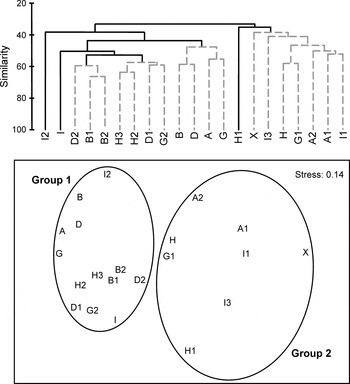
The total number of taxa collected in 21 stations by both dredge and grab sampling was 267 (see Supplementary Material). An inspection of the taxonomic list obtained by each sampling gear showed that just 154 taxa were present in the material collected by grab sampling, i.e. 113 taxa (42.3%) were absent from the quantitative samples. On the other hand, 206 taxa appeared in the dredge collections, i.e. 61 taxa (22.8%) were missing from the qualitative samples. Therefore, presence/absence data, i.e. the list of all taxa collected both with Van Veen grabs and the rectangular dredge, were preferred to quantitative samples of the soft-bottom infauna. For the calculation of similarities among stations we chose the Sørensen index, because it gives more weight to co-occurrences than to species present in only one station but absent in the other. The ordination of stations was achieved using non-metric multidimensional scaling (nMDS). A stress value of 0.14 (see Figure 2) indicates that the bivariate nMDS plot gives a potentially useful two-dimensional picture. Cluster analysis was also performed on the same similarity matrix. Following the methods of Clarke & Warwick (Reference Clarke and Warwick2001), group-averaging was chosen as the linkage option. Clustering and ordination analyses were combined to check the adequacy and mutual consistency of both representations (Clarke & Warwick, Reference Clarke and Warwick2001). The SIMPROF permutation procedure was used to test the significance of the clusters. The null hypothesis of no internal group structures in the full set of samples was rejected when P < 0.05. Species richness and taxonomic distinctness were calculated using the DIVERSE routine of the PRIMER package. The taxonomic distinctness index (Warwick & Clarke, Reference Warwick and Clarke1995) uses presence/absence data and takes into account the taxonomic relatedness among all the species present in the assemblage as expressed by a currently accepted hierarchical Linnean classification. Undetermined or non-existent supraspecific taxa (2.5% of the cases) were identified with arbitrary labels in the aggregation file.
Cluster analysis and non-metric multidimensional scaling based on presence/absence data of 267 taxa collected by grab and dredge sampling. Significant clusters (SIMPROF test, P < 0.05) are connected with solid lines. The elipses show the two major groups obtained by cluster analysis.

Canonical correspondence analysis (CCA), a multivariate method aimed at elucidating the relationships between biological assemblages of species and their environment (ter Braak & Verdonschot, Reference ter Braak and Verdonschot1995), was performed with XLStat (Version 2011.3.01). Previously, the original matrix was reduced by deleting 97 rare species found in only one station. The analysis was thus carried out on a reduced matrix of 170 taxa × 21 stations. Associations between variables were analysed with the Spearman's coefficient of rank correlation (Zar, Reference Zar2010). After inspection of the correlation matrix, highly correlated environmental variables were omitted from the analysis to avoid multicollinearity problems. CCA included a Monte Carlo permutation test (with 999 unrestricted permutations) to determine the significance of species–environment relationships.
RESULTS
Particle size analysis showed that very different sediment types were present in the study area, from sandy gravels (e.g. stations H2, H3, D, D1 and G) to muddy sands (stations X, B2 and I3). Values of the selection index ≥ 0.70 indicated that sediments were poorly to very poorly selected in two-thirds of the stations (Table 1).
A total of 267 benthic taxa were obtained using both kinds of sampling gears (see Supplementary Material). The most diversified groups were the polychaetes (62 taxa, 23.2%) and bryozoans (50 taxa, 18.7%). The highest (108 taxa) and lowest (22 taxa) richness occurred at stations D1 and X, where the sediment was sandy gravel and muddy sand, respectively (Table 1).
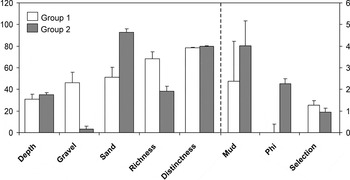
Figure 2 shows the similarity among stations as assessed by a combination of clustering and ordination (nMDS) methods. The SIMPROF permutation procedure showed that 6 out of 20 clusters were significant (P < 0.05). Two significantly different major groups of stations were related at a similarity level of 33.1%: Group 1, with 13 stations, and Group 2, with 8 stations (Figure 2). Stations belonging to Group 1 had much coarser sediments (i.e. lower phi values), a much higher percentage of gravel but lower percentages of sand and mud, and almost twice the number of species than those of Group 2 (Figure 3). Assemblages inhabiting coarse sediment stations belonging to Group 1 were characteristically composed of filter-feeding organisms (bryozoans, hydrozoans, ascidians, pedunculate cirripeds and sabellid polychaetes), carnivorous polychaetes (syllids, polynoids and nereids) and organisms associated with hard substrata (algae and chitons) or preying on colonial filter feeders (pycnogonids). On the other hand, stations belonging to Group 2 were populated by species typically associated with fine sediments, such as phoxocephalid amphipods, opheliid polychaetes, priapulids, pennatulaceans, detritivorous echinoids and bivalves (see Supplementary Material).
Comparison of environmental variables, richness and taxonomic distinctness between Groups 1 and 2 (mean + standard error).

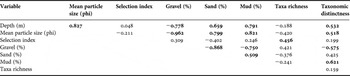
A correlation matrix showing the relationships among several environmental factors that can affect taxa richness and taxonomic distinctness is shown in Table 2. Some of the correlations in the matrix are obvious, such as phi values being directly proportional to sand and mud percentages and inversely proportional to the gravel content. Due to hydrodynamic factors, it was also expected that relatively deeper stations would be more sandy and muddy (and less gravelly) than shallower stations. Species richness was significantly correlated just with the selection index, meaning that poorly sorted (i.e. more heterogeneous) sediments were inhabited by a higher number of species than well sorted sediments. Perhaps the most unexpected correlations found in this study were those involving the index of taxonomic distinctness. The deeper and muddier stations did not have higher species richness than the shallower and coarser ones. Instead, they showed the highest values for the index of taxonomic distinctness. In other words, species inhabiting deep and muddy bottoms were on average more distantly related among each other than those inhabiting shallower and coarser bottoms. An inspection of the Supplementary Material showed that low taxonomic distinctness values in shallow stations characterized by the presence of coarse sediments (e.g. stations A and B) were due to the occurrence of a relatively high proportion of bryozoans encrusting hard substrata.
Spearman rank order correlation matrix for depth, sediment characteristics, richness and taxonomic distinctness.

Significant results (P < 0.05) in bold type.
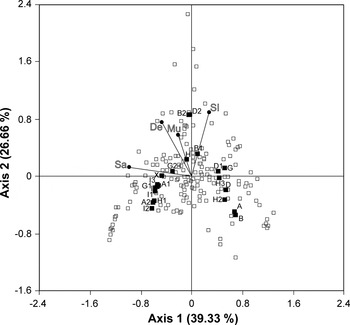
Sediment particle size (phi) and gravel content were omitted from the CCA, as both variables were highly correlated with the percentage of sand (Table 2). The result of the Monte Carlo permutation test (Pseudo F = 1.358, P < 0.0001) allowed us to reject the null hypothesis of no relationship between environmental variables and benthic community structure. The first two CCA axes explained almost 66% of the total variance in the analysis (Figure 4). Shallow stations showing the highest gravel content (B, A, H2, D and H3: Table 1) were spread out along positive values on the first axis and negative values on the second axis (Figure 4). The two deepest stations (B2 and D2: Table 1) showed positive values on the second axis and appeared somewhat isolated on the upper part of the plot (Figure 4). Stations with more than 90% of sand (I2, A2, I, A1, G1, I1, H1 and I3: Table 1) were grouped on the lower left side of the graph, along negative values on both axes (Figure 4).
Canonical correspondence analysis triplot showing the ordination of stations, species and environmental variables. Open squares, species; solid squares, stations; lines and solid circles, environmental variables; Sa, sand percentage; De, depth; Mu, mud percentage; SI, selection index. Species codes were omitted for clarity.

DISCUSSION
Banco Sarmiento has a rich benthic fauna. We found a total of 267 taxa in a variety of sediments ranging from sandy gravels to muddy sands. Its benthic assemblages have more than 62% of the species in common with Bahía San Sebastián, a shallow and protected coastal environment on the eastern shore of Tierra del Fuego (López Gappa & Sueiro, Reference López Gappa and Sueiro2007). The biogeographical affinities of its fauna should be regarded as typically Magellanic, as the distribution of most species extends to other localities of Tierra del Fuego, the southern Chilean fjords, and even to some sub-Antarctic islands of the Scotia Arc. Among the most conspicuous species are the sponge Pseudosuberites sulcatus (Thiele, 1905), the hydrozoans Amphisbetia operculata (Linnaeus, 1758), Symplectoscyphus milneanus (d'Orbigny, 1846) and Symplectoscyphus subdichotomus (Kirchenpauer, 1884), the bryozoans Cellaria malvinensis (Busk, 1852) and Tricellaria aculeata (d'Orbigny, 1847), the sipunculid Golfingia margaritacea (Sars, 1851), the ascidians Paramolgula gregaria (Lesson, 1830), Pyura legumen (Lesson, 1830) and Polyzoa opuntia Lesson, 1830, the gastropod Trochita pileus (Lamarck, 1822), the polychaetes Artacama proboscidea Malmgren, 1866 and Kinbergonuphis dorsalis (Ehlers, 1897), the isopod Joeropsis curvicornis (Nicolet, 1849) and the decapods Peltarion spinosulum (White, 1843) and Eurypodius latreillei Guérin, 1828 (see Supplementary Material).
The Polychaeta was the most species-rich infaunal group in Banco Sarmiento. Other surveys carried out in the Strait of Magellan showed that polychaetes were the dominant taxa with regards to abundance and biomass (Thatje & Brown, Reference Thatje and Brown2009; Ríos et al., Reference Ríos, Mutschke and Montiel2010), attaining even a much higher richness (Bremec et al., Reference Bremec, Elías and Gambi2000; Ríos et al., Reference Ríos, Mutschke and Morrison2003: 119 taxa; Montiel et al., Reference Montiel, Quiroga and Gerdes2011: 166 species) than in the collection examined in this study. A recent analysis encompassing a wide area of the continental shelf off Argentina, however, concluded that the polychaetes were the fourth group in abundance, after molluscs, crustaceans and echinoderms (Bremec et al., Reference Bremec, Souto and Genzano2010).
The hydrodynamic features, together with the sediment composition, were identified as the most important environmental factors influencing meiofauna distribution in the Strait of Magellan and the Beagle Channel (Chen et al., Reference Chen, Herman and Vincx1999). Similarly, the cluster analysis classified benthic stations of Banco Sarmiento in two major groups differing mainly in sediment particle size characteristics. A first cluster of stations composed of a relatively high proportion of coarse sediments was dominated by filter-feeding organisms. The second cluster contained higher levels of sand and mud than the first cluster and was characterized by the dominance of detritivorous taxa. The spatial segregation of filter-feeders and deposit-feeders is a well-known ecological pattern in subtidal habitats (Sanders, Reference Sanders1958; Rhoads & Young, Reference Rhoads and Young1970; reviewed in Gray, Reference Gray1974). Surveys carried out in Patagonian and Magellanic gulfs and bays also arrived at the conclusion that benthic organisms with different feeding mechanisms are spatially segregated according to the size fractions predominating in the sediment (Roux et al., Reference Roux, Fernández and Bremec1995; López Gappa & Sueiro, Reference López Gappa and Sueiro2007).
Benthic monitoring is often based on quantitative grab sampling of the sediment infauna, an adequate methodology for sampling sandy and muddy bottoms (e.g. Olsgard & Gray, Reference Olsgard and Gray1995). Epifaunal organisms, however, are often missed by grab sampling, but may be important components of benthic assemblages in coarser areas dominated by poorly selected sediments, which can be conveniently surveyed by combining grab and trawl sampling, since both estimates are often considerably different (Jørgensen et al., Reference Jørgensen, Renaud and Cochrane2011). Our study shows that only 34.8% of the biota was simultaneously represented in the collections gathered by grab and dredge sampling. More than 40% of the taxa was not sampled by the Van Veen grab, while almost 23% was absent in the material collected by the rectangular dredge. A survey of the polychaete fauna of the Strait of Magellan using three different sampling gears (multibox corer, Agassiz trawl and Rauschert dredge) showed also that just 15% of the total number of species occurred in more than one of the gears (Montiel et al., Reference Montiel, Quiroga and Gerdes2011).
Epibiotic organisms encrusting hard substrata appeared in stations consisting of coarse and poorly selected sediments. Among them, the bryozoans were represented by 50 species. These colonial and sessile filter-feeders are often neglected in benthic surveys. Studies carried out in regions where the publication of taxonomic monographs allows identification to species level, however, show that they may attain high biodiversity at local scales (e.g. Maughan & Barnes, Reference Maughan and Barnes2000). The presence of a relatively high number of species belonging to the same phylum in samples collected at shallow depths resulted in low values for the index of taxonomic distinctness, causing a positive and significant correlation between this biodiversity measure and environmental factors such as depth and mud content.
We also found a significantly positive correlation between taxa richness and sediment selection, meaning that poorly selected sediments were inhabited by more species than well selected sediments. This may be explained because a high degree of heterogeneity in sediment particle sizes provides many microhabitats that can support a high biodiversity of benthic organisms, as has been demonstrated for interstitial polychaetes (Villora-Moreno, Reference Villora-Moreno1997; Di Domenico et al., Reference Di Domenico, Lana and Garraffoni2009).
Studies analysing changes in community structure along the Magellan region have shown that abundance, biomass and diversity were highly heterogeneous in space and time (Ríos et al., Reference Ríos, Mutschke and Montiel2010). It should be taken into account, however, that different authors collected macrobenthic organisms with different sampling gears, e.g. isopod crustaceans were collected with a 59.5 × 23 cm rectangular dredge (Lorenti & Mariani, Reference Lorenti and Mariani1997), while the whole macrofaunal community was sampled by Ríos et al. (Reference Ríos, Mutschke and Montiel2010) using three 0.1 m2 Smith–McIntyre grabs per station. The highest abundance and diversity of isopods were found in the eastern areas of the Strait of Magellan (Lorenti & Mariani, Reference Lorenti and Mariani1997), i.e. those under the influence of a macrotidal regime and high-flow conditions (Medeiros & Kjerfve, Reference Medeiros and Kjerfve1988). On the other hand, Ríos et al. (Reference Ríos, Mutschke and Montiel2010) showed that the subtidal soft-bottom assemblages at the eastern entrance of the Strait of Magellan were characterized by a relatively low richness (49 taxa) and impoverished populations. In spite of the geographical proximity of Banco Sarmiento to the area analysed by Ríos et al. (Reference Ríos, Mutschke and Montiel2010) (~50 km), taxa richness found in the present study was high, showing that a five-fold increase in biodiversity can occur at scales of just tens of km. Therefore, we conclude that generalizations on regional biodiversity patterns should be made with caution because of the different gears used during the collection of samples, and that any inference on benthic community structure should be based on a thorough knowledge about the physical environment, particularly the hydrodynamics and sediment particle size analysis.
ACKNOWLEDGEMENTS
This study was part of a PhD thesis by R.C. supported by a scholarship of the Consejo Nacional de Investigaciones Científicas y Técnicas (CONICET). M. Collantes and E. Vallarino helped us with the multivariate analysis. Tidal corrections to depth-values were made by H. Ezcurra. We thank G. Perillo for making available his software for sediment particle size analysis and N. Landoni for his help during the SIMPROF procedure. The following people assisted us with taxonomic identifications: D. Zelaya, G. Liuzzi, D. Roccatagliata, G. Alonso, B. Doti, N. Alberico and G. San Martín. We are grateful to the crew of the PSV ‘Golondrina de Mar' for assistance during the field survey and to CONICET for financial support (PIP 2010 No. 0291 to J.L.G.).
Supplementary Materials
The supplementary material refered to in this paper can be found online at journals.cambridge.org/mbi.