Since the 2000s, manufactured goods imported from Chinese factories have dominated the Nigerian market and become essential in the everyday lives of Nigerians. However, contrary to the general impression of the “recent” popularity of Chinese products, the presence of both imported and locally manufactured Chinese goods dates back as far as the late colonial period. In the 1950s and 1960s, the Nigerian government’s pursuit of industrialization dovetailed with Chinese industrialists’ quest for an alternative manufacturing base for its enamelware products, which led to the establishment of a series of enamelware factories in Nigeria. The establishment of these Chinese-owned factories was not merely a top-down industrialization effort involving only the Nigerian state and Chinese industrialists, nor was its influence limited to these enterprises’ own workers. In fact, the end products of enamelware manufacturing—water cups, trays, buckets, bowls, and other food containers—became indispensable objects in the daily life of Nigerians, the meanings of which went far beyond their practical day-to-day uses.
The case of enamelware is unique, in that nearly 100 percent of the enamelware production in Nigeria has taken place in Chinese-owned factories.Footnote 1 Chinese-made enamelware products dominated the kitchens, living rooms, and bedrooms of ordinary northern Nigerians between the 1960s and the early 1990s, gradually replacing traditional Nigerian articles made of calabash, wood, brass, grass, and clay due to their greater durability, better sanitary properties, and pleasing aesthetics (Chuku Reference Chuku1995; King Reference King1962; Platte Reference Platte2004).
Based on an analysis of Nigerian newspapers and oral history interviews with Chinese enamelware technicians, Nigerian enamelware traders, and Nigerian consumers, this article explores the social and economic meanings of Chinese-made enamelware in northern Nigeria from the late colonial period to the 1990s. The first line of inquiry here, though mainly set up as a broader context in the text, examines the introduction of enamelware as a foreign and modern object and its manufacturing as a symbol of modernization during the colonial period and the era of independence. The unique case of Chinese-made enamelware in Nigeria offers insight into the way foreign or in particular Chinese products have influenced African economies and the lives of African consumers, workers, and traders. Scholars tend to pay more attention to the contemporary influence of Chinese products in Africa, especially the way that Chinese goods have boosted or destroyed local manufacturing industries, transformed the lives of local people, and complicated local trading practices (Akinrinade & Ogen Reference Akinrinade and Ogen2008; Dankwah & Valenta Reference Dankwah and Valenta2019; Marfaing & Thiel Reference Marfaing and Thiel2013). The material consumption of Chinese goods, as seen also in their Western counterparts, served as a means of materializing personal success and became a symbol of one’s level of personal achievement (Rowlands Reference Rowlands1996). Chinese enamelware represented newness, foreignness, and modernity, which differentiated itself as the opposition to local “tradition.” This study adds to the literature by discussing the historical aspect of Chinese goods in Nigeria, a subject that has been barely mentioned in previous research, as well as by uncovering the evolution of European-introduced and later Chinese-made enamelware from a new and modern object to an integral part of northern Nigerian tradition.
Closely related to these considerations, another line of inquiry delves into how the initially new and foreign Chinese-made enamelware was absorbed or indigenized into the world of local containers as well as the local networks of gendered meaning. Adding to studies of enamelware and “traditional” containers (Cooper Reference Cooper1995; Cunningham Reference Cunningham2009; Platte Reference Platte2004) that focus on the role of various containers as symbols of women’s economic status at the time of their marriage, my article suggests that Chinese-made enamelware acquired lifelong significance for Hausa women as seen in its passage over generations and its importance to Hausa men. The lifelong importance of enamelware and the associated social pressure its acquisition placed on Hausa women across their life stages has too often been overlooked by scholars. Hausa women found it necessary to deal with the acquisition and care of enamelware regardless of their ages: as young single women, brides, mothers-to-be, new mothers, and finally, as the mothers of grown-up, marriageable daughters. In short, the pressures associated with enamelware ownership not only accompanied women through their entire life cycle, but were also passed on from one generation to another. This study also demonstrates how entrepreneurial Hausa women turned a seemingly nonproductive activity (Callaway Reference Callaway1987:70) into a stable means of financial management or even a profitable investment. Another frequently overlooked aspect of this phenomenon was that, in spite of or perhaps even because of its strong gendered nature as women’s property, enamelware mattered greatly to men; husbands cared about the beauty, trendiness, and cleanliness of the enamelware they were using on social occasions because it reflected on the image of their wives, even on social occasions when women were not physically present.
I chose Kano as the major research site due to its importance in the trading, manufacturing, and consumption of enamelware. As the commercial center of northern Nigeria and the largest enamelware market in West Africa, Kano attracts traders from various neighboring countries who buy in large quantities.Footnote 2 To the northwest via Sokoto, enamelware is exported to Benin, Togo, Burkina Faso, and Mali; to the north it is exported to Niger; and to the northeast via Maiduguri it is sold to Chad, Sudan, the Central African Republic, and northern Cameroon. The most experienced and senior enamelware traders are concentrated in Kano, and some of them or their fathers entered the business in the late colonial period.Footnote 3
In addition to its pivotal role in West African enamelware distribution, as the home of two major factories—Northern Enamelware Ltd and Grand Industry Ltd—Kano is the manufacturing center for enamelware in northern Nigeria. Even enamelware factories in Lagos and Port Harcourt regularly send representatives to Kano to conduct surveys or seek traders’ opinions and recommendations.Footnote 4 In short, Kano is the best place from which to gain access to, and a clear understanding of, the enamelware industry as a whole. Lastly, unlike in Lagos—where enamelware is nowadays barely found—enamelware still plays an important role in the social and cultural life of Nigerians who live in Kano City and its hinterland. The experiences of Kano enamelware consumers therefore shed additional light on its past and current cultural meanings.
The selection of my oral history interviewees was based on a combination of region, age, occupation, gender, and class. All my Nigerian interviewees were located within the Kano state, yet the majority of them had migrated from the neighboring states, so their experience could speak to the broader northern Nigeria area. I mainly chose senior Nigerians born in the mid-twentieth century or earlier, who had experienced the early days of enamelware’s popularity. Among them, senior Nigerian enamelware traders were the ones who were both familiar with consumers’ preferences and with European trading firms and Chinese manufacturers. Senior female and male Nigerian consumers, both wealthy and impoverished, talked about their own experiences with enamelware, as well as the experiences of their peers.
This article covers the time from the late pre-colonial period in the late nineteenth century to the post-independence era in northern Nigeria. My oral history interviewees dated their or their ancestors’ earliest experiences using household containers to the time before the British occupation, and they frequently used “the North” or “Northern Nigeria” to relate such experience to the broader northern states of Nigeria. However, the administrative boundaries of northern Nigeria constantly changed through the twentieth century. Northern Nigeria was part of the Sokoto Caliphate in late nineteenth and early twentieth century; it was the Protectorate of Northern Nigeria from 1900 to 1914, the northern provinces of Colony and Protectorate of Nigeria from 1914 to 1954, the Northern Region from 1954 to 1967, and then multiple northern states from 1967 onwards. When my interviewees referred to “Northern Nigeria,” they were actually talking about the Northern Region (1954–1967) and all the northern states divided from it since 1967. Given the changing nature of northern Nigeria in terms of administration as well as the preferences of my interviewees, here I use northern Nigeria to represent a geographical region that is identical to the historical Northern Region during the period from 1954 to 1967.
Household Containers in Late Pre-Colonial Northern Nigeria
Nigerians have a long history of fashioning, trading, and using household containers made from a wide variety of natural materials. Of these, clay pottery is the best represented in the archaeological record, with the production of terracotta sculptures and pottery containers by northern Nigeria’s Nok culture dating back up to 2,500 years ago (Fagg Reference Fagg1972; Hogben & Kirk-Greene Reference Hogben and Kirk-Greene1966). Beyond this Nok context, archaeological evidence for the production and use of pottery has also been found elsewhere in Nigeria.Footnote 5
Pottery containers have long played an important role in the everyday life of Hausa-speaking people in northern Nigeria. Tukunya kasa, large cooking pots, were used by Hausa women to cook soup or solid food for their families in the last quarter of the nineteenth century.Footnote 6Randa, large water jars, were used to store and cool water, acting in effect as refrigerators, and tulu, smaller water pots, to fetch water from randa. Footnote 7 In addition to their utilitarian use, randa and tulu were used to cover the bodies of the deceased in burial ceremonies, and this function has remained unchallenged through the colonial and post-independence eras. Pottery containers were also used as piggy banks, teacups, and kettles for bathing; occasionally, well-painted pottery pots were used simply for household decoration.Footnote 8
Containers made from calabash, wood, grass, and brass were also widely used in late pre-colonial northern Nigeria. The calabash bowls known as kwarya can be categorized into two different types: undecorated ones used as containers for both solid food and soup that had been prepared in tukunya kasa, and decorated ones made by specialist craftspeople. Calabash gourds were easy to grow on farms and could be cut when they reached a particular target size.Footnote 9 After the whole calabash was removed from the vine, it could then be cut in half, hollowed out, and washed and dried for future use as a food container. In other words, the ease and low cost of making plain calabash bowls in northern Nigeria meant that basically everyone could become a calabash bowl-maker, and this ensured that such bowls were widely used as food containers before the importation of European metal containers began (Konan Reference Konan1974; Sargent & Friedel Reference Sargent and Friedel1986).
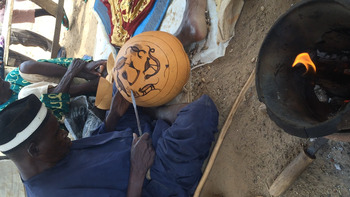
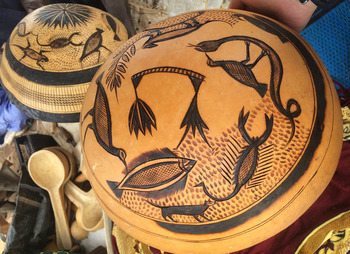
In the case of decorated kwarya, the specialist craftsmen and women sought out calabashes of good quality, in symmetrical shapes in a variety of sizes, and used knives to cut them in half. Following cleaning, drying, and polishing, images were either painted or burned into the gourd’s surfaces (see Figure 1). The images chosen varied by geographic area and according to the kwarya-makers’ individual style preferences, but often included fish, lizards, turtles, scorpions, snakes, birds, palm trees, and flowers.Footnote 10 These images represent animals and plants in Kano and the broader northern Nigeria, and there was a slight difference of popularity of images among the different states in the north (see Figure 2). Design quality was key to the appeal of decorated kwarya, since (decoration apart) ordinary consumers could have made their own calabashes, rather than resorting to the local market.Footnote 11
Musa Zabo, a kwarya maker, is carving and burning images of animals onto the surface of a decorated calabash bowl. Photo taken by the author at Kode Village, Kano State, Nigeria, September 23, 2016.

Beautiful images of animals on calabash bowls. Photo taken by the author at Kode Village, Kano State, Nigeria, September 23, 2016.

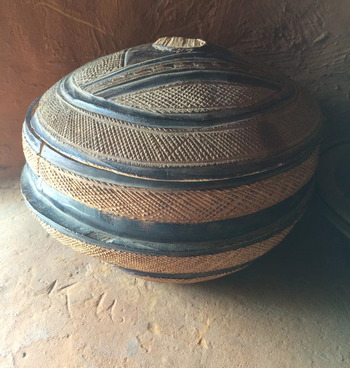
Palm-tree wood bowls known as akushi were another major type of food container in the late pre-colonial northern Nigeria (see Figure 3). Unlike the fashioning of plain kwarya, which could be achieved by anyone, akushi-making required a significant level of professional skill.Footnote 12Akushi were also much heavier and more solid than kwarya and more expensive than decorated kwarya, which meant it was usually the rich who could afford to use them in large quantities.Footnote 13 Also in contrast to kwarya, which were eaten from by both males and females, akushi were usually reserved for the use of males.Footnote 14
Palm-tree wood bowls. Photo taken by the author at Kano City, Nigeria, September 6, 2016.

Two important products of indigenous grass-weaving were adudu (baskets) and faifai (circular trays/covers). Adudu were mainly used for storing apparel and jewelry, or for transporting agricultural products over long distances.Footnote 15 With regard to the former use, the small holes in adudu provided ventilation, helping to keep clothes dry and odor-free.Footnote 16Faifai served both as covers for food containers like kwarya and akushi, and as trays for drying foodstuffs in the sun and separating husks from flour (Ahmed Reference Ahmed1962; Martin Reference Martin1903). Some colorful faifai were also used for household decoration.
Tasa, small round brass bowls/trays, were mainly used for home decoration, and kumbo were larger versions. Unlike the production of kwarya, akushi, and adudu, which was dispersed widely across northern Nigeria’s villages and towns, the handicraft of tasa-making concentrated in a limited number of places, with Bida (current Niger State) being particularly famous for the production of brassware using imported brass (Herbert Reference Herbert1984:77).Footnote 17 Bida’s origin can be traced to the early nineteenth century when slavery, slave trading, and warfare were commonplace in Nigeria (Vernon-Jackson Reference Vernon-Jackson1960).Footnote 18 Emirs fighting wars were in need of metal weapons such as spears and swords, as well as luxuries such as well-designed bowls, kettles, trays, and rings, and this demand led a group of brass- and silversmiths to come to Bida to offer their services to the Emir of Nupe. Because of their attractiveness and distinctive designs, tasa and kumbo made in Bida were much sought after by traders and consumers.Footnote 19
The various types of indigenous household containers discussed above were not just limited to everyday utilitarian purposes, but they were also deeply integrated into marriage customs in pre-colonial northern Nigeria. Hausa engagements, wedding ceremonies, bride-price or lefe and kayan daki (i.e., gifts that bride’s family sends her to her new home with) all imbued household containers with indispensable symbolic meaning (Callaway Reference Callaway1987:69–70; Cooper Reference Cooper1997:90–109; Schildkrout Reference Schildkrout and Bay1982).
In Kano, after both a young man’s parents and a young woman’s parents agreed that their children could marry, the groom’s family would be obligated to pay bride price. To successfully set up a wedding date, the groom’s family needed to send lefe or kayan lefe to the bride’s family. Lefe was mainly made up of different clothing items, shoes, bags, jewelry, cosmetics, and perfumes, and adudu were almost universally deemed the proper containers in which to send it.Footnote 20 The bride’s parents, meanwhile, needed to prepare their daughter’s kayan daki, in which containers such as tasa, kumbo, akushi, kwarya, and paipai were considered essential.Footnote 21Kayan literally means “the items that a bride is sent to her husband’s home with”; and daki is the “room” in which the items are placed. The calabash and brass bowls are normally lined up in rows in the room of the bride from the ground to the ceiling level. Sometimes they are placed inside a wooden cupboard. These lined up rows are called jere, meaning “arrangement in sequence.” During and after the wedding ceremony, relatives, friends, and guests would come to the bride’s room to inspect the preparedness of the bride for her new married life, as well as the internal decoration of her new home, and the display of containers was an essential element of this ritual.Footnote 22
The containers included in a bride’s kayan daki symbolized the social ties and economic capital of the bride’s family. As Barbara Cooper has argued, based on the case of Hausa marriage in pre-colonial Maradi, the number of calabashes deployed in a bride’s kayan daki represented her social capital, allowing the public to see “how many friends and kin she and her mother could turn to for support” in times of need (Cooper Reference Cooper1995:127). Cooper correctly points out the importance of calabash containers for domestic decoration, and thus as representations of the social status of the bride; however, the case of Kano (and northern Nigeria more generally) makes it clear that not only calabashes, but a mix of brass, calabashes, wood, and clay containers were used in Hausa marriages, depending on the wealth of the bride’s family—with specific combinations of these different container types representing social capital as well as economic status. In the last quarter of the nineteenth century in Kano, for example, rich families mainly used high-value brass kumbo and tasa for decoration; the middle ranks of society tended to choose a small quantity of tasa combined with large quantity of kwarya, covering all the walls in the bride’s room; and the poor decorated with a small number of kwarya, on only one or two walls.Footnote 23 A woman with a specific quantity of tasa or kumbo and large numbers of kwarya for decoration was called yar gata, meaning daughter of the rich, a title coveted by every bride. Visits to the bride’s room by relatives, friends, and guests were therefore also detailed explorations of the social status and actual economic power of her family, based on the type, quantity, and quality of the containers used for decoration there.
In short, indigenous household containers were widely used in pre-colonial Kano and the broader northern Nigeria for both practical and symbolic purposes. While indigenous containers were indispensable tools of daily life, some also became indicators of one’s social capital and/or economic status.
Introduction of Enamelware during the Colonial Period
The dominance of indigenous household containers for both utilitarian and symbolic purposes in northern Nigerian society remained almost unchallenged during the late pre-colonial period, when Euro-African contacts were largely limited to coastal areas.Footnote 24 Yet, these items did encounter some competition from European containers during the colonial period. In this section, I explore how European trading companies introduced enamelware to early colonial northern Nigeria, arguing that earlier colonial efforts to promote the use of enamelware did not work as expected largely due to the failure to adjust to the everyday and symbolic needs of Nigerian customers.
In the second half of the nineteenth century, with the annexation of Lagos and the establishment of the Oil Rivers Protectorate, British influence rapidly increased in southern parts of Nigeria. Via the trading activities of the Royal Niger Company, the United African Company (UAC), the London and Kano Trading Company, and other trading firms, the British gradually infiltrated the northern parts of the country, supplying imported goods and exporting local produce (Falola & Heaton Reference Falola and Heaton2008:120–21; Pedler Reference Pedler1974; Porter Reference Porter1996). When the British took over Kano in 1903 and connected it to the colonial railway system in 1911, the export trade in groundnuts and the importation of European goods both began to increase (Cook Reference Cook1943:212–41; Falola & Heaton Reference Falola and Heaton2008:120–21). European trading firms established an elaborate wholesaling and retailing network, with trading stations, warehouses, local agents, and sub-wholesalers extending from the center of Kano city to remote villages.Footnote 25 As early as the 1910s, enamelware was listed among the products imported into northern Nigeria by these companies (Porter Reference Porter1996:96).
Though enamelware would go on to dominate the northern Nigerian market for decades beginning in the late colonial period, its ascendancy was not established overnight.Footnote 26 When introducing this product in the early colonial period, European trading firms conducted commercial tests in Kano’s Kurmi Market very cautiously. Established in the fifteenth century, the Kurmi Market was the oldest and largest market in Kano, selling various types of products during the pre-colonial and colonial periods with traders from both within northern Nigeria and neighboring countries.Footnote 27 Initially, they only brought a limited selection of enamelware to gauge consumers’ responses. Only after observing their potential customers’ preferences over a long period did they start to import a broader range of enamelware in large quantities.Footnote 28 As recalled by Alhaji Abdullah Usmar, a trader born in the late 1920s:
Initially our people didn’t like enamelware, because we were using our local containers like kwarya and akushi. When they [Europeans] started to bring it, they gave some free samples and then sold it in a small quantity at a lower price. They would say, “please, take this one, go and try it.” As time went on, our people started to use it small small, but still less often than our own.Footnote 29
Some European companies set up enamelware showrooms at the Kurmi Market during the colonial period. UAC, the Compagnie Française de l'Afrique Occidentale (CFAO) and John Holt all did so and invited indigenous dealers to come in and identify their favorite designs and models, while subtly praising the advantages of such products for daily use. To attract more sellers and further promote sales, European companies also sold enamelware to local traders on low-cost credit, and this succeeded in extending the market beyond Kano city and deep into the hinterland.Footnote 30
Despite these efforts, European enamelware barely made inroads into the lives of the majority of northern Nigerians, due to the manufacturers’ and importers’ widespread failure to identify or address the specific interests and needs of the consumers. Senior Nigerian traders I interviewed recalled that, when British enamelware first arrived in the country, it featured a very limited range of designs and sizes, all at extremely high prices, and it was not favored by local customers.Footnote 31 In most cases, ownership of such goods was reserved for local emirs and chiefs or wealthy merchants, among an array of exotic European goods that served mainly as conspicuous displays of wealth. In other words, by the mid-point of the twentieth century, enamelware was not yet integrated into either the food-related daily activities of ordinary Nigerians or the symbolism of marriage ceremonies, and for this reason, traditional household containers were able to maintain their position. For example, Anthony Hopkins has argued that traditional handicrafts such as pottery-making were able to survive and develop due to their close physical proximity to their major markets, coupled with what might be termed brand loyalty, particularly in the case of containers (Reference Hopkins1973:250).
Transition in Progress: The Rise of Enamelware in the Era of Independence
Colonial-era efforts by European trading firms to introduce enamelware only managed to secure a very small portion of the market in household containers. However, after the 1950s, this situation underwent a dramatic change, with enamelware containers starting to fully take the place of traditional ones in northern Nigeria.Footnote 32 The indigenization of enamelware design by newly established Nigeria-based Chinese enamelware factories as well as their changing modes of operation adapted well to the needs of Nigerian consumers, which accounted for the rise of enamelware as the most commonly used household containers in northern Nigeria.
Once Nigeria had gained political autonomy in the 1950s and 1960s, Nigerian leaders were also eager to achieve economic independence. They believed industrialization would rid the nation of poverty, reduce its dependence on imported goods, and perhaps even increase its power to parity with that of the former colonial master.Footnote 33 Enamelware manufacturing was among the “pioneer” list of modern industries chosen by the Nigerian government to be granted incentives, which included tax relief, protective tariffs, and even direct government sponsorship. The generosity of this offer succeeded in attracting many Chinese industrialists to establish factories in Nigeria.Footnote 34 This major change in the source of enamelware, from importation from Europe and East Asia to local manufacture, greatly reduced its price, placing it within the financial reach of average Nigerians.
The typical Nigerian customer soon became aware that enamelware’s affordability was only one of its many advantages. Being made largely of metal, enamelware is much stronger than pottery and calabashes. If dropped or struck hard, it might lose some decorative elements but would remain functionally intact, unlike calabash bowls or pottery containers that would break into pieces and be rendered useless. Therefore, even though enamelware was still more expensive than traditional containers, its durability and solidity made it attractive for use in Nigerian homes.Footnote 35 Additionally, as will be discussed in the next section, the variety of designs and colors featured on high-value enamelware made it both aesthetically and socially attractive as household decor among Nigerian consumers. In addition to its superior durability and beauty, enamelware was also believed to be more hygienic than wood, calabash, and pottery containers. Hausa women could clean their enamelware bowls, trays, cups, and buckets easily using water, whereas it was time-consuming to fully clean traditional containers, particularly those that had been exposed to grease or oil.Footnote 36
Despite being manufactured locally by Chinese-owned factories, enamelware in the 1950s and 1960s, along with other imported European goods, was still often seen as a symbol of modernity both by scholars and by certain African consumers, as opposed to indigenous containers, which were symbolic of “tradition” (Geschiere Reference Geschiere, Geschiere and Roitman1997:137–38; Ferguson Reference Ferguson1999:83–86; Ali Reference Ali2010:75–89). As Editha Platte has argued, enamelware and other modern containers—seen as emblematic of “the exotic European world”—were consumed, ritualized, celebrated, and idealized as prestige goods throughout the region (Reference Platte2004:174). This may indeed have accounted for some Nigerians’ decisions to acquire locally made enamelware in the 1950s and 1960s. However, it does not by itself explain why the equally modern and far more expensive European enamelware of the previous several decades had so signally failed to attract similar customer interest.
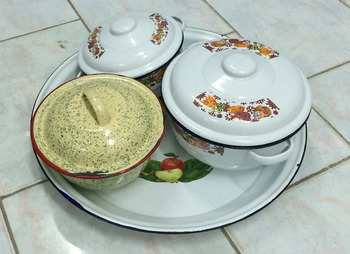
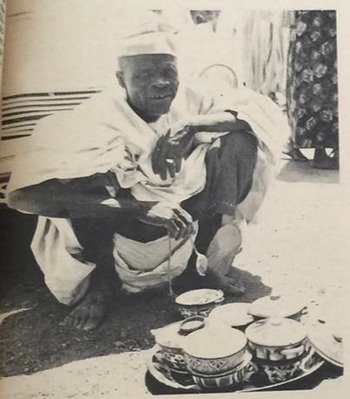
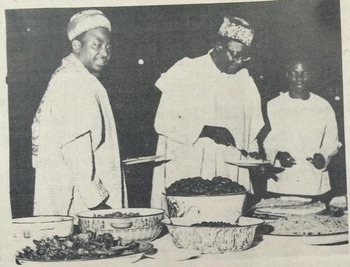
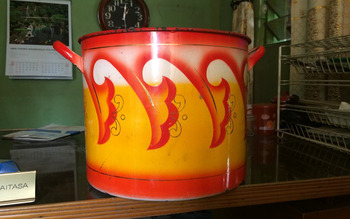
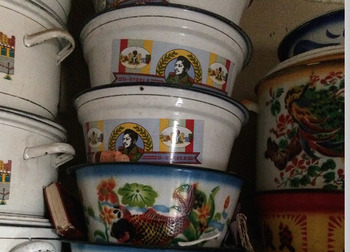
My research implies that the sudden dramatic increase in the uptake of enamelware among northern Nigerian consumers in the 1950s and 1960s lay in the increasingly indigenized designs, colors, and sizes of the enamelware products that were available, due to the narrowing of the distance—mental as well as physical—between manufacturers and consumers. The new Nigeria-based Chinese-owned enamelware factories could send representatives directly to local markets to glean information about customers’ preferences and rapidly make adjustments to their product designs according to what they had learned. For instance, different types of enamelware came to be involved in almost every aspect of food-related activity in northern Nigeria, and their importance earned them Hausa names during the colonial period. When eating at home or with a few friends, those who could afford enamelware served food on a standardized set of four pieces: a langa miya (curry dish for soup), a langa tuwo (curry dish for solid food), a kwanon sha (water bowl), and a faranti (round tray) (see Figure 4). Such sets of enamelware combinations were not previously produced by Chinese-owned factories before they came to Nigeria. As shown in Figure 5, on his pilgrimage to Mecca in 1966, an elderly man brought this standard combination of enamelware pieces with him.Footnote 37 For wedding parties, naming ceremonies, and other major events that featured large numbers of guests, fanteka (food basins) of different sizes or large langa became must-haves for the host. In Figure 6, a photograph taken during the wedding of the Emir of Kano to a daughter of the Sultan of Sokoto in 1974, the then-police commissioner Audu Bako can be seen taking food from a communal fanteka onto his personal tray. Not all uses of enamelware in northern Nigeria were food-related, however. For example, kwalla (straight pots) were used to store water or clothing (see Figure 7), and daro to wash clothes (see Figure 8).
A typical set of enamelware. On top of a faranti are (clockwise from left) a kwanon sha, a langa miya, and a langa tuwo. Photo taken by the author at Hwa Chong Enamelware Factory, Kano, Nigeria, June 3, 2016.

Pilgrim eating at the airport while waiting for his plane to Mecca, 1966. Source: “Faith and Hope on Pilgrims Progress.” New Nigerian, March 18, 1966.

Reception of wedding ceremony of the Emir of Kano. Source: New Nigerian, May 2, 1974.

Kwalla (straight pot) was used to store water or clothing. Photo taken by the author at Kurmi Market, Kano, Nigeria, June 7, 2016.

Daro (wash basin) was used to wash clothes. Photo taken by the author at Kano, Nigeria, September 4, 2016.

Nigerian traders and consumers expressed clear views on this indigenization of enamelware products. Specifically, they recalled that Nigerians had various types of indigenous domestic containers that the Europeans and Chinese took back to their own countries to study and emulate, later returning with enamelware containers based on the designs, patterns, and sizes of traditional Nigerian ones.Footnote 38 As Alhaji Nasidi put it, European and Chinese merchants
first took this akushi and left with it, then they made the same design and the same size of enamelware [as akushi]. They brought and replaced that akushi … Also the cover, they took paipai as their design for the enamelware cover; later they brought the faranti [enamel cover] to replace the paipai for cover. That was the origin [of how] they started to produce enamelware. From then even this kwanonsha [enamel water cup], you know kwarya had different sizes, they took one kwarya with them and then turned it to kwanonsha. Footnote 39
This narrative may not be precisely accurate historically, but it does contain a grain of truth. It confirms the fact that enamelware manufacturers, whether European or Chinese, kept learning from the designs, colors, sizes, and functionalities of traditional domestic containers to indigenize their own. In other words, the relationship between enamelware and traditional containers was one of inheritance and development rather than of opposition and discontinuity.
The changing operation modes of Chinese factories from the 1940s to the 1960s further spoke to the narrative of Nigerian traders and consumers. In the mid-1940s, when the same Chinese industrialists were still based in mainland China, they recalled that they simply manufactured enamelware for the domestic Chinese market using Chinese workers and engineers. There were no barriers of language or distance between them and the Chinese consumers, so they were well aware of their consumers’ preferences. In this stage, according to senior Chinese enamelware engineers, Chinese consumers seemed to use enamelware for purely practical purposes without attaching much meaning to it.Footnote 40
Later, in the mid-1950s, when British West Africa became an important market for Hong Kong-based enamelware factories, despite the fact that the factories were still using the same production lines and Chinese workers, these factories were actually no longer in charge of design. They knew they needed to produce highly colored and cheap household enamelware of new styles for the African market, yet they understood little beyond that.Footnote 41 They heard a few suggestions from their partners, but almost all information about Nigerian consumers’ preferences was filtered through the European trading firms. Chinese factory owners, managers, designers, and workers were curious about why Nigerians preferred these types of enamelware, yet they had little opportunity to discover the reasons.
This situation changed dramatically in the 1960s, when Chinese factories moved to Nigeria. Based in major cities such as Kano, Lagos, and Port Harcourt, Chinese-owned factories established a network of market information with its hub at the Kurmi Market of Kano, due to the market’s central position in the enamelware trade within Nigeria and beyond. Chinese managers and designers, accompanied by their Nigerian colleagues, conducted thorough market surveys at multiple levels. First, they visited the Kurmi Market regularly (monthly, bi-weekly, or even weekly for Kano-based ones), talking to major traders at every stall about which styles, colors, and shapes were selling faster in general.Footnote 42 Additionally, as opposed to the Hong Kong market, where they only saw a vague picture of popular enamelware usage in general, they now were able to identify different market segments with specific tastes. For instance, while consumers in states such as Kano, Jigawa, and Kaduna preferred white enamelware, those from Sokoto, Maiduguri, and Niger state were more interested in red, blue, and green pieces; consumers in the neighboring countries of Mali, Niger, Chad, and Burkina Faso also preferred deeply-colored pieces over light or white ones.Footnote 43 Furthermore, other than simply producing cheap quality enamelware as they had been directed by European trading firms previously, Chinese factories since the 1960s were able to identify and then satisfy demands from different social classes. The Chinese were mainly aiming at boosting the sale of their products, of course, yet in the process their increasingly deeper understanding of the Nigerian market also uncovered the historical gendered meaning network of household containers, which will be the subject of the next section.
The Gendered Meanings of Enamelware in Post-Independence Nigeria
The indigenization of enamelware was not limited to its practical everyday functions. In the process of defeating all of its indigenous competitors, enamelware firmly integrated itself into local networks of gendered meaning, not only in northern Nigeria but also in its West African neighbors (Cohen Reference Cohen1969:66–68; Cooper Reference Cooper1995; Cunningham Reference Cunningham2009; Platte Reference Platte2004; Sargent & Friedel Reference Sargent and Friedel1986). Enamelware not only inherited the key role of indigenous containers in marriage customs as a symbol of female wealth and prestige, but also imposed lifelong social pressures on Hausa women, both symbolically and economically, in the decades between independence and the end of the twentieth century. The way enamelware itself as an object reflected gendered prestige also changed over time. Northern Nigerian women, facing the pressure of acquiring an industrially manufactured object with cash they had little access to, demonstrated their own agenda when buying enamelware or even tried gaining profits from trading the enamelware itself.
In northern Nigeria, enamelware operated mainly in the female sphere, in terms of purchase, use, maintenance, exhibition, and resale; in other words, enamelware joined women’s “enclaved commodities” (Appadurai Reference Appadurai and Appadurai1986:25). Barbara Cooper (Reference Cooper1995) and Jerimy J. Cunningham (Reference Cunningham2009) both reported that enamelware inherited the calabash’s role as a key symbol of social capital, but then developed further into a symbol of economic capital that women could manipulate to challenge patriarchal control. However, both scholars seem to limit the marital role of enamelware to a short period of perhaps three to five years after the wedding. Among Hausa women in post-independence northern Nigeria, the collecting of enamelware was both a lifetime pursuit and a source of considerable pressure, and the symbolic importance of enamelware varied between different decades and different locations.
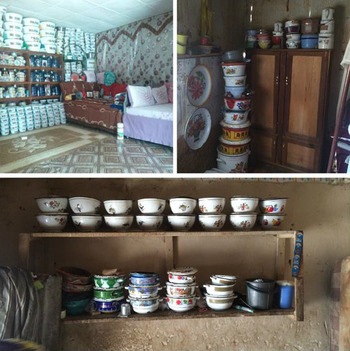
As an important element of her kayan daki, enamelware had become a symbol of wealth and prestige for a newly married woman since the 1950s. The more enamelware the bride brought from her family, the higher her social and economic status in the community.Footnote 44 A very wealthy family would fill two or three rooms with enamelware for the decoration of their daughter’s new house; a middle-class one would cover three walls of one room; and a poor one would decorate no more than two walls with enamelware, or a combination of enamelware and kwarya. Footnote 45 Such difference in enamelware decoration is less often seen now in the city of Kano, but we can still find from the suburban areas of Kano a sharp comparison in Figure 9. As we can see, the bedroom in the upper left was filled with different types of enamelware, layer by layer from top to bottom, while the other two rooms were only sparsely decorated. During a wedding, relatives, friends, and other guests would visit the bride’s room and conduct an examination of her economic status. While a bride from a rich family could expect to win the visitors’ compliments and establish her social and economic status in the community via an extensive display of enamelware, a poor bride who had only cheap indigenous containers such as kwarya or a small quantity of enamelware might be looked down upon in her community or even openly ridiculed. The bride’s room therefore became a space of considerable social pressure.
Bedrooms and living rooms of Hausa women with different economic backgrounds. Photo taken by the author at Kano, Nigeria, September 10, 2016.

The pressures that attended enamelware as a status indicator also motivated brides to pursue the title of yar gata, which (as we have seen) had previously been connected to the type, quantity, and quality of indigenous containers they owned. In the 1950s, however, the prior emphasis on a complex evaluation of a bride’s kumbo, tasa, kwarya, and akushi shifted to a strictly quantitative assessment of her enamelware alone.Footnote 46 In the transitional period of the 1950s and 1960s, when the use of enamelware in kayan daki in Kano City was still limited to the rich and the middle class, parents in the outlying villages who could add any enamelware to the kayan daki of their daughter would automatically earn her the title of yar gata. As my interviewee Bilkisu recalled,
It was a new thing. If people bought those things [enamelware] for their daughters, then they must be called yar gata. They pasted it to the wall as decoration, and people in the whole village rushed to see. If one woman saw enamelware in the room, she would go around the houses to tell people that she had seen interesting new things, and she would shout “that family is rich, you people go and see, you people go and see!”Footnote 47
By the 1970s and 1980s, with enamelware more commonly seen in both city and villages, the threshold for yar gata status also increased, with the key being the number of walls the bride could decorate with it. A yar gata was expected to decorate three walls with enamelware: one hung line by line with small round enamel trays, a second lined with shelves holding middle-sized enamel bowls, water cups, and basins, and a third piled layer by layer with larger enamel straight pots, buckets, and wash basins.Footnote 48 Later in the 1990s in Kano city, regular enamelware started to be replaced by advanced enamelware (casserole) or samira, as local Hausa people called it, in defining yar gata, for the latter stood out as more expensive, fashionable, and good-looking. Yet in the surrounding suburban areas and villages, regular enamelware was still cherished as the most popular objects in the marriage ceremony. Chinese factories were keenly aware of such changes and launched new products accordingly.
Moreover, the social pressures associated with enamelware did not cease with the completion of the wedding ceremony. Rather, anxieties around purchasing, maintaining, and updating her enamelware collection followed a Hausa woman across her life stages, forcing her to renew her collection of enamelware time and time again, whether as a newly married woman, as a new mother, or when marrying off her daughter.Footnote 49 As a mother-to-be, for example, she needed to update her collection to ensure an adequate welcome to visiting family and friends, who would come to see the enamelware as well as the newborn. As my informant Fatuwa put it,
When getting pregnant, I started to think about re-decorating the wall as people would come to see me and the baby after I gave birth. So, I took down old ones, sold them, and then added money to buy some new ones.Footnote 50
While wealthy and middle-class women could simply replace old enamelware items with new, working-class women could often only redecorate by washing, repositioning, and rearranging their collection.Footnote 51 And Hausa women usually had more than one child, which necessitated that they repeat the preparation process for welcoming the social examination of their extended families and peers every time they became pregnant. At first glance, such pressure would appear to have diminished later in life, along with the number of such social visits, but another form of pressure then emerged as any female children approached marriageable age. Then, rather than concern about her own status as indicated by her enamelware collection, instead, a woman would be motivated to make plans for marrying off her daughter(s) with a decent collection of enamelware, thus earning her daughter the title Yar Gata, or at least to elevate her status as much as she could. Given the high quantity of enamelware that this would require, and the associated high cost, preparing for a daughter’s kayan daki was therefore a multiple-year endeavor for most Hausa mothers, with many beginning to stock up on enamelware when their daughters were twelve, buying between half a dozen and two dozen pieces per year, at odd intervals whenever they accumulated enough capital. As Bilkisu and Fatuwa recalled,
If you have a daughter, the enamelware you prepared for her is not done in one time because that is too much money! When she is eleven or twelve years old, you start to buy small and you keep, then buy small and you keep. Every few months you buy fanteka, kwano, or kwansha like this…If you buy, you know, everything changes, the one you buy when your daughter is twelve years old may get old-fashioned and nobody is using it. So you need to get to the market to exchange for a new one. During the period of accumulation for your daughter’s kayan daki, you need to keep buying and keep updating: what remains for your daughter in her room when she gets married needs to be the newest to show to other people.Footnote 52
In other words, the transition from being a new wife to being the mother of a daughter meant that the focus would switch from trying to become Yar Gata oneself to earning this designation for one’s child. Nevertheless, the social pressure to have thoroughly up-to-date enamelware remained the same, and in most cases, it was only after such pressure had been fully passed on to her daughter(s) that a Hausa woman could largely cease to worry about enamelware’s symbolic implications.
The lifetime social pressure enamelware generated created economic pressure as well. Before the 1950s, when calabash and other indigenous containers were in use, northern Nigerian women could rely on their own work (growing, producing, and decorating calabash by themselves) and mobilization of social networks (Cooper Reference Cooper1997:108) to amass their kayan dayi; however, with the advancement of enamelware and establishment of enamelware factories in the 1960s, women found themselves in an adverse cash economy in which they had scant access to wages. Under these circumstances, they had to pursue petty trade, sewing, and cooking food as a few of the income-generating activities to accumulate and buy enamelware. Despite being socially and economically pressured when buying enamelware, northern Nigerian women had their own agenda and agency, as they were well aware of its economic value.
First, buying enamelware was women’s own choice of financial management. It was considered one of the best strategies by which women could preserve the value of the money they earned. Collecting enamelware was often seen to be better than a bank deposit, due to the changing value of Nigerian currency, as a form of insurance against inflation, adverse life changes, and economic difficulties. Furthermore, women did not simply “deposit” their earnings into enamelware conservatively; rather, they invested in it with their aesthetic judgement and investment horizon. Every time a new design of enamelware was released, large numbers of women would try to add it to their collection. If the design was highly desirable but produced in small numbers, its value skyrocketed, and those who had managed to obtain it could sell it for a profit. Some entrepreneurial Nigerian women even specialized in the trade of buying and selling enamelware. As opposed to the male enamelware traders who were based in the major markets, these female enamelware traders came directly to the doors of their female neighbors. They identified those enamelware pieces with appreciation space, bought them from their neighbors, and then sold them later for profit.Footnote 53
In addition to their choice of financial management, northern Nigerian women invested in enamelware as it was female-only property independent of their husbands. The enamelware component of one’s kayan daki was “the economic start for a newly married woman”; it was regarded as her own property, independent from her husband, and thus represented her economic independence (Platte Reference Platte2004:185). A wife who wanted to buy something but lacked sufficient funds had the unquestioned freedom to sell her enamelware for cash. She might mention such decisions to her husband, but they did not require his approval. As Alhamed Muhammed commented when I asked him about his wife selling enamelware, “[I]t is her property from her parents. If she wants to buy something, she could sell enamelware she had and no one can say a thing. It is her property.”Footnote 54 In some cases, women accumulated such a large amount of high-quality enamelware that they were able to sell it for enough money to build or buy their own houses or obtain other major assets.Footnote 55 Knowing enamelware’s economic value for women, Chinese factories would periodically release new designs, colors, and shapes of enamelware or casseroles to the market, sometimes launching limited-edition designs to boost both the sale and the price.Footnote 56
More importantly yet less well-known, just like their wives, husbands also cared about the quality, beauty, and stylishness of enamelware, as it was a symbolic representation of their wives in male-exclusive social occasions beyond women’s own rooms. As mentioned above, Hausa men’s food was usually served on a standardized enamelware set of four pieces: a langa miya (curry dish for soup), a langa tuwo (curry dish for solid food), a kwanon sha (water bowl), and a faranti (round tray) (see Figure 4). When eating with their male friends in the neighborhood or other occasions, men were as keenly curious as women about the newest design of the enamel pots, paying attention to whether their own set was more beautiful and fashionable than those belonging to their peers. As Talatuwa commented,
Men talked about the beautifulness of enamelware while eating. (Laughs) When seeing beautiful enamelware other men would compliment him of having a beautiful wife who serves food in beautiful containers. After the meal when other husbands got back to their own house, they would complain to their wife: “You see, Yusuf’s wife gets Yusuf beautiful containers and decent food, so Yusuf and his wife are the top class among us; his wife’s enamelware is better than yours.” Then the wife might get some money from the husband, or she used her own money to look for newer ones to bring home to make her husband happy.Footnote 57
Many of my Nigerian informants, both female and male, acknowledged that enamelware dishes very often symbolized a man’s wife’s own value in a highly public way.Footnote 58 This was only possible due to the gendered nature of enamelware as women’s exclusive property. As such, the absence of women from newspaper images of a pilgrim showing off his enamelware set at the airport (see Figure 5) and the wedding ceremony of the Emir of Kano (see Figure 6) does not necessarily imply the absence of women’s influence or concerns.
Conclusion
Enamelware’s desirable newness and modernity was inescapably bound up with its inheritance of old and “traditional” qualities. In other words, in attempting to account for enamelware’s success, its deep integration into the pre-colonial social institutions of northern Nigeria was as important as (or arguably more important than) its representation of modernity. Enamelware, despite being introduced as a modern object and its manufacturing as a modern industry, had gone through a decades-long process of indigenization into the local gendered meaning network, which guaranteed its success in northern Nigeria.
Enamelware in northern Nigeria experienced a serious decline after 2000. This was due to encroachment on its market share by cheaper and more modern plastic, ceramic, and stainless-steel containers imported from China. Made-in-China products brought by mainland Chinese traders into Nigeria and other African countries since the 2000s, however, shared little similarities with their predecessors, such as locally-made enamelware by Nigeria-based Chinese factories. While the latter focused on the indigenization of its design and integration into local meaning networks, the former was often known for its low price and “inferior” quality, targeting low-income families in a much simpler way to flood the market (Liu Reference Liu2019; Obeng Reference Obeng2019). In addition, newly arriving Chinese goods were mainly the result of Sino-Nigerian trading connections, in contrast to previous manufacturing efforts made by Hong Kong Chinese industrialists. Chinese manufacturers were both behind the two types of “Chinese” products, yet they symbolized a dramatic change in Chinese influence in Nigeria rather than continuities. Such negative influence on the market share of enamelware in part led to its being categorized into Hausa “tradition.” A room in the Kano Museum dedicated to Hausa marriage traditions includes a small round enamelware tray alongside indigenous containers made of pottery, calabash, wood, brass, and grass. Thus, enamelware has been memorialized and crystalized as a traditional part of northern Nigerian marriage customs. With continuing changes in the marketing and availability of containers in Nigeria, the role of enamelware continues to be updated and redefined. Even though Nigerian women have more choices and options than previously, enamelware has a historical presence that will ensure its viability and value for years to come.
Funding Sources
This article is supported by the “the Fundamental Research Funds for the Central Universities” as Junior Faculty Fund of Beijing Normal University (Grant No. 2019NTSS12). The name of the project is “A Study on the History of Overseas Chinese in Nigeria.”