INTRODUCTION
Nemertean diversity of The Netherlands has received limited attention historically, with the first checklist published only recently (Faasse, Reference Faasse2003). Eleven species were discovered that were not previously recorded in The Netherlands, extending the total number of species to 18 (Faasse, Reference Faasse2003). (Gittenberger & Schipper, Reference Gittenberger and Schipper2008). Some of these findings were the result of regular SCUBA surveys conducted to monitor the marine invertebrate fauna in The Netherlands (north-east Atlantic) (Gmelig Meyling & de Bruyne, Reference Gmelig Meyling and de Bruyne2003). Nemerteans are not usually identified below phylum level during routine ecological surveys, which means that dedicated surveys with a focus on species identification will likely provide additional important species distribution data. During one of these surveys at Zierikzee, we found Cephalothrix specimens that, externally, did not fit the description of the only native north-east Atlantic species Cephalothrix rufifrons (Johnston, Reference Johnston1837) reported for this area. This prompted planning of two additional dedicated nemertean surveys at Zierikzee and Sint Annaland. Species distinctions within the genus Cephalothrix are often based upon very subtle external and usually internal morphological differences, but DNA comparisons have proven a reliable alternative for species identification (Chen et al., Reference Chen, Strand, Norenburg, Sun, Kajihara, Chernyshev, Maslakova and Sundberg2010; Fernández-Alvarez & Machordom, Reference Fernández-Alvarez and Machordom2013; Leasi & Norenburg, Reference Leasi and Norenburg2014). Kajihara et al. (Reference Kajihara, Sun, Chernyshev, Chen, Ito, Asakawa, Maslakova, Norenburg, Strand, Sundberg and Iwata2013) demonstrate that Cephalothrix hongkongiensis Gibson Reference Gibson and Morton1990 and Cephalothrix simula (Iwata, Reference Iwata1952) are morphologically indistinguishable, making DNA comparison the only reliable way to identify these species.
Here we report the first record of the non-indigenous nemertean Cephalothrix simula from northern Europe based on mitochondrial cytochrome oxidase I (cox1) gene sequence comparisons. This species is endemic to the north-west Pacific, but has been previously reported from the northern coast of Spain (Atlantic Ocean) and the Mediterranean and Adriatic coasts of Spain and Italy, respectively (Fernández-Alvarez & Machordom, Reference Fernández-Alvarez and Machordom2013).
MATERIALS AND METHODS
Survey area
The south-eastern seaboard of the North Sea consists almost exclusively of soft sediments. The south-west of The Netherlands is an estuarine area of the rivers Rhine, Meuse and Scheldt on the south-eastern seaboard of the North Sea. In the mouths of the estuaries, deep channels have been cut out by currents. To protect the low-lying land, sea dykes have been built and sublittoral tidal channel slopes have been reinforced with boulders to prevent landslides and damage to the sea dykes. The Oosterschelde is a former estuary, closed off from riverine influence and protected against the sea with a storm-surge barrier. It is now an area important for shellfish culture, mainly mussels and recreational activities such as yachting. Due to shellfish imports and the presence of two nearby international ports, Antwerp and Rotterdam, many alien marine species have been introduced to the Oosterschelde (Wolff, Reference Wolff2005). Most introduced species are associated with the man-made coastal protection works. SCUBA surveys were conducted at two locations in the Oosterschelde, i.e. Zierikzee and Sint Annaland. Zierikzee is a recently disturbed location, where in 2009 steel slag and boulders were used for additional reinforcement of the subtidal slope to a depth of about 17 m below the low water mark. In Sint Annaland no recent reinforcements have taken place; the boulder slope at the sampling location gives way to a flattish sandy bottom at 14 m below the low-water mark.
Survey methods
SCUBA surveys were performed during dives at two locations (Table 1). At both locations a transect about 2 m wide was carefully inspected by two divers, from the low-water mark to the end of the boulder slope and about 5 m further on the sandy bottom below. Nemertean specimens other than the well-known species of the area, Lineus longissimus (Gunnerus, Reference Gunnerus1770) or Tubulanus superbus (Kölliker, Reference Kölliker1845), were collected at Zierikzee. In addition, a 10 × 10 cm2 sample of bryozoan/hydrozoan turf was collected. At Sint Annaland a 10 × 10 cm2 sample was taken from a mat of Lanice conchilega (Pallas, Reference Pallas1766) tubes on the sandy bottom. At Zierikzee a Lanice mat was absent.
Details of observations of Cephalothrix simula (Iwata, Reference Iwata1952) in The Netherlands.

Laboratory analyses
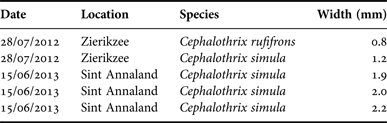
Two nemerteans from Zierikzee (28 July 2012) and six from Sint Annaland (15 June 2013) were preserved in 96% ethanol. The two specimens from Zierikzee and three from Sint Annaland were further analysed. Width measurements were taken of these five nemerteans (Table 2). Measurements were taken behind the mouth from preserved specimens, hence the position is approximate. Cox1 sequences of the same five specimens were determined. Total DNA was purified from alcohol preserved tissue using the QIAamp DNA Mini Kit (Qiagen) and a fragment (~710 bp) of the mitochondrial cytochrome oxidase I (cox1) gene was PCR amplified with HCO2198 and LCO1490 primers (Folmer et al., Reference Folmer, Black, Hoeh, Lutz and Vrijenhoek1994) following standard protocols. Amplified DNAs were purified by incubating for 15 min at 37°C with Exo and SAP enzymes (USB®) and subsequently sequenced with the above-mentioned primers using the ABI BigDye® Terminator Cycle Sequencing Kit and an ABI 31310XL Genetic Analyzer. Sequences were aligned with 184 relevant Cephalothrix sequences downloaded from GenBank using MUSCLE (Edgar, Reference Edgar2004) and uncorrected pairwise distances (p-distances) were calculated using the PAUP* software package (Swofford, Reference Swofford2003). The five sequences from The Netherlands were deposited in GenBank (Cephalothrix rufifrons Zierikzee KP411243, Cephalothrix simula Zierikzee KP411244, Cephalothrix simula St. Annaland KP411245, KP411246, KP411247). For species delimitation, a tree-based criterion was employed. Nemertean outgroup sequences – Tubulanus pellucidus (Coe, Reference Coe1895) and Tubulanus sexlineatus (Griffin, Reference Griffin1898) – chosen based on the analysis of nemertean relationships (Andrade et al., Reference Andrade, Strand, Schwartz, Chen, Kajihara, Döhren, Sun, Junoy, Thiel, Norenburg, Turbeville, Giribet and Sundberg2012), were added to the alignment and identical haplotypes were removed using the DNA collapser of FaBOX (Villesen, Reference Villesen2007). This resulted in a data set consisting of 102 Cephalothrix sequences plus the two outgroup sequences. A maximum likelihood (ML) tree was inferred using RAxML as implemented on the Cipres server (Miller et al., Reference Miller, Pfeiffer and Schwartz2010). Bootstrap analysis (100 pseudoreplicates) was employed to assess clade support. The Poisson Tree Process (PTP) method of species delimitation using a Bayesian approach as implemented on the bPTP web server (Zhang et al., Reference Zhang, Kapli, Pavlidis and Stamatakis2013) was employed using the RAxML tree as input. 500,000 MCMC generations were run for each of the three analyses using different seeds and convergence was monitored. The general mixed Yule-coalescent (GMYC) approach (Pons et al., Reference Pons, Barraclough, Gomez-Zurita, Cardoso, Duran, Hazell, Kamoun, Sumlin and Vogler2006) was not utilized, as it requires an accurate ultrametric tree (Zhang et al., Reference Zhang, Kapli, Pavlidis and Stamatakis2013; Tang et al., Reference Tang, Humphreys, Fontaneto and Barraclough2014), which could not be generated from our RAxML input tree using the commonly employed r8s program (Sanderson, Reference Sanderson2003), possibly because some branch lengths approached zero.
Width measurements of Cephalothrix used for molecular analysis.

RESULTS
The specimens collected at Zierikzee were visible with the naked eye as single orange-coloured worms (Figure 1) on boulders between the bryozoan/hydrozoan turf and other invertebrates covering the boulders. Bryozoan/hydrozoan turf collected contained several juveniles of the terebellid polychaete worm Nicolea zostericola (Örsted, Reference Örsted1844). At Sint Annaland, no nemerteans were observed on the boulder slope. A mat of tubes of the terebellid polychaete worm Lanice conchilega covered several square metres of the sea bottom at a depth of 14 m, immediately below the boulder slope. In a 10 × 10 cm2 sample of Lanice tubes the only species observed were Lanice conchilega and orange-coloured Cephalothrix.
Cephalothrix simula, 28 July 2012, Zierikzee, The Netherlands, in situ, depth about 10 m, on the ascidian tunicate Ciona intestinalis (Linnaeus, 1767), with the bryozoan Scrupocellaria scruposa (Linnaeus, 1758) on the left.
Cox1 sequences of specimens were compared with sequences from GenBank. The cox1 sequences of one of the two specimens from Zierikzee (28 July 2012) and all three specimens sequenced from Sint Annaland (15 June 2013) were identical and showed the least divergence (p-distance = 0–8.34%) from vouchers published in GenBank for specimens that were identified as Cephalothrix simula with morphological and genetic data (Chen et al., Reference Chen, Strand, Norenburg, Sun, Kajihara, Chernyshev, Maslakova and Sundberg2010; Fernández-Alvarez & Machordom, Reference Fernández-Alvarez and Machordom2013; Kajihara et al., Reference Kajihara, Sun, Chernyshev, Chen, Ito, Asakawa, Maslakova, Norenburg, Strand, Sundberg and Iwata2013). The Netherlands sequences were identical to the sequence of the Japanese specimen of Cephalothrix simula deposited by Kajihara et al. (Reference Kajihara, Sun, Chernyshev, Chen, Ito, Asakawa, Maslakova, Norenburg, Strand, Sundberg and Iwata2013) and p-distances between The Netherlands sequences and those of southern European specimens of Cephalothrix simula submitted by Fernández-Alvarez & Machordom (Reference Fernández-Alvarez and Machordom2013) ranged from 0 to 0.16%. Fernández-Alvarez & Machordom (Reference Fernández-Alvarez and Machordom2013) indicated that all sequences of the southern European specimens fall within network 11 of Chen et al. (Reference Chen, Strand, Norenburg, Sun, Kajihara, Chernyshev, Maslakova and Sundberg2010). The cox1 sequence of the second specimen from Zierikzee was most similar to GenBank vouchers for Cephalothrix rufifrons (p-distance = 0–0.78%). Uncorrected genetic distance (p-distance) between cox1 sequences of Cephalothrix simula and Cephalothrix rufifrons ranges from ~14.68 to 15.48%.
Maximum likelihood analysis places three specimens from Sint Annaland and one from Zierikzee in a strongly supported clade (bootstrap value = 99%) containing other European specimens and those from Japan (including the topogenetype; Figure 2), all of which were previously identified as Cephalothrix simula using alternative delimitation methods (Chen et al., Reference Chen, Strand, Norenburg, Sun, Kajihara, Chernyshev, Maslakova and Sundberg2010). This cluster, inclusive of the three Sint Annaland and one Zierikzee specimen, is inferred as a distinct species by PTP and is designated as Cephalothrix simula sensu stricto. The PTP analysis also infers two species that form consecutive sister taxa to Cephalothrix simula sensu stricto in the ML tree and this grouping of three entities is herein referred to as Cephalothrix simula sensu lato (Figure 2). One specimen from Zierikzee falls within a Cephalothrix rufifrons clade (bootstrap value = 100%) and this group is supported as a distinct species by PTP species delimitation (Figure 2).
Maximum likelihood tree of cox1 haplotypes. Bootstrap percentages ≥50% are indicated at corresponding nodes. Cephalothrix simula sensu stricto contains sequences from Japan, including the type locality, Fukue, Japan (JP) and sequences from Europe. Haplotypes from Korea, China and Europe identical to those contained in this clade were excluded as required by RAxML prior to analysis. Red bars indicate the 24 species inferred by PTP/bPTP analysis. C. simula sensu lato contains two clades (marked with ?) that are inferred as separate species (see text). Abbreviations: CN, China; JP, Japan; NL, The Netherlands; OG, Outgroup; RU, Russia; SE, Sweden; SP, Spain; UK, United Kingdom.
Most of the nemerteans collected at Zierikzee and Sint Annaland were different in colour pattern and size from those that were hitherto identified with external characters as the native Cephalothrix rufifrons. In contrast to Cephalothrix collected in previous years, the whole body was tinged with bright orange, although becoming paler towards the rear. Sometimes a bright orange spot is present on the head. Often a dark grey core (digestive tract) of the body shimmers through (Figure 3). This form was never collected before 2012. Presumed native Cephalothrix rufifrons from previous years (Figure 4) also have an orange spot on the head, the rest of the body being uniformly pale straw-coloured, without any grey. In the specimens collected in 2012 and 2013 (Table 2) the body of Cephalothrix simula was conspicuously flatter in shape than the body of Cephalothrix rufifrons, a difference that has not been quantified. Furthermore, body width was larger in alcohol preserved specimens of Cephalothrix simula than in Cephalothrix rufifrons: 1.8 mm (SD 0.4 mm) in Cephalothrix simula and 0.8 mm in Cephalothrix rufifrons. Unfortunately, only one specimen of Cephalothrix rufifrons was available and measurement of a larger sample of both species is desirable. According to Gibson (Reference Gibson1974), the width of live Cephalothrix rufifrons is 0.5 mm or less, while Strand & Sundberg (Reference Strand and Sundberg2010) report a width of less than 1 mm. Our rough estimation of the width of live specimens of Cephalothrix simula is about 1 mm, which is consistent with measurements of live, relaxed specimens (Fernández-Alvarez & Machordom, Reference Fernández-Alvarez and Machordom2013).
Cephalothrix simula, 15 June 2013, from Sint Annaland, The Netherlands, ex situ.
Cephalothrix rufifrons, 14 March 2001, from the Goesse Meer, The Netherlands, ex situ, on the bryozoan Cryptosula pallasiana (Moll, 1803).
DISCUSSION
The PTP delimitation approach strongly suggests that one specimen from Zierikzee and three from Sint Annaland are Cephalothrix simula. In the ML tree sequences of these individuals are positioned in the clade containing specimens previously inferred as Cephalothrix simula (see Chen et al., Reference Chen, Strand, Norenburg, Sun, Kajihara, Chernyshev, Maslakova and Sundberg2010; Fernández-Alvarez & Machordom, Reference Fernández-Alvarez and Machordom2013; Kajihara et al., Reference Kajihara, Sun, Chernyshev, Chen, Ito, Asakawa, Maslakova, Norenburg, Strand, Sundberg and Iwata2013). This clade, supported as a species by PTP, is equivalent to network 11 of Chen et al. (Reference Chen, Strand, Norenburg, Sun, Kajihara, Chernyshev, Maslakova and Sundberg2010), and Kajihara et al. (Reference Kajihara, Sun, Chernyshev, Chen, Ito, Asakawa, Maslakova, Norenburg, Strand, Sundberg and Iwata2013) stated that, based on their revised analyses, specimens in this network should ‘always’ be designated as Cephalothrix simula. Two other entities inferred by PTP corresponding to networks 6 and 8 of Chen et al. (Reference Chen, Strand, Norenburg, Sun, Kajihara, Chernyshev, Maslakova and Sundberg2010) form successive sister groups to Cephalothrix simula sensu stricto (network 11 of Chen et al. (Reference Chen, Strand, Norenburg, Sun, Kajihara, Chernyshev, Maslakova and Sundberg2010) and these authors implied that networks 6 and 8 also corresponded to Cephalothrix simula. However, Fernández-Alvarez & Machordom (Reference Fernández-Alvarez and Machordom2013) stated that the barcoding gap between these three networks suggests cryptic speciation, which is congruent with our PTP inference. It is noteworthy that our PTP delimitation results are consistent overall with those of Leasi & Norenburg (Reference Leasi and Norenburg2014) for cephalothricids, but consideration of other Cephalothrix species falls outside the scope of this contribution.
Cephalothrix simula originates from the north-west Pacific (Kajihara, Reference Kajihara2007). Chen et al. (Reference Chen, Strand, Norenburg, Sun, Kajihara, Chernyshev, Maslakova and Sundberg2010) reported its presence in Italy and Foss (Reference Foss2011) reported the introduction of Cephalothrix simula to the Pacific coast of North America. The identity of Cephalothrix simula from The Netherlands was established by molecular analysis in December 2012. Soon after, the presence of Cephalothrix simula was reported from the Mediterranean and Atlantic coasts of Spain (Fernández-Alvarez & Machordom, Reference Fernández-Alvarez and Machordom2013). The latter authors concluded that Cephalothrix simula was introduced by anthropogenic transport, based on presumed natural dispersal limitations. From our limited data it is impossible to infer whether multiple introductions to southern and northern Europe, respectively, were involved. However, it is noteworthy that all northern European cox1 sequences were identical to that of a Japanese specimen, unlike some cox1 sequences from southern Europe, leaving open the possibility of multiple introductions. Population genetic studies with large sample sizes will be necessary to clarify this question.
In the years 2001–2002 an extensive survey of the nemertean fauna of hard substrates on the coast of The Netherlands (Faasse, Reference Faasse2003) more than doubled the number of nemertean species known from the area. Cephalothrix rufifrons was reported from a few locations. However, during the 2001–2002 survey and subsequent investigations (Gittenberger & Schipper, Reference Gittenberger and Schipper2008) Cephalothrix simula was not recorded, leaving open the possibility that this species was introduced to The Netherlands during the last decade. Although the specimens were collected from the Oosterschelde, an area with extensive shellfish culture and receiving seed mussels imported from surrounding countries, the introduction vector of Cephalothrix simula is not known with certainty. The area is situated between the two large international ports of Antwerp and Rotterdam and this situation results in many species introductions by shipping (Wolff, Reference Wolff2005). The similarity between Cephalothrix rufifrons and Cephalothrix simula and the absence of the latter in regional identification keys and checklists (e.g. Howson & Picton, Reference Howson and Picton1997) are reasons to point out the presence of Cephalothrix simula at different locations in Europe. Our findings also show that Cephalothrix simula sometimes co-occurs with Cephalothrix rufifrons. As an introduced species and predator, Cephalothrix simula may affect food chains in invaded areas. Fernández-Alvarez & Machordom (Reference Fernández-Alvarez and Machordom2013) found Cephalothrix simula to represent 28% of all nemerteans sampled at one of their two Mediterranean sampling stations, while no native Cephalothrix were present in the samples. A lack of quantitative data on native Cephalothrix precludes an evaluation of potential competitive exclusion (Fernández-Alvarez & Machordom, Reference Fernández-Alvarez and Machordom2013).
Although reliable identification of Cephalothrix simula is presently only possible by comparison of cox1 sequences with GenBank sequences, we have given a short description of colouration and width measurements, to alert researchers collecting similar specimens to the possibility they have collected Cephalothrix simula. It will be possible to identify Cephalothrix simula with external characters in the future only if the differences described can be confirmed by observing and measuring a large number of specimens and correlated with sequence-based species delimitation.
Although the intercontinental and transoceanic introduction of marine organisms to other parts of the world is a widespread phenomenon, reported instances of nemertean introductions are almost non-existent. This is unlikely to reflect the real share of nemerteans in marine species introductions. As mentioned in the Introduction, in routine ecological monitoring programs nemerteans are not usually identified below phylum level, which virtually precludes early detection of introduced nemerteans. Three regions where the composition of the nemertean fauna has been investigated for several years each yielded a nemertean species introduced from a different part of the world. First, Turbeville (Reference Turbeville2011) reported the north-east Atlantic species Emplectonema gracile (Johnston, Reference Johnston1837) from South Carolina, USA (north-west Atlantic). Second, the north-west Pacific Cephalothrix simula was recorded from Spain and Italy (southern Europe) (Fernández-Alvarez & Machordom, Reference Fernández-Alvarez and Machordom2013) and from The Netherlands (northern Europe) (present paper). Fernández-Alvarez & Machordom (Reference Fernández-Alvarez and Machordom2013) question the non-native status of E. gracile in the north-west Atlantic, postulating a high dispersal capacity of this species based on its present distribution on both sides of the North Pacific and North Atlantic, disregarding that many cosmopolitan distributions are in fact anthropogenic (Carlton, Reference Carlton1989). Turbeville (Reference Turbeville2011) refers to many comprehensive faunal surveys in the north-west Atlantic, inclusive of nemerteans, published in the 19th and 20th Centuries that do not mention this conspicuous intertidal species, suggesting a recent introduction to the Atlantic coast. It is interesting to note in this regard that Chernyshev (Reference Chernyshev, Sun, Adrianov, Lutaenko and Sun2014) mentions the presence of Cephalothrix larvae in the ballast water of ships in Port Vladivostok, Peter the Great Bay, north-west Pacific.
During spring 2012, unusually large numbers of the terebellid polychaete worm Nicolea zostericola were observed at Zierikzee, the first collection locality of Cephalothrix simula. Densities were so high that they attracted the attention of several recreational divers/photographers (http://www.natuurbericht.nl/?id=7992&cat=strand_en_zee). Bryozoan/hydrozoan turf collected with nemerteans on 28 July 2012 at Zierikzee contained numerous juveniles of N. zostericola. The association of Cephalothrix simula with the terebellid N. zostericola at Zierikzee and its occurrence in a mat of the terebellid Lanice conchilega at Sint Annaland merit further investigation into the food preference of Cephalothrix simula. Cephalothrix simula is known to eat polychaetes and oligochaetes in the laboratory (Wang et al., Reference Wang, Sun and Li2008) and Chernyshev (Reference Chernyshev, Sun, Adrianov, Lutaenko and Sun2014) found small polychaetes, amphipods, isopods and nemerteans in the gut contents.
It is also worthwhile to point out the potentially extreme toxicity of Cephalothrix simula. Asakawa et al. (Reference Asakawa, Ito and Kajihara2013) found that in one case a single worm exceeded the minimum human lethal dose of the neurotoxin tetrodotoxin and that 48% of the worms contained more than 20% of the minimum human lethal dose.
ACKNOWLEDGEMENTS
We thank Marianne Ligthart (Stichting Anemoon, Bennebroek, The Netherlands) for assistance with the SCUBA surveys and Chris Friedline and Andrew Eckert for advice regarding ultrametric tree inference. Our manuscript benefited from the comments of an editor and two anonymous reviewers.