The traditional ceramic industry, especially the sector relating to ceramic tiles manufactured using the dry process, has grown significantly in Brazil in recent decades, propelled by the availability and quality of raw materials. The state of São Paulo produced the greatest amount of ceramic clays, with 92% being concentrated in the Santa Gertrudes Ceramic Cluster (CCSG). The CCSG has become key to this growth, as it employs technology for manufacturing coatings using the dry process (Azzi et al., Reference Azzi, Osacký, Uhlík, Čaplovičová, Zanardo and Madejová2016; Christofoletti et al., Reference Christofoletti, Moreno and Batezelli2006a, Reference Christofoletti, Shimada and Nogueira2006b, Reference Christofoletti, Moreno and Motta2009; Motta et al., Reference Motta, Christofoletti, Garcez, Florêncio, Boschi and Moreno2005; Zanardo et al., Reference Zanardo, Montibeller, Navarro, Moreno, Da Rocha, Del Roveri and Azzi2016).
Currently, the CCSG represents the largest ceramic centre in the Americas, with a storage capacity of 812.29 million m2 and a production of 538.32 million m2 in 2020, 87% of which occurred using the dry process and 13% using the wet process (Associação Paulista das Cerâmicas de Revestimento, 2021). While the dry process uses a single raw material for the dough formulation, the wet process requires a greater variability of raw materials, namely kaolins and clays (plastic and superplastic), fluxing materials (phyllites, feldspars and feldspathic rocks) and others in smaller percentages (quartz, talc, carbonates, etc.). The major product manufactured by means of the wet process is glazed porcelain stoneware tiles, followed by technical porcelain tiles.
Porcelain stoneware tiles are ceramic materials with low porosity and excellent mechanical and functional performance, such as chemical and freezing resistance (Barbieri et al., Reference Barbieri, Bonfatti, Ferrari, Leonelli, Manfredini and Settembre Blundo1997; Leonelli et al., Reference Leonelli, Bondioli, Veronesi, Romagnoli, Manfredini, Pellacani and Cannillo2001). Combining these technical properties with good aesthetic appearance, porcelain stoneware tiles have been increasing rapidly in production worldwide, conquering new market segments every year. Today, it is produced widely in China, Italy, Spain, Brazil, Indonesia and Turkey, among other countries.
Both in the CCSG and in Brazil in general there is a growth trend in porcelain stoneware tile production, while other types of ceramic slabs remain stable or show reductions in production. Allied to this growth, there has also been a significant increase in the size of the plates produced. As a result, there has been an increase in the demand for plastic clays in general, which account for 20–30% of the mass percentage of the composition, in addition to special, superplastic clays for providing greater mechanical resistance to the raw specimen.
It is notable that in traditional European factories where porcelain stoneware tiles were developed, the most frequently used clays that present the best performance come from the sedimentary basin of Donetsk, Ukraine, which yields a light firing colour, high plasticity, fine melting characteristics, very fine granulometry and adequate rheological behaviour in the final product (Zanelli et al., Reference Zanelli, Iglesias, Dominguez, Gardini, Raimondo, Guarini and Dondi2015). These excellent properties have not yet been fully interpreted, although there is evidence for the influence of the particle-size distribution and crystallinity of clay minerals on these properties (Dondi et al., Reference Dondi, Ercolani, Melandri, Mingazzini and Marsigli1999, Reference Dondi, Guarini, Raimondo and Salucci2003, Reference Dondi, Iglesias, Domínguez, Guarini and Raimondo2008; Galos, Reference Galos2011a, Reference Galos2011b; Petrick et al., Reference Petrick, Diedel, Peuker, Dieterle, Kuch and Kaden2011).
In Brazil, white-firing plastic clays do not present great dry mechanical resistance and nor are they fluxing materials, meaning that they require the addition of high-plasticity clays and fluxing agents in the composition of the mass referred to here as superplastic clays. There have been few scientific works published in relation to the geological and technological characterization of plastic clay deposits in São Paulo State for use in the ceramic industry (Motta, Reference Motta1991; Pressinotti, Reference Pressinotti1991; Motta et al., Reference Motta, Tanno and Cabral1993, Reference Motta, Christofoletti, Garceza, Florêncio, Boschi and Moreno2004a, Reference Motta, Zanardo, Marsis, Tanno and Cuchierato2004b; Cardoso et al., Reference Cardoso, Santos, Coelho and Santos1998; Thomazella, Reference Thomazella2003; Senna et al., Reference Senna and Souza Filho2004). As a result of the current scenario, and projecting a growing demand for clays to produce porcelain stoneware tiles, this paper presents unpublished data from clay research in the state of São Paulo, aiming to establish geological references for some plastic and superplastic clays deposits and to contribute to the discovery of new deposits, with the objective of supplying the CCSG in particular.
Geological context of the deposits
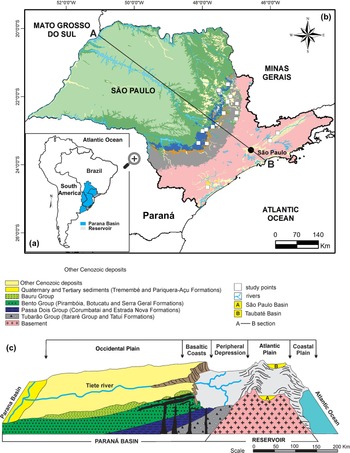
The main occurrences of plastic and superplastic clays in the state of São Paulo occur in sedimentary basins, particularly the Quaternary clays of valley floors in alluvial sediments and those associated with the sediments of Paraná, Taubaté and São Paulo, besides other small Cenozoic sedimentary basins (Fig. 1).
(a) Map of South America, with the Paraná Basin. (b) Simplified geological map of the state of São Paulo with the studied areas highlighted. (c) Geomorphological and geological section (A–B) of the state of São Paulo. Modified from Companhia de Pesquisa de Recursos Minerais (2006).

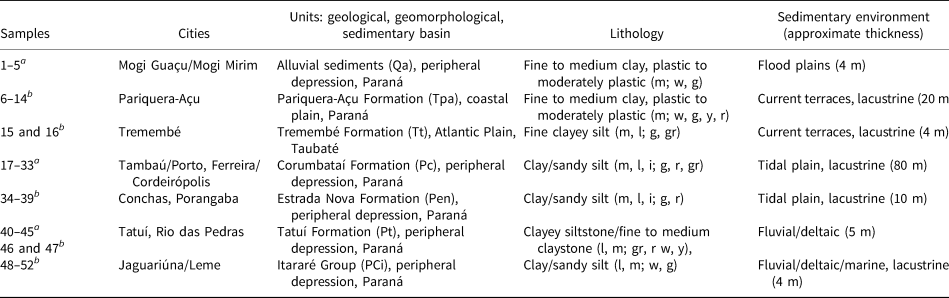
Based on previous knowledge (e.g. Motta, Reference Motta1991; Motta et al., Reference Motta, Tanno and Cabral1993; Christofoletti et al., Reference Christofoletti, Moreno and Batezelli2006a, Reference Christofoletti, Shimada and Nogueira2006b; Christofoletti & Rocha, Reference Christofoletti and Rocha2018), our prospecting of plastic and superplastic clays for the territory of São Paulo focused on the targets discussed in this section (Table 1).
Characteristics of the studied samples.

aActive mine.
bProspecting points.
Colours: g = grey; gr = green; p = purple; r = red; w = white; y = yellow.
Sedimentary structures: i = intercalated; l = laminated; m = massive.
Quaternary alluvial plains
The main deposits of white-firing plastic clays occur in the alluvial plains of rivers with meandering patterns, in the form of irregular pockets of varying dimensions, frequently intercalated with sandy banks (Cabral Jr et al., Reference Cabral, Motta, Mello, Tanno, Sintoni, Salvador and Chieregatti2001). Specifically, the traditional ball clay from São Simão in the Tamanduá river valley, used to produce sanitaryware, and the clays from the Pardo and Mogi Guaçu river basins are the main sources for the production of porcelain stoneware tiles, with typical deposits being those in the Aguaí and Mogi Mirim municipalities (Pressinotti, Reference Pressinotti1991; Thomazella, Reference Thomazella2003). Although most of the plastic clay production for porcelain stoneware tiles come from this geological environment through the exploitation of small deposits, the present study is focused on deposits from other environments, seeking alternatives of greater size and plasticity not available or researched previously in the alluvial plains.
Tertiary basins associated with the Continental Rift of Southeast Brazil
This Tertiary structural tectono-sedimentary unit, called by Almeida (Reference Almeida1976) the ‘Serra do Mar Rift System’ and redefined by Riccomini et al. (Reference Riccomini, Sant'Anna, Ferrari, Mantesso, Bartorelli, Carneiro and Brito Neves2004) as the ‘Continental Rift of Southeast Brazil’ (RCSB), includes important sedimentary records. These are rich in smectitic clays in the syntectonic phase and kaolinitic clays in the post-tectonic phase. The RCSB sedimentary records in São Paulo encompass the Taubaté and São Paulo basins and the Sete Barras Formation in the Ribeira Valley.
In this unit, the paralic facies of the Taubaté Basin, mainly the Tremembé Formation, were prioritized. The Tremembé Formation was initially defined by Almeida (Reference Almeida2018) and corresponds, in the current conception (Riccomini, Reference Riccomini, Sant'Anna, Ferrari, Mantesso, Bartorelli, Carneiro and Brito Neves2004), to a lacustrine system of the playa lake type, of Oligocene age, developed in the central portion of the Taubaté Basin, represented by fine-grained clayey siltstones, with a massive structure or with plane-parallel lamination.
The Pariquera-Açu Formation was redefined by Melo (Reference Melo1990) as a more recent Tertiary unit, which starts at the edges of the RCSB at the location represented by the Sete Barras Formation and extends downstream of the Ribeira River, highlighting a wide lacustrine facies in the vicinity of the city of Pariquera-Açu, where the lithological set is essentially represented by silty-clay plastic rocks of light colours (white, grey, green, yellow and reddish). Christofoletti et al. (Reference Christofoletti, Motta and Meneghel2022) described the geological, geochemical and ceramic characteristics of this unit in detail.
Paraná Basin
The Permian sediments of the Corumbataí, Estrada Nova, Tatuí and Permo-Carboniferous formations of the Itararé Subgroup stand out in the Paraná Basin. The Corumbataí and Estrada Nova formations belong to the Passa Dois Group and have essentially clayey characteristics and wide exposure in the state of São Paulo. They present facies composed of silty or silt-sandy rocks, with fine to medium granulometry, sometimes containing centimetric to metric intercalations of fine to medium-grained sand. Locally, carbonates may be present in their matrixes. The sedimentary structure varies from massive and laminated to rhythmic (Landim, Reference Landim1970; Sousa, Reference Sousa1985; Christofoletti et al., Reference Christofoletti, Moreno and Batezelli2006a, Reference Christofoletti, Shimada and Nogueira2006b, Reference Christofoletti, Batezelli and Moreno2015, Reference Christofoletti, Del Roveri and Zanardo2020; Warren et al., Reference Warren, Assine, Simões, Riccomini and Anelli2015).
The Tatuí Formation, exclusive to the state of São Paulo, is formed by a succession of fine sandstones and siltstones up to 60 m thick. Between these layers are conglomeratic levels of fluvio-deltaic origin (Assine et al., Reference Assine, Zacharias and Perinotto2003; Chahud, Reference Chahud2011). The Itararé Subgroup is described as a set of Permo-Carboniferous-age lithotypes deposited under glacial influence in various sedimentary environments. It is composed of diamictites, sandstones of variable particle-size distributions, siltstones, rhythmites, mudstones, claystones and shale intercalations, in addition to rare limestone and coal beds (Soares et al., Reference Soares, Landim, Sinelli, Wernick, Wu and Fiori1977; Milani et al., Reference Milani, Melo, da Souza, Fernandes and França2007). The main superplastic clay deposits occur in the Corumbataí and Tatuí formations and are present in the upper layers of these units in the form of alterites, which are more plastic and depleted in Fe2O3.
Materials and methods
For each study area, a base geological map was prepared, and complementary information was added to carry out the fieldwork, involving the evaluation of active and inactive mining, in addition to several study points in the selected targets. Prospecting was carried out through road walks, the description of outcrop points and the assembly of surface and subsurface sections with the support of manual augers and shallow drillings (up to 12 m). In these areas, description and characterization of the facies were performed, particularly regarding lithology, granulometry and sedimentary structure, following Miall (Reference Miall1994) and Walker (Reference Walker2006), proceeding via the elaboration of columnar profiles, photographic registration, georeferencing and sample collection for later reference in the laboratory.
Fifty-two samples were collected from various geological units (Fig. 1), and their characteristics are listed in Table 1. The samples were dried at 110°C, quartered, homogenized, ground and kept in plastic bags to be sent for laboratory analysis. Their physical and chemical properties were investigated using various methods.
The bulk and clay mineralogical compositions were determined using X-ray diffraction (XRD) with a PANalytical diffractometer (B.V. Lelyweg, Almelo, The Netherlands) using Ni-filtered Cu-Kα1 radiation (λ = 1.54056 Å), 30 mA and 40 kV, in the range 3–70°2θ with a step size of 5” per 0.02°. The phases present were identified using PANalytical's X'Pert Highscore Plus software and the International Centre for Diffraction Data (ICDD) PDF2 database. The clay fraction was separated by sedimentation according to Stokes’ law (Thiry, Reference Thiry1974), followed by centrifugation, placement on glass slides, natural drying, solvation with ethylene glycol for 48 h and heating at 500°C for 2 h.
The chemical composition was determined for samples fused with lithium metaborate using inductively coupled plasma optical emission spectrometry (ICP-OES) and inductively coupled plasma mass spectrometry (ICP-MS) in Labexchange (Burladingen, Germany). The ceramic technological analyses followed Brazilian norms (Associação Brasileira de Normas Técnicas, 1997) and were directed towards the evaluation of the production of semiporous coatings using the dry process and porcelain stoneware tiles using the dry and wet processes.
Initially, the samples were dried in the sun and/or in an electric oven, quartered, crushed and ground in a Servitech hammer mill equipped with a 1.0 mm sieve and sieved using an ASTM No. 35 mesh with a 0.5 mm opening. Subsequently, 60 × 20 × 5 mm3 specimens were shaped in a hydraulic press (CT320) under a pressure of 400 kgf cm–2 (Servitech Ltd, Tubarão, Santa Catarina, Brazil), followed by drying at 110°C and then firing in a laboratory oven at 1120°C for 20 min and at 1190°C for 35 min (Flyer, São Carlos, São Paulo, Brazil). Dry and fired apparent density, dry and fired flexural modulus of rupture (FMR), water absorption, apparent porosity, linear firing shrinkage (RLQ) and loss on ignition (LOI) were determined.
The cation-exchange capacity (CEC) and exchangeable cations (Na, K, Ca and Mg) were determined using the ammonium acetate method (Schollenberger & Simon, Reference Schollenberger and Simon1945; Mehlich, Reference Mehlich1948). The exchangeable cations extracted during NH4+ saturation were determined using atomic absorption spectrophotometry. The CEC of each sample results from the sum of exchangeable Na, K, Ca and Mg (meq 100 g–1).
Organic carbon (Corg) was measured according to Walkely & Black (Reference Walkley and Black1934). The Corg is oxidized in acidic medium (H2SO4) with 1.0 N potassium dichromate (K2CrO7), and the excess of this reagent is measured by titration with 0.5 N ferrous solution (FeSO4 or Fe(NH4)2(SO4)2). Those samples that were more suitable for the production of porcelain stoneware tiles were selected and submitted to particle-size distribution analysis by sedimentation using an X-ray SediGraph III Plus V1.00 analyser (Malvern Instruments Ltd, Worcestershire, UK). The specific surface area was determined using the Brunauer–Emmett–Teller (BET) method (Brunauer et al., Reference Brunauer, Emmett and Teller1938) by nitrogen adsorption with a Micromeritics Flowsorb II 2300 analyser (Norcross, GA, USA).
Results
Geology
The Quaternary (Qa) sediments are widely distributed in the studied valleys; the younger Tertiary sediments with the Pariquera-Açu (Tpa) formations and other similar geological units occur in irregular patches raised on the edges of valleys and interfluves. The oldest Tertiary basins are located in the RCSB, highlighting the Tremembé Formation (Tt). The size of the lenses or clay layers in the oldest units increases from 2 to >20 m. The clays have variable plasticity and are coloured grey to greenish, and they form massive and laminated sedimentary structures. According to Riccomini et al. (Reference Riccomini, Sant'Anna, Ferrari, Mantesso, Bartorelli, Carneiro and Brito Neves2004), these sediments were deposited in a lacustrine system of the playa lake type of Oligocene age. The sediments present in the Corumbataí (Pc), Estrada Nova (Pen), Tatuí (Pt) and Itararé (PCi) formations show more clayey and finer facies, generated in a low-energy depositional environment dominated by decantation processes, possibly in deep shallow or lacustrine shelf conditions in a continental basin (Soares et al., Reference Soares, Landim, Sinelli, Wernick, Wu and Fiori1977; Chang, Reference Chang1984; Sousa, Reference Sousa1985; Gama Jr et al., Reference Gama, Perinotto, Ribeiro and Padula1992).
These geological units are represented by silty or silt-sandy rocks, arranged in layers, with fine to medium granulometry and sometimes with centimetric intercalations of fine-grained sand, with a carbonate or silicate matrix in the upper layers. They display mainly massive, laminated and parallel-plane sedimentary structures and their colours have reddish, greenish and greyish tones.
The thicknesses of these deposits vary and can reach tens of metres in the upper layers. In Tatuí and Corumbataí in particular the sediments are altered, and plastic clays with finer granulometries and without sedimentary structures were preserved, giving rise to the formation of alterites.
Mineralogical analysis
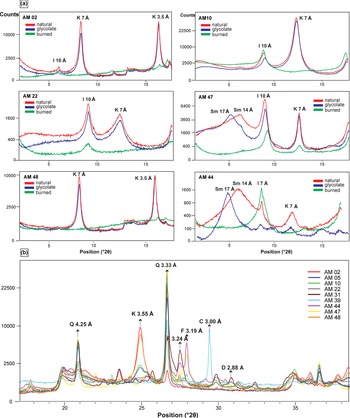
Figure 2 shows representative XRD traces of clay fractions and bulk samples that have been air dried, ethylene glycol solvated and heated at 550°C. Quartz is one a main component in all samples, followed by microcline. Among the non-silicate minerals, the carbonates, calcite and dolomite are more abundant in samples 36, 38 and 39 of the Estrada Nova Formation. The only oxide present was hematite, found relatively infrequently in the studied samples.
XRD traces of representative samples: (a) <2 μm fraction; (b) whole sample. C = calcite; D = dolomite; F = microcline; H = hematite; I = illite; K = kaolinite; Q = quartz; Sm = smectite.

The clay minerals identified were kaolinite, illite and smectite, coexisting in most samples, with kaolinite being the most abundant in all samples. The second most frequent was illite, especially in the rocks of the Corumbataí Formation. Smectite occurred in only a few samples, being more abundant in the Tatuí Formation, especially in samples 44 and 47, and in the Corumbataí Formation (samples 24 and 33). Mixed-layer illite/smectite was also detected in some samples.
Lithogeochemical characteristics
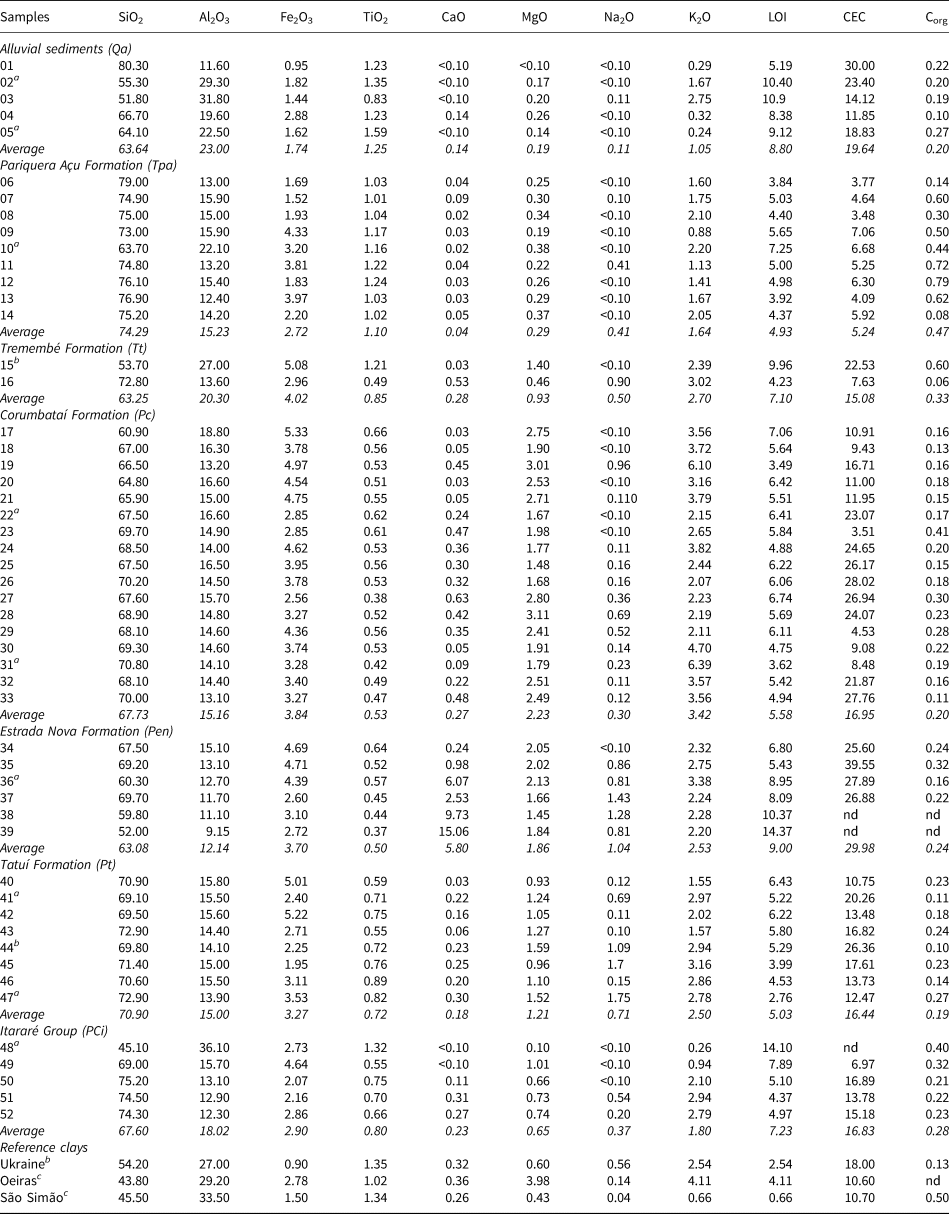
Table 2 presents the major elemental chemical compositions, CECs and Corg values of the studied and reference samples.
Major element chemical composition (wt.%); CEC (meq 100 g–1) and Corg (wt.%).

aSelected samples for complementary analyses.
bReference clays for porcelain stoneware tiles.
cReference ball clays for sanitaryware.
nd = not determined.
SiO2 is the main chemical constituent, followed by Al2O3, and Fe2O3; Na2O, K2O, CaO and MgO are present in variable amounts (Table 2). In the Quaternary and Tertiary alluvial sediments of the Pariquera-Açu and Tremembé formations, the SiO2 content of the samples varies between 63.2 and 74.2 wt.% and the Al2O3 content varies from 15.2 to 23.0 wt.%, with those from the Pariquera-Açu Formation being more SiO2-rich and more Al2O3-rich Quaternary alluvial sediments. Except for the Tremembé Formation, the Cenozoic sediments studied can be characterized as refractory and Si–Al-rich, consisting essentially of kaolinite and quartz. The alkali and alkaline earth element oxides (Na2O, K2O, CaO and MgO) that are considered fluxing elements show low abundances in the Quaternary sediments and slightly greater abundances in their Tertiary counterparts, averaging 1.49 and 2.38 wt.%, respectively. The chromophore oxides (Fe2O3 and TiO2) are less abundant. The abundances of Fe2O3 and TiO2 are 1.74 and 1.25 wt.%, respectively, in the Quaternary alluvial sediments, 2.72 and 1.10 wt.%, respectively, in the Pariquera-Açu Formation and 4.00 and 0.85 wt.%, respectively, in the Tremembé Formation. The Pariquera-Açu Formation had the smallest CEC value of (5 meq 100 g–1) among the studied sediments, and a Corg value of 0.5 wt.% which was the greatest.
The Permian and Permo-Carboniferous Corumbataí, Estrada Nova and Tatuí formations and the Itararé Group have different chemical compositions from the more recent sediments, with SiO2 and Al2O3 remaining the most frequent constituents. In the Corumbataí Formation, 17 samples were selected based on the abundance of Fe2O3, with a maximum Fe2O3 content of 5 wt.%. These samples had an average SiO2 content of 67.7 wt.%, Al2O3 of 15.2 wt.%, K2O of 3.4 wt.%, Na2O of 0.3 wt.%, MgO of 2.2 wt.% and Fe2O3 of 3.8 wt.%; some samples from the superplastic clay mining fronts of Mina Fazendinha in the city of Porto Ferreira had a lower Fe2O3 content (~3 wt.% in samples 22 and 23).
The clays from the Corumbataí Formation are the most fluxing clays among the studied targets due to the frequent presence of illite, albite and microcline. Occasionally, the K2O content exceeds 6 wt.%, providing special fluxing behaviour, and even more so when this is associated with a great content of Fe2O3. The presence of iron facilitates fluxing in the ceramic specimens, but large Fe2O3 contents limit their use, especially in the production of porcelain stoneware tiles, due to the reddish colour obtained after firing.
The CEC of the studied clays varied between 25 meq 100 g–1 (samples 22 and 24 from Mina Fazendinha) and 5–15 meq 100 g–1. In addition, Corg averaged 0.2 wt.%.
In the Estrada Nova Formation, the SiO2 and Al2O3 contents were lower (63 and 12 wt.%, respectively) due to carbonate enrichment (CaO and MgO) in some facies at average values of 5.8 and 1.9 wt.%, respectively. The mean value of Fe2O3 was 3.7 wt.%, that of K2O was 2.5 wt.% and that of Na2O was 1.0 wt.%. The mean CEC was 30 meq 100 g–1, the highest among all the targets studied, and that of Corg was ~0.25%.
The samples from the Tatuí Formation had average values of 70.0 wt.% SiO2, 15.0 wt.% Al2O3, 2.5 wt.% K2O and 1.0 wt.% MgO. The Fe2O3 and TiO2 contents are relatively high for use in porcelain stoneware tiles, exceeding 3 and 1 wt.%, respectively. However, locally there exist layers with Fe2O3 contents of between 2 and 3 wt.% (e.g. samples 43, 44 and 45 from the Santa Adelaide Mine in the Tatuí municipality). The mean CEC value was 16.44 meq 100 g–1, but sample 44 had a CEC of 26 meq 100 g–1. Corg presented a mean value of 0.19%.
Finally, in the Itararé Subgroup sediments, the five samples analysed were identified as alterites. The sediments, originally rich in chlorite and illite, were physically and chemically weathered. Samples 48 and 49 are kaolinized and poor in alkalis, with sample 48 being more clayey, representing essentially kaolin, with 45 wt.% SiO2, 36 wt.% Al2O3 and 14 wt.% LOI, and sample 49 having more sandy characteristics. The remaining samples, located in the meandering organic Quaternary fluvial sediments of the valley floor, show a greenish colour and are probably enriched in smectite, with Fe2O3 contents of ~2.0 wt.%, Al2O3 contents of 13.0 wt.%, SiO2 contents of 75.0 wt.%, K2O contents of 2.5 wt.%, a CEC of ~15 meq 100 g–1 and a low Corg of 0.2 wt.%.
The Corg is linked directly to the plasticity index, but values >0.5% can lead to defects in the finished product, such as bubbles and black hearts (Barba et al., Reference Barba, Beltrán, Felíu, Garcia-Ten, Ginés, Sánchez and Sanz2002). In the studied samples, the greatest mean Corg value was found in the sediments of the Pariquera-Açu Formation (0.5 wt.%), followed by the Tremembé Formation (0.3 wt.%).
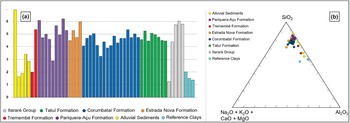
The SiO2/Al2O3 ratio varies between 4 and 6 in samples with moderate clay contents. Samples 02, 03, 27 and 48 with great clay contents have SiO2/Al2O3 ratios of 0–2, comparable to the reference samples (Fig. 3a). When plotted in the ternary diagram (SiO2)/(NaO2 + K2O + CaO + MgO)/(Al2O3), most samples are projected close to the SiO2–Al2O3 axis, suggesting that they are refractory, being composed essentially of quartz and kaolinite (Fig. 3b). Samples from the alluvial sediments are more aluminous and are projected close to the reference samples, whereas samples from the Corumbataí and Estrada Nova formations are more fluxing, plot far from the SiO2–Al2O3 axis.
(a) SiO2/Al2O3 ratios and (b) (SiO2)/NaO2 + K2O + CaO + MgO)/(Al2O3) ternary diagram of the studied samples and reference clays.

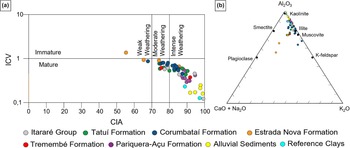
The relationships between the Index of Compositional Variability (ICV), Chemical Index of Alteration (CIA) and Chemical Index of Weathering (CIW) were used to assess sediment maturity and weathering intensity (Fig. 4; Long et al., Reference Long, Yuan, Sun, Xiao, Wang, Cai and Jiang2012). Most clays are texturally mature, with moderate to intense weathering, except for two samples from the Estrada Nova Formation that plot as immature rocks with limited weathering. In the ternary diagram (Al2O3)/(CaO + Na2O)/(K2O) (Nesbitt & Young, Reference Nesbitt and Young1989, Reference Nesbitt and Young1982), used to access the weathering trend, most samples plot close to the Al2O3–K2O axis and close to the Al2O3 vertex, proving the great abundance of kaolinite (Fig. 4b).
Classification diagrams of the degree of weathering of the source rocks and the textural and chemical maturity of the sediments in the study areas. (a) CIA vs ICV diagram (Nesbitt & Young, Reference Nesbitt and Young1982, Reference Nesbitt and Young1989). (b) (Al2O3)/(CaO + Na2O)/(K2O) ternary diagram of molecular proportions.

Technological properties
The observed variation in the technological properties resulted mainly from the variations in the chemical, mineralogical and granulometric compositions of the clayey sediments, in part due to their various formation environments and to the tectono-sedimentary evolution and surface dynamics. Among the clay properties assessed in studies of plastic and superplastic clays for ceramic production, the plasticity of the raw and dry samples and clay fluxing are key. These parameters are indicated by the dry and fired proof-body characteristics, including water absorption (WA), FMR, RLQ and apparent bulk density (AD).
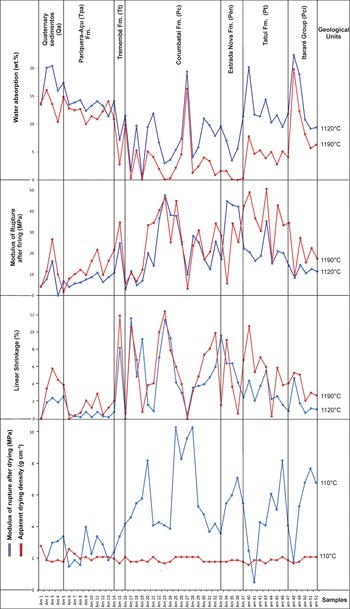
Figure 5 displays the ceramic properties of the samples. The lowest WA values were determined in samples from the Corumbataí, Estrada Nova and Tatuí formations, namely 0–5 wt.% at 1190°C and 0.1–11.9 wt.% at 1120°C, except for sample 27 of the Corumbataí Formation and samples 40 and 43 of the Tatuí Formation, which displayed greater WA values. The greatest mean WA values were observed in the Quaternary and Tertiary alluvial sediments of the Pariquera-Açu and Tremembé formations (10.0–16.1 wt.% at 1190°C and 12.4–20.4 wt.% at 1120°C, respectively), except for sample 15 from the Tremembé Formation, which showed greater fluxing behaviour due to the greater abundance of alkali oxides.
Technological properties of the studied samples.

The samples from the Corumbataí, Estrada Nova and Tatuí formations displayed more efficient sintering and developed FMR values mostly between 13 and 50 MPa after firing at 1120°C and 1190°C, respectively, with the Corumbataí and Estrada Nova formations standing out, displaying mean FMR values of 22.2 and 25.8 MPa and of 22.2 and 25.8 MPa at these temperatures, respectively. The lowest FMR values were obtained in the Tertiary sediments of the Pariquera-Açu Formation (4.1–10.8 MPa at 1120°C and 8.0–27.0 MPa at 1190°C), followed by Quaternary samples (4.4–16.3 MPa at 1120°C and 4.4–26.7 MPa at 1190°C) and the Itararé Group (8.4–14.4 MPa at 1120°C and 9.6–27.3 MPa at 1190°C).
The RLQ displayed a clear trend with the FMR, with the greatest values observed in samples from the Corumbataí Formation (0.5–11.6% at 1120°C and 0.8–12.4% at 1190°C). The lowest RLQ values were recorded in samples from the Pariquera-Açu Formation (0.2–0.8% at 1120°C and 0–0.9% at 1190°C), with mean values of 5.6% and 5.7% and of 0.5% and 1.3% at these temperatures, respectively.
The average values of AD and FMR of the dry bodies were greater in specimens from the Corumbataí and Estrada Nova formations (1.9 and 1.8 g cm–3 and 5.9 and 6.0 MPa, respectively), leading to greater resistance to the transport of the pieces in the manufacturing process. These properties are due to the good particle-size distribution and the great plasticity of the clays, with the latter being linked to the greater abundance of swelling clay minerals. The lowest values of AD and FMR were recorded in the Quaternary and Tertiary alluvial sediments of the Pariquera Açu Formation, with mean values of 1.8 and 2.9 g cm–3 and 2.4 and 2.8 MPa, respectively (Fig. 5).
Permo-Carboniferous clays, especially those found in the Corumbataí Formation, have become a global reference raw material in the production of semiporous coatings using the dry process, as they have fine melting characteristics and well-sorted granulometry. The very fine superplastic clayey facies at the bottom of current valleys or at plateau levels in the form of alterites occurred mostly in the Corumbataí and Tatuí formations, as well as in the Itararé Subgroup, and they are being used successfully for the production of glazed porcelain stoneware tiles.
The Quaternary (Qa) and Tertiary (Tpa) alluvial clays, due to their more refractory and siliceous characteristics, presented greater WA values and lower FMR and fluxing oxide values, limiting their use as single raw materials in porcelain stoneware tile production. Nevertheless, their great dry AD and light firing colour in some samples are favourable for manufacture of porcelain stoneware tiles.
Particle-size distribution
The granulometric distribution of clays is a determining factor in their suitability for various applications, and particular attention should be paid to the finer fraction (<2 μm) for ceramic products (Mahmoudi et al., Reference Mahmoudi, Srasra and Zargouni2008). Particle shape is a fundamental property of powders, which affects packing and therefore bulk density, porosity, permeability, cohesion, fluidity and agglomeration behaviour (Heyd & Dhabbar, Reference Heyd and Dhabbar1979).
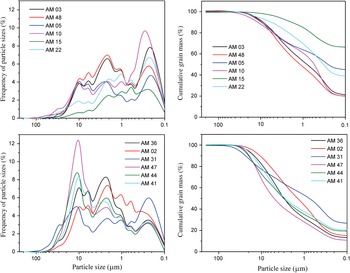
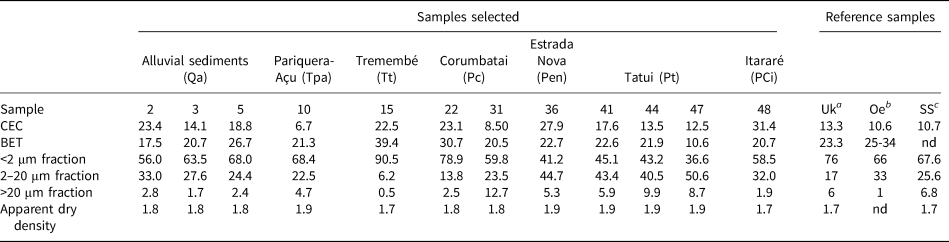
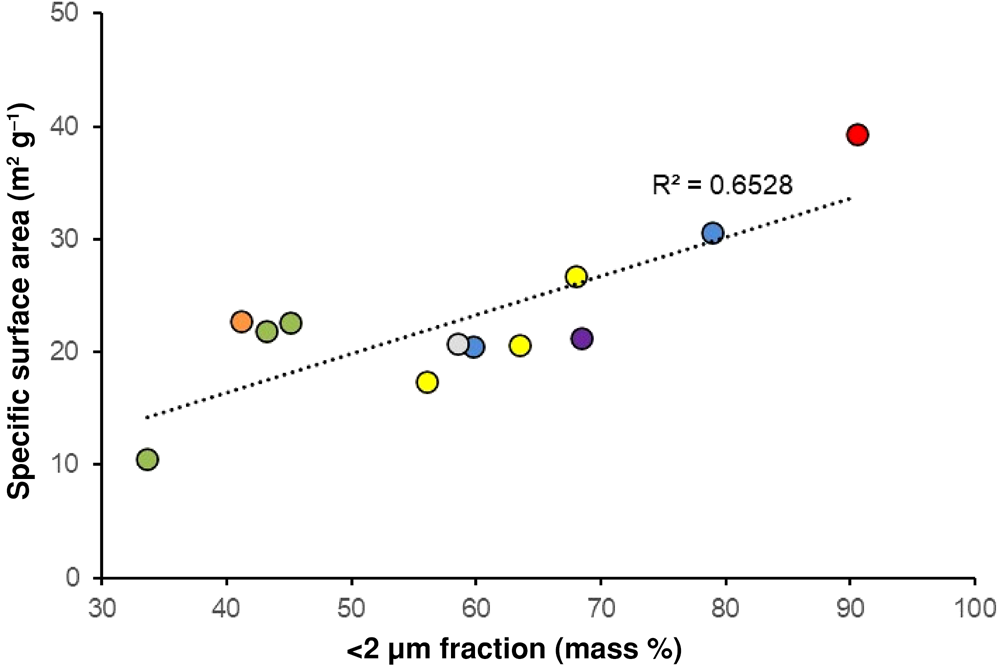
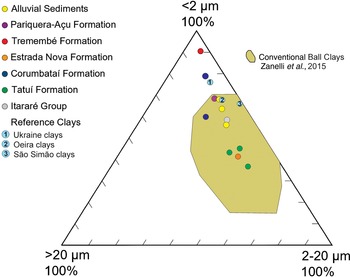
Figure 6 and Table 3 indicate the granulometric distributions of the most plastic samples. Samples 3, 5, 10, 15, 22 and 48 have a finer particle size and samples 2, 31, 36, 41, 44 and 47 have a coarser particle size. The samples with finer particle sizes had particles <2 μm at 58.5–90.5%, 2–20 μm at 6.2–32.0% and >20 μm at 0.5–1.7%. In the samples with coarser particle sizes, 36.6–41.2% of the particles were <2 μm in size, 23.5–33.0% of the particles were 2–20 μm in size and 2.8–12.7% of the particles were >20 μm in size. The particle sizes are correlated with the specific surface area (BET), with the greatest specific surface area values observed in samples with greater concentrations of the <2 μm fraction (Fig. 7). Most samples are projected in the field of conventional ball clays (Fig. 8), with one sample from the Tremembé Formation and one from the Corumbataí Formation plotted close to the <2 μm vertex, indicating a very fine granulometry comparable to the Ukrainian ball clays (Zanelli et al., Reference Zanelli, Iglesias, Dominguez, Gardini, Raimondo, Guarini and Dondi2015).
Particle-size analysis using a laser sedigraph. The top two graphs show samples with greater concentrations of the <2 μm fraction; the bottom two graphs show samples with lesser concentrations of the <2 μm fraction.

Complementary characterization of the selected samples.

CEC measured in meq 100 g–1, BET specific surface area measured in m2 g–1, particle sizes analysed using a laser sedigraph measured in % and density measured in g cm–3.
Samples 2 and 3 are from Santa Luzia Mine, Aguai, São Paulo; sample 5 is from Piteira Mine, Mogi Mirim, São Paulo; sample 22 is from Fazendinha Mine, Porto Ferreira, São Paulo; sample 41 is from Irapuá Mine; and sample 44 is from Santa Adelaide Mine, Tatuí, São Paulo.
nd = not determined; Oe = Oeiras; SS = São Simão; Uk = Ukraine.
aData from Dondi et al. (Reference Dondi, Raimondo and Zanelli2014).
bData from Motta et al. (Reference Motta, Tanno and Cabral1993) and Alcântara et al. (Reference Alcântara, Teixeira, Marques, Oliveira, Santos Junior and Matos2007).
cData from Cardoso et al. (Reference Cardoso, Santos, Coelho and Santos1998).
Correlation between the <2 μm fraction and the specific surface area of the samples.

Projection of the studied clays in the diagram of Winkler (Reference Winkler1954).

Discussion
The Quaternary alluvial sediments of the current plains and in the Tertiary Cenozoic of the Pariquera-Açu and Tremembé formations are composed of plastic or moderately plastic clays, with colours varying from greenish to greyish light to white tones, with notable reddish spots in the Pariquera-Açu Formation (Tpa). In the ternary diagram (SiO2)/(NaO2 + K2O + CaO + MgO)/(Al2O3), most of these samples are projected close to the SiO2/Al2O3 axis and have a refractory character due to the predominance of quartz and kaolinite. Minor illite is also present in the Pariquera-Açu (Tpa) formation (Fig. 3b). The clays from the Corumbataí and Estrada Nova formations are more fluxing due to the presence of illite minerals and feldspar. These samples are plotted far from the SiO2/Al2O3 axis (Fig. 3b) and display intense weathering and grain maturity (Fig. 4).
In the Tremembé Formation, the clays are finer, with a greenish colour and with a greater contribution of illite and K2O (2.7 wt.%). Minor microcline, calcite and hematite are also present, with microcline being a significant component in some plains in the north-east of the state, sometimes increasing the K2O content. The Fe2O3 content is ~2.0 wt.%, especially in the samples of Quaternary (Qa) and Tertiary sediments from the Pariquera-Açu Formation (Tpa), which guarantees a clear colour in the post-firing product.
The Permian and Permo-Carboniferous sediments of the Paraná Basin, present in the Corumbataí, Estrada Nova, Tatuí and Itararé formations, were generated in a sedimentary environment of low deposition energy in an intracratonic basin of large spatial amplitude, resulting in finer facies, represented by silty or silt-sandy rocks with fine to medium granulometry. Sometimes the sediments show centimetric to metric intercalations of fine to medium-grained sand and massive or laminated structures, with thicknesses of ~20 m being common. In one particular geomorphological situation, the alterites formed by supergene enrichment of kaolinite, with contribution from smectite, via in situ transformation from other Al-silicates (mainly clay minerals) occurring in higher positions of preserved plateaus or at the bottom of current valleys under alluvial sedimentation. They were fine-grained, plastic and had variable colours, with a predominance of greenish, whitish and greyish tones.
The Permian and Permo-Carboniferous sediments differ from the Quaternary and Tertiary alluvial sediments in their greater presence of K2O, Na2O, MgO and CaO, particularly in samples from the Corumbataí Formation, where K2O averaged 3.43 wt.% and MgO averaged 2.23 wt.%. The latter sediments also have lower chromophore oxide contents and sometimes lower smectite contents.
The samples from the Estrada Nova Formation had great average CaO and MgO contents (5.80 and 1.86 wt.%, respectively). The abundance of Fe2O3 is greater in these samples, ranging from 2.90 to 3.94 wt.%. The mineral composition of these samples varies among the units of the Paraná Basin. Quartz is the dominant mineral present, and microcline or albite feldspar, calcite, dolomite and hematite are present in some samples from the Corumbataí and Estrada Nova formations. Kaolinite and illite are the main clay minerals, with illite being predominant in the Corumbataí Formation rocks. Smectite is present, especially in alterites.
The chemical and mineralogical characteristics are reflected in the samples’ technological behaviour. The finer granulometry and flux composition enabled an improved response to the drying process and to the firing process at the two temperatures to which the samples were submitted, allowing for more efficient sintering. This in turn resulted in low WA and AD values and high FMR and RLQ values.
In the younger Cenozoic sediments (Qa and Tpa), the fired clays showed low FMR values, probably associated with greater kaolinite contents and sometimes greater quartz contents. However, the older Tertiary clays (Tt) and the Palaeozoic mudstones are more easily melted, with the fired specimens having high mechanical strength, attributed to the greater presence of illite and feldspar in addition to the finer granulometry.
The samples from the Corumbataí, Estrada Nova and Tatuí Formations displayed the best characteristics. However, due to their greater Fe2O3 contents, the firing colours were darker, varying from light grey and light brown to dark and light red. In the alterites of the Tatuí and Corumbataí formations, lower AD values were observed due to weathering alteration and leaching, resulting in a finer granulometry.
Regarding the firing colour, the white firing clays contain in principle <1 wt.% Fe2O3, whereas some clays contain up to ~4 wt.% Fe2O3. Although showing darker colourations, they can still be used for porcelain stoneware tiles when they benefit some of the properties of the ceramic mass, especially its dry mechanical strength and fusibility.
The particle-size distribution analyses of the silty clay sample fraction indicate that the Tertiary clays of the Tremembé Formation are the finest, with a great abundance of the <2 μm fraction, followed by the Corumbataí Formation clays and other Cenozoic clays. These clays presented a finer granulometry, confirmed by their greater BET specific surface areas. Therefore, these clays are more plastic, but the plasticity of the Quaternary clays (measured in FMR) is not sufficient to impart the necessary mechanical resistance to the raw specimens, which requires superplastic clays. The great plasticity is confirmed by the greater CEC and Corg values of these samples. The alteritic clays in the Permian and Permo-Carboniferous sediments, due to intense weathering and leaching, show greater plasticity, associated with the greater smectite content and with the depletion of colouring oxides.
A very important technological property of clays for the manufacture of porcelain stoneware tiles is their plasticity, which, when combined with great fusibility and a light firing colour, creates the ideal final product. One of the best examples of this is represented by the clays from the Donetsk Basin, Ukraine (Dondi et al., Reference Dondi, Guarini, Raimondo and Salucci2003; Galos, Reference Galos2011a, Reference Galos2011b).
The plastic ball clays from the state of São Paulo are detrital and are related to the current alluvial plains, with kaolinite being the only clay mineral present (Motta et al., Reference Motta, Tanno and Cabral1993). Additionally, some Late Tertiary sedimentary formations would also be compatible with kaolins of detrital origin. In addition to these environments, other plastic clay deposits could be related to alterites, such as older sediments that were subject to mineralogical transformation in the post-depositional evolution of the sedimentary basins.
The Quaternary sediments at the alluvial plains are rich in kaolinite, associated with non-clay minerals such as quartz and feldspar. In the main types of ores studied, the SiO2 contents in samples 2, 3 and 5 ranged from 52 to 65 wt.%, Al2O3 ranged from 20 to 30 wt.% and Fe2O3 ranged from 0.9 to 1.8 wt.%. The alkali oxide content is very low, except for in sample 3, with 2.7 wt.% of K2O resulting from potassium feldspar in the silt-sandy fraction.
In the search for alternatives to kaolinite detrital deposits, this study investigated the Pariquera-Açu Formation (Tpa), where there is an expressive Upper Tertiary lacustrine basin composed of clayey-silty-sandy sediments, ~20 m thick, grey in colour and showing rust stains. Samples 6–14 (Table 2) contain, on average, 75.0 wt.% SiO2, 15.0 wt.% Al2O3, 1.6 wt.% K2O and 2.7 wt.% Fe2O3, with a predominance of kaolinite and, subordinately, illite, in addition to variable quartz contents in the sand and silt fractions. In the ceramic tests, these clays presented FMR values in the order of 2.5 MPa, WA values of 10 wt.% and generally light firing colours (beige, grey, brown) when submitted to firing at 1190°C. The clays presented a good particle-size distribution and could be alternatives in the supply of plastic clays, especially for producing glazed porcelain stoneware tiles.
In the Tremembé Formation, facies composed of thin, light green, laminated layers were selected, intercalated with fine-grained sandstone layers. Sample 15 showed the best result, with great plasticity, very fine granulometry, WA of 3 wt.%, FMR of 3.4 MPa and light brown post-firing colour at 1190°C.
In the Permo-Carboniferous rocks of the Paraná Basin, the main clay varieties were alterites, which presented the best performance. These strata are positioned at the top levels of plateau sectors and were preserved at the bottom of current valleys under the recent sedimentation of alluvial plains.
In Porto Ferreira municipality, Fazendinha Mine is located in the Mogi Guaçu river alluvial plain, providing one of the reference clays used in this study. This clay is used as a raw material in the ceramic industry. Currently, this is the main superplastic clay deposit in São Paulo. In this mine, there is a large clay lens at the top of the Corumbataí Formation (Pc), with a thickness of up to 5 m and great plasticity. Samples 22–24 developed FMR values of ~4 MPa and had a relatively low Fe2O3 content (2.7 wt.%), high fluxing capacity and light brown firing colour at 1190°C.
Additional occurrences of reference superplastic clays in São Paulo State are in Santa Adelaide Mine (samples 43–45), Irapuá Mine (samples 46 and 47), in the city of Tatuí and in the preserved plateau of the Tatuí Formation sector (Pt) at 600 m altitude. The clays are composed of layers of massive to laminated siltstones and they are plastic, whitish and >5 m thick, found under a thick reddish alteration mantle. These clays showed similar characteristics to those of Porto Ferreira but are less fluxing.
The Permo-Carboniferous clayey sediments of the Itararé Subgroup (PCi), in the region of the city of Leme and under the Mogi Guaçu river alluvial plain, were assessed and an alterite layer was detected. The sediments showed good chemical, mineralogical and ceramic properties (samples 50–52). However, the thickness of this layer is limited and did not exceed 1 m.
A clay of the Tatuí Formation (Pt), located in the city of Rio das Pedras at altitudes a little above 600 m, is considered as an alternative to superplastic clays. Samples 46 and 47 showed an expressive layer of illitic siltstones beneath a mantle of alteration with smectite, with Fe2O3 contents of 3.1 and 2.8 wt.%, respectively, FMR of 4 MPa, WA of 4% and a light brown firing colour at 1190°C.
Other Permian sequences studied in the Paraná Basin, especially in plateau terrains, were the Corumbataí (Pc), Estrada Nova (Pen) and Itararé Subgroup (PCi) formations. However, the remaining sites of these units were not related to well-preserved and defined plateau levels, but they are probably linked to Neogene erosion surfaces, correlated to the occurrences in Tatuí and Rio das Pedras municipalities in the state of São Paulo.
Conclusion
This work focused on the geological features of clays and on the evaluation of their use as ceramic raw materials for porcelain stoneware tile production, thus providing a better understanding of the genesis of these deposits, as well as regarding the prospects for the discovery of new deposits that could increase supply. We identified clays with plastic and superplastic characteristics, which affect their applicability for the production of porcelain stoneware tiles and stoneware.
The plastic and superplastic clay deposits showed variations in their mineralogical, chemical, physical and technological properties. These variations originate from the variable depositional environments, as well as from post-depositional processes, either due to tectono-sedimentary evolution or to weathering followed by leaching.
In São Paulo State, two main types of clay occurrences were recognized: a detrital synsedimentary type, which can also be called plastic clay, with kaolinite as the main detrital clay mineral; and an alterite type, associated with the transformation of originally illitic lithified siltstones, with reddish firing and superplastic fluxing clays, generally consisting of illite, kaolinite and smectite, in addition to occasional amorphous phases.
The synsedimentary detrital deposits are Quaternary alluvial sediments and Neogene sediments in the Pariquera-Açu and Tremembé formations. These alluvial environments host the main plastic clay mines in São Paulo State, characterized by 2–3 m thick clayey kaolinite lenses, concentrated mainly in the meandering alluvial plains in the north-east of the state, such as the geomorphological province of the Paulista Peripheral Depression, but they also occur in similar plains of the crystalline plateau. The Neogene formations constitute a new alternative for plastic clay reserves, as they were observed in the Pariquera-Açu Formation as an extensive lacustrine basin with a clayey pack >10 m in the southern part of the state.
The deposits formed by alteration (alterites) in the Permo-Carboniferous Corumbataí, Estrada Nova and Tatuí formations and the Itararé Group occur at the bottom of current valleys and in preserved plateau sectors. These deposits resulted from the mineralogical and chemical transformation of mainly illitic lithified sediments into kaolinite and smectite, associated with depletion of Fe2O3. The sediments show fluxing behaviour and incorporate important superplastic characteristics for porcelain stoneware tile masses.
This research revealed new occurrences of sediments corroborating the hypothesis of the alterites model, and this raises the possibility of extending the two alterite subtypes to new areas of Ancient Tertiary sediments in the Taubaté Basin and especially in the Paraná Basin Permian sediments. Additional studies are recommended in both types, and especially in alterites, to help us to understand their geological/geomorphological aspects, as well as to provide greater precision to prospective guides and improved knowledge of the chemical, physical and mineralogical characteristics of these clays and their ceramic properties, thereby contributing to the prospecting for clay raw materials used in the formulation of porcelain stoneware tile masses.
Financial support
This work was financed by FAPESP – Fundação de Amparo à Pesquisa do Estado de São Paulo, Process n° 2019-02899-7, project ‘Plastic and Superplastic Clays Characterization as a Source of Raw Material for Mass Composition in the Porcelain Stoneware Tiles Production in the State of São Paulo’.
Conflicts of interest
The authors declare none.