Introduction
Affective disorders are severe, chronic disorders associated with a reduced life expectancy due to an increased risk of medical comorbidity (Osborn et al., Reference Osborn, Levy, Nazareth, Petersen, Islam and King2007; Kemp et al., Reference Kemp, Gao, Chan, Ganocy, Findling and Calabrese2010; Kessing et al., Reference Kessing, Vradi and Andersen2015; Patten et al., Reference Patten, Williams, Lavorato, Wang, Jette, Sajobi, Fiest and Bulloch2018). Metabolic syndrome (MetS) is a cluster of risk factors characterized by obesity, high blood pressure, lipid and glucose dysregulation which together mediate an increased risk of diabetes type 2 and cardiovascular disease (CVD) (Zerati et al., Reference Zerati, Monteiro Guimaraes, Miranda De Carvalho, Saes, Ragazzo, Wolosker and De Luccia2014). Patients with affective disorders have an increased risk of MetS compared with the general population (Czepielewski et al., Reference Czepielewski, Daruy Filho, Brietzke and Grassi-Oliveira2013; Vancampfort et al., Reference Vancampfort, Correll, Wampers, Sienaert, Mitchell, De Herdt, Probst, Scheewe and De Hert2014; Vancampfort et al., Reference Vancampfort, Stubbs, Mitchell, De Hert, Wampers, Ward, Rosenbaum and Correll2015) and although the exact pathophysiology of this relationship is unknown, several interacting pathways seem to contribute to the overlap between the conditions, including proximal risk factors such as diet and physical activity influencing risk phenotypes e.g. obesity, low-grade inflammation and disturbances in the regulation of oxidative stress (Rethorst et al., Reference Rethorst, Bernstein and Trivedi2014; de Melo et al., Reference de Melo, Nunes, Anderson, Vargas, Barbosa, Galecki, Carvalho and Maes2017; Baghai et al., Reference Baghai, Varallo-Bedarida, Born, Hafner, Schule, Eser, Zill, Manook, Weigl, Jooyandeh, Nothdurfter, Von Schacky, Bondy and Rupprecht2018). Further, increased levels of peripheral inflammatory markers (Munkholm et al., Reference Munkholm, Brauner, Kessing and Vinberg2013; Fernandes et al., Reference Fernandes, Steiner, Molendijk, Dodd, Nardin, Goncalves, Jacka, Kohler, Karmakar, Carvalho and Berk2016; Kohler et al., Reference Kohler, Freitas, Maes, De Andrade, Liu, Fernandes, Stubbs, Solmi, Veronese, Herrmann, Raison, Miller, Lanctot and Carvalho2017) and oxidative generated damage to lipids, proteins, DNA and RNA (Maes et al., Reference Maes, Galecki, Chang and Berk2011; Brown et al., Reference Brown, Andreazza and Young2014; Munkholm et al., Reference Munkholm, Poulsen, Kessing and Vinberg2015) seem associated with affective disorders. Although not included in the diagnostic criteria for MetS, insulin resistance is considered a key factor for MetS, and has been suggested to be associated with affective disorders (Ramasubbu, Reference Ramasubbu2002; Guha et al., Reference Guha, Bhowmick, Mazumder, Ghosal, Chakraborty and Burman2014). Another contributor to low-grade inflammation is obesity (Visser et al., Reference Visser, Bouter, Mcquillan, Wener and Harris1999; Kiliaan et al., Reference Kiliaan, Arnoldussen and Gustafson2014). Both obesity and affective disorders have a heritable element with heritability estimates of 50–90% for obesity (Stunkard et al., Reference Stunkard, Foch and Hrubec1986; Hebebrand et al., Reference Hebebrand, Friedel, Schauble, Geller and Hinney2003), 60–85% for bipolar disorder and 31–42% for unipolar disorder (Sullivan et al., Reference Sullivan, Neale and Kendler2000; Smoller and Finn, Reference Smoller and Finn2003; Kendler et al., Reference Kendler, Aggen and Neale2013). Further, genetic studies emphasize a genetic overlap between obesity and affective disorders (Afari et al., Reference Afari, Noonan, Goldberg, Roy-Byrne, Schur, Golnari and Buchwald2010; Jokela et al., Reference Jokela, Elovainio, Keltikangas-Jarvinen, Batty, Hintsanen, Seppala, Kahonen, Viikari, Raitakari, Lehtimaki and Kivimaki2012; Samaan et al., Reference Samaan, Anand, Zhang, Desai, Rivera, Pare, Thabane, Xie, Gerstein, Engert, Craig, Cohen-Woods, Mohan, Diaz, Wang, Liu, Corre, Preisig, Kutalik, Bergmann, Vollenweider, Waeber, Yusuf and Meyre2013).
Inflammation and oxidative stress have been investigated as trait or state markers in affective disorders in prior studies, but these markers have seldom been explored as risk markers in high-risk study design. Although only longitudinal studies can make conclusions of causality, a high-risk study including monozygotic twins (MZ) is a unique way to investigate potential risk factors, as unaffected twins from discordant twin pairs have a high familial risk of getting the same disease as their affected co-twin given their identical genes.
In the present high-risk study, we included a sample of MZ twins who were either (i) affected twins (both twins with a prior diagnosis of unipolar or bipolar disorder) and (ii) high-risk twins (affectively healthy twins with an affected co-twin) and low-risk twins (both twins with no personal or family history of affective disorder). The primary aims were to compare the prevalence of (1) metabolic syndrome and (2) levels of inflammatory markers, and (3) oxidative stress levels between the three groups. An additional aim was to investigate the associations between MetS and the levels of inflammatory markers and oxidative stress.
We hypothesized that the prevalence of MetS and the levels of inflammatory markers and oxidative stress would be highest in the affected group and present to a lesser degree in the high-risk group and lowest in the low-risk group. We further hypothesized that inflammatory markers and markers of oxidative stress would be associated with MetS.
Method
Participants and recruitment
Monozygotic twins were identified in this population-based study, through a nationwide record linkage of The Danish Twin Registry (DTR), The Danish Psychiatric Central Research Center (DPCRR) and The Danish Civil Registration System (for further details see Ottesen et al., Reference Ottesen, Meluken, Scheike, Kessing, Miskowiak and Vinberg2018).
The record linkage identified MZ twins who were affected (diagnosed with unipolar or bipolar disorder according to ICD-10, DF30-39 criteria between 1995 and 2014), their unaffected high-risk co-twin and a group of low-risk twin-pairs. The twins were included if the diagnosis was confirmed by a face to face schedules for clinical assessment in neuropsychiatry (SCAN) interview (Wing et al., Reference Wing, Babor, Brugha, Burke, Cooper, Giel, Jablenski, Regier and Sartorius1990), and if they were in remission or partial remission on the day of investigation defined as ⩽14 on the Hamilton Depression Rating Scale (HDRS-17) (Hamilton, Reference Hamilton1967) and the Young Mania Rating Scale (YMRS) (Young et al., Reference Young, Biggs, Ziegler and Meyer1978). Exclusion criteria included a history of brain injury, birth weight <1300 g, pregnancy, current substance abuse, severe somatic illness or if the twins were dizygotic. Additionally, the low-risk twins were excluded if they had a first-degree relative with an organic mental disorder, schizophrenia spectrum disorders or an affective disorder. Further, the low-risk twin pairs were matched on age and sex for the concordant and discordant twin-pairs. Recruitment took place from December 2014 until January 2017 (for further details see Ottesen et al., Reference Ottesen, Meluken, Scheike, Kessing, Miskowiak and Vinberg2018).
The study was approved by the Danish National Board of Health (Sundhedsstyrelsen), the data protection agency (2014-331-0751) and the local ethical committee (H-3-2014-003). The project was completed in accordance with the Helsinki-Declaration-2 and all participants gave written informed consent.
Measures
Metabolic Syndrome
Metabolic syndrome was classified according to the International Diabetes Federation (IDF) (Zerati et al., Reference Zerati, Monteiro Guimaraes, Miranda De Carvalho, Saes, Ragazzo, Wolosker and De Luccia2014): ‘Central obesity (waist circumference ⩾94 cm for Europid men and ⩾80 cm for Europid women, with ethnicity specific values for other groups) plus any two of the following four factors: Raised TG level: ⩾150 mg/dL (1.7 mmol/L), (or specific treatment for this lipid abnormality), reduced HDL cholesterol: <40 mg/dL (1.03 mmol/L*) in males and <50 mg/dL (1.29 mmol/L*) in females (or specific treatment for this lipid abnormality), raised blood pressure: systolic BP ⩾130 or diastolic BP ⩾85 mm Hg (or treatment of previously diagnosed hypertension), raised fasting plasma glucose (FPG) ⩾100 mg/dL (5.6 mmol/L) (or previously diagnosed with type 2 diabetes)’ (Zerati et al., Reference Zerati, Monteiro Guimaraes, Miranda De Carvalho, Saes, Ragazzo, Wolosker and De Luccia2014).
Blood pressure was measured after 15 min rest using a calibrated automatic sphygmomanometer and waist circumference was measured as the midpoint between the lowest rib and the iliac crest in an upright position (Cornier et al., Reference Cornier, Despres, Davis, Grossniklaus, Klein, Lamarche, Lopez-Jimenez, Rao, St-Onge, Towfighi and Poirier2011). Weight was measured using a calibrated floor scale (Kern MPE PM®) and height was measured on a rigid stadiometer.
Insulin resistance
The homeostatic model assessment (HOMA) is a model used to determine insulin resistance (IR) from basal fasting glucose and insulin. The HOMA-IR was calculated from the widely used equation HOMA1-IR = (fasting plasma insulin (mIU/L) × fasting plasma glucose mmol/L)/22.5). A HOMA1-IR above 2.9 indicates significant insulin resistance (Matthews et al., Reference Matthews, Hosker, Rudenski, Naylor, Treacher and Turner1985; Wallace et al., Reference Wallace, Levy and Matthews2004).
Inflammatory markers and markers of oxidative stress
Blood and urine samples were obtained between 9 A.M and 11 A.M after 15 min of rest. Participants were in a fasting state. Samples of blood and urine were immediately kept on ice and within one hour the blood and urine sample was centrifuged at 4 °C for 15 min. Hereafter aliquots of plasma and urine were transferred to Eppendorf tubes and stored at −80 °C until analysis. Plasma concentrations of interleukin-6 (IL-6), were measured using a commercially available ELISA kit (Quantikine®ELISA Cat. No. HS600B, R&D Systems, Minneapolis, USA). Samples were analysed in duplicates and mean concentrations were calculated from a double-logarithmic fitted model standard curve. The lower limit of detection for IL-6 was 0.039 pg/ml and the interassay coefficient of variance (CV) was 9.6%. High sensitive C-reactive protein (hsCRP) concentration was determined using a particle-enhanced immunoturbidimetry assay (Roche/Hitachi) range and limit of quantification 0.3–20 mg/L and lowest detection limit 0.15 mg/L on a Cobas 8000, c502 modul (Roche, Basel, Schweiz). Tumor-necrosis-factor-α (TNF-α) was measured using an ELISA kit, The Quantikine® HS, cat. No. STA00D Human TNF-α Immunoassay with an assay range of 0.5–35 pg/mL, interassay CV: 10.4%. In the analysis of TNF-α, 54% of the samples were below the limit of quantification (0.5 pg/mL) and therefore uncertain (but remained in the analysis), and 16% were below the limit of detection and excluded from the analysis.
The urinary content of the oxidized nucleosides 8-oxodG and 8-oxoGuo were quantified using a modified-ultraperformance liquid chromatography and mass spectrometry (UPLC-MS/MS) assay. Briefly, the chromatographic separation was performed on an Acquity UPLC system (Waters Corp., Milford, CT, USA) using an Acquity UPLC BEH Shield RP18 column (1.7 lm, 2.1 9 100 mm; Waters Corp.) and a VanGuard pre-column (1.7 lm, 2.1 9 5 mm; Waters Corp.) with a column temperature of 4 °C. The mass spectrometry detection was performed on a Xevo-TSQ triple quadrupole mass spectrometer (Waters Corp.), using electrospray ionization in the positive mode for 8-oxodG and negative ionization mode for 8-oxoGuo. Further details and validation procedures are described elsewhere (Rasmussen et al., Reference Rasmussen, Andersen, Nielsen, Cejvanovic, Petersen, Henriksen, Weimann, Lykkesfeldt and Poulsen2016). The 8-oxodG and 8-oxoGuo urinary excretion was normalized to the urinary creatinine concentration, quantified by Jaffe's reaction. Investigators performing the laboratory analyses were blinded to the diagnosis of the participant.
Statistics
Overall, continuous dependant variables were analysed with mixed model analysis of variance where the intra twin-pair dependence was accounted for by using twin pair identification numbers as a random factor. Categorical dependant variables were analysed with logistic regression models and the intra twin-pair dependence was done by use of the generalized estimating equations (GEE) model for twin pairs. In all models, group was considered the fixed factor. Whenever the data was not normally distributed, it was log-transformed. The data in the tables are unadjusted and antilogged.
To adjust for covariates, we conducted two models. In model 1, sex and age were added as covariates. In model 2, smoking and alcohol consumption was added to the model. To investigate associations between inflammation markers, oxidative stress and MetS, the respective markers were added to model 2 in the logistic regression model one at the time. Analyses were conducted using the mixed, genmod and glimmix procedures in SAS 9.4 (SAS Institute Inc.)
Our analyses strategy was threefold. First, we compared the following three groups: (1) remitted or partially remitted MZ twins with a personal history of unipolar or bipolar disorder (affected), (2) unaffected MZ twins with a co-twin history of unipolar or bipolar disorder (high-risk), and (3) MZ twins with no personal or first-degree family history of unipolar or bipolar disorder (low-risk). Subsequently, post-hoc pair-wise analyses were performed between the three groups, aiming to identify the exact group difference, if existents.
In the secondary analyses (concordance analyses), we repeated the analyses at twin pair level and studied whether the concordant twin pairs (with a presumed higher genetic load than discordant pairs) would express poorer outcome than the discordant twin pairs. The genetic risk was investigated by comparing the following three groups: (1) the concordant affected twin pairs (both twins affected), (2) the discordant twin pairs (one twin affected, the other twin healthy) and (3) low-risk twin pairs (both twins healthy). These analyses were performed in a similar manner to the primary analyses.
Finally, in the tertiary analyses we wanted to elucidate whether the risk factors separated between the discordant twin pairs. Thus, the within-pair difference between the affected and the unaffected twins in the discordant twin pairs was investigated using paired t tests (discordance analyses).
Results
The cohort
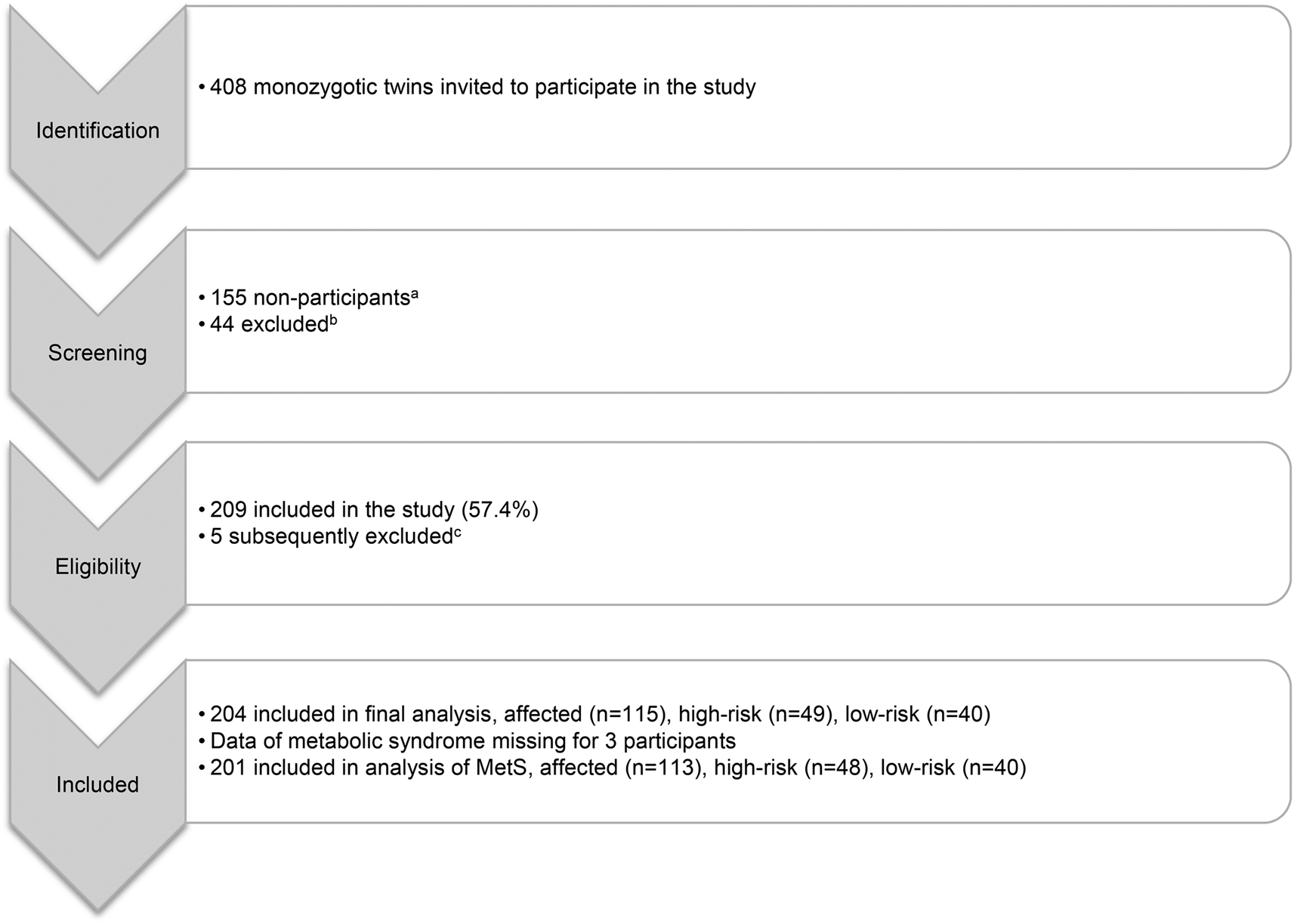
Through identification via register linkage in June 2014, 408 MZ twins (204 twin-pairs), aged 18–50 years were invited to participate in the study. The twins were either concordant or discordant for an affective disorder diagnosis according to ICD-10 criteria (F30-F39, unipolar or bipolar disorder), or were twins without personal or family history of psychiatric disorders (low-risk/healthy controls). After the initial invitation, 44 twins were excluded, 115 twins declined to participate, and five twins were excluded after the diagnostic interview, due to a personal or first-degree family history of schizophrenia or schizotypal disorder. In total, 204 MZ twins were included in the statistical analyses (115 participants had an affective disorder, 49 high-risk and 40 at low-risk) (Fig. 1). There were missing metabolic variables for three participants. In the secondary concordance analyses, only whole twin pairs were included (n = 89 pairs, 25 MZ concordant twin pairs 45 MZ discordant twin pairs and 19 healthy MZ twin pairs). Finally, for the tertiary discordant intra-pair analyses, data from the 45 discordant MZ twin pairs were included. For detailed description of the sample see Ottesen et al., Reference Ottesen, Meluken, Scheike, Kessing, Miskowiak and Vinberg2018.
Flow chart for the metabolic syndrome (MetS) analysis. Participants were monozygotic (MZ) twins having an affective disorder diagnosis (affected twins), or a co-twin with the affective disorder (high-risk twins) or no personal or family history of affective disorder (low-risk twins). aDeclined (n = 97), not found (n = 40), other (n = 17). bDeath (n = 2), dizygotic (n = 4), birth-weight<1300 g (n = 10), severe somatic illness (n = 4), severe head-trauma (n = 2), current substance abuse (n = 3), non-remission (n = 5), pregnancy (n = 3), other (n = 2), low-risk twins having a first-degree relative with psychiatric illness (n = 9). cHigh-risk twins having an F20 diagnosis (n = 1), affected twins having an F20 diagnosis (n = 4).

Sociodemographic variables, smoking, alcohol and medication
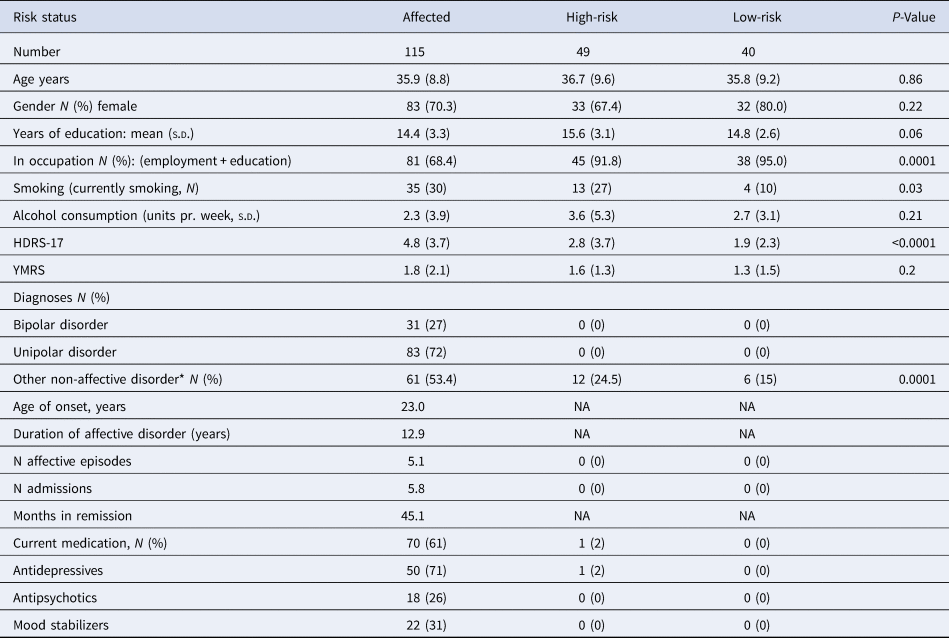
As seen from Table 1, the three groups (1) affected, (2) high-risk, and (3) low-risk, were comparable in terms of age, sex, years of education and alcohol consumption. However, the affected group was less often employed or studying than the high-risk (p = 0.001) and low-risk groups (p = 0.001) and had a greater number of comorbid non-affective diagnoses compared to the high-risk (p = 0.0005) and low-risk (p = 0.0002) groups. The affected group were more often current smokers than the low-risk group (30% v. 10%, p = 0.009), with a trend towards the high-risk group smoking more than the low-risk group (27% v. 10%, p = 0.06). The affected group had been in remission for 45 months and had had 5.1 affective episodes and 5.8 admissions to a psychiatric department (mean, Table 1).
Risk status, socio-demographic, diagnostics, medication, smoking and alcohol consumption in affected, high-risk and low-risk monozygotic twins

Data are expressed as estimated mean (s.d.) (when other is not stated). Values are presented as raw, unadjusted values. HDRS-17 = Hamilton Depression Rating Scale-17, YMRS = Young Mania Rating Scale. *e.g. anxiety disorders, personality disorders
Sixty-one percentage in the affected group were prescribed psychotropic medication and one high-risk twin received an antidepressant with anxiety as indication (Table 1).
Metabolic syndrome
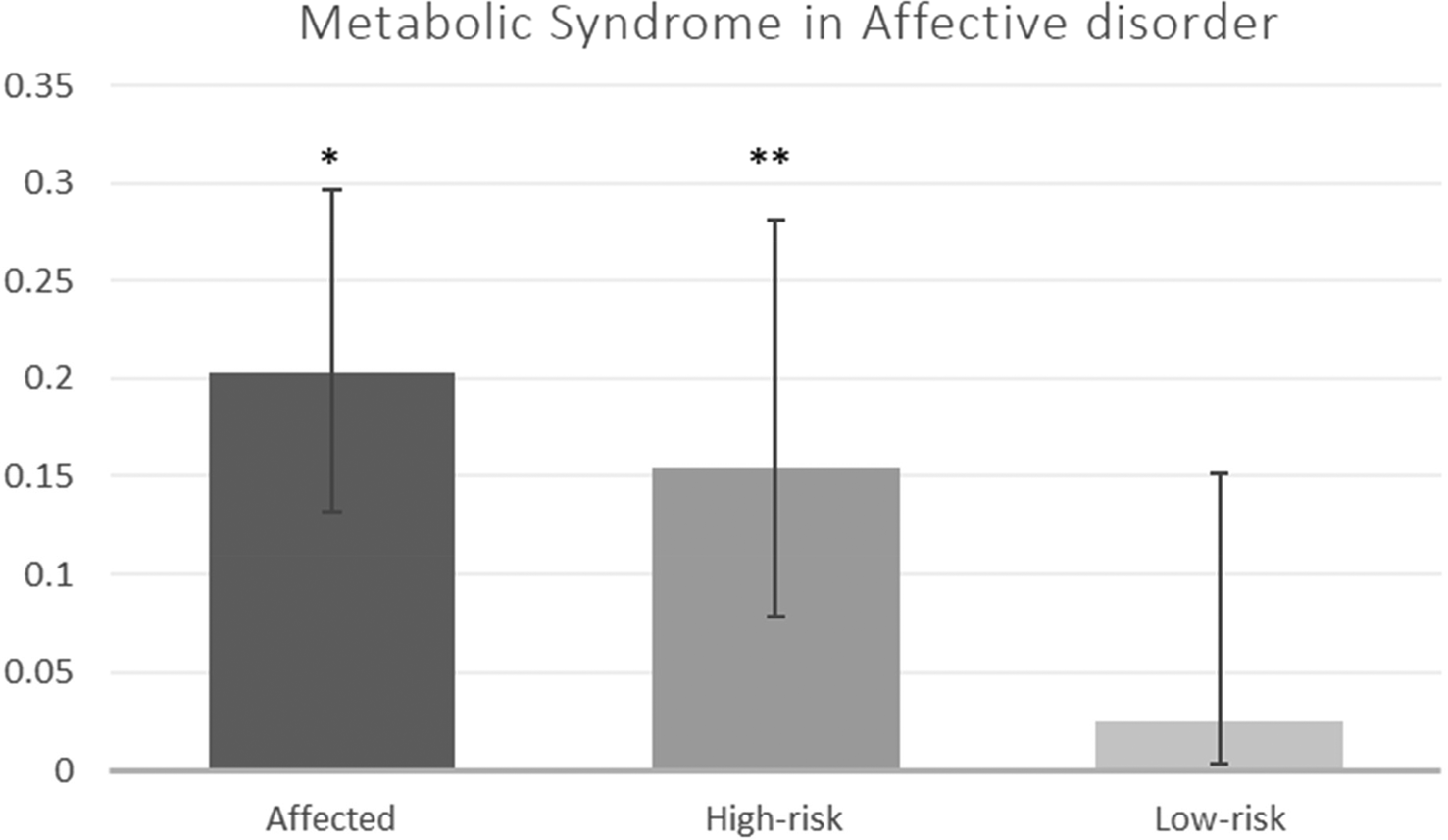
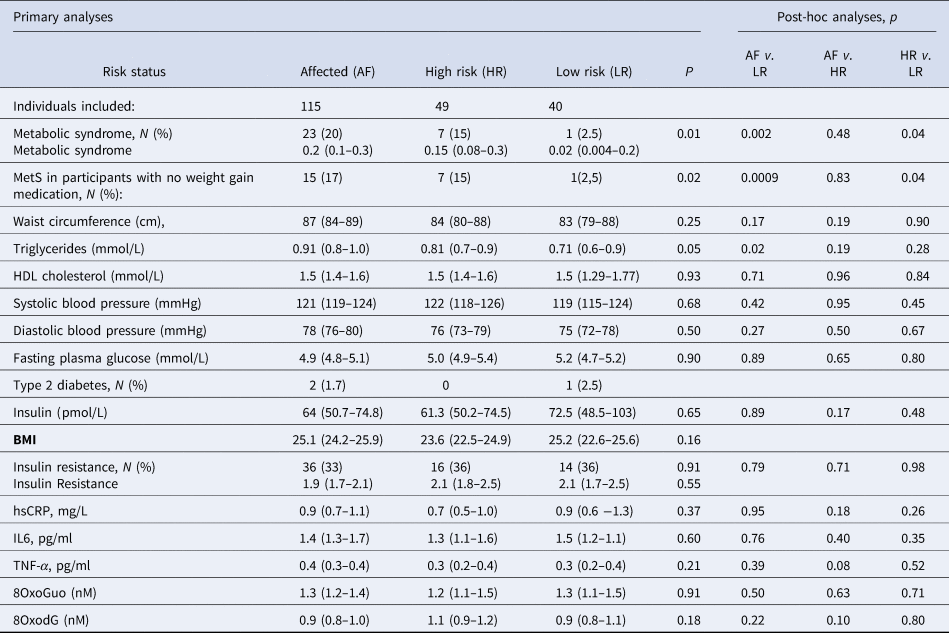
Data were analyzed for 201 participants. One or more variables included in the MetS definition were missing for three participants. All but two twin-pairs in the study were Europids. One twin pair was from Asia where central obesity is defined as waist-circumference >90 for men and >80 for women. One twin-pair was from the Middle-east where the European definition for waist-circumference was used. Table 2 shows the unadjusted results from the primary analysis comparing metabolic, inflammatory and oxidative markers between the affected group, the high-risk group and the low-risk group. As illustrated in Fig. 2, the affected, and the high-risk group had a statistically significantly higher prevalence of MetS compared to the low-risk group (20% v. 15% v. 2.5%, p = 0.0006). Adjusting for age and sex in model 1, and further adding the covariates alcohol and smoking in model 2, did not change this result.
Comparison of the prevalence of metabolic syndrome in affected, high-risk and low-risk monozygotic twins. Illustrated as estimated mean. Error bars = 95% confidence interval, * affected v. low-risk, p = 0.0002, ** high-risk v. low-risk, p = 0.04.

Primary and post-hoc group analysis of metabolic, inflammatory and oxidative markers in affected, high-risk and low-risk monozygotic twins

Data are expressed as estimated mean (95% confidence interval) (when other is not stated). Values are presented as raw, unadjusted values. MetS = metabolic syndrome; hsCRP = high sensitive C-reactive protein; IL-6 = interleukin-6; TNF-α = tumor necrosis factor-α; 8-oxodG = 8-oxo-7,8-dihydro-20-deoxyguanosine; 8-oxoGuo = 8-oxo-7,8-dihydroguanosine; HDL = high density lipoprotein; BMI = body mass index
In the secondary analysis the concordant affected twin-pairs and the discordant twin-pairs had a statistically significant higher prevalence of MetS compared to the low-risk twin-pairs (22% v. 15.9% v. 2.6%, p = 0.03). When adjusting for sex and age in model 1 and adding smoking and alcohol consumption in model 2, the higher prevalence was still significant between the affected concordant twin-pairs and the low-risk group (p = 0.03) however non-significant between the high-risk and the low-risk groups (p = 0.08). Duration of affective disorder did not predict the presence of MetS. In the tertiary analysis, there were no statistically significant differences between the unaffected and the affected twin in the discordant twin-pairs.
In further post-hoc sensitivity analyses where the participants who received weight-gaining medicine (defined as a drug which according to the product resume had weight-gain as a common side-effect (>10% of users would gain weight) including 22% in the affected group) were excluded, the affected and the high-risk group still had a statistically significant higher prevalence of MetS compared to the low-risk group (affected v. low risk: p = 0.009, high-risk v. low-risk: p = 0.04, affected v. high-risk: p = 0.83).
In post-hoc analyses, exploring the possible associations between MetS and inflammation markers, the three inflammation markers were added as covariates one at the time. There was a positive association between hsCRP and MetS (OR = 1.21, CI: 1.05–1.39, p = 0.008) and between IL-6 and MetS (OR = 1.01, CI: 1.01–1.003, p < 0.0001). No association was found between TNF-α and MetS (p = 0.8).
Insulin resistance and the components included in metabolic syndrome
There were 27 values of insulin over the upper reference limit (10–125 pmol/L) so these values were omitted from the analyses. The primary analyses showed no statistically significant differences in the prevalence of insulin resistance between the three groups, and nearly all the components included in MetS did not reveal any significant between group differences. Only triglycerides were significantly higher in the affected compared to the low-risk group (Table 2).
The secondary concordance analysis and the tertiary analysis comparing the twins in the discordant twin pairs showed no significant differences regarding insulin resistance and the components included in MetS.
Inflammatory markers
As shown in Table 2, the primary analyses showed no statistically significant differences in hsCRP, IL-6 or TNF-α levels, which were confirmed also when adjusting for age, sex, smoking and alcohol use.
In the secondary concordance analysis, no significant differences in inflammation markers were discovered. The tertiary analysis showed no differences between the twins and the twins without the affective disorder in the discordant twin-pairs.
Oxidative stress
In the primary unadjusted analysis, we found no group differences between the affected, the high-risk and the low-risk groups regarding the two oxidative stress biomarkers: 8OxodG and 8OxoGuo (see Table 2). Adjusting for sex and age in model 1 and adding smoking and alcohol consumption in model 2, did not change this result.
No differences were found between the groups in the secondary concordance analysis in any of the oxidative markers, nor between the discordant twins in the tertiary discordance analysis.
In exploratory post-hoc analysis, 8OxoGuo levels showed a positive association with IL-6 (p = 0.0005 r = 0.24), but not with hsCRP (p = 0.1) and TNF-α (p = 0.09). Further, 8OxodG levels were associated with IL-6 (0.04, r = 0.14) but not associated with hsCRP (p = 0.9) and TNF-α (p = 0.53).
Discussion
Consistent with our hypothesis, the main finding of this MZ high-risk study was that there was a higher prevalence of MetS in the affected (N = 113) and the high-risk group (N = 48) compared to the low-risk group (N = 40). Adjusting for age, sex, smoking and alcohol consumption, and excluding participants receiving potential weight gaining psychotropic medication did not change the result. In contrast, our hypothesis that inflammatory and oxidative stress markers would be elevated in the affected and the high-risk group was not supported. At the time of investigation, the affected MZ twins had been in remission or partial remission for more than three years. Further, the duration of affective disorder did not predict the presence of MetS in affected individuals. Thus, the increased prevalence of MetS in the affected group was not driven by the current mood state or the use of psychotropic medication. We find it interesting that healthy high-risk twins have a higher prevalence of MetS compared to low-risk twins and although we did not assess lifestyle habits, none of the twin pairs (except one pair) lived together and may not share dietary habits. The affected participants were in remission or partial remission at the time of inclusion indicating that MetS may not only act as state marker but could indeed be a trait marker, however, this should be further confirmed in longitudinal studies (Landucci Bonifacio et al., Reference Landucci Bonifacio, Sabbatini Barbosa, Gastaldello Moreira, De Farias, Higachi, Camargo, Favaro Soares, Odebrecht Vargas, Nunes, Berk, Dodd and Maes2017).
Studies investigating risk factors for MetS in high-risk individuals are sparse. Mannie et al. (Mannie et al. Reference Mannie, Williams, Diesch, Steptoe, Leeson and Cowen2013) found elevated systolic blood pressure in individuals at high risk for depression. This study included adolescents with a parent with affective disorder. We found no differences in blood pressure, insulin resistance or other components of the MetS (beside a small difference for triglycerides) so no single marker did drive the found difference in MetS. The evidence of the association between insulin resistance and affective disorders are conflicting. Guha et al. (Reference Guha, Bhowmick, Mazumder, Ghosal, Chakraborty and Burman2014) found a higher prevalence of insulin resistance in patients with BD compared to healthy controls (Guha et al., Reference Guha, Bhowmick, Mazumder, Ghosal, Chakraborty and Burman2014), whereas another study did not find this association in patients with mood disorders (unipolar and bipolar disorder) (Landucci Bonifacio et al., Reference Landucci Bonifacio, Sabbatini Barbosa, Gastaldello Moreira, De Farias, Higachi, Camargo, Favaro Soares, Odebrecht Vargas, Nunes, Berk, Dodd and Maes2017). A review has suggested insulin resistance to be a state-dependent marker for depression, elevated in only acute episodes of the disorder and normalizing when in recovery (Ramasubbu, Reference Ramasubbu2002). This is in line with our results and with the before mentioned study (Landucci Bonifacio et al., Reference Landucci Bonifacio, Sabbatini Barbosa, Gastaldello Moreira, De Farias, Higachi, Camargo, Favaro Soares, Odebrecht Vargas, Nunes, Berk, Dodd and Maes2017) that also investigated participants presumably in remission (mean Hamilton depression rating scale = 7.30). Regarding the affected group, findings from prior studies are in line with our results e.g. a meta-analysis including 52.678 individuals with severe mental illness showed that MetS is 58% more prevalent in individuals with severe mental disorders compared to the general population (Vancampfort et al., Reference Vancampfort, Stubbs, Mitchell, De Hert, Wampers, Ward, Rosenbaum and Correll2015). However, the prevalence of MetS in our low-risk group was lower than previous reports from the general Danish population (Lauenborg et al., Reference Lauenborg, Mathiesen, Hansen, Glumer, Jorgensen, Borch-Johnsen, Hornnes, Pedersen and Damm2005; Krane-Gartiser et al., Reference Krane-Gartiser, Breum, Glumrr, Linneberg, Madsen, Koster, Jepsen and Fink-Jensen2011). This could be due to the low number of participants in our low-risk group but could also reflect the younger age in our low-risk group (mean age 35.8) compared with mean age of the general population in these studies (49.9 and 45.0, respectively) (Lauenborg et al., Reference Lauenborg, Mathiesen, Hansen, Glumer, Jorgensen, Borch-Johnsen, Hornnes, Pedersen and Damm2005; Krane-Gartiser et al., Reference Krane-Gartiser, Breum, Glumrr, Linneberg, Madsen, Koster, Jepsen and Fink-Jensen2011). As the prevalence of MetS rises with increasing age (Park et al., Reference Park, Zhu, Palaniappan, Heshka, Carnethon and Heymsfield2003) younger age may partly explain the lower prevalence of MetS in our low-risk group.
Metabolic syndrome and lifestyle
Patients with affective disorders often exhibit a more unhealthy lifestyles with more smoking, increased alcohol consumption, lower levels of physical inactivity and more unhealthy diet intakes; all factors predisposing to metabolic disturbances (Henderson et al., Reference Henderson, Vincenzi, Andrea, Ulloa and Copeland2015; Goldstein, Reference Goldstein2017). Further, improvements in lifestyle habits seem to reduce the symptoms of depression (Berk et al., Reference Berk, Sarris, Coulson and Jacka2013; Hiles et al., Reference Hiles, Lamers, Milaneschi and Penninx2017; Lassale et al., Reference Lassale, Batty, Baghdadli, Jacka, Sanchez-Villegas, Kivimaki and Akbaraly2018). Smoking cessation is linked to improved mental health (Taylor et al., Reference Taylor, Mcneill, Girling, Farley, Lindson-Hawley and Aveyard2014), dietary improvement can improve depression (Jacka et al., Reference Jacka, O'neil, Opie, Itsiopoulos, Cotton, Mohebbi, Castle, Dash, Mihalopoulos, Chatterton, Brazionis, Dean, Hodge and Berk2017) and there is a meta-analytic level of evidence that physical activity can prevent incident depression (Conn, Reference Conn2010; Hiles et al., Reference Hiles, Lamers, Milaneschi and Penninx2017; Schuch et al., Reference Schuch, Vancampfort, Firth, Rosenbaum, Ward, Silva, Hallgren, Ponce De Leon, Dunn, Deslandes, Fleck, Carvalho and Stubbs2018). Here, the affected group smoked significantly more than the low-risk group and there was a trend toward the same pattern in the high-risk group. Adjustment for current smoking and for alcohol consumption, did however not change the significant group differences regarding MetS. This is in line with another study that found that smoking alone was not associated with CVD but the combination of MetS and smoking significantly increased the risk of CVD (Lee et al., Reference Lee, Kang, Song, Rho and Kim2015). However, it is not clear whether MetS is a marker of an unhealthy lifestyle influencing the risk for depression or a direct mediator of risk e.g. functions as an active risk pathway.
Metabolic syndrome and medication
Most studies have investigated MetS in patients with affective disorders who were prescribed psychotropic medication finding an increase in MetS in patients prescribed antipsychotics (Vancampfort et al., Reference Vancampfort, Stubbs, Mitchell, De Hert, Wampers, Ward, Rosenbaum and Correll2015) and tricyclic antidepressant (TCA) (Fava, Reference Fava2000; McIntyre et al., Reference Mcintyre, Soczynska, Konarski and Kennedy2006). Studies examining MetS in patients with affective disorders without current psychotropic treatment are sparse but one study revealed an increase in the risk of MetS in drug-naïve patients with bipolar disorder (N = 80) (Guha et al., Reference Guha, Bhowmick, Mazumder, Ghosal, Chakraborty and Burman2014) in line with the present finding when excluding participants on current weight-gaining medication. Overall it cannot be excluded that prior use of psychotropic medication may have induced an earlier weight gain and changes in metabolic profile in our affected group, as most of the affected participants previous or currently were treated with psychotropic medication. Nevertheless, this cannot explain that their healthy and drug-naïve co-twins also presented with an increased prevalence of MetS compared to the low-risk group.
Metabolic syndrome and genetics
The relationship between affective disorders and MetS is probably bidirectional (Pan et al., Reference Pan, Keum, Okereke, Sun, Kivimaki, Rubin and Hu2012) and may either imply a shared genetic vulnerability or common environmental risks. Both conditions are highly heritable, and several risk genes which may be involved in both affective disorders and risk factors for CVD have been identified (Amare et al., Reference Amare, Schubert, Klingler-Hoffmann, Cohen-Woods and Baune2017). One study found that the FTO gene (fat mass and obesity associated) was associated with obesity and mediated by depressive symptoms (Rivera et al., Reference Rivera, Cohen-Woods, Kapur, Breen, Ng, Butler, Craddock, Gill, Korszun, Maier, Mors, Owen, Preisig, Bergmann, Tozzi, Rice, Rietschel, Rucker, Schosser, Aitchison, Uher, Craig, Lewis, Farmer and Mcguffin2012) and other studies revealed that possible pleiotropic genes such as e.g. GSK3, APOE and BDNF seem to influence both affective symptoms and components of MetS such as HDL, cholesterol and obesity (Amare et al., Reference Amare, Schubert, Klingler-Hoffmann, Cohen-Woods and Baune2017). Our high-risk study design did not allow us to calculate the heritability estimates for affective disorders and MetS/obesity, as we did not include dizygotic twins. Our findings of increased prevalence of MetS in participants at high risk of affective disorders point to an existence of a shared metabolic mood syndrome (Mansur et al., Reference Mansur, Brietzke and Mcintyre2015) that may be driven by a shared overlapping genetic and environmental vulnerability for both conditions.
Inflammation and oxidative stress
No differences in inflammatory and oxidative markers were seen between the three groups in the present study. In contrast, several studies have found an association between inflammation markers, oxidative stress and affective disorders (Valkanova et al., Reference Valkanova, Ebmeier and Allan2013; Munkholm et al., Reference Munkholm, Brauner, Kessing and Vinberg2013), and between CVD and especially OxoGuo (Kjaer et al., Reference Kjaer, Cejvanovic, Henriksen, Petersen, Hansen, Pedersen, Christensen, Torp-Pedersen, Gerds, Brandslund, Mandrup-Poulsen and Poulsen2017). One explanation could be that the affected group was in remission or partial remission as both inflammatory and oxidative markers may act primarily as state rather than trait markers of affective episodes (Kim et al., Reference Kim, Jung, Myint, Kim and Park2007; Berk et al., Reference Berk, Kapczinski, Andreazza, Dean, Giorlando, Maes, Yucel, Gama, Dodd, Dean, Magalhaes, Amminger, Mcgorry and Malhi2011; Munkholm et al., Reference Munkholm, Brauner, Kessing and Vinberg2013). Contrary, a prior study from our group demonstrated increased levels of oxidative markers in euthymic patients with bipolar disorder (Munkholm et al., Reference Munkholm, Poulsen, Kessing and Vinberg2015). However, this sample was characterized by having a rapid cycling course and had only been in remission for a short period of time, whereas most affected MZ twins in our study had unipolar disorder and had been in remission for more than three years. Further, it seems as oxidative stress markers are less affected by genes but more influenced by environmental factors (Broedbaek et al., Reference Broedbaek, Ribel-Madsen, Henriksen, Weimann, Petersen, Andersen, Afzal, Hjelvang, Roberts, Vaag, Poulsen and Poulsen2011) e.g. the stress of having an affective episode. This indicates that inflammation markers and oxidative stress are indeed more expressions of a state than trait markers in line with previous studies (Kapczinski et al., Reference Kapczinski, Dal-Pizzol, Teixeira, Magalhaes, Kauer-Sant'anna, Klamt, Pasquali, Quevedo, Gama and Post2010).
The observed associations between MetS and inflammation (hsCRP and IL-6) in our study may reflect that abdominal adipose tissue produces cytokines and hormones and thus contributes to pathogenic immunometabolic responses (Shelton and Miller, Reference Shelton and Miller2010). The lack of an association between TNF-α and MetS must be interpreted with caution as 54% of the samples were below the levels of quantification. Cytokines cross the blood brain barrier and thus act on the brain, leading to decreased neurogenesis in emotion-regulating brain structures (Shelton and Miller, Reference Shelton and Miller2010; Sublette and Postolache, Reference Sublette and Postolache2012). This links to the hypothesis that the world-wide obesity epidemic may contribute to an increased prevalence of affective disorders (Hruby and Hu, Reference Hruby and Hu2015). Obesity, oxidative stress and inflammation can also increase blood brain barrier permeability increasing the propensity for cytokines to access the brain (Morris et al., Reference Morris, Fernandes, Puri, Walker, Carvalho and Berk2018).
Strengths and limitations
The comprehensive data collection and the large cohort of MZ twins are strengths of the study together with the recruitment through nationwide registers. To conduct a high-risk study with MZ twins is also a unique strength, as the discordant high-risk twin (due to the nearly 100% identical genes) is at ultra-high risk for onset of affective disorder compared to first-degree relatives who only share 50% of their genes. Several limitations should nonetheless be considered. The modest number of participants in the high-risk and especially in the low-risk group may lead to inaccuracies in the statistical inference procedures for the MetS outcome. Our results must therefore be interpreted with caution. Further, we could not calculate heritability estimates as we did not include DZ twins as in a classical twin design, and the cross-sectional design limited our possibility to draw causal conclusions. Another limitation in this investigation of MetS, is our lack of data collection regarding dietary habits, sleep habits and exercise patterns. Some studies have managed to adjust for these lifestyle factors however the associations between affective disorders and MetS were only slightly reduced. Collecting these data is however difficult and often influenced by substantial bias due to self-report information and life style habits may have an impact on MetS (Penninx and Lange, Reference Penninx and Lange2018).
Perspectives and implications
Our results show that early detection of MetS is clinically important not only in patients with affective disorder but seems also to translate to individuals at high familial risk. Clinically, lifestyle interventions such as increases physical activity, dietary support and smoking cessation are important to improve depressive symptoms (Sun et al., Reference Sun, Liu and Ning2012; Rosenbaum et al., Reference Rosenbaum, Tiedemann, Sherrington, Curtis and Ward2014; Kvam et al., Reference Kvam, Kleppe, Nordhus and Hovland2016) and may reduce the risk of MetS (Church et al., Reference Church, Earnest, Skinner and Blair2007; Sari-Sarraf et al., Reference Sari-Sarraf, Aliasgarzadeh, Naderali, Esmaeili and Naderali2015; Dawson et al., Reference Dawson, Dash and Jacka2016). Further, obesity is associated with decreased treatment response in patients with affective disorders (Kloiber et al., Reference Kloiber, Ising, Reppermund, Horstmann, Dose, Majer, Zihl, Pfister, Unschuld, Holsboer and Lucae2007; Oskooilar et al., Reference Oskooilar, Wilcox, Tong and Grosz2009).
Conclusion
Metabolic syndrome was more prevalent in affected and high-risk MZ twins compared to low-risk twins and thus seems to reflect a familial risk factor for affective disorder indicating that MetS may act as a trait marker for affective disorders however future longitudinal studies are warranted to clarify this. Further, the presence of MetS was associated with higher levels of low-grade inflammation. Taken together, the findings indicate that there may exist a distinct subgroup of affective disorders that present a ‘metabolic mood syndrome’ profile. If these results can be confirmed in longitudinal studies, this highlights the importance of early detection and intervention with increased awareness of unhealthy lifestyle that may contribute to later psychopathology (O'Neil et al., Reference O'neil, Jacka, Quirk, Cocker, Taylor, Oldenburg and Berk2015).
Acknowledgements
Thanks to the Danish Twin Registry for cooperation in the study, especially thanks for support, data work and technical help from Inge Petersen and Axel Skytthe from the Danish Twin Registry. Finally, thanks to Anne Præstegaard for flexible and practical assistance.
Author contributions
MV and KM conceived and designed study. LK contributed to the conception and design. MV and KM obtained the funding. MV applied for the Data and the Ethical permissions and cooperated on the register linkage with the Danish Twin Registry. IM and NMO recruited the patients and runned the study together with MV. NMO and TS undertook the data extraction and the statistical analyses. NMO and MV drafted the manuscript drafts and NMO revised the final version. All authors had substantial contributions to the design, analysis, and interpretation, and participated in manuscript drafting or revisions.
Conflicts of interest
MV has received consultancy fees from Lundbeck in the past three years. LVK has within the preceding three years been a consultant for Sunovion and Lundbeck. KWM has received consultancy fees from Lundbeck, Allergan and Janssen in the past three years. The remaining authors declare no conflicts of interest.
Financial support
The study was supported by The Capital Region of Denmark, the Augustinus Foundation, the Axel Thomsen's Foundation, the Lundbeck Foundation (R108-A10015), the Hoerslev Foundation, and Fonden til Lægevidensskabens Fremme. MB is supported by a National Health and Medical Research Council (NHMRC) Senior Principal Research Fellowship (APP1059660 and APP1156072). The sponsors had no role in the planning or conduct of the study or in the interpretation of the results.