Introduction
Language production is a complex cognitive process that involves a well-choreographed sequence of steps in converting meaning into fluent speech. Efficient lexical retrieval is a critical step in fluent production (Sandoval, Gollan, Ferreira & Salmon, Reference Sandoval, Gollan, Ferreira and Salmon2010) and is dependent upon vocabulary size and lexical selection. Vocabulary knowledge is critical because activation is limited to the available lexical candidates. Intuitively, individuals who have an extensive vocabulary have more lexical candidates to choose from (Bialystok, Craik & Luk, Reference Bialystok, Craik and Luk2008; Luo, Luk & Bialystok, Reference Luo, Luk and Bialystok2010). Lexical selection is the critical step in the resolution of lexical competition, enabling the retrieval of a single lexical candidate from among a set of co-activated competitors (Dell, Schwartz, Martin, Saffran & Gagnon, Reference Dell, Schwartz, Martin, Saffran and Gagnon1997; Levelt, Roelofs & Meyer, Reference Levelt, Roelofs and Meyer1999).
Lexical selection is viewed by most as a competitive process (Levelt et al., Reference Levelt, Roelofs and Meyer1999; Roelofs, Reference Roelofs1992), although non-competitive views have also been proposed (Dell et al., Reference Dell, Schwartz, Martin, Saffran and Gagnon1997; Mahon, Costa, Peterson, Vargas & Caramazza, Reference Mahon, Costa, Peterson, Vargas and Caramazza2007). A competitive selection process may be domain-specific (e.g., lexical or linguistic), such as direct lateral inhibition (Howard, Nickels, Coltheart & Cole-Virtue, Reference Howard, Nickels, Coltheart and Cole-Virtue2006; Snyder, Banich & Munakata, Reference Snyder, Banich and Munakata2014), or domain-general, involved in cognitive or inhibitory control (Snyder et al., Reference Snyder, Hutchison, Nyhus, Curran, Banich, O'Reilly and Munakata2010; Thompson-Schill, D'Esposito, Aguirre & Farah, Reference Thompson-Schill, D'Esposito, Aguirre and Farah1997). The involvement of inhibitory control in language production has been investigated in the context of verbal fluency (Bialystok et al., Reference Bialystok, Craik and Luk2008; Luo et al., Reference Luo, Luk and Bialystok2010; Suarez, Gollan, Heaton, Grant & Cherner, Reference Suarez, Gollan, Heaton, Grant and Cherner2014) and discourse fluency (Engelhardt, Nigg & Ferreira, Reference Engelhardt, Nigg and Ferreira2013; Korko & Williams, Reference Korko and Williams2017; Pivneva, Palmer & Titone, Reference Pivneva, Palmer and Titone2012). Better inhibitory control has been linked to more efficient resolution of lexical competition, resulting in more fluent language production (Bialystok et al., Reference Bialystok, Craik and Luk2008; Luo et al., Reference Luo, Luk and Bialystok2010; Pivneva et al., Reference Pivneva, Palmer and Titone2012; Suarez et al., Reference Suarez, Gollan, Heaton, Grant and Cherner2014) and fewer disfluencies (Engelhardt et al., Reference Engelhardt, Nigg and Ferreira2013; Korko & Williams, Reference Korko and Williams2017).
Bilinguals experience additional challenges in resolving lexical competition relative to monolinguals, as the two languages are activated in parallel and compete for selection (for reviews, see Costa, Reference Costa, Kroll, F and De Groot2005; Kroll, Bobb, Misra & Guo, Reference Kroll, Bobb, Misra and Guo2008; Kroll & Gollan, Reference Kroll, Gollan, Goldrick, Ferreira and Miozzo2014), regardless of whether bilinguals speak (e.g., Colomé & Miozzo, Reference Colomé and Miozzo2010; Costa, Caramazza & Sebastian-Galles, Reference Costa, Caramazza and Sebastian-Galles2000; Hoshino & Kroll, Reference Hoshino and Kroll2008) or hear (e.g., Canseco-Gonzalez et al., Reference Canseco-Gonzalez, Brehm, Brick, Brown-Schmidt, Fischer and Wagner2010; Lagrou, Hartsuiker & Duyck, Reference Lagrou, Hartsuiker and Duyck2011; Marian & Spivey, Reference Marian and Spivey2003b) one language alone. Since bilinguals cannot “switch off” the unintended language (Colomé & Miozzo, Reference Colomé and Miozzo2010; Hoshino & Kroll, Reference Hoshino and Kroll2008; Lagrou et al., Reference Lagrou, Hartsuiker and Duyck2011; Martín, Macizo & Bajo, Reference Martín, Macizo and Bajo2010), they must resolve conflict from competing cross-linguistic responses (e.g., Meuter & Allport, Reference Meuter and Allport1999; Misra, Guo, Bobb & Kroll, Reference Misra, Guo, Bobb and Kroll2012) in addition to the within-language competition experienced by monolingual speakers of each of the two languages (e.g., Marian & Spivey, Reference Marian and Spivey2003a). Available data suggest a possible involvement of a domain-general mechanism in the resolution of lexical competition (Green, Reference Green1998). While both languages are regulated (e.g., Mercier, Pivneva & Titone, Reference Mercier, Pivneva and Titone2014), the dominant first language (L1) needs to be suppressed the most because it competes more strongly (e.g., Kroll et al., Reference Kroll, Bobb, Misra and Guo2008; Linck, Kroll & Sunderman, Reference Linck, Kroll and Sunderman2009). Meuter and Allport (Reference Meuter and Allport1999) were the first to propose that domain-general control may support lexical selection in bilinguals. In evaluating the cost of switching from one language to another, they reported longer naming latencies associated with switching between languages compared to non-switching conditions (i.e., switch cost). In addition, switching from the non-dominant second language (L2) to the dominant L1 induced a larger switch cost. This asymmetric switch cost was taken by the Inhibitory Control Model (Green, Reference Green1998) as evidence that bilinguals inhibit their stronger L1 during L2 production and subsequently need to overcome this momentary suppression when switching back to the dominant L1.
To what extent are these processes unique to bilinguals? Recent studies suggest that monolinguals and bilinguals appear to employ the same fundamental mechanisms of within-language competition resolution (Blumenfeld & Marian, Reference Blumenfeld and Marian2011), but differ in terms of how effectively they engage cognitive control (e.g., Abutalebi, Reference Abutalebi2008; Abutalebi & Green, Reference Abutalebi and Green2007; Blumenfeld & Marian, Reference Blumenfeld and Marian2011). Studies employing neuroimaging measures have shown that the L1 and L2 may be processed through the same neural mechanisms (Abutalebi, Reference Abutalebi2008; Abutalebi & Green, Reference Abutalebi and Green2007; Perani & Abutalebi, Reference Perani and Abutalebi2005), but that additional control is involved in the processing of the weaker L2 (Abutalebi, Reference Abutalebi2008; Abutalebi & Green, Reference Abutalebi and Green2007). Recruitment of cognitive resources has been demonstrated for within-language conflict resolution in monolinguals (Hsu & Novick, Reference Hsu and Novick2016) and bilinguals (Blumenfeld & Marian, Reference Blumenfeld and Marian2011), as well as for cross-linguistic conflict resolution in bilinguals (Adler, Valdés Kroff & Novick, Reference Adler, Valdés Kroff and Novick2020). However, quantitative differences have been reported in the way monolinguals and bilinguals recruit cognitive control during language processing tasks. Using a two-trial paradigm to investigate the immediate consequences of lexical competition, Blumenfeld and Marian (Reference Blumenfeld and Marian2011) reported that the processes that give rise to within-language competition appear to be similar for monolinguals and bilinguals, but that the consequences of competition appear to be more extended for monolinguals than bilinguals. While both groups demonstrated sensitivity to the presence of within-language competition, bilinguals appeared to resolve that competition more efficiently than monolinguals, experiencing less spillover onto the next trial.
The current study
The greater efficiency in resolving the consequences of competition observed in bilinguals relative to monolinguals suggest that language experience itself may be critical in capturing variation in competition resolution. Many studies have compared bilinguals and monolinguals as a way of establishing this relationship. However, there have been recent criticisms about using group comparisons (e.g., Botella, Privado, Suero, Colom & Juola, Reference Botella, Privado, Suero, Colom and Juola2019; Grandy, Lindenberger & Werkle-Bergner, Reference Grandy, Lindenberger and Werkle-Bergner2017). An alternative and potentially more powerful way of assessing the role of language experience in shaping the consequences of lexical competition is to examine individual differences. The current study takes that approach by using an index of individual differences that is unique in the literature. Here, we assess differences in discourse fluency, in addition to standard single-word measures of semantic and phonemic fluency (Bialystok et al., Reference Bialystok, Craik and Luk2008; Luo et al., Reference Luo, Luk and Bialystok2010; Suarez et al., Reference Suarez, Gollan, Heaton, Grant and Cherner2014), to capture variation. The discourse-level measure of fluency provides an alternative measure of individual variation that offers an opportunity to assess language experience more broadly (Festman, Reference Festman2012; Korko & Williams, Reference Korko and Williams2017; Pivneva et al., Reference Pivneva, Palmer and Titone2012), beyond the set of standard single-word (Bialystok et al., Reference Bialystok, Craik and Luk2008; Luo et al., Reference Luo, Luk and Bialystok2010; Suarez et al., Reference Suarez, Gollan, Heaton, Grant and Cherner2014) or single-utterance measures (Engelhardt et al., Reference Engelhardt, Nigg and Ferreira2013) on which much of the literature is based. Discourse fluency is a real-world, ecologically valid measure of lexical competition that may quite uniquely reflect the influence of language usage and experience. Given that much of language experience is based on the production and recognition of spoken words, discourse fluency is a particularly well-suited measure of language experience to be coupled with a measure of lexical competition resolution in spoken word recognition. While most research evaluating the consequences of language experience on individual variation in language processing efficiency has focused on reading (e.g., Braze, Tabor, Shankweiler & Mencl, Reference Braze, Tabor, Shankweiler and Mencl2007; Hamilton, Freed & Long, Reference Hamilton, Freed and Long2013; Misyak & Christiansen, Reference Misyak and Christiansen2012), the current study focuses on the auditory domain because individuals experience more language input auditorily (i.e., spoken words) than visually (i.e., written words) across the lifespan. The logic of the present study was to combine measures of fluent language production (i.e., discourse fluency, semantic fluency, phonemic fluency), which served as indicators of language experience with a non-linguistic measure of cognitive control (difference score on the Simon task) and a fine-grained experimental measure of competition resolution in spoken word recognition (phonological neighborhood density effect) in monolingual and L2 speakers. This approach enabled us to evaluate how individual variation in production fluency and in Simon task performance relates to phonological neighborhood density effects in spoken word recognition.
The phonological neighborhood density effect was chosen as the outcome measure of the study because it captures the competitive nature of lexical retrieval in spoken word recognition. Lexical selection in spoken word recognition has typically been framed as a competitive process involving either direct lateral inhibition (e.g., McClelland & Elman, Reference McClelland and Elman1986) or emergent competition due to overlapping distributed representations (e.g., Gaskell & Marslen-Wilson, Reference Gaskell and Marslen-Wilson1997), although models without explicit competition can account for at least some phenomena (e.g, Magnuson, Tanenhaus, Aslin & Dahan, Reference Magnuson, Tanenhaus, Aslin and Dahan2003). During spoken word recognition, listeners must map the noisy, transient and sequential speech input signal onto one of many possible lexical interpretations (for reviews, see Magnuson, Mirman & Myers, Reference Magnuson, Mirman, Myers and Reisberg2013; Mirman, Reference Mirman and Mirkovic2016). Phonological neighborhood density (Luce, Reference Luce1986) captures the competitive nature of this process by providing a measure of the number and summed frequency of phonologically-similar lexical candidates that partially match the unfolding speech. The effect of density thus illustrates the computational problem in spoken word recognition: spoken words with many phonologically-similar neighbors are recognized more slowly and less accurately than words with few phonological neighbors (Luce & Large, Reference Luce and Large2001; Luce & Pisoni, Reference Luce and Pisoni1998; Magnuson, Dixon, Tanenhaus & Aslin, Reference Magnuson, Dixon, Tanenhaus and Aslin2007). The effect of phonological neighborhood density in spoken word recognition has been observed across a variety of tasks (Luce & Pisoni, Reference Luce and Pisoni1998; Vitevitch & Luce, Reference Vitevitch and Luce1999) and replicated with monolinguals (e.g., Botezatu, Landrigan, Chen & Mirman, Reference Botezatu, Landrigan, Chen and Mirman2015; Garlock, Walley & Metsala, Reference Garlock, Walley and Metsala2001; Sommers & Danielson, Reference Sommers and Danielson1999; Taler, Aaron, Steinmetz & Pisoni, Reference Taler, Aaron, Steinmetz and Pisoni2010) and bilinguals (Bradlow & Pisoni, Reference Bradlow and Pisoni1999; Imai, Walley & Flege, Reference Imai, Walley and Flege2005; Takayanagi, Dirks & Moshfegh, Reference Takayanagi, Dirks and Moshfegh2002). Although robust, the effect has been related to individual differences in vocabulary size (e.g., Botezatu & Mirman, Reference Botezatu and Mirman2019; Charles-Luce & Luce, Reference Charles-Luce and Luce1990; De Cara & Goswami, Reference De Cara and Goswami2003) and inhibitory control (Bartolotti & Marian, Reference Bartolotti and Marian2012; Sommers & Danielson, Reference Sommers and Danielson1999; Taler et al., Reference Taler, Aaron, Steinmetz and Pisoni2010). Phonological density is initially facilitative in infants, who prefer listening to spoken words from dense neighborhoods (Jusczyk, Luce & Charles-Luce, Reference Jusczyk, Luce and Charles-Luce1994; Mani & Plunkett, Reference Mani and Plunkett2011; Pitrat, Logan, Cockell & Gutteridge, Reference Pitrat, Logan, Cockell and Gutteridge1995). However, it becomes inhibitory in children (Garlock et al., Reference Garlock, Walley and Metsala2001; Metsala, Reference Metsala1997) and adults (Botezatu et al., Reference Botezatu, Landrigan, Chen and Mirman2015; Garlock et al., Reference Garlock, Walley and Metsala2001; Sommers & Danielson, Reference Sommers and Danielson1999) as vocabulary size increases (Botezatu & Mirman, Reference Botezatu and Mirman2019; Charles-Luce & Luce, Reference Charles-Luce and Luce1990; De Cara & Goswami, Reference De Cara and Goswami2003).
The present study examined the nature of the selection mechanism involved in fluent language production by testing whether it involves a competitive mechanism that is specific to the language domain, or a domain-general ability possibly involved in inhibitory control (Green, Reference Green1998; Snyder et al., Reference Snyder, Hutchison, Nyhus, Curran, Banich, O'Reilly and Munakata2010; Thompson-Schill et al., Reference Thompson-Schill, D'Esposito, Aguirre and Farah1997, Reference Thompson-Schill, Swick, Farah, D'Esposito, Kan and Knight1998). If lexical selection is domain-specific, then there should be a link between efficient lexical retrieval in language production and comprehension, despite possible reliance on different input and output lexicons (Gow, Reference Gow2012) and differences in the primary source of input to lexical processing (i.e., semantic for production, phonological for comprehension), but no relationship to the ability to ignore irrelevant information in non-linguistic tasks. In contrast, if lexical competition is resolved through domain-general mechanisms, then inhibitory control should be associated with efficiency in resolving lexical competition in spoken word recognition and production, suggesting interdependence between language processing and executive function skills.
In the two experiments to be reported, we consider the sources of individual variation in resolving lexical competition during spoken word recognition in monolingual and L2 speakers. Previous work has suggested that even monolinguals reveal variation in language processing in the native language (Tanner & Van Hell, Reference Tanner and Van Hell2014) and that the influence of these individual differences may be particularly critical depending upon level of proficiency (Pakulak & Neville, Reference Pakulak and Neville2010) and context of language use (Bice & Kroll, Reference Bice and Kroll2019). For the purpose of revealing individual variation in different contexts of language learning and use (see Fricke, Zirnstein, Navarro-Torres & Kroll, Reference Fricke, Zirnstein, Navarro-Torres and Kroll2019 for a review of the importance of this endeavour), we examined the performance of native English-speaking monolinguals who varied in native language proficiency and native English L2 learners who varied in L2 proficiency. Experiment 1 asked whether individual differences in language production fluency, indexed by performance on discourse, semantic and phonemic fluency tasks, and individual differences in cognitive control, indexed by performance on the Simon task, were associated with variation in resolving competition from phonological neighbors in spoken word recognition among native English monolinguals. Experiment 2 considered whether this relationship can be replicated across languages, by testing whether individual differences in L2 language production fluency and cognitive control among native English L2 learners were associated with variation in lexical competition resolution in L1-English spoken word recognition. Across the two experiments, differences in language production fluency and cognitive control served as independent/predictor variables and the magnitude of the phonological neighborhood density effect in English spoken word recognition served as the dependent/outcome variable.
Experiment 1: sources of variation in English monolinguals
Experiment 1 investigated whether individual differences in language production fluency (i.e., discourse, semantic and phonemic fluency task performance) and cognitive control (i.e., Simon task performance) among native English monolinguals were associated with variation in resolving competition from phonological neighbors in spoken word recognition. English words from dense and sparse phonological neighborhoods were presented in moderate noise using a spoken-to-written word-matching task. Participants were expected to exhibit the typical inhibitory effect of phonological neighborhood density in spoken word recognition: slower response times (RTs) and/or lower accuracy rates in recognizing spoken words from denser phonological neighborhoods (Luce, Reference Luce1986; Luce & Large, Reference Luce and Large2001; Luce & Pisoni, Reference Luce and Pisoni1998). Critically, we predicted that individuals with higher discourse, semantic and/or phonemic fluency might be more efficient in resolving lexical competition and would therefore exhibit smaller effects of phonological neighborhood density in spoken word recognition. The expected relationship between language production fluency and the resolution of lexical competition in spoken word recognition would suggest that lexical selection involves a competitive process. Alternatively, if the relationship simply reflects vocabulary knowledge, then individuals with higher production fluency might exhibit larger effects of phonological neighborhood density in spoken word recognition. Additionally, if efficient lexical competition resolution engages domain-general control mechanisms, then individuals with better cognitive control were expected to be more efficient in resolving lexical competition in both spoken word recognition and production.
Method
Participants
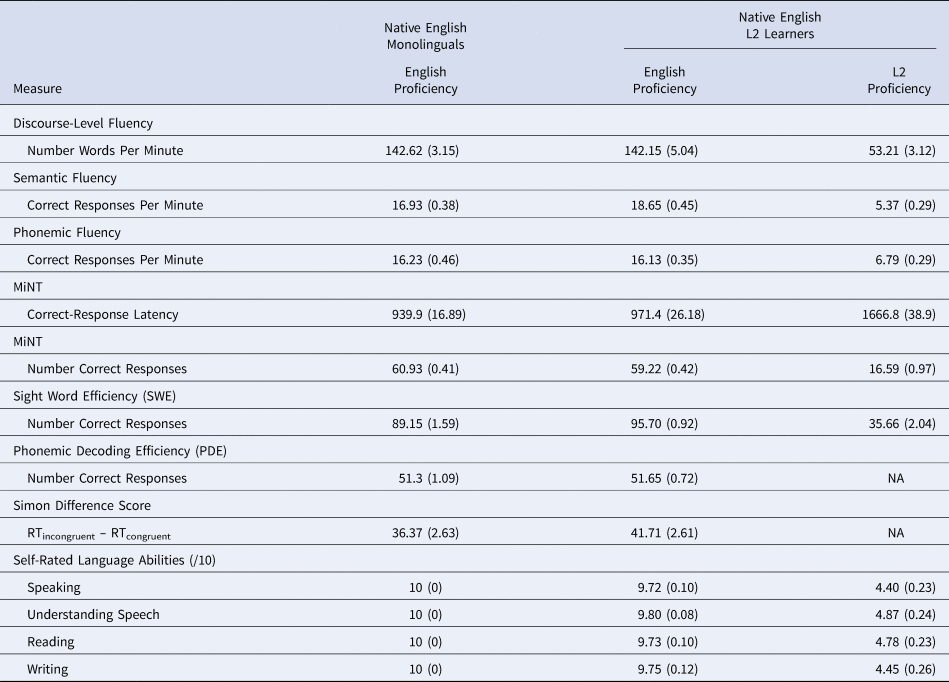
Fifty-two college-aged native English speakers (13 male, mean age = 21.3, age range = 18–30 years) immersed in the English-speaking environment of the US, who varied on measures of language production (Table 1), but reported normal hearing, normal or corrected-to-normal vision and no history of neurological, language, reading or learning disorders were recruited from the University of Missouri and completed the study for payment. Participants were functionally monolingual in English, having had no exposure to an L2 before the age of six, less than four years of formal L2 study, no current enrollment in an L2 course and no study abroad experience.
Mean (Standard Error) psycholinguistic data for native English monolinguals and native English L2 learners.

Materials and procedure
Participants completed a set of tasks presented electronically using the E-Prime 2.0 software (Psychology Software Tools Incorporated, 2012) that measured (1) spoken word recognition, (2) spoken word production, (3) vocabulary knowledge, (4) reading skill, (5) cognitive control and (6) proficiency self-ratings, in this order. Each task is described below.
Spoken word recognition
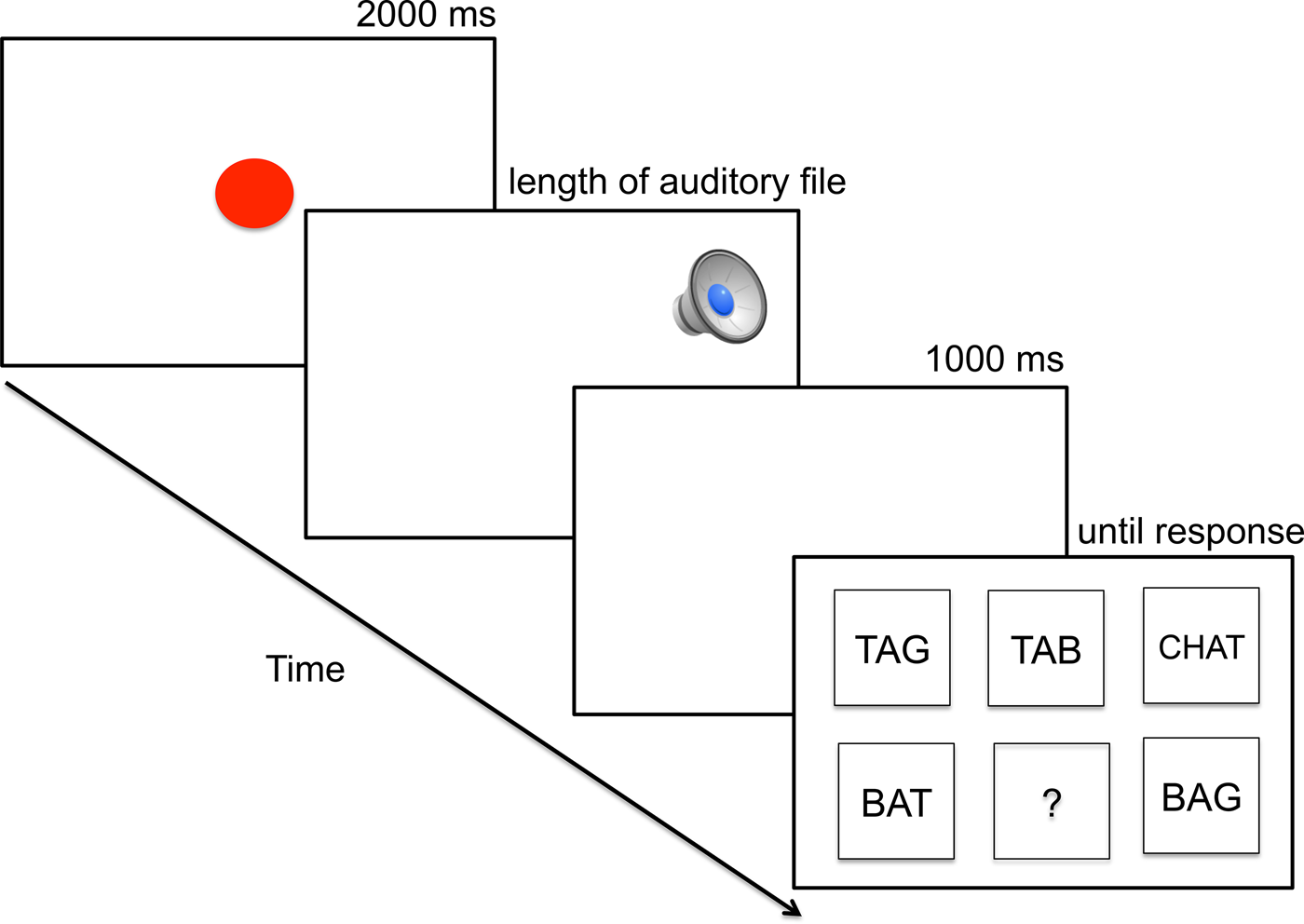
Spoken word recognition was measured using a spoken-to-written word-matching task modeled on the identification of words in noise procedure employed by Luce and Pisoni (Reference Luce and Pisoni1998) and previously used with younger and older healthy adults (Botezatu et al., Reference Botezatu, Landrigan, Chen and Mirman2015) and individuals with post-stroke aphasia (Botezatu & Mirman, Reference Botezatu and Mirman2019). The materials and task procedure were described in full detail by Botezatu and Mirman (Reference Botezatu and Mirman2019), who also provide the complete list of experimental stimuli. The task used 600 monosyllabic English words that were divided into 120 auditory-presented targets and 480 visually-presented distractors. Target words varied systematically in phonological neighborhood density, resulting in two conditions: 60 words with many phonological neighbors (dense condition: e.g., BAG) and 60 words with few phonological neighbors (sparse condition: e.g., BALL). Distractors were of three types: cohort neighbors, rhyme neighbors and unrelated (i.e., onset neighbors of rhyme distractors and offset neighbors of cohort distractors). The auditory targets were spoken by a female native speaker of American English and presented in a background of white noise to make word recognition more difficult. Audio recordings were normalized at 60 dB and then 62 dB of white noise were added digitally over the entire length of the recording, creating a signal-to-noise ratio of −2dB. Figure 1 shows the trial event sequence. Each trial began with a 2000 ms preparation screen, followed by a randomly-selected auditory stimulus presented over headphones. To allow spoken word recognition to occur without bias from visually-presented response options (e.g., Chen & Mirman, Reference Chen and Mirman2015), a 1000 ms blank screen followed the auditory target. Each trial ended with a 2 x 3 array of response options that remained on the screen until a response was made. The locations of the response options on the screen were randomized on each trial. Participants were instructed to select the cell containing the word they heard using a mouse with their right (dominant) hand. This differed from the procedure reported by Botezatu and Mirman (Reference Botezatu and Mirman2019), who tested stroke patients and had them respond using the left hand due to right side hemiparesis. Participants were encouraged to select the “?” response option whenever they were unable to recognize the target from among the other response options, analogous to responding “I don't know” in the free-response version of the task. A set of 20 practice trials preceded the experimental set. RTs and accuracy rates were collected on each trial. Absolute outliers (trials with responses slower than 4000 ms) and relative outliers (trials with average response latency ±3 standard deviations from participants and items means) were excluded.
Trial event sequence of the spoken-to-written word-matching task.

Spoken word production
Discourse-level fluency was assessed in semi-structured contexts (picture description task) and structured contexts (story tell task). In the picture description task, participants described the Cookie Theft scene from the Boston Diagnostic Aphasia Examination (Goodglass & Kaplan, Reference Goodglass and Kaplan1983) and the Picnic scene from the Western Aphasia Battery (Kertesz, Reference Kertesz1982). In the story tell task, participants told two stories (“Cinderella” and “The Little Red Riding Hood”) after reviewing the story plot using a picture book. Participants had five minutes to complete each randomly-selected description and narrative trial. The resulting language samples were transcribed offline from audio recordings by trained independent raters. A discourse fluency score was computed for each participant as the average number of words per minute produced across the picture-description and story-tell tasks.
Word-level production fluency was assessed using a minute-long semantic fluency task (Delis, Kaplan & Kramer, Reference Delis, Kaplan and Kramer2001) that required retrieval of lexical items belonging to a named semantic category (animals, clothing, furniture, fruits) and a phonemic fluency task (Delis et al., Reference Delis, Kaplan and Kramer2001) that required retrieval of words that begin with a certain letter (F, A, or S). On each task, participants’ score reflected the average number of correct responses, excluding repetitions (simple or inflected), proper names and words in the non-target language.
Vocabulary
Expressive vocabulary was assessed using a computerized version of the Multilingual Naming Test (MiNT, Gollan, Weissberger, Runnqvist, Montoya & Cera, Reference Gollan, Weissberger, Runnqvist, Montoya and Cera2012), which asked participants to name a set of 68 line drawings, preceded by five practice trials. On each trial, a sequentially-selected picture was presented for 5000 ms or until response onset. Each stimulus was followed by a 1000 ms blank screen. Participants were instructed to say “I don't know” if they did not know the name of a picture. RTs and accuracy rates were collected on each trial. Response accuracy was scored off line from audio recordings by independent raters. Individuals’ MiNT performance was scored in terms of number of correct-response trials and average correct-response latency.
Reading skill
Speeded sight word reading and phonemic decoding were tested using the Sight Word Efficiency (SWE) and Phonemic Decoding Efficiency (PDE) subtest of the Test of Word Reading Efficiency (TOWRE; Torgesen, Wagner & Rashotte, Reference Torgesen, Wagner and Rashotte1999). Both subtests measured the number of items read correctly within 45 seconds. To obtain a stable measure of reading, a composite reading score was computed for each participant by summing the number of correct-response trials on the SWE and PDE subtests.
Cognitive control
Individual differences in cognitive control were measured using the Simon task (Simon & Rudell, Reference Simon and Rudell1967). The task presented a blue or red square against a white background either on the right, center or left side of a computer screen, with equal probability of occurrence for each position. Participants pressed one of two color-coded keys on the standard keyboard to indicate the color of a square, irrespective of the location in which the square appeared. In the experimental trials, the square appeared on the same side as the correct-response button (congruent trials) in half of the trials, but on the opposite side in the other half (incongruent trials). In the filler trials, the square appeared in the center of the screen. By asking participants to attend to the color, but not the location of the square, the task measured their ability to ignore irrelevant information. RTs and accuracy rates were collected on each trial. A set of 24 practice trials preceded the 126 experimental trials. A Simon difference score was computed for each participant as the difference in mean correct-response latency between incongruent and congruent trials after absolute outliers (trials with responses faster than 200 ms or slower than 2000 ms) and relative outliers (average response latency ±3 standard deviations from participants or items means) were excluded.
Proficiency self-ratings
Participants provided information about language learning experience and self-rated their speaking, understanding, reading and writing ability in each known language on a scale from zero (no proficiency) to ten (native-like proficiency) using a computerized version of the Language Experience and Proficiency Questionnaire (Marian, Blumenfeld & Kaushanskaya, Reference Marian, Blumenfeld and Kaushanskaya2007).
Data analysis
On the spoken-to-written word-matching task, incorrect-response trials (representing 20.9% of the data) were excluded from the response latency data, but not from the response accuracy data. Then, absolute outliers (trials with response latencies above 4000 ms, representing 1.4% of the data) and relative outliers (trials with response latencies 3 standard deviations slower or faster than each participant or item mean RT, representing 0.9% of the data) were excluded. On the Simon task, incorrect-response trials (representing 2.3% of the data) were first removed and then absolute outliers (trials with response latencies below 200 ms and above 2000 ms, representing 0.05% of the data) and relative outliers (trials with response latencies 3 standard deviations slower or faster than each participant or item mean RT, representing 2.3% of the data) were excluded.
Correct-RTs for the spoken-to-written word-matching task were analyzed using linear mixed-effects models with random effects of participants and items (Baayen, Davidson & Bates, Reference Baayen, Davidson and Bates2008; Barr, Levy, Scheepers & Tily, Reference Barr, Levy, Scheepers and Tily2013). Response accuracy was analyzed using mixed-effects logistic regression. The analyses were implemented in R version 3.2.3 (R Development Core Team, 2016) using the lme4 package version 1.1-11 (Bates et al., Reference Bates, Maechler, Bolker, Walker, Bojesen Christensen, Singmann and Green2016).
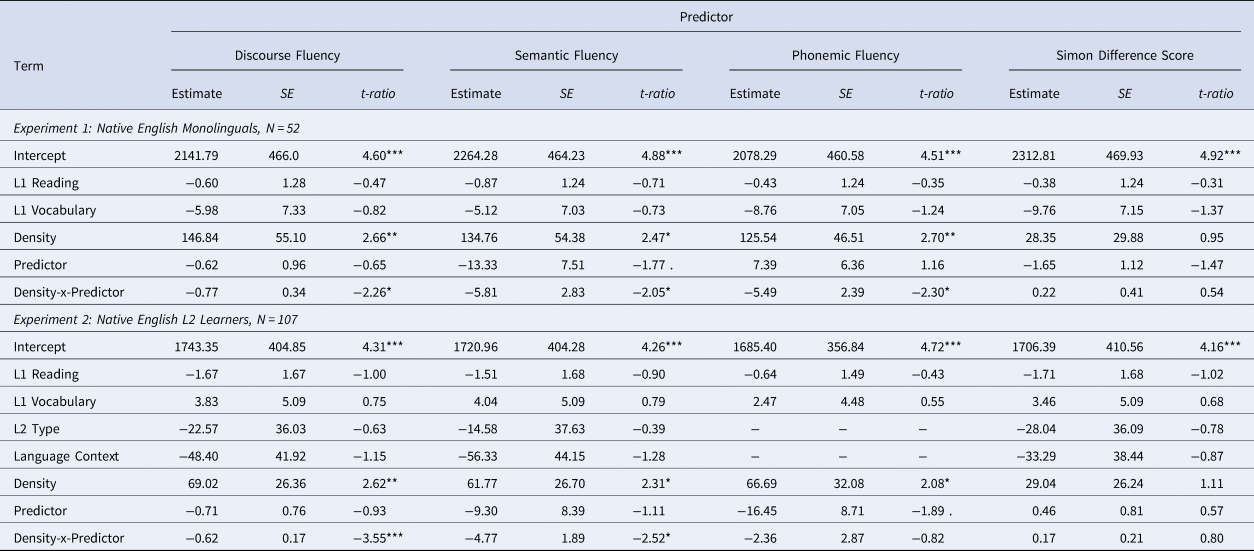
For each analysis, the base model included the fixed effect of neighborhood density (dense versus sparse), and a maximal random effect structure defined by the experiment design (Barr et al., Reference Barr, Levy, Scheepers and Tily2013), consisting of random effects of participants and items and by-participant and by-item random slopes of neighborhood density (dense versus sparse) and neighborhood type (cohort versus rhyme), and their interaction. Fixed effects were discourse, semantic and phonemic fluency, and Simon difference scores. Fixed effects were evaluated individually (in separate models), first in terms of their overall effects on RTs and accuracy rates (i.e., as a main effect), then in terms of their interaction with neighborhood density. This interaction term was the critical test of whether differences in language production fluency and cognitive control, respectively, modulate effects of phonological neighborhood density in spoken word recognition. Each model controlled for individual differences in reading skill and expressive vocabulary. Improvement in model fit for each of these steps was evaluated using the likelihood ratio test (χ2 test with degrees of freedom equal to the number of parameters added). For linear models, parameter-specific p-values were computed using the normal approximation (i.e., treating the t-value as a z-value; for discussion see Barr et al., Reference Barr, Levy, Scheepers and Tily2013). Parameter estimates for the full models are presented in Table 2.
Predictor models of response latency in native English monolinguals (Experiment 1) and native English L2 learners (Experiment 2).

p < 0.1; * p < 0.05; ** p < 0.01; *** p < 0.001.
Monolingual full model formula: RT ~ L1 Reading + L1 Vocabulary + Density x Predictor + (Density * Type + 1 | participant) + (Density * Type + 1 | item)
L2 learner full model formula: RT ~ L1 Reading + L1 Vocabulary + L2 Type + Language Context + Density x Predictor + (Density * Type + 1 | participant) + (Density * Type + 1 | item)
Results and discussion
Experiment 1 asked whether individual differences in language production fluency (operationalized as performance on discourse, semantic and phonemic fluency tasks) and cognitive control (operationalized as performance on the Simon task) among native English monolinguals were associated with variation in resolving competition from phonological neighbors in spoken word recognition. Table 3 shows participants’ average RTs and accuracy rates to English words from sparse versus dense phonological neighborhoods. Participants were slower to recognize spoken words from dense relative to sparse phonological neighborhoods, Estimate = 146.84, SE = 55.10, t = 2.66, p = 0.008, but equally accurate in recognizing words from each condition, Estimate = 0.05, SE = 0.31, z = 0.16, p = 0.88. This replicates the standard inhibitory effect of phonological neighborhood density in spoken word recognition (Luce & Large, Reference Luce and Large2001; Luce & Pisoni, Reference Luce and Pisoni1998; Magnuson et al., Reference Magnuson, Dixon, Tanenhaus and Aslin2007).
Mean (Standard Error) response latencies and accuracy rates to English words from sparse versus dense phonological neighborhoods in the spoken-to-written word-matching task.

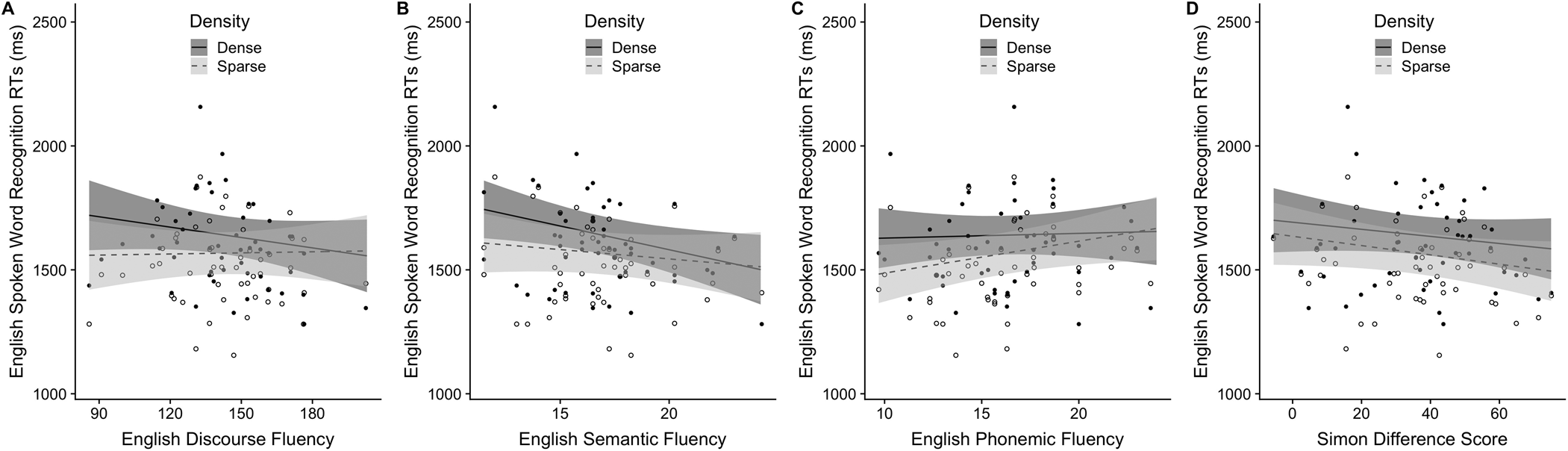
To determine whether language experience captured individual variation in lexical competition resolution, we examined whether discourse, semantic and phonemic fluency modulated the density effect on RTs. The main effect of neighborhood density on RTs was modulated by discourse fluency, χ2(1) = 5.08, p = 0.024, Estimate = −0.77, SE = 0.34, t = −2.26, p = 0.024, semantic fluency, χ2(1) = 4.20, p = 0.040, Estimate = −5.81, SE = 2.83, t = −2.05, p = 0.040 and phonemic fluency, χ2(1) = 5.23, p = 0.022, Estimate = −5.49, SE = 2.39, t = −2.30, p = 0.022. There was also a trend toward a significant main effect of semantic fluency, Estimate = −13.33, SE = 7.51, t = −1.77, p = 0.076. Participants who produced more words per minute in discourse, semantic and phonemic fluency tasks were more efficient in resolving competition among phonological neighbors in spoken word recognition (see Figure 2 Panels A, B and C). This result is consistent with evidence from aphasia that more fluent language production is related to more efficient resolution of lexical competition in spoken word recognition (Botezatu & Mirman, Reference Botezatu and Mirman2019).
Continuous model fits of response latencies to English words from dense relative to sparse phonological neighborhoods in English monolinguals as a function of English discourse fluency (Panel A), English semantic fluency (Panel B), English phonemic fluency (Panel C) and Simon difference scores (Panel D). Shaded areas indicate standard errors.

To determine whether the relationship between language production fluency and the efficiency of resolving lexical competition in spoken word recognition may engage domain-general control, we tested whether the Simon difference score also modulated the neighborhood density effect. The interaction between the Simon difference score and neighborhood density did not improve model fit, χ2(1) = 0.29, p = 0.593, Estimate = 0.22, SE = 0.41, t = 0.54, p = 0.592. Participants who had more difficulty in resolving competition from phonological neighbors in spoken word recognition did not also experience more difficulty in resolving competition from stimulus location in the incongruent Simon trials (see Figure 2 Panel D). The results are inconsistent with previous studies relating the efficiency of resolving lexical competition during spoken word recognition to individual differences in inhibitory control (e.g., Sommers & Danielson, Reference Sommers and Danielson1999; Taler et al., Reference Taler, Aaron, Steinmetz and Pisoni2010).
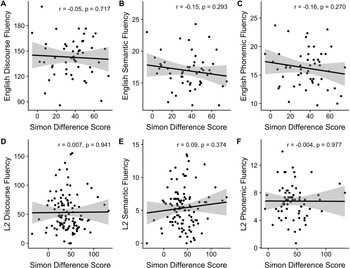
Furthermore, there was no significant correlation between Simon difference scores and discourse fluency, r = −0.05, p = 0.717, semantic fluency, r = −0.15, p = 0.293, or phonemic fluency, r = −0.16, p = 0.270 (see Figure 3 Panels A, B and C). Based on Simon task performance as the single index of domain-general processing in this study, we found no evidence that fluent language production may engage domain-general control mechanisms. This result is inconsistent with previous reports of an association between better cognitive control and higher discourse (Engelhardt et al., Reference Engelhardt, Nigg and Ferreira2013; Korko & Williams, Reference Korko and Williams2017; Pivneva et al., Reference Pivneva, Palmer and Titone2012) and verbal fluency (Bialystok et al., Reference Bialystok, Craik and Luk2008; Luo et al., Reference Luo, Luk and Bialystok2010; Suarez et al., Reference Suarez, Gollan, Heaton, Grant and Cherner2014).
Correlation scatterplot of English production fluency scores and Simon difference scores in English monolinguals (Panels A, B and C) and L2 production fluency scores and Simon difference scores in L2 learners (Panels D, E and F). Shaded areas indicate standard errors.

Summary of results
Experiment 1 revealed that higher discourse, semantic and phonemic fluency was associated with more efficient resolution of lexical competition in spoken word recognition, but that neither spoken word production nor spoken word recognition were related to Simon difference scores. Results suggest that more fluent language production may be linked to more efficient spoken word recognition. However, based on a single index of domain-general processing (i.e., Simon task performance), there was no evidence that the two processes may engage domain-general control mechanisms.
Experiment 2: sources of variation in L2 learners
Experiment 2 investigated whether individual differences in L2 production fluency (i.e., performance on L2 discourse, semantic and phonemic fluency tasks) and cognitive control (i.e., Simon task performance) among native English L2 learners were associated with variation in competition resolution dynamics in L1 spoken word recognition. Fluent L2 speech production has also been linked to efficient suppression of co-activated competitors from the irrelevant (native) language (Kroll et al., Reference Kroll, Bobb, Misra and Guo2008; Linck et al., Reference Linck, Kroll and Sunderman2009; Meuter & Allport, Reference Meuter and Allport1999; Misra et al., Reference Misra, Guo, Bobb and Kroll2012; Philipp, Gade & Koch, Reference Philipp, Gade and Koch2007) and engagement inhibitory control processes (Bialystok et al., Reference Bialystok, Craik and Luk2008; Korko & Williams, Reference Korko and Williams2017; Luo et al., Reference Luo, Luk and Bialystok2010; Pivneva et al., Reference Pivneva, Palmer and Titone2012; Suarez et al., Reference Suarez, Gollan, Heaton, Grant and Cherner2014). The resolution of lexical competition during L1 spoken word recognition is potentially complicated by L2 proficiency, as L2 learners must suppress temporarily co-activated competitors from both languages (Blumenfeld & Marian, Reference Blumenfeld and Marian2007, Reference Blumenfeld and Marian2013; Spivey & Marian, Reference Spivey and Marian1999). For example, when native English learners of Spanish hear the /k/ at the onset of the word “CALF”, they not only activate English phonological competitors such as “CASH” and “CAB”, but also available Spanish competitors such as “CASA” and “CAMA” that match the target word onset. There is ample evidence that bilinguals experience competition from cross-linguistic neighbors during L1 spoken word recognition (Blumenfeld & Marian, Reference Blumenfeld and Marian2007; Marian, Blumenfeld & Boukrina, Reference Marian, Blumenfeld and Boukrina2008; Marian, Spivey & Hirsch, Reference Marian, Spivey and Hirsch2003; Spivey & Marian, Reference Spivey and Marian1999), activating a wide network of similar-sounding words in the non-target language (Marian et al., Reference Marian, Blumenfeld and Boukrina2008) even when the linguistic environment is purely monolingual (Canseco-Gonzalez et al., Reference Canseco-Gonzalez, Brehm, Brick, Brown-Schmidt, Fischer and Wagner2010; Marian et al., Reference Marian, Blumenfeld and Boukrina2008; Marian & Spivey, Reference Marian and Spivey2003b; Mercier et al., Reference Mercier, Pivneva and Titone2014; Spivey & Marian, Reference Spivey and Marian1999). Co-activation of L2 competitors increases with L2 proficiency (Blumenfeld & Marian, Reference Blumenfeld and Marian2007, Reference Blumenfeld and Marian2013) and so does inhibitory control (Blumenfeld & Marian, Reference Blumenfeld and Marian2013). Employing an individual differences approach, Mercier et al. (Reference Mercier, Pivneva and Titone2014) reported that better inhibitory control among bilinguals was linked to less within-language competition during L1 spoken word recognition.
In Experiment 2, we sought to extend this research by evaluating whether variation in lexical competition resolution during L1 spoken word recognition was associated with individual variation in L2 production fluency and cognitive control among L2 learners. L2 learners who were more fluent in the L2 were predicted to be better able to resolve lexical competition from the native language and therefore exhibit smaller effects of phonological neighborhood density in L1-English spoken word recognition. Results from Experiment 1 suggested that monolinguals did not engage domain-general control mechanisms (indexed as Simon difference scores) in either spoken word production or recognition. However, evidence from Blumenfeld and Marian (Reference Blumenfeld and Marian2011) suggests that only bilinguals may engage domain-general inhibition to resolve within-language competition, even though both groups show similar within-language competition during L1 spoken word recognition. Therefore, if learners engage domain-general mechanisms of competition resolution to resolve within and cross-language competition, then individuals with better cognitive control might be expected to be more efficient in resolving competition from L1 and L2 lexical neighbors during L1 spoken word recognition and L2 spoken word production. Alternatively, if L2 proficiency merely increases the number of competitors, adding L2 competitors to the existing L1 competitors without training competition resolution, then L2 learners who were more fluent in L2 speech production might exhibit larger effects of phonological neighborhood density in L1-English spoken word recognition and no relationship between L2 fluency and cognitive control.
Method
Participants
One hundred seven native English speakers (29 male, mean age = 20.9, age range = 18–42 years) who were L2 learners of either a structurally-similar L2-Spanish (N = 68, 16 male, mean age = 20.6, age range = 18–42 years), or a structurally-dissimilar L2-Chinese (N = 39, 13 male, mean age = 21.2, age range = 18–30 years) were recruited from the University of Missouri and Beijing Normal University and completed the study for payment. The majority of L2 learners in the sample (68 learners of Spanish and 12 learners of Mandarin Chinese) were immersed in the English-speaking environment of the US Midwest and had no study abroad experience, while 27 learners of Mandarin Chinese had been immersed in a Chinese-speaking environment for an average of 6.4 months at the time of the study. All participants reported normal hearing, normal or corrected-to-normal vision and no history of neurological, language, reading or learning disorders. Learners had no exposure to an L2 before the age of six and less than four years of formal L2 study. Learners varied on measures of L2 production fluency (Table 1), but maintained L1-English dominance, (i.e., showing overall better performance on L1-English tasks than L2 tasks; all p < 0.001).
Materials and procedure
The materials and procedure were the same as in Experiment 1. Equivalent measures of spoken word production and expressive vocabulary were used in the two languages. Reading in the L2 was measured using a published Spanish equivalent (Miller et al., Reference Miller, Heilmann, Nockerts, Iglesias, Fabiano and Francis2006) and an in-house Chinese equivalent of the SWE subtest of the TOWRE. Phonemic decoding was assessed in English only. Phonemic fluency was assessed in Spanish (P, M or R), but not in Chinese due to no agreed-upon equivalent measure. Learners were tested in the L1 first and L2 last to avoid L1 inhibition following L2 performance (Levy, McVeigh, Marful & Anderson, Reference Levy, McVeigh, Marful and Anderson2007; Misra et al., Reference Misra, Guo, Bobb and Kroll2012).
Data analysis
On the spoken-to-written word-matching task, incorrect-response trials (representing 21.3% of the data) were excluded from the response latency data, but not from the response accuracy data. Then, absolute outliers (trials with response latencies above 4000 ms, representing 2.1% of the data) and relative outliers (trials with response latencies 3 standard deviations slower or faster than each participant or item mean RT, representing 0.7% of the data) were excluded. On the Simon task, incorrect-response trials (representing 3.2% of the data) were first removed and then absolute outliers (trials with response latencies below 200 ms and above 2000 ms, representing 0% of the data) and relative outliers (trials with response latencies 3 standard deviations slower or faster than each participant or item mean RT, representing 2.2% of the data) were excluded.
As in Experiment 1, data were analyzed using mixed-effects regression with fixed effects of neighborhood density, and included fixed effects of L2 discourse, semantic and phonemic fluencyFootnote 1 and Simon difference scores and random effects of participants and items and by-participant and by-item random slopes of neighborhood density (dense versus sparse) and neighborhood type (cohort versus rhyme), and their interaction. Fixed effects were evaluated individually, first in terms of their overall effects on RTs, then in terms of their interaction with neighborhood density. Fixed effect contributions to model fit were evaluated by likelihood ratio test. In addition to controlling for individual differences in L1-English reading and vocabulary, each model also controlled for L2 type (structurally-similar L2-Spanish versus structurally-dissimilar L2-Chinese) and language context (US versus China).
Results and discussion
Experiment 2 examined whether individual differences in L2 discourse, semantic and phonemic fluency and cognitive control among L2 learners were associated with variation in competition resolution dynamics in L1 spoken word recognition. Participants were slower to recognize L1 spoken words from dense relative to sparse phonological neighborhoods, Estimate = 69.02, SE = 26.36, t = 2.62, p = 0.009, but equally accurate in each condition, Estimate = −0.13, SE = 0.19, z = −0.70, p = 0.48 (see Table 2). This replicates the inhibitory effect of phonological neighborhood density in spoken word recognition reported in previous work (Luce & Large, Reference Luce and Large2001; Luce & Pisoni, Reference Luce and Pisoni1998; Magnuson et al., Reference Magnuson, Dixon, Tanenhaus and Aslin2007), as well as in Experiment 1.
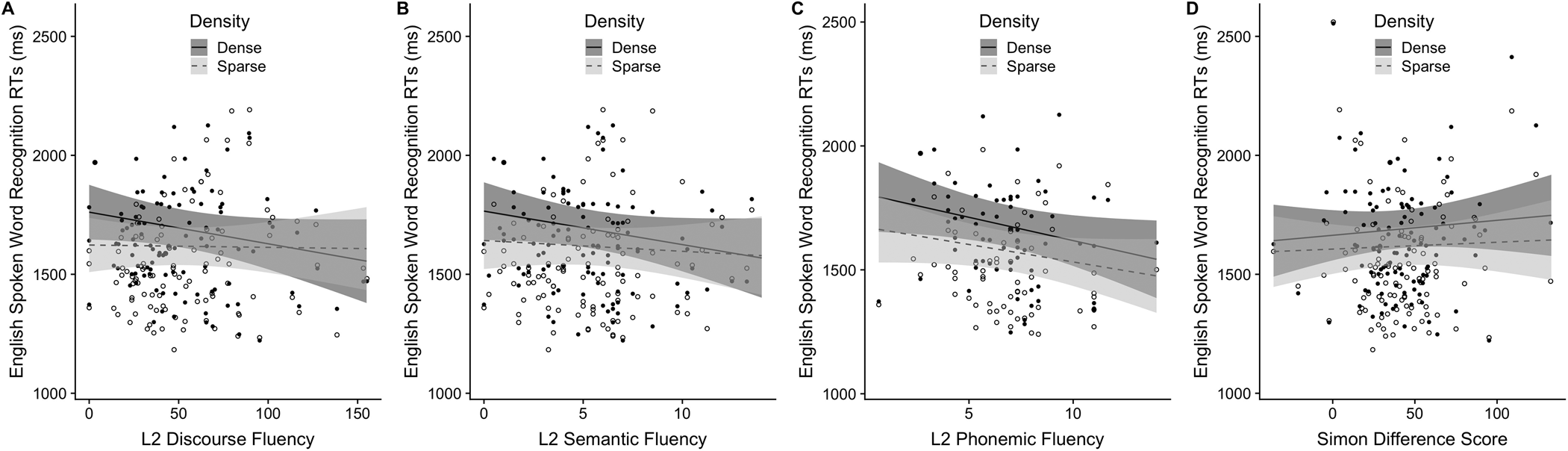
To determine whether L2 experience captured individual variation in L1 lexical competition resolution, we evaluated whether L2 discourse, semantic and phonemic fluency modulated the neighborhood density effect on RTs. The main effect of neighborhood density was modulated by L2 discourse fluency, χ2(1) = 12.50, p < 0.001, Estimate = −0.62, SE = 0.17, t = −3.55, p < 0.001 and L2 semantic fluency, χ2(1) = 6.31, p = 0.012, Estimate = −4.77, SE = 1.89, t = −2.52, p = 0.012, but the interaction with L2 phonemic fluency did not reach significance, χ2(1) = 0.68, p = 0.410, Estimate = −2.36, SE = 2.87, t = −0.82, p = 0.410. There was also a trend toward a main effect of L2 phonemic fluency, Estimate = −16.45, SE = 8.71, t = −1.89, p = 0.059. The lack of a significant interaction with L2 phonemic fluency should be considered in the context of a smaller participant sample, as this analysis was run on the sample of English learners of L2-Spanish only, since phonemic fluency was not assessed in L2-Chinese due to no agreed-upon equivalent measure. Learners who produced more L2 words in either discourse or semantic fluency tasks were more efficient in resolving competition among phonological neighbors in L1 spoken word recognition and therefore exhibited a smaller density effect on response latency (see Figure 4 Panels A and B). The results are consistent with previous evidence that bilinguals actively suppress their dominant language to produce the less dominant language (Guo, Liu, Misra & Kroll, Reference Guo, Liu, Misra and Kroll2011; Linck et al., Reference Linck, Kroll and Sunderman2009; Meuter & Allport, Reference Meuter and Allport1999; Misra et al., Reference Misra, Guo, Bobb and Kroll2012; Philipp et al., Reference Philipp, Gade and Koch2007). Additionally, by showing that individual differences in L2 production fluency were associated with individual variation in the efficiency of L1 lexical competition resolution within a group of L2 learners, we demonstrate that the evaluation of individual differences within L2 learner groups may be a potential alternative to group comparisons.
Continuous model fits of response latencies to English words from dense relative to sparse phonological neighborhoods in native English L2 learners as a function of L2 discourse fluency (Panel A), L2 semantic fluency (Panel B), L2 phonemic fluency (in L2-Spanish learners only; Panel C) and Simon difference scores (Panel D). Shaded areas indicate standard errors.

To determine whether the relationship between individual differences in L2 production fluency and the efficiency of resolving lexical competition in L1 spoken word recognition may engage domain-general control, we tested whether the Simon difference score also modulated the neighborhood density effect. The interaction between the Simon difference score and the neighborhood density effect did not improve model fit, χ2(1) = 0.64, p = 0.422, Estimate = 0.17, SE = 0.21, t = 0.80, p = 0.421 (see Figure 4 Panel D). The result is consistent with that reported in Experiment 1, but inconsistent with previous reports that bilinguals engage domain-general inhibition to resolve within-language competition during L1 spoken word recognition (Blumenfeld & Marian, Reference Blumenfeld and Marian2011; Mercier et al., Reference Mercier, Pivneva and Titone2014).
Additionally, there was no significant correlation between Simon difference scores and L2 discourse fluency, r = 0.007, p = 0.941, L2 semantic fluency, r = 0.09, p = 0.374, or L2 phonemic fluency, r = −0.004, p = 0.977 (see Figure 3 Panels D, E and F). Based on Simon task performance as the single index of domain-general processing in this study, we found no evidence that fluent L2 production may engage domain-general cognitive mechanisms. This result is inconsistent with previous research that associated higher L2 speech (Korko & Williams, Reference Korko and Williams2017; Pivneva et al., Reference Pivneva, Palmer and Titone2012) and L2 verbal fluency (Bialystok et al., Reference Bialystok, Craik and Luk2008; Luo et al., Reference Luo, Luk and Bialystok2010; Suarez et al., Reference Suarez, Gollan, Heaton, Grant and Cherner2014) with better inhibitory control. However, this pattern of results is consistent with the results reported in Experiment 1 and with a recent report that while more frequent L2 exposure was associated with better cognitive control (i.e., smaller Simon difference scores), Simon difference scores did not account for variance in L2 speaking proficiency among college-aged students who were in the early stages of L2 learning (Botezatu, Guo, Kroll, Peterson & Garcia, Reference Botezatu, Guo, Kroll, Peterson and Garcia2021).
Summary of results
Experiment 2 revealed that higher L2 discourse and semantic fluency was associated with more efficient resolution of lexical competition in L1 spoken word recognition, but that neither L2 spoken word production nor L1 spoken word recognition were related to Simon difference scores. Results suggest that more fluent L2 production may be linked to more efficient spoken word recognition within the L1. However, based on a single index of domain-general processing (i.e., Simon task performance), there was no evidence that the two processes may engage domain-general control mechanisms.
General discussion
Previous studies have compared monolinguals and bilinguals as a way of establishing the relationship between language experience and competition resolution. The current study assessed the role of language experience in shaping lexical competition resolution within monolingual and L2 speaker groups. Across two experiments, we demonstrated that language experience may be a source of individual variation in the efficiency of lexical competition resolution by evaluating within-language effects in monolingual speakers as well as cross-language effects in L2 speakers. In each group, we found converging evidence from single-word and discourse-level measures of fluency that more fluent language production was associated with more efficient lexical competition resolution in spoken word recognition. However, we found no evidence that the relationship may engage domain-general control, as indexed by Simon difference scores.
We report behavioral evidence that, even among monolingual native speakers of English living in a unilingual language environment, language experience is a source of individual variation in the efficiency of lexical competition resolution. Past studies have identified electrophysiological evidence of individual differences in lexical semantic (Newman, Tremblay, Nichols, Neville & Ullman, Reference Newman, Tremblay, Nichols, Neville and Ullman2012), syntactic (Pakulak & Neville, Reference Pakulak and Neville2010) and morphosyntactic processing (Tanner & Van Hell, Reference Tanner and Van Hell2014) among native English monolinguals engaged in detecting lexical semantic or grammatical violations in visually-presented sentences. The present study extends this research by showing that individual differences in native language processing may also be identified in the lexical domain, where higher proficiency among adult monolingual speakers is related to more efficient lexical competition resolution in spoken word recognition. The study critically demonstrates not only that individual variation in lexical processing may be captured using behavioral measures, but also that it can be observed in the auditory domain. This is important because, quantitatively, language experience reflects variation in spoken input more than variation in written input, as individuals spend on average more time listening to speech than reading. This work adds to a growing body of literature which suggests that, even among monolinguals, the native language is open to influences from multiple sources. The sources of variation may be individual, reflecting differences in language proficiency (e.g., Pakulak & Neville, Reference Pakulak and Neville2010), or contextual, reflecting differences in the way a particular language is used (e.g., Bice & Kroll, Reference Bice and Kroll2019).
Critically, we found behavioral evidence that L2 experience is a source of individual variation in the efficiency of L1 lexical competition resolution among L2 learners and that the cross-language relationship may occur independently of L2 type and language context. Previous studies have shown that individual differences in L2 processing indicate distinct stages of learning (Tanner, Inoue & Osterhout, Reference Tanner, Inoue and Osterhout2014; Tanner, McLaughlin, Herschensohn & Osterhout, Reference Tanner, McLaughlin, Herschensohn and Osterhout2013) and that bilinguals may be better than monolinguals in resolving cross-linguistic interference from the native language (Bartolotti & Marian, Reference Bartolotti and Marian2012). The present study demonstrates that individual differences in language experience predict the efficiency of L1 lexical competition resolution within the group of L2 speakers and that the evaluation of individual differences within L2 learner groups may be a powerful alternative to group comparisons. Based on the cross-sectional design of the current study, we cannot determine the direction of causality in this relationship. Future studies should employ longitudinal designs to elucidate whether L2 use fine-tunes lexical competition resolution within the L1, or whether individual differences in the efficiency of L1 lexical competition resolution predict L2 proficiency outcomes.
While we found converging evidence from single-word and discourse-level measures of fluency that more fluent language production was associated with more efficient lexical competition resolution in spoken word recognition in both monolinguals and L2 learners, there was no evidence from either monolingual or L2 speakers that spoken word production and recognition may engage domain-general control, operationalized as Simon task performance in the current study. These results are compatible with the proposal that spoken word production and recognition may involve a competitive lexical selection mechanism that may be specific to the language domain, such as direct lateral inhibition (Howard et al., Reference Howard, Nickels, Coltheart and Cole-Virtue2006; Snyder et al., Reference Snyder, Banich and Munakata2014). The results may be taken to support theories that postulate domain-specific resources (e.g., Fedorenko, Behr & Kanwisher, Reference Fedorenko, Behr and Kanwisher2011), and against theories that postulate that a domain-general inhibitory control mechanism may be shared by multiple systems (e.g., Snyder et al., Reference Snyder, Hutchison, Nyhus, Curran, Banich, O'Reilly and Munakata2010; Thompson-Schill et al., Reference Thompson-Schill, D'Esposito, Aguirre and Farah1997).
The larger issue of how cross-language competition is regulated to enable fluent performance and how that regulation may be related to aspects of domain-general control has been discussed in a number of recent papers (e.g., Kang, Ma, Li, Kroll & Guo, Reference Kang, Ma, Li, Kroll and Guo2020; Kroll, Tabori & Navarro-Torres, Reference Kroll, Tabori and Navarro-Torres2021). In the present work, the evidence for lack of a contribution from performance on the Simon task is consistent with the view that language processes may engage some, but not all, domain-general mechanisms of cognitive control (e.g., Luque & Morgan-Short, Reference Luque and Morgan-Short2021). We note that the Simon task was the only measure of cognitive control employed in the present study. It is possible that the Simon task may not be sufficiently demanding to capture individual differences in cognitive control in young adults, who are at the peak of their cognitive ability (Bartolotti, Marian, Schroeder & Shook, Reference Bartolotti, Marian, Schroeder and Shook2011; Costa, Hernández, Costa-Faidella & Sebastián-Gallés, Reference Costa, Hernández, Costa-Faidella and Sebastián-Gallés2009; Linck & Weiss, Reference Linck and Weiss2015). Future research should further test this relationship using a set of more complex and cognitively demanding measures of control (Kapa & Colombo, Reference Kapa and Colombo2014; Luque & Morgan-Short, Reference Luque and Morgan-Short2021; Paap & Greenberg, Reference Paap and Greenberg2013). It is also possible that reduced L2 proficiency may be the reason for the lack of a relationship between Simon task performance and language processing measures in this study. Previous research has shown evidence of enhanced cognitive control in highly proficient bilinguals (e.g., Kheder & Kaan, Reference Kheder and Kaan2021; Singh & Mishra, Reference Singh and Mishra2012). In the current study, bilingual participants reported reduced L2 exposure (i.e., less than four years of formal L2 instruction) and maintained L1-English dominance, suggesting that they may not have had enough practice retrieving the L2 to show differences in behavioral measures of cognitive control.
Taken together, the results suggest that language experience reflects a reliant source of variation in lexical retrieval efficiency among monolingual and L2 speakers and that use of any language, not only one's native language, may train the lexical selection mechanism, improving its efficiency. This interpretation is consistent with previous work in language development (Pierce, Genesee, Delcenserie & Morgan, Reference Pierce, Genesee, Delcenserie and Morgan2017) and adult language processing (Pakulak & Neville, Reference Pakulak and Neville2010) suggesting that language experience results in more efficient processing of language (for a review, see Prat, Reference Prat2011).
Acknowledgements
This research was supported by a Catalyst Award and a Richard Wallace Faculty Incentive Grant from the University of Missouri and an Advancing Academic-Research Careers Award from the American Speech-Language-Hearing Association to M. R. Botezatu, as well as by Grant 31871097 from the National Natural Science Foundation of China to T. Guo. The writing of this paper was also supported in part by NIH Grant HD082796 and NSF Grants BCS-1535124 and OISE 1545900 to J. F. Kroll. We would like to thank Daniel Mirman for a helpful conversation, Kathleen Acord, Madison Backes, Ashley Bramer, Jennifer Calvin, Sierra Clemetson, Sarah D'Amico, Ryley Ewy, Laura Fry, Madison Hinmon, Jaclyn Johnson, Zeping Liu, Hanna Lowther, Sarah Marx, Carlos Martinez Villar, Allie Mitan, Xi Ren, Istvan Romhany, No-Ya Yu and Qiming Yuan for help with data collection, transcription and coding.