All living creatures exist with others in relationships – networks of ecological, biological, psychological and social interactions – that are ongoing and meaningful, and at some level affect their animate neighbours. This point seems so self-evident that it should not need stating. Yet in many instances both archaeologists and scholars within other disciplines remain mired within an anthropocentric metanarrative which serves the purpose of limiting the study of these relationships either to the human use, or to the (human) cultural construction, of non-human animals. That is changing. In arguing that a ‘shift . . . of emphasis to the live animal as an autonomous being with its own agency and even its known perspective on other species is long overdue’ (p. 116), Nick Overton and Yannis Hamiliakis offer a valuable contribution toward refining the ongoing archaeological re-examination of the potential gestalt of the human–animal social interface.
I agree that this project can move forward without a deeper critique of why zooarcheology is the way it is and why it is being left out of discussions of human–animal relations within the broader academy; I don't take issue with these omissions. However, as a means of suggesting some theoretical scaffolding and direction I would like to touch on a few of the various other ‘turns’ which have funded, or could fund, such an endeavour, and why they make me optimistic for the future of a social-zooarchaeological venture. I do this because, despite some caveats, I share with the authors an overall conviction that this project can and should be one of convergence rather than collision.
First, the authors situate their proposal within the ‘animal turn’, and this does not stand alone. It is worth noting that Euro-American political activism of the 1960s and 1970s broadly challenged power relations generally and fostered both concern with rights and advocacy for the oppressed, including the environment as an entity, and academic interest in the creation of such disciplines as feminist, queer, ethnic, ecological and environmental studies (cf. Birke Reference Birke2009, 2). Here, the animal rights movement led to philosophical challenges to the ethics surrounding the human use of animals (Singer Reference Singer2002), a point to which I shall return. The last quarter of the last century also saw ethology expanded to incorporate aspects of animal cognition into previously purely positivistic theory (Griffin Reference Griffin1984). Challenges to modernist ideas separating humans from animals and the environment (e.g. Latour Reference Latour1993) played a significant role in the development of a post-humanist ethic and research agenda aimed at decentring the human (Haraway Reference Haraway2003; Reference Haraway2008; Wolfe Reference Wolfe2003). At the same time, a large-scale move away from positivist epistemologies fostered by the ‘linguistic turn’ manifested in postmodernism and post-structuralism, and refined in our field within postprocessualism, created an essentialist–constructivist dualism. This debate is still very much in play within the growing multidisciplinary subdiscipline (arguably now a discipline in its own right) of animal studies. Here, to oversimplify a bit, Shapiro (Reference Shapiro2008) differentiates between animal studies where animals are absent referents within constructions that are entirely human – where most conventional zooarchaeolgies have been situated – and human–animal studies which may reach beyond human conceptions to the animals themselves. The approach of human–animal studies, then, brings into scholarly discussions animals ‘as such’ – as they ‘live and experience the world independently of our constructions of them’ (Shapiro Reference Shapiro2008, 9), ‘both as experiencing individuals and as species-typical ways of living in the world’ (ibid., 14). In other words, Shapiro has critiqued the animal-studies approach as moving from the objective to the (human) subjective, a shift that in the process excluded animal subjectivities. I read Shapiro to mean that one way around this is, essentially, to return to essentializing, because it is only through first understanding species-level ways of being that we can get at individual animal subjectivities and then from there to human–animal intersubjectivities.
Along these lines, Overton and Hamiliakis note that in ‘exploring the “otherness” of whooper swans as a species, there is a danger of implicitly suggesting homogeneity, in which all swans, whilst understood as having agency, were considered intrinsically the same’ (p. 124). While I appreciate the intent here to disengage from an anthropocentric stance, at the same time I applaud the authors’ use of biological and ethological references and personal experience to set up just such a ‘homogenized’ swan-ness. I suggest that we need neither consider such background disrespectful nor apologize for such essentializing, because swan-ness is important; it provides the ground on which the individual stands and can be understood.
I also bring up this constructivist–essentialist tension because it can be seen to correlate with similar tropes underlying interpretive and conventional zooarchaeologies respectively, and because I think it is one of the challenges a ‘transformed social zooarchaeology’ (p. 112) will need to address. Within the essentialist–constructionist binary, James (Reference James, Cochrane and Gardner2011, 127) notes that many interpretive archaeologists perceive ‘“Darwinians” [as] different, dreary, determinist, [and] therefore dodgy and probably dangerous’. While I consider my own work interpretive, reflexive and contextual, and while I recognize historical particularity and contingency, here I find myself pulling on both ends of this theoretical rubber band and compelled to necessarily venture into just such suspect territory. This is because if humans are fully plastic then nothing significant can be said about characteristics of human experience – human-ness – or, here, the collective state of swan-ness, in ways that would allow us to analogize human–animal relations in the present to those in the past, which seems to me a sensible and productive path to take (Albarella and Trentacoste Reference Albarella and Trentacoste2011; Argent, forthcoming; Broderick, forthcoming).
Another reason to bridge the constructionist–essentialist binary is that it rests upon the faulty assumption that while humans construct their worlds, animals act on instinct within theirs. Considering some animals as having agential qualities necessitates the acknowledgement that they can create contingent meanings. Conversely, when we relegate animal behaviours to instinct, we seemingly forget that humans, too, operate at this level. In this regard, however, it matters little if we characterize similarities in sociality as the product of agency or instinct, or whether the body shapes the mind or vice versa. What seems more on point is whether or not we can share sociality with the animals we find in archaeological settings, and can do so in a truly bidirectional way. I believe we can. I believe that a bit of critical essentializing can show that humans share a cluster of enacted needs that are indeed fundamentally pan-human, and arguably pan-social in that they may be shared with other social animals, and it is through these that interspecies sociality is possible.
To move this forward, what about ‘the social’ might be firmly stated? First, humans, along with various other species, are social animals, animals who rely on each other for collective coexistence. Gamble and Gittins (Reference Gamble, Gittins, Meskell and Preucel2007, 109) offer some characteristics of (human) social life that might be seen during any archaeological period: it is embodied; routinized; material and mutual, where interactions between agents and artefacts create and modify it; and hybrid, where ‘analytical distinctions between thing/person, animal/human, nature/culture are no longer supported because of the social relationship contained in the notion of hybrid’. We might we also agree that these are ‘non-discursive elements of social life’ (Hodder Reference Hodder, Meskell and Preucel2007, 38), and that virtually all, if not all, of these elements are shared between and among members of other social animal species. Within human–human or human–non-human shared worlds ‘the social’ consists of a series of selves sharing interpersonal-relational, phenomenological-corporeal, and ontological spaces – all fruitful areas of study for a social-zooarchaeological agenda. I suggest, further, that the substrate upon which these proceedings rest concerns the needs that push us toward others. Schutz (Reference Schutz1966) proposed one such model for humans by noting that we are driven to others, to the social, by needs for inclusion, affection and control, and I believe similar motives might be found in other social animals (see Argent Reference Argent2010). All of these elements of shared sociality can provide a foundation upon which to base an interspecies zooarchaeological ‘social’, in ways that allow us to move beyond tropes of human domination and subsistence schemes.
This work might consist equally of pulling the animal into the human social, while at the same time situating the human within our animal nature. If we are to indeed consider that barrier we have set up between us and them as entirely artificial, we might break away from the notion that humans operate in the world primarily using their capacity for higher cognition, while non-humans function by instinct alone and therefore these two social planes cannot intersect. Because when we put down our ‘work’ – whether that consists of turning off the computer, putting away the donkey or bringing home a deer for dinner – we find that the worlds of interconnectedness we inhabit are incredibly similar to those of other social animals and constitute another category of work entirely, the work, precisely, of being social animals. We travel across the landscape to find things to eat; we tend our children, mates and families; we visit and meet new people; we adhere to agreed-upon norms; we negotiate roles and statuses and agreements; we participate in collective action; we play and fight and teach and love. I am not suggesting animal social behaviours directly mirror human ones; we do these things in our own unique human ways and those ways vary considerably cross-culturally. I rather contend that there is enough overlap between behaviours, actions, intentions and needs that we can each understand a bit of what the other goes through. We see ourselves in other animals and, if we are open to these things, we recognize through their behaviour that they, too, see themselves in us. It is because of these shared elements that humans and non-humans can engage in relationships that are ‘sympatric’, an ecological term that refers to close interspecies associations that are social–behavioural, rather than biological (Lestel, Brunois and Gaunet Reference Lestel, Brunois and Gaunet2006, 158).
In stating that human socialities can be seen to correlate with non-human ones in this manner, I have set aside my concerns at both essentializing and anthropomorphizing, as is being done in the study of other realms of shared human–animal experience. As a parallel, acknowledging that at an emotional level ‘there are dog-joy and chimpanzee-joy and pig-joy, and dog-grief, chimpanzee-grief, and pig grief’ (Bekoff Reference Bekoff2006, 77) does not confuse these with human emotions. At the same time it does not discount their existence for fear of pejorative accusations of anthropomorphizing – an approach de Waal (Reference De Waal2001, 69) has termed ‘anthropodenial, the a priori rejection of shared characteristics between humans and animals when in fact they may exist, the concept of which operates to promote the human–animal dualism’. Rather, such comparisons focus on ‘continuities’ shared by social species while, at the same time, recognizing and respecting ‘discontinuities’, how animals differ from humans (Noske Reference Noske1997, 126).
This takes us to a second recent and important turn, the ‘affective turn’, where the exploration of human emotion has received considerable attention in the humanities, sciences and social sciences (Clough and Halley Reference Clough and Halley2007), and a bit in our own field (Argent Reference Argent2010; 2013; forthcoming; Tarlow Reference Tarlow2000; Harris and Sørensen Reference Harris and Sørensen2010). Regarding affective states, psychologists recognize that emotions can carry positive or negative valence. I suggest we could expand this in scale to the social, where behaviours might be classified upon a spectrum from prosocial to antisocial. I will not loiter on the reasons for this, but simply note that a vast and pervasive metanarrative across a variety of disciplines focuses on the antisocial to the exclusion of the prosocial. Speaking of this, for instance, within the field of science, Balcombe (Reference Balcombe2009, 208) notes that ‘discussions of animal sentience have been almost exclusively in the negative realm: pain, stress, distress . . . overlooking the positive qualities of their lives’. Outside the academy, television documentaries of grisly predator–prey encounters promote the notion that, to paraphrase Tennyson, nature is ‘red in tooth and claw’, cycling back into our belief that this is so. Within this metanarrative, antisocial tropes of objectification, hierarchy, domination are enmeshed with those of commodification and subsistence. This viewpoint ignores that what makes social animals social in the first place is that they are highly cooperative and, if we are to buy into Schutz's scheme of social needs expanded to include other social animals, seek not only control, but also inclusion and affection.
In response to this type of critique, within the affective turn a sub-turn we might term the ‘pro-social turn’ has emerged wherein empathy, cooperation and care are foregrounded as worthy of study. Aspects of this turn explore empathy, and how empathy serves to facilitate prosocial interactions in humans (e.g. Decety and Ickes Reference Decety and Ickes2009; Keltner, Marsh and Smith Reference Keltner, Marsh and Smith2010; Sussman and Cloninger Reference Sussman and Cloninger2011), in animals (Bekoff and Pierce Reference Bekoff and Pierce2009; de Waal Reference De Waal2009) and in human–animal interactions (Argent Reference Argent, Smith and Mitchell2012), including those that are archaeologically visible (see Spikins, Rutherford and Needham Reference Spikins, Rutherford and Needham2010; also Argent, forthcoming, for a fuller discussion). While certainly we need not abandon topics such as hunting, butchering and consumption when their traces appear in the archaeological record, I suggest that allowing for the possibility of impactful interspecies interactions of a more positive, prosocial valence is one way that a revised social archaeology can indeed ‘revisit “economic” questions from a more productive angle’ (p. 117). If we can move past the trope of the human exploitation of animals, we see that they can mean more to us than dinner. Framed in this way the ‘capital’ exchanged within the interspecies social reaches well beyond the economic, where prosocial currencies – time, care, interest and cooperation, all shared within interspecies biographies and histories – have immense value to all social animal species, including our own. As convincingly put by Clark (Reference Clark, Cassidy and Mullin2007, 51), when concepts of ‘“giving,” “generosity,” “hospitality,” “care,” “affection” [and] “love”’ regain validity in contemporary thought, we can begin to ‘acknowledge that relations of giving and taking, caring and being cared for . . . are always already at play in the more official economies we partake in’.
Along these lines, Overton and Hamiliakis recognize that ‘non-human animals have the power and ability to elicit responses from people, including emotive responses’ (p. 114) and speak of ‘affective engagements’ (p. 134). Perhaps due to my own personal and intellectual trajectory, in their wonderfully rich discussion of the remains from Grave 8 at the Vedbæk-Bøgebakken cemetery I found myself wanting more. I found myself wanting – if only as qualified speculation – more about the potential nature of the affective engagements between this swan, this woman and this newborn child placed upon the swan's soft wingtip. I wanted more than practice and place, tasks and materials, and the suggestion that ‘the wingtip may have elicited memories of the experiences and places of hunting, killing, butchery and consumption’ (p. 134). Obviously a newborn would not have had the time to develop a relationship with this swan, but might there have been bonds – of friendship, companionability or protection – between this swan and this woman? Might the woman have raised or cared for the swan when young or ill or injured? Does this anomalous burial argue for a relationship that was anomalous as well, that extended beyond slaughter and tool-making?
I would like here to return to the essentials of swan-ness to explore their capabilities for relationships with a series of questions and answers. What are swans’ social worlds like – without humans? Their lives are embedded within flocks, but also families. They are gregarious birds who usually pair-bond for life, and care for and protect their young, and to do this they must recognize each other. If ‘each swan has the potential to be recognized as an individual’ (p. 124), might also each swan have the ability to recognize humans as individuals, as do horses (Stone Reference Stone2010) and, perhaps more pertinently, crows (Marzluffa et al. Reference Marzluffa, Wallsa, Cornella, Witheya and Craig2010)? Can and might individual swans share bonds with humans? Other social animals can and do bond with other species; many lonely racehorses are given goats or donkeys as ‘pets’, and bond deeply and behave protectively with them and with humans. With these points in mind, it might be highly significant that this infant was not placed upon the swan's wing, but precisely upon the wingtip, the body part used by swans to communicate ‘in the highly social practice of “carpal flapping”, where the wings are held outstretched shaking their tips in expression of bonding between individuals’ (p. 134), perhaps materially evoking ideal, if not actual, bonds of care, kindness and protection within this burial.
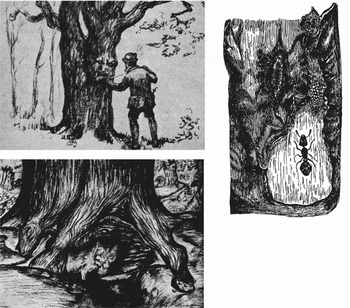
Questions like those I have raised are not inaccessible once ‘the social’ is expanded to encompass more than the ‘human social’. I think the authors would agree with me that bridging the binary of (animal) nature as opposed to (human) culture to postulate an interspecies, cocreated ‘social’ cannot consist merely of the human side of the equation. As Hill (Reference Hill2011, 410) notes, ‘Societies that conceive of animals as other-than-human persons are attributing to them what the philosophy of mind terms “phenomenal consciousness” – the ability to experience the world in qualitative, subjective and experiential ways.’ A true social zooarchaeology seems to invoke a similar type of perspectivism, one that might productively send us deeper into previously unfamiliar, subjective animal lifeworlds and minds in challenging and exciting ways, one that allows for an animal's Umwelt, ‘phenomenal world’ (von Uexküll Reference Von Uexküll and Schiller1957, 5; see figure 1), and also its Innenwelt, ‘inner world’. Although I am happy to include my work dealing with how smaller-scale interspecies interpersonal relationships feed into larger social structures under an umbrella termed social zooarchaeology, perhaps here the addition of the prefix ‘inter-’ – as in ‘intersocial zooarchaeology’ – might serve to remind us that what we are attempting to get at is interspecifically bidirectional, inclusive and intersubjective.
A forester's, fox's and ant's perceptions of an oak tree (von Uexkill 1957, figures 46, 48, 50)

In sum, I believe Overton and Hamilakis have raised points that will continue to be extremely provocative in the best possible way. In closing I would like to backtrack to one final turn, the ‘political turn’ in archaeological theory concerned with the taking up of alterity, power, control, colonialism and exploitation both in the present and in the archaeologically visible past. Insofar as this manifesto is a declaration of principles, if we are to challenge anthropocentricism as a theoretical construct we might also recognize that from sociopolitical and postcolonial standpoints, animals today remain situated as Other to Western norms, subalterns within human worlds. Including animal others as impactful agents in our interpretations of past societies – doing intersocial zooarchaeology – requires a reassessment of our responsibility to animals in the present. Zooarchaeological narratives which portray animals in past societies as nothing more than unminded objects allow us to step back from our actions in the present. Such narratives about the past not only generate representations of reality, but also perpetuate the realities that those representations depict. In this way, they support a broader rhetorical vision which has the result of allowing the ongoing objectification and exploitation of animals in the present. If we are, as I enthusiastically agree with Overton and Hamilakis we should, to welcome animals into the human social as worthy of study, then might we not also welcome them into our schemes of social justice? If we are to advocate for a multivocality that includes animal voices, then including other animals in our efforts as the emotional, social and cultural agents they are – agents capable of both pain and joy, with their own agendas that both include and exclude us – not only provides a means to fresh interpretations of the societies that lived with them, it also is work we might do in good conscience.