INTRODUCTION
Let me start with the most important thing first. Basic ethics of intellectual property dictate that Thomas Lee is a posthumous coauthor of what I say here about two ancient burials he exhumed at Izapa in 1963, and he is so listed in that capacity for this and other reasons. That on record, much of what I propose is based on interrogating incomplete and ambiguous records Lee left and cannot for certain be construed to represent his views. We never discussed these burials or their significance. Thus, I write in the singular to assume responsibility for my speculations and do not pretend to speak for Lee on matters of interpretation. The effort here is unavoidably dialogic in that I mostly represent his view of the evidence in third-person perspective to counter my own.
In their summary history of ancient Izapa, Lowe, Lee, and Martínez (Lowe et al. Reference Lowe, Lee and Martinez Espinosa1982) made two modest claims for Teotihuacan influence at this site that appear somewhat dismissive. They noted that the Teotihuacan-like ceramic vessels at Izapa are local wares and that clear Teotihuacan influence was limited to the Middle Classic period Loros phase (estimated as a.d. 500–600). Their view privileged ceramic artifacts over all other artifacts. I argue that obsidian objects found with two burials indicate direct contact with peoples of Teotihuacan before this time. The nature of any contacts between peoples of Izapa and Teotihuacan, or intermediaries, remains to be worked out. In evaluating possibilities, it would help to have all the evidence. We call attention to obsidian artifacts of Teotihuacan origin and style at Izapa that heretofore have not been recognized or reported. These artifacts add a bit to the overall picture of Teotihuacan influence on the Pacific Slope of Chiapas and Guatemala.
The artifacts we find particularly interesting are a long, bipointed biface or “laurel-leaf” knife of Pachuca obsidian found in the burial labeled “Feature 30” and a long string of 1,158 Pachuca obsidian beads made from perforated pressure blade segments found with the burial labeled “Feature 52.” These artifacts were made by artisans associated with the Teotihuacan polity and merit detailed description in their own right, but that is not our purpose here. We report them with their burials as individual items, among many, to provide a modicum of cultural context for these artifacts, as well as for Izapa in its global setting in Middle Classic times. It is significant that these items made it to Izapa, and stayed there, and even more significant that they were placed in graves of honored dead in temple platforms in Group F.
The following descriptions and illustrations of the durable offerings of these two Classic burials add to the knowledge of Teotihuacan influence at Izapa. As defined by Lowe et al. (Reference Lowe, Lee and Martinez Espinosa1982:146–147), Burial F-30 dates to the Kato phase (a.d. 400–500), and Burial F-52 dates to the Loros phase of the following century. In his coordination of Mesoamerican chronologies, Lowe (Reference Lowe, Taylor and Meighan1978:376) stated that the Teotihuacan style was “clearly dominant” at Izapa for the period a.d. 450–600. To support this claim, he cited Lee's (Reference Lee1973) paper on Izapa's “post-Formative” ceramic sequence and its description of Loros-phase slab-leg cylinder vessels with lids, elaborate vessel forms that clearly copied Teotihuacan models. Although lidded cylinder tripods were a novel form of pottery at Izapa beginning in Loros times, Lowe et al. (Reference Lowe, Lee and Martinez Espinosa1982:147) clarified that no “Teotihuacan trade ware has been identified at Izapa … only local imitations of the style characteristics, and none of these outside of Group F.” The implication of their observation is that residents of Izapa copied Teotihuacan objects, but not that faithfully, and did not have access to the genuine articles. Such bowl deprivation may eventually prove to have been the case, but it is too early to tell based on the mortuary offerings from a few burials. It is worth stressing the logical point that their view privileged pottery over other artifacts. The pots they illustrate as faux Teotihuacan pottery (Lowe et al. Reference Lowe, Lee and Martinez Espinosa1982:Figures 7.21, inset, and 7.22i) came from Feature 52. As described here, more compelling evidence of Teotihuacan contact is seen in obsidian artifacts. The obsidian and dark red stone bead necklace found with Burial F-52 is vastly more impressive than any of the copycat pots.
We restrict our focus to basic description and reporting, rather than get entangled in the global case for Teotihuacan's empire. We begin with background to the excavations at Izapa and Group F and then describe the two burials and their contents. We then conclude with comments about the possible significance of these burials for understanding Middle Classic Izapa. The inspiration and guidelines for these comments come from Spence's (Reference Spence1996) analysis of the significance of Teotihuacan obsidian artifacts in the Maya area.
EXCAVATIONS IN GROUP F
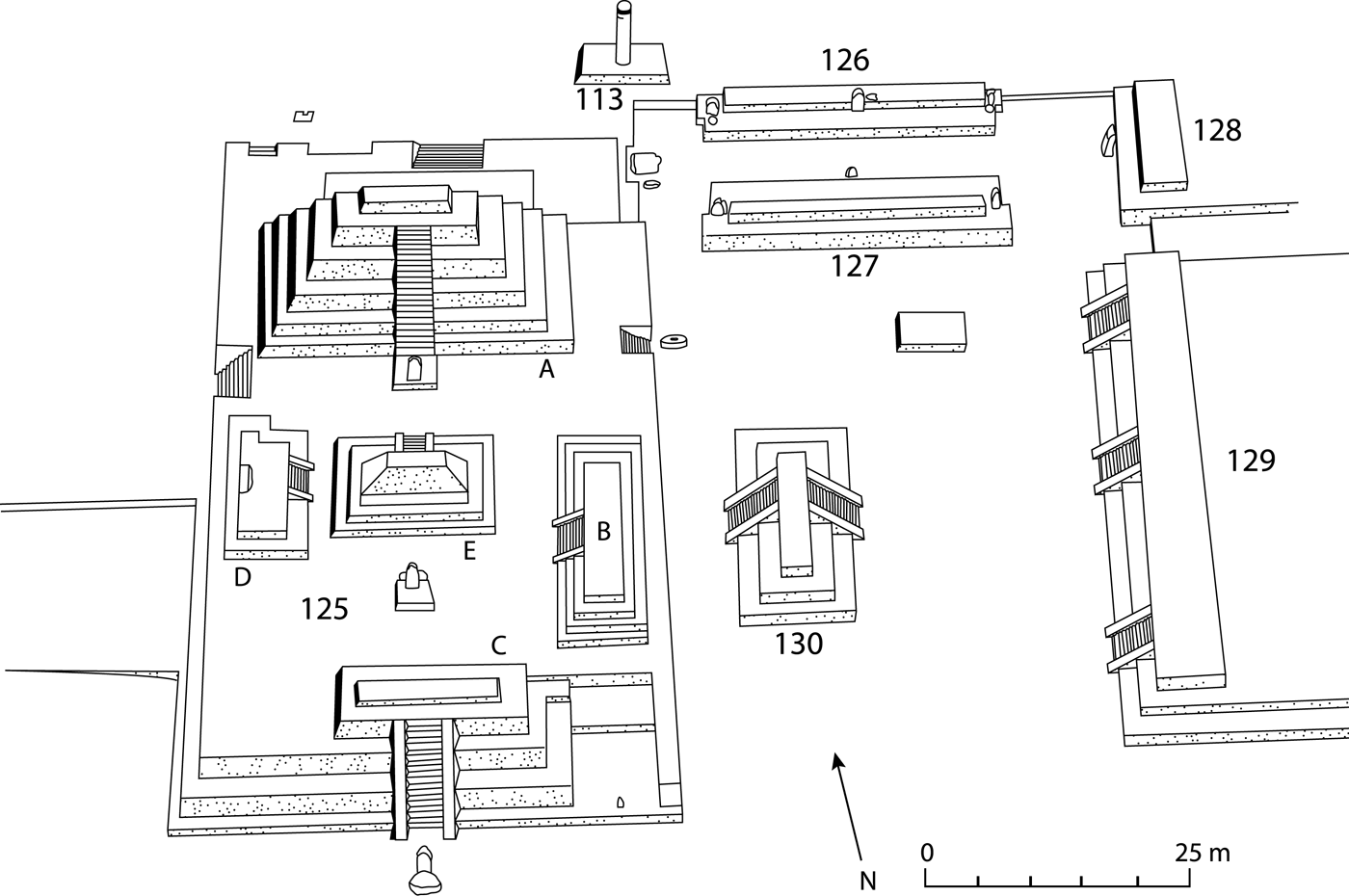
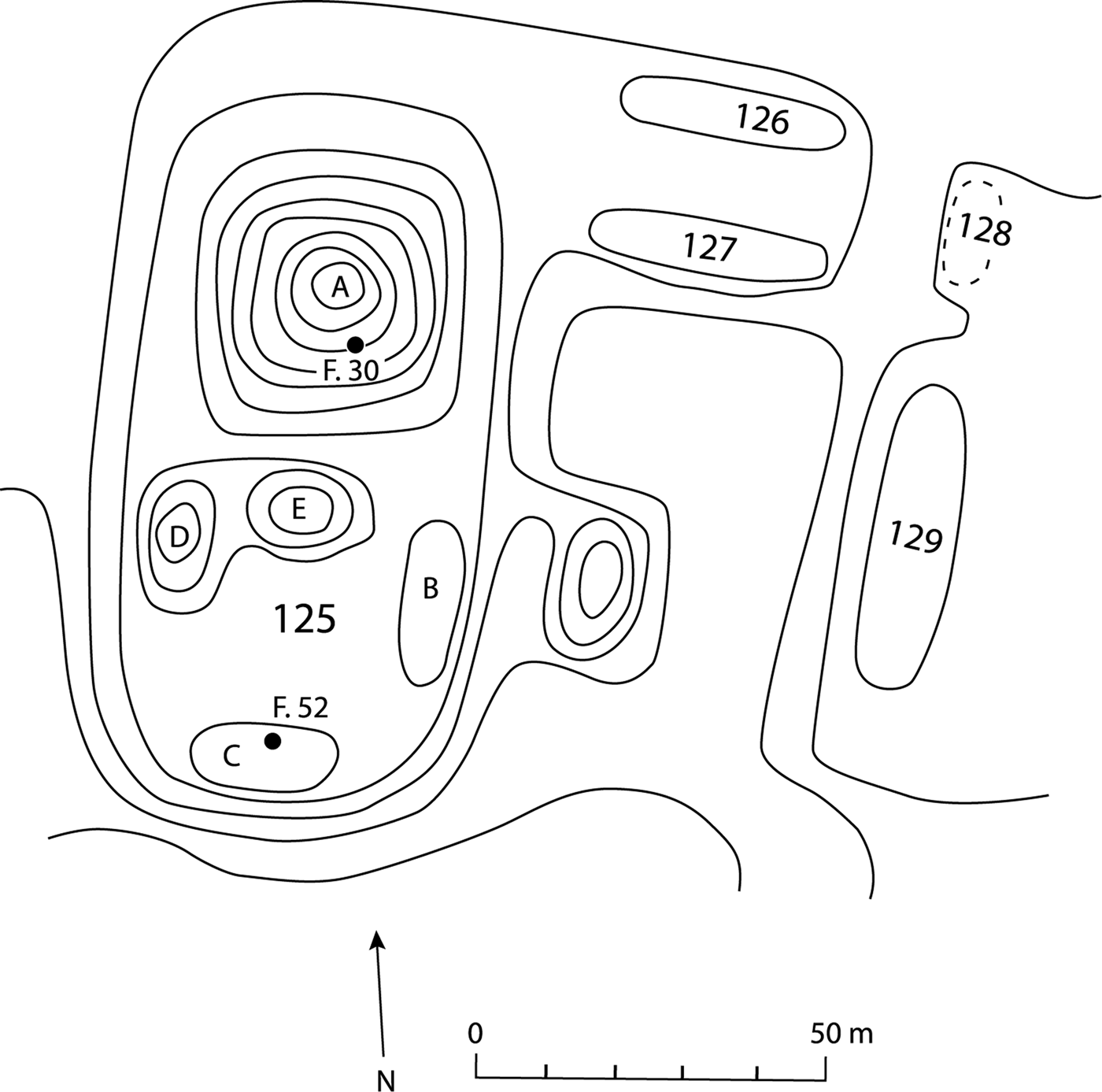
The data presented here come from work undertaken at Izapa (from November of 1961 to July of 1965) by the New World Archaeological Foundation (NWAF) under the direction of Lowe. The burials of interest were discovered in the northern sector of this site known as Group F. Most of the excavations in this group were under Lee's direction, and his was the responsibility for the final reporting of the work there. Excavations demonstrated that the occupational history of this mound group differed significantly from that of central Izapa to the south. The southern part of the site was built and thrived mostly in Preclassic times, and northern Izapa was built and occupied in Protoclassic and Classic times. Lee's (Reference Lee1973, Reference Lee1978) work in Group F came to concern the “post-Formative” occupation at this site (Lowe et al. Reference Lowe, Lee and Martinez Espinosa1982:224–245). As illustrated in Figure 1, Group F is a tight complex of low, cobble-faced platforms and plazas, with the dominant complex being a low basal platform or acropolis on which were built five platforms. The broad, basal mound has been designated as Mound 125, and the platforms on top of it are Mounds 125a–125e. Most of the mounds are located near the edges of the basal platform and thus define an interior plaza in the center of the acropolis. The small Mound 125e was built in the middle of this plaza and effectively divided it into northern and southern halves. Most of the burials and caches found at Group F were from the platforms on top of the base platform. Feature 30 was found in Mound 125a and Feature 52 was found in Mound 125c (Figure 2).
Overview of Group F. Reconstruction drawing by Eduardo Martínez, courtesy of the New World Archaeological Foundation (NWAF).

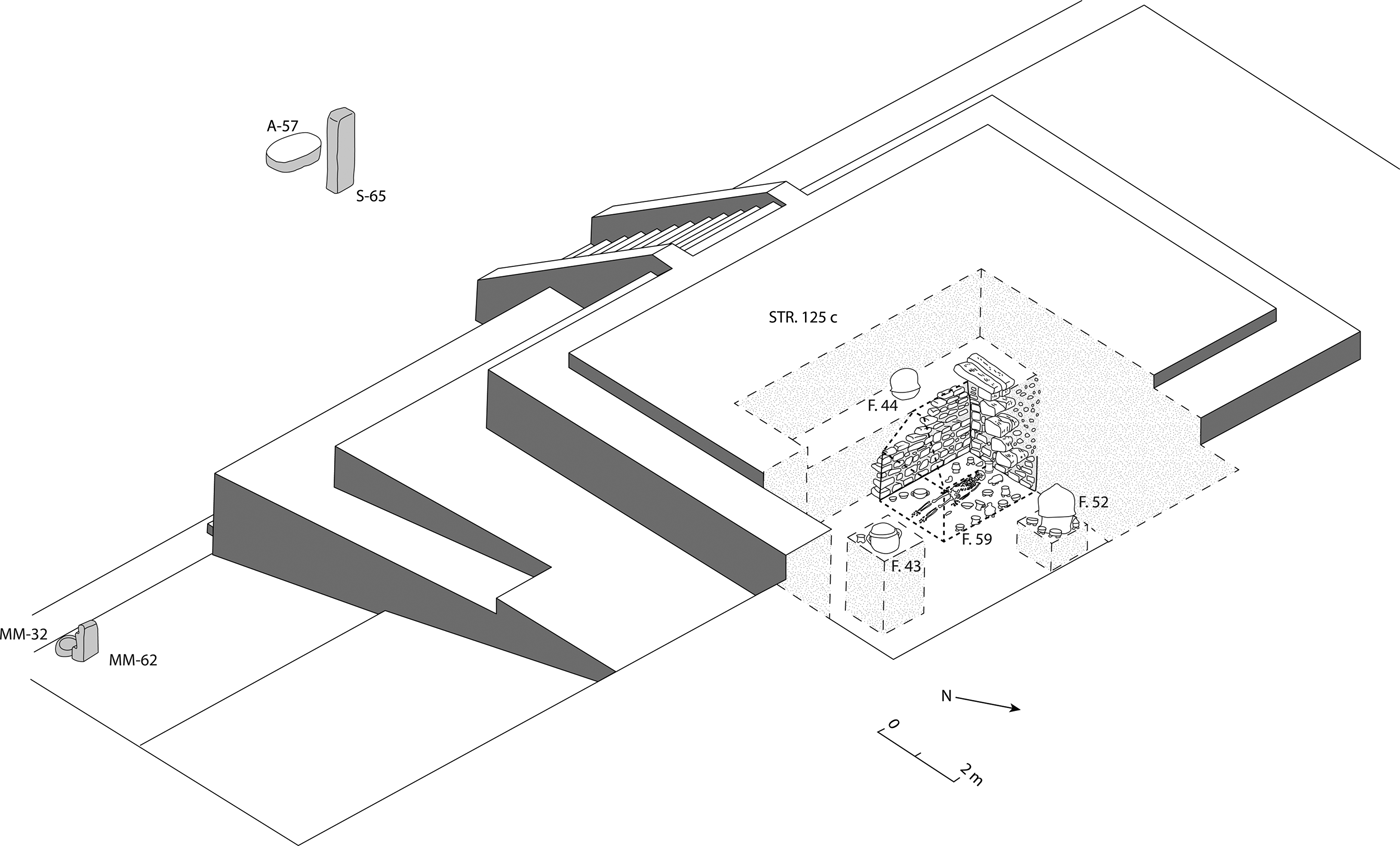
Plan of the Mound 125 complex in Group F, showing the locations of Features 30 and 52. Drawing by Eduardo Martínez, courtesy of the New World Archaeological Foundation (NWAF).

These are not the only burials found for their phases in Group F, but they are the ones identified so far with obvious Teotihuacan artifacts. Because of problems of preservation of human bone at Izapa, one cannot determine with certainty how many other features of the two phases of concern were actually burials coeval with the ones described here. In NWAF excavations at Izapa, all burials and caches were given a “feature” number because of the uncertainty in most cases of being able to determine whether a group of pots or other intentionally placed objects were burial offerings or votive offerings. Features 30 and 52 were considered to have been urn burials. The latter was unusual because fragments of adult human bone were actually found in the urn and make its identification as a burial certain. Sixteen features in Group F were recorded for the Loros phase, eight of which were likely burials. Of the 13 features for the earlier Kato phase, six were likely burials. These other burials and caches provide a broader cultural context for the two burials reported here. Lowe et al. provide brief summaries of the overall burial and caching patterns for the Kato and Loros phases in the 1982 Izapa report. For the Kato phase, they (Lowe et al. Reference Lowe, Lee and Martinez Espinosa1982:147) observed:
Four of the definite burials were in large urns, each with up to thirty other vessels. The [non-burial] votive caches included few vessels and rarely anything else; the urn burial furniture, on the other hand, nearly always included artifacts not made of clay, such as obsidian cores, blades and retouched lance heads, a single jade item, and small quantities of malachite, galena, and biotite mica [sic]. Other major objects were a slate mosaic mirror back, a quartz crystal, and a loop-handle “padlock” stone similar to those often seen carried by players in ball game scenes.
All these listed special items were found with Burial F-30 and were not characteristic of Kato burials in general. The offerings for other Kato burials were mostly ceramic vessels. The Loros-phase burial pattern was similar to that of the Kato phase, with the details differing in the content of rare artifacts found with burials: “[a]rtifacts other than pottery vessels in the Group F Loros-phase offerings include a tall cylindrical vase of marble with a tall pedestal base (in a near destroyed condition), an amber ring, obsidian blades, bird-effigy ocarinas, jade celts, pottery earplugs, small rectangular specular hematite pieces, tubular beads of dark red stone, and small obsidian disc beads” (Lowe et al. Reference Lowe, Lee and Martinez Espinosa1982:151). Some of these rare artifacts were found with Burial F-52.
BURIAL F-30
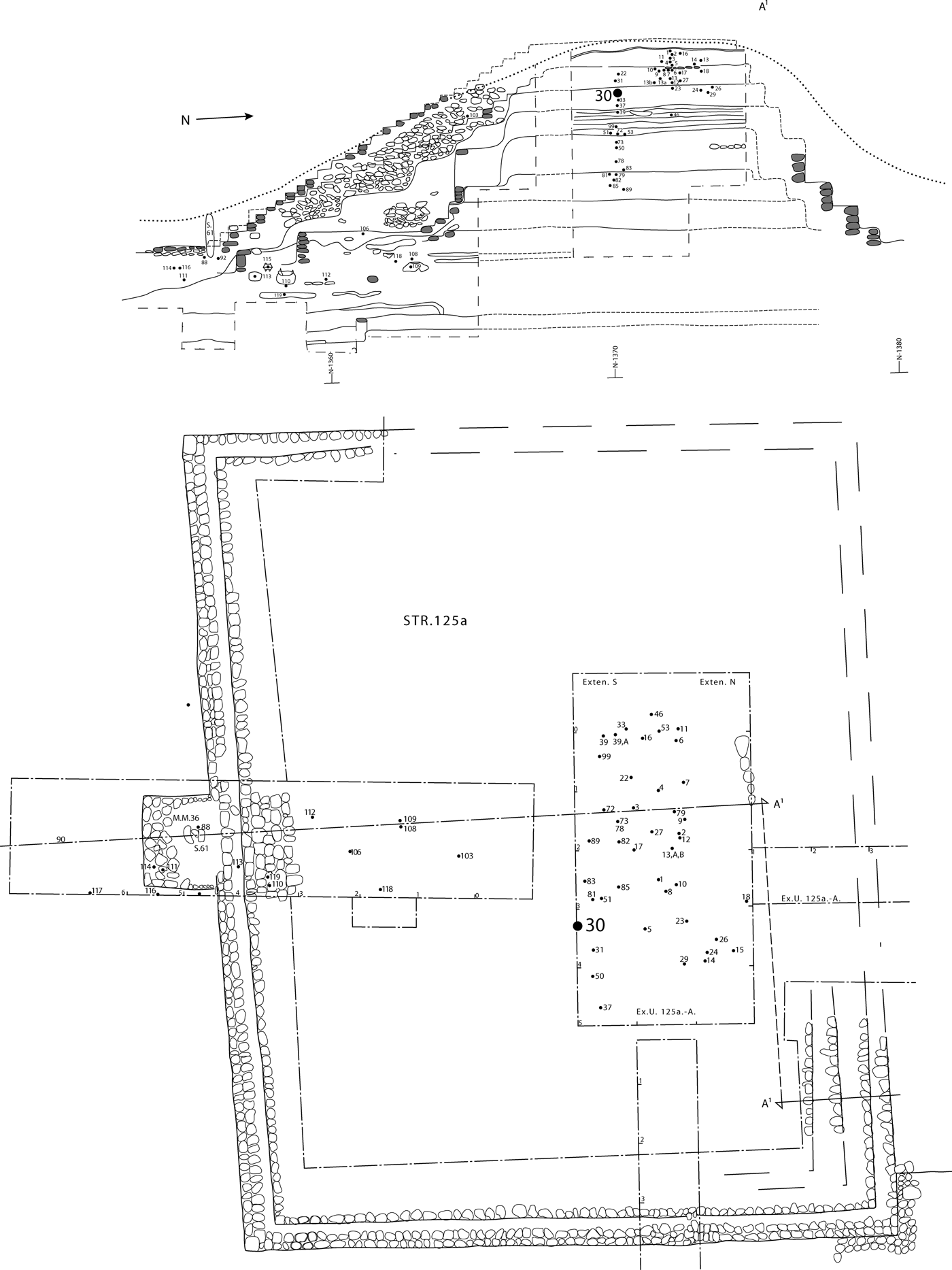
Feature 30 was located about 2 meters below the surface near the apex of Mound 125a, the tallest and largest mound in Group F. Numerous other features were located in close proximity to it, but separate from each other, thus most of these caches and burials must have had surface markers, at least for each floor, to avoid intruding offerings one on top of another. A 10 × 6-m test pit excavated through the summit of this mound recovered information on dozens of features with scores of restorable ceramic vessels that were critical in piecing together the late chronology for Izapa, including the Middle Classic period (Lowe et al. Reference Lowe, Lee and Martinez Espinosa1982:135–155). The locations of these features are shown in Figures 3 and 4. For Mound 125a, all the burials of the Kato and Loros phases were in the upper two meters. The vertical positions of these burials indicate that Mound 125a obtained most of its height prior to the Kato phase. Burials of this era do not appear to have been associated with episodes of structure renewal or significant building projects. There were two modest modifications of Mound 125a in Kato times that raised its height about 1.5 meters. Burial F-30 was intruded into the first Kato addition and hence was from the later Kato occupation (see Figure 3).
Plan and profile drawing of Mound 125a, showing the locations of all features. Drawing by Eduardo Martínez, courtesy of the New World Archaeological Foundation (NWAF).

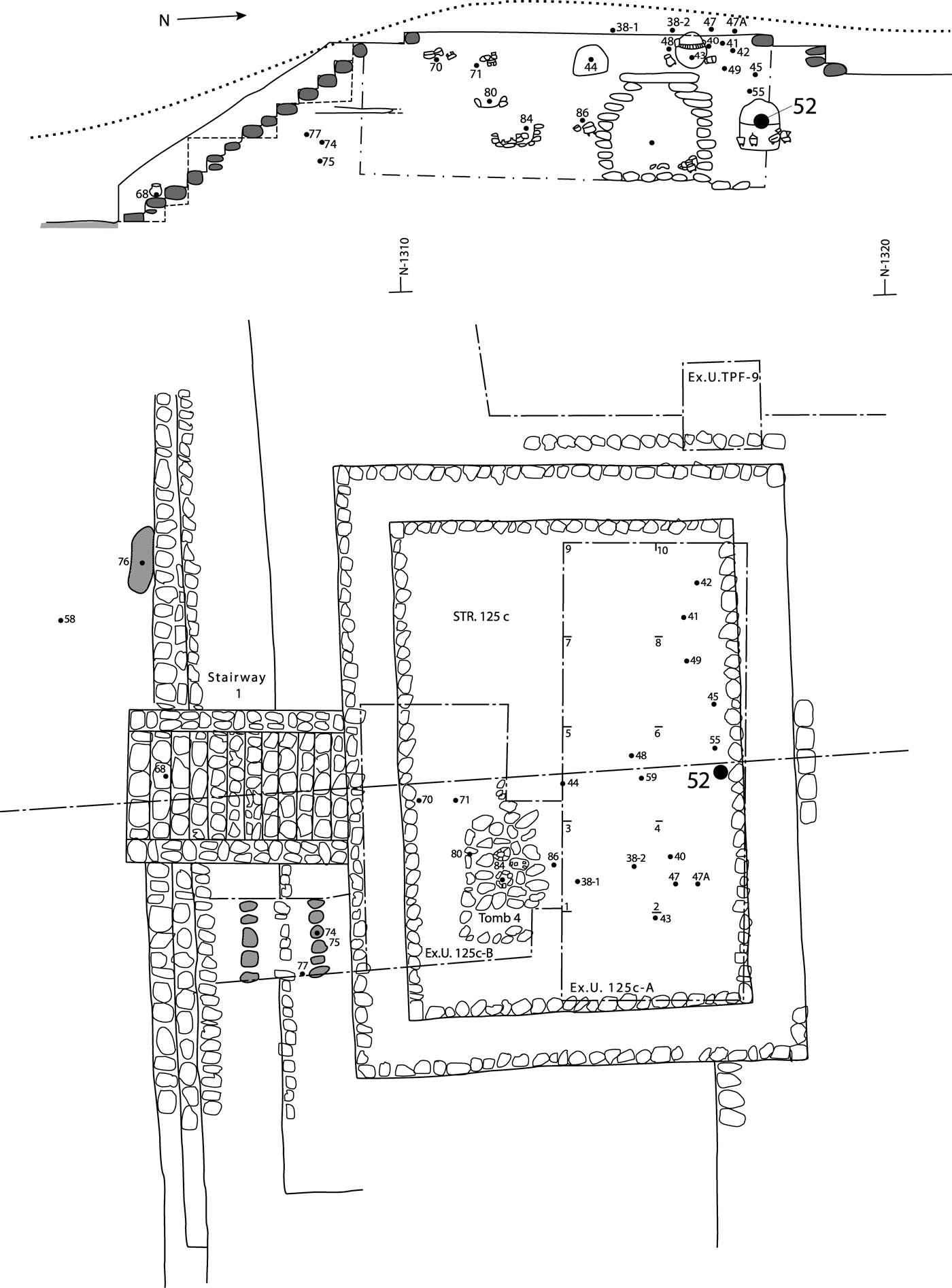
Plan and profile drawing of Mound 125c, showing the locations of all features. Drawing by Eduardo Martínez, courtesy of the New World Archaeological Foundation (NWAF).

Burial F-30 is considered an urn burial, but for reasons detailed below, it probably should be thought of as a burial with an included urn, or perhaps even a double burial. Burial in urns was a local practice at Izapa that started at least three centuries before the Kato phase (Lowe Reference Lowe1993; Lowe et al. Reference Lowe, Lee and Martinez Espinosa1982:191–196), as described by Lieske (Reference Lieske2018) in her article on Group B. Urn burial thus represented a continuity of cultural practices at Izapa and was not a signal of foreignness. Such signals may have been conveyed by the contents of some mortuary offerings.
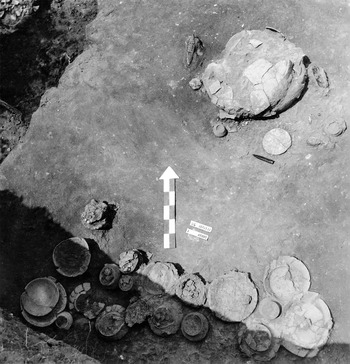
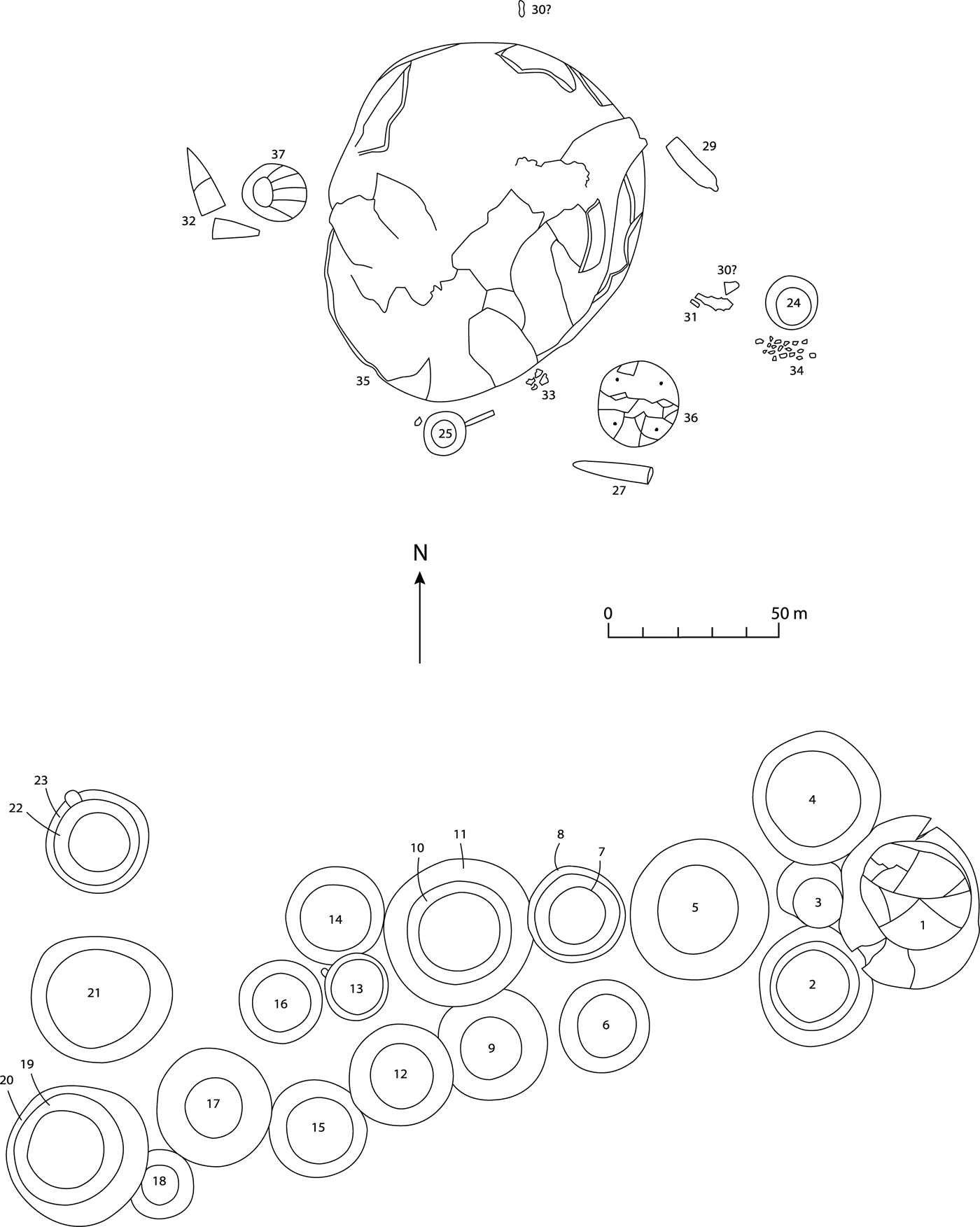
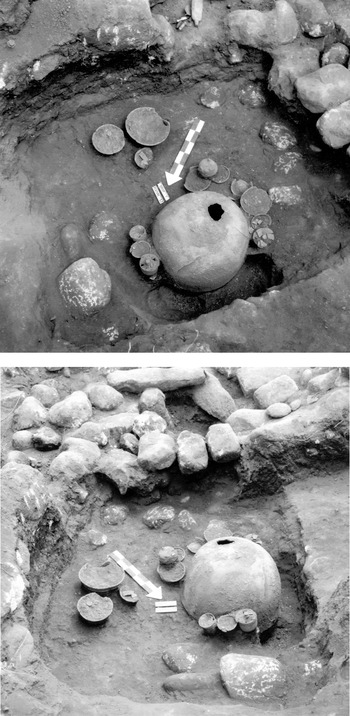
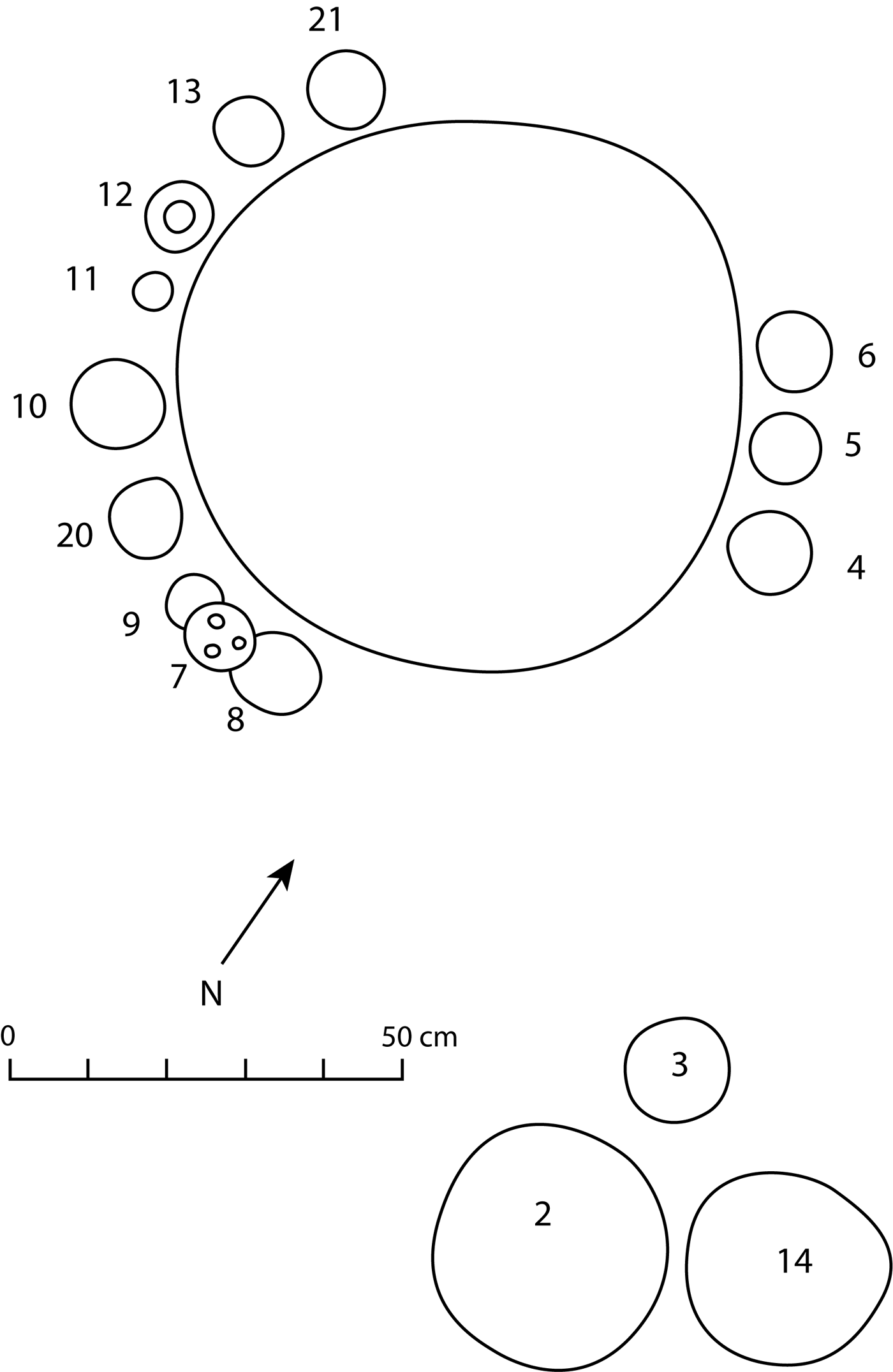
Burial F-30 was placed in a simple pit dug through the temple floor of Structure K2 of Mound 125a (see Lowe et al. Reference Lowe, Lee and Martinez Espinosa1982:245, Figure 13.17). It took up a lot of space and would have required an excavation about two meters square and one meter deep. As evident in the field photograph and drawing (Figures 5 and 6), the vessels of the burial offering clustered in two groups and were divided by a cleared area the size and shape of an adult human body. A similar cleared area among offering pots was noted for a Loros-phase tomb burial (see below) and is thought to be evidence of the placement of a body. I propose that the empty area between the clustered burial vessels in Feature 30 was the location of an extended burial. This possibility complicates the interpretation of this feature. It could represent two different burials: one extended and one in an urn. Given the size of the urn and the small diameter of its mouth, it would have been appropriate for a primary burial of an infant or for a secondary burial.
Photograph of Feature 30. Photograph by Mario Vega, courtesy of the New World Archaeological Foundation (NWAF).

Drawing of Feature 30, showing the location of all the offerings. From field drawings by Salvador Ordoñez, courtesy of the New World Archaeological Foundation (NWAF).

As detailed below, the burial goods of Feature 30 represent a complementary distribution of items. The line of pots on the south side of the burial extends just over two meters. The vessels were separated from the large urn by about 70 centimeters of clear space. If this vacancy had once been filled with a human body, the burial would have been oriented east-west, with the head likely pointed west and a pair of ceramic vessels just beyond the head position. It would also mean that the burial had not been accompanied with any durable, personal jewelry that would have been found in this space. All of the non-ceramic offerings associated with Burial F-30 were to the north of the empty alleyway and encircled the urn. I think an inverted bowl capped this crushed urn, as was the custom for urn burials. The two pots found near the urn are similar to many in the line of pots to the south and indicate their contemporaneity.
If two different burials constitute Feature 30, my guess is that the urn burial was later and intruded nearby. Whether one or two burials were interred as a single event, or two different events, cannot be determined after the fact. I think all the vessels were placed during the same event and represent one feature. The question is important because of the objects found in the two different clusters. Burial F-30 had four polychrome bowls imported from the Maya Lowlands (see below) and a long obsidian laurel-leaf knife of Pachuca gold-sheen obsidian chipped in Teotihuacan style and undoubtedly from there. The imported bowls were with the cluster of pots to the south, and the obsidian knife was with the stone objects to the north. The complementarity in the placement of these objects, and their symbolism, is good evidence they were part of the same event and that considerable care was taken in placing them in a meaningful way in the grave. I would not be surprised if the urn burial had contained a young sacrificial offering for the main, vanished, extended burial. This urn “burial” is a geologist's dream, with specimens of exotic minerals arranged around it in fine order. We say more about this after bringing the pots into the discussion.
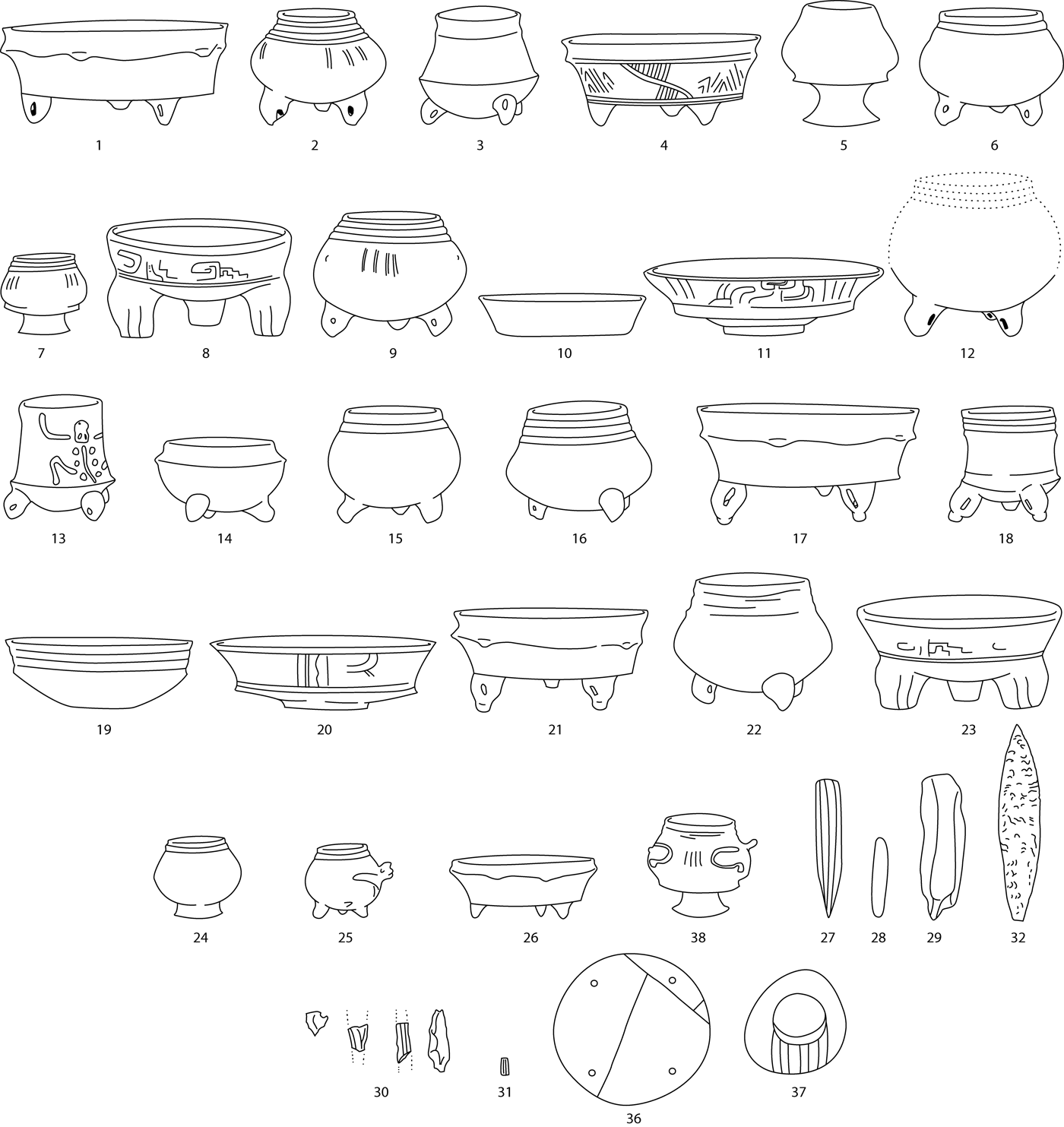
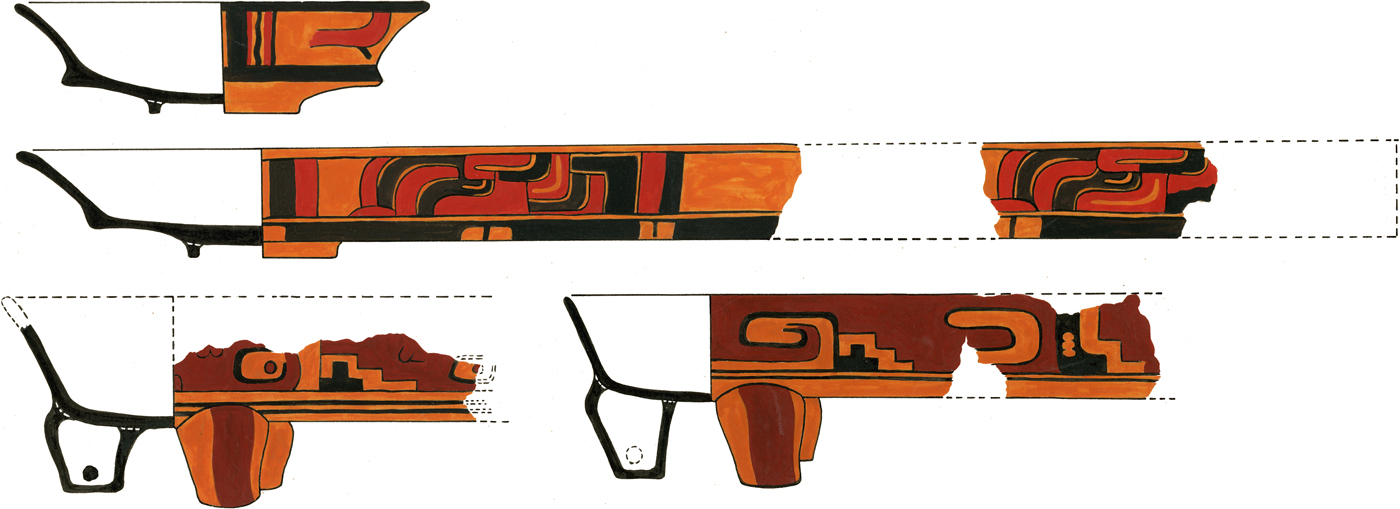
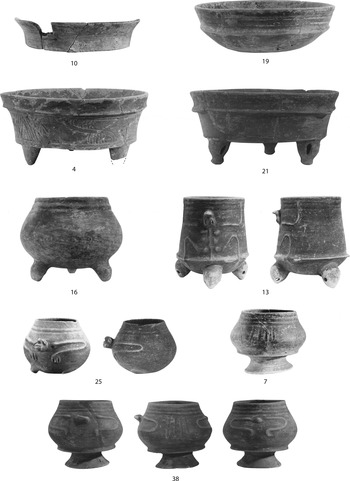
If one considers only the ceramic vessels included as offerings, and not the vessels of the bowl-urn coffin, there were 26 containers in the two clusters, an auspicious Mesoamerican number indicating that together the offering pots formed a unity. Most of these vessels were dark reddish brown wares and were tripod bowls or “jars,” meaning deep bowls with incurved mouths (Figure 7). These vessels are ordered and illustrated here by the specimen numbers given them in the field (Figure 6). A remarkable fact is that four of the 26 ceramic vessels recovered were trade wares from the Maya Lowlands (Figure 8). Lowe et al. (Reference Lowe, Lee and Martinez Espinosa1982:140, Figure 7.16b) reported and illustrated these vessels but did not specify the feature they came from or say much about them. The presence of these vessels in Burial F-30 was the key to limiting the Teotihuacan horizon to the following phase, as best exemplified by the ceramic assemblage found with Burial F-52. Here is how they (Lowe et al. Reference Lowe, Lee and Martinez Espinosa1982:147) framed matters:
Four Lowland Maya polychrome vessels – two ring-base bowls and two swollen-tripod bowls (Figure 7.16b) – were found completely smashed in a single Kato offering; these have been identified by R. E. Smith (personal communication), who places them in the Dos Arroyos Orange-polychrome type which is Tzakol 2–3 in date. These rare trade vessels were critically useful for establishing the true late Early Classic assignment of the Kato complex. It is also interesting, and important, to note that the late Tzakol vessels apparently arrived at Izapa prior to the appearance of the Teotihuacan style horizon.
This fact is indeed extremely interesting and important in understanding the ceramic complexes at Izapa, but it has overshadowed other evidence. Another message to be read from the Burial F-30 offerings is that Teotihuacan goods arrived at Izapa prior to the change in Loros-phase pottery styles and, at the time, lowland Maya and Teotihuacan influence were both present. Based on identified imported items, Burial F-30 had an international flavor, with fancy pottery from the Maya lowlands, obsidian items from highland Mexico and Guatemala, and other rare items of quartz crystal, jade, malachite, mica, pyrite, and crystals of specular hematite from parts unknown.
Drawings of items found in Burial F-30. Drawings by José Nuñez, courtesy of the New World Archaeological Foundation (NWAF).

Reconstruction drawings of the Dos Arroyos Orange-polychrome pots found in Burial F-30. Drawings by Ramiro Jiménez, courtesy of the New World Archaeological Foundation (NWAF).
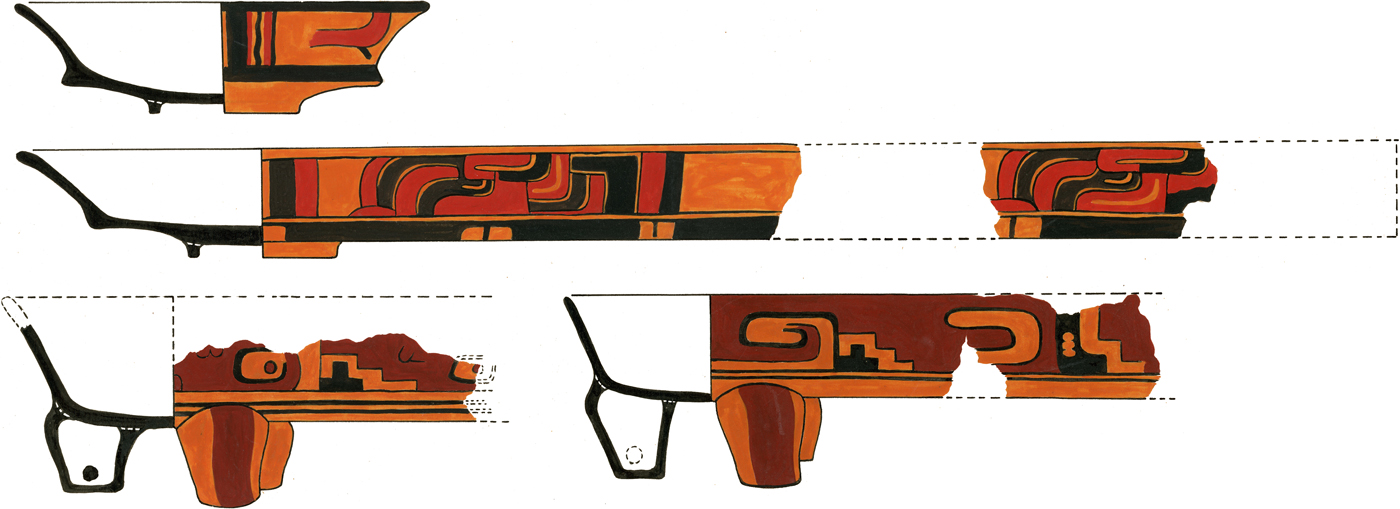
Some of the accompanying illustrations of these items merit explanation. Most of the drawings published here were prepared in the late 1960s when the Izapa Group F excavation report was being prepared for publication. Given strictures on publications and budgets in those days, all the ceramic vessels and other artifacts were drawn cartoon-like at one-fifth scale. As evident in Figure 7, these drawings convey a sense of the whole offering at a glance, with the various shapes and relative sizes of offered objects evident in simplified form, but they are not technical drawings meant for precise description. As apparent in the following list of objects from Burial F-30, local vessels for the Kato phase were variants of Tusta Rusty Red or Kapoc Red-Brown, dark red wares that differed in their paste composition and forms. The imported Maya pots are the Dos Arroyos Orange-polychromes mentioned. For some vessels found in Group F features, there is no other information available than these one-fifth scale sketches. The most complete vessels have been turned into the Mexican government and are housed in the Regional Museum of the Instituto Nacional de Antropología e Historia (INAH) in Tuxtla Gutiérrez, Chiapas, Mexico. I was able to examine some of these in December of 2015 and verify their type and observe evidence of their use in ancient times. Among the projects left unfinished from the 1960s work at Group F was finalization of the post-Formative ceramic typology; I am completing that task. The type names listed here for the vessels from Burials F-30 and F-52 come from my simplification of Lee's preliminary classification. The varietal distinctions listed are from his analysis in the 1970s. These type names and descriptions are of little relevance here other than to distinguish between local and non-local vessels.
Mortuary Furniture of Feature 30 (Figures 5–10)
(1) Tusta Rusty Red: Modeled Variety tripod bowl, 10.7 cm high and 29.3 cm in diameter.
(2) Kapoc Red-Brown: Modeled-Grooved Variety hollow tripod jar, 14.0 cm high and 17.0 cm in diameter.
(3) Kapoc Red-Brown: Modeled Variety hollow tripod jar, 13.0 cm high and 14.2 cm in diameter.
(4) Tusta Rusty Red: Modeled-Gouged Variety tripod bowl, 11.0 cm high and 24.0 cm in diameter.
(5) Kapoc Red-Brown: Modeled Variety pedestal base jar, 13.1 cm high and 14.0 cm in diameter.
(6) Kapoc Red-Brown: Modeled Variety hollow tripod jar, 14.0 cm high and 17.8 cm in diameter.
(7) Kapoc Red-Brown: Modeled-Grooved Variety pedestal base jar, 9.0 cm high and 10.9 cm in diameter. Vessel 7 was placed inside of Vessel 8.
(8) Dos Arroyos Orange-polychrome swollen-leg tripod bowl, 22.1 cm in diameter and over 14 centimeters high.
(9) Kapoc Red-Brown: Modeled-Grooved Variety hollow tripod jar, 15.0 cm high and 19.2 cm in diameter.
(10) Tusta Rusty Red: Grooved-Incised flat-bottom bowl, 4.5 cm high and 20.0 cm in diameter. Vessel 10 was placed inside of Vessel 11.
(11) Dos Arroyos Orange-polychrome ring-base bowl, 9.7 cm high and just over 28 centimeters in diameter.
(12) Kapoc Red-Brown: Modeled Variety hollow tripod jar, 19.5 cm high and 14.4 cm in diameter.
(13) Kapoc Red-Brown: Modeled Variety effigy tripod vase, 13.7 cm high and 12.2 cm in diameter.
(14) Kapoc Red-Brown: Modeled Variety tripod jar, 8.2 cm high and 14.3 cm in diameter.
(15) Kapoc Red-Brown: Modeled Variety tripod jar, 13.5 cm high, 3.0 mm thick, and 16.5 cm in diameter. This vessel shows significant wear on the bottom of its feet and has an eroded and worn rim. The interior bottom of this jar also shows wear.
(16) Kapoc Red-Brown: Modeled-Grooved Variety hollow tripod jar, 13.4 cm high and 12.0 cm in diameter. This small, thin, red pedestal cup shows moderate wear on its rim and base.
(17) Tusta Rusty Red: Modeled Variety tripod bowl, 13.0 cm high and 26.0 cm in diameter.
(18) Kapoc Red-Brown: Modeled Variety tripod bowl, 13.1 cm high and 12.4 cm in diameter.
(19) Tusta Rusty Red: Modeled-Grooved-Incised Variety bowl, 7.2 cm high and 22.2 cm in diameter. Vessel 19 was placed inside of Vessel 20.
(20) Dos Arroyos Orange-polychrome ring-base bowl, 7.5 cm high and 29.5 cm in diameter.
(21) Tusta Rusty Red: Modeled Variety tripod bowl, 11.2 cm high and 24.0 cm in diameter.
(22) Fragment of a Kapoc Red-Brown: Modeled Variety hollow tripod jar, 14.2 cm high and at least 19.2 centimeters in diameter. Vessel 22 was placed inside of Vessel 23.
(23) Dos Arroyos Orange-polychrome swollen-leg tripod bowl, over 11 centimeters high and over 25 centimeters in diameter.
(24) Kapoc Red-Brown: Modeled-Grooved Variety hollow tripod jar, over 9 centimeters high and 11.0 cm in diameter.
(25) Kapoc Red-Brown: Modeled Variety effigy tripod bowl, over 9.7 centimeters high and over 10.7 centimeters in diameter.
(26) Fragment of a Tusta Red: Modeled Variety bowl with a medial ridge, 17.7 cm in diameter and over 7 centimeters high.
(27) Polyhedral obsidian blade core with a prepared, flat platform; 16.7 cm long and 2.9 cm in diameter. I have not seen this core, and I can find no evidence it was processed or turned over to INAH, so its current whereabouts is a mystery. The field photograph and studio drawing depict a remarkably well-shaped and, by Chiapas standards, a very long pressure blade core that looks like it could yield another dozen blades. I suspect this core is of El Chayal or San Martin Jilotepeque (SMJ) obsidian because pressure blades made at Izapa at this time were from cores from these highland Guatemala sources. A Guatemalan origin has not been verified, however. Michael Spence (personal communication 2016) suggests that the core could be of Pachuca obsidian, given its size, regularity, and form and, hence, be another item from Teotihuacan.
(28) Long tubular jade bead 9.3 cm long, 1.5 cm in diameter, and a wall thickness of 2.0 to 3.0 mm.
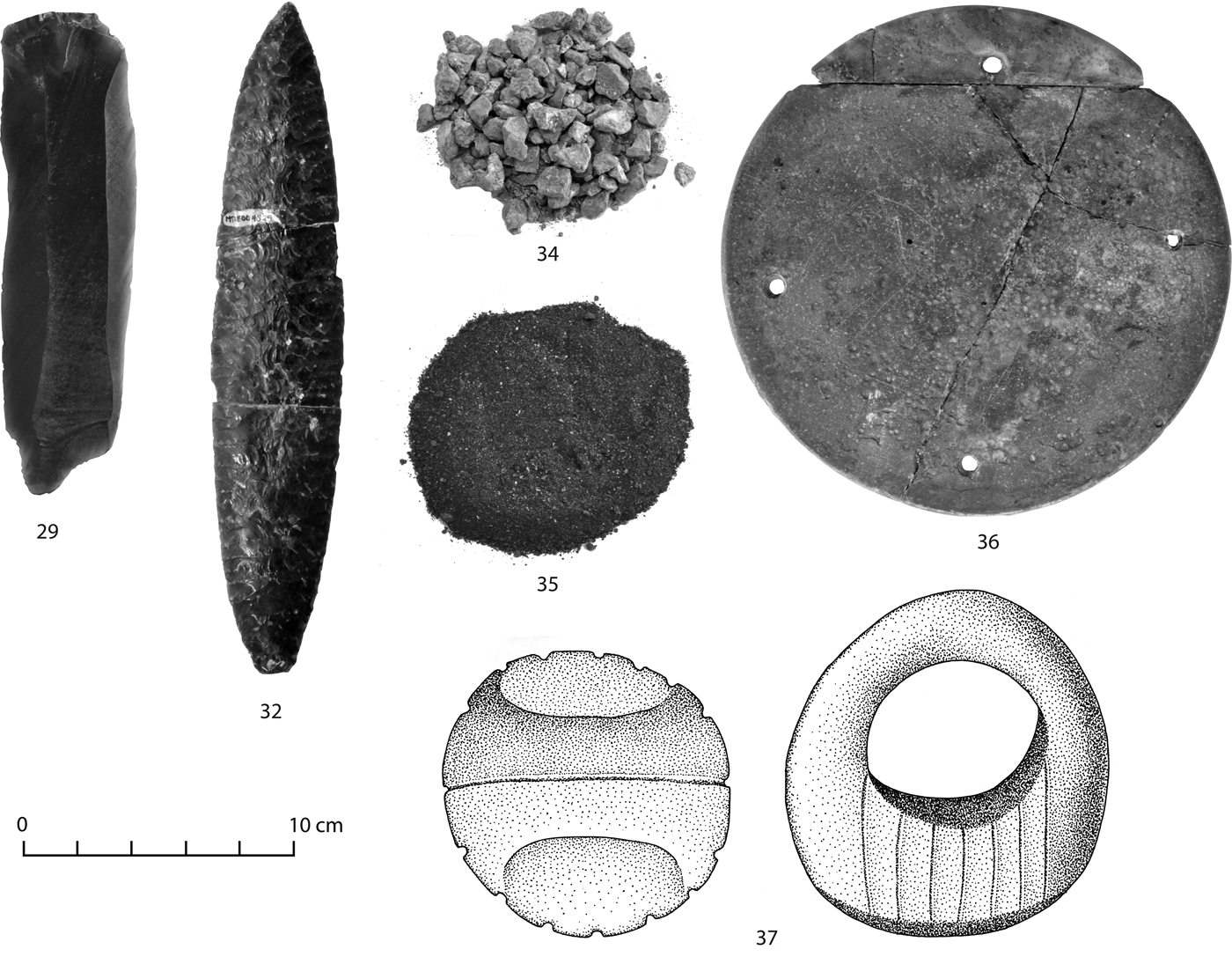
(29) Whole macroblade of SMJ obsidian from highland Guatemala. It has a flat, trapezoidal cross section and two nearly pristine, sharp edges. It measures 17.5 cm in length, 5.0 cm in width, and 1.9 cm thick.
(30) One obsidian waste flake and four obsidian pressure blades with trapezoidal cross sections. They were found near the quartz crystal on the east side of the urn. These are of SMJ and El Chayal obsidian.
(31) One small quartz crystal 1.9 cm long and 6.0 mm thick.
(32) Long, elliptical, bipointed obsidian biface of Pachuca obsidian and chipped in the Teotihuacan style, 24.1 cm long, 5.0 cm wide, and 1.0 cm thick. The style is of very regular, narrow, parallel, oblique flake scars that trend left-right from an 8 o'clock position upward to a 2 o'clock position, a flaking pattern characteristic of modern left-handed knappers but which can be produced right-handed with different holding positions (Hirth et al. Reference Hirth, Titmus, Flenniken, Tixier and Hirth2003). The edges also show fine retouch that removed the sharp edges all the way to the tip. The field drawing shows that this knife was in three pieces at the time of discovery, with the base piece askew and disarticulated (Figure 6). In contrast, the field photograph (Figure 5) shows the biface as three articulated pieces in their original position, as if the weight of overburden broke the object in place. I think the photograph is the earlier image and that the end piece was jogged out of position by the time the drawing was made. The rather equal segments of the resultant three pieces suggests the knife was broken deliberately as part of the mortuary ritual, but I have not verified this possibility through experiments in deliberately breaking bifaces of similar size and thickness. The tip of this knife shows a small burination from direct impact from hitting a resistant substance when used in a thrusting motion. The tip has also been re-chipped rather poorly, thereby modifying the original symmetry of the piece when seen in plan view. The biface shows all the signs of having been used as a sacrificial knife.
(33) Small muscovite mica flakes. There is no indication of the number of pieces involved with this trace of mica or the size of the original piece. A very large sheet of muscovite was found in a Late Classic offering in Mound 5 (Clark and Lee Reference Clark and Lee2013:10, Figure 5).
(34) Small nodules of malachite (together they weigh 64 g). These appear to be a clump of raw material and accord well with the logic of other clumps of minerals found in the southern arc around the urn. They do not appear to be pieces of a disintegrated artifact. They may have been minerals for making pigments for paint.
(35) Fine grains of iron mineral, probably specular hematite. The particles are slightly magnetic. As with the handful of small malachite nodules, these iron-base crystals may have been for making pigments for paint. None of these small piles of minerals was found inside a ceramic vessel. They could have been placed in small containers of perishable materials or put loose on the ground around the burial urn.
(36) Large, dark gray slate back for a mosaic mirror, 19.0 cm in diameter and varying from 4.0 to 5.0 mm in thickness. The variation in thickness is because some sections of the upper face have a thin layer of decomposed pyrite on them that show up in the field photograph as scaly exfoliations (Figure 5). The object is nearly a perfect circle with a circumference a few hairs’ breadth short of 60 centimeters. It has a fine and very regular beveled edge 2.2 mm wide that tapers up from its highly smoothed and polished short face to its flatter and unpolished wider face. The beveled face appears to have been the backside of the mirror; pieces of pyrite for a mosaic mirror would have been glued to the rougher surface of the wider face shown in the field photograph. The mirror face was placed up in the offering. Both faces show brownish rust stains, and both have pock marks and pot-lid fractures that look like the effects of chemical erosion, likely from the oxidizing and decomposition of the pyrites once on its broader surface. Four large perforations are rather evenly spaced on the mirror 1.9 to 2.1 cm in from the edge. These four holes define the corners of a rectangle 11.0 by 9.6 cm. These holes are conically drilled from the narrow (back) face to the wide face. The holes are not completely circular. The entry holes vary from 7.3 to 9.3 mm in diameter, and the exit holes range from 5.9 to 6.9 mm in diameter. There are globs of rust in some of these holes. Two very small holes were also drilled in the piece much closer to the edge. Only one of these holes is clearly evident in the photograph (Figure 10) because one of the breaks of this piece of slate went through the other hole. These small perforations were set just in from the bevel at 4.0 mm from the edge. The entrance diameter of the intact perforation is 2.9 mm, and the exit diameter is 2.2 mm. This pyrite mirror was impressively large; it was twice the size of most pyrite mirrors found at Izapa. Taube (Reference Taube, Gallaga M. and Blainey2016:299) argues that pyrite mirrors are evidence of Early Classic Teotihuacan influence, an observation supported by the artifacts in Burial F-30. If this mirror came from Teotihuacan, it would have been the most impressive object from there found at Izapa.
(37) Loop-handle stone, 12.0 cm long, 11.7 cm in diameter, and 10.5 cm thick. This artifact is similar in form to the famous “knuckle-dusters” of Preclassic times that Taube and Zender (Reference Taube, Zender, Orr and Koontz2009) argue were used in gladiatorial boxing rituals. In Burial F-30, it is just one more unusual stone object among the many surrounding the urn. The careful vertical grooving on this hand stone is unusual. I have not seen or examined this artifact.
(38) Kapoc Red-Brown: Modeled Variety effigy pedestal base jar, 10.5 cm high and 12.0 cm in diameter.
Photographs of some ceramic vessels from Burial F-30. Photographs by Mario Vega, courtesy of the New World Archaeological Foundation (NWAF).

Other artifacts found in Burial F-30. Photographs by Carlos Lopez and drawings by Mario Vega, courtesy of the New World Archaeological Foundation (NWAF).

Comments
This is one of the few features from Group F with a blank field card. Apparently, the feature was so obviously significant at the time of its discovery that it was accorded special treatment from the start and recorded in a different way. There is a large format field drawing of the plan of the burial (reproduced as Figure 6) but no notes to go with it. The detailed notes were apparently more than a simple field card could handle. The preceding list is modified from Lee's draft manuscript of his excavation report. Three of Lee's listings of pots do not accord with the detailed drawing. In particular, he lists a 22.2-cm diameter vessel as being nested inside a jar 12.0 cm in diameter. I adjusted his assignments of three pots to match the information in the drawing. This reconciliation also amended what I considered a logical inconsistency in the placement of pots in the burial, an inconsistency which arose I think from bookkeeping oversights in the field rather than from careless ancient ritual.
Some artifacts from this feature are still in the care of the NWAF, and I examined them to get more details and better photographs. Lee's manuscript lists Vessel 26 as being a medium size “jar,” but the field drawing (Figure 6) indicates a much larger vessel, presumably the urn of the “urn” burial. The field drawing depicts a pot about 70 centimeters in diameter. I suspect that the poor reporting of this item was because the two vessels of the urn container were considered together and that only a few rim sherds of the covering vessel were saved to make a representation drawing. If so, the small size of the covering bowl (17.7 cm mouth diameter) indicates a small orifice for the urn, and hence a small burial package, either a child or a bundle of bones of a secondary burial. Michael Spence (personal communication 2016) suggests that the urn diameter would only have accommodated the body of an infant about one year old. I have not seen the sherds from this urn, but an Early Classic practice in the Izapa region was to saw urns in half at their widest point (shoulder) and put a body inside and cap the two parts of the sundered urn with an upside-down vessel over the mouth of the urn. If this had happened, the urn of this burial could have included bones or a body of an adult.
The imported polychrome bowls from the Maya lowlands should allow scholars at some future date to refine the Izapa chronological sequence and tie it to the sequences of the Maya area and to the Basin of Mexico. Culbert (Reference Culbert1993) illustrates similar ring-base polychrome bowls from Tikal that date to the Manik phase (coeval with the Tzakol phase at Uaxactun). I have not found any examples of swollen-leg polychrome bowls in the literature similar to those from F-30. Laporte and Fialko (Reference Laporte and Fialko1995:61–62, Figures 32 and 35) illustrate bowls with similar legs that date to the Manik 2 phase (a.d. 300–380). The ring-base bowls have been found as late as Manik 3A (illustrated in Culbert Reference Culbert1993:Burials 10 and 22). The same burials have tripod cylinder vessels similar to those from F-52. These minimal data support the Izapa sequence that the Kato complex precedes the Loros complex. I would align Kato with late Manik 2 and Loros with Manik 3A. Clearly, these phases need to be refined and calibrated through more extensive comparative research. As mentioned, F-30 is a late Kato offering. I would not be surprised if F-52 were an early Loros offering.
Concerning the objects surrounding the urn, I am struck by the variety of stone artifacts and raw materials included, and by their arrangement. I have never seen anything like this assemblage in a Chiapas burial. The stone artifacts all appear to have been deliberately selected for variety and to have been placed carefully around the central urn. Obsidian items flanked the urn on three sides, with the blade core to the south (pointing west), the Pachuca obsidian knife on the west (pointing north), and the SMJ macroblade on the east (pointing south). The four blade segments and one waste flake were also on the east. The large mirror back had pyrite tesserae glued to it that would have been part of four or more clumps of unusual minerals located on the south, one including pale mica of a natural mirror. The long jade bead is the same elongated shape as the nearby obsidian blade core (Figure 7), and they both were aligned east-west, perpendicular to the alignment of the Pachuca bifacial knife and the SMJ macroblade. A quartz crystal, a handful of copper ore, another handful of a silvery and shiny substance, probably specular hematite, a knuckle-duster, and two or three pots flesh out the inventory of items in the orbit of the urn. The two ceramic vessels (Vessels 24 and 25) shown on the drawing next to the urn appear out of place in this gathering that showcased stones and minerals from all over. It is rather obvious that the stone objects were unusual or spectacular and were placed around the urn to mark particular directions and relationships. Their choreography puts a different spin on all the items found with this burial. They look more like symbolic representations of some kind rather than markers of possessed wealth.
As to the ceramic vessels, if one excludes the burial container, there were 26 pots that were obvious members of pairs, triads, and quartets. The Maya polychromes, for instance, were a pair of pairs: two ring-base polychrome bowls, and two fat-leg, flat-foot tripod polychrome bowls (Figure 8). Each Maya imported bowl had a vessel of local ware placed inside of it. The two Maya tripods had Kapoc Red-Brown vessels in them, and the two Maya ring-base bowls had Tusta Rusty Red bowls inside of them. The pairing of vessel forms and types was not random. No other vessels were in a nested arrangement. The number and representation of vessels appears to have been significant also, but I do not see any arrangement among them as obvious as that for the stone artifacts. One of the more unusual vessels is Item 38, a Kapoc Red-Brown effigy jar with a pedestal base. Its position in the burial assemblage is not indicated on the field drawing. Its late number indicates it was the final object recognized in the field, suggesting that it was discovered at the time the objects were being removed from the excavation. If true, it was likely the first and lowest item placed in the offering. The best place for it to have remained hidden was underneath Vessel 26 or inside of it. Vessel 38 is in remarkably good shape, hence I think it was buried underneath the skirt of Vessel 26 and protected by it rather than being crushed inside of it. This is my speculation. Unlike Burial F-52 described below, there is no evidence that anything was found inside the burial urn, neither human bones nor items of personal adornment.
In terms of my hypothesis that part of Feature 30 was an extended burial of an adult, the two vessels I think marked the head position were slightly apart from the rest of the line and invaded the otherwise vacant alley between the two clusters of mortuary goods. These two vessels were one of the Maya fat-leg polychrome bowls (Vessel 23) and a small, Kapoc Red-Brown tripod jar (Vessel 22) nested inside it. As evident in the photograph of the burial (Figure 5), all of these bowls, jars, and vases were placed mouth up. Some of the smaller vessels were placed in larger vessels, which suggests that some ceramic vessels were offerings by themselves (all the Maya bowls) and were not containers for food or drink.
BURIAL F-52
In contrast to Burial F-30, the urn burial of Feature 52 was more of the standard type and was a much tighter arrangement of objects. Figures 4 and 11–13 illustrate the burial and its furniture as well as its position among the Mound 125c Loros-phase burials. Burial F-52 was located just inside the northern edge of Mound 125c and about a meter below the surface (Figures 2 and 4). As evident in Figure 13, Burial F-52 was just north of a stone corbel-vaulted Loros-phase tomb designated as “Tomb 1” (also known as Feature 59 and Tomb 4 in Figure 4). This tomb was violated in Late Classic times and its contents compromised, otherwise it would probably have been the focus of this essay. The reconstruction drawing depicts a phantom, extended burial in the empty alley between the rows of offerings, a situation similar to that just hypothesized for Burial F-30. As illustrated in the plan and profile drawings for Mound 125c (Figure 4), four Loros-phase burials were found in Mound 125c, but no Kato burials were. This low platform was built in Jaritas times; therefore, all the Loros-phase burials were intruded into it.
Two views of Feature 52. Photographs by Mario Vega, courtesy of the New World Archaeological Foundation (NWAF).

Drawing of Feature 52. From field drawings by Salvador Ordoñez, courtesy of the New World Archaeological Foundation (NWAF).

Reconstruction drawing of Burial Feature F-52 in its architectural setting, showing the location of the looted Tomb 1 (a.k.a. Tomb 4 in Figure 4) and other urn burials. Drawing by Eduardo Martínez, courtesy of the New World Archaeological Foundation (NWAF).

Burial F-52 was unusual because the larger and longer urn was the lid to the shorter one. As seen in the photograph and drawing of this burial (Figures 11 and 12) most of the offering vessels were placed right next to the walls of the urn, with three vessels separated about 30 centimeters south of it. The reconstruction drawing of the profile of Mound 125c (Figure 4) shows the base level of the offering pots to have been about 20 centimeters above the base of the lower urn. This arrangement indicates that a deeper hole was excavated to set the urn before the offering vessels were splayed around it.
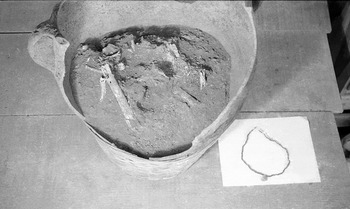
There were not as many offering pots with this burial as with Burial F-30. Many cobbles are evident in the photograph near Burial F-52, but they were older walls unrelated to the urn, which was intruded in a simple pit about a meter square and deep on the north side of Mound 125c. None of the non-ceramic offerings are indicated on the drawing, and the feature notes are silent on the matter of their precise location. A photograph of Vessel 15 shows human bones in the lower urn and the bead necklace in the background (Figure 14), presumably because the beads and pendant were found in the urn at the level of these long bones. This photograph is evidence that the lower urn was transported intact to the lab and its excavation completed there under ideal conditions of recovery. Most of the small items reported for this burial were presumably found in the bottom of this urn. The necklace shown with the urn is much shorter than the one eventually reported (see below), thereby suggesting that many more beads were found in the rest of the urn in the lab excavation. The fact that such small objects were recovered at all, and in their frequency, indicates they were in a sealed context that facilitated their recovery.
Vessel 15 of Burial F-52, showing bones and a necklace found in the urn. Photograph by Mario Vega, courtesy of the New World Archaeological Foundation (NWAF).

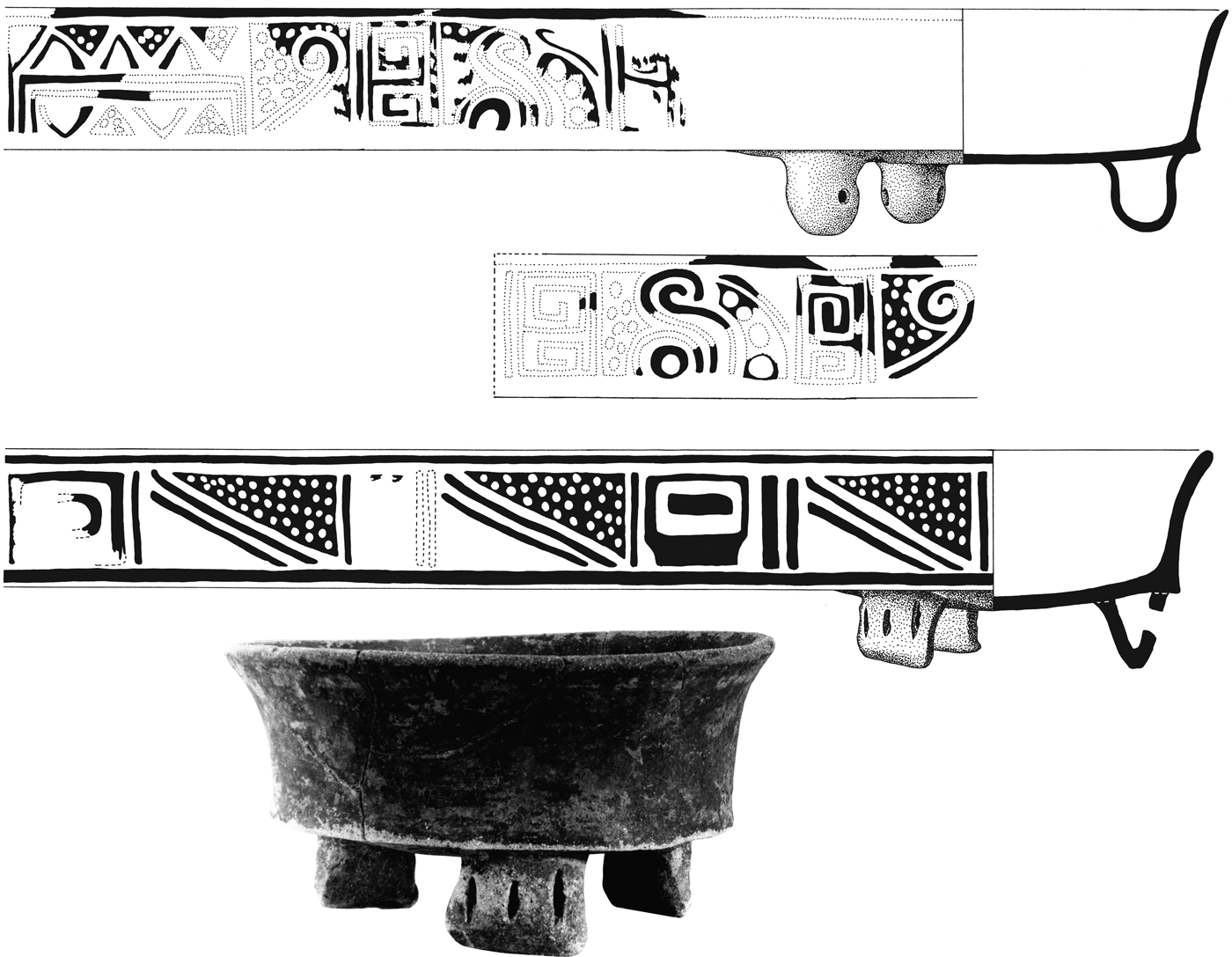
As evident in the following list of mortuary goods, Tusta Rusty Red bowls continued to be made and used at Izapa during the Loros phase, but Kapoc Red-Brown vessels were discontinued and replaced by bowls with specular red slip, designated as the Chico Specular Red type. Most tripod legs on these vessels were more vertical than those on pots of the preceding phase, a modal shift to Teotihuacan forms. Most of the vessels found in Burial F-52 were of the new Chico Specular Red type. Two were a rarer type of specular red with designs painted on them in black. Lee called these “Perdido Red Painted: Black and Red Variety,” a type described by Parsons (Reference Parsons1967, Reference Parsons1969) in his study of Bilbao pottery from the Laguneta phase (a.d. 400–700) of the central coast of Guatemala. Lee saw very close similarities between the ceramics of Izapa and those of Bilbao. He thought this type originated in the Bilbao region and that Izapa potters adopted it. As noted, the Loros phase also saw changes in vessel forms to mimic some slab-leg, knob-lid, tripod cylinders from Teotihuacan. The Escuintla region of the central coast of Guatemala is famous for its close ceramic ties to Teotihuacan. It is possible that some of the Teotihuacan influence on Izapa crockery came indirectly from Teotihuacan through the Escuintla region, as indicated by the adoption of Perdido Red Painted pots, rather than directly from the north.
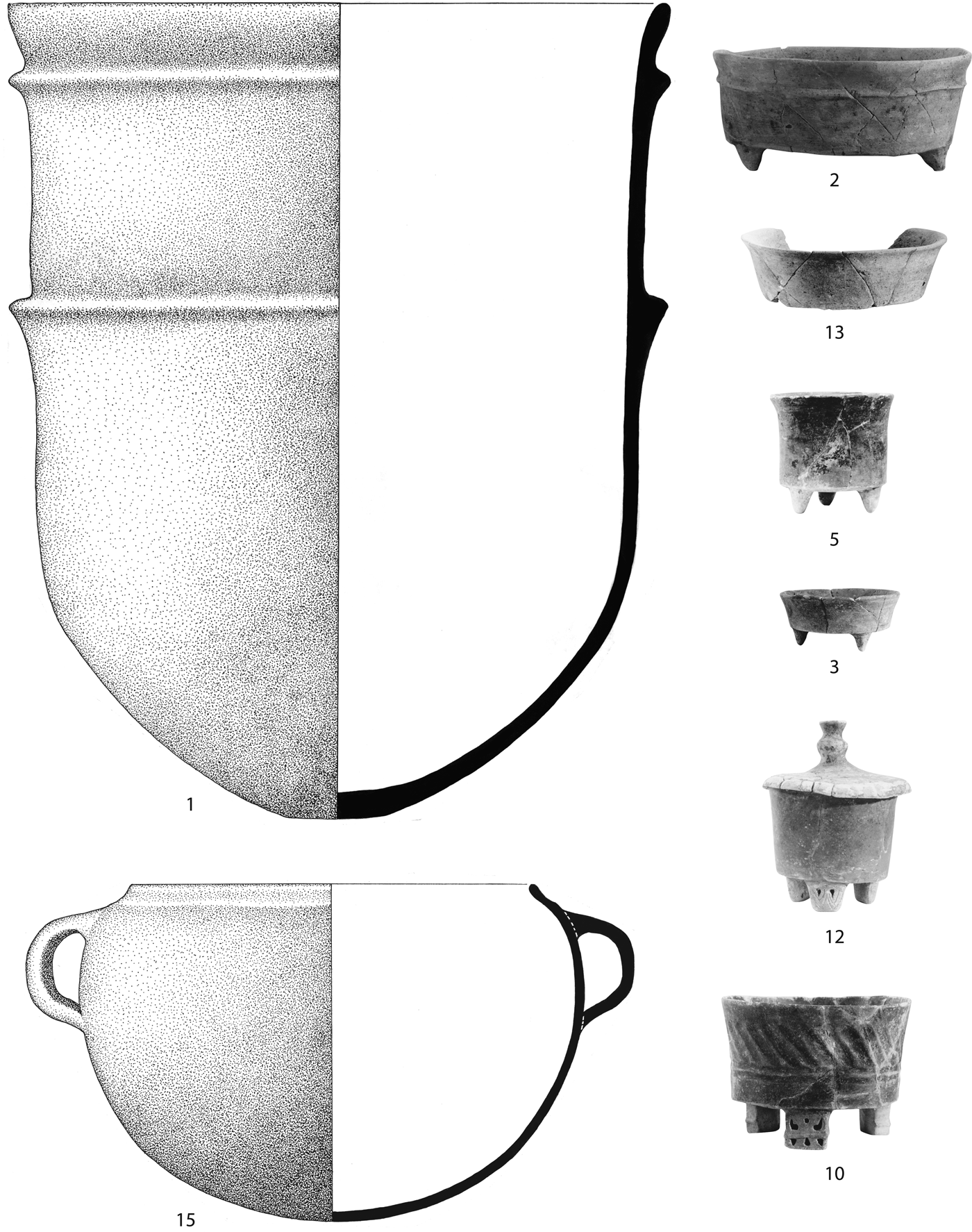
Mortuary Furniture of Feature 52 (Figures 15–18)
(1) Rollo Orange: Modeled Variety huge round-bottom urn with sub-labial ridge, 86.5 cm high and 71.0 cm in diameter. This vessel was placed inverted on Vessel 15 to make the burial chamber (see Figure 13).
(2) Tusta Rusty Red: Modeled Variety tripod bowl with a flat bottom and medial ridge, 14.5 cm high and 31.0 cm in diameter.
(3) Chico Specular Red: Plain Variety tripod bowl with flat bottom and flared walls, 6.4 cm high and 14.0 cm in diameter.
(4) Chico Specular Red: Plain Variety tripod cylinder or vase, 11.0 cm high and 11.0 cm in diameter.
(5) Chico Specular Red: Plain Variety tripod cylinder, 11.0 cm high and 12.3 cm in diameter.
(6) Chico Specular Red: Modeled Variety tripod bowl with hollow legs, 7.0 cm high and 14.3 cm in diameter.
(6a) Chico Specular Red: Modeled Variety tripod bowl knob-handle lid, 11.9 cm high and just over 12.6 centimeters in diameter.
(7) Chico Specular Red: Plain Variety tripod bowl with solid peg legs, flat bottom, and flared wall, 6.5 cm high and 14.4 cm in diameter. Vessel 7 was inverted partially over Vessels 8 and 9.
(8) Chico Specular Red: Plain Variety tripod bowl with solid peg legs, flat bottom, and flared wall, 7.0 cm high and 14.9 cm in diameter.
(9) Chico Specular Red: Plain Variety tripod bowl with solid peg legs, flat bottom, and flared wall, 5.5 cm high and 14.5 cm in diameter.
(10) Chico Specular Red: Modeled-Grooved Variety deep tripod bowl with hollow slab legs and gadrooned decoration, 15.0 cm high and 19.7 cm in diameter.
(11) Chico Specular Red: Plain Variety tripod vase with solid peg legs, 11.0 cm high and 12.5 cm in diameter.
(12) Chico Specular Red: Modeled Variety tripod bowl with hollow slab supports, over 7 cm high and 14.3 cm in diameter.
(12a) Chico Specular Red: Modeled Variety tripod bowl knob-handle lid, 12.0 cm high and just over 14.3 centimeters in diameter.
(13) Tusta Rusty Red: Plain Variety bowl with flat base and flared wall, 6.0 cm high and 21.0 cm in diameter.
(14) Tusta Rusty Red: Modeled Variety tripod bowl with medial ridge, 13.0 cm high and 29.5 cm in diameter.
(15) Rollo Orange: Modeled Variety loop-handle urn, 35.0 cm high and 45.0 cm in diameter. This vessel was below Vessel 1 in a lip-to-lip arrangement.
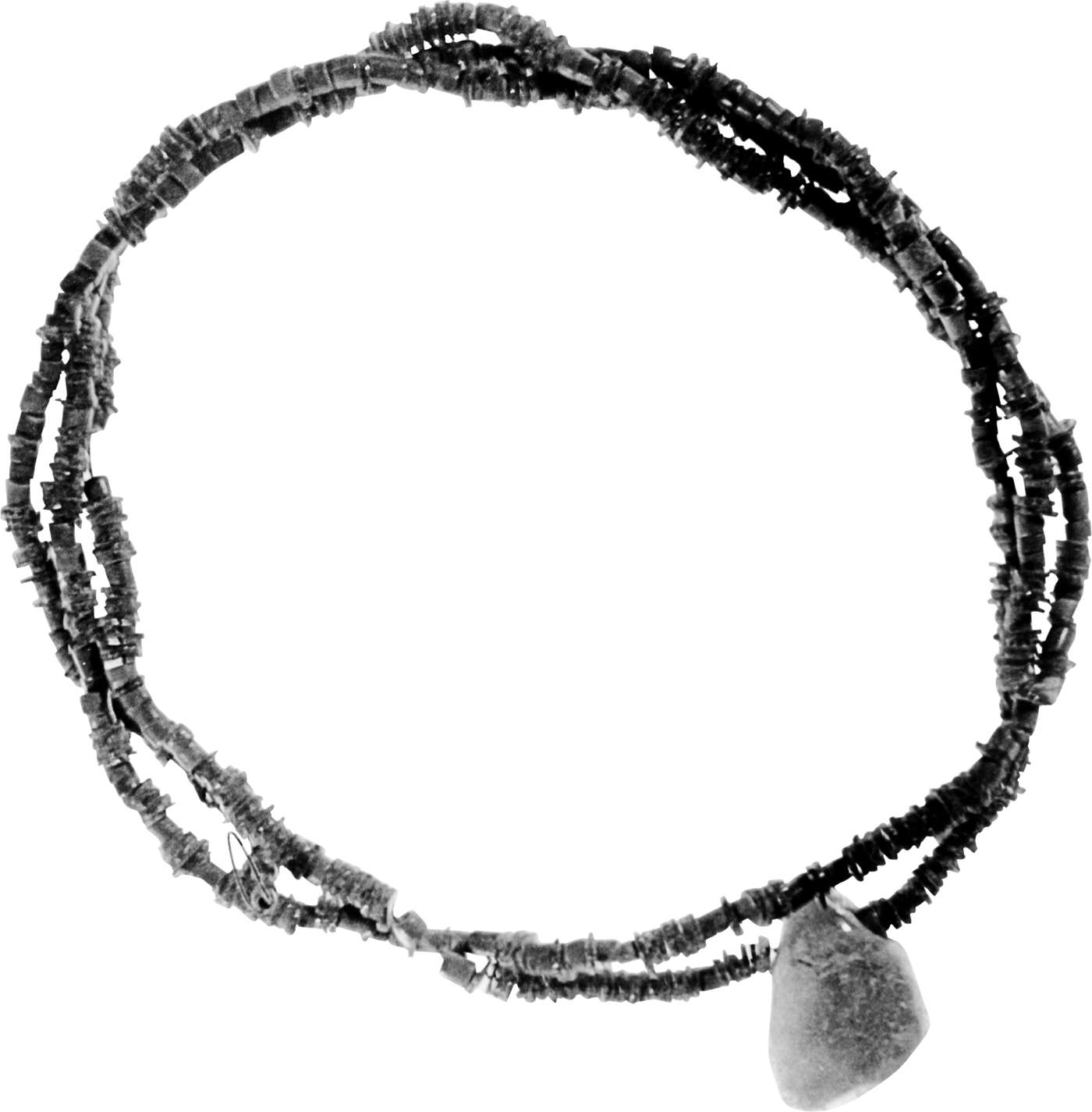
(16) Necklace with a jade pendant and tubular red stone beads and flat obsidian disc beads of Pachuca obsidian (Figure 18). The reconstructed string is 1.7 m long and includes 1,158 obsidian beads and 462 short tubular beads of unidentified, dark red stone. The obsidian beads range in diameter from 2.7 to 4.2 mm and in thickness from 1.8 to 0.3 mm. The 462 small red stone beads range in diameter from 2.1 to 3.5 mm and from 0.8 to 3.2 mm in length. The hole diameters for both kinds of beads range from 0.7 to 1.8 mm. The red stone beads were made by drilling and polishing, and the obsidian beads were made by delicate percussion and fine pressure. Alejandro Pastrana (personal communication 2013) has found an obsidian bead workshop at the Pachuca obsidian mines and has excavated a sample of workshop debris. Broken pieces of obsidian beads from there show that holes were made in sectioned pressure blades by some means of percussion and that these holes were not drilled or even partially drilled, a procedure that fits Kidder's (Kidder et al. Reference Kidder, Jennings and Shook1946:138, 140) hypothetical reconstruction of the process. Each punched hole was chipped slightly to open it and to blunt the sharp edges left from the removed cone. The blade segment was then chipped from the opposite face from that of the exit hole down to the desired diameter for the bead. The beads found with Burial F-52 are among the smallest in diameter known for Mesoamerica and are barely wider than their central holes (cf. Kidder et al. Reference Kidder, Jennings and Shook1946:138, Figure 157f; Spence Reference Spence1996:25, Figure 2c). Ten to 20 of these beads fit in a square centimeter of space and 300 fit in a teaspoon. I have been involved with Alejandro Pastrana and James Woods in trying to replicate these beads, but we still have not discovered a simple or reliable way to punch the holes, the necessary first step of the process. We suspect that making these small perforations must have been simple and somewhat reliable and would have required much less time than drilling. The most time consuming part would have been the detailed micro-chipping involved. Even if the whole process could have been done in 15 minutes, the obsidian beads in this necklace would have represented at least 290 person-hours of work. If one factors in even a spectacularly low error rate of five percent, the manufacturing work represented would have taken at least 305 hours of knapping time. Although fewer in number, the red stone beads would have taken much longer to make because of the initial shaping, fine drilling, and polishing involved. The third element of this necklace was an emerald green, triangular piece of jade. Its drilling and polishing would have taken about 50 hours. By these crude estimates, the production time for elements of the necklace was in the range of 700 to 1,000 person-hours. In terms of production costs, this necklace must have been a very valuable object. We have described all these perforated stones as elements of a single necklace, but that is conjecture. The beads were not found in articulated position, hence, several different necklaces or strands of beads many have been involved. The red stone beads may not have been interspersed with the obsidian beads.
(17) Jade mosaic mask pieces (about 175 pieces). I have not seen these pieces or any photographs of them, but they represented another great outlay of labor because each piece had to be cut, polished, and fitted. They were probably part of a pendant or small mask. These mosaic pieces must have been found inside the urn with the beads. The jade most likely came from highland Guatemala and the mosaic pieces were presumably made somewhere close by their source of origin rather than at Izapa.
(18) Thick shell disc bead, 1.7 cm in diameter and 8.0 mm thick; the diameter of the hole is 3.0 mm. This may have been part of the necklace of item 16.
(19) Bones and teeth of the interred body.
(20) Perdido Red Painted: Black and Red Variety tripod bowl with flat bottom and rounded, hollow feet, 9.5 cm high and 23.0 cm in diameter.
(21) Perdido Red Painted: Black and Red Variety tripod bowl, 10.8 cm high, 20.8 cm in diameter, and 6.0 mm thick. The bottoms of the slab tripod supports show significant wear, and there is heavy wear on the rim as well. This was a well-used bowl before it was placed with the burial.
Drawings of the ceramic vessels found in Burial F-52. Drawings by José Nuñez, courtesy of the New World Archaeological Foundation (NWAF).

Photograph of some vessels from Burial F-52. Drawings by Ramiro Jiménez and photographs by Mario Vega, courtesy of the New World Archaeological Foundation (NWAF).

Perdido Red Painted pots from Burial F-52. Drawings by Ramiro Jiménez and photograph by Mario Vega, courtesy of the New World Archaeological Foundation (NWAF).

Obsidian and red stone bead necklace with a jade pendant from Burial F-52. Photograph by Mario Vega, courtesy of the New World Archaeological Foundation (NWAF).

I cannot explain the late numbers given to Vessels 20 and 21. They do not correspond to their positions in the arc of pots around the urn or to their visibility. Vessel 20 is evident in the field photograph (Figure 11) at the same level as the other pots. This same photograph shows that the north side of the urn had been excavated to the bottom of its base, and this excavation must have removed Vessels 13 and 21 in the process.
Comments
If the burial urns are excluded from the analysis of offered ceramic vessels, there were 15 pots included with Burial F-52 as offerings. These vessels were quite clearly organized as triads of two-versus-one. The duality in threes is most clearly seen in the three tripod cylinder vases placed on the east side of the urns. Two of the red cylinder vessels had solid peg legs, and one had hollow slab legs and a knob lid. The other triad of cylinders in the offering (Vessels 10–13) was placed on the west side of the urns directly opposite of Vessels 4–6 and included another knob-lid vessel and two open ones. The triad of separated pots to the south of the urn consisted of one small specular red bowl and two large, orange-red ones. A triad to the southwest of the urn had one vessel inverted over the other two with their mouths up. The vessels of the last triad were not positioned together. In the general arrangement, there were three vessels to the east of the urn, three vessels separated from the urn to the south, and nine vessels on its west side. No nonperishable objects were placed to the north of the urn, a characteristic shared with Burial F-30.
As with the ceramic vessels in Burial F-30, the few I could examine show signs of moderate to extensive use, meaning that the pots in both burials came from inventories that were being used at the time and were not vessels made especially for the mortuary event. More specifically, the pots appear to have been serving vessels for food rather than for preparing it. All the offering bowls in Burial F-52 appear to have been designed to serve food, and in modest proportions. In contrast, almost half of the vessels in Burial F-30 appear to have been for serving liquids. All the pots in these burials were whole, and there does not appear to have been any offered fragments of deliberately broken vessels. None of the vessels were ritually “killed,” a treatment accorded ceramic vessels in burials at other Chiapas communities at this time (see Agrinier Reference Agrinier1964).
The date of this offering is a key to interpretation. Lowe et al. (Reference Lowe, Lee and Martinez Espinosa1982:148, Figure 7.21) assign it to the Loros phase (a.d. 500–600), but this assignation was clearly only a ballpark estimate based on minimal evidence. A good match for F-52 is to vessels in Manik 3A-phase burials at Tikal (see Culbert Reference Culbert1993) that date to a.d. 378–480 (Moholy-Nagy Reference Moholy-Nagy2016). This temporal range would place F-52 in the time frame at Izapa currently assigned to the Kato phase. The change in red ceramic wares at Izapa between Kato and Loros times points to a significant difference, but it says nothing of the timing of the change or of the duration of each complex. Any refinements in the chronology will require additional evidence.
The non-ceramic offerings in Burial F-52 appear to have been items of personal adornment and were likely part of the clothing and jewelry on the body placed inside the urn. This is a very different circumstance from that described for Burial F-30 and its exotic stone objects surrounding the urn. The jade mosaic pieces found with Burial F-52 may have been part of a burial mask. I consider the option of a mosaic pectoral less likely because the body already had an elaborate necklace with a jade pendant, but a mosaic pendant could have been part of this complex assemblage as well. The small red stone and obsidian beads may have been part of one or more necklaces. The beads and mosaic pieces came from different parts of Mesoamerica and would not originally have been part of the same piece of jewelry.
Pierced disks of obsidian have been called beads and sequins. Those in Burial F-52 appear to have been beads. Had they been sequins, they could have covered only 107 square centimeters of cloth when sewn closely together, but this would not have been much. For their type, the obsidian beads are among the smallest known. They are smaller than the hole diameters of the large obsidian sequins reported by Kidder (Kidder et al. Reference Kidder, Jennings and Shook1946:138, Figure 157f) for Kaminaljuyu. The small size of the Izapa obsidian discs would seem to counter the purpose of sequins because nearly all of their flat, mirror surface has been chipped away. About all they have to offer is thickness, which serves them well as beads.
SOME CONCLUDING THOUGHTS
For Lowe and Lee, Izapa was all about trade—its location on the Pacific corridor connecting eastern and western Mesoamerica and its blessed environmental circumstance for growing cacao and having access to a range of splendid tropical products. Izapa was the Soconusco writ small, and it suffered the same social and political instability as the region as a whole, an instability that arose from an imbalance between natural ecological wealth and human inhabitants. There was more natural wealth for the taking at Izapa than there were people who could prevent it from being taken. Thus, Izapa was a perennial soft target for those with political muscle desiring its resources as tribute. In Lowe's view, being at the crossroads was equivalent to being in the crosshairs. The constant pressure from strong states on all sides arrested local growth and led to perpetual political instability. From this point of view, the touch of Teotihuacan at Izapa is truly remarkable because it seems so light as to have been non-existent. There is no evidence that Teotihuacan ever conquered, controlled, or meddled with Izapa, and this circumstance counters much of what Lowe and Lee thought about Izapa as a trade center or resource prize. The NWAF excavations at Izapa were sufficiently extensive and aggressive that any serious relationship with Teotihuacan should have manifested itself in hundreds of artifacts. If Teotihuacan had a strong presence at Izapa it was in a place the NWAF did not check. Investigation of the many house mounds discovered north of Group F in recent work by Rosenswig may be the right spot and change the story, but for now, there does not appear to have been much of a story. Future fictions have only a handful of facts to go on, or to restrain them. I review the facts here.
The first surprise of Lee's excavations in Group F at Izapa was the discovery that there had been people living at Izapa in Middle Classic times. After several seasons of excavating in south Izapa, encountering evidence of the Teotihuacan period came as a stunning revelation. As it turns out, Group F remains the only sector of Izapa where occupation for this era has been verified, and this trace is limited to burials and caches. The unknown variable in the story of possible Izapa-Teotihuacan relations is Izapa, not Teotihuacan. We have almost no evidence of occupation at Izapa by anyone for this era, and the scant traces found are two dozen offerings and boneless burials in the Mound 125 complex. If few people lived at greater Izapa from a.d. 400–600, there would have been little reason for Teotihuacanos or their allies to drop by, other than to pay respects to the long dead and their relic carved stone monuments. Current evidence indicates a minimal population at Izapa during the Middle Classic, perhaps a caretaker group keeping the place open as a shrine. Likewise, surveys in the eastern Soconusco region of which Izapa is a part have found very little evidence of Middle Classic occupation, but this may be a recognition problem generated by the Teotihuacan phenomenon and expectations of it among archaeologists. If local people did not participate in the material accouterments of the Teotihuacan horizon in any blatant way, there would be few artifacts to link them to it. The demographic situation in the Soconusco is a critical element of the story to be told, but for now I table questions dependent on future finds and deal with evidence in hand.
Some people, including elite individuals, lived at Izapa during the Teotihuacan era, as evident by artifacts illustrated here for Burials F-30 and F-52. Just how long a period was involved is an open question. According to Lowe et al.’s assessment (Reference Lowe, Lee and Martinez Espinosa1982:151), the Loros-phase ceramics demonstrate that Izapa peoples began to participate in the Teotihuacan ceramic horizon near its end at a.d. 500–600. I am not convinced that much time elapsed between Burials F-30 and F-52 or that the Kato and Loros phases each bracketed a century. These are clearly generous assessments of time to fill the Middle Classic void in the Izapa chronology. The vessels illustrated here should allow future researchers to refine the Izapa chronology. The more important point relates to relative chronology—that the Kato complex preceded the Loros complex. The actual temporal difference between F-30 and F-52 could have been less than 50 years.
The items found with Burial F-30 show that some elite individuals at Izapa during Kato times had access to foreign goods: lowland Maya polychrome bowls and a laurel-leaf knife from Teotihuacan, and perhaps a mosaic pyrite mirror and an obsidian blade core. At a minimum, this evidence testifies of connections between some individuals at Izapa to persons at Teotihuacan and Tikal before the noted change in Izapa's red ceramic bowls. The connections could have been direct or through intermediaries; for sake of discussion, we presume direct contact in our remaining arguments. Whatever its base population, Izapa in the Kato and Loros phases was a functioning stratified society with elites who had access to foreign goods from far away and who were privileged to be buried beneath temple floors of its active civic-ceremonial center. These circumstances suggest a viable community of several thousand souls rather than a moribund one of ancient undertakers. I expect Middle Classic residential mounds will be found north of the Group F complex and show that Izapa was a thriving place in Teotihuacan times.
As apparent in other articles in this special section of Ancient Mesomaerica, at the moment the evidence from Izapa definitely does not accord with its hyped role in international trade, as understood from a straight economic perspective. In this article, we have focused on two obsidian items from Teotihuacan. To these can be added 14 short segments of Pachuca obsidian blades found in general NWAF excavations at Izapa. These do not comprise even one percent of all the obsidian pieces recovered at Izapa, thus, they stand as compelling evidence that the people there did not trade for Pachuca green obsidian blades. Other than Plumbate pots during the Late Classic period, Izapa's postulated long-distant exports for all time periods are all supposed to have been perishable products, so we do not expect to find any evidence of Izapa exports at their arrival points, but we do expect that foreign products offered in exchange for them would have come in. Long-distant imports could all have been perishables as well, but this has not been the expectation. Teotihuacanos scattered durable goods and trinkets all over Mesoamerica. Only a few of them have shown up at Izapa in investigations so far, and these do not include ceramic bowls, censers, or figurines.
Traditional expectations of Teotihuacan commerce, trade, or exchange warp the very ability to think of past relationships among Mesoamerican peoples. Consider the two artifacts highlighted here. In terms of transported weight over distance, the obsidian knife weighs 127.5 g, almost 10 times more than the obsidian beads (14.6 g). One would expect the transport costs of the biface to have been greater, but the marginal weight of both goods would have been negligible for human burden bearers. In a head-to-head comparison based on weight, the obsidian knife was the more significant item in terms of transport costs. What if we evaluated things by number instead of weight and considered the necklace as 1,158 individual obsidian beads? This would change the calculus between the goods astronomically. Claiming that nearly 1,200 pieces of Pachuca obsidian arrived at Izapa in Loros times and constituted more than 90 percent of the number of obsidian pieces found would sound infinitely more impressive than the naked truth that a single necklace of minuscule beads made its way to Izapa.
What about labor costs going into each product? The obsidian beads would have required at least 300 person-hours to make, and maybe even twice as many. On the other hand, the laurel-leaf knife could have been made in an hour or two by a competent craftsperson working slowly. The knife could have been made in the time needed to make three beads, meaning that the beads would have taken about 400 times longer to make than the biface. The labor tied up in the knife versus the necklace is not in the same order of magnitude, but it is not at all clear that labor time related to exchange value or symbolic value of any kind. Considering either item as a product or a commodity for “exchange” makes nonsense of the dynamics involved. It is unimaginable, for example, that itinerant merchants would have traveled to Izapa to hawk such specialized merchandise to unknown consumers for a few chocolate beans and parrot feathers. The utilities of these obsidian items were not everyday. I cannot imagine a “faceless market” for them. These were not supply and demand items. The biface was probably a sacrificial knife. What was its market? Who was even entitled to own one or use one, let alone to sell one? As Spence (Reference Spence1996) has convincingly argued, these obsidian objects were not “commodities” in any reasonable sense of that term. What they were remains a question deserving more investigation and contemplation (see below). As he argues, their importance and significance was more symbolic than economic, a point congruent with my critique of Teotihuacan's once-imagined obsidian empire (Clark Reference Clark and Isaac1986). Spence's point is the key insight for the Teotihuacan objects and Teotihuacan-like items at Izapa. What was their symbolic or social-relational significance? If they were material manifestations of relationships, what relationships were being communicated or expressed, to whom, and for what purpose? Moreover, how were these relationships communicated to others?
The social turn for understanding Teotihuacan obsidian products is also the key to evaluating the evidence of copycat pots (see Ball Reference Ball and Miller1983). The changes in the forms of local ceramic vessels at Izapa during the Loros phase were clear signs that those with power and influence in such matters desired to send a signal of cultural affiliation to, or sympathy for, things Teotihuacan. Messages enduring even to today were sent in special settings and circumstances. All the serving vessels in Teotihuacan style from Izapa, for example, were found with burials of elite individuals in temple platforms in Group F. These individuals or their surviving kin were the ones making the claims of foreign connections. Their claims, however, may have been more proximate and practical than imagined. Izapa's high and mighty may have been closely involved with powerful individuals in the mid-coast of Guatemala a week's walk away in the Escuintla-Bilbao area rather than with those from Teotihuacan a few months’ journey distant. In terms of future fictions on this question, it will be important to keep in mind that the change in the “look” of Izapa ceramics from Kato to Loros times was something under the control of people living at Izapa and was not an imposition by a foreign power. The action of Izapeños looks like voluntary emulation and acknowledgment of foreign norms rather than servitude. The faux Teotihuacan ceramics at Izapa are evidence of local desires to adopt vogue mores of international discourse. In contrast, the two Teotihuacan obsidian artifacts found at Izapa provide a glimpse of the other side of desire: that of Teotihuacanos interested in Izapa.
The objects in question are rather unusual in Mesoamerican archaeology. Spence (Reference Spence1996) summarizes evidence of Teotihuacan obsidian objects in the Maya area. Laurel-leaf knives like the one in Burial F-30 are quite rare outside the Valley of Mexico, and, by his tally in 1996, they show up in the Maya area in a few graves and in one cache (Spence Reference Spence1996:24, Table 1). Sequins or obsidian beads are also rare everywhere. Laurel-leaf knives and sequins were both found in royal burials at Kaminaljuyu (Kidder et al. Reference Kidder, Jennings and Shook1946:138), and the green obsidian objects from these tombs are the closest formal matches to the objects found at Izapa. For the moment, however, the obsidian bead necklace found in Burial F-52 is the only one known outside of Teotihuacan; a necklace found at this city has 300 beads (Alejandro Pastrana, personal communication 2016). The composite bead necklace found in Burial F-52 at Izapa comprised of 1,158 obsidian beads is a unique object of unknown economic value. Its symbolic value is equally problematic. It conveys no overt iconography or symbolism, and it looks like a modest piece of jewelry. The necklace was a long, thin string of black and red beads with a small jade pendant. It appears to have been an item of personal beautification. Any social meaning for the object beyond questions of personal appearance and perhaps social status would likely have come from knowing the circumstances of its acquisition and of the person from whom it was acquired. The full necklace may have been assembled at Izapa from component parts brought in from three different regions and thus have sent a variety of social signals, with the obsidian beads being the part from Teotihuacan.
Even limiting attention to the string of obsidian beads, the necklace's journey from the Pachuca obsidian mines is of interest. How did such an item come to be at Izapa? It is hard to imagine its arrival from a simple economic transaction. I think Spence (Reference Spence1996) is right in attributing such items to gifting between individuals. Rather than imagine relations between polities for every foreign object, a more appropriate starting assumption would deal with the people involved and consider such objects as tokens of relationships between specific persons. Of course, the distinction between personal and public may not have been clear. The individuals implicated in a transfer of possessions may have been in charge of polities, or very influential in them, with their will essentially being the will of the state. Such known ambiguities may have been counted on in the transfer of goods and affections—gifts to solidify political and economic benefits.
Spence observes that special items of Teotihuacan obsidian in Mayaland show up in individual graves instead of caches, presumably because the objects were individual goods indicative of personal relationships rather than those concerned with affairs of state. His observations and claims also capture nicely the sparse evidence of Teotihuacan objects at Izapa that were not part of his study because they had not been reported in print. The laurel-leaf biface and necklace could well have been special gifts given by Teotihuacan individuals to friends at Izapa (or friends of friends), themselves elites with reasons to venture forth on the international scene. The possibility that the objects in question belonged to Teotihuacanos living at Izapa is not explored here but cannot be dismissed. I consider only the hypothesis I deem most probable. The assumption is that both parties in each of these dyadic relationships derived material benefits from their friendship and relationship, but these benefits may not have redounded to the political entities with which they affiliated. This portrayal of Teotihuacan gifts does not fit precisely the modern category of political bribes, but it comes close.
In making his case, Spence (Reference Spence1996) explored the distinction proposed by Gregory (Reference Gregory1982) for Melanesian societies between gifts and commodities. Spence argues that many of the obsidian objects from Teotihuacan found in the Maya area would better be considered gifts rather than commodities. He also follows Gregory in characterizing gifts as “inalienable goods.” The theoretical ground for “inalienable goods” has shifted since Spence's study, and in ways that draw out some interesting implications for his thesis. Spence focuses on the “inalienability of the gift” for creating social bonds between individuals rather than on the derivative idea of “inalienable possessions” of a kinship group that helped its members conserve their identity through time (Weiner Reference Weiner1985, Reference Weiner1992). Although I explore the more ample meaning of “inalienable” proposed by Weiner in the remainder of my remarks, I concur with Spence's central point that some Teotihuacan obsidian objects were more social than economic. One of his compelling points concerns the final placement of these items in burials and caches, evidence he advances to denounce their supposed commodity status. In response to Spence's argument, Moholy-Nagy (Reference Moholy-Nagy1999) argues that we need to focus on more than just the recovery contexts of artifacts and the raw materials from which they were made. The types of artifacts and their presumed functions need to be accorded equal weight. Gifting pressure blades to elites who had ready access to them from other sources, in her view, would have made little political sense and have had little social impact (Hattula Moholy-Nagy, personal communication 2017). I agree. The green obsidian items found in Burials F-30 and F-52 at Izapa were well out of the ordinary and would have had a very narrow range of viable utilities. The main point on which I think we can all agree is that we should avoid monolithic thinking that presumes all objects made of the same materials served similar functions or circulated in ancient societies in the same ways, even obsidian objects from the same quarries.
The notion of inalienable obsidian goods in southern Mesoamerica raised by Spence merits more discussion than possible here. In a paper on La Venta Olmec jades, Colman and I (Clark and Colman Reference Clark and Colman2013) argue that placement of valuables in graves is good evidence that the objects involved were not inalienable goods. Burial contexts generally do not fit this category of social goods. In Weiner's (Reference Weiner1992) view, inalienable possessions involve the paradox of “keeping-while-giving.” The social magic of inalienable goods is that the donor retains possession of them, and the recipient is merely a temporary caretaker. In her view, all such gifts eventually have to make their way home to their true owner. This special social relationship does not describe any known Teotihuacan obsidian objects found in the Maya area. The totality of Spence's analysis implies that ownership of the obsidian objects in question was indeed transferred from generous Teotihuacan owners-donors to new owners in Mayaland. These objects left the control of their first owners never to return. I cannot imagine there was ever an expectation that they should. Another concept-term is needed to characterize the kinds of transferred gifts Spence describes.
The final disposition in burials of special Teotihuacan obsidian objects sustains Spence's thesis that these goods were gifts that created, marked, or solidified relationships of various sorts between persons. I think his observations and evidence can be taken further. The fact that these objects were systematically removed from the realm of the living supports the idea that the social bonds they symbolized did not survive the deaths of the principals involved. This is a long way of saying that the obsidian objects in question were something quite different from “inalienable goods,” as currently understood. Special Teotihuacan obsidian objects appear in alienated contexts all across Mesoamerica. They were clearly alienable and alienated goods, and, as Spence argues, many were just as clearly not commodities in the Western sense. How should they be characterized? For now, “gift” will do.
Quibbles over the meaning of “inalienable goods” may appear much fuss about nothing, but the global relationships of interest should manifest themselves in micro-details. It is worth pointing out that much of the clarification of inalienable goods postdates Spence's article, so evaluating his argument against changing views allows us to appreciate aspects not evident at the time. Spence makes a compelling case that many Teotihuacan objects carried to eastern or southern Mesoamerica were gifts rather than commodities. The situation he describes transcends the specific term chosen to describe it. In hindsight, his invocation of “inalienable goods” draws attention to the fact that the objects involved were not of that sort – far from it. Considerations of ways in which these goods fail to qualify draw out features of such postulated goods, which help clarify the situation at Izapa. In contrast to inalienable possessions that link generations of possessors in a historic chain, the Teotihuacan special obsidian goods (i.e., non-blades) listed in Spence's analysis show all the signs of having been socially non-fungible and non-transferable. Whereas inalienable goods hang around for centuries, the situation Spence describes is of goods with built-in expiration dates. These objects do not appear to have accrued personal histories of the kinds known for special goods in Melanesia, the inspiration for the notion of inalienable goods. Instead, most of the objects Spence reports come from ritual contexts and are in good shape. They show little or no evidence of extensive wear from use, handling, or refurbishing. The knife from Izapa Burial F-30 is broken, but this could have been caused by the weight of overlying deposits. It shows evidence of use and maintenance, but it is hard to judge what these modifications mean for gauging its past use-life and biography.
Inalienable goods should bear stigmata of a life that spanned human generations. One should expect something along the lines of the phenomenon of Olmec jades showing up in Classic Maya tombs or in offerings in the Aztec Templo Mayor: valuable objects that long outlived their makers and, in rare cases, their very culture. To my knowledge, none of the Teotihuacan obsidian artifacts reported in lands distant from that city bear marks of extensive handling, repair, or extended social existence. Rather, archaeologists have taken these artifacts as being ephemera strictly contemporaneous with the ceramic vessels with which they have been found. None of them has been interpreted as an heirloom or as an anachronism in its setting. This said, it is worth noting that the observations needed to evaluate the status of Teotihuacan obsidian goods as possible inalienable goods have not been taken. Such evaluations will require piecing together artifact biographies to evaluate their social lives, beginning with their conception in the Pachuca mines or workshops in Teotihuacan. It would help a great deal to have a more precise chronology of the manufacturing dates of the different kinds of items. For now, there is no evidence that these obsidian objects outlived their primary owners. This is a signal observation important for understanding the Izapa artifacts. An implication of their human life span is that the social bonds they created and symbolized did not survive the demise of their owners or donors. As implied in Spence's summary of the data, the descendants of the persons who owned these objects did not hang onto them. Rather, they buried these glass trinkets while there was still a memory trace in them of what they once represented. These were “until-death-doth-us-part” objects. These material tokens were not conserved as concrete signs of enduring social relationships. Their burial signaled closure of former social relationships.
In his comments on a draft of this article, Spence made several points worth raising in this discussion and recording for future discussion. He suggested that the expended obsidian core found in Burial F-30 could have come from Pachuca and thus have been an object from which blades were removed at Izapa. If true, it would have been a “partitive” object. This brings up a pairing of “partitive” and “inalienable.” The obsidian core is so regular and fine that I suspect that if it is of Pachuca obsidian, it was brought to Izapa as a finished object and curiosity rather than as a commodity for producing blades. The few fragments of green pressure blades found at Izapa do not appear to have been made there, thus I do not think Pachuca cores arrived at Izapa as partible objects. The same cannot be said of the necklace. If there were ever an object built for disassembly, it was the obsidian and red stone bead necklace. It would have been very easy to break this down and give token beads to nearly 2,000 people. Some beads may indeed have been given away, but on the whole, the necklace appears to have been left intact and worn to the grave by its owner. The same goes for the pyrite mirror found with Burial F-30. At 19 cm in diameter, the mirror likely had 50–80 individual pyrite tesserae that could have been removed and given as mementos to friends and relatives attending a burial ritual. The mirror appears to have been interred as a whole object rather than fragmented to pass keepsakes among the living. Fragmentation of valuables is a feature expected for inalienable possessions (Clark and Colman Reference Clark and Colman2013). I do no see fragmentation of Teotihuacan objects at Izapa or elsewhere.
This brings me to closing speculations. If I have read the social evidence of special Teotihuacan obsidian artifacts in Mayaland presented by Spence (Reference Spence1996) correctly, upon the death of their owners these special objects automatically transformed from the socially extraordinary to the eschatologically ordinary. The knife was still a knife, and the necklace was still a necklace, but they ceased to be material symbols and palpable evidence of living, long-distance relationships or of perduring genealogical relationships among the living and became, instead, tokens for a corpse. As a matter of fact, the death of either party in the social pact consummated with such obsidian gifts would have canceled the bond between them begun with the transfer of special objects. In short, these goods would have passed from the realm of special gifts to inert stuff similar to plain, ole commodities. As if this irony were not enough given his argument, Spence's compiled evidence implicates another. These most durable of Teotihuacan things were eternal testaments of ephemeral social ties—of passing fancies. The life force of these objects came from their owners and donors, rather than from their intrinsic properties as manufactured objects of rare materials. Once spent, these glass gifts could go into the burial hole with grandpa or grandma on their passing, and apparently did.
If Spence's thesis about Teotihuacan gifting is correct, and if following his lead I have placed the two obsidian objects found at Izapa in Burials F-30 and F-52 in their likely social and cultural circumstances, then these artifacts have something interesting to tell us about ancient Izapa and Teotihuacan. There are more “ifs” to add to this beginning. If these objects arrived at Izapa as special gifts for targeted recipients from known benefactors (no faceless trade of commodities involved), they were, and still are, material signs that some of Izapa's governing elite had powerful friends with connections to Teotihuacan. They would also be evidence of two very separate relationships rather than of one enduring one. The personal was not fungible, partible, or transferable to other parties. At minimum, these special tokens of negotiated and fabricated friendships indicate a level social playing field in which some Izapeños and Teotihuacanos interacted with each other as peers during the lapse of a century, despite the blatant disparities in the resources of their respective polities. The necklace and the knife were clear indexical signs decipherable even today of the political independence of Izapeños from Teotihuacanos.
RESUMEN
Describimos dos entierros del clásico medio encontrados en excavaciones en Izapa, Chiapas, en 1963 y analizamos sus contextos arqueológicos y los bienes mortuorios encontrados con cada uno. Cada entierro contenia un objeto de obsidiana verde de Sierra de las Navajas, Pachuca, Hidalgo, fabricado en Teotihuacan o en el yacimiento de obsidiana mismo. Interpretamos la importancia de estos objetos especiales según la hipotesis de Spence (1996) del intercambio de dádivas entre elites de Teotihuacan y otros en tierras lejanas. La presencia de un cuchillo y collar de cuentas de obsidiana verde en Izapa demuestra conexiones sociales entre algunos teotihuacanos e izapeños durante el clásico medio y, a la vez, su independencia política mutua.
ACKNOWLEDGMENTS
I greatly appreciate comments on early versions of this report by Laura Kosakowsky, Hattula Moholy-Nagy, and Michael W. Spence and for editorial corrections by my wife, Sandy Clark. I am particularly indebted to Arlene Colman for upgrading the images and drawings included here.