Industrialized democracies have become increasingly economically interdependent in recent decades with the rise in mobile capital and international trade. As a result of this economic globalization, governments in advanced democracies appear to be both less able to control the economic conditions (and thus the prospects) of their countries, and more cautious in doing so out of fear of harming their constituents’ economic interests. Similar arguments have been applied to a variety of policy variables.Footnote 1 We argue that if government policy options have become more constrained, then it will matter less to citizens who controls government. In so far as electoral turnout is a function of how much is perceived to be at stake, political participation may have declined as a consequence of globalization. More subtly, we hypothesize that the globalization of ownership (direct and portfolio investment) reduces turnout by constraining domestic policy. Policy constraints, however, are expected to be less sensitive to the globalization of trade because trade flows are less mobile and sensitive to government policy, and are arguably less consequential for the domestic economy. If correct, capital mobility is increasingly challenging the essence of democratic accountability and participation.
This article considers our preferred constraint hypothesis alongside the competing compensation hypothesis, which argues that governments have recognized the social costs of globalization and have compensated globalization's losers by increasing spending on social programmes.Footnote 2 If globalization has caused a rise in government social spending, then that may instead encourage higher turnout by increasing the importance of distributive politics.Footnote 3 Thus economic globalization could bolster turnout if the compensation hypothesis applies and proves to dominate the constraint effect.
It is clear that since the 1960s there has been increasing global integration in industrialized democracies,Footnote 4 while at the same time voter turnout has declined markedly.Footnote 5 In our sample of twenty-three industrialized countries from 1970–2007, the average country has seen turnout fall by 8.9 percentage points, while foreign direct investment (FDI) flows, FDI stock, portfolio equity stock and international trade have increased by 13.8, 96.9, 109.7 and 31.1 percentage points, respectively (excluding Luxembourg). Even though there is good reason to link the two phenomena, any two trending variables will be correlated.Footnote 6 To avoid this spurious correlation problem, we remove trends in turnout for each country and focus on variation in turnout within countries.
Our results strongly support the constraint hypothesis operating through foreign ownership, while international trade has no systematic effect on turnout. Furthermore, contrary to the compensation hypothesis, this direct negative effect on turnout is reinforced by an indirect effect working through reductions in government spending.
While recent research has also suggested a negative relationship between turnout and a composite index of economic globalization,Footnote 7 its methods do not differentiate trends across countries or extract fixed country heterogeneity, so the results may be spurious.Footnote 8 Substantively, the theory expounded here – which emphasizes that different dimensions of economic globalization have different effects – is new and finds support in our empirical analysis.
We first present our theoretical argument in the context of previous research. Next we describe our data and methods, followed by our results and conclusions.
THEORY AND PREVIOUS RESEARCH
We broadly define economic globalization as the process of integration into global markets that is facilitated by reductions in transaction costs. Accordingly, economic globalization constitutes a threat of international economic competition and a dependence on foreign markets.
This article develops the constraint and compensation hypotheses as possible mechanisms through which economic globalization could affect turnout. The constraint mechanism suggests that globalization decreases turnout by reducing perceptions of government efficacy or polarization in the party system. The compensation hypothesis instead posits that governments compensate globalization's losers for the social costs of globalization in the form of public spending; this in turn raises turnout by increasing the role of government and thus the importance attached to voting. Although both mechanisms could operate simultaneously, we argue that the constraint mechanism dominates any compensation effect – particularly in the case of foreign ownership of capital. While we find the constraint mechanism more theoretically appealing, the widely cited compensation argument also demands consideration.
This section first outlines these arguments and considers how each affects an individual's decision to vote. We then develop the theory by arguing that a negative effect of economic globalization on voter turnout is far more likely to arise from foreign ownership, especially the most flexible forms of ownership, than from international trade.
Economic Globalization as a Constraint
Macroeconomic pressures
The argument that international economic integration has restricted the range of viable options in certain domestic policy areas is not new. Economic globalization enhances the influence of the market in the domestic economy; not only are foreign corporations and investors not accountable to the domestic government and its objectives, but domestic equivalents will be less encumbered by government decisions as operations can instead be focused abroad.Footnote 9 Assuming that government objectives emphasize macroeconomic outcomes – because voters care about thisFootnote 10 and governments seek future electionFootnote 11 – the constraint theory argues that global economic integration restricts economic policy-making options, engendering ‘race to the bottom’ convergence across states competing for a fixed supply of internationally mobile capital.Footnote 12 Similar arguments could apply to export competitiveness. The cycle is perpetuated as it becomes the market's expectation that government will not interfere with the market. As Garrett and MitchellFootnote 13 succinctly summarize, ‘Governments are held to ransom by mobile capital, the price is high, and punishment for non-compliance is swift.’ These pressures may particularly affect left-wing parties if the median voter is not right wing,Footnote 14 forcing such parties to give up more ground as the party system converges. AldersonFootnote 15 finds that social democratic governments have experienced significantly greater capital outflows, especially in the post-1980 era of accelerating globalization.
As international markets pervade the domestic economy, anti-market government intervention becomes costlier as economic success increasingly depends on the non-withdrawal of foreign capital and trade relations that sustain macroeconomic performance and domestic consumption patterns. Accordingly, governments are forced to cater to foreign constituencies.Footnote 16 Political parties and governments in the most integrated polities recognize the constraints of an internationally mobile tax base,Footnote 17 and converge on a narrower set of policy options following the loss of de facto government efficacy in the face of financial markets.Footnote 18 Underpinning this argument is the assumption that parties seeking to govern will not commit to polarized policies that are economically suboptimal; accordingly, parties struggle to differentiate their policies.
Several policy domains stand out as particularly constrained by economic globalization. First, governments face pressure to remain competitive by reducing (or at least not increasing) the tax burden on potentially mobile firms. Mobile firms are also better placed to avoid high taxation. Importantly, if long-run revenue streams decline, then ultimately the scope of government programmes must also decline. Secondly, industrial, product market, labour market and trade regulations that affect the costs of conducting business face significant pressures. Thirdly, discretionary economic policy – both fiscal and monetary – is likely to be constrained. International capital markets come to expect that governments will not pursue radical discretionary policies – and can constrain such policies by the threat of capital flight. For example, the time-inconsistency literature implies that governments may only adjust output from its natural rate to the extent that inflation expectations lag behind policy.Footnote 19 Again, mobile capital enhances this constraint where private sector actors are flexible enough to apprehend such policies. Fourthly, social policy options may be constrained, although the discussion below emphasizes that this is empirically uncertain. More generally, CernyFootnote 20 suggests that many types of government spending face downward pressure to minimize the crowding out of private sector investment. In sum, although economic globalization cannot constrain all government policy domains (and so does not signal the end of politics),Footnote 21 it appears capable of substantially reducing the set of feasible policies in important domains, as well as the capacity to spend.
Deciding to turn out.
Although our empirical tests are limited to countries over time, any aggregate association is compelling only if there are theoretical reasons to link macro phenomena to an individual's decision to vote. The hypothesized effect of globalization on turnout is clear in the classical rational voting calculus.Footnote 22 Individual i's utility from voting (Ui ) is a function of the probability that he or she will influence the outcome of the election (Pi ), the expected utility gained from successfully influencing the electionFootnote 23 (Bi ) and selective incentives (costs Ci and a generic sense of duty Di ) derived from voting. If and only if Ui = PiBi − Ci + Di > 0 will i vote. If perceived government efficacy – manifested in a government's scope for decision making and control of the economy – falls, i's potential benefits (operating through Bi ) fall and so, ceteris paribus, Ui falls. The comparative static implication is that aggregate turnout should decline as the expected benefits of voting wane as economic globalization constrains governments. However, despite successfully identifying some important empirical predictors,Footnote 24 the classical model has received considerable criticism – much of which relates to Pi being inconsequentially small.Footnote 25
The globalization-constraint argument could equally work through alternative turnout mechanisms. Including globalization in Aldrich'sFootnote 26 model, we argue that as policy differentials become smaller, actors will allocate fewer resources to election campaigns and thereby produce a lower turnout. Globalization similarly reduces the perceived benefits to group leaders of providing selective incentives for their members to turn outFootnote 27 and decreases the importance of the election and level of disagreement in ‘ethical agent’Footnote 28 turnout models. Therefore, assuming the costs of motivating members to vote are constant, equilibrium turnout will decline. Finally, globalization reduces the differences between groups that arise from different policies and also reduces discussion within groups as politics becomes less salient, and thus reduces turnout in social network models that emphasize social approval.Footnote 29
Given this article's aggregate focus, we do not test which mechanism best captures an individual's turnout decision. However, there is good reason to believe that economic globalization could reduce the incentive to vote in each of these models.
The constraint mechanism assumes that economic globalization does not engender debate or motivate people to vote for parties according to their policy positions on globalization. The constraint theory effectively assumes that citizens feel domestic elections are useless as a means of influencing the development of globalization, or that they choose not to try to use their vote in this way, or that they have not considered the relationship between globalization and government policy. While there are certainly anti-globalization social movements – some of which have influenced particular referendums (such as the 2005 French referendum on the proposed EU constitution) – our impression is that national elections have not experienced systematic voter mobilization as a result of (debate over) economic globalization. BurgoonFootnote 30 finds that a minor backlash can only be detected in Organisation for Economic Co-operation and Development (OECD) countries with very limited welfare provisions. Ultimately, this is an empirical question and we will only observe a constraint effect in the data if it dominates any reactionary mobilization.
Evidence for the mechanisms underpinning the constraint hypothesis.
We now consider evidence for the potential mechanisms underpinning the impact of the constraint hypothesis on turnout. Constraints on government might affect turnout indirectly by constraining parties and what they offer to voters, or more directly through citizens’ own perceptions of their government's room for manoeuvre. We discuss each of these in turn.
First, whether globalization has led to a reduction in the expected policy benefits from voting depends on the extent to which economic outcomes constrain party policy preferences once it attains office. There has been substantial debate over whether economic and social policy are affected by the ideological complexion of the government.Footnote 31 Pontusson and RuedaFootnote 32 consider differences between mainstream parties in OECD countries using the Comparative Manifesto Project (CMP) left-right scale and find that while parties (and the median voter) have generally shifted to the right, there were also clear signs of party convergence during 1975–98, particularly in the 1990s – a period of accelerating economic integration.
Directly testing this link in the causal chain, Steiner and MartinFootnote 33 create a measure of left-right party dispersion based on CMP items and find that countries with higher levels of economic globalization on the composite KOF indexFootnote 34 are less polarized. Although supportive of the constraint mechanism, we should be cautious using CMP data: manifesto scores only reflect the emphasis put on certain issues (not the actual policy proposals),Footnote 35 produce a systematic centralizing bias when measuring extreme parties,Footnote 36 and may be insensitive to changing policy constraints and contexts.Footnote 37
While there may be issues with the measurement of party polarization, it is clear that voters are sensitive to differences between parties: they tend to prefer parties they are ideologically close to,Footnote 38 and citizens who see little difference between the parties are less likely to vote.Footnote 39
Secondly, regardless of the perceptions of party positions, if there is a constraint on government it is more likely to have an impact on turnout if it is directly perceived and felt by citizens. Although VowlesFootnote 40 finds no effect of trade or financial integration on perceptions of ‘who is in power can make a difference’,Footnote 41 other research suggests that voters do think that globalization affects their own economic interests and their governments’ ‘room for manoeuvre’.
Various studies show that attitudes toward globalization policies are sensitive to individual consumption, skills profiles and income.Footnote 42 So there is evidence that citizens are aware of globalization and believe it has consequences for them. Citizens also think that economic outcomes in their country depend heavily on the global economy.Footnote 43 In a recent study of ten OECD countries, HellwigFootnote 44 shows widespread attribution of national ‘economic circumstances’ to ‘ups and downs in the world economy’, the more so the more globalized the economy. While most people in the United States (by far the least globalized case) held the government responsible, the world economy was the major culprit in the other nine countries and was chosen by a majority of respondents in five cases.
The notion that voters in more globalized economies feel their governments have less power to influence economic outcomes is given further support by studies which show that objective and subjective economic performance is a weaker predictor of support for the incumbent government in more globalized countries.Footnote 45 Moreover, those who believe that economic circumstances are mostly attributable to the global economy are least likely to hold their government to account for those outcomes.Footnote 46 Part of the explanation for this is that economic outcomes are more a mixture of local and global effects in more globalized societies, which voters can identify and account for.Footnote 47 It also seems that voters who believe their government has relatively little economic power are more likely to base their votes on non-economic issues.Footnote 48 Globalization may also reduce the clarity of government responsibility for outcomes, as Powell and WhittenFootnote 49 argued some institutional arrangements do.
So there is considerable evidence that many people perceive their governments to be constrained by economic globalization, that the extent to which they do varies with the level of globalization and that this is reflected in voters’ choices. We also know that people are less likely to vote if they think it does not matter much who they vote for or who is in power,Footnote 50 as should be more likely where governments are perceived to be and/or actually are more constrained. Thus perceptions of globalization-induced government weakness should lead to lower turnout.
Note then that the constraint hypothesis may work without there necessarily being any real constraint – just the perception of constraint correlated with the levels of globalization. Moreover, the constraint hypothesis does not require that citizens perceive the source of any constraint to be globalization. The above evidence does suggest that globalization leads to perceptions of constraint from globalization and that perceptions of government unresponsiveness lead to lower turnout, but a causal mechanism in which voters abstain because of their accurate perceptions of globalization-induced constraint is just one possibility.
While this subsection has identified some evidence for various links in different possible causal chain(s) between economic globalization and lower turnout, it has also illustrated data availability and measurement problems that may make it difficult to convincingly test potential mechanisms. Our empirical test focuses on the aggregate link between globalization and turnout. However, we conclude with a discussion of further work on the micro mechanisms.
Hypothesis.
The preceding arguments entail the constraint hypothesis’ central aggregate-level prediction, which directly links globalization to turnout:
Hypothesis 1: Economic globalization reduces turnout.
The constraint hypothesis does not imply ‘the end of turnout’; there is no level of globalization that fully constrains economic policy, and political conflict is not solely based on cleavages constrained by economic globalization. We develop this hypothesis by arguing that distinct dimensions of economic globalization affect turnout differently. But first we consider the counterargument that globalization might have a positive effect on turnout.
The compensation hypothesis
By contrast, the compensation hypothesis posits that governments respond to public demand for insurance and institute policies that rectify the negatives associated with globalization. Such adverse consequences principally include job insecurity in threatened sectors, greater economic volatility, and rises in income inequality as income accrues to capital and skilled labour in sectors with a comparative advantage.Footnote 51 Neoclassical trade theory predicts that negative effects will be concentrated in unskilled labour in industrialized economies.
Although compensation could be manifested in a variety of policy domains, the literature has primarily examined how trade and financial openness have affected welfare spending in OECD countries. No consensus has yet been achieved. BurgoonFootnote 52 finds that trade and FDI flows increase manifesto support for welfare and education policies among left parties. Looking at aggregated and decomposed welfare spending, the compensation hypothesis finds some support,Footnote 53 while others argue that both effects occur concurrently and affect policy tools differently.Footnote 54 However, similar samples have also found that spending has decreased in more open economies.Footnote 55 The modal spending study fails to discern a clear effect.Footnote 56
The compensation hypothesis could extend to electoral turnout if increased government spending increases electoral turnout. When the government spends more, elections may become more salient as voters and group leaders with different preferences over compensation compete over a larger pie and demand different mixes of taxes and spending. ColomerFootnote 57 characterizes this as the ‘importance of politics’; his panel analysis of twenty-one countries finds that turnout increases by 0.33 percentage points for every 1 percentage point of gross domestic product (GDP) of additional public expenditure.Footnote 58 Such distributional conflict could stimulate turnout among the winners or losers from increased spending.
Hypotheses.
Applying the compensation hypothesis to turnout implies the following mediated association at the aggregate level:
Hypothesis 2A: Economic globalization increases government spending.
Hypothesis 2B: Government spending increases electoral turnout.
In theory, the constraint and compensation hypotheses could operate simultaneously, in which case we are interested in which effect dominates.
As noted above, a significant literature posits that economic globalization constrains government activity and instead decreases spending by increasing competition between countries – the opposite of Hypothesis 2a. This could in turn decrease the importance of politics. Thus we set Hypothesis 2a against an indirect constraint alternative:
Hypothesis 3A: Economic globalization decreases government spending.
Hypothesis 3B/2B: Government spending increases electoral turnout.
Dimensions of Globalization: Ownership and Trade
Previous studies have typically ignored the possibility that different dimensions of economic globalization may not work equally through the constraint and compensation mechanisms. Empirical applications often use composite measures of globalization that include measures of foreign ownership and international trade, such as the KOF globalization indicator,Footnote 59 or simply include multiple globalization variables without considering the differential effects of each component. In this subsection we explicitly consider how two dimensions of economic globalization – the globalization of ownership, or foreign ownership of capital, and the globalization of trade, or increasing trade dependence – differentially affect economic actors, political actors and voters. We first discuss the mobility and sensitivity of different cross-border transactions, before turning to the differential impact of globalization's dimensions on economic performance and political decision making. We propose a hierarchy in which the most flexible forms of foreign ownership have the largest effects on turnout.
Differing flexibility of transactions.
Economic flows vary in their potential mobility and sensitivity to changing political and economic contexts. Capital is generally more mobile and sensitive to changes in government policy than international trade – and thus internationally mobile capital represents a more powerful constraint on politicians. Considerable evidence suggests that markets respond quickly to economic aggregates, government partisanship and policy reforms.Footnote 60 Trading patterns change slowly because the factors of production that underlie comparative advantage change slowly. Moreover, more than half of trade in advanced democracies is intra-industry,Footnote 61 which has made international trade more complementary and less competitive.Footnote 62 Around one-third of trade in the OECD is intra-firm,Footnote 63 which further decreases flexibility.
Although capital investment is typically more flexible than trade, there is a hierarchy of flexibility among ownership variables. FDI stocks – which include controlling (>10 per cent) stakes, start-ups and property investmentFootnote 64 – are the least mobile; thus they are relatively insensitive to structural changes because they include sunk and high exit cost investments. FDI flows are fresh investment decisions and so are more sensitive to current rates of return. However, because FDI often only travels within multinational enterprises (for example, reinvesting profits) or within industries, we should not think of FDI flows as highly mobile or sensitive. Finally, portfolio equity stock – defined as small, primarily stock market, investmentsFootnote 65 – is highly flexible: these investments should be the most sensitive to changing rates of return; they most closely approximate perfect capital mobility in the sense that they can move almost costlessly, immediately and across industries. Because transactions represent small stakes, or may be part of complex portfolio strategies, investors are not strongly tied to their stocks.
Accordingly, we argue that capital can respond more quickly to changes in government policy than patterns of international trade. Thus, voters and governments may be more concerned by, and so feel constrained by, the risks and implicit threats associated with capital mobility than with international trade.Footnote 66 Further, we expect a hierarchy such that the effects of portfolio equity stock exceed those of FDI flows and FDI stock. For these changes in international flows to be consequential for voters, they must affect the macroeconomic outcomes that voters care about.
Differing economic and political impacts.
We now consider the implications of different dimensions of globalization for macroeconomic performance, and thus the cost-benefit analyses of policy makers who seek to win support from voters who care about economic growth, wages and employment. Foreign capital supports economic growth by providing additional investment and technological transfer in some cases,Footnote 67 although disentangling the causal relationship has proved difficult.Footnote 68 Crucially, the withdrawal of foreign capital entails considerable economic costs, which increase with dependence on foreign capital.Footnote 69 If domestic capital does not plug the gap – which is particularly likely if firms make binary investment decisions or move en masse – swift capital flight can significantly harm voters in the real economy. Furthermore, Mosley and SingerFootnote 70 find that open capital accounts increase a country's stock market valuation; this is important for voters, whose assets are increasingly tied to stock indices.
The positive effect of trade on economic growth is arguably more ambiguous than foreign ownership. Although economies that are open to trade tend to grow faster, the long-run effects remain uncertain.Footnote 71 Given that the merits of openness are often complex and contingent, the threat of losing trade – which is less flexible – is likely to constrain governments less than foreign capital.
The distributional consequences of trade liberalization differ by type of trade, and so may not even be politically salient. In specific factor trade models, workers in uncompetitive industries with non-transferable skills may lose their jobs following trade liberalization and be forced into sectors where their marginal product (and thus wages) is lower.Footnote 72 This picture typifies inter-industry trade between countries with different production functions and implies a demand for compensation.
However, influential recent analyses have emphasized intra-industry trade in which advanced countries trade differentiated products, which is more likely to induce reallocations within industries toward the largest and most productive firms.Footnote 73 Intra-industry trade should act as a weaker constraint on governments than inter-industry trade because changes in trade patterns and welfare are less politically salient,Footnote 74 which suggests that the impact of increased trade dependence will be weaker than foreign ownership, and will thus induce larger sectoral reallocations according to comparative advantages.Footnote 75
The impact of trade is further complicated by political responses that could divide citizens and make government more active, as suggested by the compensation hypothesis. Empirical evidence suggests that voter trade policy preferences respond to trade-related labour market outcomes,Footnote 76 and that such labour market experiences influence political preferences.Footnote 77 However, MargalitFootnote 78 also finds that compensatory policies can mitigate negative voter responses to trade, and thus provides a rationale for increasing government activity in response to trade shocks. This evidence suggests that the negative consequences of trade can ignite as political issues; if additional government activity is divisive, this could increase incentives for voters to turn out.
While outward (or non-domestic) investment also hurts domestic actors, it is harder to identify losers from investments that were not made. This unobserveable concern is difficult for governments to address without recourse to the cross-border competition in economic incentives that underpins the constraint argument. Abiad and ModyFootnote 79 find no effect of government partisanship on financial reform adoption. Accordingly, we expect that foreign investment will not make compensation such a salient political issue.
Hypotheses.
In sum, we argue that economic globalization as a constraint on domestic policy operates more powerfully through foreign ownership than international trade. Given the evidence that voters are sensitive to constraints on government and that economic policy polarization has declined, this implies that measures of the globalization of ownership – FDI flows and portfolio equity stock especially, but also FDI stocks – should have stronger negative effects on turnout than international trade:
Hypothesis 4A: Increases in foreign ownership (FDI and portfolio equity) transactions reduce turnout, and do so more than increases in international trade.
Furthermore, the most flexible forms of ownership are expected to act as the most powerful constraints on government, and reduce turnout the most.
The effect of the globalization of trade is ambiguous. Although increases in trade could induce similar negative effects on turnout and its intermediaries, we argue that trade is more likely than foreign ownership variables to affect government spending and support polarizing political cleavages. If international trade is more likely to lead to demand for compensation than foreign ownership, then we should find that trade has a stronger positive – or weaker negative – effect on government spending than indicators of foreign ownership (depending on whether the compensation or constraint hypothesis holds). Therefore, if the compensation mechanism dominates the constraint mechanism:
Hypothesis 4B: Increases in international trade increase government spending, which in turn increases turnout.
DATA AND METHODS
To test the hypothesis outlined above, this article analyses two country panel datasets. This section first operationalizes economic globalization, then details our data and methods. While our theory may have more general applicability, data availability and concerns about causal homogeneity restrict our analysis to established OECD members – those who have been OECD members for all or most of the sample period, 1970–2007. The start point was chosen for reasons of data availability while the end point is before the 2008 financial crisis, although it also happens that globalization data availability after 2007 is problematic. Detailed variable sources, operationalization and descriptive statistics are provided in the Appendix.
Measuring Economic Globalization
Economic globalization presents complex operational issues. Unfortunately, there is no direct measure of voter perceptions of globalization or globalization's constraint on government efficacy across our sample. Rather than using policy-based measures of economic openness, we use aggregate cross-border economic transactions as the most appropriate indicators of globalization for the theories being tested here. As discussed above, actual trade and capital flows are more likely to drive fear of investment and trade loss and to be noticed by citizens. Although policy is important, many other factors determine firm investment decisions.Footnote 80 The popular KOF measure of economic globalization separates actual flows from capital market restrictions.Footnote 81 Although useful as a summary, it assumes that ownership and trade represent a single underlying globalization dimension.
As argued above, we believe that the effects of globalization may vary by transaction type, and therefore examine FDI Flows, FDI Stock, Portfolio Equity Stock and Trade separately – all are measured annually as a percentage of GDP. Data on trade is obtained from the World Bank.Footnote 82 Capital account stocks come from an updated version of Lane and Milesi-Ferretti'sFootnote 83 dataset, which uses a wealth of sources to compile estimates of capital stocks. Finally, data on FDI flows come from UNCTAD.Footnote 84 In each case we combine assets and liabilities (or outflows and inflows) to provide an indicator of the overall dependence of an economy on international transactions. Assets and liabilities are compared below, but show little difference.
We transform each globalization indicator x as follows. Rather than just employ the natural logarithm of x, we distinguish values of x above and below zero to capture diminishing effects in order to militate against the possibility that highly open economies such as Luxembourg drive our results.Footnote
85
It is theoretically appealing to believe that a given Δx has a weaker effect for larger initial values of |x|. We add one to prevent the logarithmic function from approaching −∞ near x = 0. Accordingly, we use the following procedure to calculate adjusted values
 $$$\tilde{x} $$$
:
 $$\tilde{x}\, = \,\left\{ {\matrix{ {{\rm{ - ln( - }}x\,{\rm{ + }}\,{\rm{1)}}} \hfill & {{\rm{if}}\ x\, \lt \,0} \hfill \cr {{\rm{ln( }}x\,{\rm{ + }}\,{\rm{1)}}} \hfill & {{\rm{if}}\ x\geq 0} \hfill \\\end\right$$
For ease of nomenclature we continue referring to this monotonic transformation as the log. Using a squared term instead confirms the diminishing effects of economic globalization.
Unsurprisingly, the (transformed) globalization indicators are positively correlated. The large correlations between foreign ownership variables – FDI Flows has correlation coefficients of 0.83 and 0.76 with FDI Stock and Portfolio Equity Stock, respectively, while the correlation between FDI Stock and Portfolio Stock is 0.86 – suggest that these indicators reflect the latent ownership concept. However, the associations between ownership and trade variables are moderate – Trade has correlation coefficients of 0.48, 0.50 and 0.31 with FDI Flows, FDI Stock and Portfolio Equity Stock, respectively. This supports our claim that foreign ownership and trade represent distinct dimensions of economic globalization. To examine the ownership variables together, we calculate Ownership Scale – the first factor in an analysis extracting country fixed effects.Footnote 86
Government Spending Data
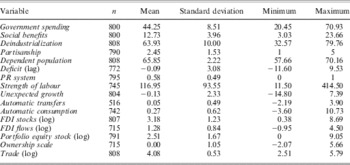
The compensation hypothesis is typically tested on social welfare spending. However, general equilibrium shifts induced by economic globalization may not be limited to this sphere, while demand for many forms of social spending should be unaffected.Footnote 87 Various types of targeted government spending – including active and passive labour market programmes, government investment, subsidy initiatives and human capital formation – represent alternative forms of spending that could compensate globalization's losers. Accordingly, we remain agnostic to the source of spending and use Government Spending – total annual government disbursements as a percentage of GDP – as the dependent variable. The sample mean for such spending is 45.3 per cent of GDP. Our results are robust to using a traditional Social Benefits Spending variable, whose sample mean is 13.5 per cent of GDP. Both measures are from the OECD Economic Outlook database.Footnote 88
We include a battery of control variables based on previous analyses of government spending.Footnote 89 The baseline model includes measures of Deindustrialization, the Dependent Population, Partisanship, proportional representation (PR system), lagged budget Deficit, Unexpected Growth and Strength of Labour. We address the cyclicality of spending by controlling for Automatic Transfers and Automatic Consumption.Footnote 90
Data were available for an unbalanced panel of twenty-one OECD countries over the period 1970–2007,Footnote 91 and unlike our election data are measured at annual intervals. To address missingness, almost exclusively on the automatic transfers variable, we use multiple imputation.Footnote 92
Electoral Turnout Data
Our primary dependent variable of Aggregate Electoral Turnout refers to elections to the lower legislative chamber. Two metrics are commonly used to measure turnout: as a proportion of registered voters or as a proportion of the voting age population (VAP). The VAP denominator is estimated relatively infrequently and can introduce errors that would otherwise be absent where registration procedures are high quality.Footnote 93 Therefore we measure Turnout as the proportion of the registered electorate using data from the International Institute for Democracy and Electoral Assistance.Footnote 94 However, following Franklin,Footnote 95 we use the VAP measure for the United States, where registration operates differently. We check our analyses using the VAP measure and find identical results.
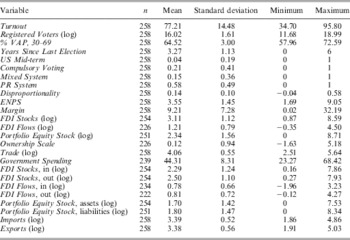
In addition to adding Government Spending as an intermediary variable to test for the compensation path, we also control for alternative explanations of electoral turnout. Since many variables have been used to explain turnout,Footnote 96 our baseline model only includes controls for which there are strong theoretical priors for inclusion. To capture the effect of socio-economic variables, we control for the size of the electorateFootnote 97 and a life-cycle effect measured by the proportion of the VAP aged thirty to sixty-nineFootnote 98 – Registered Voters Percent VAP Thirty to Sixty-nine, respectively. Economic growth was not included because there is no clear theoretical prior,Footnote 99 while there is insufficient variation in GDP per capita across this sample to be meaningful; the main results are unaffected by the inclusion of either. Given that we employ fixed-effect specifications, time-invariant political institutions are captured by country intercepts. However, because some countries have changed electoral formulas we include controls for PR System and Mixed System;Footnote 100 in addition, we include a measure of vote-seat Disproportionality Footnote 101 and a Compulsory Voting dummy.Footnote 102 To capture electoral fatigue and the lower salience that is potentially attached to legislative elections not held concurrently with presidential elections, we include Years Since Last Election Footnote 103 and a US Mid-term dummy variable. Finally, we control for contingent political variables – namely Margin of Victory Footnote 104 and the effective number of political parties by seat share (ENPS).Footnote 105 We consider many other variables as robustness checks, focusing especially on European integration.
Data availability and our OECD requirement generated a maximum sample of 259 elections across twenty-three countries, 1970–2007, to be used in the subsequent analysis.Footnote 106
Statistical Methods
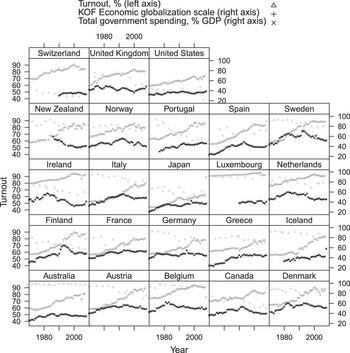
Panel data entail a number of important model specification issues, many of which are not adequately addressed in the existing literature. We start by examining Figure 1, which depicts trends in electoral turnout on the left axis and government spending and the KOF summary measure of international financial flows – a weighted index containing trade, FDI flows, FDI stocks, portfolio investment and remittancesFootnote 107 – on the right axis for each of the twenty-three countries. Figure 1 shows that while electoral turnout has declined in most countries, this decline has occurred from varying starting points and to different extents. Although less pronounced, most countries have gradually increased expenditures over the period in which globalization increased.
Turnout, total government spending and economic globalization, 1970–2007 Note: left axis: Δ indicates turnout; right axis: + indicates KOF economic globalization scale, × indicates total government spending (as % GDP).

To test our hypotheses, we parametrically model the relationship between economic globalization and the dependent variables of Government Spending and Turnout. Diagnostic tests and Figure 1 inform our model specification. First, we address heteroskedasticity and clustering within countries by using cluster-robust standard errors.Footnote 108 Secondly, a WooldridgeFootnote 109 test of the baseline models unsurprisingly indicated the presence of first-order serial correlation.Footnote 110 We model this with a lagged dependent variable (LDV); model diagnostics indicate that this is sufficient to remove residual (and higher-order) serial correlation.
Thirdly, the presence of omitted country effects biases coefficient estimates. A HausmanFootnote 111 test suggests the coefficients from a random-intercept model are biased by omitted country effects.Footnote 112 Since cross-sectional variation is not required for identification (even if it enhances efficiency in some cases) and our theory is principally concerned with the effects of changes in globalization rather than levels, we include country fixed effects (FEs). Ultimately, if changes in the extent of globalization are associated with changes in spending and turnout within countries, this constitutes more convincing evidence of a causal link than cross-sectional correlations would do.Footnote 113 Examining turnout in US House elections, ClouseFootnote 114 also finds cross-sectional models to be problematic and implements a similar first-differencing transformation.
A final, and perhaps greatest, concern is spurious correlation,Footnote 115 as economic globalization and government spending have generally increased over time while turnout has decreased. This is evident from Figure 1, but is also indicated by a Fisher test.Footnote 116 Furthermore, trends in turnout differ considerably across countries; Australia and Belgium observe relative constancy, while Switzerland appears to experience a non-linear decline. There are a number of ways to address spurious correlation. One popular approach inserts common time trends. Alternatively, Garrett and MitchellFootnote 117 and Steiner,Footnote 118 when examining government spending and turnout respectively, employ period dummies to capture common time effects. However, it is hard to believe that ‘time’ – which may proxy for cohort shifts or broad economic or political changes – works in the same way across heterogeneous countries, as common time trends and period dummies imply. Inappropriately extracting common time dynamics across countries where time affects countries differently may bias estimates, or at least fail to address the spurious correlation concern.Footnote 119 In order to capture country-specific dynamics, and thus control for unobserved trends that might induce spurious correlation, we detrend the data by including quadratic trend terms specific to each country.Footnote 120
Plümper, Troeger and ManowFootnote 121 note that removing trends eliminates variation that may be explained by economic globalization, and thus our test is conservative. Nevertheless, because spurious regression is a major concern, only if we can show that economic globalization and turnout are related after detrending can we claim robust evidence that economic globalization has caused a decline in turnout. Besides, if globalization is related to turnout, it should be related to the variation in turnout around any polynomial decline. In addition to making the data stationary, country-by-country detrended data also mitigate the possibility that a LDV will absorb substantive effects in the presence of strong serial correlation.Footnote 122 Combined, these specification choices imply the following regression equation:
 $${{y}_{it}}\, = \,\alpha {{y}_{it\,{\rm{ - }}\,1}}\, + \,{{\tilde{x}}_{it}}\brbeta \, + \,{{z}_{it}}\brgamma \, + \,yea{{r}_t}{{\brdelta }_{\rm{1}}}\, + \,year_{t}^{2} {{\brdelta }_{\rm{2}}}\, + \,{{\mu }_i}\, + \,{{{\epsilon}}_{it}}\ \ \ \,\,i\, = \,1, \ldots, \,N;t\, = \,1, \ldots, {{T}_i}$$
where the subscripts denote observations from period t in country i, yit
is the dependent variable, yit
−1 takes coefficient α,
 $$${{\tilde{x}}_{it}} $$$
is a 1 × G vector of G globalization variables with G × 1 coefficient vector β, zit
is a 1 × K vector of strictly exogenous control variables with K × 1 coefficient vector γ, yeart
δ
1 and
 $$$ year_{t}^{2} {{\brdelta }_{\rm{2}}} $$$
denote 1 × N (standardized) quadratic country-specific time trends multiplied by N × 1 vectors of coefficients for each country, μi
are N country FEs and εit
is the error term. Note that, unlike annual government spending data, elections are not an annual event, and thus t differs across the spending and turnout models. Although the independent variables appear to only affect yit
contemporaneously, the LDV gives the equation a dynamic structure and thus identifies long-run effects in addition to short-run (contemporaneous) effects.Footnote
123
Estimating Equation 2 is problematic because the inclusion of a LDV alongside country FEs induces endogeneity and thus renders OLS inconsistent. NickellFootnote 124 demonstrates this inconsistency for fixed T, but shows that this dynamic bias disappears as T→∞. Because the dimensions of the turnout and government spending datasets differ, we use different estimation techniques.
For turnout, we estimate Equation 2 using the one-step Arellano and BondFootnote 125 ‘difference GMM’ estimator designed for panels with short T where dynamic bias is greatest. This estimator first-differences Equation 2 to eliminate μi and instruments for Δyit −1 with structurally orthogonal lags of the level yit − s , s ≥ 2 (and all other exogenous variables). Consistent estimation requires no s-order serial correlation in the differenced errors (verifies orthogonality of lags) and Δyit −1 not overidentified (instruments are exogenous). Although consistent in N, difference GMM is typically used for small-T-large-N panels, and so its small N properties may be in doubt. However, our estimation strategy is robust to more conventional but inconsistent OLS approaches (see robustness section).
For the imputed spending models, where T is large relative to N, we instead use a bias-corrected OLS estimator known as least squares dummy variable correction (LSDVC), first proposed by Kiviet.Footnote 126 BrunoFootnote 127 extended LSDVC to our case of unbalanced panels. LSDVC computes the bias of OLS estimates relative to a consistent estimator – we use the difference GMM estimator – and then adjusts coefficient estimates for bias of order N −1 T −2. Bootstrapped standard errors are calculated using 500 simulations for each imputed dataset. Simulation studies show that LSDVC consistently outperforms GMM and OLS estimators of autoregressive models with unit FEs in terms of both bias and root mean squared error for relatively large T across a variety of parameter specifications.Footnote 128 A detailed discussion of estimation issues is provided in the online appendix. All models were estimated using Stata 12.
RESULTS
We now test our hypotheses using the data and methods described above. Our results provide strong support for the constraint hypothesis (Hypothesis 1) – but operating only through foreign ownership, not trade (Hypothesis 4a ). The negative effect of the globalization of ownership on turnout is largest and most robust for the most flexible flows, FDI Flows and Portfolio Equity. In addition to this direct macro-level effect, we also find evidence of an indirect effect: contradicting the compensation hypothesis (Hypotheses 2a, 4b), foreign ownership (and perhaps also trade) reduces total and social benefit government spending (Hypothesis 3a ), which in turn further decreases turnout (Hypothesis 2b/3b ).
Government Spending
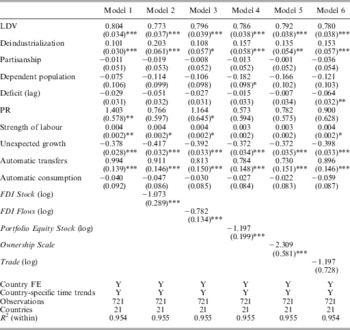
To first evaluate the compensation hypothesis (Hypothesis 2a ) and the argument that this operates through trade (Hypothesis 4b ), we examine the impact of economic globalization on government spending. Taking Government Spending as the dependent variable, Model 1 in Table 2 combines the LSDVC estimates for Equation 2 across the 10 imputed datasets using the baseline specification. Models 2–6 separately add the economic globalization variables.
The coefficients on the control variables are generally consistent with the findings in the extant literature: not only is spending slow moving, but deindustrialization and union strength are positively correlated with spending. There is, however, no evidence to suggest that increases in the power of left-wing parties, budget surpluses, large dependent populations or countries with PR systems spend more. Replicating Iversen and Cusack,Footnote 129 spending responds strongly to unexpected economic growth and automatic transfers.
Turning to Models 2–6 and Hypothesis 2a , the spending data provide no evidence to support the compensation hypothesis operating through either foreign ownership or trade. Rather, the data suggest that increases in foreign ownership decrease Government Spending—which is consistent with the constraint hypothesis (Hypothesis 3a ) and the globalization of ownership. In the short run, the median country's increase in FDI Stock, FDI Flows and Portfolio Equity Stock from 1970–2007 (from 9.7 per cent to 91.7 per cent, 1.6 per cent to 11.4 per cent, and 0.7 per cent to 41.5 per cent of GDP, respectively) reduced total spending as a proportion of GDP by 2.3, 1.2 and 3.9 percentage points, respectively. Long-run feedback through the LDV quintuples the magnitude of these effects and thus represents a substantial reduction in spending. The ownership scale reinforces these results by showing that the first factor is also significantly negative. The uncertainty surrounding the coefficient on Trade– which is also negative but significant just outside the 10 per cent level– suggests that neither the constraint nor compensation hypotheses dominate, although we cannot distinguish between trade having no impact on spending and the net effect of opposing forces being equal. For there to exist a negative indirect effect on electoral turnout, however, the coefficient on Government Spending in the turnout models must take a positive coefficient (Hypothesis 2b/3b ). We test this alternative hypothesis in the next subsection.
Robustness checks.
First, very similar results emerge if we estimate the models with OLS or difference GMM instead of LSDVC. Secondly, the results are robust to using the non-imputed data, with the sole exception that PR systems consistently have higher spending. Thirdly, to address possible common shocks we included year dummies, both instead of and in addition to country-specific time trends (which may be insufficiently flexible to capture common shocks). The results are robust, except that Trade is significantly negative around the 1 per cent level in both cases. Fourthly, to address endogeneity concerns, we used suitable lagged levels as GMM instruments in difference GMM models, finding very similar results; Trade was significant around the 5 per cent level. All unreported analyses and robustness checks cited can be found in our replication code.
Finally, the findings for Government Spending are substantively similar to analyses using Social Benefits as a proportion of GDP;Footnote 130 see the online appendix. The (unreported) decline in the globalization coefficient magnitudes is to be expected, since social benefits are a fraction of total spending. Trade again has a statistically significant negative effect on social benefits– providing further evidence against the compensation hypothesis. This suggests that even if party manifestos increasingly profess their support for welfare and education programmes,Footnote 131 this is not reflected in spending.
Electoral Turnout
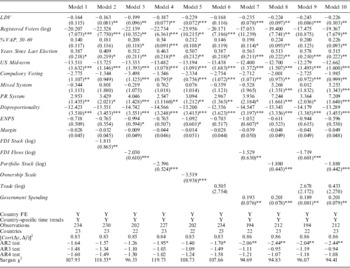
The results for electoral turnout obtained from estimating Equation 2 with difference GMM are shown in Table 2. These models test the aggregate implications of the constraint hypothesis (Hypothesis 1) and the hypothesis that foreign ownership is the driving force behind this effect (Hypothesis 4a ). Model 1 shows the baseline turnout specification. Models 2–10 include measures of economic globalization, first entering these variables separately before examining the inclusion of foreign ownership variables together with trade and spending variables simultaneously. The coefficients in Table 2 are instantaneous within-country marginal effects; long-run effects are computed below.
The coefficients on the control variables in Model 1– which are fairly consistent across subsequent models– generally exhibit the expected effects. Elections in more proportional electoral systems, with fewer parties, smaller and predominantly middle-aged populations, with longer periods between elections, and concurrent presidential elections (in the United States) experience higher turnout. Margin has the expected negative sign but fails to achieve significance in any model.Footnote 132 The negative coefficient for Compulsory Voting contrasts with analyses focusing on cross-sectional variation, but is based on only two instances of reform.Footnote 133 The negative coefficient for the LDV represents reversion to trend; its small size suggests the effect is immediate and relatively persistent.Footnote 134 The serial correlation (AR) tests indicate that there are no problems instrumenting for the LDV,Footnote 135 while the Sargan overidentification test is not rejected in any model.Footnote 136
Direct effects of economic globalization.
Entering the economic globalization variables separately in Models 2–6, we find a negative effect working through foreign ownership. This provides strong support for Hypotheses 1 and 4a. FDI Stocks, and especially FDI Flows and Portfolio Equity Stock, exhibit large negative coefficients that are statistically significant. These results are consistent with our theory that the globalization of ownership reduces incentives to turn out. The Ownership Scale reflects the combination of these variables and is also negative and highly significant. There is no evidence for any effect of trade dependence. This supports our claim that the structural impacts of trade liberalization may not directly alter voter behaviour (Hypothesis 4a ).
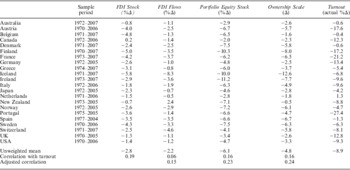
Table 3 presents the predicted long-run effect of changes in foreign ownership on turnout in each country over the sample period. Predictions for country i were computed recursively,Footnote 137 accounting for the values of globalization variable g at each election t through dynamic feedback:
 $${{\hat{\beta }}_g}\left[ {\left( {\mathop{\sum}\limits_{t\, = \,2}^{{{T}_i}} {{{{\hat{\alpha }}}^{{{T}_i}\,{\rm{ - }}\,t}} } {{{\tilde{x}}}_{itg}}} \right){\rm{ - }}{{{\tilde{x}}}_{i1g}}} \right]. \eqno (3)$$
We treat the first observation
 $$${{\tilde{x}}_{i1g}} $$$
as exogenous. Table 3 suggests foreign ownership has had a major effect in most countries, and has thus contributed considerably to the observed declines in turnout. On average across countries, of the 8.9 percentage point decline in turnout, changes in FDI Stock, FDI Flows and Portfolio Equity Stock have equated to 2.8, 2.2 and 6.1 percentage point declines in turnout, respectively. Because these variables are highly correlated and were estimated in separate models, the sum of these effects should not be interpreted as a total foreign ownership effect. Given that the data have been detrended and the ownership variables may have contributed to time trends, these estimates are probably lower bounds. In some countries the predicted effect of economic globalization exceeds the actual decline because of countervailing forces.
Indirect effects of economic globalization.
Models 7 and 8 assess the indirect globalization hypothesis (Hypothesis 2b/3b ) by including Government Spending as an additional covariate. Government Spending is positive, suggesting that – as predicted, and previously found by ColomerFootnote 138 – larger government increases incentives for voters to turn out. The coefficients on FDI Flows and Portfolio Equity Stock decrease in magnitude (albeit insignificantly), but remain significant – which indicates that the constraining effects of foreign ownership do not solely operate through spending. This finding suggests the existence of two constraint paths for the globalization of ownership: one that operates negatively from ownership directly and a second that operates negatively and indirectly through reduced government spending. Multiplying the coefficients from Tables 1 and 2 estimates that the negative indirect effects are approximately one-twentieth the magnitude of the direct effects of the globalization variables. The addition of Trade in Models 9 and 10 demonstrates the robustness of these findings, and provides further evidence that no dominating constraint or compensation effect operates through international trade. Unreported regressions examining FDI Stock show that the coefficient becomes insignificant – we suggest that this lack of robustness reflects the relative immobility of FDI Stock compared to changes in such stocks and more transient portfolio investment.
Economic Globalization and Government Spending

Note: all models estimated with LSDVC using one-step difference GMM bias corrections of order N −1 T −2. Standard errors clustered by country were computed using 500 bootstrapped simulations and were combined across ten imputed datasets using Rubin averaging rules. The R 2 term comes from the OLS FE model before adjustment, and is averaged across imputations.
*p < 0.1, **p < 0.05, ***p < 0.01.
The results thus provide strong support for the constraint hypothesis, arguing that economic globalization reduces the incentive to vote (Hypothesis 1), but also suggest an indirect effect that – contrary to the compensation hypothesis – causes governments to reduce their spending, which in turn further reduces turnout (Hypothesis 3). These effects operate solely through the globalization of ownership (Hypothesis 4a ). Given the difficulties of drawing valid inference, our models necessarily extracted variation from the data (especially by removing stable country differences and within-country trends); that we still find such clear results lends the relationships considerable credibility.
Inward vs. outward globalization.
Having established that different aspects of economic globalization have different effects, before turning to our robustness checks, it makes sense to ask whether the effects of globalization differ between their inward and outward components. It may be that governments fear the withdrawal of foreign capital from their country and may welcome the return of capital invested abroad. So inward foreign ownership might be more constraining than outward.
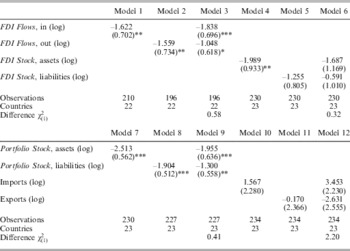
However, decomposing the globalization variables suggests that the constraining impact of foreign ownership works equally in either direction. Using the same baseline models estimated in Table 2, Table 4 reports the coefficients in which the external assets/net outflows and external liabilities/net inflows components are distinguished and entered into regression equations separately and then simultaneously. Although the coefficients on FDI Stock and Portfolio Equity Stock assets are larger, statistical tests fail to reject the null hypothesis of equal size. Similarly, the evidence for FDI Flows tentatively suggests that inflows dominate outflows, with only the former achieving statistical significance at the 5 per cent level. Again noting that FDI constitutes only equity holdings of at least 10 per cent, this may be explained by large and visible foreign takeovers – such as the US firm Kraft's takeover of the UK firm Cadbury in 2010 – strongly influencing voters’ perceptions. This suggests the possibility of differences in the effects of immediate (flows) and longer-term accumulative (stocks) ownership. Such conclusions are cautious, as the coefficients are not statistically different. Even after decomposition, trade variables had no clear effects.
Economic Globalization and Aggregate Turnout

Note: all models estimated with one-step difference GMM. Differenced variables are used as standard instruments, and all level lags of the dependent variable exceeding two are used as GMM instruments, except in Models 1, 3, 6–10, where third-order lags are used. Model 2 restricts the number of lagged-level instruments to nine to avoid overidentification. Country-clustered robust standard errors in parentheses. *p < 0.1, **p < 0.05, ***p < 0.01.
Predicted Long-run Effect of Foreign Ownership on Turnout by Country

Note: predictions are derived from Models 2–5 in Table 2 according to Equation 3, using data for all available years. Insufficient data were available for Luxembourg for legitimate comparison; meaningful changes in FDI flows were not available for Belgium (only two elections); FDI flows for Germany are first measured in 1990; FDI flows and portfolio equity stock for Greece are first measured in 1989; FDI flows and portfolio equity stock for Iceland are first measured in 1987; FDI flows for Switzerland are first measured in 1983. Change in turnout for the United States is between the 1970 and 2006 mid-terms. Adjusted correlation removes all shortened series enumerated above.
Assets and Liabilities Decomposition

Note: models are otherwise identical to Models 2–6 in Table 2. The null hypothesis for χ 2 is that globalization coefficients are equal.
Descriptive Statistics – Government Spending Models (pre-imputed data)

Descriptive Statistics – Turnout Models

Robustness checks.
Despite adopting the most rigorous statistical approach that we deem reasonable, robustness checks are still necessary. With the occasional exceptions of FDI Stock and Government Spending, our findings are robust to all checks.
Our first set of checks examines sensitivity to variable and observation inclusion. First, the main findings in Table 2 are robust to separately dropping all twenty-three countries. The only exception is FDI Stock, which was significant only at the 10 per cent level about half the time and once fell just outside the 10 per cent band. Secondly, removing cases with standardized residuals with an absolute value exceeding two suggests that our findings are not driven by outliers. Thirdly, to address concerns that tax havens drive the analysis, we removed Iceland, Ireland, Luxembourg and Switzerland and found very similar results. Fourthly, all results are robust to the removal of US mid-terms. Fifthly, we found substantively similar results when measuring turnout as a proportion of the VAP; here standard errors declined and the coefficient on FDI Stock increased in magnitude and became significant at the 1 per cent level, although Government Spending became insignificant. Sixthly, our results – with the rare exceptions of FDI Stock and Government Spending – are robust to including many feasible control variables.Footnote 139 Seventhly, adding our globalization variables to Franklin'sFootnote 140 generational models yielded similar results. Finally, to address concerns about common shocks we included dummy variables for each decade, both instead of and in addition to country-specific time trends. Unsurprisingly, the dummies reveal turnout is declining by decade, but leave the main results intact.
An especially important concern is that much of the economic globalization in the OECD is due to European integration.Footnote 141 The profound links between the two have three potentially important implications. First, patterns of trade and capital flows will be in part the product of developments in European integration. Secondly, with policy making at the European level constraining national governments, EU membership is another potential source of lower turnout. Thirdly, this might lead to weaker effects of economic integration on turnout among EU members, especially those involved in the European Monetary System (EMS). However, splitting the sample by EU (including predecessors) membership and countries that have joined the Eurozone, the online appendix shows similar results in both samples,Footnote 142 indicating that similarly constraining effects of globalization occurred outside the EU.Footnote 143 Moreover, including controls for contemporary and cumulative EU membership left our results unchanged and do not suggest that the EU has an independent effect on turnout. It is possible that, while European integration has increased economic constraints, the importance of EU political decision making has counterbalanced this effect.
Secondly, we examined two popular alternative estimation procedures and found that these less demanding estimators provide stronger results. First, a FE model with a LDV and country-clustered standard errors estimated with OLS yielded analogous coefficients and smaller p-values, with the exception that FDI Stocks fell just outside the 10 per cent standard. Secondly, implementing the Beck and KatzFootnote 144 OLS approach with panel-specific AR1, country FEs and panel-corrected standard errors saw the coefficient magnitudes and t-statistics for the globalization variables uniformly increase. Thus, the difference GMM estimates are not a small-sample artefact. We also used the ‘system GMM’ estimatorFootnote 145 – designed for cases in which lagged levels are weak instruments for Δyit −1 because yit follows a random walk (not the case here) – and found substantively similar results for the globalization variables, except that FDI Stock became essentially zero and insignificant, in turn moving the scale just outside the 10 per cent margin.Footnote 146
Thirdly, averaging the independent variables across the prior electoral cycle produced very similar results. Contemporaneous measures of the independent variables could have overestimated the speed with which voters update their perceptions (in ways that an LDV cannot capture), or missed annual or cyclical volatility. We also tested for a difference between contemporaneous and electoral cycle averages by subtracting the cycle average from the value for the election year. This difference was significant in only one case: Trade in Model 10. We conclude that immediate experiences produce similar effects to experiences over the full electoral cycle.
Finally, the assumption of homogeneous causal effects across countries may seem heroic.Footnote 147 To examine such variation in globalization coefficients, we estimated multilevel models with random coefficients.Footnote 148 Overall, there is little coefficient heterogeneity, suggesting that economic globalization has similarly affected turnout across OECD nations.Footnote 149 This finding thus supports the predicted effects of foreign ownership in Table 3, which assume coefficient homogeneity.
Is economic globalization endogenous to turnout?
While we have argued that economic globalization has affected turnout, the reverse causal direction is also plausible. A possible argument runs as follows: the working (manufacturing) class opposes globalization in advanced democracies because it stands to lose from further integration,Footnote 150 and so where turnout is higher – which implies higher working-class mobilization, given that this group usually exhibits disproportionately low turnoutFootnote 151 – governments respond by keeping globalization at lower (and more politically viable) levels. Pontusson and RuedaFootnote 152 argue that turnout affects the programmes of left parties only where low-income voters are mobilized, while Iversen and CusackFootnote 153 show that while turnout does not affect social transfers, it does increase government consumption. MahlerFootnote 154 finds that turnout increases government redistribution.
There are good reasons to doubt this story. The idea that higher turnout produces a stronger left share of the vote is an implicit (but crucial) component of the causal path from turnout to globalization. However, FisherFootnote 155 shows that increases in turnout are not positively associated with increases in left vote share, while Moene and WallersteinFootnote 156 find that turnout reduces spending on social insurance. Furthermore, instrumenting for the differenced globalization variables with orthogonal lagged levels, as with the spending models, leaves the results unchanged.Footnote 157 In practice, this means instrumenting the most recent difference with the level of globalization of around a decade earlier. Using a more traditional 2SLS approach, we find that the negative foreign ownership results remain significant when these variables are instrumented for by the linear combination of lagged economic growth and lagged (log) GDP per capita – both of which are significant determinants of capital flows that are plausibly not directly related to turnout. These results can be found in our online appendix.
CONCLUDING DISCUSSION
This article considered two alternative mechanisms by which economic globalization may influence voter turnout, setting the constraint hypothesis against the compensation hypothesis. We further distinguished two distinct strands of economic globalization, arguing that the impact of the globalization of ownership (essentially capital mobility) should differ from the globalization of trade.
Examining aggregate data from twenty-three OECD countries since 1970, we find strong support that a constraint mechanism operates through foreign ownership, both directly and – in strict opposition to the compensation hypothesis – indirectly by reducing government spending. As we theorized, the effect of economic globalization on turnout depends on which indicator is used. Measures of the globalization of ownership were all negatively related to turnout, following a hierarchy in which the most flexible flows were most constraining, while trade had no clear effect. Thus a key conclusion is that, after applying rigorous tests that account for stable country differences and country-specific turnout trends, there is robust evidence that the globalization of ownership has contributed to the marked decline in turnout in developed societies. If developing countries are even more capital dependent,Footnote 158 this effect could be even larger.
The compensation hypothesis suggests that turnout might increase as a result of economic globalization, which we argued is theoretically most likely to be driven by the globalization of trade rather than foreign ownership. Given that international trade did not have a positive impact on either spending (as an intermediary) or turnout, the compensation mechanism is either non-existent or dominated by the constraining effect of economic globalization.
In order to illuminate the theoretical mechanisms it would have been ideal to have high-quality comparative survey data (including a panel component) covering the 1970–2007 period with survey items on turnout and various social attitudes on globalization and electoral politics. While we found some indications from the Comparative Study of Electoral SystemsFootnote 159 data that increasing globalization produces declining efficacy, indifference between parties and lower turnout within countries, the results were not robust. Although these were the best available data for the purpose, they include only a subset of OECD countries between 1996 to 2007 – typically just two or three elections per country, during a period when changes in globalization were relatively muted. There are also the usual problems of low response rates and measurement error in social surveys, and the particularly difficult problem of measuring turnout.Footnote 160 Under the circumstances, null findings from these survey data certainly do not represent refutations of our hypotheses, just the absence of evidence for them. The problems and limitations of the survey data also make us appreciate the comparatively comprehensive nature and high quality of the macro data.
Ultimately, while clear survey results could have provided a more detailed picture of the micro mechanisms, they are not essential to establish strong evidence for our hypotheses, which concern macro-level explanatory variables and a dependent variable that is much more accurately measured (and widely available) at the country level than at the individual level. By extracting country-level trends and fixed effects, our theory fits closely with the nuances in the data and is able to dismiss many alternative explanations.
We believe that this article makes an important contribution, both theoretically and empirically, to our understanding of electoral turnout – especially to the important problem of turnout decline.Footnote 161 Our estimates suggest that, despite being widely overlooked, economic globalization is responsible for a considerable portion of the decline since 1970 – on average, about two-thirds in the case of portfolio equity transactions, the most powerful ownership-constraint variable.
APPENDIX
Spending Models
Government Spending: Total disbursements of general government, as a percentage of GDP. Variable YPGTQ.Footnote 162
Deindustrialization: Percentage of labour force that is not employed in the agricultural or industrial sectors.Footnote 163
Partisanship: Schmidt index of cabinet composition, ranging from 1 (right hegemony) to 5 (left hegemony).Footnote 164
Dependent Population: Percentage of population aged below sixteen or above sixty-four.Footnote 165
Deficit: Budget deficit (spending – revenue), as a percentage of GDP.Footnote 166
PR System: Dummy variable coded 1 for PR electoral system.Footnote 167
Strength of Labour: Defined, as per Iversen and Cusack,Footnote 168 as the product of union density and union centralization.Footnote 169
Unexpected Growth: Defined, as per Iversen and Cusack,Footnote 170 as real GDP per capita growth at time t minus average real per capita growth in the preceding three years.Footnote 171
Automatic Transfers: Defined as per Iversen and Cusack.Footnote 172
Automatic Consumption: Defined as per Iversen and Cusack.Footnote 173
FDI Flows (log): FDI inflows plus outflows, as a percentage of GDP.Footnote 174 Rather than difference the estimated data on FDI stocks from Lane and Milesi-Ferretti,Footnote 175 we instead employ the specifically measured UNCTAD FDI flows data. The two series are only moderately correlated (r = 0.39). Accordingly, we consider only the UNCTAD data that we believe to be more reliable because it has not been imputed and has been compiled using a consistent methodology.
FDI Stock (log): FDI assets plus liabilities, as a percentage of GDP.Footnote 176
Portfolio Equity Stock (log): See text for definition.Footnote 177
Trade (log): Exports plus imports, as a percentage of GDP.Footnote 178
Country-specific Time Trends: Standardized linear and quadratic year terms for each country.
Turnout Models
Turnout: Percentage of the registered population that voted (except in the United States, where we use the percentage of the voting age population).Footnote 179
Registered Voters (log): Natural logarithm of the total number of registered voters.Footnote 180
Per cent VAP, thirty to sixty-nine: Percentage of voting age population aged thirty to sixty-nine. Spain's value for 2000 linearly interpolated.Footnote 181
Years Since Last Election: Number of years between elections to the national-level lower house.
US Mid-term: Dummy variable coded 1 for US mid-term elections.
Compulsory Voting: Dummy variable coded 1 if a country employs compulsory voting.Footnote 182
Mixed System: Dummy variable coded 1 for mixed electoral system.Footnote 183
Disproportionality: Index of relative disproportionality.Footnote 184
ENPS: Effective number of political parties by seats in parliament.Footnote 185
Margin: Percentage of the popular vote won in the first round of an election by the top party/group minus the second-place party/group. We use the vote share obtained through the party list in mixed systems.Footnote 186