


“We are not supposed to be an assembly of gentlemen who have no interests of any kind and no association of any kind. That is ridiculous. That may apply in Heaven, but not, happily, here.”
—Winston Churchill, characterizing the House of Commons in 1947In October 1989, Nigel Lawson resigned after six years as Chancellor of the Exchequer under Margaret Thatcher. Four months later, while still a Member of Parliament (MP), Lawson was named a nonexecutive director at Barclays Bank with a salary of 100,000 British pounds (GBP)—roughly four times his MP pay. The afternoon the appointment was announced, Barclays' market value rose by nearly 90 million pounds (Hollingsworth Reference Hollingsworth1991, 150).
Such anecdotes suggest that political connections can be of great value to private firms. In a number of recent papers, scholars have begun to systematically examine this value in a variety of settings. Firms with personal and/or financial connections to politicians have enjoyed higher stock valuations in Indonesia (Fisman Reference Fisman2001), the United States (Goldman, Rocholl, and So n.d.; Jayachandran Reference Jayachandran2006; Roberts Reference Roberts1990), Malaysia (Johnson and Mitton Reference Johnson and Mitton2003), and Nazi Germany (Ferguson and Voth Reference Ferguson and Voth2008). In the United States, politically connected firms are more likely to secure procurement contracts (Goldman, Rocholl, and So Reference Goldman, Rocholl and So2008), and in Pakistan, they are able to draw more favorable loans from government banks (Khwaja and Mian Reference Khwaja and Mian2005). Faccio (Reference Faccio2006) shows that the benefits of political connections are larger in countries with higher corruption scores.
In this article, we approach the market for political favors in the UK from the opposite perspective. Where others have focused on the benefits companies like Barclays obtain through connections to powerful politicians, we analyze the benefits politicians like Lawson obtain on the basis of their political power. If firms buy political favors, and if they do so in part by providing employment, gifts, or bribes to politicians, then politicians can be expected to benefit financially from office just as firms do from connections to officeholders. We attempt to measure this benefit by examining the effect of serving in Parliament on the estates of British politicians who entered the House of Commons between 1950 and 1970, and have since died.
Measuring the value of political power is difficult in part because detailed data on politicians' personal finances is generally not available. Even where it is, as in the U.S. Congress since the early 1990s, we generally do not have good data about income or wealth after the member leaves office, when much of the financial value of political power may be realized (Diermeier, Keane, and Merlo Reference Diermeier, Keane and Merlo2005). Even if we knew a given MP's income from all sources over the course of his or her life, it would still be difficult to determine what portion of those payments were a result of his or her political power. MPs are not randomly selected from the population (which is unfortunate for researchers, but arguably beneficial for citizens), so a comparison of MPs' income or wealth with that of a peer group outside politics is likely to reflect factors that led MPs to gain political office as well as the value of political office itself.
Our strategy for addressing these problems is to compare the wealth (at death) of MPs with that of politicians who ran for Parliament unsuccessfully. Voting, not randomization, decides which candidates win elections; we address the resulting selection problem in two ways. First, we employ conventional methods of covariate adjustment (matching and regression) to control for imbalances in key candidate-level confounding factors recorded in our data set, including age, occupation, schools and universities attended, and titles of nobility. Second, we employ a regression discontinuity design (Lee Reference Lee2008; Thistlethwaite and Campbell Reference Thistlethwaite and Campbell1960), exploiting the quasirandom assignment of office in very close races to estimate the effect of office on wealth. Our estimation strategies yield the same basic result: serving in Parliament was quite lucrative for MPs from the Conservative Party, but not for MPs from the rival Labour Party. Conservative MPs died almost twice as wealthy as similar Conservatives who unsuccessfully ran for Parliament; no such difference is evident among Labour politicians.Footnote 1
Our identification strategy and rich set of covariates make us quite confident that the difference in wealth we observe between winning and losing candidates is due to serving in Parliament itself (as opposed to background differences between successful and unsuccessful politicians); however, estimating that effect alone does not tell us how serving in office increased wealth for Conservative politicians. Serving in political office could affect one's wealth at death through many channels, including official perquisites (the office could provide a salary and in-kind payment different from what one could earn in the private sector), lifestyle changes (a life of politics could shape one's consumption patterns or bequest motive), and health (the stress or glory of being in Parliament might affect how long one accumulates and depletes savings). Our investigations suggest that these pathways do not account for the wealth gains we observe among Conservative politicians. The official perquisites of office were modest in the period we examine, particularly compared to salaries in the occupations that Conservative candidates typically held before standing for office. We know of no particular lifestyle changes made by Conservative MPs that would substantially affect their personal finances or bequests.Footnote 2 Our analysis also reveals no effect of winning office on longevity.
We suggest that office was lucrative for Conservative politicians because it endowed them with political connections and knowledge that they could put to personal financial advantage. We show that winning office more than tripled the rate of corporate nonexecutive directorships among Conservative politicians; back-of-the-envelope calculations suggest that this difference in the number of directorships alone can account for a sizable portion of the wealth differential between MPs and unsuccessful candidates from the Conservative Party. MPs were evidently valuable to firms as directors and consultants because of their political knowledge and connections, a finding that complements evidence from several other studies showing that political connections add value to firms. (For example, in the U.S., Goldman, Rocholl, and So [n.d.] finds that companies experience a positive abnormal return when they announce the nomination of a politically connected individual to the board of directors.)
We argue that the larger benefit enjoyed by Conservative MPs was due in part to differences in the way the parties were financed and organized. In the period in which these MPs were elected, the Labour Party was funded and dominated by a handful of trade unions that used their influence to secure the exclusive loyalty of a large proportion of Labour MPs. The Conservative Party, in contrast, gathered its financial support from diffuse contributors and had no dominant constituency, leaving MPs relatively free to forge relationships with numerous outside firms that competed for their legislative services. MPs from both parties thus explicitly provided services to outside interests, but the trade unions shaped Labour Party institutions such that they could acquire those services without bidding for the services of individual MPs.
Our article is among the first to provide direct empirical estimates of the financial rewards of political office. It is closely related to Querubin and Snyder (Reference Querubin and Snyder2008), who use census data to assess whether members of the U.S. Congress in the 19th century enjoyed faster wealth growth than unsuccessful Congressional candidates. Our estimates speak to the “career concerns” literature in political science, including work on candidate recruitment (Besley and Coate Reference Besley and Coate1997; Fiorina Reference Fiorina1994; Osborne and Slivinski Reference Osborne and Slivinski1996; Rohde Reference Rohde1979; Schlesinger Reference Schlesinger1966) and candidate retirement (Diermeier, Keane, and Merlo Reference Diermeier, Keane and Merlo2005; Groseclose and Krehbiel Reference Groseclose and Krehbiel1994; Hall and van Houweling Reference Hall and van Houweling1995; Keane and Merlo Reference Keane and Merlo2007). The monetary benefit of office holding also appears as an important parameter in numerous recent political economy models that examine the selection and behavior of politicians (e.g., Besley Reference Besley2005; Reference Besley2006; Caselli and Morelli Reference Caselli and Morelli2004; Dal Bó, Dal Bó, and Di Tella 2006; Mattozzi and Merlo Reference Mattozzi and Merlo2007; Messner and Polborn Reference Messner and Polborn2004). There is no consensus in the theoretical literature on the relationship between the financial rewards of political office and the quality of policy making; rigorous empirical study of that relationship is only just beginning (see, e.g., Ferraz and Finan Reference Ferraz and Finan2008). It is evident, however, that significant nonsalary compensation has the potential to shift MPs' priorities away from their official duties and toward the interests of client firms (Besley Reference Besley2006; Gagliarducci, Nannicini, and Naticchioni Reference Gagliarducci, Nannicini and Naticchioni2008; Thompson Reference Thompson1987). Our analysis furnishes the first estimates of the total financial rewards of attaining legislative office (including nonsalary pay), demonstrates that nonsalary benefits were a considerable part of those rewards in postwar British politics, and shows that those rewards can vary depending on the organization of interests in political parties.
We present our evidence and argument as follows. In the next section, we discuss the regulation of MPs' outside employment and other financial arrangements in a comparative international context. Next, we introduce our data on the wealth of British politicians and use these data to estimate the effect of serving in Parliament on wealth. We then consider possible channels through which MPs likely increased their wealth, focusing on opportunities for earning outside income through consultancies and directorships, and consider possible reasons why Conservatives and not Labourites benefited from these opportunities.
VALUE OF A PARLIAMENTARY SEAT IN CONTEXT
Before embarking on our empirical analysis of the financial benefit of winning a seat in the House of Commons, it is worth illuminating the context surrounding MPs' finances. No study has previously attempted to empirically determine the total financial rewards of serving in Parliament, but there has been considerable controversy about and discussion of the financial lives of MPs that points to the significance of the topic and gives an idea of what to expect.
MPs earn salaries that are considered modest relative to their counterparts in other countries and in comparable professions within Britain (Baimbridge and Darcy Reference Baimbridge and Darcy1999; Judge Reference Judge1984), but there is a widespread public perception that some MPs use office to enrich themselves by other means. A Gallup poll in 1985 found that 48% of respondents believed that “most MPs make a lot of money by using public office improperly”; by 1994, when scandals surrounding parliamentary bribes had become a prominent political issue, the proportion of respondents answering in the affirmative had risen to 64%, while more than 80% believed it improper for MPs to accept payment for advice about parliamentary matters (which is, in fact, a common practice in Parliament) (Norton Reference Norton2003, 367).
Although outright bribery has occasionally been the focus of some attention (particularly in the “cash for questions” scandal of the mid-1990s), most public scrutiny has focused on the practice of MPs taking on outside employment while in office. As in most other parliaments, members of the British House of Commons are permitted to take on a variety of outside work while serving in office. Throughout the period since World War II, it has been common for MPs to serve on corporate boards, act as paid “parliamentary consultants” for firms or industry groups, and draw stipends from trade unions. Although the practice of MPs simultaneously holding outside jobs is consistent with the concept of parliaments as citizens' assemblies, it has long been recognized that these outside arrangements might conflict with MPs' duties to serve the public interest and their constituencies. A number of exposés (e.g., Doig Reference Doig1984; Finer Reference Finer1962; Hollingsworth Reference Hollingsworth1991; Judge Reference Judge1984; Noel-Baker Reference Noel-Baker1961; Roth Reference Roth1965; Stewart Reference Stewart1958) highlighted these conflicts, often focusing on Conservative MPs, who were reportedly more likely to acquire lucrative outside employment. Debates surrounding members' salaries and outside interests, taken up both in Parliament and in the broader public sphere, presaged recent formal models on the issue of legislative compensation (e.g., Gagliarducci, Nannicini, and Naticchioni Reference Gagliarducci, Nannicini and Naticchioni2008). Defenders of MPs' outside interests argued that members gained policy-relevant knowledge from their outside work and that banning parliamentary consultancies and directorships would drive the best MPs out of politics, while those advocating restrictions claimed that limiting outside employment would reduce conflicts and encourage sitting MPs to focus on their legislative work.
The House of Commons has addressed the potential conflict between legislative duties and outside interests by forbidding ministers from taking outside work and, since 1975, requiring other members to disclose any financial interests or income that could be thought to influence their judgment or actions as MPs.Footnote 3 Up to the mid-1990s, it was not necessary to disclose the amount paid by any outside source, and disclosure itself was considered voluntary; as one MP stated in an interview in the mid-1980s, “If someone was up to something they wouldn't register it” (Mancuso Reference Mancuso1995, 158). Starting in 1996, following a scandal in which members were caught accepting payments for raising issues in Parliament, MPs were required to report amounts received from outside employment and expressly forbidden from carrying out “paid advocacy,” but their right to take on work as consultants and directors while in office (and any work whatsoever afterward) was protected. This approach may seem lax from the perspective of the present-day U.S. Congress, whose members are prohibited from taking on almost all outside employment; face strict caps on earned income, gifts, and travel; and are prohibited from taking lobbying employment during a “cooling off period” after leaving Congress.Footnote 4 Compared to other legislatures internationally, though, the UK's regulations on conflict of interest are quite typical (Faccio Reference Faccio2006).Footnote 5 What is unusual is the closeness of connections between British MPs and British industry: Faccio (Reference Faccio2006) estimates that 39% of British firms (by market capitalization) have politicians in the executive ranks or as major shareholders, making the UK the third most connected country in her sample, behind only Russia and Thailand.Footnote 6
To provide a longer view of the extent of connections between sitting MPs and business in the UK, we recorded the outside interests reported by MPs for 1975 (the first year disclosure was required), 1990, and 2007. Figure 1 depicts the proportion of MPs, by party, who reported outside employment as directors, journalists, or consultants, as well the proportion of MPs who reported other employment (i.e., unrelated to MP work), a union sponsorship, or significant shareholdings.Footnote 7 The plots indicate that a considerable proportion of MPs had outside engagements but, as might be expected, there were stark differences in the types of engagements undertaken by Conservative and Labour MPs. Around half of Conservative MPs sat on corporate boards at each point examined, and around half reported employment as a “parliamentary consultant.” Labour MPs were much less likely to hold either kind of position but, up until the 1990s, were very likely to be sponsored by a trade union. (The Labour Party ended union sponsorships in 1996, in part to sharpen its attacks on Conservatives' outside financial dealings.Footnote 8) Plenty of anecdotal evidence suggests that the rough pattern of outside interests revealed by official disclosure starting in 1975 extends back well into the 1950s and 1960s.Footnote 9
Members of Parliament Declaring Outside Interests (1975, 1990, and 2007)

To this point, we have considered outside employment in which MPs have engaged while in office, but some of the financial rewards of holding office probably come after an MP retires from politics (whether because payments for political services are delayed until they can more easily be hidden or because the MP continues to provide political services). A distinct advantage of our research design (which uses probate values as the outcome) is that it should measure rewards MPs collect during their entire lives after winning office, including after they retire from politics. Because former MPs are not subject to disclosure requirements, far less information is publicly available about the employment opportunities they enjoyed after leaving office than before. Looking at the U.S. Congress, Diermeier et al. (Reference Diermeier, Keane and Merlo2005) conclude based on a survey of former members' first jobs after leaving office that legislative experience confers a considerable boost in earning power.
WEALTH OF CANDIDATES TO HOUSE OF COMMONS
Data and Estimation Sample
Our research design assesses the financial benefits of political office by comparing the wealth of MPs with that of unsuccessful candidates. In this section, we describe the process by which we collected wealth data, along with relevant covariates, for a sample of winning and losing candidates to the British House of Commons.
As a measure of wealth, we focus on politicians' probate values, a legal record of the size of an individual's estate at the time of death.Footnote 10 Probate values have been used to analyze the relationship between economic interests and voting in nineteenth-century Parliament (Aydelotte Reference Aydelotte1967) and are widely used in studies of economic mobility by economic historiansFootnote 11; even today, probate values provide the basis for official statistics on the distribution of wealth.Footnote 12 More than 90% of UK citizens leave a probate record (the exceptions being mostly indigent people), and the probate values for residents of England and Wales since 1858 are available in a single archive in London that allows one to collect the probate value for a person with a known name and date of death.
Because the biographies of MPs are typically listed in encyclopedias and official publications, the names and dates of death of successful candidates are easy to acquire. The primary difficulty is in finding the date of death of losing candidates, who for the most part leave a scant historical trace. Fortunately, starting in the late 19th century, The Times of London published brief biographies of every parliamentary candidate (winning and losing) standing for the House of Commons in each election. Because the candidate biographies are published at the time of the election, they do not, of course, provide the date of death. Still, the details provided by the biographies—in particular, the full candidate name, along with the year and sometimes month of birth—are sufficient to locate many candidates in public death record archives. We used an online genealogy databaseFootnote 13 that indexed all death records filed since 1984 by year and month of birth, which made it quite straightforward to find the date of death for a candidate using the information provided in The Times biographies.Footnote 14 An additional benefit of The Times biographies is that they include information on the education, occupation, and sometimes family background of the candidates, characteristics that are likely to be correlated with the candidates' ability and wealth at the time they ran for office.
We therefore digitized The Times Guide to the House of Commons for each of the seven general elections between 1950 and 1970,Footnote 15 and extracted key biographical and electoral information for every candidate (some 5,729 individuals). For each candidate, we record the full name, date of birth (year and, if available, month), education (both secondary and university), and occupation, as well as an indicator for whether he or she has a title of nobility. We then used the genealogy database to search for the date of death of 2,904 relatively competitive candidates, which at this stage we define as candidates who, not having previously won an election, either won or lost by less than 10,000 votes in a general election between 1950 and 1970. This restriction was intended to exclude incumbents, unbeatable candidates, and noncontenders for whom the implicit counterfactual is not welldefined.
We found near-certain matches for 665 candidates; we were unable to find a record in cases where the candidate had not yet died, died before 1984 (the start of the death record database), or produced so many matching death records (because of a common name) that we were not able to identify the correct one with sufficient certainty. To ensure the comparability of our winning and losing samples, we ignored public information about winners' death dates and searched for the date of death in the same way for both MPs and losing candidates. This results in some known Type I and Type II errors in the sample of winners, but reduces the possibility that an observed difference in wealth between the two groups could be due to measurement error.Footnote 16
With the 665 death records we obtained, we were then able to find probate values for 561 candidates in the probate calendar stored at First Avenue House in London.Footnote 17 We then exclude from our estimation sample 67 candidates who were from not from the two major parties (36 Liberals and 31 from regional parties) and a further 67 candidates who were found to have served before 1950, which leaves us with 427 candidates overall. Of these, 165 candidates are “competitive winners” in the sense that they entered Parliament in a race they won by less than 10,000 votes; the remaining 262 candidates are “competitive losers” in the sense that at some point they came within 10,000 votes of winning.Footnote 18 As an indication that the process of collecting probates did not depend on candidate characteristics in a way that might bias our results, we find that, conditional on finding the year of death for the candidate, the probability of finding a probate value is the same for winners and losers.Footnote 19 The candidates in our estimation sample are drawn from a fairly representative cross-section of Britain. A total of 383 of 658 possible constituencies are represented, with an average of 42 candidates from each of England's nine geographic regions and 16 and 19 from Wales and Scotland, respectively. (The death registry does not provide data for Northern Ireland, so we have no candidates from that region.) Within England, the ratio of candidates in our estimation sample to constituencies in the region is fairly consistent across regions, with somewhat lower representation of the relatively uncompetitive South. (The least heavily represented region, South West England, provided 47 observations and has 110 constituencies, whereas the most heavily represented region, North West England, provided 75 observations and has 76 constituencies.) The candidates' political debuts are also fairly evenly spread across our period, with about 60 candidates making their debut in each of the seven elections between 1950 and 1970. As far as we know, our database is unique in the richness of the background information and electoral results it provides about both winning and losing candidates over several elections. With Querubin and Snyder (Reference Querubin and Snyder2008), we are also among the first to collect direct measures of politicians' wealth.
Wealth Distributions
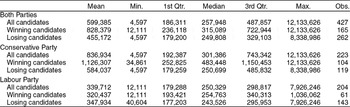
Table 1 provides descriptive statistics on the distribution of wealth at the time of death for candidates in our sample. To make the comparison meaningful, we converted the gross value of the estate into real 2007 GBP using the Consumer Price Index from the Office for National Statistics. We find that gross wealth at death varies widely across candidates ranging from 4,597 GBP for the poorest candidate (Conservative Robert Youngson) to 12,133,626 GBP for the richest candidate (Conservative Jacob Astor). The median wealth at death is 257,948 GBP. As a benchmark, the median gross value of the estate for males ages 65 and older in 2002 was 113,477 GBP,Footnote 20 indicating that the median candidate died with almost twice the wealth of the median senior citizen in recent years. This result is roughly consistent with Gagliarducci, Nannicini, and Naticchioni (Reference Gagliarducci, Nannicini and Naticchioni2008), who find that the income reported by Italian politicians before taking office exceeds the median income in the rest of the Italian population by about 45%.
Gross Wealth at Death (Real 2007 GBP) for Competitive Candidates Who Ran for House of Commons Between 1950 and 1970 (Estimation Sample)

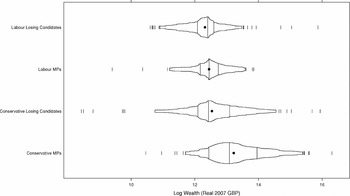
Given the well-known differences in social class between politicians from the two parties in this period, it should not be surprising that Conservative candidates died significantly richer than their Labour counterparts. As shown in Table 1, the median wealth among Conservatives exceeded that among Labourites by 50,000 GBP. Table 1 also provides the first indication that Conservative MPs died much wealthier than unsuccessful Conservative candidates; the median Conservative MP died with 483,448 GBP, whereas his or her unsuccessful counterpart passed away with a “mere” 250,699 GBP. The difference on the Labour side is less than 10,200 GBP. Figure 2 provides another look at this comparison by depicting the estimated density of log wealth for successful and unsuccessful candidates from each party. The first three wealth distributions (for winning and losing Labour candidates and losing Conservatives) look quite similar, but the wealth distribution for Conservative MPs appears to be shifted quite markedly upward. Clearly, this difference must reflect either a substantial effect of office on wealth for Conservatives or a strong electoral bias toward wealthier candidates among Conservatives (or both).
Distributions of (Log) Wealth at Death by Party for Winning and Losing Candidates to House of Commons 1950–1970

ESTIMATING THE EFFECT OF OFFICE ON WEALTH
Because political office is not randomly assigned among candidates, MPs and losing candidates may differ in ways that are correlated with both wealth and the probability of gaining office.Footnote 21 As noted in the previous section, our first line of defense against these confounding factors is to restrict our sample to relatively competitive candidates. In this section, we describe statistical approaches we use to address remaining confounders
Matching Estimates
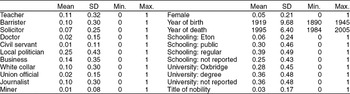
Our data set includes an unusually rich set of covariates for each candidate, which makes it possible to condition on many possible differences between winners and losers. In particular, for every candidate we record the year of birth, gender, party, schooling, university education, detailed occupation, titles of nobility,Footnote 22 and year of death. Descriptive statistics for the covariates are presented in Table 2. All characteristics except the year of death and wealth are measured from The Times Guide to the House of Commons biography that appears for the first constituency race of each candidate. The covariates are therefore “pretreatment” in the sense that they are not affected by whether the candidate won office.Footnote 23
Characteristics of Competitive Candidates Who Ran for House of Commons Between 1950 and 1970 (Estimation Sample)

Note: All covariates except year of death are measured at the time of the candidates' first race between 1950 and 1970.
To clarify the assumptions for the estimation, let W i be a binary treatment indicator coded one if candidate i served at least one period in the House of Commons, and zero if candidate i never attained office. X is an (n × k) matrix that includes our k observed covariates for all n candidates with row X i referring to the characteristics of candidate i. The variables Y i(0) and Y i(1) represent the wealth that candidate i would realize with and without gaining political office (i.e., “potential outcomes”). Evidently, only one of the potential outcomes is observed for each candidate. In the following, we proceed by assuming unconfoundedness given the observed covariates (i.e., (Y 1, Y 0) ⊥ W|X), and common support (i.e., 0 < Pr(W = 1|X) < 1) holds with probability one for (almost) every value of X (Rosenbaum and Rubin Reference Rosenbaum and Donald1983).
The validity of the unconfoundedness assumption depends on the quality of the covariates in capturing the assignment mechanism (i.e., the process by which candidates are sorted into winners or losers). Arguably, our unusually rich set of covariates captures the most obvious confounders. To the extent that wealthier candidates were better able to attain office (perhaps by using their connections to be placed in more favorable districts), the omission of wealth at the time of candidacy may be particularly problematic. However, although we do not measure preexisting wealth explicitly (no such data are available), many of our covariates—such as whether a candidate was schooled at Eton, studied at Oxbridge, worked as a barrister, or has a title of nobility—must be highly correlated with preexisting wealth and, therefore, indirectly control for this omitted factor. Later in the article, we employ a different estimation strategy based on a regression discontinuity design that relies on close elections to control for unobservable factors.
We chose matching as our main method of covariate adjustment in order to avoid parametric assumptions and to keep the analysis transparent (Imbens Reference Imbens2004; Rubin Reference Rubin2006). Specifically, we employ genetic matching (with replacement and one-to-one matching) following Diamond and Sekhon (Reference Diamond and Sekhon2008).
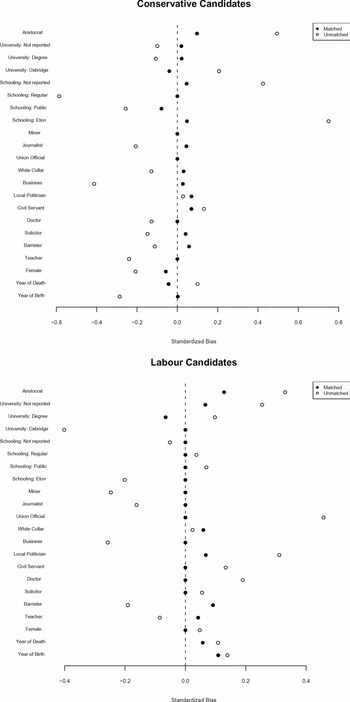
Matching Results for the Conservative Party. The upper panel of Figure 3 presents measures of covariate balance between Conservative winners and losers before and after our matching procedure. For each covariate, we plot the standardized bias as measured by the difference in means between the winners and the losers scaled by the pooled standard deviation. Accordingly, circles to the right (left) of the dashed vertical line at zero indicate a higher incidence of a certain characteristic in the group of winning (losing) candidates. As expected, there are clear differences (indicated by unfilled circles) in the distribution of preexisting characteristics between Conservative winners and losers before matching. MPs were more likely than unsuccessful candidates to have aristocratic backgrounds and elite educations. Winning candidates were less likely to be in white-collar professions (engineering, accounting, or public relations), journalism, and teaching professions, and also less likely to have business backgrounds. After matching, however, we achieve a very high degree of covariate balance, indicated by the filled circles. The standardized bias is now within 0.1 for all variables. The lowest p value across paired t tests and KS tests is .16, which indicates that the corresponding distributions for the matched groups are similar across all covariates. The matched groups of winners and losers have very similar observed characteristics, such that any remaining difference between the wealth of winning and losing candidates can plausibly be attributed to the effect of treatment rather than preexisting differences.Footnote 24
Covariate Balance Before and After Matching

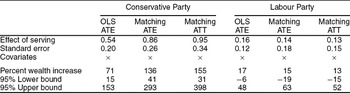
The upper panel in Table 3 displays our effect estimates. The first column presents the results from a simple OLS regression (with robust standard errors) of wealth on the treatment indicator, including all covariates. Columns two and three display the results from the matching estimator for two quantities of interest: the average treatment effect (ATE) given by τATE = E[(Y i(1)−Y i(0)], and the average treatment effect for the treated (ATT) given by τATT = E[(Y i(1)−Y i(0)|W i=1] with Abadie and Imbens (Reference Abadie and Imbens2006) standard errors. Across specifications, we find a robust and substantial impact of serving on wealth at the time of death. We estimate that serving in Parliament increased wealth at death by between 71% and 155%, depending on the specification. For all specifications, we soundly reject the null hypothesis of no effect at conventional levels.
Matching Estimates: Effect of Serving in House of Commons on (Log) Wealth at Death

Notes: N=223 for the Conservative Party, N=204 for the Labour Party; for the ATT estimation, there are 104 treated units for the Conservative Party and 61 for Labour. Covariates include all covariates listed in Table 2. ATT = average treatment effect for the Treated, ATE = average treatment effect, OLS = ordinary least squares. Matching results are from 1:1 Genetic Matching with postmatching regression adjustment. Standard errors are robust for the OLS estimation and Abadie-Imbens for matching.
Matching Results for Labour Party. Balance results for Labour candidates are reported in the lower panel of Figure 3. Again, we find some pronounced differences in the covariate distributions between MPs and unsuccessful candidates before matching. The discrepancies between winners and losers are roughly the reverse of those for the Conservative Party: among the winning Labourites, there is a smaller fraction of candidates with an Oxbridge education, Eton schooling, or business background than among the unsuccessful candidates, but a higher fraction of union officials and local politicians. After matching, these differences are almost completely removed. We obtain a very high degree of balance on all covariates, with the lowest p value across all balance tests being .30.
The lower panel in Table 3 presents the matching-based effect estimates for Labour candidates. Consistent with the distributional box plots shown previously, we find no effect of serving on wealth at death. The point estimates across all models are close to zero. Although this null finding is not very precisely estimated, the difference between the effect for Conservative and Labour MPs is clear: in an OLS regression pooling the two parties, the p value on the test that the coefficient is the same for the two parties is .05.
Regression Discontinuity Design Results
The matching results presented so far rest on the assumption of unconfoundedness, which fails if, conditional on the observed covariates, there remain imbalances in important unobserved factors between winners and losers. Controlling for unobserved confounding is impossible in most observational studies, but the unique nature of political contests provides an opportunity to apply a regression discontinuity (RD) design to the problem (Thistlethwaite and Campbell Reference Thistlethwaite and Campbell1960). Following pioneering work by Lee (Reference Lee2008), we note that in very close elections, the assignment to political office is largely based on random factors. Although winning candidates may generally be different from losing candidates at the time of the election (e.g., better looks, more money, greater speaking ability), there is no reason to expect the winners and losers of elections decided by razor-thin margins to systematically differ in any way. The RD design therefore attempts to estimate the difference in wealth precisely at the threshold where winners and losers are decided (i.e., where the margin of victory approaches zero). If local random assignment holds at the threshold, the RD estimate can thus be as credible as an estimate from a randomized experiment.
In particular, let Z i be the vote margin for candidate i. For winning candidates, Z i is computed from their first successful race as the difference between their own vote share and that of the runner-up. For losing candidates, Z i is computed from their best race as the difference between their vote share and that of the winner.Footnote 25
Given this definition, gaining office is a deterministic function of the margin W i = 1{Z i≥0}. In other words, all candidates with Z i > 0 are assigned to the group of winners and enter Parliament, whereas candidates who score just below the threshold are assigned to the group of losing candidates and do not enter Parliament. The average treatment effect at the threshold Z = 0 is then defined as

which is identified under the assumption that E[Y(0)|Z = z] and E[Y(1)|Z = z] are continuous in z.Footnote 26 This assumption is fairly weak and will fail only if candidates can strategically sort around the threshold. In fact, Lee (Reference Lee2008) shows that as long as the vote share includes some random component with a continuous density, treatment status is randomized at the threshold of winning.Footnote 27
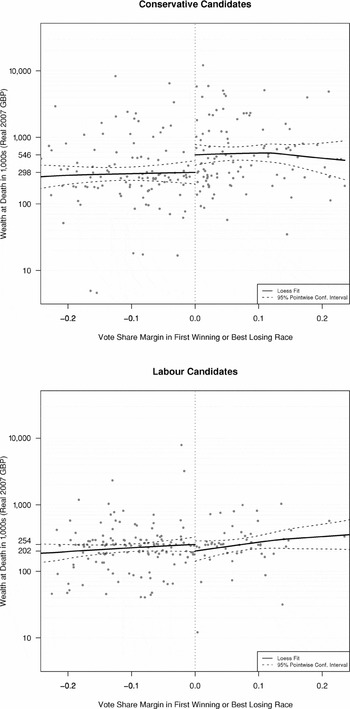
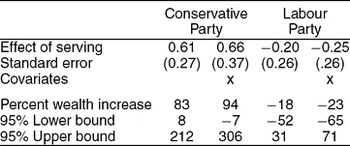
The upper panel in Figure 4 presents the graphical results from the RD design for Conservative candidates. Wealth is plotted against the vote share margin defined previously (Z i). The dotted vertical line at zero indicates the threshold separating MPs (to the right of the threshold) and unsuccessful candidates (to the left of the threshold). The solid lines represent the expected wealth conditional on the vote share margin, approximated using a locally weighted polynomial regression fitted separately to both sides of the threshold; pointwise .95 confidence bounds are indicated by dashed lines. Recall that the effect of office on wealth in the RD design is defined as the difference of the two conditional expectation functions at the threshold. By (minimally) extrapolating the polynomial fit to the threshold, we estimate that marginal winning candidates died with about 546,000 GBP compared to about 298,000 GBP for losing candidates. The first column in Table 4 displays the formal estimate of this jump in the conditional expectation function at the discontinuity, which is about 250,000 GBP or about an 83% increase in wealth at death. The (nonparametric) bootstrapped 95% confidence interval ranges from 8% to 212%. This estimate is similar to the matching results obtained previously and suggests that narrowly successful Conservative candidates almost doubled their wealth by winning office.
Regression Discontinuity Design: Effect of Serving in House of Commons on Wealth at Death

Regression Discontinuity Design Results: Effect of Serving in House of Commons on (Log) Wealth at Death

Note: Effect estimates at the threshold of winning τRDD = E[Y(1)−Y(0)|Z=0]. Estimates without covariates from local polynomial regression fit to both sides of the threshold with bootstrapped standard errors. Estimates with covariates from local linear regression with rectangular kernel (equation 2); bandwidth is 15 percentage point of vote share margin with robust standard errors. For the Conservative Party, N = 223 for the estimates without covariates, and N = 165 with covariates. For the Labour Party, N = 204 for the estimates without covariates, and N = 164 with covariates.
Another notable feature in the upper panel of Figure 4 is that the conditional expectation of wealth is remarkably flat over the support of the vote share margin shown (other than at the threshold separating losers and winners). This makes us more confident that our estimates indeed reflect the effect of winning office on wealth rather than the effect of candidate characteristics on wealth. If having a wealthy background provided a strong boost to one's political career (e.g., by making it easier to get selected for safer seats), we might expect to find that more successful politicians (in terms of vote share won) died wealthier than less successful politicians, regardless of whether they attained office. Instead, we find that close losers and not-so-close losers died with similar wealth, as did close winners and those who won handily. The key difference then is between winners and losers in the Conservative Party.Footnote 28
The lower panel in Figure 4 displays similar graphical results for the Labour candidates. Again, the RD findings correspond very closely with the matching results. There is almost no discontinuity at the threshold, suggesting that there is no effect of winning office on wealth among Labourites. The third column in Table 4 displays the estimate of the jump in the conditional expectation function at the discontinuity, which is about 56,000 GBP or about an 18% decrease in wealth at death. The bootstrapped 95% confidence interval ranges from −52% to 32%.
As expected, the results from the graphical analysis do not change when we introduce covariates into the estimation. To formally estimate the difference between the two regression functions at the discontinuity point while including our full set of covariates, we follow the proposal by Imbens and Lemieux (Reference Imbens and Lemieux2007) and fit a local linear regression of the formFootnote 29
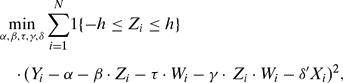
where τ identifies our treatment effect estimate. The variance of τ can simply be estimated using the standard robust variance from the OLS regression. The bandwidth around the threshold of winning, h, is chosen by the Imbens and Lemieux (two-sided) cross-validation criterion.Footnote 30 The optimal bandwidth according to this criterion is a vote share of about 15 percentage points.Footnote 31 The second and fourth columns in Table 4 present results for this regression with our full set of covariates (including schooling, university education, occupation, gender, year of birth, and year of death). Just as in a randomized experiment, the inclusion of covariates has only a small effect on the estimate of τ because, in the close neighborhood of the threshold, all observed and unobserved covariates should be independent of the treatment. We again reject the null at the conventional levels, but the standard errors, as expected, are slightly larger than in the matching analysis because the RD approach focuses on the neighborhood of the threshold, where there are fewer observations.
Robustness Tests for RD Estimation
Test for Wealth Jumps at Nondiscontinuity Points. Following the proposal by Imbens and Lemieux (Reference Imbens and Lemieux2007), we test for jumps in wealth at points other than the threshold at which office was assigned. We produce RD estimates at 5 percentage point increments along the range of the vote share variable, in each case limiting analysis to either the winning or losing candidates.Footnote 32Table 5 compares these placebo effect estimates with our estimate of the effect of winning office on wealth. (We focus on Conservative candidates because we did not find an effect for Labour.) The true vote share threshold where winners and losers are decided is zero; the estimated jump at this threshold is reproduced here in bold along with the estimated discontinuities at four placebo thresholds (−.1, −.05, .05, and .1). As should be expected, the true effect stands out in magnitude and statistical significance from the placebo effects; for none of the placebo effects is the point estimate larger than the standard error. This finding increases our confidence that our estimate measures the effect of gaining office rather than a random artifact of the data.
Testing for Jumps at Nondiscontinuity Points: Estimates for Conservative Candidates

Note: The discontinuity in wealth is estimated at vote share thresholds from −.1 to .1, including 0, the true threshold (for which results are shown in bold). Regressions include covariates.
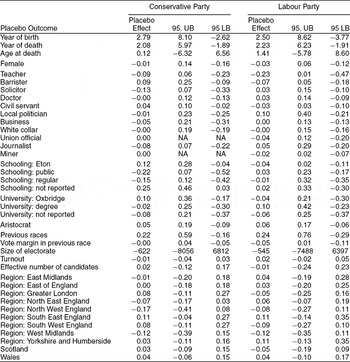
Test for Zero Average Effect on Placebo Outcomes. Here we assess whether winning office appears to have affected candidate characteristics (e.g., year of birth) that could not possibly have been affected by serving in Parliament. This type of test, which was first applied in an RD setting by Lee, Morelli, and Butler (Reference Lee, Moretti and Butler2004),Footnote 33 looks for evidence that the winners of very close elections do not appear to have been randomly selected; if they were, we would expect to see no treatment effect on these placebo outcomes. We repeatedly obtain RD estimates of the effect of serving in Parliament on these placebo outcomes and present the results for both parties in Table 6. The 95% confidence interval on the estimated placebo effect includes zero for all covariates in both parties, with only one exception (an indicator for candidates whose secondary school is not reported in their bios). Given the number of covariates being tested, we would expect some such difference by random chance, and after making any statistical correction for multiple comparisons (e.g., Bonferroni), no significant differences are found. The degree of imbalance across groups is similar to what we would expect in a randomized experiment.
Effect of Serving on Placebo Outcomes

Note: Every row shows a placebo treatment effect estimated at the threshold of winning τRDD = E[Y(1)−Y(0)|Z = 0] obtained from local linear regression with rectangular kernel (equation 2); bandwidth is 15 percentage point of vote share margin. UB and LB refer to the upper and lower bounds of the 95% confidence interval.
Included in Table 6 with the covariates we considered previously are several additional measures that we judged to provide a further useful indication of whether winners and losers of close elections may differ in some important way. One such measure is the number of attempts the candidate took before the decisive race (i.e., the first winning race for winners or the best losing race for losers), indicated by “Previous Attempts” in Table 5. If the winners in our data set triumphed through persistence, we would expect this covariate to systematically differ between the two groups. Another such measure is the vote share for the candidate's party in the same district in the prior election (indicated by vote margin in previous race). Because candidates competed to be staged in favorable districts, this is likely to be a good measure of the desirability of the seat and therefore the quality of the candidate. In the next rows in Table 6, we also checked whether the constituencies of winners and losers of close elections differ with respect to the size of the electorate, turnout, and effective number of candidates. Finally, the last rows of Table 5 consider a battery of dummy variables for each of the nine regions of England, as well as Scotland and Wales, to see whether the constituencies of winners and losers of close elections differ geographically. The fact that we do not find any significant difference for any of these variables provides support for the validity of the identification strategy.
DISCUSSION
Based on the analysis in the previous section, we conclude that serving in the House of Commons roughly doubled the wealth at death of Conservative candidates on average, but had no effect for candidates of the Labour Party. It remains to consider possible channels by which serving Parliament could have such a strong, party-specific effect on personal wealth.
How Did MPs Make Money?
One possibility to address immediately is that MPs' official pay explains the financial benefit of office: perhaps Conservative MPs received a significantly higher salary than what they would have earned outside Parliament. This conjecture is completely at odds with the evidence, however. The MP salary in the period we examine was modest compared to wages in professions most MPs commonly pursued before entering office. A survey conducted among new members of Parliament in 1979 indicates that more than three fourths of entering MPs took a pay cut to serve in Parliament; at a time when an MP's salary was 6,897 GBP in nominal terms, the median backbencher had left a job paying 11,000 GBP (Judge Reference Judge1984, 68). The New Earnings Survey, which was first conducted in 1971, indicates that over the past several decades, MPs have consistently earned somewhat more than journalists and university professors, but less than legal professionals and managers in large companies. What's more, Conservatives were more likely to face a pay cut after being elected, given that they tended to come from more lucrative careers in law and business. If salaries were the dominant factor, we might expect to see the union officials, journalists, and lecturers of the Labour Party profit, but not the accountants, barristers, and managing directors of the Conservative Party. Given that we see the opposite, salary evidently does not explain the observed pattern of benefits from office.
It is also unlikely that health effects can explain our findings. If the status boost of serving in Parliament improved health (see Redelmeier and Singh Reference Redelmeier and Singh2001, but also Sylvestre, Huszti, and Hanley Reference Sylvestre, Huszti and Hanley2006), it may have extended MPs' working lives and increased the size of their estates. (However, living longer can deplete savings.) In fact, we find no difference in the longevity of MPs and unsuccessful candidates. For both parties, a treatment indicator for winning office is statistically insignificant in regressions of either age at death or year of death on our covariates. Moreover, in our balance tests for the regression discontinuity design, we found that there is no discontinuity in age of death or year of death at the threshold of winning (Table 6). Finally, none of our results are affected by including the year of death in the regressions.
The most obvious channel through which winning office may have increased wealth is through lucrative, politically linked outside employment (particularly directorships and “parliamentary consultancies”) that have periodically come under public scrutiny. To get a sense of the extent to which MPs were able to capitalize on their office in acquiring this kind of employment, we used the Directory of Directors, an annual listing of the directors serving on boards of companies traded on the London Stock Exchange, to count the number of directorships listed in 1983 for each of the candidates for whom we also collected wealth data. We find that, controlling for our standard battery of covariates (gender; year of birth; year of death; and indicators for schooling, university, and titles of nobility), Conservative MPs indeed had significantly (p = .08) more directorships than unsuccessful candidates, with the predicted number of directorships being .46 for winners and .13 for losers at covariate means. Among Labour MPs, we find that losers actually had more directorships than winners (.54 vs. .10), although the difference was not significant (p = .47) and was driven largely by a single outlier among the losers who held 19 directorships. (With that outlier removed, the expected rate is .09 for losers and .11 for winners [p = .80].)
It seems worth asking how much of the total wealth gain we estimate for Conservative MPs could be accounted for solely by the politically linked directorships that MPs collected. To answer this, we conduct the following back-of-the-envelope calculations.
First, we need to determine by how much the added directorships would be expected to increase the average earnings of MPs compared to unsuccessful candidates. As noted previously, winning office was expected to increase the average number of public company directorships among Conservatives from .13 to .46. These figures considerably understate the increase in all directorships, however, because they include only directorships of public companies, whereas many MPs held private company directorships. If we scale the increase in 1983 directorships according to the total number of directorships reported in the 1975 RMI, it works out to an increase in roughly one directorship per member. The average annual fee for outside directors was about 25,000 GBP (in 2007 prices) plus benefits (Hollingsworth Reference Hollingsworth1991, 21, 157), indicating that winning office conferred roughly that amount in extra directorship income on our sample of MPs, at least in the 1970s and 1980s.
Second, we need to convert the gain in wealth at death that we estimated previously into a difference in annual earnings. As noted, we estimate the average wealth benefit of serving in Parliament for our sample at about 250,000 in 2007 GBP. Only a fraction of earnings is ultimately bequeathed; using U.S. probates from the 1960s and 1970s, Menchik and David (Reference Menchik and David1983) estimate the marginal propensity to bequeath from earnings at about .25 for the top quintile of his sample. If these data are an appropriate rough guide in our context, MPs would have had to earn roughly 1 million pounds more (at 2007 prices), on average, over the course of their lifetimes compared to unsuccessful candidates in order to boost their estates by the estimated amount. Because the median Conservative MP served 18 years and lived 17 more, this would require earning around 25,000 GBP more per year after being elected than one would have earned outside politics. This is precisely the boost in average annual directorship fees in 1983 that we estimated previously. Recognizing that this calculation is necessarily quite rough, it does seem that directorships alone could account for a sizable proportion of Conservative MPs' wealth gains from being elected to Parliament.
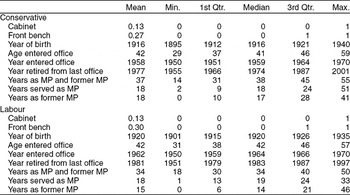
Ample anecdotal evidence confirms that MPs' directorships were not merely ways to make money on the side, but were rather integrally connected with MPs' political roles. What MPs provided for their clients as directors and parliamentary consultants was political inuence and information, either directly or through connections to ministers and members of the civil service. (As noted in Table 7, 13% of Conservative MPs served as ministers at some point in their careers, and 27% had front bench positions.) MPs and the outside interests who retain them have at times been quite candid about the nature of this political exchange. A month after leaving office as Chancellor of the Exchequer in the wake of the 1964 general election (and while a sitting MP), Reginald Maudling accepted a position as executive director of a merchant banking firm, with fees estimated at more than five times his MP salary. Journalist Andrew Roth noted that “the firm made it clear to the financial writers present that it was very useful indeed to have on tap the knowledge and contacts made by a former Cabinet Minister who had been Chancellor of the Exchequer and President of the Board of Trade” (Reference Roth1965, xii). In 1968, Conservative MP Anthony Courtney explained that “Election to the House of Commons not only consolidated but also improved my business affairs. I had acquired for the benefit of the firms with which I was connected improved personal contact with the Board of Trade and other ministers” (Reference Courtney1968, 63). The exchange of cash for influence was perhaps most obvious in the case of lobbying firms established and run by sitting MPs, of which Westminster Communications Ltd. (run by MPs Markus Fox and Keith Speed) was among the most successful. As documented in RMIs from the 1980s and 1990s, Westminster Communications provided political lobbying to a long list of clients. Fox later defended the practice of running a lobbying company while in Parliament by explaining that “We thought if we, as Members of Parliament, were actually controlling the company we could ensure we only acted for those clients who we were convinced were of good standing.”Footnote 34
Characteristics of Political Careers of Members of Parliament (Estimation Sample)

A survey of MPs in the mid-1980s suggests that the blurring between legislator and lobbyist was not limited to a few isolated entrepreneurs. Only 20% of surveyed MPs identified a hypothetical situation as corrupt in which an MP “is retained by a major company to arrange meetings and dinners in the House at which its executives can meet parliamentarians” (Mancuso Reference Mancuso1995, 35). One MP noted that “such sponsored dinners happen all the time” (44), and another commented, “The rules allow it. We all advocate causes and arrange meetings between MPs and external pressure groups” (118). Survey responses portrayed a situation in which it was “very easy” for MPs to be hired as consultants to outside firms (“you don't have to be clever to get a retainer” [154]), and in which it was common for companies to contact Conservative Party leaders and “ask for the name of an MP willing to act as an adviser” (63). One surveyed MP raised an eyebrow at the effect outside payments had on MPs' positions: “There are so many members on retainers to P.R. companies who are receiving payment for advancing specific causes, it would be interesting to see whether they would be supporting the same cause or side of an issue if they were not receiving payment” (65–66).
In sum, the evidence suggests that being elected to Parliament endowed politicians with valuable political connections and knowledge that, through directorships and other employment, helped special interests to access the levers of policy making. This is consistent with evidence from several other countries, suggesting that employing sitting or former politicians as board directors, consultants, or executives is valuable to firms precisely because of the political connections and knowledge that politicians possess (Faccio Reference Faccio2006; Ferguson and Voth Reference Ferguson and Voth2008; Fisman Reference Fisman2001; Goldman, Rocholl, and So Reference Goldman, Rocholl and So2008; n.d.; Jayachandran Reference Jayachandran2006; Johnson and Mitton Reference Johnson and Mitton2003; Khwaja and Mian Reference Khwaja and Mian2005; Roberts Reference Roberts1990).
Why Did the Benefits of Office Differ by Party?
The question remains why Labour MPs did not appear to derive as large a financial benefit from office as did their Conservative counterparts. We consider three explanations.
One explanation to consider is that differences in the ideology of the parties explain the greater propensity of Conservative MPs to take on lucrative outside work while in Parliament and to thereby profit from office. The Labour Party of the period we examine remained closely tied to the socialist principles on which the party was founded, and many members had arrived at their seats in Parliament after careers in the trades unions, a culture in which serving on a corporate board would likely be seen as betrayal. Mancuso (Reference Mancuso1995) interviewed MPs in the mid-1980s about their attitudes toward legislative ethics; she found that Labour MPs made up a disproportionate share of the group she termed “Puritans”—MPs who had the most stringent attitudes about conflicts of interest and performing favors for constituents. She suggests that Puritan attitudes can be seen as “an extension of Labour's preference for economic and social interventionism and egalitarianism,” whereas Conservative MPs' relatively lax ethical stance was consonant with the Thatcher government's embrace of “the entrepreneurial values of self-interest and initiative” (63). As Mancuso (Reference Mancuso1995) recognizes, the causal relationship between MPs' reported ethical stances and their behavior is complicated: those MPs who held outside positions in her study reported far more permissive attitudes toward potential conflict of interest, but it could have been the difference in offers of lucrative employment that shaped their views, rather than their views that shaped their employment profile. Still, it seems reasonable that part of the difference between Labour and Conservative MPs' financial gains could relate to ideological differences between the parties.
A second explanation is that the constituents of the Labour and Conservative parties wanted different kinds of political goods and that influence peddling was a more productive strategy in the market for goods desired by Conservative constituents.Footnote 35 The clients of the Conservatives were business firms seeking highly targetable goods, such as sector-specific or even firm-specific tax loopholes and regulatory breaks. Some of these goods could presumably be acquired by hiring an MP who could lobby the front bench to alter legislation and regulation accordingly. The Labour Party's clients were mainly labor unions, which sought more broad-based, programmatic policies (e.g., public ownership of industries, support for the public pension and health systems, education reform) that yielded few targeted benefits to specific unions. If we assume that Conservative MPs had more power over targetable benefits than did Labour MPs (e.g., if Conservative cabinets were more likely to award targeted benefits and Conservative MPs had more clout with Conservative cabinets), then this distinction may explain part of the difference in patterns of outside employment and wealth gain between the two parties' MPs. Then again, business interests could in theory extract targeted benefits from cabinets of either party; indeed, business PACs in the U.S. have been seen to adjust their PAC contributions to respond to a change in control in the U.S. Congress more than labor PACs, suggesting that business interests in that setting extract their targeted benefits from whoever is in power (Cox and Magar Reference Cox and Magar1999; Rudolph Reference Rudolph1999). The difference in the nature of political goods sought by the two parties may therefore provide some explanatory power, but does not seems to be enough to explain why Conservative MPs profited more.
We emphasize instead the difference in the way the market for MPs' services was organized between the two parties, which in turn resulted from a difference in the organization of the two parties. The Labour and Conservative parties in the period we examine were organized and financed quite differently from each other, in ways that ultimately affected how MPs for each party related to outside interests. In the Labour Party, a small number of very large unions provided the bulk of the financing and exercised a corresponding amount of direct influence over policy and political representation. Between 1945 and the 1990s, unions consistently provided 80% to 90% of the funding of the Labour Party central office and around two thirds of the party's funding overall (including local organizations) (Harrison Reference Harrison1960; Pinto-Duschinsky Reference Pinto-Duschinsky1981; Reference Pinto-Duschinsky and Seldon1990). Trade unions also directly provided a plurality of delegates to national party conferences as well as to local constituency councils responsible for selecting parliamentary candidates. In contrast, the Conservative Party drew its funding from a larger number of smaller players, and political influence was correspondingly diffuse. Company contributions provided only 30% of the party's income overall, and those contributions came from several hundred different companies with fairly weak coordination among themselves.Footnote 36 The bulk of Conservative Party finance came from individual contributions, whether through party fundraisers held by local constituency organizations (which alone brought in more money than did corporate contributions) or large and undisclosed individual contributions and bequests (Fisher Reference Fisher1994; Pinto-Duschinsky Reference Pinto-Duschinsky1981; Reference Pinto-Duschinsky and Seldon1990).
Because unions were intimately involved in the selection of Labour candidates and, in many cases, financed their election to Parliament, Labour MPs tended to enter office with well-defined obligations to specific unions. The means by which unions ensured the loyalty of MPs was clearest in the case of direct sponsorships, an arrangement that was formalized in the party's 1933 “Hastings agreement.” Between 1945 and 1975, sponsorships extended to more than 30% of all Labour candidates and more than 40% of all Labour MPs (Harrison Reference Harrison1960; Muller Reference Muller1977). Unions sponsored parliamentary prospects as early as the candidate selection stage; if a union's sponsored member were selected to stand for election (a process in which the unions jointly played a large role), that union would provide campaign finance through the election (Rush Reference Rush1969). Unions tended to sponsor and promote candidates from their own ranks who were likely to remain loyal representatives once in office and return to the union bureaucracy after retirement from Parliament (Muller Reference Muller1977).Footnote 37 Occasionally, a sponsored member deviated from the position advocated by the sponsoring union, with the consequence that the MP lost the sponsorship and, often, subsequently the seat (Harrison Reference Harrison1960; Muller Reference Muller1977, 153). It seems likely that any sponsored member who was selling political advice to a private firm would suffer an equal or more severe punishment. In contrast, the process of selecting Conservative candidates was shared between the party's national office and local constituency committees, neither of which gave a particularly privileged role to individual companies or other outside groups (Rush Reference Rush1969). Conservative candidates thus generally entered office with loyalties to the party and local constituency committees, but with no exclusive obligations to any particular outside interest.
We suggest that it was largely because the unions were effective in controlling politicians through nonmonetary means that Labour MPs captured a relatively small economic bonus from serving in Parliament. Conservative MPs operated in an open market for political services. Because client firms were numerous and poorly organized among themselves, they competed for MP loyalty and paid substantial sums to secure it, largely through consulting and lobbying contracts and directorship positions. Conservative MPs may have been better situated to confer those benefits (given that Conservative cabinets were likely more sympathetic to their demands), but they also entered Parliament without exclusive obligations to unions or other outside groups. On the Labour side, the labor unions suppressed the market for MPs' services by controlling the party and, through the party, the politicians themselves. Whereas Conservative clients (businesses) bought policies by paying individual members, Labour clients (the unions) bought the party itself. In that sense, the trade unions' solution looks something like backward vertical integration: instead of purchasing political services on the open market, the unions created a subsidiary (the Labour Party and its MPs) to supply political goods. (In fact, the early history of the Labour Party is basically consistent with this interpretation [Beer Reference Beer1965].)
In sum, we surmise that it is largely because business interests were less organized than the unions, and had less power in Conservative politics than did unions in Labour politics, that Conservative MPs profited more from office than did Labour MPs. It is likely that the value of office in a variety of contexts similarly depends on the extent to which constituents can use formal means of political control and are organized enough to restrain competition for political influence.
CONCLUSION
Many studies have shown that private firms gain from connections to politicians, but little is known about how politicians benefit from firms and other groups seeking political connections (Merlo Reference Merlo, R-Blundell, Newey and Persson2006, 33). If there is indeed an exchange between politicians and politically connected firms, one can expect politicians to benefit financially from office just as firms do from connections to office holders. However, this perspective has been largely overlooked so far, presumably because estimating the financial benefits of political office is challenging empirically.
In this article, we measure the value of political power in postwar British politics using data about the estates of British politicians who entered the House of Commons between 1950 and 1970 and often served well into the 1990s. We identify the effect of office on wealth at death both by controlling for a wide variety of candidate-level characteristics and by employing a regression discontinuity design that exploits the quasirandom assignment to office that takes place in close district races. We find that serving in Parliament almost doubled the wealth of candidates of the Conservative Party, but had no appreciable effect for Labour candidates. These financial benefits of office are likely attributable to payments from private firms to sitting legislators and lucrative employment opportunities provided to politicians after retirement. Conservative MPs financially benefited from directorships and consulting work that accrued to them as a result of serving in political office. Labour politicians had explicit relationships with unions that were far less lucrative; we surmise that Labour MPs were paid less for political services because the trade unions were better organized and secured their services by controlling the party rather than by paying politicians directly.
Although our application benefits from data resources unique to the UK, our general approach is broadly applicable and could be used to measure the financial returns to office in other political systems. Faccio (Reference Faccio2006) shows that the strength and scope of political connections, as well as the benefits of these connections to firms, vary widely across countries. One may expect the political power premium to vary based not only on these features, but also on the organization and financing of political parties, the degree of legislator independence (both from party leadership and from specific interest groups), and the extent of restrictions on legislator conflict of interest.





Comments
No Comments have been published for this article.