Surgical site infection (SSI) is the most frequent nosocomial infection in surgical patients. Depending on the type of surgical procedure, SSIs develop in <1% to >20% of patients after operation, and SSIs account for 38% of all nosocomial infections in this population.Reference Sax, Uçkay and Balmelli 1 – Reference Staszewicz, Eisenring, Bettschart, Harbarth and Troillet 4 SSIs prolong hospital stay and increase costs, morbidity, and mortality.Reference Anderson, Podgorny and Berrios-Torres 5 – Reference Astagneau, Rioux, Golliot and Brücker 8 Secondary to the landmark study by Haley et al,Reference Haley, Culver and White 9 surveillance is considered an essential tool for the prevention of SSI.Reference Anderson, Podgorny and Berrios-Torres 5 , Reference Haley, Culver and White 9 , 10 Many national programs have been set up for this purpose during the past 40 years.
In Switzerland, a first multicenter surveillance system for SSIs was developed in the mid-1990s and progressively included hospitals from the southwestern part of the country until 2010.Reference Staszewicz, Eisenring, Bettschart, Harbarth and Troillet 4 , Reference Romy, Eisenring, Bettschart, Petignat, Francioli and Troillet 11 , Reference Hubner, Diana, Zanetti, Eisenring, Demartines and Troillet 12 In 2009, the Swiss National Association for the Development of Quality in Hospitals and Clinics (ANQ) asked Swissnoso, the National Center for Infection Control, to implement a countrywide surveillance system for SSIs. In 2011, SSI surveillance became mandatory for Swiss hospitals with departments of surgery, and the 2 programs merged. This article reports on the results of this national surveillance system and describes its method, which includes continued on-site quality check of data generated by individual hospitals and high rates of follow-up.
METHODS
Description of the Surveillance Program
The Swissnoso SSI surveillance system was developed according to the principles of the US National Nosocomial Infections Surveillance (NNIS) system, currently known as the National Healthcare Safety Network (NHSN).Reference Emori, Culver and Horan 13 , Reference Culver, Horan and Gaynes 14 It is described in a practical guide written in the 3 national languages (German, French, and Italian), which is available for participating hospitals on the Swissnoso website (www.swissnoso.ch).
Infection control nurses (ICNs), supervised by infectious diseases specialists or other physicians without a hierarchical link within the departments of surgery, orthopedics, or gynecology are in charge of the surveillance in each participating hospital. Surgeons do not take part actively in the process of documenting SSIs. All ICNs and supervising physicians must attend a 1-day special training course before surveillance begins. SSIs are diagnosed according to the Centers for Diseases Control and Prevention (CDC) definitions and are classified as superficial incisional, deep incisional, or organ-space infections.Reference Horan, Andrus and Dudeck 15 Patients are followed-up during their hospital stay by ICNs through systematic reviews of patient charts, including medical and nursing notes, antibiotic use, microbiology and other laboratory or radiology results, and reports regarding operations, consultations, and discharges. The postdischarge follow-up is performed by ICNs through standardized phone interviews with each patient 1 month after the operation. A second interview takes place 12 months after surgeries with implants such as arthroplasties and cardiac surgeries. The follow-up survey comprises 6 questions regarding unplanned medical visits, rehospitalization, antibiotic prescription, and clinical symptoms of infection. At least 5 telephone attempts must be documented before a patient can be considered lost to follow-up. Any suspected or unclear case triggers further contacts with the family or hospital physician to gather any available additional information. Any suspicion of SSI or unclear situation is presented to the supervising physician for decision according to the CDC criteria. As an example, Table 1 shows the criteria used for superficial SSIs secondary to colon surgery. Approximately every other year, 1-day onsite audits by Swissnoso supervisors take place in each participating hospital to evaluate the quality of the surveillance. These audits include comprehensive reviews of 15 randomly selected operations that have been included in the surveillance.
CDC/NHSN Criteria Used for the Diagnosis of Superficial Incisional SSI in Colon Surgery

NOTE. CDC, Centers for Disease Control and Prevention; NHSN, National Health Safety Network; SSI, surgical site infection.
a More than one criteria can be used for the same infection.
Hospitals are free to choose at least 3 among 15 surgical procedures. However, those doing colon surgery must include this procedure. All patients undergoing the included procedures during given surveillance periods must be registered and followed-up. The variables collected include characteristics of the patients (sex, age, American Society of Anesthesiologists [ASA] score, and delay from admission to operation) and characteristics of the operations: contamination class, duration of the operation, planned or unplanned (ie, emergency) procedure, type and timing of antibiotic prophylaxis, minimally invasive or laparoscopic operation, multiple procedures during the surveyed operation, reoperation for noninfectious complications. Data are entered online in a university-owned, web-based database (www.ispm.unibe.ch), and each hospital has direct individual access to its results. Various data validation rules automatically apply during data entry. Inventory reports are available for every hospital, signaling cases to be completed or cases with possible errors. A hotline, staffed by Swissnoso collaborators, is available 5 of 7 days per week.
Detailed reports are edited yearly for every participating hospital, allowing crude and adjusted comparisons with others, using the NNIS/NHSN risk index.Reference Culver, Horan and Gaynes 14 The implementation or reinforcement of preventive measures is left to each hospital’s discretion. Participants are invited to an annual meeting where the results are presented and discussed. Since 2014, starting with the 2011 data, the Swiss National Association for the Development of Quality in Hospitals and Clinics (ANQ) has openly published the surveillance results by hospital (http://www.anq.ch/messergebnisse/ergebnisse-akutsomatik/), including their names, NNIS/NHSN adjusted SSI rates, and quality of surveillance as rated during onsite visits.
Statistical Analyses
Analyses were performed on data collected from October 2011 to September 2015. Characteristics of the patients and operations, 4-year cumulative SSI rates (3-year for surgeries with implants), proportions of postdischarge diagnoses, and proportions of superficial incisional, deep incisional, and organ-space infections were calculated by type of surgical procedure.
Because not all participating hospitals began the surveillance simultaneously, temporal trends in SSI rates were calculated for each surgical procedure taking the duration of participation in the surveillance program into account rather than calendar years. This duration was determined for each hospital and was stratified in 1-year periods, as described in previous studies.Reference Staszewicz, Eisenring, Bettschart, Harbarth and Troillet 4 , Reference Manniën, van der Hof, Muilwijk, van der Broek, van Benthem and Wille 16
Forward stepwise logistic regression models were developed for each surgical procedure that had been included for >2 years in the surveillance program to identify independent risk or protective factors for SSI, including the duration of participation in the program. The following covariates were entered in the initial models: time from the initiation of the surveillance to the surveyed operation, patient sex, age, ASA score, delay from admission to operation, contamination class, duration of the operation, emergency procedure, antibiotic prophylaxis <1 h before incision, laparoscope use for digestive surgery, multiple procedures during the operation, and reoperation within the follow-up period for noninfectious complications. In surgical procedures where the time from the initiation of the surveillance to the surveyed operation was not initially retained as a significant covariate in the final model, it was added to obtain notwithstanding the effect of this variable independently of changes in patient characteristics over time. In addition, individual hospitals with significantly increasing or decreasing SSI rates over these time periods were identified using the Cochrane-Armitage test.Reference Armitage 17
Analyses were performed using SAS version 9.4 software (SAS Institute, Cary, NC). All tests were 1-tailed, and α was set at 0.05 throughout the study.
RESULTS
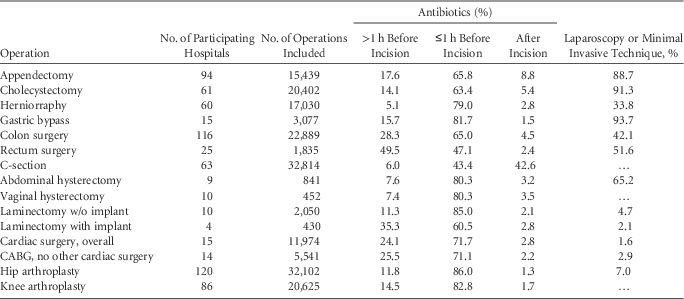
Overall, 187,501 operations in 164 hospitals had been included in the surveillance system and could be analyzed (Table 2). Patient and operation characteristics, including age, sex, NNIS/NHSN risk index, contamination of the surgical wound, ASA score, and duration of the operation appeared similar to those reported in other large populations (Online Supplemental Table 1). Hysterectomies and laminectomies were included only in 2015 in the surveillance, explaining the smaller numbers of operations. Prophylactic antibiotics were often administered >1 hour before incision or after incision, showing room for improvement. In C-sections, antibiotics were still given late in 42.6% of the patients, after umbilical cord clamping.
Number of Operations and Hospitals Included in the Surveillance, Timing of Antibiotic Prophylaxis, and Surgical Technique, by Type of OperationFootnote a

NOTE. CABG, coronary arterial bypass.
a Total percentage may not equal 100 due to missing values or rounding.
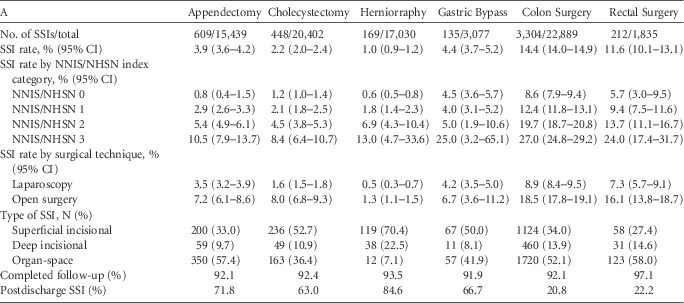
The aggregated rates of SSIs are shown in Table 3 by operation, globally, and stratified by NNIS/NHSN risk index category, by surgical technique (laparoscopic vs open) for digestive surgery, and by type of infection. Also shown in Table 3, 90% of the operations in digestive surgery were followed-up for 1 month and >80% of surgeries with orthopedic implants and cardiac surgeries with foreign-material implants were followed-up for 1 year. Many SSIs occurred after discharge; these rates varied from 20.7% in colon surgery to 93.3% in knee arthroplasty. Taking all operations into account, 3,292 of 6,953 SSIs (47.4%) were detected after discharge: 1,599 (48.6%) were superficial incisional, 521 (15.8%) were deep incisional, and 1,172 (35.6%) were organ-space infections. Rehospitalization occurred in 455 of 1,599 (29.4%) patients with postdischarge superficial incisional SSIs, in 412 of 521 (79.1%) patients with postdischarge deep incisional SSIs, and in 1,129 of 1,172 (96.3%) patients with postdischarge organ-space infections. Mean and median times to the diagnosis of SSI varied respectively from 9.8 to 17.6 days and 9 to 16 days for surgeries without implant, and from 29.9 to 83.2 and 17 to 34 days for surgeries with implant (Online Supplemental Table 2). A significant decrease was observed in operation-specific SSI rates of 27 hospitals or surgical departments over the observed time period, whereas a significant increase was observed in 11 hospitals (Online Supplemental Table 2).
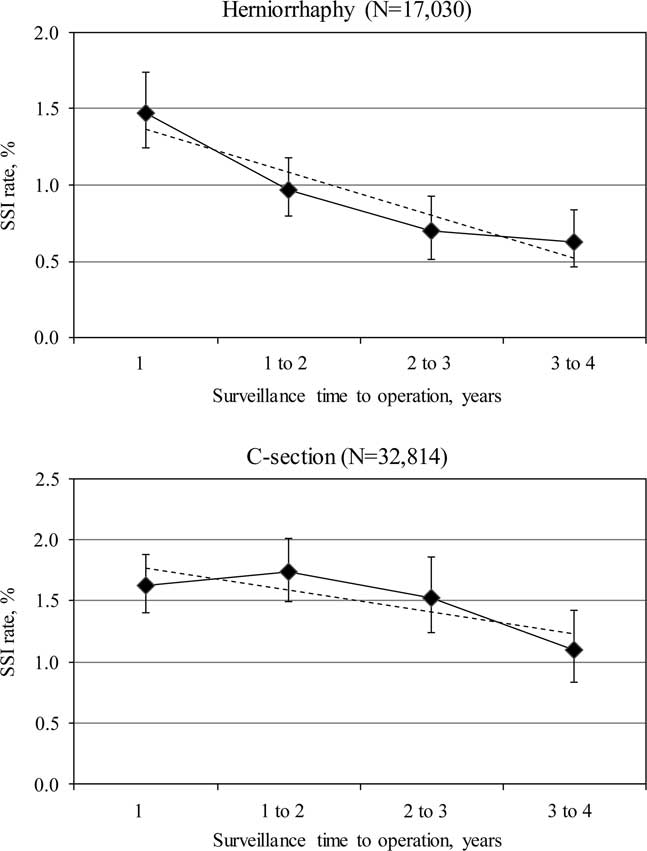
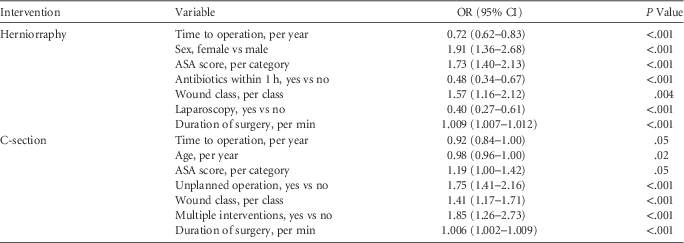
The effect of the time from the start of surveillance to the operation on SSI rates, as estimated by logistic regression models, is shown in Table 4 for herniorraphy and C-section, the 2 operations for which it remained an independent protective factor after adjustment for other factors. This effect is shown for all the types of operations in Online Supplemental Table 3. The trends of SSI rates according to this time are shown in Figure 1 for herniorrhaphy and C-section, and SSI trends are shown in Online Supplemental Figure 1 for each operation that had been included in the surveillance for >2 years.
Crude rates of surgical site infections (SSI) after herniorrhaphy and C-section according to the time from the initiation of surveillance to the date of the operation, by surgical procedure.

DISCUSSION
Some SSI rates reported by our surveillance system may appear high in comparison with those reported in France, England, Germany, and the European Union and in the United States by the CDC’s National Healthcare Safety Network (NHSN).Reference Edwards, Peterson and Mu 18 – 22 These rates are quite similar to those reported in the Netherlands by the PREZIES system and those reported in the United States by the American College of Surgeons National Surgical Quality Improvement Program (ACS NSQIP).Reference Mannien, van den Hof, Brandt, Behnke, Wille and Gastmeier 23 , Reference Ju, Ko, Hall, Bosk, Bilmoria and Wick 24 Indeed, the Swissnoso system shares several characteristics with these 2 programs that distinguish their approach from other SSI surveillance systems and might contribute to the finding of higher SSI rates.
First, the Swissnoso program puts particular efforts in postdischarge surveillance (PDS) and reaches complete follow-up in the majority of included operations (from a minimum 82.8% in cardiac surgeries to 97% in rectal surgeries). Indeed, PDS is an important component of SSI surveillance, particularly in the current setting where hospital stays tend to be shorter and surgical procedures are more frequently performed in an ambulatory setting.Reference Anderson, Podgorny and Berrios-Torres 5 , Reference Huotari and Lyytikäinen 25 – Reference Reilly, Allardice, Bruce, Hill and McCoubrey 27 As in other systems that also perform active PDS,Reference Ju, Ko, Hall, Bosk, Bilmoria and Wick 24 , Reference Manniën, Wille, Snoeren and van den Hof 26 high rates of SSI were detected postdischarge in our program, varying from 20.7% in colon surgeries to >90% in arthroplasties. In addition, 51.4% of the SSIs detected through PDS were severe (deep incisional or organ-space infections) and some of them, if not rehospitalized in the same hospital where the first operation took place, would not have been recognized without active PDS.
However, no consensus exists on a method for PDS, and methods may differ between systems. We chose an indirect active method based on standardized phone interviews with the patients by trained ICNs, completed by a secondary contact with his/her general practitioner (GP) in case of a suspected SSI or an unclear situation. Written or oral questionnaires administered to patients or surgeons have low sensitivity and specificity for detecting SSIs.Reference Sands, Vineyard and Platt 28 , Reference Whitby, McLaws and Collopy 29 Nonetheless, Whitby et alReference Whitby, McLaws and Collopy 29 found that the patient’s recall of prescription of an antibiotic by their GP for SSI during the postoperative period correlated very well with diagnoses made by experienced ICNs, particularly when confirmed by the GP in those patients reporting an infection. Our PDS is based on both a questionnaire administered to the patients by an ICN and a subsequent contact with their GPs, and we believe that it is a reliable and necessary tool for getting the correct figures to feed back to hospitals and surgical teams. Other systems based on electronic algorithms and/or administrative data may be less resource consuming, but they still need development to be used with heterogeneous information systems.Reference Gastmeier and Behnke 30 Automated telephony could also help decrease the workload of IC nurses.Reference McNeish, Lyle and McCowan 31
Second, since public reporting of SSI rates by hospitals became mandatory in Switzerland, important efforts were made to periodically audit hospitals to minimize risks of underreporting due to various possible biases that have been reported elsewhere and recently motivated specific recommendations from the US Healthcare Infection Control Practices Advisory Committee.Reference Talbot, Bratzler and Carrico 32 Indeed, studies in Scotland, the Netherlands, Australia, and New York state found 0.6% to 4.3% of SSIs among cases initially not reported as such.Reference Mc Coubrey, Reilly, Mullings, Pollock and Johnston 33 – Reference Haley, van Antwerown and Tserenpuntsag 36 Our audits revealed differences between hospitals, particularly in the access to the necessary clinical information for ICNs to detect cases. They found 1.4% of false negatives, and 0.09% of false positives (Kuster et al., Structure, Process and Outcome Quality of Surgical Site Infection Surveillance in Switzerland. Submitted. April 2017). Thus, to create incentives to perform better, Swissnoso gives marks to hospitals for the quality of their surveillance that are openly published together with their infection rates. Moreover, the same SSI case definitions may allow variable interpretations between persons and countries and could also result in artificial differences in SSI rates.Reference Birgand, Lepelletier and Baron 37
The main goal of SSI surveillance is to decrease SSI rates by providing hospitals, surgical teams, and stakeholders with data that can be used for benchmarking, monitoring, and, if deemed necessary, implementation of better preventive measures. Reaching this goal depends on factors that are external to the surveillance system and linked to hospitals or surgical departments themselves. Indeed, some individual hospitals or departments participating in our surveillance system experienced decreasing SSI rates in some operations over a 4-year observation period and others did not. But a general, statistically significant and independent protective effect on SSI of the duration of participation in the Swissnoso system was seen only for herniorrhaphy and C-section, whereas no significant trends were found for other surgeries. Such observations have already been made in other surveillance programs where SSI rates tend to decrease over time for some operations but not for others or even do increase.Reference Staszewicz, Eisenring, Bettschart, Harbarth and Troillet 4 , Reference Manniën, van der Hof, Muilwijk, van der Broek, van Benthem and Wille 16 , Reference Brandt, Sohr, Behnke, Daschner, Rüden and Gastmeier 38 , Reference Astagneau, L’Hériteau and Daniel 39 Various requirements have been listed for a surveillance system to succeed.Reference Gastmeier, Sohr and Schwab 40 They may be implemented at different levels of adherence among hospitals, within the same hospital, or among particular surgical teams. Overall, our results showed that the timing of antibiotic prophylaxis should be improved in most surgeries. Secondary to the initiation of surveillance, Swissnoso launched a new program aiming at introducing standardized process measures in hospitals for monitoring and improving some preventive measure for SSI such as hair removal, skin disinfection, and the dosing and timing of antibiotics.
In conclusion, a high-quality nationwide SSI surveillance program was implemented in Switzerland in 2011. Its first results show high SSI rates as compared with other programs, but these differences may be, at least in part, artificial and due to methodological differences, particularly with respect to an effective PDS system that detected up to 47% of all SSIs, but this system is resource consuming and could benefit from future developments in information technology. In addition, regular on-site audits guarantee the quality of the collected data. To date, the ultimate goal of SSI surveillance (a decrease in SSI rates) has only been reached in a subset of patients and hospitals, but temporal trends are difficult to predict over a relatively short period of time. A longer observation period and additional efforts by hospitals may thus be necessary to reach this goal through projects based on a culture of safety such as those developed in the United States by the Comprehensive Unit-based Safety Program (CUSP) of the Armstrong Institute for Patient Safety and Quality.
Global Surgical Site Infection (SSI) Rates, Postdischarge Follow-up Rates, and Postdischarge SSI Rates, by Types of Operation


NOTE. SSI, surgical site infection; CI, confidence interval; NNIS, National Nosocomial Infection Surveillance; NHSN, National Healthcare Security Network.
Adjusted Risk and Protective Factors for SSI After herniorraphy and C-Section, Including the Effect of the Time From the Initiation of Surveillance to the Operation (Time to Operation)

NOTE. OR, odds ratio; CI, confidence interval; ASA, American Society of Anesthesiologists.
ACKNOWLEDGMENTS
Members of Swissnoso: Carlo Balmelli, Marie-Christine Eisenring, Stephan Harbarth, Stefan Kuster, Jonas Marschall, Virginie Masserey Spicher, Didier Pittet, Christian Ruef, Hugo Sax, Matthias Schlegel, Alexander Schweiger, Nicolas Troillet, Andreas Widmer, and Giorgio Zanetti.
Financial support: No financial support was provided relevant to this article.
Potential conflicts of interest: All authors report no conflicts of interest relevant to this article.
SUPPLEMENTARY MATERIAL
To view supplementary material for this article, please visit https://doi.org/10.1017/ice.2017.55